AI in Oil and Gas: 34% Lower Ops Costs, +45% Decision Accuracy for a Global Operator
A centralized AI platform turning thousands of unstructured oilfield documents into real-time, data-driven drilling decisions.Wondering how AI in oil and gas could turn your unstructured geological and operational data into faster decisions?
Executive Summary
How Did a Global Oilfield Operator Use AI in Oil and Gas to Cut Ops Costs 34% and Sharpen Decisions 45%?
A top global company in oilfield exploration and development was sitting on the right data and the wrong workflow. Geological reports, scans, handwritten field forms, and operational PDFs ran into the thousands every month, scattered across enterprise systems and field setups. The team wanted to boost efficiency in oil field analysis, automate data integration, and speed up decision-making, but every analysis still started with manual stitching, and critical data pipelines were straining across an Azure-and-hybrid multi-cloud footprint.
This case study walks through how Teamvoy built a centralized, AI-driven platform: AI-driven data integration to unify enterprise data, advanced OCR and NLP pipelines on GPT-4o, LangChain, and Azure Cognitive Services to turn thousands of documents into structured datasets each month, scalable event-driven pipelines on Apache Airflow and Python 3.12 with Terraform + Helm infrastructure-as-code on the Azure hybrid cloud, and knowledge transfer programs to align data, engineering, and business teams. The result: a 34% reduction in operational costs across data management, and a 45% lift in decision-making accuracy for resource allocation, drilling prioritization, and risk assessment.
01. About the Client
Who Is the Client, and Why Is AI in Oil and Gas Exploration a Now-Problem?
The client is a top global company in oilfield exploration and development, operating across multiple regions. The team wanted to boost efficiency in oil field analysis, automate data integration, and speed up decision-making with AI solutions, and to do that, it needed a centralized, AI-driven platform that could analyze unstructured geological and operational data from various systems and generate real-time, data-driven recommendations for oil field development.
The strategy behind the mandate matters. Oilfield exploration runs on data that is overwhelmingly unstructured, geological reports, scans, handwritten forms, operational PDFs – and overwhelmingly fragmented across enterprise platforms and field systems. AI in oil and gas exploration is not a science project at this scale; it is the only tractable path from raw operational documents to recommendations a drilling team can act on inside the same day. That is the problem Teamvoy was hired to solve.
02. The Challenge
What Problems Does AI in the Oil and Gas Industry Have to Solve First?
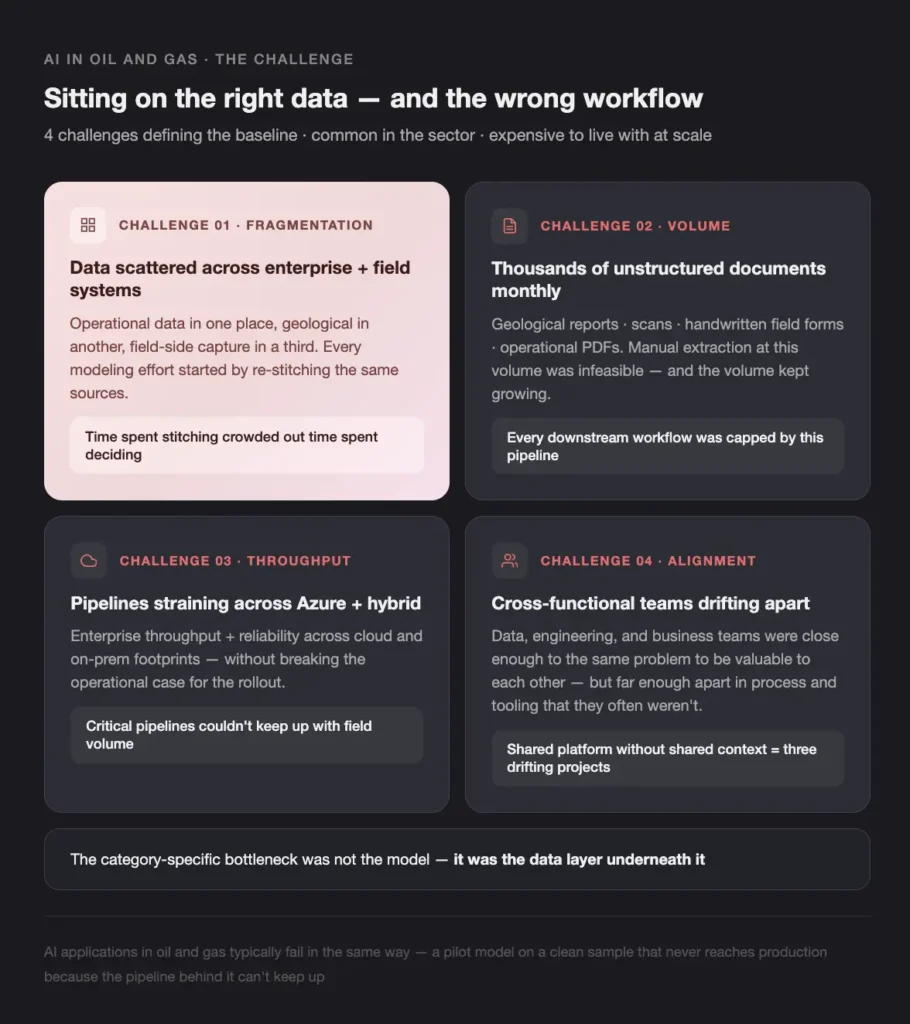
Four challenges defined the baseline, each one common in the sector, each one expensive to live with at scale:
- Combining data from different enterprise and field systems. Operational data lived in one place, geological data in another, field-side capture in a third. Every modeling effort started by re-stitching the same sources, and the time spent stitching crowded out the time spent deciding.
- Automating the processing of thousands of unstructured documents, reports, scans, handwritten forms, PDFs. Manually extracting the structured signal out of that pile was infeasible at volume, and the volume kept growing. Until that pipeline was automated, every other workflow downstream was capped by it.
- Scaling critical data pipelines across multi-cloud setups – Azure and hybrid. The platform had to deliver enterprise-grade throughput and reliability across cloud and on-prem footprints without the cost profile breaking the operational case for the rollout.
- Ensuring consistent knowledge sharing and teamwork among cross-functional teams. Data, engineering, and business teams were close enough to the same problem to be valuable to each other, but far enough apart in process and tooling that they often weren’t.
Why This Approach
Why a Centralized Platform for AI Applications in Oil and Gas Industry?
AI applications in oil and gas industry settings tend to fail in the same way: a pilot model is built on a clean sample, it never makes it to production because the data pipeline behind it cannot keep up, and the team moves on. The category-specific bottleneck is not the model; it is the data layer underneath.
For this operator, the right fit was a centralized AI-driven platform, one place where enterprise data is unified, where unstructured documents are turned into structured datasets continuously, where the pipelines feeding both are operating at production scale, and where real-time recommendations flow back into the workflows the field teams already run. Without that center of gravity, every individual AI use case becomes its own integration project.
The deeper reason this worked is that it drew a clean line between data, intelligence, and decisions. The data integration layer made the inputs trustworthy. The OCR + NLP layer turned scattered documents into queryable signal. The pipelines kept everything fresh. And the recommendation layer delivered outputs into the same systems drilling teams were already using, not into a separate dashboard nobody opens.
03. What We Did
How Did Teamvoy Build the AI in Oil and Gas Platform?
The engagement delivered four interlocking workstreams: enterprise data integration, advanced OCR + NLP for unstructured documents, scalable event-driven pipelines on the Azure hybrid cloud, and a knowledge transfer program tying the teams behind it together.
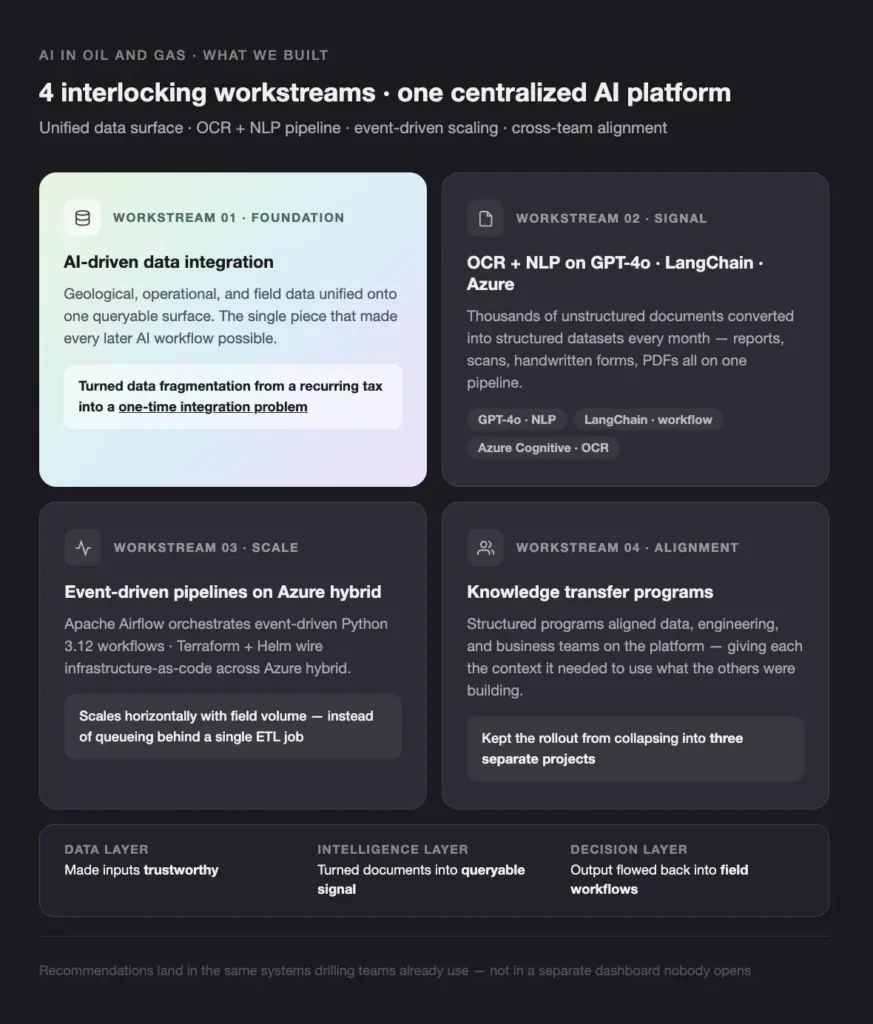
AI-driven data integration. Teamvoy designed and led the integration layer that unifies enterprise data across the operator’s systems, so geological, operational, and field data sit on one queryable surface. That single piece is what made every later AI workflow possible, it turned data fragmentation from a recurring tax into a one-time integration problem.
Advanced OCR and NLP pipelines (GPT-4o, LangChain, Azure Cognitive Services). The OCR + NLP pipeline converts thousands of unstructured documents, reports, scans, handwritten forms, PDFs – into structured datasets each month. GPT-4o and LangChain handle the language work, Azure Cognitive Services handles the OCR side, and the combination is what makes the platform’s signal layer keep up with field volume.
Scalable event-driven data pipelines (Airflow, Python 3.12, Terraform + Helm, Azure hybrid cloud). Apache Airflow orchestrates event-driven workflows in Python 3.12, with Terraform + Helm wiring infrastructure-as-code across the operator’s Azure hybrid environment. The platform scales horizontally with field volume rather than queueing behind a single ETL job.
Knowledge transfer programs. Teamvoy initiated structured knowledge transfer programs to align data, engineering, and business teams on the platform. That alignment is what kept the rollout from collapsing into three separate projects, it gave each team the context it needed to use what the others were building.
Tech Stack
Which Technologies Power the AI in Oil and Gas Platform?
- GPT-4o – large-language model handling the NLP side of the document processing pipeline.
- LangChain – framework wiring GPT-4o into multi-step workflows over geological and operational documents.
- Azure Cognitive Services – OCR layer for scans, handwritten forms, and other image-based documents.
- Apache Airflow + Python 3.12 – orchestration for scalable, event-driven data pipelines.
- Terraform + Helm – infrastructure-as-code across the operator’s Azure hybrid cloud footprint.
- Azure hybrid cloud – the underlying runtime, sized for enterprise throughput and reliability.
Key Features
Which Features Define the AI Use Cases in Oil and Gas We Built For?
- Unified enterprise data surface – geological, operational, and field data integrated into one queryable layer instead of recurring re-stitching.
- OCR + NLP pipeline turning thousands of unstructured documents per month – reports, scans, handwritten forms, PDFs – into structured datasets the platform can act on.
- Real-time, data-driven recommendations feeding directly into resource allocation, drilling prioritization, and risk assessment workflows.
- Scalable event-driven pipelines that grow with field volume instead of queueing behind monolithic ETL jobs.
- Infrastructure-as-code (Terraform + Helm) across the Azure hybrid cloud – reproducible, auditable, and portable across the multi-cloud footprint.
- Cross-functional knowledge alignment – data, engineering, and business teams operating on shared context, not just a shared platform.
Key Engineering Decisions
Which Engineering Decisions Made the Platform Reliable Under Field Volume?
Four decisions shaped how the platform behaves under real oilfield load, and they are the same ones that kept the cost curve flat as document volume scaled.
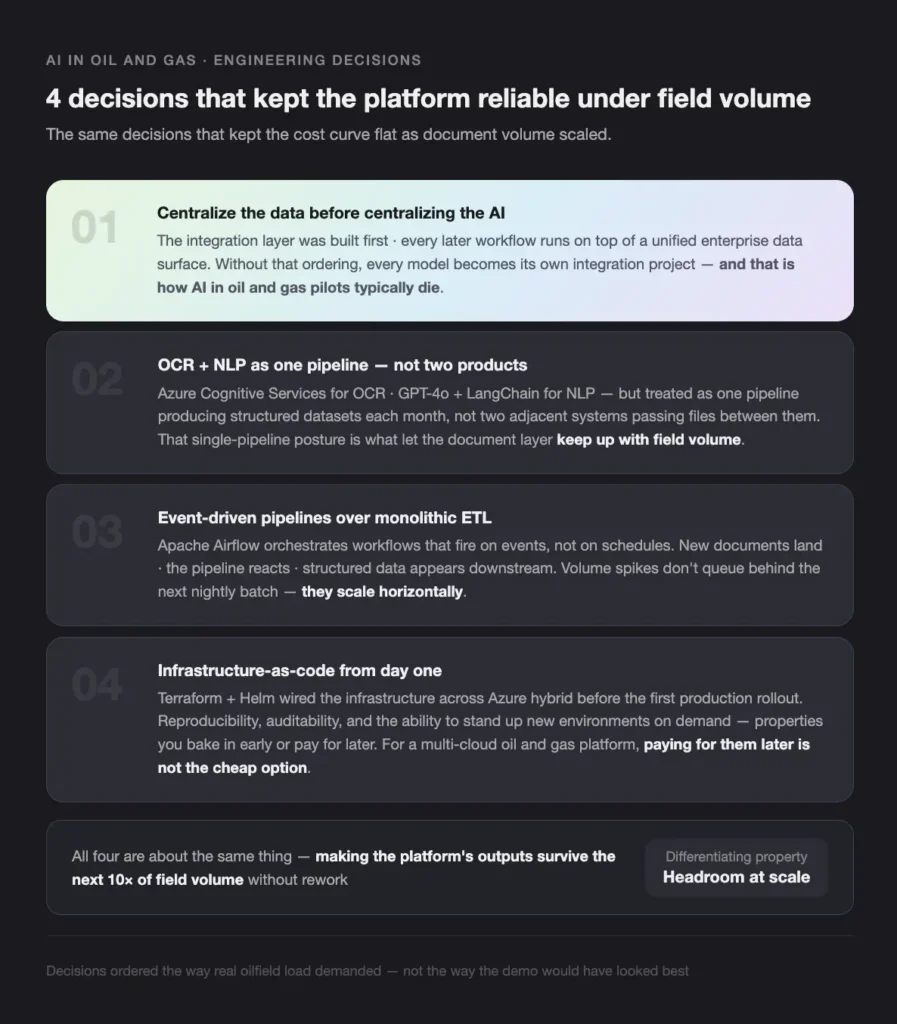
Centralize the data before centralizing the AI. The integration layer was built first. Every later workflow runs on top of a unified enterprise data surface, so AI components don’t each have to solve their own data-stitching problem. Without that ordering, every model becomes its own integration project, and that is how AI in oil and gas pilots typically die.
OCR + NLP as one pipeline, not two products. Azure Cognitive Services for OCR, GPT-4o + LangChain for NLP – but treated as a single pipeline producing structured datasets each month, not as two adjacent systems passing files between them. That single-pipeline posture is what made the document layer keep up with field volume.
Event-driven pipelines over monolithic ETL. Apache Airflow orchestrates workflows that fire on events, not on schedules. New documents land, the pipeline reacts, structured data appears downstream. Volume spikes don’t queue behind the next nightly batch, they scale horizontally.
Infrastructure-as-code from day one. Terraform + Helm wired the infrastructure across Azure hybrid before the first production rollout. Reproducibility, auditability, and the ability to stand up new environments on demand are properties you bake in early or pay for later, for a multi-cloud oil and gas platform, paying for them later is not the cheap option.
04. Impact
What Impact Did AI in Oil and Gas Have on the Operator’s Business?
The platform’s measured impact moved the two numbers the operator cared about most. Automation of data integration and digitization workflows lowered manual labor and infrastructure maintenance costs, delivering a 34% reduction across data management processes. Real-time, AI-driven recommendations gave the team a more accurate foundation for resource allocation, drilling prioritization, and risk assessment, improving decision-making accuracy and confidence by approximately 45%, directly impacting project efficiency and field development outcomes.
Qualitative Results at a Glance
- 34% reduction in operational costs across data management – automation of data integration and digitization workflows lowered manual labor and infrastructure maintenance.
- 45% lift in decision-making accuracy and confidence – real-time AI recommendations sharpened resource allocation, drilling prioritization, and risk assessment.
- Thousands of unstructured documents converted into structured datasets each month – reports, scans, handwritten forms, and PDFs all on one pipeline.
- Critical data pipelines scaled cleanly across Azure and hybrid environments via Terraform + Helm infrastructure-as-code.
- Data, engineering, and business teams aligned on the same platform through structured knowledge transfer programs.
- Real-time recommendations now flow directly into oil field development workflows instead of sitting in adjacent dashboards.
The broader payoff is operational. The constraint on the operator’s decision speed used to be data readiness; now it is the engineering and geological judgment that sits on top. That is the right place for the constraint to live in an oil and gas operator at this scale, and it is the deliverable the platform was ultimately built for.
Lessons Learned
What Should Operators Adopting AI in Oil and Gas Know Before They Start?
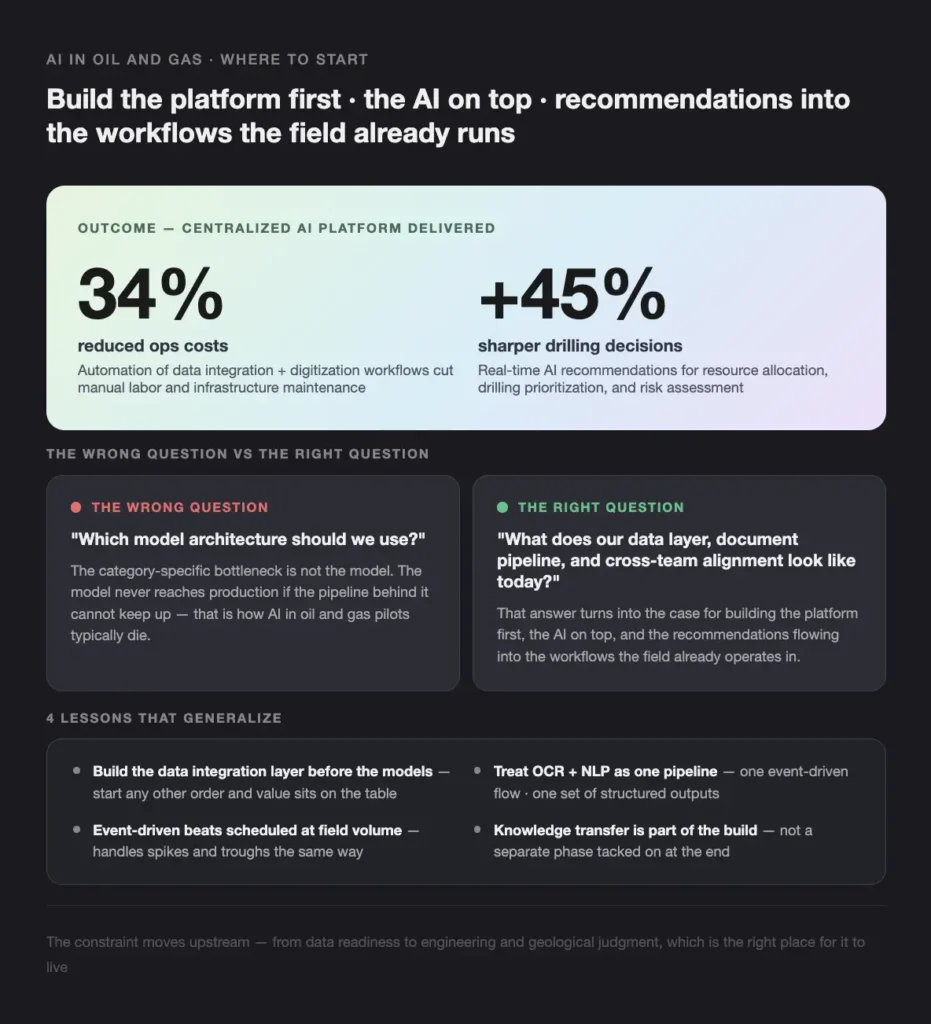
A few takeaways generalize beyond this engagement and apply to any operator weighing AI in oil and gas as a serious investment, not a pilot.
Build the data integration layer before the models. The temptation in this category is to start with a flashy model on a clean sample. That model never makes it to production. Unify the enterprise data first, then build the AI on top, in that order, because doing it any other order leaves the value on the table.
Treat OCR and NLP as one pipeline. Most operators run them as two adjacent systems passing files between each other, and most operators have a backlog of unstructured documents that the seams between those systems can’t keep up with. One pipeline, one event-driven flow, one set of structured outputs, that is what makes the document layer scale.
Event-driven beats scheduled at field volume. Nightly ETL is fine until field volume spikes. Event-driven pipelines handle the spike the same way they handle the trough, by reacting to what arrived, not by waiting for the next batch window.
Knowledge transfer is part of the build, not a separate phase. Data, engineering, and business teams who share a platform but don’t share context tend to drift in three different directions. Building the alignment program into the project is what kept the rollout from collapsing into three uncoordinated streams.
05. Conclusion
Where Should Operators Start with AI in the Oil and Gas Industry?
For this global operator, AI in oil and gas was less about adopting a model and more about putting a real platform underneath the operation. The centralized integration layer, the OCR + NLP pipeline on GPT-4o and Azure, the event-driven pipelines on Airflow and Python 3.12, and the Terraform + Helm infrastructure-as-code on Azure hybrid turned a fragmented, slow, document-heavy workflow into a decision engine, one that cuts operational costs 34% and lifts decision accuracy 45%. If you are evaluating AI in the oil and gas industry, the most important question is not “which model architecture should we use?” – it is “what does our data layer, our document pipeline, and our cross-team alignment look like today?” The answer is usually the case for building the platform first, the AI on top, and the recommendations flowing back into the same workflows the field already operates in.
Thinking about AI in oil and gas for your operation?
Tell us what your data layer, OCR pipeline, and field-side document volume look like today Teamvoy will help you map the integration, the AI/ML platform, and the realistic path from scattered documents to real-time recommendations feeding the workflows your teams already run.