Application Modernization Services for Legacy Business Systems
Application modernization services rebuild legacy business systems on current architecture: re-platforming, refactoring, cloud migration and data modernization. Teamvoy modernizes business-critical systems for regulated industries, in increments, without a feature freeze.
Trusted by teams running critical systems














Verified B2B client reviews from fintech, insurance, healthcare, and hi-tech engagements.

A B2B review platform that connects businesses with verified software solutions providers.

Transparent platform where current and former employees share company reviews and interview experiences.
What Our Clients Say
Teamvoy has successfully launched the system within the set timeline and integrated all the required tools and features. The collaborative team led regular meetings, delivered on time, and communicated effectively. Their proactive problem-solving approach and commitment to innovation stand out.

Jim Hill, Director of Marketing & Business Development, Market Access Direct, LLC
The care and interest they showed are what makes Teamvoy special. The system contributes to company sales, which is the best metric of success. Teamvoy was excellent in terms of project management and were extremely responsive while coming up with creative solutions.

Arnon Rosan, CEO & Founder, EverBlock Systems, LLC
The game had a huge impact on the client’s business and helped display the exhibition. Teamvoy utilizes project management tools to ensure a smooth workflow. The team us understanding, hard-working, and experienced.

Dr. Christian Stein, CEO, MeinObject
Teamvoy’s support and expertise have been integral in helping the client build and scale their product. An agile partner, they manage their tasks well and are consistent in delivering according to schedule. Their strong understanding of blockchain and the quality of their work make them stand out

Gordon Little, Managing Director, Iress
We work with them for over 2 years, and they have been very reliable and timely in providing us quality development services. Their creative input and talented team helped us build a better product!

Nazar Fedorchuk, CEO & Founder, Senstone
What application modernization services cover
Six deliverables, in the order they happen – and the assessment is separable from everything after it.

Assessment
Two to three weeks reading the codebase, the data model and the integration surface, including the behaviour nobody documented. It ends in a migration sequence you could hand to another firm.
Target architecture
The stack decision, the contracts between services and the observability layer, all agreed before code. Settling these after the first increment is what makes modernization programmes drift.
Integration
Explicit contracts with the systems you are not modernizing: the ERP, the warehouse, the third-party APIs. They keep their own release schedule, which is what stops one migration turning into five.
Incremental migration
One capability moves at a time behind an integration layer, with traffic shifted in stages. Each increment holds a rollback point, so there is never a single date when everything changes.
Data modernization
Customer, transaction and reference data migrated record by record rather than in bulk. Source, target and exception counts are published per batch, so your team verifies the result instead of trusting it.
Run phase
Monitoring, SLAs and a roadmap once the last increment lands. Most of a programme’s real cost arrives in the six months after cutover, and this is the phase that decides whether the work holds.

Our Application Modernization Success Stories



Modernization or rewrite
- What changes: Platform, architecture, data layer
- System availability: Runs throughout
- Risk profile: Contained per increment
- Typical duration: 3–12 months, in stages
- When it fits: Logic is sound, platform has age
- What changes: Everything, including business logic
- System availability: Two systems until cutover
- Risk profile: Concentrated at launch
- Typical duration: 12–36 months
- When it fits: Logic no longer matches the business
The six modernization approaches
Modern software is vital for daily operations. Implementing tech modernization solutions allows you to:

Rehost
Lift the workload onto new infrastructure, unchanged.
Fits when a data centre contract is ending and the system simply has to live somewhere else.
The limit: it changes nothing about why the system is hard to work on – every reason arrives intact on the new hardware.
Replatform
Swap self-managed components for managed equivalents.
Fits when operational load is the problem – patching, backups and capacity planning are eating time that should go elsewhere.
The limit: you inherit the managed service’s constraints, from supported versions to the upgrade schedule.
Refactor
Improve the internal structure without changing behaviour.
Fits when the team touches this code weekly, which is where structural work compounds into delivery speed.
The limit: there is nothing visible to demo, which makes it hard to fund and easy to cut.
Re-architect
Split the system along new service boundaries.
Fits when independent deployability is a real constraint – separate teams, release cadences and scaling profiles.
The limit: it gets recommended far more often than warranted, usually before anyone has checked those conditions hold.
Rebuild
Write the system again on a current stack.
Fits when the stack has no upgrade path and no amount of incremental work will create one.
The limit: every undocumented behaviour becomes a defect the moment users meet the replacement.
Replace
Retire the system in favour of a commercial product.
Fits for payroll, CRM, ticketing and most back-office functions, where the problem is well solved and your version of it isn’t a differentiator.
The limit: it only works where your process can bend to the product.
Legacy application modernization
Legacy modernization services from Teamvoy run in four stages, starting with the system you have rather than the architecture you want.
Three steps:
Where it usually starts

-
Team Fit
How well the new stack matches the skills already available in the team and how much retraining the transition will require.
-
Support lifecycle
How well the technology is supported, how mature its ecosystem is, and whether it can remain a stable choice for the next several years.
-
System Fit
Whether the stack solves the system’s actual performance, scale, integration, and operational requirements without adding unnecessary complexity.
AI in application modernization
AI carries part of the migration work, and a senior engineer signs every output before it reaches your system.
Test generation
Coverage written across a legacy surface that was never tested, before anything moves. It is the difference between a migration you can verify and one you hope about.

Code review
Every increment is checked against the target architecture’s rules, not only for correctness. It catches the drift that appears when several people implement one pattern.
Reconciliation
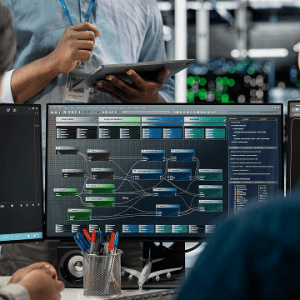
Verification across migrated data is automated rather than sampled. That is what makes a record-level guarantee possible at scale.

Documentation recovery
Undocumented behaviour is surfaced from the code and the logs. It is the slowest part of an assessment and the part most often skipped.

Migration scaffolding
The repetitive translation between old and new interfaces is generated rather than hand-written. It is reviewed rather than trusted, which is the point.

Not sure which parts of your tech stack actually need to change?
How Teamvoy delivers application modernization services
Application modernization moves in stages. Each stage has a clear outcome before the next one starts.

01. Assessment (2–3 weeks)
Review the codebase, data, integrations, infrastructure, and deployment process. The result is a clear view of what should stay, what needs to change, and what should move first.
02. Define the target architecture (2–4 weeks)
Select the technology stack, architecture, integration approach, and monitoring requirements based on the system and business needs.
03. Modernize the first capability (from 6 weeks)
Move one meaningful part of the application first. Keep the existing path available until the new capability is tested, stable, and ready for real traffic.
04. Migrate in stages (3–9 months)
Move the remaining capabilities in a defined sequence. Validate functionality and data at each stage rather than waiting until the end of the migration.
05. Run and improve (ongoing)
Monitor the modernized application in production, maintain SLAs, resolve issues, and continue improving the system as requirements change.
Modernization without a feature freeze
Modernization should not put the product roadmap on hold. New features can continue to ship while the application moves to the new architecture in stages.
How delivery works
The trade-off
Observability from day one
Clear progress
Three Ways To Start With Teamvoy
There are three ways to begin a modernization programme, and each starts with a technical conversation. Which one fits depends on how much you already know about the system you are moving.
First Increment
One capability moved behind an integration layer, with a rollback point and working software at the end. Best for teams that already know which part moves first.
Legacy System Assessment
Two to three weeks reading the codebase, data model and integration surface. It ends in a migration sequence you could hand to any partner, including none.
15-Min Technical Call
A direct call with a senior engineer about what is breaking, where the migration risk sits, and whether modernization is even the right answer.
Why choose Teamvoy as your application modernization company
See how Teamvoy approaches application modernization, from migration planning and production continuity to data validation and engineering ownership.
Talk To A CTO About Your Modernization Programme
Talk to a Chief Technology Officer on the first call.