




01. Our client
The solution was developed specifically for Teamvoy’s internal sales team, which operates in a highly competitive B2B technology services market and manages a large pipeline of prospects through digital sales channels. Its internal sales team manages over 3,000 active leads per quarter and works mainly through digital channels. To keep pace, the team needed an ai sales agent that could replace daily manual research without disrupting existing workflows. This case also shows how an ai sales assistant can support senior sales managers in high-volume pipelines.
Context
The sales team works every day with:
- Pipedrive (Professional Plan) handling more than 15,000 historical leads
- LinkedIn and LinkedIn Sales Navigator for outbound and account tracking
- Apollo and R2B2 for lead sourcing and enrichment
- Email and Slack for deal coordination and internal updates
Sales managers must follow dozens of signals across hundreds of accounts. This environment made sales automation with ai a priority and set the stage for an ai sales agent acting as a constant research layer. The same workflows also required an ai sales assistant to surface signals without adding noise.
What Sales Managers Must Track
Managers are responsible for monitoring:
- Funding rounds, M&A events, and product launches
- Leadership changes across target accounts
- Hiring spikes across engineering, sales, and product teams
- Career moves of decision-makers on LinkedIn
- Data accuracy inside Pipedrive
Without intelligent sales automation, these tasks required manual checks across 6–8 tools per account. This limited the impact of ai for sales teams before implementation.

02. Challenge
Manual Lead Research and Fragmented Intelligence
Before this project, no ai sales solution for b2b was in place. Each manager spent around 2 hours per day collecting public data.
Sales managers had to manually monitor company news, funding events, hiring activity, and leadership changes, track decision-makers’ career moves and professional activity on LinkedIn, identify “hot” and “warm” leads without real-time signals, and manually transfer lead and company data into Pipedrive.
This resulted in high time spent on routine research instead of selling, missed or delayed sales triggers, less personalized follow-ups, and lower conversion rates across the sales funnel. The process delayed outreach by one to three days after a signal appeared. The absence of enterprise sales automation caused missed opportunities and uneven follow-up quality, making it clear that an AI sales agent and AI sales assistant were required to handle the volume.
This process delayed outreach by 1-3 days after a signal appeared. The absence of enterprise sales automation caused missed opportunities and uneven follow-up quality. It became clear that an ai sales agent and ai sales assistant were required to handle this volume.
Main Goals
1. Automate Sales Research
Replace manual checks with an ai sales agent that watches companies and contacts continuously. This reduced dependency on spreadsheets and browser tabs and laid the foundation for ai sales system for teams.
2. Deliver Real-Time Insights
Push alerts within minutes of a signal appearing. The ai-powered sales assistant flags hiring spikes, executive moves, and press mentions the same day they occur.
3. Centralize CRM Updates
Allow sales reps to create or update leads in one click. This supported sales automation for enterprises without retraining the team.
4. Detect Sales Triggers Earlier
Use hiring data and role changes as early indicators. This helped reps start conversations 7–14 days earlier than before, proving how ai improved sales performance in daily operations.
5. Improve Funnel Results
Reduce research time by 92% and raise post-call follow-up rates by 18%, measured over two quarters.
03. Cooperation
The project followed a tight feedback cycle between Sales Ops, IT, and the AI team. This collaboration supported a real ai sales automation case study rather than a theoretical build.
Team
The team included a PM overseeing delivery, AI Engineers building the ai sales agent, and a QA Engineer validating data accuracy and alert timing. The ai sales assistant logic was tested against historical sales outcomes.
Cooperation Stages
The development of the Sales AI Agent followed a four-stage structured lifecycle: discovery, preparation, coding, and notification.
1. Discovery
The AI team reviewed sales qualification rules, CRM data flows, and notification rules. This stage defined how the ai sales assistant should behave for hot versus warm leads.
2. Preparation
CRM API access was reviewed and tested. Security rules were approved, allowing the ai sales agent to read and write lead data safely.
3. Coding & Development
Core logic was built in short cycles. Sales managers reviewed early outputs weekly, shaping how insights were ranked and summarized.
4. Notification & Integration
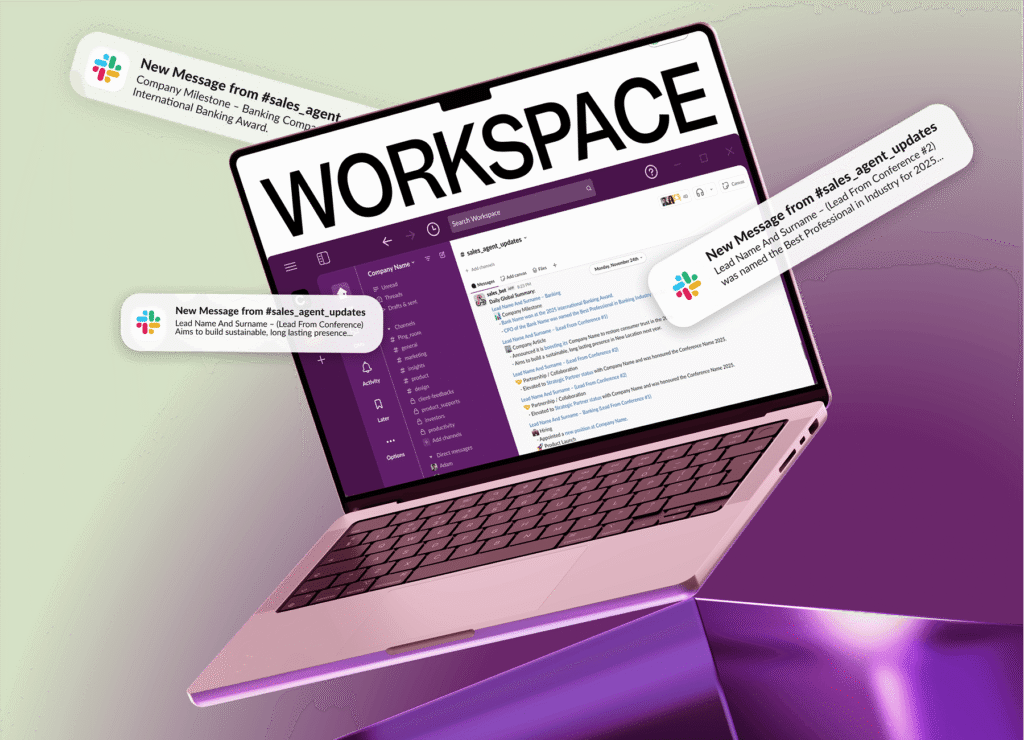
Alerts were delivered through CRM notes and a dedicated Slack bot. Each alert included a short summary and a direct profile link, supporting ai sales tool for saas workflows.
04. Solution
We built a new ai sales agent designed to collect and interpret public data from company websites, LinkedIn, and news sources. Acting as an ai sales assistant, it converts raw activity into buying intent signals and writes them directly into the CRM.
The agent runs on an event-based model. When a signal appears, the assigned sales rep receives a message within 3–5 minutes.
This setup supports intelligent sales automation without changing how the team sells.
Key Features
- Social and Web Monitoring: Tracks posts, job listings, and announcements
- Intent Categorization: Labels signals based on internal sales rules
- CRM Updates: Writes structured notes and updates lead fields
- User Alerts: Sends Slack and CRM notifications
- Daily Data Refresh: Keeps profiles current
These features form a practical ai sales system for teams and support enterprise sales automation in daily sales work.
Key engineering decisions:
The ai sales agent was built with a strong focus on data accuracy, signal freshness, and predictable system behavior under daily sales load. Each technical decision supported clear sales outcomes and reduced noise for the team.
Two-phase data collection model
The system uses a two-phase scraping approach to balance coverage and reliability.
Authenticated Sales Navigator scraping is used for individual decision-makers. This includes job changes, role updates, and personal activity that signals responsibility shifts.
Guest-level scraping is applied to company pages, career pages, and public job boards to track hiring volume, role types, and expansion signals.
This structure allowed broader visibility while respecting LinkedIn access limits and reducing account lock risks.
CRM data caching and local storage
To avoid repeated API calls, the ai sales assistant caches leads, contacts, and companies locally.
- All CRM entities are stored in a SQLite database
- Data access is handled through Peewee ORM
- This reduced Pipedrive API usage by over 60% during daily scans
Local storage also allowed offline analysis and fast lookups without network delays.
Multi-source signal consolidation
The system collects signals from LinkedIn activity, job postings, and Google News mentions.
An LLM processes this data to:
- Remove duplicate or low-value updates
- Group related events into a single account-level summary
- Surface only signals linked to buying intent
This step was critical to avoid alert overload and support intelligent sales automation in daily workflows.
URL normalization and Sales Navigator mapping
LinkedIn URLs vary widely between public and Sales Navigator formats.
The ai sales agent:
- Converts public LinkedIn URLs into Sales Navigator URLs
- Stores both formats in the database
- Maintains a consistent mapping for future authenticated access
This ensured reliable scraping and prevented broken profile references.
Time-based filtering and alert control
Every scraped item is stored with a created_at timestamp.
The system:
- Queries only records from the last 24 hours for daily reports
- Blocks repeat alerts for older data
- Prevents sending the same update multiple times to Slack
This reduced notification volume by around 35% and helped sales reps focus on fresh signals only.
06. Info
Industry:
IT Services;
B2B Sales
Services Provided:
AI Engineering Agents;
AI Sales Agent and AI Sales Assistant Development
Technology Stack:
Language & Runtime: Python 3.10+, Async task execution for scheduled monitoring
Data Layer: SQLite for local structured storage; Peewee ORM for lead, contact, and company models; Timestamped records for change detection and reporting.
External Services & Integrations: LLM APIs for signal summarization and intent classification, Pipedrive API for lead, deal, and activity updates, Web scraping modules for LinkedIn, company websites, and job boards.
