From Manual Research to Revenue Signals: AI Sales Agent in Action
Executive Summary
How Did Teamvoy Use an AI Sales Agent to Eliminate Two Hours of Manual Research a Day?
For a sales team working a pipeline of more than 3,000 active leads per quarter, the bottleneck was never finding prospects — it was keeping up with them. Funding rounds, leadership changes, hiring spikes, and decision-maker job moves were all sitting in public sources, but pulling them together meant six to eight tools per account and roughly two hours of manual checks per manager, per day. The answer was an AI sales agent: a system that watches companies and contacts continuously, classifies the signals it finds, and writes them straight into Pipedrive.
This case study walks through how Teamvoy built that AI sales agent for its own internal sales team — combining authenticated LinkedIn Sales Navigator scraping, public web monitoring, an LLM consolidation layer, and a Pipedrive integration that updates leads in one click. The result: research time fell from 120 minutes to 8 minutes per day, outreach started 1–2 days earlier on average, and reps handled 22% more active conversations.
About The Client
Who Is the Sales Team and Why Does Lead Intelligence Matter at This Volume?
The solution was built for Teamvoy’s own internal sales team, which operates in a competitive B2B technology services market and manages a high-volume pipeline through digital sales channels. The team works over 3,000 active leads per quarter and more than 15,000 historical leads sit inside Pipedrive (Professional Plan). LinkedIn and LinkedIn Sales Navigator drive outbound and account tracking; Apollo and R2B2 handle sourcing and enrichment; Slack and email coordinate the day.
At that scale, the problem is not access to information — it is keeping the right information current. Senior sales managers are responsible for monitoring funding rounds, M&A events, product launches, leadership changes, hiring spikes, decision-maker career moves on LinkedIn, and the accuracy of the Pipedrive data underneath all of it. None of those signals are hard to find individually. Together, across hundreds of accounts, they stop being trackable by hand. That was the environment that made an AI sales agent a priority — and the case where an ai sales assistant could genuinely support senior managers instead of adding another dashboard to ignore.
The Challenge
What Problem Does an AI Sales Agent Solve for High-Volume B2B Pipelines?
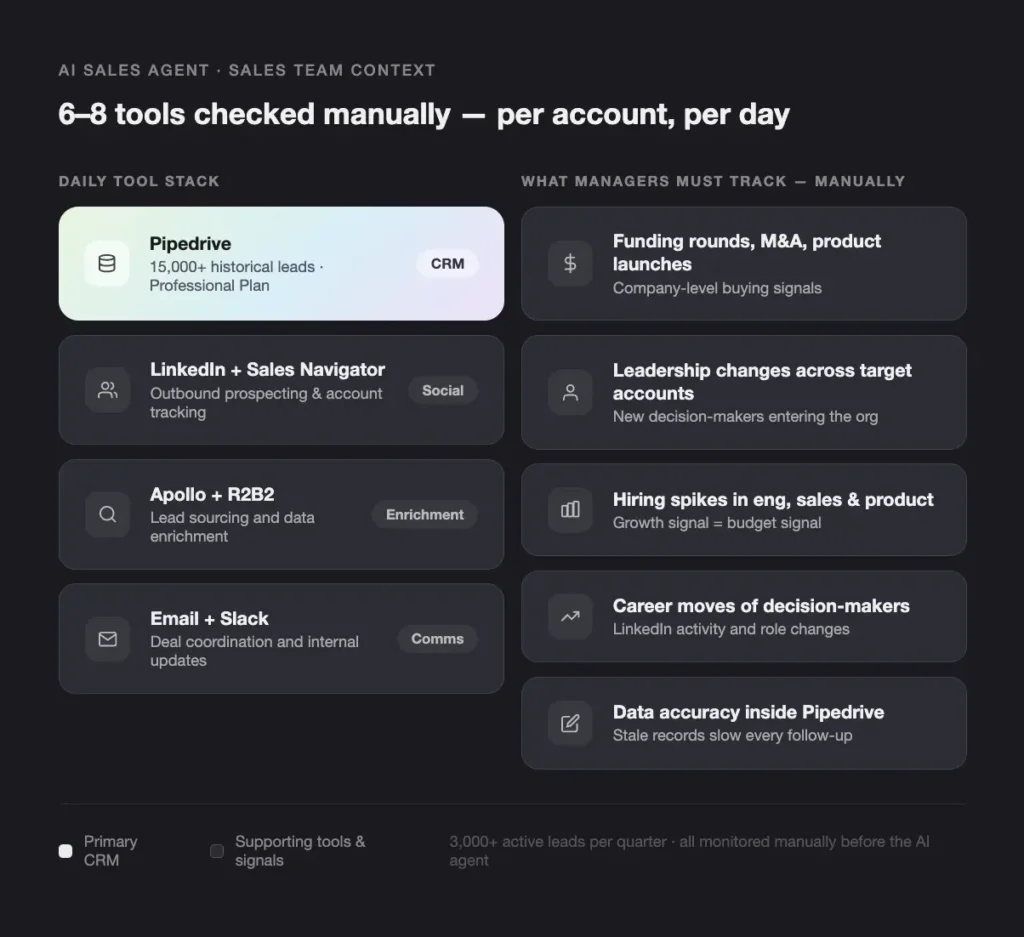
Before this project, there was no AI sales solution for B2B in place. Each sales manager spent roughly two hours per day collecting public data — checking company news, watching funding events, scanning hiring activity, tracking leadership changes, following decision-makers on LinkedIn, and copying everything worth keeping into Pipedrive.
The cost was structural, not just hours. Routine research crowded out actual selling. Sales triggers were missed or arrived late. Follow-ups lost personalization because nobody had time to read the latest signal before sending the next email. Conversion rates across the funnel softened. On average, outreach trailed a real signal by one to three days — which, in a competitive market, is the difference between starting a conversation and reading about a closed round.
The absence of enterprise sales automation made the gap obvious. An AI sales agent had to handle the volume, and an AI sales assistant had to sit close enough to the team that nobody had to learn a new tool to benefit from it.
Why This Approach
What Is an AI Sales Agent, and Why Did This Architecture Fit the Use Case?
An AI sales agent is a system that continuously watches public signals about target companies and contacts, interprets them against an internal sales rulebook, and writes the relevant ones into a CRM as actionable updates. The category ranges from light-touch alerting tools to full AI sales systems for teams that drive prospecting, qualification, and follow-up flows.
For Teamvoy, the requirement was specifically an AI sales assistant that could (a) collect data from LinkedIn, company sites, and news sources without tripping access limits, (b) classify what mattered against the team’s own qualification rules, and (c) drop everything into Pipedrive and Slack in a form a busy rep would actually read. That ruled out generic alerting products and pointed toward a purpose-built agent with an LLM consolidation layer in the middle.
The deeper reason this architecture worked is that it draws a clean line between collection and decision. The agent does not push every public update into the CRM — it consolidates them, drops duplicates and low-value items, and surfaces only signals tied to buying intent. That is what turned it into a real sales automation with AI rather than a noisier inbox.
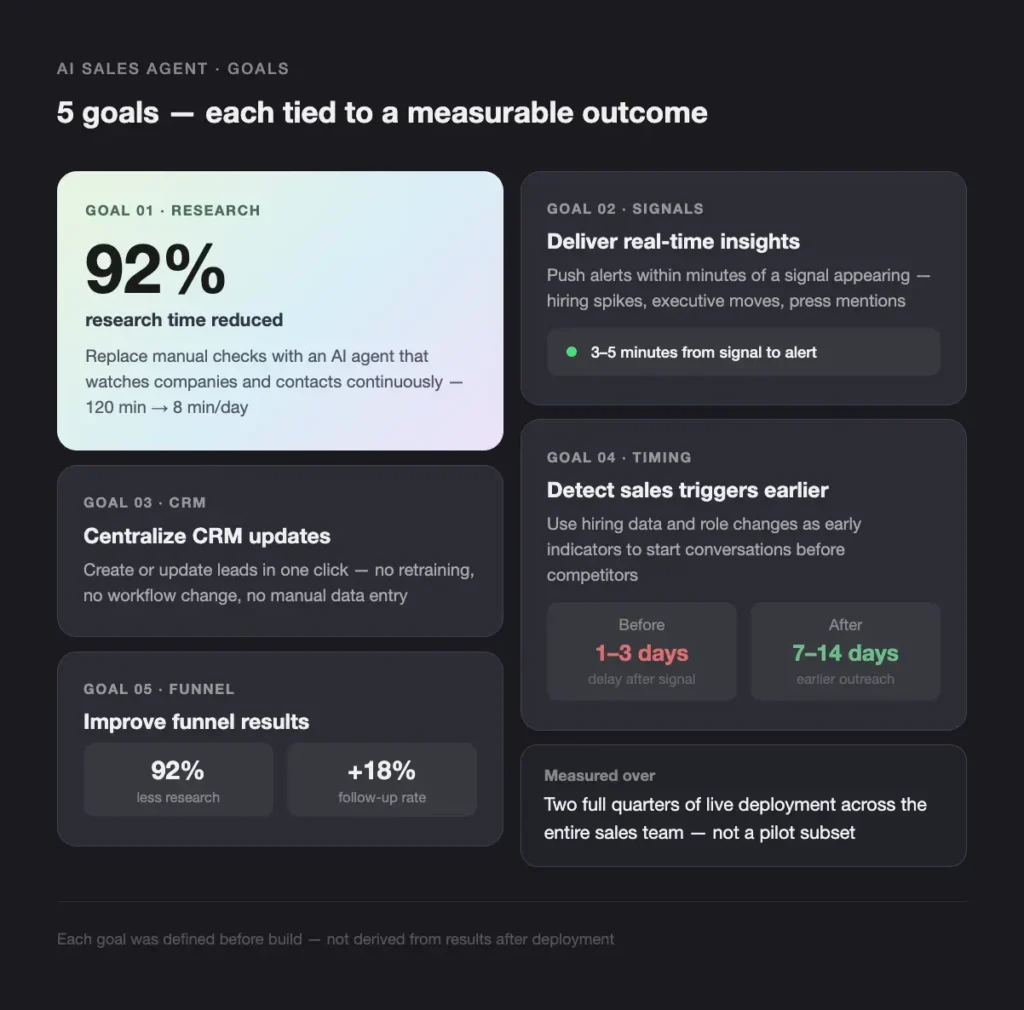
The project followed a tight feedback cycle between Sales Ops, IT, and the AI team. This collaboration supported a real ai sales automation case study rather than a theoretical build.
Team
The team included a PM overseeing delivery, AI Engineers building the ai sales agent, and a QA Engineer validating data accuracy and alert timing. The ai sales assistant logic was tested against historical sales outcomes.
Cooperation Stages
The development of the Sales AI Agent followed a four-stage structured lifecycle: discovery, preparation, coding, and notification.
1. Discovery The AI team reviewed sales qualification rules, CRM data flows, and notification rules. This stage defined how the ai sales assistant should behave for hot versus warm leads.
2. Preparation CRM API access was reviewed and tested. Security rules were approved, allowing the ai sales agent to read and write lead data safely.
What We Did
How Did Teamvoy Build the AI Sales Agent and Connect It to Pipedrive?
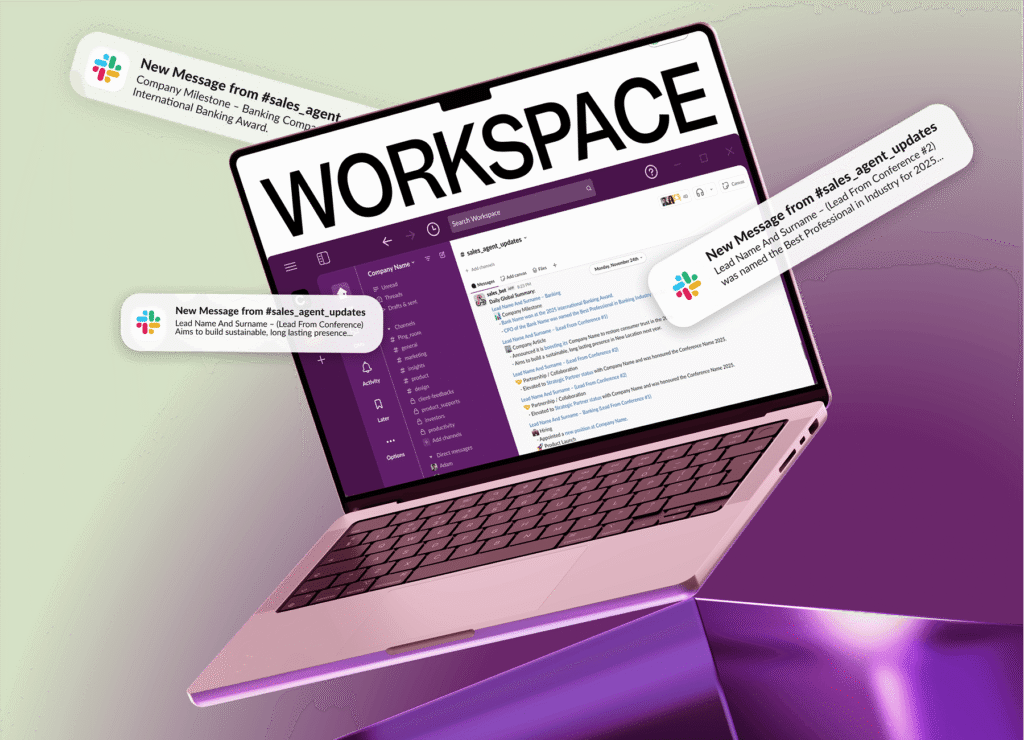
Teamvoy built an event-based AI sales agent that runs end-to-end without manual triggers. When a signal appears — a new job posting, a leadership change, a press mention — the system collects it, consolidates it against everything else known about that account, classifies it as hot or warm, and pushes a short summary to the assigned rep within three to five minutes through Slack and a CRM note with a direct profile link.
Behind the scenes, the agent caches Pipedrive entities locally in SQLite via Peewee ORM, so daily scans don’t hammer the CRM’s API. Every scraped record is timestamped, so the system can answer questions like “what’s new in the last 24 hours” without re-querying upstream. The same persistence layer makes the pipeline replayable and auditable: every signal the rep ever saw is on disk, and every signal we chose not to surface is too. The project followed a four-stage lifecycle — discovery, preparation, coding, and notification — with sales managers reviewing early outputs weekly. That feedback loop is what shaped the ranking logic: the difference between a hot signal and a warm one is a sales judgment call, not a technical one, and the agent had to learn it from the people who actually close deals.
Tech Stack
Which Technologies Power the AI Sales Agent Pipeline?
- Pipedrive API — for reading, writing, and updating leads, contacts, and companies inside the team’s existing CRM.
- LinkedIn Sales Navigator (authenticated) — for individual decision-maker activity: job changes, role updates, and signals of shifting responsibility.
- Guest-level LinkedIn + public job boards — for company hiring volume, career-page activity, and expansion signals.
- LLM APIs — for signal summarization, deduplication, and buying-intent classification.
- SQLite + Peewee ORM — local persistence for leads, contacts, companies, and every scraped record, all timestamped.
- Slack bot + Pipedrive notes — the two surfaces where reps actually see the agent’s output.
Key Features
Which Features Define a Production-Ready AI Sales Agent for B2B Teams?
- Social and web monitoring across LinkedIn posts, job listings, company announcements, and Google News mentions.
- Intent categorization that labels each signal against the team’s internal sales rules — hot, warm, or noise.
- One-click CRM updates: structured notes and field updates written directly to Pipedrive, with deduplication against existing records.
- Real-time alerts through Slack and Pipedrive notes, each with a short summary and a direct profile link.
- Daily data refresh that keeps account and contact profiles same-day accurate.
- Persistent, timestamped local store of every scraped record, so the agent can be replayed, audited, or extended without losing history.
Key Engineering Decisions
Which Engineering Decisions Make an AI Sales Agent Reliable Under Daily Load?
Five decisions shaped the agent’s behavior under real sales conditions — and they are the same ones that kept noise down once the team started relying on it.
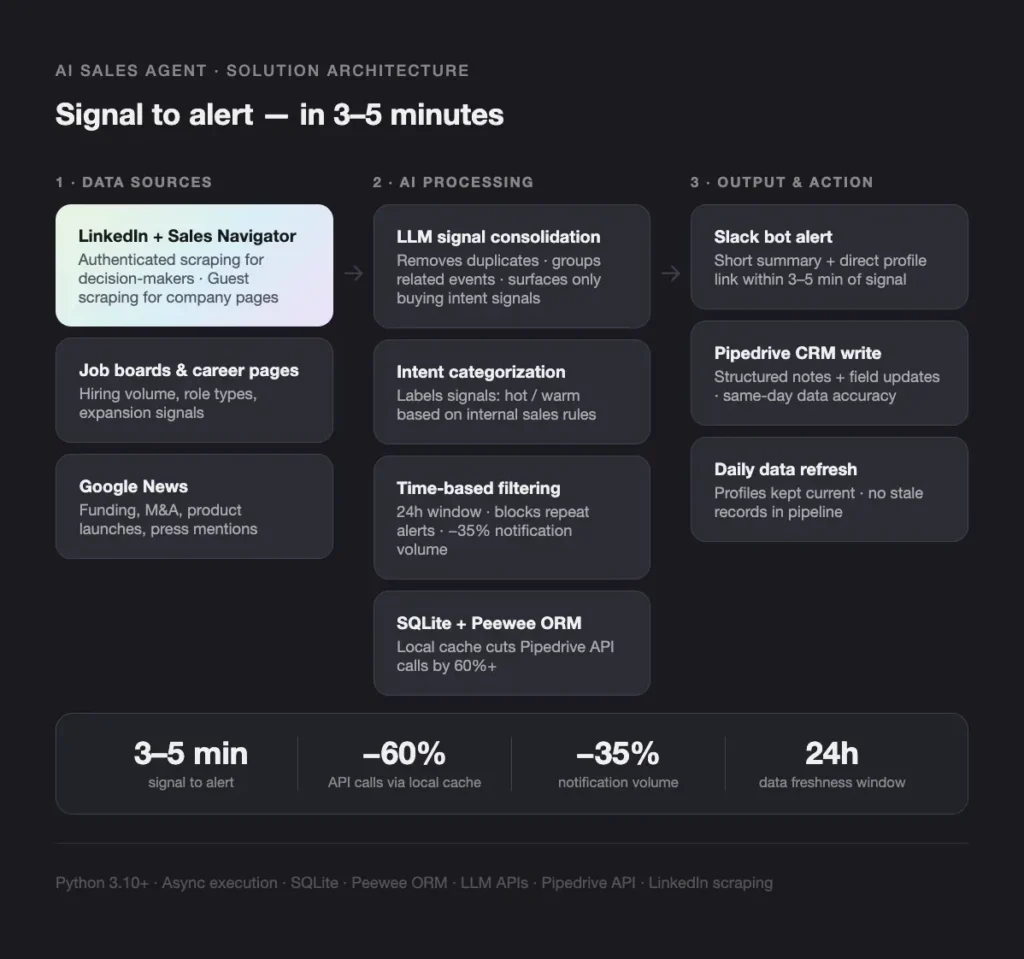
Two-phase data collection. The agent splits scraping into authenticated and guest-level passes. Sales Navigator (authenticated) is used for individual decision-makers, where job changes and role updates carry the most signal. Guest-level scraping covers company pages, career pages, and public job boards, where hiring volume and expansion patterns matter more than any single profile. The split broadened visibility while staying inside LinkedIn’s access limits and keeping the risk of account locks low.
CRM data caching and local storage. All Pipedrive entities — leads, contacts, companies — are cached locally in SQLite through Peewee ORM. That reduced Pipedrive API usage by over 60% during daily scans, made offline analysis possible, and let the agent respond to queries without paying a network round-trip every time.
Multi-source signal consolidation. Signals from LinkedIn activity, job postings, and Google News mentions are passed through an LLM that removes duplicates, groups related events into a single account-level summary, and surfaces only the items tied to buying intent. This was the step that prevented alert overload — without it, intelligent sales automation collapses into another noisy inbox.
URL normalization and Sales Navigator mapping. Public LinkedIn URLs and Sales Navigator URLs look different and behave differently. The agent converts between them, stores both formats, and maintains a consistent mapping so authenticated access does not break the next time a profile is referenced. Boring infrastructure, but it is the difference between a reliable agent and one that quietly stops working on the URLs that matter most.
Time-based filtering and alert control. Every scraped item carries a created_at timestamp. Daily reports query only the last 24 hours, repeat alerts on older data are blocked, and the same update never reaches Slack twice. That single rule cut notification volume by roughly 35% and is the biggest reason reps trust the feed.
Impact
What Impact Did the AI Sales Agent Have on the Sales Team’s Day-to-Day?
After 90 days of full-team deployment, the AI sales agent had moved the team’s daily rhythm. Research time dropped from 120 minutes to 8 minutes per day, per manager. Outreach started 1–2 days earlier on average, because the signal arrived in Slack instead of being found later in a manual sweep. Reps handled 22% more active conversations, and Pipedrive’s data freshness moved to same-day accuracy across leads, contacts, and companies.
Post-call follow-up rates rose 18% over two quarters — measured against the same team, the same product, and the same market. Hiring data and role changes turned out to be the most consistent early indicator: on average, the agent surfaced them 7–14 days before the same accounts would have appeared through manual research, which is the window where being early actually changes the outcome of a deal.
Qualitative Results at a Glance:
- Manual research time fell from 120 minutes to 8 minutes per day, per sales manager — a 92% reduction.
- Outreach now starts 1–2 days earlier on average; hiring-signal alerts arrive 7–14 days before manual discovery.
- Sales reps handle 22% more active conversations without adding headcount or hours.
- Pipedrive moved to same-day data accuracy, with 60%+ fewer API calls thanks to local caching.
- Slack notification volume dropped roughly 35% after time-based filtering, so the alerts that remain are the ones reps actually act on.
- Post-call follow-up rates rose 18% over two quarters — the same team, the same product, a different rhythm.
What Impact Did the AI Sales Agent Have on the Sales Team's Day-to-Day?
After 90 days of full-team deployment, the AI sales agent had moved the team’s daily rhythm. Research time dropped from 120 minutes to 8 minutes per day, per manager. Outreach started 1–2 days earlier on average, because the signal arrived in Slack instead of being found later in a manual sweep. Reps handled 22% more active conversations, and Pipedrive’s data freshness moved to same-day accuracy across leads, contacts, and companies.
Post-call follow-up rates rose 18% over two quarters — measured against the same team, the same product, and the same market. Hiring data and role changes turned out to be the most consistent early indicator: on average, the agent surfaced them 7–14 days before the same accounts would have appeared through manual research, which is the window where being early actually changes the outcome of a deal.
The broader payoff is operational: the team’s time shifted from research to follow-up. For a pipeline where speed-to-respond and timing of outreach materially affect close rates, that is the win.
Lessons Learned
What Should B2B Teams Know Before Deploying an AI Sales Agent?
A few takeaways generalize beyond this engagement and apply to anyone evaluating AI sales automation for a high-volume B2B pipeline.
Pick an AI sales agent that consolidates signals — not one that forwards them. Most tools in this category are alerting layers: they find updates and ship them. The ones worth integrating with deduplicate, group, and rank before anything reaches a rep. That single architectural property determines whether the agent is a productivity gain or a new tab to ignore.
Cache the CRM locally. Every team eventually hits API limits, and every CRM eventually rate-limits a useful workflow. A local store turns daily scans from an external dependency into an internal one, and unlocks analyses the CRM’s UI cannot do.
Time-stamp everything and filter on it. The single highest-leverage rule in the system was “don’t alert twice on the same thing.” It sounds trivial. It is the difference between a feed reps trust and a feed reps mute.
Treat the AI sales agent as one component, not the product. The agent is a critical input, but the value lives in the pipeline that follows — CRM hygiene, Slack delivery, ranking against the team’s own rules, and the weekly review loop that taught the agent what “hot” actually means. Buying an AI-powered sales assistant without designing those layers tends to leave the value on the table.
Conclusion
Where Should B2B Teams Start with AI Sales Automation?
For Teamvoy’s internal sales team, deploying an AI sales agent was less about replacing people and more about removing the work that was already crowding out selling. The Pipedrive + LinkedIn + LLM pipeline turned a manual, fragmented process into something that runs continuously and shows up in Slack at the moment a rep can actually use it. The team did not change how it sells. The agent changed what was in front of them when they sat down to sell.
If you are evaluating an AI sales solution for B2B, the most important question is not “which scraping or alerting tool is best?” — it is “what does the pipeline look like between the signal and the rep?” The answer determines whether your AI sales agent becomes a real pipeline engine or just another dashboard nobody opens.
Thinking about adding an AI sales agent to your B2B pipeline?
Tell us what your sales team is tracking by hand today and where you'd like that work to land — Teamvoy will help you design the agent, the data layer, and the realistic path from first signal to clean CRM record.