AI Voice Assistant for Inbound Calls: Retell AI + HubSpot at Garrison Flood
Every inbound call becomes a structured HubSpot lead — automatically. Wondering how an AI voice assistant could capture every lead your team misses?
Executive Summary: How Did Garrison Flood Control Use an AI Voice Assistant to Eliminate Manual Lead Entry?
For a company that fields high-stakes inbound calls every day — homeowners worried about flooding, municipal engineers comparing systems, contractors asking for site visits — every missed detail costs a lead. Garrison Flood Control needed a way to capture, structure, and route those calls into their CRM without forcing managers to take notes during conversations. The answer was an AI voice assistant: Retell AI handles the call, our integration pipes the structured output into HubSpot, and a complete lead record exists by the time the call ends. This case study walks through how Teamvoy connected an AI voice assistant to HubSpot using Retell AI, Ruby on Rails, and a webhook-driven pipeline that turns every inbound conversation into a clean, queryable lead. The result: managers see who called, what they need, and a short summary of the conversation — automatically.
01. Our Client
Who Is Garrison Flood Control and Why Do Inbound Calls Matter for the Business?
Garrison Flood Control is a U.S.-based manufacturer and installer of flood protection systems. The company serves a notably broad mix of customers — single-family homes, commercial properties, municipalities, infrastructure projects, parking garages, power stations, and other facilities — and each segment has its own urgency, technical requirements, and procurement process.
That mix translates directly into a phone-heavy lead pipeline. A homeowner calling after a regional storm, a property manager planning a retrofit, and a city engineer comparing vendors all need different information and different follow-up paths. For a sales team, the friction is not in finding leads — it is in capturing the right details fast enough to act on them. Inbound calls had become the company’s most valuable channel and its most leak-prone one.
02. Challenge
What Problem Does an AI Voice Assistant Solve for High-Volume Inbound Lead Capture?
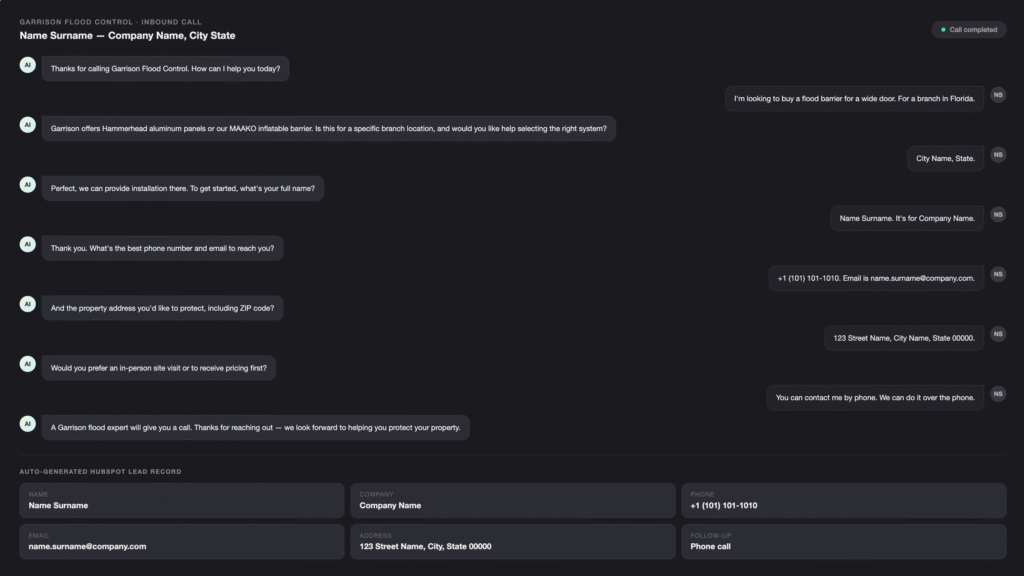
The company needed to automate lead processing from phone calls. Three things had to happen on every inbound call: capture contact details, understand the caller’s request, and produce a short summary that a manager could read in seconds. Doing this manually meant a sales rep had to listen, take notes, switch between the phone and HubSpot, and risk inconsistent data. The desired outcome was simple. Every call should leave behind a structured lead record in HubSpot with the contact’s name, email, phone number, address, city/state, company, whether a site visit was requested, the lead source, and a short summary of what was discussed. No spreadsheet. No retyping. No, “I’ll add it to the CRM after lunch.”
What Is an AI Voice Assistant Like Retell AI, and Why Did It Fit the Use Case?
An AI voice assistant is a system that engages in real-time conversations with callers, transcribes and understands the dialogue, and provides structured outputs that other software can consume. The category covers everything from simple IVR replacements to generative AI voice assistant platforms that handle multi-turn negotiations and qualification flows.
For Garrison Flood Control, the requirement was a voice AI assistant that could handle inbound sales calls, ask for the right information, and return it as structured fields — and answer the caller’s questions about the product along the way. Retell AI fit because it ships exactly that interface: a callable voice agent that can both qualify a lead and respond to product questions in real time, a webhook on call completion, and an API that returns the call’s structured payload — a fully configurable schema (for Garrison, fields like name, email, phone, address, city/state, company, site visit need, lead source, and a short summary, but any field the business needs can be added). That made it a natural anchor for an AI voice assistant in business pipelines, where every call needs to be recorded in a CRM.
The deeper reason Retell AI was a good fit, though, is that it is one of the few AI voice assistant software options that draws a clean line between conversation and data. It does not ask the integration layer to parse audio or untangle transcripts — it hands over structured fields, ready to map.
03. Solution
How Did Teamvoy Integrate the AI Voice Assistant with HubSpot?
Teamvoy built an integration between Retell AI and HubSpot that runs end-to-end without human intervention. The flow is straightforward: a customer calls in, the AI voice assistant from Retell AI handles the conversation and collects the required fields, and when the call ends, Retell sends a webhook to a Ruby on Rails service we built. The service uses the Retell API to fetch the full call details, parses out the CRM payload, and decides whether the contact already exists in HubSpot. If it does, the record is updated; if not, a new contact is created. Either way, a HubSpot note is attached with the conversation summary and the captured contact details. Behind the scenes, the system stores call metadata in PostgreSQL so the integration can be replayed, audited, or extended without re-querying Retell. That choice paid off as the workflow grew — every new field, every new mapping, every new branch could be tested against real call records rather than synthetic data.
Which Technologies Power the AI Voice Assistant Pipeline?
- Retell AI API — the voice AI assistant that handles inbound calls and emits structured fields.
- Ruby on Rails — the integration service that orchestrates webhook handling, API calls, and CRM logic.
- HubSpot API — for creating and updating contacts and attaching call summary notes.
- Webhooks — to trigger the pipeline the moment a call ends, with no polling delay.
- PostgreSQL — persistent call log for replay, audit, and future analytics.
Key Engineering Decisions: Which Engineering Decisions Make an AI Voice Assistant Pipeline Reliable?
Three decisions shaped the integration’s reliability and made it easy to extend.
First, we treated Retell AI as the single source of truth for call data. Rather than parsing transcripts or deriving fields downstream, the integration fetched Retell’s structured payload through the API and trusted it. That made the HubSpot side simple — direct field mapping, with no ambiguity about which value should win.
Second, we built around webhooks instead of polling. The moment a call ends, the pipeline runs. There is no scheduled job to lag behind, no fragile cron schedule to maintain, no batch window to wait through. For a sales team that needs to follow up while the lead is still warm, the difference matters.
Third, we logged everything to PostgreSQL. Webhooks fail. APIs rate-limit. Network partitions happen. With every call recorded server-side, the integration can be replayed without rerunning the conversation, and edge cases can be debugged with real data rather than guesses.
04. Impact
What Impact Did the AI Voice Assistant Have on Garrison Flood Control’s Sales Workflow?
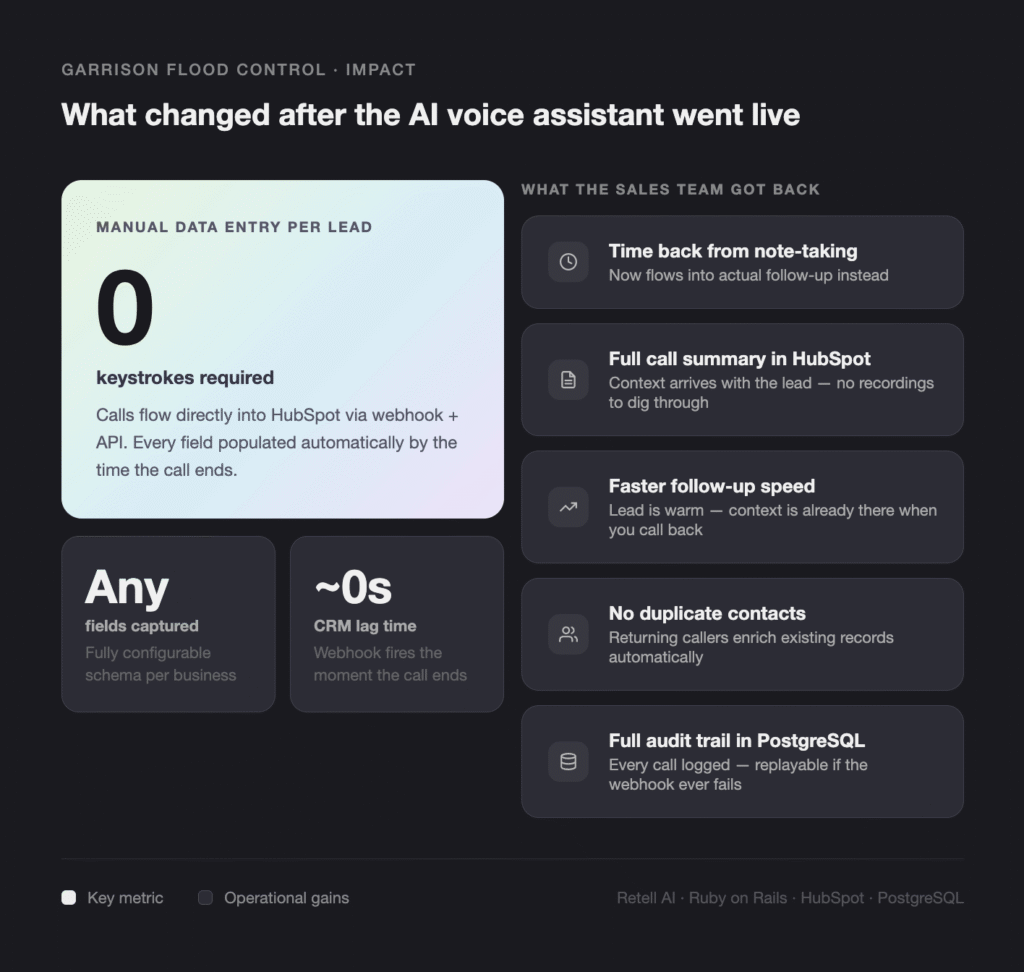
As soon as the integration went live, every inbound call automatically generated a structured lead record in HubSpot — with no manual data entry. The sales team got back the time they were spending on note-taking and CRM updates, and that time started flowing into actual follow-up.
Qualitative Results at a Glance
- Every inbound call automatically becomes a structured HubSpot lead — no manual data entry required.
- Managers see contact details and a short call summary inside HubSpot, instead of digging through notes or recordings.
- Follow-up is faster because the conversation context arrives at the same time as the lead.
- Existing HubSpot contacts are enriched instead of duplicated when callers come back.
- A persistent PostgreSQL call log makes the pipeline replayable and auditable, so failed integrations can be fixed without losing leads.
The broader payoff is operational: managers’ time shifts from data entry to actually responding to qualified inbound interest. For a business where speed-to-respond materially affects close rates, that is the win.
Lessons Learned: What Should Businesses Know Before Deploying an AI Voice Assistant?
A few takeaways generalize beyond this engagement and apply to anyone evaluating AI voice assistant software for inbound sales. Pick an AI voice assistant that emits structured data. Many AI voice assistant apps stop at transcription. The ones worth integrating with hand you fields. That single architectural property determines whether your CRM integration takes a week or a quarter.
Webhook plus API beats polling — every time. For inbound sales, the latency between the end of the call and the CRM record is the metric that matters most. Webhooks make that latency near-zero by design. Persist the raw call data on your side. Even if your AI voice assistant software stores everything, a local copy in PostgreSQL or equivalent gives you replay, audit, and the ability to evolve the schema without losing history.
Treat the AI voice assistant as one component, not the product. The voice agent is a critical input, but the value lives in the pipeline that follows — deduplication, enrichment, notes, and follow-up triggers. Buying or building a generative AI voice assistant without designing the pipeline downstream tends to leave value on the table.
Conclusion: Where Should Businesses Start with AI Voice Assistant Software?
For Garrison Flood Control, deploying an AI voice assistant was less about replacing humans and more about removing friction. The Retell AI + HubSpot pipeline turned a manual, error-prone process into an automated one that runs every time the phone rings. Teamvoy built the integration so that every call produces a complete lead record — without changing how customers experience the call itself.
If you are evaluating an AI voice assistant for business, the most important question is not “which voice agent is best?” — it is “what does the pipeline look like after the call?” The answer determines whether your AI voice assistant becomes a real lead engine or just another expensive demo.
Thinking about adding an AI voice assistant to your inbound channel?
Tell us where the calls go today and where you’d like them to land – Teamvoy will help you design the integration, schema, and a realistic path from the first webhook to clean CRM records.