
The engagement began with two distinct but related problems: a client-facing booking chatbot that could orchestrate transactions across multiple carriers, and an internal knowledge-access system based on Model Context Protocol that could plug AI workflows directly into company sources. Both threads needed to ship as part of a single, coherent program of work.
Generative AI in Travel: AI Chatbot & MCP for a Global Booking Platform
A browser-based AI chatbot and an MCP knowledge layer — generative AI in travel, shipped end-to-end. Curious how generative AI could simplify your travel platform’s booking flow?
Scaling Intelligence: Building an AI-Native Booking Engine for Multi-Modal Travel Platforms
Scaling Intelligence: Building an AI-Native Booking Engine for Multi-Modal Travel Platforms
Scaling Intelligence: Building an AI-Native Booking Engine for Multi-Modal Travel Platforms
Scaling Intelligence: Building an AI-Native Booking Engine for Multi-Modal Travel Platforms
Summary: How Did a Berlin Booking Platform Use Generative AI in Travel to Reinvent Multi-Modal Reservations?
Generative AI in travel is moving from experimental pilots to production-grade infrastructure. Booking platforms, OTAs, and mobility providers are realizing that conversational interfaces, retrieval-augmented workflows, and protocol-based integrations can collapse complex multi-provider journeys into a single, intuitive experience. This case study explores how a global travel booking and mobility platform partnered with Teamvoy to deliver two complementary gen AI in travel solutions: a customer-facing AI chatbot that handles end-to-end multi-modal bookings, and an internal Model Context Protocol (MCP) layer that securely connects AI workflows to company knowledge sources.
The result was an MVP that validated the feasibility of browser-based booking automation through conversational AI, while at the same time demonstrating how MCP-based platforms for AI travel assistants can dramatically simplify how employees access internal documentation. Both halves of the project reinforce a key thesis shaping the gen AI in travel industry: success depends not just on the model, but on the integration architecture that surrounds it.
01. Our Client
Who Is the Berlin-Based Multi-Modal Travel Platform Behind This Case Study?
The client is a global travel booking and mobility platform headquartered in Berlin, Germany. Since its founding in 2013, the company has helped travelers compare and book multi-modal transportation — rail, bus, air, and ferry — through a single digital storefront. The platform operates across international markets and partners with a broad network of regional and global transportation providers, making it one of the more visible names in the European travel-tech landscape.
Like most platforms in this category, the client sits at the intersection of two notoriously hard problems: stitching together fragmented inventory from dozens of carriers, and presenting that complexity to travelers in a way that feels effortless. As consumer expectations have shifted toward AI-native interfaces, the company recognized an opening to use generative AI in travel not as a feature add-on, but as a substrate for redesigning the booking journey itself.

02. Challenge
What Problem Does Generative AI in Travel Solve for Multi-Modal Booking Platforms?
Building a customer-facing booking chatbot
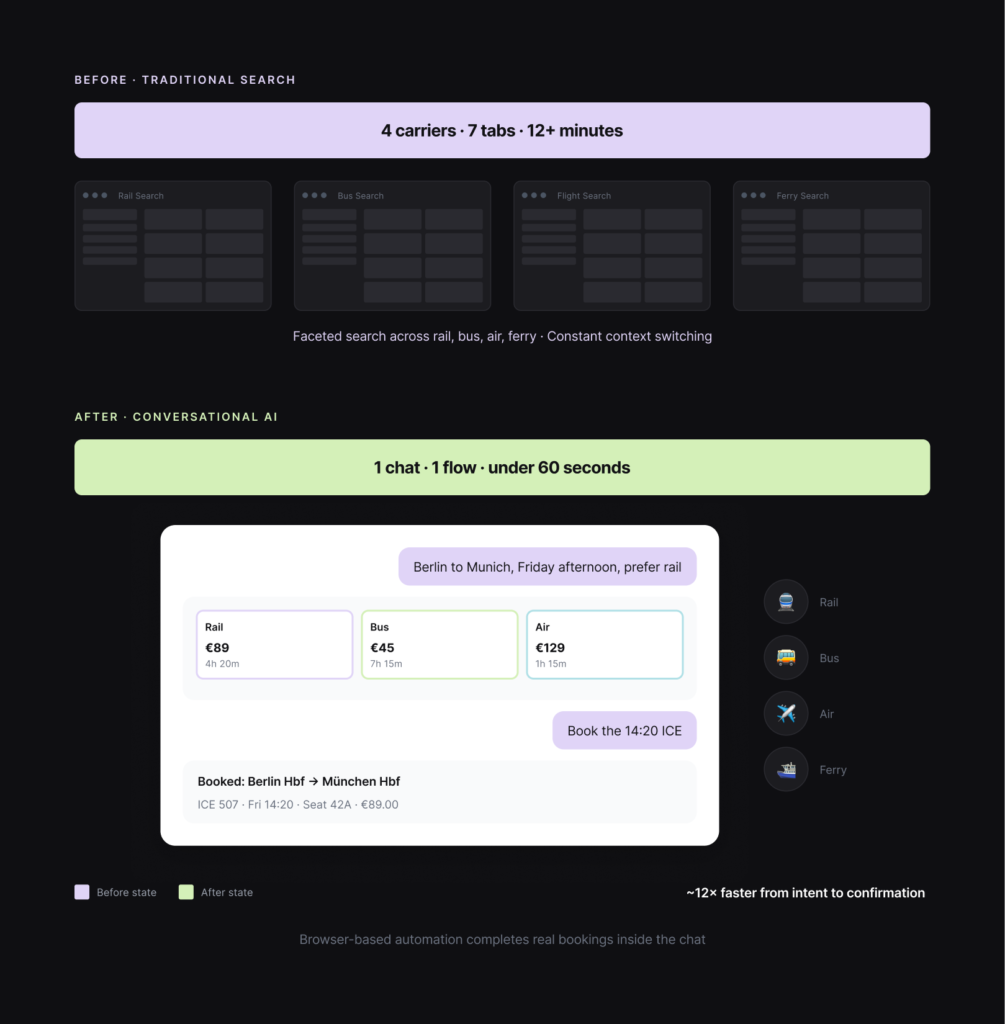
The product team wanted a user-friendly online solution that could be embedded in a chatbot and support full end-to-end booking flows across multiple travel providers. Travelers needed to describe a trip in natural language, see comparable options across carriers, and complete reservations — payment, seat selection, confirmation — through a conversational, browser-based experience. Traditional faceted-search UIs handle this poorly when itineraries span rail, bus, air, and ferry. Conversational gen AI in travel promised a smoother path, but only if the underlying booking flows could be automated reliably.
Unlocking internal knowledge with MCP
In parallel, the team needed an internal-use solution for secure, structured access to company knowledge sources — most urgently Google Drive. The volume of operational documentation, partnership agreements, and product specs had grown beyond what employees could realistically navigate with keyword search. The goal was to plug AI-powered workflows directly into these sources via Model Context Protocol, so internal teams (and the AI assistants they used) could retrieve precisely the right context, on demand, without copying content into prompts manually.
These two challenges shared a common requirement: a deliberate architecture that respected the boundary between external customer interactions and internal data, while still leveraging modern gen AI in travel patterns to deliver value on both sides.
Why Is Generative AI in Travel Becoming Production-Grade Infrastructure?
Travel is one of the most natural fits for generative AI. Trip planning is fundamentally a conversation — destinations, dates, constraints, preferences, trade-offs — and travelers have long resented the rigid filter-and-grid pattern that dominates most booking sites. Generative AI optimization in travel works because it lets the interface meet the customer where they already are: typing a sentence, asking a follow-up, changing their mind.
But the bigger opportunity sits beneath the chat window. Gen AI in the travel industry rewards companies that treat their AI assistants as orchestration layers, not chat widgets. That means connecting the assistant to live inventory, payment, reservation systems, and internal knowledge through stable, well-defined protocols. Platforms for AI travel assistants that get this right turn the chatbot from a marketing experiment into a revenue-generating channel.
This case study sits squarely in that second category. The work was less about prompt engineering and more about building reliable integrations: scraping and automating multi-provider booking flows in a browser, and standing up an MCP layer that gave AI workflows safe, structured access to internal sources.
03. Our Approach
How Did Teamvoy and the Client Build a Generative AI Travel Solution Together?
Our engagement was scoped around two parallel workstreams that ran on shared design principles but separate delivery tracks.
The first workstream focused on creating a client-facing chatbot booking experience. The objective was to integrate multiple travel providers into a single conversational flow and support the entire booking and reservation journey — from initial search and price comparison through to checkout and confirmation. Beyond technical delivery, an explicit goal was improving customer experience by turning multi-step booking complexity into a fluid back-and-forth conversation.
The second workstream focused on the internal MCP-based access layer. Here the goal was to connect AI workflows with internal tools, starting with Google Drive, and to enable secure retrieval of relevant content. The intended outcome was straightforward: less time hunting for documents, more time using them. By implementing MCP rather than a custom one-off integration, the team set the foundation for adding other sources later — Notion, Confluence, ticketing systems, partnership databases — without rewriting the integration layer each time.
Teamvoy worked closely with the client’s product, engineering, and operations stakeholders throughout discovery, sprint planning, and iterative delivery. The collaboration emphasized fast feedback loops: shipping rough versions of each capability quickly, learning from real usage, and refining behavior against concrete failure cases rather than hypothetical specs.
04. Solution
What Does an AI-Native Travel Booking Solution Actually Look Like in Production?
The final solution consisted of two complementary systems — one customer-facing, one internal — that together formed a complete blueprint for deploying generative AI in travel at production scale.
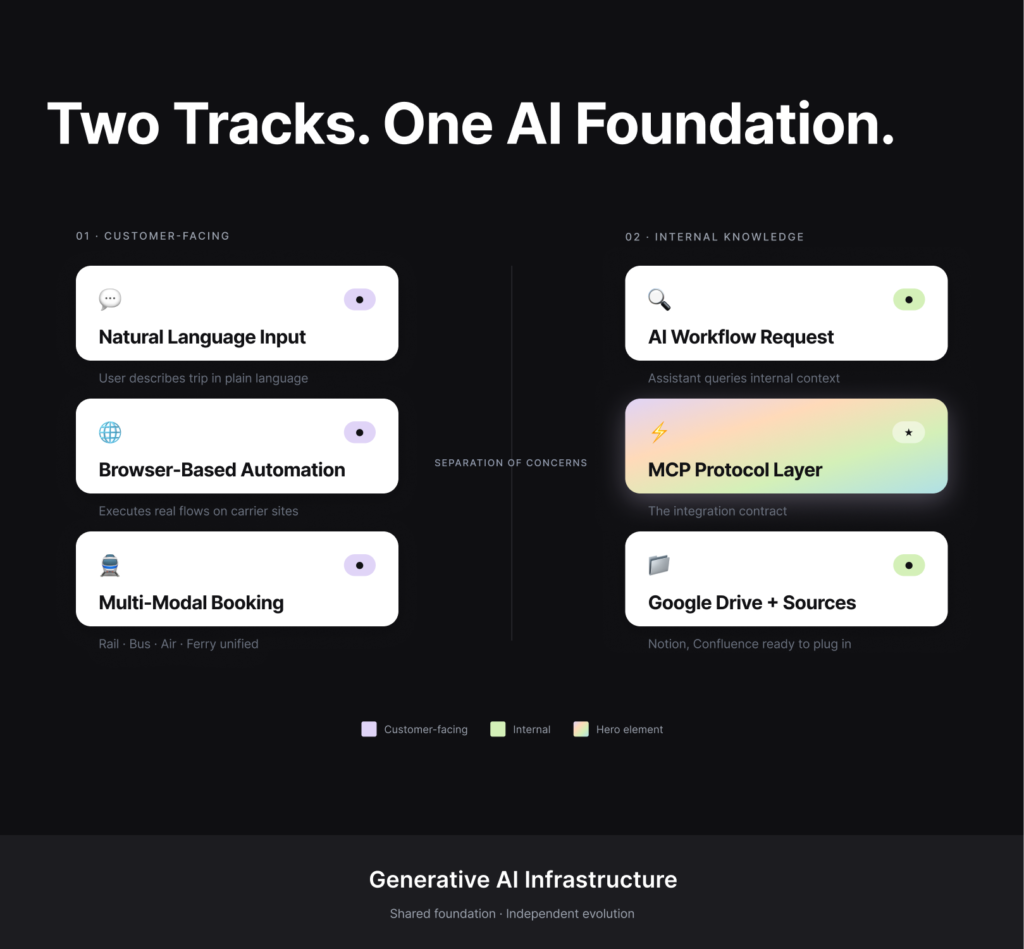
Part 1: A browser-based AI chatbot for customer-facing booking
The customer-facing component was a conversational booking assistant designed to run in the browser. Users describe a trip in natural language — for example, asking to get from Berlin to Munich on Friday afternoon with a preference for rail — and the assistant translates that into structured queries against multiple providers, returning options the user can compare, refine, and ultimately book without leaving the chat. The chatbot was integrated with the platform’s network of carriers and supported the full booking and reservation flow, including the dynamic, often inconsistent steps that providers require to complete a transaction. By executing those flows directly in a browser environment, the assistant could handle real reservations rather than acting as a glorified search front-end.
Part 2: An internal MCP-based knowledge-access layer
The second component was an internal MCP server that exposed Google Drive content (and the broader knowledge stack behind it) as structured tools that AI workflows could call on demand. Instead of pasting documents into prompts or relying on stale, manually maintained context, internal teams could now ask their AI assistants questions and trust that the right files, sections, and metadata were retrieved automatically — with the access controls of the underlying source preserved. This was a deliberate bet on MCP as the integration substrate of choice. Custom connectors create technical debt; MCP creates a contract. As more AI tools across the company adopted MCP-aware clients, every workflow could plug into the same internal layer without reinventing the wheel.
Key Features: Which Features Power a Production-Grade Generative AI Travel Chatbot?
The platform brought together a focused set of capabilities on both sides of the architecture.
- Conversational booking flow that guides users through reservation steps directly in chat, removing the friction of jumping between forms and tabs.
- Multi-provider integration that unifies rail, bus, air, and ferry options behind a single conversational interface, eliminating the need to compare across separate sites.
- Browser-based execution that lets the assistant complete real bookings against live provider sites — the difference between a polished demo and a working product.
- MCP integration that provides structured AI connectivity with internal company systems, exposing tools for retrieval, search, and metadata lookup.
- Google Drive access that surfaces internal documents and operational knowledge in a format AI workflows can consume reliably, turning a sprawling drive into a queryable knowledge layer.
Key Engineering Decisions: Which Engineering Decisions Make Gen AI in Travel Reliable in the Real World?
A handful of architectural choices shaped the project’s trajectory and gave the MVP its durability.
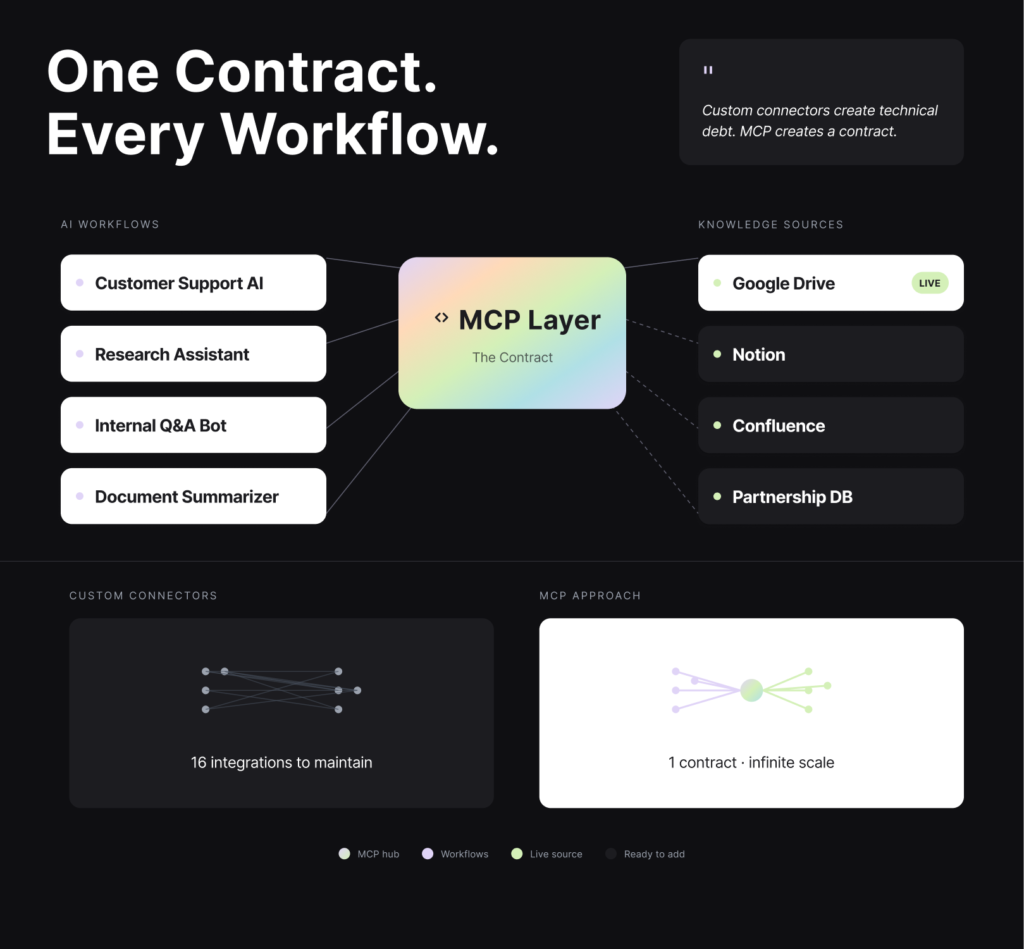
First, Teamvoy deliberately separated the external customer-facing booking experience from the internal knowledge-access use case. They share underlying AI infrastructure, but their security models, performance requirements, and failure modes differ enough that conflating them would have made both worse. Splitting them produced cleaner boundaries, simpler operational concerns, and a clearer path to scale each side independently.
Second, we chose browser-based automation for the booking flows. Travel provider sites are notoriously dynamic — markup changes, JavaScript-heavy checkouts, region-specific quirks — and API coverage across the industry is uneven. Driving a real browser turned out to be the most reliable way to handle that diversity, especially when paired with the conversational layer that translated user intent into discrete browser actions.
Third, we made the chatbot the primary interface rather than treating it as one channel among many. Conversational interaction is what unlocks the simplification; framing the entire experience around it forced the rest of the system to align with that promise.
Fourth, we adopted Model Context Protocol for internal integrations. MCP provides a scalable, structured way to connect AI systems with tools like Google Drive without locking the platform into proprietary APIs. As the internal stack grows, the same pattern can absorb new sources with minimal incremental work — a small architectural choice with outsized long-term leverage for any platforms for AI travel assistants the client decides to build next.
05. Impact
What Impact Did the Generative AI in Travel MVP Deliver?
As an MVP, the project validated the feasibility of using a browser-based chatbot for multi-provider booking and reservation flows, while also proving the value of MCP-based access to internal knowledge sources. Together, those two outcomes give the client a credible foundation for deeper investment in generative AI in travel.
Qualitative Results at a Glance
- MVP validated end-to-end multi-provider booking through a browser-based conversational AI chatbot.
- Smoother user journey: complex provider-based reservation flows reduced to a guided conversation.
- Faster, more structured retrieval of internal documents through MCP-based access to Google Drive.
- Reduced manual search effort and improved team efficiency during early-stage AI workflow adoption.
- Reusable two-track architecture: customer-facing AI experiences and internal AI infrastructure cleanly separated, both extensible.
The solution improved the usability of the booking flow, reduced friction in the user journey, and demonstrated how conversational interaction could simplify provider-based reservation processes. Internally, it made access to documents and operational knowledge faster and more structured, helping reduce manual search effort and improving team efficiency during early-stage implementation. Importantly, the two-track architecture proved out a pattern the client can extend: keep customer-facing AI experiences and internal AI infrastructure separate, integrate both through stable protocols, and let each evolve at its own pace.
Overall Impact: Where Does Generative AI in Travel Go From Here?
Generative AI in travel works best when it is treated as system-level infrastructure, not a chat overlay. This project showed how a global booking platform can deploy gen AI in travel on two fronts at once: a customer-facing chatbot that turns multi-provider bookings into a conversation, and an internal MCP layer that makes company knowledge instantly accessible to AI workflows. The MVP validated the approach, simplified the user journey, and created a foundation the client can build on as they continue to invest in AI-native travel experiences.
If you are exploring generative AI optimization in travel, designing platforms for AI travel assistants, or thinking about how MCP fits into your AI stack, this two-track pattern is a strong starting point — and a reminder that the most durable gen AI in travel solutions are the ones built on disciplined integration, not just clever prompting.
Thinking through your own gen AI in travel roadmap?
Tell us what you are trying to build — Teamvoy will help you map the architecture, the integrations, and the realistic path from MVP to production.
Thinking through your own gen AI in travel roadmap?
Tell us what you are trying to build — Teamvoy will help you map the architecture, the integrations, and the realistic path from MVP to production.
Book a 15-minute call with a senior AI engineer this week.
PREFER email?
Urgent — AI in production failing or vendor rescue: call directly.
Response within one business day.

Tell us which pilot is stuck — and what shipping it would unlock.
A senior AI engineer answers this form. Not a sales inbox. Reply within one business day.