
Key takeaways:
Agentic AI in manufacturing enables autonomous, coordinated AI systems that plan, decide, and act across complex production workflows, surpassing traditional automation. This approach improves operational efficiency, quality control, and supply chain responsiveness by integrating AI agents with human collaboration.
- Agentic AI coordinates multiple specialized AI agents to optimize manufacturing processes dynamically.
- It enhances predictive maintenance by autonomously scheduling repairs and minimizing downtime.
- Continuous quality monitoring allows immediate defect detection and process adjustments.
- Supply chain agility improves through real-time coordination of inventory, logistics, and production.
- Successful implementation requires integration with existing systems, human oversight, and iterative modernization.
| Topic | Key Insight | Why It Matters | Action Item |
| Agentic AI vs Traditional AI | Agentic AI autonomously manages multistep workflows across departments, unlike task-specific traditional AI. | Enables dynamic response to complex manufacturing challenges. | Evaluate current AI capabilities and plan for agentic AI adoption. |
| Components of Agentic AI | Includes perception, reasoning, planning, collaboration, and learning modules working together. | Supports sophisticated autonomy with human oversight. | Design AI architecture incorporating these components. |
| Benefits of Agentic AI | Improves maintenance, quality control, and supply chain responsiveness autonomously. | Leads to higher efficiency, reduced downtime, and better product quality. | Identify key processes for agentic AI enhancement. |
| Implementation Challenges | Data integration, legacy systems, and workforce adaptation are main hurdles. | Addressing these ensures smooth AI deployment and acceptance. | Develop integration middleware and training programs. |
| Measuring Success | Use KPIs like downtime reduction, throughput, quality, decision efficiency, and collaboration. | Tracks ROI and guides continuous improvement. | Establish KPI tracking and regular performance reviews. |
Unlocking the Power of Agentic AI in Manufacturing
Agentic AI in manufacturing refers to autonomous AI systems that independently plan, decide, and act across complex production workflows. Unlike traditional automation, these intelligent systems coordinate multiple specialized AI agents to optimize manufacturing operations, maintain quality, and collaborate closely with human experts. This approach enables adaptive, goal-driven processes that enhance efficiency and innovation in manufacturing environments.
What is Agentic AI in Manufacturing
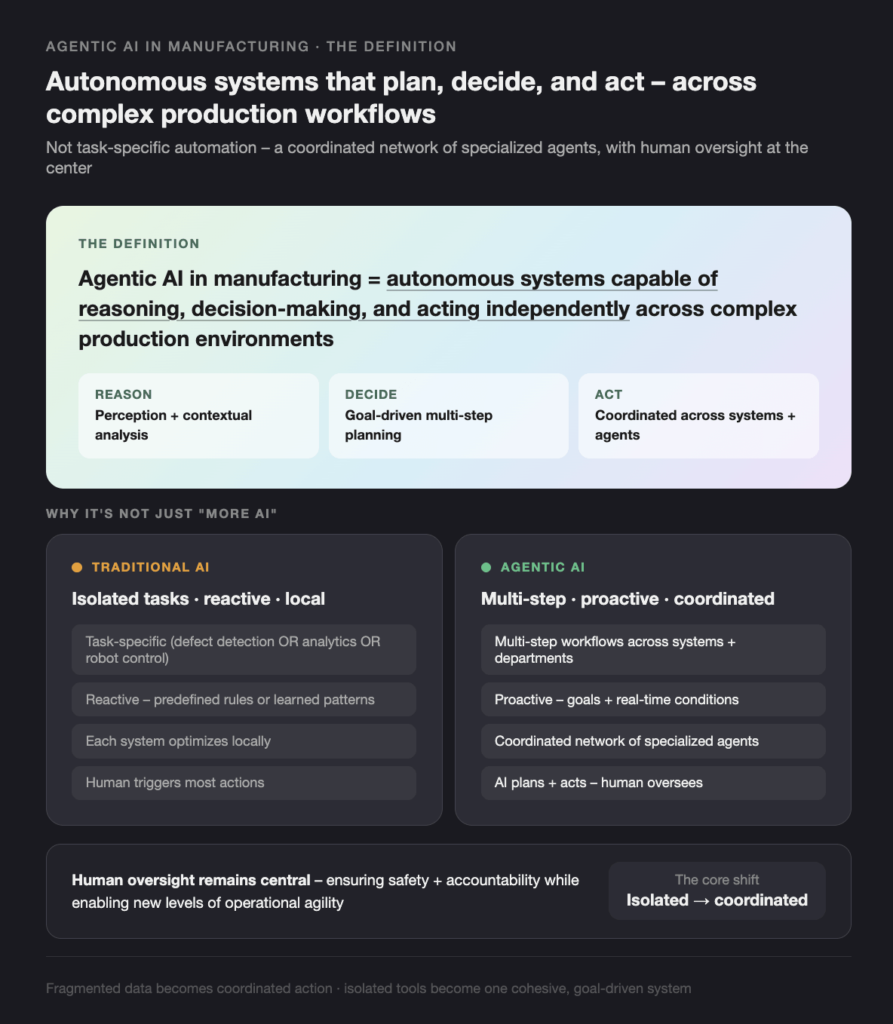
Agentic AI in manufacturing consists of autonomous systems capable of reasoning, decision-making, and acting independently across complex production environments. Unlike traditional automation, which performs predefined tasks, agentic AI coordinates multiple specialized agents to optimize workflows, maintain quality, and collaborate with human operators. These AI agents work in concert to adapt dynamically to changing conditions and achieve defined goals.
Traditional AI often focuses on isolated tasks such as predictive analytics or robotic control, but agentic AI integrates these capabilities into a cohesive system. It addresses challenges like fragmented data and complex decision-making by translating information into coordinated actions. Human oversight remains central, ensuring safety and accountability while enabling new levels of operational agility. At Teamvoy, our understanding of intelligent automation allows us to guide manufacturers through these new capabilities, blending AI autonomy with human expertise in collaborative workflows that transform production processes.
How Agentic AI Differs from Traditional AI and Automation
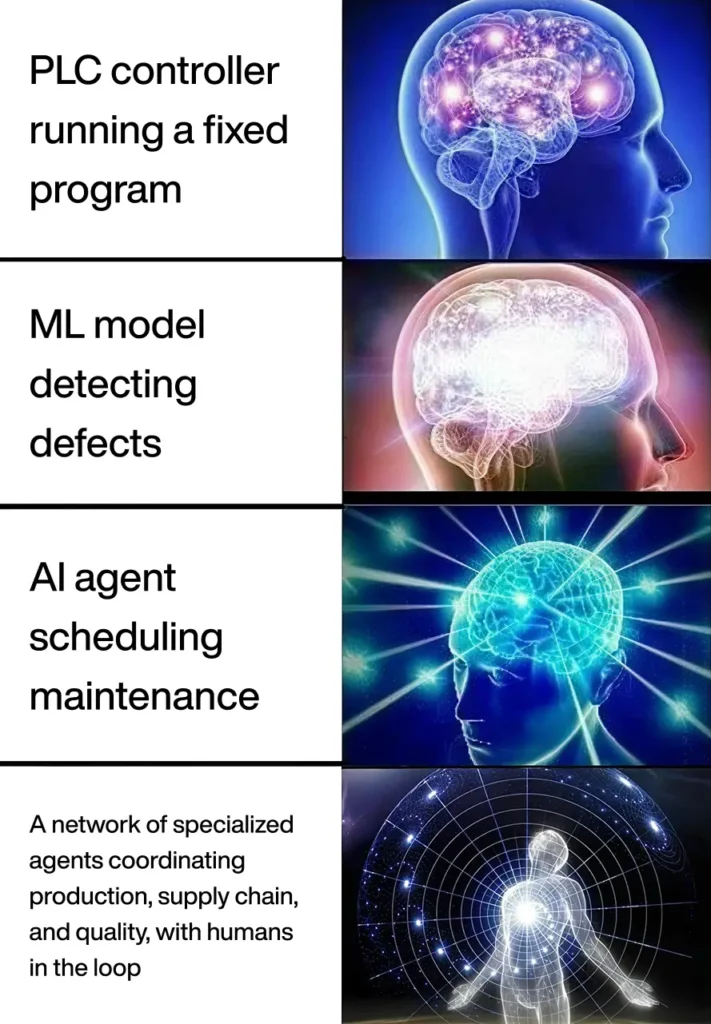
Traditional AI systems in manufacturing typically perform narrow, task-specific functions such as defect detection or robotic arm control, operating reactively based on predefined rules or learned patterns. In contrast, agentic AI systems exhibit autonomy by proactively planning and executing multistep workflows that span across multiple systems and departments. They function as coordinated networks of agents, each specializing in areas like production scheduling, maintenance, or supply chain logistics, collaboratively optimizing overall operations. This shift from isolated automation to integrated, goal-driven autonomy enables manufacturing environments to respond dynamically to real-time conditions and complex constraints.
Components of Agentic AI Systems in Manufacturing
Agentic AI systems commonly integrate several components, including:
- Perception Modules: Continuously gather and interpret data from sensors, machines, and enterprise systems.
- Reasoning Engines: Analyze contextual information and operational goals to make informed decisions.
- Planning and Execution Units: Develop and implement multistep action plans across workflows.
- Collaboration Interfaces: Facilitate interaction between AI agents and human operators, ensuring oversight and adaptability.
- Learning Mechanisms: Adapt based on feedback and changing environments to improve performance over time.
This architecture supports sophisticated autonomy while maintaining human-in-the-loop governance essential for safety and compliance.
Benefits of Agentic AI in Manufacturing
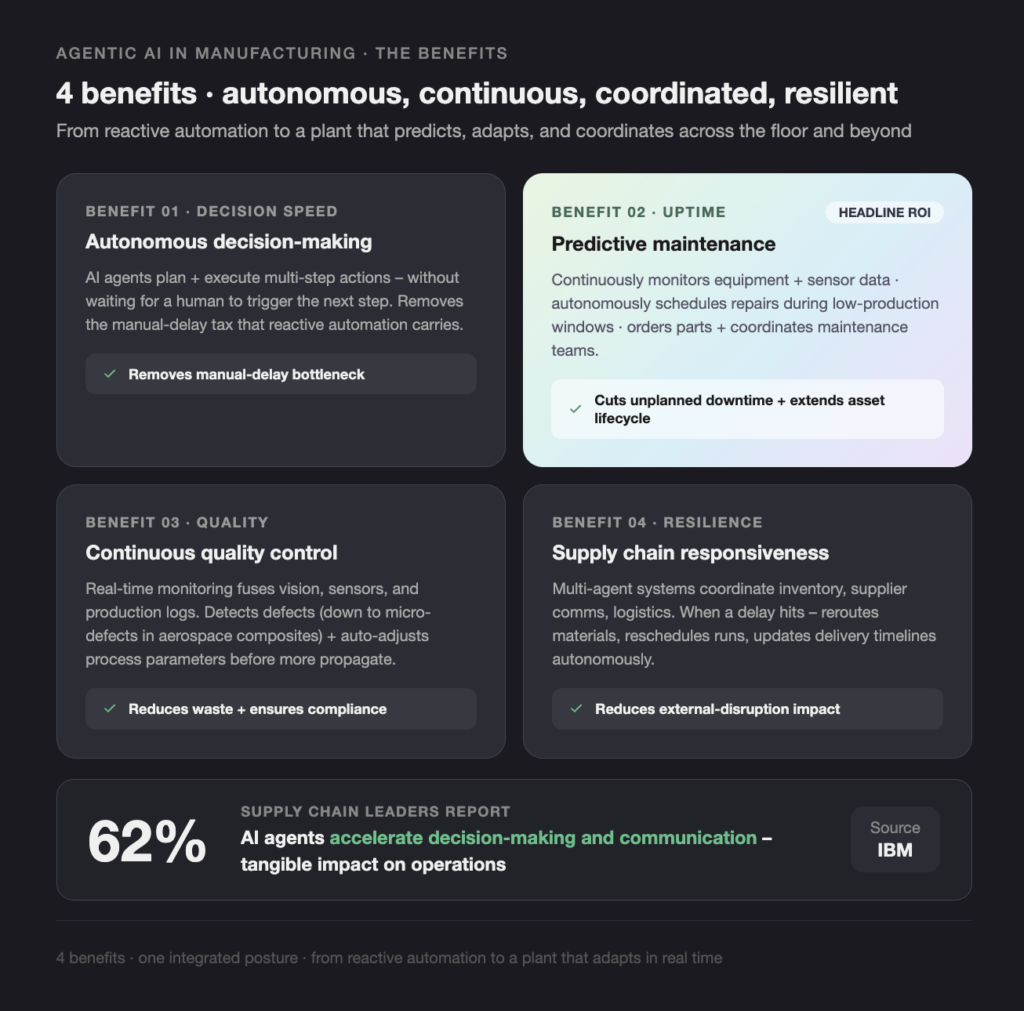
Agentic AI enhances manufacturing by enabling autonomous decision-making, reducing unplanned downtime, improving quality control, and accelerating supply chain responsiveness. By continuously monitoring equipment and production data, these AI systems predict failures and schedule maintenance proactively, significantly cutting downtime.
Quality control benefits from real-time monitoring and defect detection, allowing immediate adjustments to maintain product standards. Supply chain processes become more responsive as multi-agent AI systems coordinate inventory, logistics, and production schedules in real time.
These improvements lead to increased operational efficiency, resilience, and innovation, helping manufacturers stay competitive in rapidly evolving markets. In fact, 62% of supply chain leaders report that AI agents accelerate decision-making and communication, highlighting the tangible impact on operations (IBM).
Teamvoy’s consulting projects showcase how integrating agentic AI can unlock these benefits while maintaining human collaboration and control. Explore some of our manufacturing AI case studies to see these results in action.
Enhancing Predictive Maintenance with Agentic AI
Traditional predictive maintenance relies on analyzing historical data to forecast equipment failures, often requiring human intervention to schedule repairs. Agentic AI advances this by autonomously interpreting real-time sensor data, diagnosing issues, and proactively orchestrating maintenance activities. For example, an agentic AI system can detect early signs of bearing wear in a motor, automatically schedule a repair during low production periods, order necessary parts, and coordinate with maintenance teams—all without manual input. This self-healing capability minimizes unplanned downtime and extends asset lifecycles.
Improving Quality Control through Continuous Monitoring
Agentic AI systems employ continuous quality control by integrating data from vision systems, sensors, and production logs. They detect anomalies or defects promptly, enabling immediate corrective actions. For instance, in aerospace manufacturing, agentic AI can identify micro-defects in composite materials and adjust process parameters autonomously to prevent further defects. This real-time responsiveness reduces waste, improves product consistency, and ensures compliance with stringent industry standards.
Accelerating Supply Chain Responsiveness
Supply chains in manufacturing are complex and subject to frequent disruptions. Agentic AI coordinates multiple agents managing inventory levels, supplier communications, and logistics to dynamically adjust production plans. When a supplier delay occurs, agentic AI can reroute materials, reschedule production runs, and update delivery timelines autonomously. This agility enhances resilience and reduces the impact of external disruptions on manufacturing operations.
Implementing Agentic AI in Manufacturing
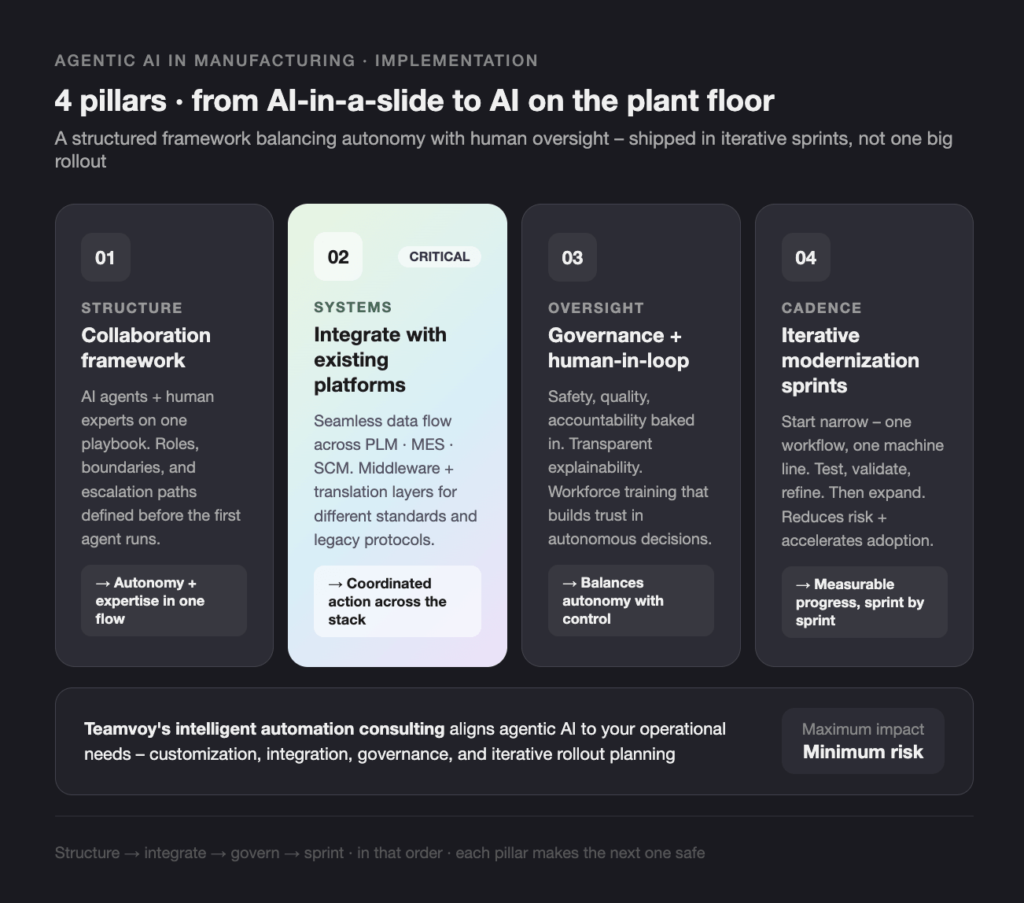
Successful implementation of agentic AI requires a structured framework that emphasizes collaboration between AI agents and human experts. Integration with existing manufacturing systems such as Product Lifecycle Management (PLM), Manufacturing Execution Systems (MES), and Supply Chain Management (SCM) is critical to ensure seamless data flow and coordinated actions.
Human oversight and governance frameworks are essential to maintain safety, quality, and accountability, balancing autonomy with control. Adopting an iterative modernization sprint approach allows manufacturers to implement agentic AI gradually, measure progress, and optimize continuously. Our intelligent automation consulting services at Teamvoy provide tailored strategies that align agentic AI capabilities with your operational needs. We guide clients through customization, integration, and governance planning to maximize the technology’s impact while minimizing risks. Learn more about our AI consulting services.
Integration Challenges and Solutions
Integrating agentic AI into existing manufacturing environments presents challenges such as disparate data formats, legacy system compatibility, and organizational change management. Agentic AI systems must interface with PLM, MES, and SCM platforms, which often use different standards and protocols. Overcoming these requires robust middleware and data translation layers that facilitate real-time, bidirectional communication. For strategies on managing legacy systems, see our insights on legacy platform modernization.
Moreover, workforce adaptation is critical; employees need training to collaborate effectively with AI agents and to trust autonomous decisions. Establishing clear governance policies and transparent explainability of AI actions helps build confidence and ensures compliance with safety and quality standards.
Iterative Modernization through Sprints
Implementing agentic AI is best approached through iterative sprints, each focusing on specific workflows or functional areas. This allows manufacturers to test and validate AI capabilities incrementally, gather feedback, and refine models. For example, a sprint might target predictive maintenance on a specific machine line, followed by expanding to quality control in subsequent phases. This approach reduces risk, enables measurable progress, and accelerates adoption. Learn more about this approach in our article on AI modernization sprints.
Measuring Success with Agentic AI
Measuring success in agentic AI deployments involves tracking key performance indicators (KPIs) such as reduced unplanned downtime, improved throughput, enhanced product quality, and the efficiency of collaboration between AI agents and human teams. These metrics provide clear insights into operational improvements and ROI.
Continuous feedback loops enable ongoing optimization, ensuring that AI systems adapt to evolving conditions and business goals. Examples include monitoring maintenance scheduling effectiveness, decision-making speed, and defect reduction rates.
At Teamvoy, we emphasize transparent performance metrics and regular reviews as part of our collaborative AI-human workflow approach. This ensures that agentic AI remains aligned with your strategic objectives and delivers measurable benefits. For detailed guidance, see our article on AI performance metrics.
Key Performance Indicators for Agentic AI
- Downtime Reduction: Measures the decrease in unplanned equipment stoppages due to proactive maintenance.
- Throughput Improvement: Tracks increases in production volume or speed without compromising quality.
- Quality Metrics: Includes defect rates, rework frequency, and compliance with standards.
- Decision-Making Efficiency: Assesses the speed and accuracy of AI-driven decisions compared to manual processes.
- Human-AI Collaboration: Evaluates the effectiveness of workflows integrating AI agents and human operators.
Regularly analyzing these KPIs helps organizations identify areas for improvement and demonstrate the tangible value of agentic AI investments.
Conclusion
Agentic AI in manufacturing represents a significant step forward from traditional automation, offering autonomous, coordinated, and adaptive systems that work alongside human experts to optimize complex workflows. By embracing agentic AI, manufacturers can increase operational efficiency, improve quality, and enhance supply chain responsiveness—critical factors in today’s competitive industrial landscape.
At Teamvoy, we combine deep expertise in intelligent automation consulting with a customer-centric approach to help manufacturers implement agentic AI successfully. Our focus on collaborative AI-human workflows ensures that technology empowers your teams while safeguarding governance and quality.
The future of manufacturing is intelligent, autonomous, and collaborative. Agentic AI is the key to unlocking that future, and we’re here to guide you every step of the way.