- Choose an AI agent development company on shipped-to-production track record, not demos. Gartner expects over 40% of agentic AI projects to be cancelled by end of 2027.
- On the τ-bench benchmark, top agents finish under half of tasks and consistency collapses across runs, so demand reliability-across-runs, not a single happy-path success rate.
- Post-launch drift, quadratic token billing, and integration upkeep push true cost well past the build quote, so total cost of ownership matters more than sticker price.
- Compliance maturity is demonstrable: a serious partner names the controls built for DORA, HIPAA, PCI-DSS, or SOC 2 instead of listing logos.
- Ask six questions before signing: who guards write access, who owns the eval harness, who owns drift, who owns the IP, which regulations are in scope, and who is accountable when the agent acts wrong.
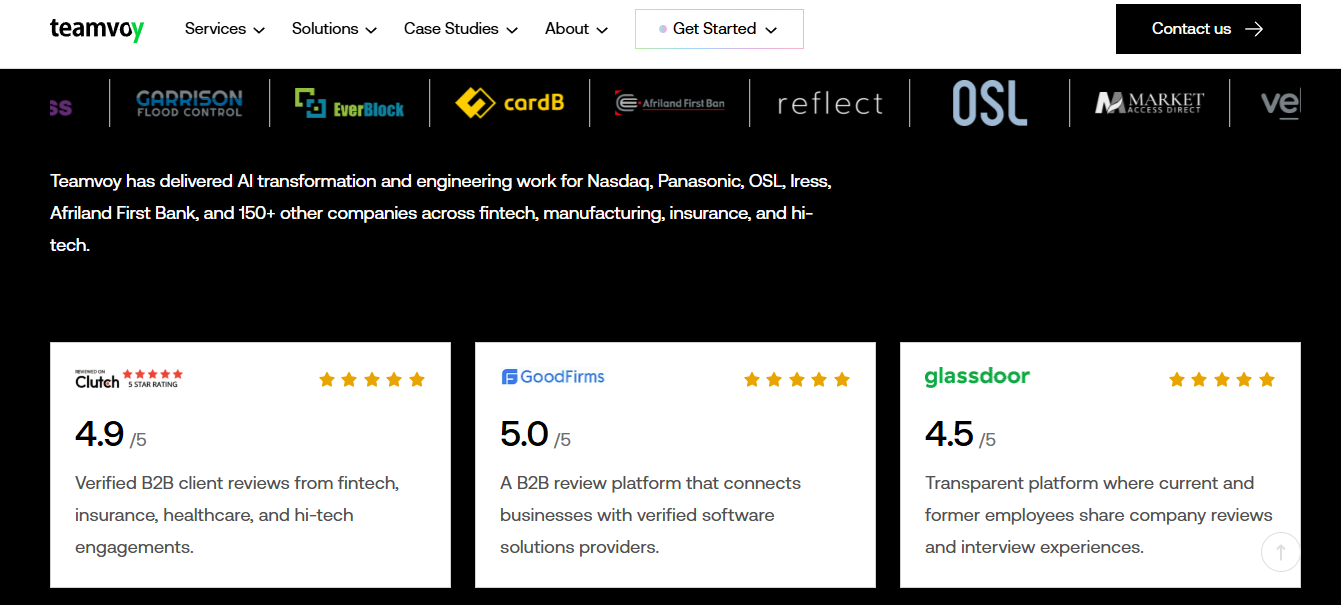
- Teamvoy is built for build-and-ship on regulated or legacy systems, with a senior lead accountable into production across a 4-plus year average engagement.
Q1: The 13 best AI agent development companies in 2026: criteria, who this is for, the field, and the comparison table
Choose on production track record, not demos. Gartner expects over 40% of agentic AI projects to be cancelled by the end of 2027, citing rising costs and weak risk controls. So the deciding questions are simple. Does a partner ship to production or stop at a pilot? Who owns agent QA and evals? And who is accountable when an agent acts wrong with live data?
⚠️ Why this choice carries real risk
Picking an AI agent partner is not a logo decision. It is a multi-year bet on a system that will touch your data, your customers, and your audit trail. A bad pick costs you a rebuild, not a refund. Gartner’s 2025 prediction that more than 40% of agentic AI projects will be scrapped by 2027 is the clearest warning on the table. This guide describes kinds of partners, not a ranked league table, so a CTO, founder, or IT director can match a situation to a partner. It uses production track record, agent QA, eval rigor, framework-neutrality, drift ownership, compliance maturity, and accountability as its lens.
🧪 The gap nobody screenshots: demo vs production
Here is the contradiction at the heart of this category. Vendor pages claim broad production success. Independent data says otherwise. On τ-bench, a published benchmark for tool-and-user agents, state-of-the-art agents complete under half of tasks, and consistency collapses across repeated runs (a pass^8 rate under 25% in retail). A demo only has to look right once. A production agent has to be right every time it has write access to your CRM, your tickets, or your billing.
The first thing I look at on an AI integration call is not the model. It is the data layer and the legacy core. Most agents in the enterprise today are still in read mode, which is really just a fancy search box. The day an agent gets write access to update records or provision users is the day accountability stops being a slide and starts being a contract.
Our Evaluation Criteria
I used seven axes to describe each partner. The same seven, in the same order, on every card below.
- ⭐ Deployment track record: Has this partner shipped agents into live production, or does the public evidence stop at a pilot or MVP?
- ✅ Agent QA discipline: Do they treat the agent like infrastructure that can act, with regression suites, circuit breakers, and adversarial testing?
- 🧪 Eval rigor: Do they measure reliability across repeated runs, not a single happy-path success rate?
- 🔓 Framework-neutrality: Do they pick the model and framework that fit your system, or resell their own stack? Lock-in is a cost you inherit.
- ⏰ Drift ownership: Who detects regression, retrains, and absorbs a runaway bill after launch?
- 🛡️ Compliance maturity: Can they name the controls they built for DORA, HIPAA, PCI-DSS, or SOC 2, or do they list logos?
- 📋 Accountability model: When the agent acts wrong, who owns the fix, and is that ownership written down?
A note on what “production” really demands. A demo passes once. A production agent must be right every time, with write access, under load, while a regulator can ask for the audit trail. That is the line most pilots never cross. This is the territory our AI agent development services are built around.
Who This Guide Is For
- The Burned CTO inheriting an agent or platform a previous vendor walked away from, who needs evidence and accountability, not another transformation pitch. This is where our IT audit services usually start.
- The Enterprise IT Director inside a regulated environment with a DORA, HIPAA, or PCI-DSS deadline, who needs auditable delivery, not a junior team that exits before go-live. Auditable delivery is the core of how we approach banking and fintech work.
- The vibe-coded founder whose AI-assisted MVP got traction and is now unstable in production, who needs stabilisation and a clear path forward, not a rewrite from scratch. That is the heart of our technology modernization practice.
The field at a glance
- Teamvoy: Best for AI integration on a regulated or legacy system that has to keep running.
- Achievion Solutions: Best for AI proof-of-concept and MVP work where the idea still needs validation.
- AppMakers USA: Best for app-first teams adding AI features to a mobile product.
- Azumo: Best for staff-augmentation when you have your own roadmap and need senior AI engineers.
- BlueLabel: Best for an AI assistant layered on a legacy ERP with decades of operational data.
- Comrade Digital: Best for marketing-and-web teams adding AI to a customer-acquisition stack.
- DOOR3: Best for enterprise product teams needing UX-led AI inside complex internal tools.
- Diffco AI: Best for data-science-heavy AI builds where the model is the hard part.
- Dualboot Partners: Best for scale-ups building an AI product alongside an existing engineering team.
- Frogslayer: Best for mid-market firms turning an internal AI idea into a revenue product.
- GenAI.Labs USA: Best for teams that want a generative-AI-first build from a specialist shop.
- Grow Law: Best for legal-sector teams adding AI to a compliance-sensitive practice.
- HatchWorks AI: Best for nearshore AI delivery with a generative-AI development model.
Master Comparison Table
| Company | Best For | Engagement Model | Industry Depth and Compliance Coverage |
|---|---|---|---|
| Teamvoy | AI integration on a regulated or legacy system that must keep running | Long-term partner (4+ year average) with a senior technical lead | Fintech, insurance, healthcare, manufacturing, complex SaaS; works inside PCI-DSS, SOC 2, GDPR, HIPAA, DORA scope |
| Achievion Solutions | AI proof-of-concept and MVP validation | Project-and-exit, POC to MVP | Cross-industry AI and data science; no named heavy-regulated compliance scope publicly claimed |
| AppMakers USA | App-first teams adding AI features | Project-based app development | Mobile and web app builds across consumer sectors; regulated-industry depth not a stated focus |
| Azumo | Senior AI engineers on your roadmap | Staff augmentation, nearshore | Software, data, AI and ML across industries; compliance varies by engagement |
| BlueLabel | AI assistant on a legacy ERP | Project-and-exit, product build | Manufacturing, consumer products, enterprise; SOC 2-aware delivery, no broad regulated scope publicly claimed |
| Comrade Digital | AI in a customer-acquisition stack | Project or retainer (marketing-led) | Marketing, web, SEO with AI automation; not a regulated-industry engineering partner |
| DOOR3 | UX-led AI in complex internal tools | Project-based product and design | Enterprise software, internal tooling; compliance varies by engagement |
| Diffco AI | Data-science-heavy AI builds | Project-based AI and ML development | AI and ML, healthcare, fintech R and D; compliance varies by engagement |
| Dualboot Partners | AI product alongside your team | Long-term partner, co-build | SaaS, fintech, enterprise; SOC 2-aware, scope varies |
| Frogslayer | Internal AI idea to revenue product | Project-and-build, product studio | Mid-market software, services; compliance varies by engagement |
| GenAI.Labs USA | Generative-AI-first build | Project-based GenAI specialist | GenAI builds across sectors; regulated scope not publicly detailed |
| Grow Law | AI in a legal practice | Project or retainer (legal-sector) | Legal services and law-firm marketing; not a general regulated engineering partner |
| HatchWorks AI | Nearshore generative-AI delivery | Staff augmentation, GenAI delivery | Software, healthcare, fintech; SOC 2-aware nearshore delivery |
Teamvoy
- Deployment track record: Ships AI into live production on systems already running, not just pilots.
- Agent QA discipline: Treats the agent as infrastructure that can act, with testing built into delivery.
- Eval rigor: Measures reliability against real workflows, with the data layer assessed first.
- Framework-neutrality: Picks the model and stack for your system; no proprietary lock-in to resell.
- Drift ownership: Senior lead stays accountable into production across a 4+ year average engagement.
- Compliance maturity: Delivers inside PCI-DSS, SOC 2, GDPR, HIPAA, and DORA scope.
- Accountability model: One senior technical lead owns the system end to end.
- AI integration and legacy stack modernization for a streaming platform, with continuous post-release support (Takflix, ongoing since January 2025).
- Four-year fintech engagement covering crypto, trading, and mission-critical wallet systems running 24/7 for real money (Bitspark).
- Named work across regulated and high-stakes environments including Nasdaq, OSL, and Panasonic Avionics.
“Teamvoy actively uses agentic AI across internal workflows and delivery, which speeds up development, raises quality, and adds extra value for the client. Their work has resulted in fewer issues and a better user experience.”
Dmytro Maryanych, Manager, Takflix (AI Development & Legacy Modernization) · Clutch verified review
“All components of our tech stack need to work together and are always operational 24/7 for real trading of real money. Their technical expertise was top class.”
George Harrap, CEO, Bitspark (Fintech, Crypto & Trading Systems) · Clutch verified review

Achievion Solutions
- Deployment track record: Strong on POC and MVP launches; less public evidence of long-run production ownership.
- Agent QA discipline: One client flagged QA gaps where raised issues were not caught before delivery.
- Eval rigor: Pilot-stage validation with real user testing; reliability-across-runs not publicly claimed.
- Framework-neutrality: Builds in Python and common stacks; no obvious proprietary lock-in.
- Drift ownership: Project-and-exit model; post-launch ownership varies by engagement.
- Compliance maturity: No named heavy-regulated scope (DORA, HIPAA, PCI-DSS) publicly claimed.
- Accountability model: CEO-engaged, project-manager-led; founder reaches out for feedback directly.
- Built an AI platform POC and MVP for a design company, beta-tested with over 150 users.
- Developed an MVP, beta, and website for a health data company.
- Built a Python data-science recommendation algorithm for an education nonprofit.
“We had a Beta test run of the MVP with over 150 users. Showed that we had a MVP that worked. We were impressed with their ability to deliver a high-quality, polished MVP.”
Anonymous, Partner, Design Company · Achievion Solutions Clutch verified review
AppMakers USA
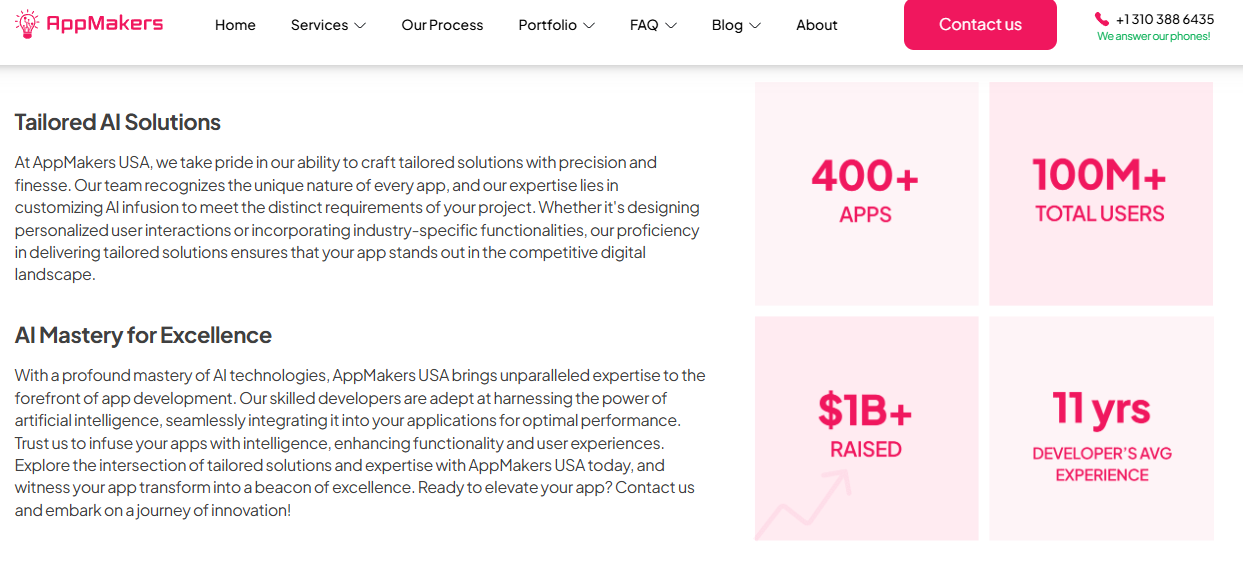
- Deployment track record: Ships consumer-facing apps; AI is typically a feature layer, not an autonomous agent.
- Agent QA discipline: App-grade QA; agent-specific testing not publicly detailed.
- Eval rigor: Not publicly claimed for agent reliability across runs.
- Framework-neutrality: Standard mobile and web stacks; no obvious lock-in.
- Drift ownership: Project-based; post-launch ownership varies by engagement.
- Compliance maturity: Regulated-industry scope not publicly emphasized.
- Accountability model: Project-team delivery against a defined app scope.
- Mobile and web app builds across consumer-facing categories.
- AI feature integration inside existing applications.
- End-to-end app delivery from design through store launch.
“In a small pilot, time from request to approval dropped from about a day to a few hours, and we cut back-and-forth emails to nearly zero. They had people on their team who came from science/lab backgrounds, so they really deeply understood our needs.”
Jubilee Haddasah Munozvilla, CEO, Research Lab Supply Firm · AppMakers USA Clutch verified review
Azumo
- Deployment track record: Engineers contribute to production builds; the client usually owns the system.
- Agent QA discipline: Depends on the client’s own QA process, since engineers embed in your team.
- Eval rigor: Set by the client; Azumo supplies the talent, not the methodology.
- Framework-neutrality: Neutral by nature; engineers work in your chosen stack.
- Drift ownership: Stays with the client; augmentation does not own the system long-term.
- Compliance maturity: Varies; the client carries regulatory accountability.
- Accountability model: You own the system; Azumo owns the staffing.
- AI, machine learning, and custom software delivery for enterprise clients.
- Nearshore engineering teams embedded into client roadmaps.
- Data and ML engineering across multiple industries.
“They meet the timelines for the delivery of each use case across each phase of the engagement. This engagement has no defined end date. They have also helped on other projects as well.”
Michael Butler, Director of Partnerships, nlx.ai · Azumo Clutch verified review
BlueLabel
- Deployment track record: Shipped a production AI assistant on a live manufacturing ERP with measurable results.
- Agent QA discipline: Sprint-based delivery with monitoring and optimization post-launch.
- Eval rigor: Reports business outcomes (dispatch calls down 50%+); reliability-across-runs not publicly stated.
- Framework-neutrality: Built on OpenAI tooling; stack choice tied to the use case.
- Drift ownership: Provides post-implementation monitoring and optimization.
- Compliance maturity: SOC 2-aware delivery; no broad regulated scope publicly claimed.
- Accountability model: Project team with CTO and architect involvement; transparent on budget.
- AI assistant integrated with a manufacturing ERP, indexing 40 years of operational data.
- OpenAI-powered automation that reduced a telecom client’s dispatch calls by over 50% and cut roughly $10,000 per month in cost.
- Modern data layer encoding senior-specialist playbooks to reduce reliance on tribal knowledge.
“Functioning prototype that had the buy-in from the clinicians and was technically ready to integrate with our full stack. What stood out most was how quickly they got to know us as a customer.”
Anonymous, Chief of Staff to the CEO, Healthcare Technology Company · BlueLabel Clutch verified review
Comrade Digital
- Deployment track record: Ships marketing-and-web outcomes; AI shows up as automation, not autonomous agents.
- Agent QA discipline: Marketing-grade QA; production agent testing not in scope.
- Eval rigor: Measures marketing KPIs (leads, traffic), not agent reliability.
- Framework-neutrality: Marketing tooling led; not a model or framework decision.
- Drift ownership: Retainer model covers ongoing campaign work, not agent drift.
- Compliance maturity: Not positioned as a regulated engineering partner.
- Accountability model: Account-managed delivery against marketing goals.
- Website rebuild and SEO that grew traffic and leads for a stone-products supplier.
- PPC lead generation that lifted a manufacturer’s quote requests from 5-10 to 20-25 per month.
- A lead-tracking dashboard with call transcription for a material-handling client.
“We went from receiving approximately 5-10 quote requests per month to 20-25. I was impressed by the lead tracking dashboard Comrade created for me. Each lead’s phone call was transcribed into text description and that made it easy to recall what had been discussed.”
Rob Kozaczka, Sales & Marketing, Fort Dearborn Enterprises · Comrade Digital Clutch verified review
DOOR3
- Deployment track record: Delivers enterprise software and internal tools; AI sits inside product workflows.
- Agent QA discipline: Product-grade QA and design process; agent-specific testing varies.
- Eval rigor: Measures product and UX outcomes; agent reliability metrics not publicly emphasized.
- Framework-neutrality: Works in client-appropriate stacks; design-led rather than stack-led.
- Drift ownership: Project-based; post-launch ownership depends on the contract.
- Compliance maturity: Varies by engagement; not a single named regulatory focus.
- Accountability model: Product-and-design team accountable for the delivered tool.
- Enterprise software and internal tooling for large organizations.
- UX-led product design embedding AI into employee-facing workflows.
- Complex product builds where adoption depends on usability.
“DOOR3’s communication is key. It feels like a true partnership; it feels like a team within our company. Their openness to understanding what we do is impressive. It’s a niche industry with complicated financial products.”
Tara York, Managing Director, Luma Financial Technologies · DOOR3 Clutch verified review
Diffco AI
- Deployment track record: Shipped production-ready V2 platforms, including AI-driven product flows.
- Agent QA discipline: Clients report on-time, on-budget delivery; agent-specific QA not detailed publicly.
- Eval rigor: Reports performance and reliability gains; reliability-across-runs not publicly stated.
- Framework-neutrality: Works across backend, frontend, and AI integrations in client stacks.
- Drift ownership: Provides post-deployment support; long-run ownership varies by contract.
- Compliance maturity: Cross-industry; no named heavy-regulated scope publicly claimed.
- Accountability model: Small senior teams; founders named directly in client reviews.
- Refactored and modernized a real-estate platform’s infrastructure for a scalable V2 launch (Gitcha).
- Built a production-ready AI-assisted landscape design platform from concept to V2 (CustomScape.ai).
- Backend and third-party shipping API integration for a logistics platform (Via.Delivery).
“We saw meaningful results across the board: the project was completed on schedule, stayed within budget, and immediately improved our platform’s performance and reliability.”
Jacob Hokinson, CPO, Gitcha · Diffco AI Clutch verified review
Dualboot Partners
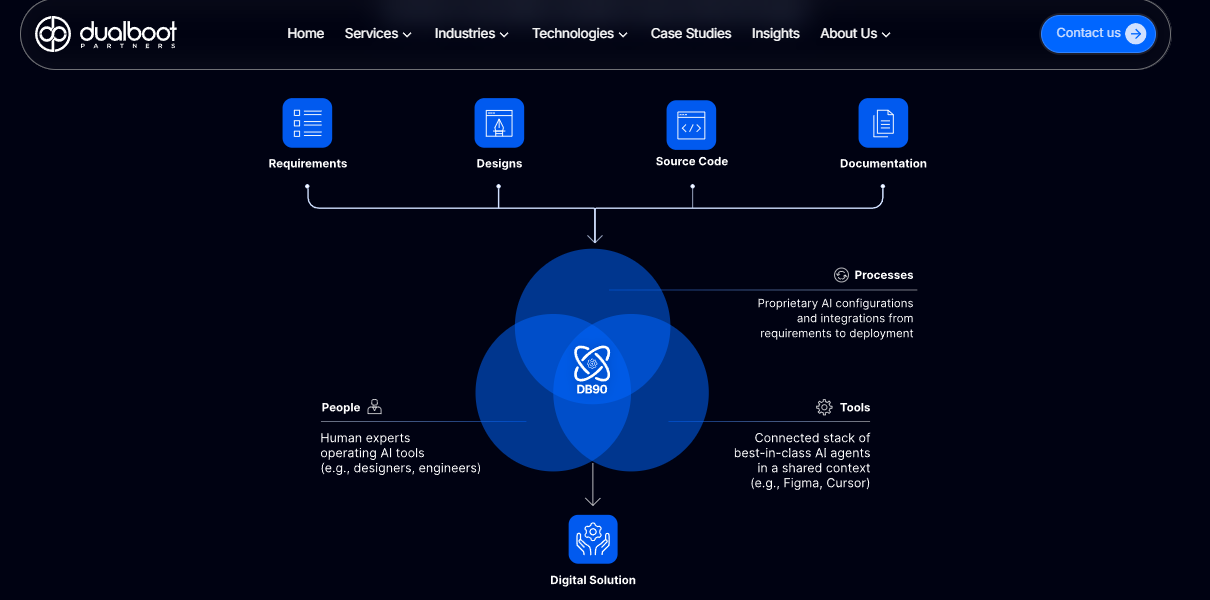
- Deployment track record: Co-builds production software alongside in-house teams.
- Agent QA discipline: Client reports products staying within requirements; agent-specific QA not detailed.
- Eval rigor: Outcome-focused; reliability-across-runs not publicly stated.
- Framework-neutrality: Works in client stacks as an embedded co-build partner.
- Drift ownership: Long-term posture supports ongoing ownership; confirm per contract.
- Compliance maturity: SOC 2-aware; scope varies by engagement.
- Accountability model: Senior leads named by clients; responsive, embedded delivery.
- Custom software and UX/UI for a gaming company, with strong adherence to requirements.
- Embedded co-build engagements with scale-up engineering teams.
- SaaS and fintech product delivery across multiple clients.
“What was most impressive and unique was how seamlessly the Dualboot team integrated with Primoprint. They never felt like a separate entity — we collaborated with them just as we would with our own internal team.”
Jen Manning, COO, Primoprint · Dualboot Partners Clutch verified review
Frogslayer
- Deployment track record: Builds custom software products for mid-market firms; ships to launch.
- Agent QA discipline: Product-grade QA; agent-specific testing not publicly emphasized.
- Eval rigor: Outcome- and revenue-focused; agent reliability metrics not publicly detailed.
- Framework-neutrality: Builds in client-appropriate stacks as a product studio.
- Drift ownership: Project-and-build; post-launch ownership varies by contract.
- Compliance maturity: Varies; not a single named regulatory focus.
- Accountability model: Product-studio team accountable for the delivered product.
- Custom software product builds for mid-market organizations.
- Internal-idea-to-revenue product engagements.
- End-to-end delivery from concept through launch.
“Test cases defined the success of the project; ultimately we hit 80% success early on in the project (within 2 weeks) and by the end of the project we hit our 95% target.”
Kenneth Croft, IT Manager, Q Investments · Frogslayer Clutch verified review
GenAI.Labs USA
- Deployment track record: Generative-AI specialist; verify production references for your specific use case.
- Agent QA discipline: Not publicly detailed; ask for the testing approach on write-access agents.
- Eval rigor: Not publicly stated for reliability across repeated runs.
- Framework-neutrality: Generative-AI-first; confirm whether it ties you to a preferred stack.
- Drift ownership: Not publicly detailed; clarify post-launch ownership.
- Compliance maturity: Regulated scope not publicly detailed.
- Accountability model: Specialist team; confirm who owns the system end to end.
- Generative-AI and LLM application development.
- Specialist focus on generative-AI use cases.
- Request named production references when shortlisting.
“Their combination of deep technical skill and professionalism as a firm. They are amazing at creative problem-solving, and their infrastructure makes it easy to understand what is happening and why.”
Anonymous, Sr Machine Learning Engineer, Google · GenAI.Labs USA Clutch verified review
Grow Law
- Deployment track record: Focused on legal-sector tooling and marketing; verify production AI references.
- Agent QA discipline: Not publicly detailed; confidentiality and privilege raise the QA bar in legal.
- Eval rigor: Not publicly stated; ask how hallucination risk is tested.
- Framework-neutrality: Confirm whether tooling is proprietary or stack-flexible.
- Drift ownership: Not publicly detailed; clarify post-launch ownership.
- Compliance maturity: Legal-vertical focus; confirm data-handling and privilege controls.
- Accountability model: Vertical specialist; confirm system-level ownership.
- Legal-sector technology and marketing engagements.
- Practice-focused tooling for law firms.
- Request named AI production references when shortlisting.
“Grow Law Firm takes a holistic approach to marketing. They examine the entire website and do everything from building backlinks to updating the blog. Grow Law Firm not only does keyword research and PPC, but they also create momentum through their approach.”
Mark Hodgson, President & Founding Member, MDH Law · Grow Law Clutch verified review
HatchWorks AI
- Deployment track record: Delivered a production-ready LLM MVP on GCP with data pipelines and a chatbot.
- Agent QA discipline: Structured agile delivery with sprint reviews and user acceptance testing.
- Eval rigor: Validated against predefined questions and quality benchmarks; consistency-across-runs not stated.
- Framework-neutrality: Builds on cloud and LLM stacks suited to the use case.
- Drift ownership: Sprint-based delivery; confirm post-MVP ownership.
- Compliance maturity: SOC 2-aware nearshore delivery; scope varies.
- Accountability model: Strong PM-led delivery; clients single out the lead PM.
- Production-ready LLM MVP ingesting ADS-B air-traffic data into a natural-language chatbot on GCP.
- Data warehouse and analytics-to-conversation integration with embedded visualizations.
- Structured agile delivery from Sprint 0 architecture through user acceptance testing.
“90%+ accuracy of chat responses from user questions. Their commitment to get the end product right and to be flexible when the situation required.”
Josh Horton, Director of Data, Analytics & AI, Cox2M (IoT) · HatchWorks AI Clutch verified review
Q2: How rigorous are these companies on agent QA and evaluation (evals)?
Agent QA discipline means treating the agent like infrastructure that can act, and eval rigor means measuring whether it succeeds reliably, not once. On τ-bench, a published agent benchmark, state-of-the-art agents finish under half of tasks, and consistency collapses across repeated runs (a pass^8 rate under 25% in retail). So a partner reporting reliability across runs beats one quoting a single happy-path success rate.
🧪 Agent QA is not demo testing
Demo testing asks one question: did it work that time? Agent QA asks a harder one: does it work every time, under load, when inputs go sideways? An “eval” (short for evaluation) is a repeatable test that scores the agent against fixed tasks. The model is not the product. The harness around it is.
A demo passes once. A production agent with write access must be right on every run, because the failures are not theoretical. I have seen an agent loop overnight with no circuit breaker and burn roughly $4,200 in tokens before anyone woke up. This is exactly the failure mode our AI agent development services are built to prevent.
⚠️ When the human and the agent both miss it
Worse failures are quiet. An agent without injection defense can be talked into leaking an SSH key in minutes, while the human reviewing it nods along. The benchmarks back this pattern: AgentBench, an academic suite, shows agents failing on long-horizon reasoning and tool use, not just edge cases.
This is why I run what I call “angry agents” on our own work at Teamvoy. We throw adversarial, hostile, malformed inputs at the agent on purpose to find where it breaks before production does. If a vendor cannot show you an eval harness, they are showing you a demo. Our AI development services bake this testing into delivery.
✅ Three questions to ask any partner
Ask these on the first call, and listen for specifics, not adjectives.
- “Show me your eval harness.” A mature partner has a repeatable test suite that scores the agent across many runs, not a single screen recording.
- “What is your reliability across runs, not your best run?” Demand a pass-rate over repeated attempts. Single-run accuracy hides the collapse τ-bench measures.
- “What stops a runaway loop?” Look for circuit breakers, regression suites that catch drift, and adversarial tests in the pipeline, not just unit tests.
I could be wrong on where the benchmarks land a year from now, since the models keep moving. But the discipline holds regardless of the model. From what surfaces when you actually run these systems, the partners who ship to production are the ones who test for failure on purpose, not the ones with the slickest demo. If you want a read on whether your stack is ready for an agent that can act, our IT audit services start there.
Q3: Who owns post-deployment drift and the accountability SLA when an agent degrades?
Post-deployment drift ownership means a named party is accountable when the agent gets quietly worse: accuracy slides, costs balloon, context degrades. Ask who monitors regression, what triggers retraining, and who absorbs a runaway bill. Without a written accountability SLA (service-level agreement, the contract clause defining who fixes what, by when), drift becomes your problem the moment the vendor invoices the final milestone.
⏰ The agent that gets quietly worse
Drift is not a crash. A crash you notice. Drift is the agent slowly answering worse while every dashboard stays green. By the time someone flags it, the vendor has shipped and gone.
Two silent sources cause most of it. Token use can grow quadratically as an agent loops, so a 20-step task can cost far more than a 10-step one, not twice as much. And many models degrade past roughly 40% of their context window filled, a “dumb zone” where a 168k window quietly stops reasoning well. Catching this early is part of how we approach AI integration services.
💸 Why project-and-exit models leave you holding it
Here is the divide in the category. A project-and-exit vendor’s incentive ends at the final milestone. Drift shows up after that, so it lands on you, often with a billing surprise attached.
The other failure mode is tribal knowledge. When the agent breaks at 2 AM and the only person who understood it has rolled off, you are debugging a system with no memory of how it was built. The standard read treats drift as a monitoring tool problem. It is an ownership problem, which is why our technology modernization work centres on long-term ownership, not handoff.
✅ The questions that surface real ownership
- “Who detects regression, and how?” A named owner with alerting beats “we’ll keep an eye on it.”
- “What triggers a retrain, and who pays for it?” Pin the trigger and the cost owner in writing.
- “Who absorbs a runaway bill?” If the answer is “you,” price that risk in now.
This is the territory Teamvoy is built for. Our engagements average 4+ years, with a senior lead who owns the system after the milestone, not just before the exit. I will not pretend that is the right fit for a throwaway prototype. But for an agent you have to live with, drift ownership is the whole game. For teams running money-critical systems, our banking and fintech work shows what that ownership looks like in production.
Q4: How does compliance engineering maturity differ across these partners (DORA, HIPAA, PCI-DSS, SOC 2)?
Compliance engineering maturity is the difference between a partner who can name the controls they built for DORA, HIPAA, PCI-DSS, or SOC 2 and one who lists logos. NIST’s Generative AI Profile defines the govern, map, measure, and manage controls that regulated agents need. A mature partner builds auditable delivery into the work, rather than bolting a security slide onto the end.
🛡️ Maturity is demonstrable, not declarable
Any vendor can say “we’re secure.” A mature one shows you the artifact: the access log, the data-flow diagram, the control mapped to a named clause. What I have learned in twelve-plus years delivering into regulated environments is that an auditor does not want assurances. They want a trace.
So the test is simple. Ask a partner to name one control they built for a specific regime, and watch whether they reach for an architecture detail or a logo wall. In our insurance engagements, that trace is built in from day one.
📋 The three pillars that separate them
- Named-regulator experience by industry. Banking carries PSD2 and DORA, healthcare carries HIPAA, payments carry PCI-DSS. Depth in one does not transfer automatically to another, so ask which regime, in which industry, on which system.
- Auditable delivery in practice. Every change is traceable, every access is logged, and every decision is documented as you go. Across the regulated work I have led inside fintech and healthcare, this is daily engineering, not a final-week scramble.
- Oversight design. Human-in-the-loop means a person approves before the agent acts. Human-on-the-loop means a person monitors and can intervene. For a regulated write-access agent, which one you choose is a compliance decision, not a UX one.
This pillar work runs through our healthcare delivery, where auditable change history is not optional.
⚠️ Why this is the live risk
A prompt-injection attack, where a crafted input tricks the agent into acting against the rules, is not just a security bug in a regulated system. It is a reportable compliance event. KPMG found that 62% of organizations cite weak data governance as the main barrier to AI adoption, which is exactly why the data layer is the first question, not the model.
Compliance is architecture. You design it in, or you pay to retrofit it later. At Teamvoy, that is the work, not the deck. If you want a read on your data layer, legacy core, and compliance exposure before anyone ships an agent, that is what our IT cost optimization and readiness assessment cover, with no sales process, just an engineer’s assessment.
Q5: Framework-neutrality vs lock-in, and consulting-only vs build-and-ship: which delivery model fits your situation?
Framework-neutrality means a partner picks the model, framework, and protocol that fit your system, not the one they resell. The delivery model then decides who owns the result. Consulting hands you a deck, platforms hand you a builder you staff yourself, and build-and-ship partners own the system into production. If nobody on your team can maintain what gets built, advisory-only leaves you stranded.
🔓 The lock-in you don’t see until later
Lock-in rarely arrives as a headline. It arrives as a proprietary stack you cannot leave and a single-model dependence you cannot swap. The day that model’s price jumps or its quality dips, you have no exit.
Then there is the integration tax. Build everything in-house, and you become Chief Integration Officer forever, maintaining glue code nobody else understands. The protocol bet adds to it: standards like MCP and A2A (ways for agents to talk to tools and to each other) are still settling, so betting your architecture on one is a real risk. Our AI integration services start by mapping that exposure before any stack is chosen.
⚖️ How the four delivery models differ on accountability
The models split cleanly on one question: who owns the result in production?
- Consulting-only: You get strategy and a roadmap. ⚠️ Accountability for the working system stays with you.
- Platform: You get a builder tool. You still staff the people who build and run agents on it.
- Staff augmentation: You get senior hands inside your team. You own the architecture and the outcome.
- Build-and-ship: A partner owns the system end to end, into production and past it.
If you need senior hands inside your own roadmap, you can hire AI engineers directly. If you want a partner accountable for the whole system, our AI agent development services sit at the build-and-ship end.
✅ If you are X, choose Y
- If you have a strong platform team and a unique core, build in-house, but only then. Free AI-generated code is the most expensive debt when nobody can read it.
- If you know exactly what to build, staff augmentation gives you capacity without a handoff.
- If “we keep getting handed off” is your pain, a build-and-ship partner with a named owner fits better.
This last one is Teamvoy’s territory. We build and ship with a senior lead accountable into production, on engagements that average 4+ years. My founder-engineer bias is simple: pick the tool for the system, not the system for the tool. The data layer and the legacy core decide the stack, not the vendor’s preference, which is why technology modernization and AI work go hand in hand for us.
I am sitting with one open question. As MCP and A2A mature, does framework-neutrality get easier, or does each new standard just create a fresh lock-in to dodge? If you are weighing that bet on a live system, that is a conversation worth having.
Q6: What does AI agent development cost, and what should you ask before signing?
A proof-of-concept (a throwaway build to test the idea) typically runs $15K to $100K, and a production agent $25K to $500K or more. But the headline figure is not the real cost. Quadratic token billing, integration maintenance, and post-launch drift push total cost of ownership well past the build quote.
💰 The quote that hides the real cost
Total cost of ownership (TCO) is what the system costs you over its life, not what the build costs on day one. Three things inflate it quietly. Token use can grow quadratically as an agent loops, so longer tasks cost far more than they look.
Integration maintenance is the second. Someone has to keep the glue code working as your systems change. The third is the cost of no guardrails: I have watched an unmonitored agent loop overnight and burn roughly $4,200 before anyone noticed. Catching that early is part of what our IT audit services are for.
✅ Six questions to ask before you sign
Comparing sticker prices across firms is a trap, because pricing is custom-quote everywhere. Ask these instead, and listen for specifics.
- “Who guards write access?” A credible answer names the approval step before an agent changes live data, not “it’s secure.”
- “Can I see your QA and eval harness?” Look for a repeatable test suite scoring reliability across runs, not a single demo.
- “Who owns post-launch drift, and who pays for a runaway bill?” A named owner and a written trigger beat “we’ll watch it.”
- “Who owns the prompts and any fine-tuned models?” The answer should be you. Get IP and data ownership in writing.
- “Which regulations are in scope?” A mature partner names the regime (HIPAA, PCI-DSS, DORA) and the controls built for it.
- “Who is accountable when the agent acts wrong?” If the answer is vague, that is your risk, priced in later.
A simple test cuts through demoware. Can the developer explain the code without reading the AI’s own comments? If not, you are buying unmaintainable code, and unmaintainable code is dead on arrival. For regulated builds, our banking and fintech and healthcare work shows what scoped, auditable pricing looks like.
Where my view sits right now is that the build quote is the least interesting number in the room. The honest variable is what the system costs you over a multi-year life. If you want a straight read on that before signing anyone, that is exactly what our IT cost optimization assessment is for, and at Teamvoy the door is open for it.