- The AI development companies worth trusting in 2026 staff senior architects, disclose subcontracting, ship production systems over demos, and stay accountable after go-live.
- Roughly 95% of enterprise generative-AI pilots deliver no measurable return, per MIT Project NANDA; they fail at data, integration, and ownership, not the model.
- Match the partner to your situation, not a ranking: a vibe-coded startup needs stabilisation, a regulated enterprise needs named-regulator experience.
- AI-washing is real; Builder.ai marketed roughly 700 human engineers as autonomous AI before its 2025 insolvency, so ask who writes the code and where.
- Pricing is custom-quote everywhere; compare engagement models and regional rate bands rather than headline numbers before you sign.
- Almost-right AI code is the costly kind: one 2025 study found AI-co-authored code introduced about 1.7 times more problems than human-only code.
Q1. Which AI Development Companies Are Worth Trusting With a Production System in 2026?
The AI development companies worth trusting in 2026 are the ones that staff senior architects, disclose whether they subcontract, ship production systems instead of pilots, and stay accountable after go-live. This guide assesses 16 firms, including Teamvoy, Azumo, HatchWorks AI, Orases, and Vention, against those four axes. The goal is to help you match a partner to your situation, not to crown a winner.
I have spent twelve years at Teamvoy delivering into banking and fintech, insurance, and healthcare. So I am not writing this as a league table. I am writing it as a field map. Pick the firm built for the system you actually have.
⚠️ Why this choice carries more risk than it looks
A bad AI vendor does not just waste a quarter. They leave you with code nobody on your team can read, a stalled pilot, and a system that is harder to fix than before they arrived.
The numbers back this up. Roughly 95% of enterprise generative-AI pilots have failed to deliver a single dollar of measurable return. The 2025 collapse of Builder.ai made the deeper risk plain. Court filings showed the firm leaned on around 700 human engineers in India for work it marketed as autonomous AI. They promised a machine. They sold a sweatshop.
So the question underneath “best AI development company” is simpler than it sounds. Are these senior architects building durable systems? Or a junior bench using “vibe coding” to ship things you will pay for twice? If that last risk is your worry, the vibe coding security risks are worth understanding before you sign.
Our Evaluation Criteria
I picked four axes because they are the ones that actually predict how an engagement ages. Each one maps to a failure I have watched play out in production.
- ✅ Engineering-bench seniority. Does a senior engineer own your system end to end? Or do juniors cycle through with nobody accountable?
- ✅ Subcontracting transparency. Will the firm tell you plainly who writes your code, and where? Hiding the bench is the warning sign, not the subcontracting itself.
- ✅ Shipped-vs-POC ratio. How many systems have they run in production, versus proofs of concept they demoed and walked away from?
- ✅ Post-deployment accountability. Who owns the bugs, the token bill, and the maintenance after go-live? Most lists ignore this entirely.
Two secondary checks matter for regulated readers: named-regulator experience (HIPAA, GDPR, SOC 2, PCI-DSS, and DORA), and the engagement model the firm actually sustains. If you are weighing one of these decisions now, an independent IT audit surfaces those gaps before a contract does.
Who This Guide Is For
I wrote this for four people I talk to often. You will likely recognise yourself in one of them.
- The Burned CTO who inherited a system a previous vendor underdelivered, and needs a credible path forward without repeating the mistake.
- The Technical Founder sitting on a legacy core that worked at small scale but is now hard to change.
- The Enterprise IT Director in a regulated environment with a modernization mandate or a compliance deadline.
- The Vibe-Coded Founder whose AI-assisted MVP got traction, then turned unstable in production.
For the technical founder on a fragile core, our approach to technology modernization is built around stabilising what runs, not rewriting it. For the enterprise director, AI integration services on a regulated stack start with the data layer first.
The 16 Partners at a Glance
No rankings here. Each firm exists for a different situation. Read the “best for” line, not a number.
- Teamvoy: Best for AI integration and legacy modernization on a regulated system that has to keep running.
- Azumo: Best for nearshore AI and data engineering teams extending an existing roadmap.
- HatchWorks AI: Best for generative-AI product builds with a defined GenAI delivery process.
- Orases: Best for custom AI software where one accountable team owns the build end to end.
- Vention: Best for embedding vetted engineers into your own pods at startup speed.
- DOOR3: Best for enterprise UX-led software where research drives the build.
- BlueLabel: Best for AI assistants layered onto a legacy ERP or operational data.
- Achievion Solutions: Best for early-stage AI POC-to-MVP validation with US-based project management.
- Scopic: Best for long-running distributed builds across healthcare and regulated niches.
- Dualboot Partners: Best for scale-ups needing product and AI capacity alongside their team.
- Sidebench: Best for venture-style product strategy plus build for enterprises and startups.
- SOLTECH: Best for US-based custom software with ongoing support relationships.
- Frogslayer: Best for product-company builds where the partner shares delivery ownership.
- Imaginovation: Best for full-stack web, mobile, and AI builds for mid-market clients.
- JetRockets: Best for Ruby and web-platform builds for founders who value engineering depth.
- Six Feet Up: Best for Python-heavy data and AI platforms in research and enterprise settings.
Master Comparison Table
| Company | Best For | Engagement Model | Industry Depth and Compliance Coverage |
|---|---|---|---|
| Teamvoy | AI integration and modernization on regulated systems that must keep running | Long-term partner (4+ year average) | Fintech, insurance, healthcare, and manufacturing; experience with SOC 2, PCI-DSS, GDPR, and HIPAA-aligned delivery |
| Azumo | Nearshore AI and data teams extending a roadmap | Staff augmentation and project | SaaS, media, and fintech; compliance varies by engagement |
| HatchWorks AI | Generative-AI product builds | Project and long-term partner | SaaS, healthcare, and fintech; HIPAA and SOC 2 within scope per engagement |
| Orases | Custom AI software with one accountable team | Project-and-exit and ongoing support | Insurance, healthcare, and manufacturing; compliance varies by engagement |
| Vention | Embedding vetted engineers into your pods | Staff augmentation | SaaS, consumer tech, and startups; regulated coverage not typically the focus |
| DOOR3 | Enterprise UX-led software | Project and long-term partner | Enterprise, finance, and healthcare; compliance varies by engagement |
| BlueLabel | AI assistants on legacy ERP and operational data | Project and ongoing support | Manufacturing, software, and services; compliance varies by engagement |
| Achievion Solutions | Early-stage AI POC-to-MVP validation | Project-and-exit | Healthcare data, education, and design; compliance varies by engagement |
| Scopic | Long-running distributed builds | Long-term partner | Healthcare, manufacturing, and finance; SOC 2 and HIPAA-aware per engagement |
| Dualboot Partners | Scale-up product and AI capacity | Long-term partner | Fintech, SaaS, and enterprise; compliance varies by engagement |
| Sidebench | Venture-style strategy plus build | Project and long-term partner | Healthcare, enterprise, and startups; HIPAA within scope per engagement |
| SOLTECH | US-based custom software with support | Project and ongoing support | SaaS, services, and logistics; compliance varies by engagement |
| Frogslayer | Product-company builds with shared ownership | Long-term partner | SaaS, services, and manufacturing; compliance varies by engagement |
| Imaginovation | Full-stack web, mobile, and AI builds | Project-and-exit | Retail, healthcare, and services; compliance varies by engagement |
| JetRockets | Ruby and web-platform builds | Project and long-term partner | Fintech, real estate, and SaaS; compliance varies by engagement |
| Six Feet Up | Python-heavy data and AI platforms | Project and long-term partner | Research, enterprise, and government-adjacent; compliance varies by engagement |
If you are still unsure which row describes your situation, that read is exactly what an AI consulting conversation is for, and you can always tell us what you are running to get a second opinion before you commit.
Teamvoy
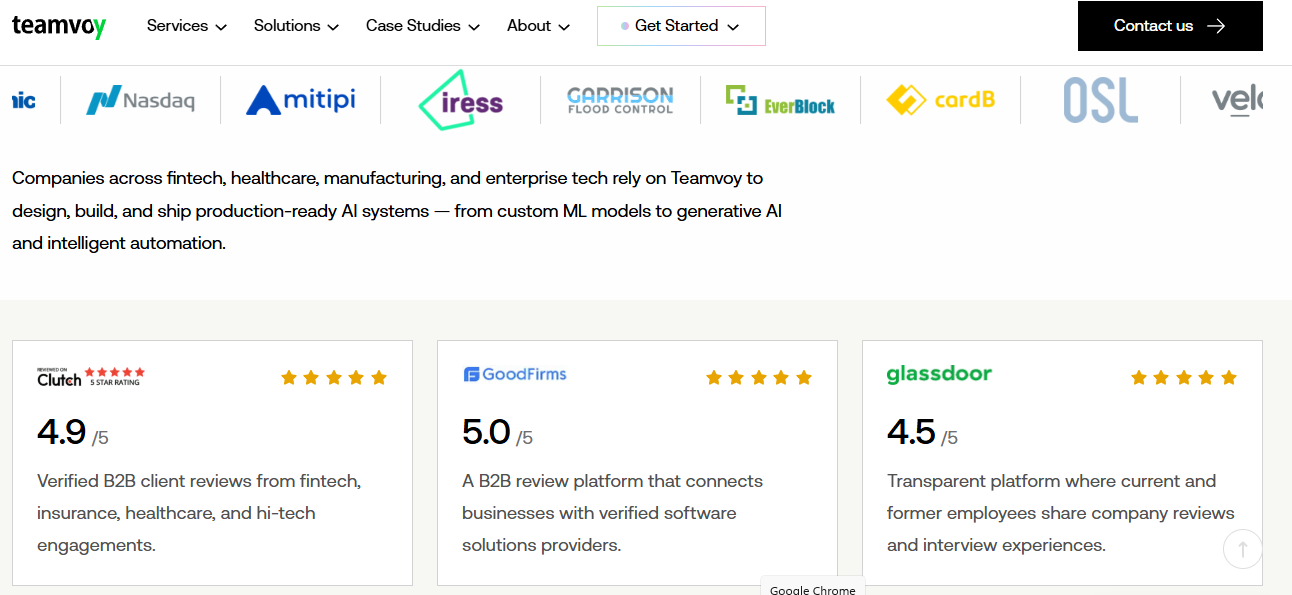
- Engineering-bench seniority: A senior technical lead owns the system, with an AI-native team behind them.
- Subcontracting transparency: Delivery is in-house; you know who writes your code.
- Shipped-vs-POC ratio: Built for production systems that run for years, not demos.
- Post-deployment accountability: Stays on for continuous post-release support and maintenance.
- Regulated-industry depth: Fintech, insurance, healthcare; SOC 2, PCI-DSS, GDPR-aware delivery.
- Integrated agentic AI and modernized the legacy stack for the Takflix streaming platform, with ongoing post-release support.
- Built a blockchain product from POC to MVP to scale for Iress, sustained over a multi-year engagement.
- Acted as the core technology team for fintech Bitspark across four years of mission-critical crypto trading.
“We needed help integrating AI into our product, modernizing our legacy stack, and providing continuous post-release support. Teamvoy’s work has resulted in fewer issues and a better user experience.”
— Dmytro Maryanych, Manager, Takflix (streaming) Teamvoy Clutch – Verified Review
“Teamvoy has a great structure and communication, topped off with a lot of openness for new ideas to solutions. Absolutely flawless, flexible and on time.”
— CPO, Aya (startup, Denmark) Teamvoy Clutch – Verified Review

Azumo
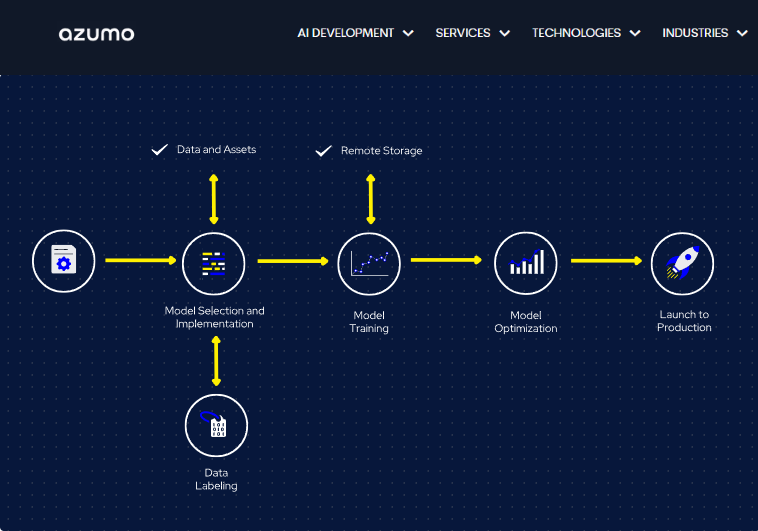
- Engineering-bench seniority: Mixed-seniority nearshore pods; quality varies by team assigned.
- Subcontracting transparency: Nearshore delivery model is stated openly.
- Shipped-vs-POC ratio: Strong on shipped app and data work alongside client teams.
- Post-deployment accountability: Suited to ongoing augmentation, less to full system ownership.
- Regulated-industry depth: Varies by engagement; not a regulated-first shop.
- Long track record of AI, data, and application builds for SaaS and media clients.
- Positions around nearshore staff augmentation for teams that already have direction.
- Reviewed positively on Clutch for communication and delivery cadence.
“They meet the timelines for the delivery of each use case across each phase of the engagement. This engagement has no defined end date. They have also helped on other projects as well.”
— Michael Butler, Director of Partnerships, nlx.ai Azumo Clutch – Verified Review
HatchWorks AI
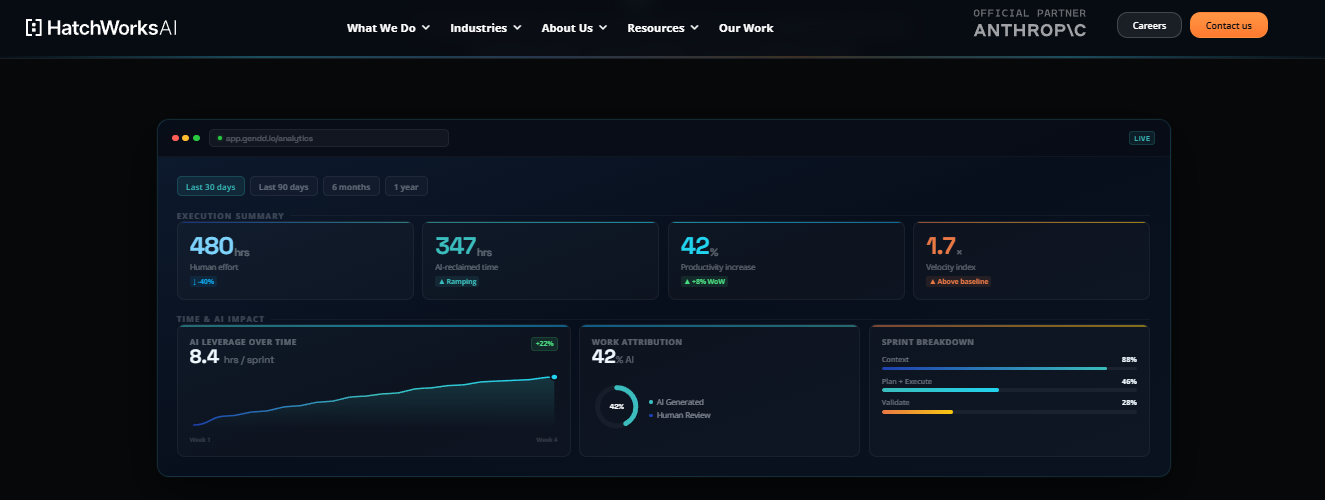
- Engineering-bench seniority: Product-led teams with a defined GenAI delivery method.
- Subcontracting transparency: Nearshore model is stated.
- Shipped-vs-POC ratio: Markets a structured path from idea to shipped GenAI product.
- Post-deployment accountability: Supports ongoing product partnership.
- Regulated-industry depth: HIPAA and SOC 2 within scope per engagement.
- Focused practice around generative-AI and “AI-augmented” software delivery.
- Serves SaaS, healthcare, and fintech product teams.
- Strong Clutch standing for generative-AI engagements.
“90%+ accuracy of chat responses from user questions. Their commitment to get the end product right and to be flexible when the situation required.”
— Josh Horton, Director of Data, Analytics & AI, Cox2M (IoT) HatchWorks AI Clutch – Verified Review
Orases
- Engineering-bench seniority: One accountable US-based team per client; reviewers cite strong ownership.
- Subcontracting transparency: US-based delivery is its core positioning.
- Shipped-vs-POC ratio: Reviewers report shipped, working products faster than expected.
- Post-deployment accountability: Offers ongoing support relationships.
- Regulated-industry depth: Insurance, healthcare, manufacturing; compliance varies by engagement.
- Built an AI tool for a lending firm that cut loan-document time from 15 to 20 minutes down to 30 seconds.
- Delivered remote-care dashboards and onboarding for a health-tech company.
- Consistently high Clutch ratings for delivery and partnership.
“What normally would take 15 to 20 minutes for a well trained quoting person to accurately make loan documents in the insurance space now takes 30 seconds. Truly the best investment I think I have ever made.”
— Adam McCroskie, Owner, Lending Company Orases Clutch – Verified Review
Vention
- Engineering-bench seniority: Vetted engineers embed into your team; you direct the seniority mix.
- Subcontracting transparency: Staff-augmentation model is explicit.
- Shipped-vs-POC ratio: Engineers ship inside your sprint process, measured like your own staff.
- Post-deployment accountability: Accountability stays with your team, not the vendor.
- Regulated-industry depth: SaaS and consumer tech focus; regulated coverage is not the core.
- Engineers reported fully embedded and productive within roughly eight weeks at a B2B SaaS platform.
- Delivered backend, frontend, and QA alongside in-house staff at startup speed.
- Repeat engagements cited by reviewers, with strong account management.
“Vention had a surprisingly good talent pool on their staff. They delivered fast, high-quality code and closed tickets and bugs extremely quickly. The team felt like part of our internal staff.”
— Jesse Boyes, CTO, H3R3, Inc. Vention Clutch – Verified Review
DOOR3
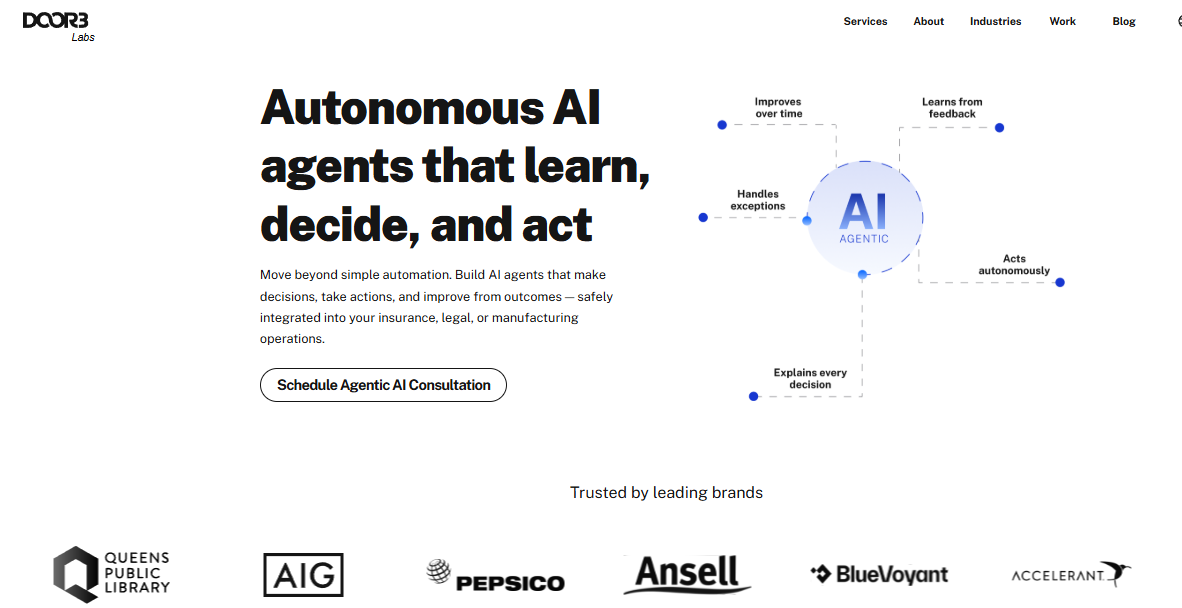
- Engineering-bench seniority: Senior UX and engineering teams for enterprise clients.
- Subcontracting transparency: US-based delivery positioning.
- Shipped-vs-POC ratio: Strong on research-led, shipped enterprise software.
- Post-deployment accountability: Supports longer client relationships.
- Regulated-industry depth: Enterprise, finance, healthcare; compliance varies by engagement.
- Long history of enterprise software and UX engagements.
- Serves finance, healthcare, and large-enterprise clients.
- Recognised on Clutch for UX-led delivery.
“DOOR3’s communication is key. It feels like a true partnership; it feels like a team within our company. Their openness to understanding what we do is impressive. It’s a niche industry with complicated financial products.”
— Tara York, Managing Director, Luma Financial Technologies DOOR3 Clutch – Verified Review
BlueLabel
- Engineering-bench seniority: Teams pairing AI engineers with architects, per reviewer accounts.
- Subcontracting transparency: Delivery model stated in engagements.
- Shipped-vs-POC ratio: Reviewers report measurable production outcomes.
- Post-deployment accountability: Provides monitoring and optimization after launch.
- Regulated-industry depth: Manufacturing and services; compliance varies by engagement.
- Unified 40+ years of manufacturing records (roughly 390,000 orders, 9,400 clients, 3,700 products) into a searchable AI assistant.
- Cut expert lookup time by about 75% for core workflows, per the client.
- An AI automation build reduced dispatch calls by over 50% for a software firm.
“Functioning prototype that had the buy-in from the clinicians and was technically ready to integrate with our full stack. What stood out most was how quickly they got to know us as a customer.”
— Anonymous, Chief of Staff to the CEO, Healthcare Technology Company BlueLabel Clutch – Verified Review
Achievion Solutions
- Engineering-bench seniority: Small teams; US project management with Ukraine-based data scientists.
- Subcontracting transparency: Distributed model surfaced in reviews.
- Shipped-vs-POC ratio: Strong on POC and MVP validation; less on long-run production.
- Post-deployment accountability: One reviewer flagged QA gaps needing rework.
- Regulated-industry depth: Healthcare data and education; compliance varies by engagement.
- Delivered an AI platform MVP for a design firm, beta-tested with over 150 users.
- Built MVP, beta, and website for a health-data company.
- Reviewers praised a CEO who actively gathered feedback to improve.
“We had a Beta test run of the MVP with over 150 users. Showed that we had a MVP that worked. We were impressed with their ability to deliver a high-quality, polished MVP.”
— Anonymous, Partner, Design Company Achievion Solutions Clutch – Verified Review
Scopic
- Engineering-bench seniority: Large distributed bench; seniority varies by team.
- Subcontracting transparency: Fully remote, distributed model is stated.
- Shipped-vs-POC ratio: Strong on sustained, shipped product work.
- Post-deployment accountability: Built for long-running relationships.
- Regulated-industry depth: Healthcare and finance; SOC 2 and HIPAA-aware per engagement.
- Long history of custom software across healthcare, manufacturing, and finance.
- Positions around sustained, multi-year client relationships.
- Established Clutch presence across many engagements.
“I was very impressed with the comprehensiveness of Scopic’s services. We had needs that crossed into different areas, but they had the full set of skills that we needed to achieve our goals for this project.”
— Josh Polster, CEO, Mediphany Scopic Clutch – Verified Review
Dualboot Partners
- Engineering-bench seniority: Product-and-engineering teams aimed at growth-stage companies.
- Subcontracting transparency: Delivery model stated per engagement.
- Shipped-vs-POC ratio: Oriented to shipped product alongside client teams.
- Post-deployment accountability: Built for ongoing partnership.
- Regulated-industry depth: Fintech and SaaS; compliance varies by engagement.
- Works with growth-stage and enterprise clients on product and AI.
- Positions around partnership rather than one-off projects.
- Solid Clutch standing for delivery.
“What was most impressive and unique was how seamlessly the Dualboot team integrated with Primoprint. They never felt like a separate entity — we collaborated with them just as we would with our own internal team.”
— Jen Manning, COO, Primoprint Dualboot Partners Clutch – Verified Review
Sidebench
- Engineering-bench seniority: Senior product and engineering teams; US-based.
- Subcontracting transparency: US-based delivery positioning.
- Shipped-vs-POC ratio: Builds strategy through to shipped product.
- Post-deployment accountability: Supports continued partnership.
- Regulated-industry depth: Healthcare and enterprise; HIPAA within scope per engagement.
- Serves enterprises, startups, and healthcare clients.
- Positions around strategy plus full build.
- Recognised on Clutch for product work.
“I’m impressed by Sidebench’s professionalism in project management. I’m also impressed by their design stage, in which we planned the entire project in terms of integrations, workflows, and UI. The product they’ve helped us create has been exceptional.”
— Anonymous, Executive, BrilliSkin Sidebench Clutch – Verified Review
SOLTECH
- Engineering-bench seniority: US-based teams with ongoing support practice.
- Subcontracting transparency: US delivery positioning.
- Shipped-vs-POC ratio: Track record of shipped custom software.
- Post-deployment accountability: Offers continued support relationships.
- Regulated-industry depth: SaaS and services; compliance varies by engagement.
- Long-running custom software practice.
- Serves SaaS, services, and logistics clients.
- Established Clutch presence.
“SOLTECH’s customer service distinguishes them from the competition. The team goes above and beyond to meet our needs.”
— Kattie Henderson, Manager of Software Project Mgmt, Neptune Technology Group SOLTECH Clutch – Verified Review
Frogslayer
- Engineering-bench seniority: Senior product engineering teams; US-based.
- Subcontracting transparency: US delivery positioning.
- Shipped-vs-POC ratio: Oriented to shipped, revenue-generating products.
- Post-deployment accountability: Frames engagements around shared outcomes.
- Regulated-industry depth: SaaS and services; compliance varies by engagement.
- Long history of product builds for growth companies.
- Emphasis on outcomes over staffing.
- Recognised on Clutch.
“Test cases defined the success of the project; ultimately we hit 80% success early on in the project (within 2 weeks) and by the end of the project we hit our 95% target.”
— Kenneth Croft, IT Manager, Q Investments Frogslayer Clutch – Verified Review
Imaginovation
- Engineering-bench seniority: Full-stack teams for mid-market clients.
- Subcontracting transparency: Delivery model stated per engagement.
- Shipped-vs-POC ratio: Track record of shipped web and mobile apps.
- Post-deployment accountability: Project-led, with optional support.
- Regulated-industry depth: Retail and services; compliance varies by engagement.
- Broad portfolio across web, mobile, and AI features.
- Serves retail, healthcare, and services clients.
- Strong Clutch ratings.
“Showcasing a strong understanding of our goals, Imaginovation transformed our concepts and vision into an intuitive, well-performing solution. The team delivers on time and promptly addresses needs and concerns.”
— Andrew Cherry, COO & Product Manager, Everflex Health Imaginovation Clutch – Verified Review
JetRockets
- Engineering-bench seniority: Engineering-led teams valued by technical founders.
- Subcontracting transparency: Delivery model stated per engagement.
- Shipped-vs-POC ratio: Track record of shipped web platforms.
- Post-deployment accountability: Supports longer partnerships.
- Regulated-industry depth: Fintech and real estate; compliance varies by engagement.
- Long history of Ruby on Rails and web platform builds.
- Serves fintech, real estate, and SaaS clients.
- Recognised on Clutch for engineering quality.
“We are in the process of populating the software with our hospital and physician data, and we intend to go live with the physicians in the next 30-45 days. Their level of service has been exceptional.”
— Kimberly Arthurs, Director of Business Ops, Preferred Solutions Healthcare JetRockets Clutch – Verified Review
Six Feet Up
- Engineering-bench seniority: Senior Python engineers; US-based.
- Subcontracting transparency: US delivery positioning.
- Shipped-vs-POC ratio: Track record of shipped data and AI platforms.
- Post-deployment accountability: Supports ongoing relationships.
- Regulated-industry depth: Research and enterprise; compliance varies by engagement.
- Long history of Python, data, and cloud platform builds.
- Serves research, enterprise, and government-adjacent clients.
- Established Clutch presence.
“The measurable outcomes included the creation of a proof-of-concept product that met our rigorous testing phases and demonstrated the potential for scalability.”
— Brad Fruth, Director of Innovation, Becks Hybrids Six Feet Up Clutch – Verified Review
Q2. What Exactly Does an “AI Development Company” Do, and Where Do Most of Them Quietly Stop?
An AI development company builds and integrates machine-learning systems into your product. That means large language model (LLM) apps, retrieval pipelines, agents, and computer vision. The useful distinction in 2026 is not what they can demo. It is where they stop. Many sell consulting decks and two-day proofs of concept, then exit. A smaller set treats the data layer and the legacy core as the first two questions, and stays accountable once the system serves real users.
🧩 The work, in plain terms
Strip away the marketing and the category covers a handful of jobs.
- LLM apps: chat and text features built on models like GPT or Claude.
- RAG pipelines: “retrieval-augmented generation,” where the system pulls your own documents into an answer.
- Agents: software that takes actions across tools, not just text replies. Building these well is the core of AI agent development services.
- Computer vision: reading images, scans, or video.
- MLOps: the plumbing that keeps models running and monitored in production.
Most firms list all of these. The Radixweb and Master of Code roundups read almost identically on capability. Capability is table stakes now. It tells you very little.
⚠️ The two-day demo that never ships
Here is where the quiet stop happens. A firm builds a slick demo in two days. It impresses the room. Then it never reaches production, because production is a different problem.
I have seen this pattern enough times to trust it. The demo runs on clean sample data. Your real data is messy, fragmented, and spread across systems nobody fully documented. Sound data engineering is what turns that mess into something a model can use.
A common version is what I call the dumb-RAG trap. A team dumps all your Confluence, Slack, and Salesforce records into a vector database and hopes the model sorts it out. You do not get reasoning. You get thrashing and noise.
🧠 The model is the third question, not the first
Across the AI integration work I have led, the first thing I look at is never the model. It is the data layer, then the legacy core. The model comes third.
I think of it as the nervous system versus the brain. The industry obsesses over the brain, the model choice. But even a state-of-the-art model is useless when it gets bad data or cannot act reliably. The biggest bottleneck is integration, the boring part nobody demos, which is exactly what our AI integration services are built around.
At Teamvoy, this is why we ask about your data before your roadmap. A firm that stops at the demo leaves you to discover the data problem alone, six months in. A firm that owns the system finds it on day one. That difference is the whole ballgame.
Q3. Why Do 95% of AI Pilots Die Before Production, and What Does Shipped-vs-POC and “Almost-Right” Code Reveal About a Vendor?
Roughly 95% of enterprise generative-AI pilots never deliver measurable return. Pilots rarely fail on the model. They fail at integration, data, and accountability. And the most expensive code an AI writes is the code that almost works. It passes review, ships, and sits wrong for months. So the honest questions for any vendor are their shipped-versus-POC ratio, and who owns that debt after go-live.
📊 The number, and where it comes from
The 95% figure is not a vendor slogan. It comes from MIT’s Project NANDA report, “The GenAI Divide: State of AI in Business 2025,” published in July 2025.
The study found that, despite $30 to $40 billion in enterprise spending, only about 5% of pilots reached real value at scale. The rest stalled. The report’s own takeaway was blunt: success comes from embedding AI into workflows, not from deploying models.
🔌 Pilots die at the seams, not the model
This matches what I see on the ground. The model is rarely the thing that breaks. The data feeding it breaks. The integration with your legacy core breaks. Nobody owns the system once the demo team leaves. A disciplined approach to system integration is what keeps those seams from failing.
A 2 a.m. story makes it concrete. An on-call engineer fed an alert into an AI tool. The tool read the docs and said “restart the server.” He restarted it six times. A senior engineer then read the logs for thirty seconds and saw the real cause, a full database connection pool. That is tribal knowledge, and no model holds it for you.
💸 Why “almost right” costs the most
Now the contrarian part. Completely wrong code is cheap, because it gets caught. Tests fail, builds break, someone throws it away. Almost-right code is the expensive one. It passes review, ships to production, and compounds quietly.
The data is catching up to this. A December 2025 CodeRabbit study of 470 GitHub pull requests found AI-co-authored code introduced about 1.7 times more problems than human-only code. You are not always speeding up. Sometimes you are building a backlog for future-you. This is the same dynamic that drives a tech debt avalanche.
That line, from an engineer describing AI-generated debt, captures the cost nobody budgets for. Almost-right code passes code review, ships to production, and sits in your codebase for six months before anyone realizes it is wrong.
✅ Two questions that separate a partner from a vendor
Turn all of this into something you can ask on a call.
- What is your shipped-vs-POC ratio? How many systems have you run in production, versus demos you handed off and left?
- Can your developer explain this code without the AI’s comments? A POC is a sales artifact. A production system is a liability someone owns at 2 a.m.
At Teamvoy, a senior engineer owns the system end to end. We use a simple test on AI-written code: does it reuse what exists, does it follow our conventions, and can a human explain it unaided. Code nobody can explain is dead code, no matter how fast it shipped. When that debt has already piled up, our technology modernization work starts by making it readable again.
Q4. How Do You Spot “AI-Washing” and the Subcontracting Trap Before You Sign?
AI-washing is marketing human or off-the-shelf work as proprietary, autonomous AI. The cleanest tests are simple. Ask who writes the code, and where. Ask for the production system, not the demo. Ask whether delivery is subcontracted to a team you will never meet. Transparency about the bench is the tell. The hiding is the warning sign, not the subcontracting itself.
🚩 The $1.5 billion cautionary tale
You do not have to imagine the worst case. It already happened, in public.
Builder.ai, a London startup once valued around $1.5 billion and backed by Microsoft, sold an “AI” assistant called Natasha that supposedly built apps autonomously. In reality, the heavy lifting went to roughly 700 engineers in India who wrote the code by hand. Apps marketed as “80% built by AI” ran on tools that were barely functional.
The company entered insolvency in 2025. They promised a machine. They sold an offshore code farm with a chatbot on the front.
⚠️ Why the subcontracting itself is not the crime
Let me be fair here. Subcontracting and nearshore delivery are normal. Plenty of good firms do it well and say so plainly.
The problem is concealment. When you do not know who writes your code, you cannot judge seniority, security, or who will answer in month eighteen. A linked risk is security debt. One study of vibe-coded apps found a majority carried vulnerabilities, the digital equivalent of leaving your windows unlocked, a pattern we break down in our look at vibe coding security risks.
This frustration shows up wherever buyers compare notes.
“Most agencies charge overpriced retainers for work that’s not deserving of a retainer.” Reddit Thread
✅ The pre-signing diligence checklist
Run these questions before you sign. Honest firms answer them in one sentence each.
- Who writes the code, and where? Get names, locations, and seniority, not a logo wall.
- Show me a production system, not a demo. Ask for something running with real users.
- What is shipped versus POC? A portfolio of pilots with no production tail is a flag.
- Who owns my account in month eighteen? Watch for the senior who closes the deal, then vanishes.
- Who owns the bugs and the bill after go-live? Accountability should be named in writing.
- What compliance have you actually delivered under? HIPAA, GDPR, SOC 2, and PCI-DSS, named, not implied.
One honest limit, founder to founder. A verified-review profile, like a Clutch page, helps but does not settle it. Reviews tell you how a firm behaved on past work. They cannot tell you which team gets staffed on yours. That is why you still ask. An independent IT audit is one way to get a clear-eyed read before you commit.
At Teamvoy, we keep delivery in-house and put a senior lead on the system, because the engagements we take on, regulated platforms that cannot go down, do not survive a mystery bench. That is also why banking and fintech teams come to us when a previous vendor has walked away.
Q5. What Is “Almost-Right” AI Code Really Costing You After the Vendor Leaves?
The most expensive code an AI writes is the code that almost works. Completely wrong code gets caught, because tests fail and builds break. Almost-right code passes review, ships, and sits for months before someone finds it is wrong. By then the fix has compounded. AI pull requests now average about 10.8 issues each, versus 6.4 in human code. Post-deployment accountability, who owns that debt after go-live, is the criterion most lists ignore.
💸 The cost no one budgets for
Here is the part the standard read gets backwards. We treat wrong code as the danger. It is not. Wrong code announces itself.
The quiet killer is code that looks right. It compiles, it passes review, and it ships. Then it sits in production, subtly off, for six months until someone traces a strange bug back to it.
I have watched this happen on rescue engagements. The previous vendor’s code was not broken. It was almost right, which is far harder and slower to untangle. Cleaning that up is the core of our technology modernization work.
The data now backs the gut feel. A December 2025 CodeRabbit study of 470 pull requests found AI-co-authored code carried about 10.83 issues per request, against 6.45 for human-only code. That is roughly 1.7 times more.
A common pattern is the suppressed warning. A pull request that disables eleven lint rules is not clean code. It is tape over the warning light, holding the problem hostage until later. This is the same dynamic we describe in the tech debt avalanche.
To be fair, AI at scale can work brilliantly with the right guardrails. Spotify’s Honk agent now merges 1,000 pull requests in ten days, but only because every change runs through automated build, lint, and test loops before a human sees it. The verification is the point, not the model. Building those autonomous loops safely is the heart of AI agent development services.
✅ The three-question test
So ask the question lists skip: who maintains this after the vendor leaves? Then run any AI-written change through three checks.
- Does it reuse what already exists, or reinvent it?
- Does it follow your conventions, or its own?
- Can a developer explain it without the AI’s comments?
At Teamvoy, code that fails the third check is dead code to us, no matter how fast it shipped. Speed you cannot maintain is just debt with a deadline. An independent IT audit is one way to surface that hidden debt before it compounds.
Q6. How Should a Startup Versus an Enterprise Choose, and What Will It Actually Cost?
Match the partner to your situation, not a ranking. A vibe-coded startup with an unstable MVP needs a stabilisation shop that can read code nobody wrote. A regulated enterprise under a DORA or HIPAA deadline needs named-regulator experience and a senior lead who stays through go-live. Pricing is custom-quote everywhere. So compare engagement models and regional rate bands, not headline rates.
🎯 Four situations, four fits
The real question is never “who is best.” It is “who is built for the system you actually have.”
- The Burned CTO (inherited a half-finished build): needs a vendor-rescue and stabilisation partner. Avoid a pure POC shop that ships demos and exits.
- The Technical Founder on a legacy core: needs modernization without a rewrite. Avoid a firm that proposes a full rebuild as the only option. Our AI modernization sprints are built for exactly this constraint.
- The Enterprise IT Director under a deadline: needs named-regulator depth. Eligibility to work in your sector does not equal proven compliance delivery. For financial platforms, our work on building regulator-ready AI in fintech shows what that looks like.
- The Vibe-Coded Founder (AI-built MVP now unstable): needs a readiness-and-stabilisation team. Avoid more vibe coding on top of vibe coding, because the vibe coding security risks only compound.
There is a useful frame here. AI makes the engineers you have more effective, but only if those engineers already know how to build. It does not replace the judgment.
💰 Why there is no price column
Anyone who quotes you a flat headline rate is selling, not scoping. Real pricing depends on your stack, your risk, and your timeline. Our breakdown of AI integration cost shows why the spread is so wide.
What you can compare is regional rate bands for senior engineers, as ranges, not quotes.
- United States: roughly $100 to $160 per hour for senior developers.
- Western Europe: roughly $80 to $120 per hour.
- Eastern Europe: roughly $55 to $90 per hour, often the best cost-to-quality balance.
- South and Southeast Asia: roughly $20 to $60 per hour, with wider quality variance.
- AI and ML specialists carry a 40% to 60% premium over generalists in every region.
The bigger cost is rarely the rate. If you buy a build with no one owning it afterward, you become Chief Integration Officer forever. That salary is yours. Disciplined system integration is what keeps that role off your desk.
Where this is handled
We run an AI & System Readiness Audit before anyone writes a line of code.
If you’re unsure whether your stack is ready for AI, or whether a pilot can actually reach production, that’s the work we do every day; the door’s open.
Request a readiness auditA fair limit, founder to founder. A 3-to-5-day audit surfaces your risk and a plan. It is not a full implementation, and it should not pretend to be one.
Q7. What Should You Ask Before You Sign, and What Are the Red Flags?
Before you sign, ask five things. Who writes the code, and where? What have you shipped to production, not demoed? Is delivery subcontracted? Who owns the system after go-live? Which named regulators have you delivered under, BaFin, DORA, PCI-DSS, or HIPAA? The red flags are a refusal to name the bench, a portfolio of pilots with no production tail, and a senior who vanishes after the sales call.
✅ The five questions to ask
Keep it simple. Honest firms answer each in a sentence.
- Who writes the code, and where? Names and seniority, not a logo wall.
- What have you shipped to production? Ask for something running with real users, not a demo.
- Is delivery subcontracted, and to whom? Subcontracting is fine. Hiding it is not.
- Who owns the system in month eighteen? Not just at kickoff.
- Which named regulators have you delivered under? BaFin, DORA, PCI-DSS, HIPAA, and GDPR, named, not implied.
For regulated buyers, add one security question. Ask how they handle the “lethal trifecta,” an AI agent with data access, untrusted input, and the ability to send information out. That combination is where the real breaches live, and it is a core concern for banking and fintech platforms.
🚩 The red flags, and one expensive story
Some answers should stop the conversation.
- ❌ A refusal to name who writes your code.
- ❌ A portfolio of pilots with no production tail.
- ❌ A senior who closes the deal, then disappears.
- ⚠️ No mention of circuit breakers or cost limits on agents.
That last one is not abstract. I have seen an AI agent get stuck in an overnight retry loop with no circuit breaker, a hard stop that kills a runaway process. It quietly burned around $4,200 while everyone slept. Ask whether a vendor builds those stops by default, which is something our AI consulting team treats as non-negotiable.
So here is where I land, and the question I am still sitting with. The market keeps asking which AI firm is best. I think that is the wrong question. The right one is which partner is built for the system you actually run at 2 a.m.
If you can tell me what you are running and where it is stuck, I can usually tell you what kind of partner you need, even when that partner is not Teamvoy. That is the conversation worth having. The door is open. You can always tell us what you are running to start it.