- There is no single best enterprise AI company, only the one built for your situation: regulated stack, legacy core, or a vibe-coded MVP under strain.
- Most 2025 pilots stalled because teams optimized the model and ignored the integration layer, the nervous system connecting AI to systems you already run.
- Vet partners on six pillars: eval-harness ownership, model-agnosticism, data isolation, IP and weight ownership, red-team and observability handover, and a written drift SLA.
- A demo-seller optimizes for the pitch; a production partner optimizes for the system that still works in eighteen months.
- Expect roughly a 10K to 50K assessment up to 500K-plus for a production platform, but compare on accountability, not a sticker price.
- Auditable governance mapped to NIST, DORA, PCI-DSS, HIPAA, GDPR, and BaFin is a deliverable, not a slide.
Q1. Which enterprise AI development company fits your situation in 2026?
There is no single best enterprise AI development company. There is only the one built for your situation. The 14 firms below are assessed on six things buyers rarely ask until a pilot stalls: who owns the eval harness, whether the stack is model-agnostic, how your data is isolated, who owns the IP and model weights, how red-teaming and observability are handed over, and what the post-deployment drift and retraining terms actually say.
I founded Teamvoy in Lviv in 2013, and I have spent twelve-plus years and 150+ projects watching how this work goes right and wrong. Picking a partner for a regulated, long-running system is a high-stakes call. A wrong pick on a multi-year engagement compounds quietly, like an “almost right” model that passes review and breaks six months later. This guide is for the CTO, founder, or IT director choosing a partner they will have to live with. It is a field assessment, not a league table.
🧭 The bottleneck is the nervous system, not the brain
Here is the thing most pilots get backwards. Teams obsess over the brain (model choice) and ignore the nervous system (integration). Even a top model is useless when it gets bad data or cannot act reliably. An agent that only reads data is just a fancy search box. Production agents need write access to update CRMs, create tickets, and provision users. That gap is why an estimated 95% of enterprise generative AI pilots have failed to deliver measurable return, and why thoughtful AI integration services matter more than model choice.
⚠️ The trap you are trying to avoid
The failure mode I see most is the buyer who becomes “Chief Integration Officer forever.” You inherit every API schema, custom field mapping, and retry path the vendor built, then maintain it alone after they exit. The six criteria below are designed to surface that risk before you sign.
Our Evaluation Criteria
I picked these six criteria because they decide whether you own a working system or rent a black box. They are specific to AI development engagements, not generic agency checkboxes.
- ⭐ Eval-harness ownership: Do you keep the test suite, golden datasets, and scoring logic after handover, or does the vendor? Without it, you cannot prove the system works or detect drift.
- ⭐ Model-agnosticism vs lock-in: Can the system swap or route between models (GPT, Claude, Gemini, Llama, or a small purpose-built model) without a rebuild? Gartner expects small task-specific models to be used three times more than general LLMs by 2027.
- ⭐ Data isolation and tenancy: Is your data segregated by tenant, kept in the right jurisdiction, and never silently training shared models?
- ⭐ IP and model-weight ownership: Who owns the fine-tuned model and its weights when the contract ends? Deloitte found unclear ownership is a top blocker to scaling AI.
- ⭐ Red-team and observability handover: Do you receive the security testing, logs, and dashboards, or just a model?
- ⭐ Post-deployment drift and retraining SLA: Is there a written accuracy threshold that triggers retraining, a cadence, and clarity on who pays?
Who This Guide Is For
This guide will help you most if you recognize yourself in one of these situations.
- The Burned CTO: You inherited a system a previous vendor underdelivered or abandoned, and you cannot afford the same mistake twice.
- The Enterprise IT Director: You operate inside a regulated environment (DORA, PCI-DSS, BaFin, or HIPAA) with a compliance deadline and a board mandate.
- The Technical Founder on a legacy core: Your product scaled, the architecture drifted, and you need AI integration without a disruptive rewrite.
The Kinds of Partner Covered
Each firm below exists for a different situation. None is objectively first.
- Teamvoy: Best for regulated systems under pressure that need senior-led modernization and AI integration, not a rewrite.
- HatchWorks AI: Best for teams wanting a structured “generative-driven development” delivery model.
- NineTwoThree AI Studio: Best for product teams turning an AI idea into a venture-backed MVP.
- Valere: Best for founders who want product strategy bundled with AI build.
- Vention: Best for scale-ups needing large, flexible staff augmentation with AI capability.
- Azumo: Best for nearshore AI and data engineering at a managed-cost point.
- Diffco AI: Best for science-heavy and computer-vision AI prototypes.
- BlueLabel: Best for AI assistants layered on legacy ERP and operational data.
- Achievion Solutions: Best for early AI proof-of-concept and MVP validation.
- Trigent Software: Best for enterprises wanting an established offshore QA and AI delivery base.
- SOLTECH: Best for US-based custom software with growing AI practice.
- DOOR3: Best for enterprise UX-led application work with AI features.
- Six Feet Up: Best for Python-heavy, senior-led AI and data platform work.
- Sidebench: Best for venture-studio-style design and AI product builds.
Master Comparison Table
| Company | Best For | Engagement Model | Industry Depth & Compliance Coverage |
| Teamvoy | Regulated systems under pressure needing senior-led AI integration and modernization without a rewrite | Long-term partner (4+ yr avg) | Fintech, healthcare, insurance, complex SaaS; BaFin, PSD2, DORA, SOC 2, PCI-DSS, HIPAA, GDPR, SEC/FINRA |
| Azumo | Production-grade AI development, AI agents, RAG, and data engineering for startups and enterprises | Nearshore partner / Staff augmentation / End-to-end delivery | Healthcare, finance, SaaS, media, gaming, manufacturing; SOC 2, HIPAA-ready, GDPR & CCPA support |
| NineTwoThree AI Studio | Turning an AI idea into a venture-grade MVP | Project-and-exit / studio | Fintech, healthcare, logistics; SOC 2-aware, broader compliance varies |
| Valere | Founders wanting product strategy bundled with AI build | Project-and-exit / partner | Fintech, media, enterprise SaaS; compliance varies by engagement |
| Vention | Scale-ups needing large flexible staff augmentation with AI | Staff augmentation | Fintech, healthcare, retail; SOC 2, HIPAA-aware, varies by team |
| HatchWorks AI | Teams wanting a structured generative-development delivery method | Long-term partner / nearshore | Cross-industry SaaS, healthcare; compliance varies by engagement |
| Diffco AI | Science-heavy and computer-vision AI prototypes | Project-and-exit | Healthcare, biotech, retail; compliance varies by engagement |
| BlueLabel | AI assistants on legacy ERP and operational data | Project-and-exit / partner | Manufacturing, retail, services; compliance not typically the focus |
| Achievion Solutions | Early AI proof-of-concept and MVP validation | Project-and-exit | Cross-industry, some health data; compliance varies by engagement |
| Trigent Software | Established offshore QA and AI delivery base | Staff augmentation / managed | Cross-industry enterprise; SOC 2-aware, varies by engagement |
| SOLTECH | US-based custom software with a growing AI practice | Project-and-exit / partner | Healthcare, logistics, SaaS; HIPAA-aware, varies by engagement |
| DOOR3 | Enterprise UX-led applications with AI features | Project-and-exit / partner | Enterprise, finance, healthcare; compliance varies by engagement |
| Six Feet Up | Python-heavy, senior-led AI and data platform work | Project-and-exit / partner | Gov, research, cloud governance, SaaS; isolated-environment testing |
| Sidebench | Venture-studio-style design and AI product builds | Project-and-exit / studio | Healthcare, public sector, enterprise; HIPAA-aware, varies |
Teamvoy
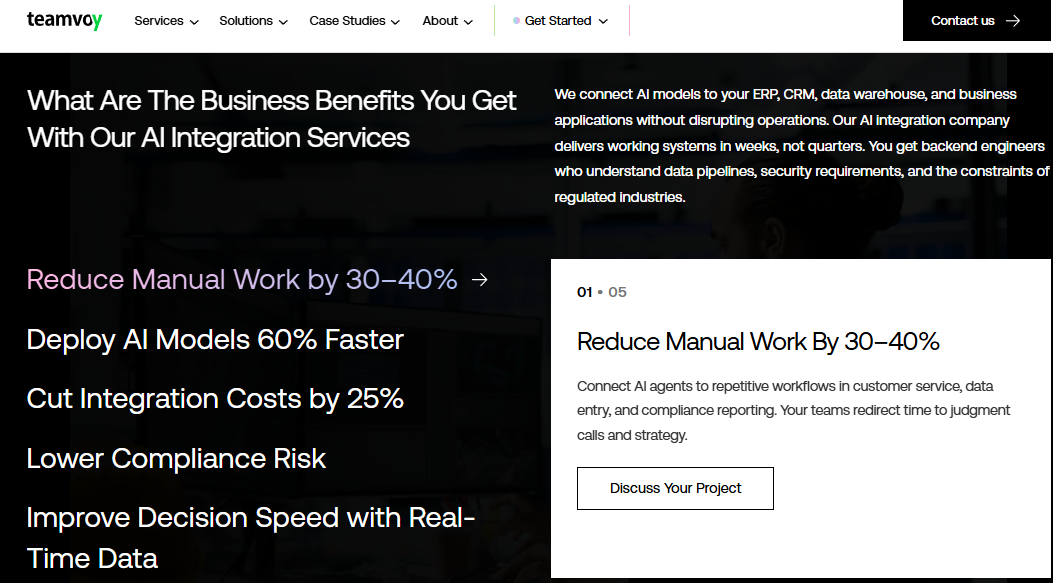
- Eval-harness ownership: Test suites and acceptance logic stay with the client by default.
- Model-agnosticism: Agentic AI used across delivery; no single-provider lock-in claimed.
- Data isolation: Built isolated, white-label, customer-segregated environments in delivery.
- IP and weight ownership: Full-cycle build means the client owns the system and code.
- Red-team and observability handover: Senior lead owns the system end to end, including post-release support.
- Drift and retraining SLA: Long-term partner model covers continuous post-release support; exact SLA varies by engagement.
- Named work with Nasdaq and Market Access Direct in the US regulated market.
- Four-year technical partnership with fintech Bitspark across crypto, trading, and mission-critical wallet systems running 24/7.
- AI integration plus legacy-stack modernization with continuous post-release support for streaming service Takflix, ongoing since January 2025.
“Their technical expertise was top class. We have been with Teamvoy for 4 years and found a great partner for the growth of Bitspark.”
— George Harrap, CEO, Bitspark (Fintech) Teamvoy Clutch – Verified Review
“We needed help integrating AI into our product, modernizing our legacy stack, and providing continuous post-release support. We’re impressed with their involvement in processes and quick completion of work.”
— Dmytro Maryanych, Manager, Takflix (Streaming) Teamvoy Clutch – Verified Review
Azumo
- Eval-harness ownership: Not publicly documented; confirm ownership of evaluation frameworks, test suites, and acceptance criteria during contracting.
- Model-agnosticism: Works across OpenAI, Anthropic Claude, Gemini, Llama, DeepSeek, and other leading foundation models, selecting the best model for each use case rather than locking clients into a single provider.
- Data isolation: Enterprise AI systems are delivered under SOC 2-certified development practices with private infrastructure options available depending on engagement requirements.
- IP and weight ownership: Custom AI solutions are built for clients; ownership of source code, fine-tuned models, and model weights should be defined within the engagement agreement.
- Red-team and observability handover: Provides MLOps, monitoring, deployment, and model management capabilities, though handover deliverables should be confirmed for each engagement.
- Drift and retraining SLA: Supports continuous monitoring, retraining, and production AI maintenance; ongoing support terms vary by project.
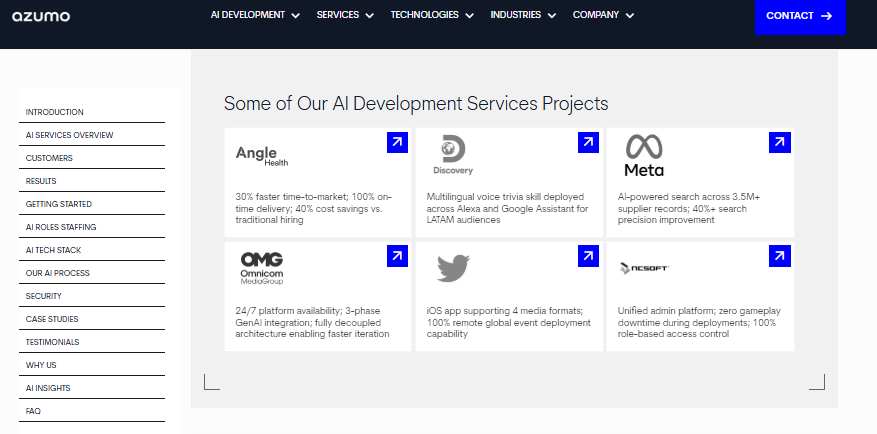
Production-focused AI engineering partner that combines nearshore delivery with expertise across AI agents, RAG, LLM fine-tuning, computer vision, NLP, MLOps, and data engineering to help organizations deploy enterprise AI systems at scale.
Azumo’s AI development services help startups and enterprises build production-grade AI applications, including AI agents, retrieval-augmented generation (RAG), computer vision, NLP, LLM fine-tuning, and MLOps solutions. Since 2016, Azumo has delivered more than 100 production AI systems for startups and Fortune 100 companies, combining nearshore engineering with enterprise-grade security to deploy scalable AI solutions across healthcare, finance, SaaS, media, manufacturing, and gaming.
- More than 100 production AI systems delivered since 2016.
- Trusted by startups and Fortune 100 companies including Meta, Omnicom, Discovery Channel, Zynga, and Angle Health.
- Built an LLM-powered insurance automation platform that reduced quote generation time by 90% (45 minutes to 5 minutes).
- Delivers AI solutions across healthcare, finance, SaaS, media, manufacturing, gaming, and enterprise software.
“They meet the timelines for the delivery of each use case across each phase of the engagement. This engagement has no defined end date. They have also helped on other projects as well.”
— Michael Butler, Director of Partnerships, nlx.ai Azumo Clutch – Verified Review
NineTwoThree AI Studio
- Eval-harness ownership: Not publicly claimed; confirm in the contract.
- Model-agnosticism: Works across mainstream LLMs; routing approach varies.
- Data isolation: Varies by engagement.
- IP and weight ownership: Studio builds typically transfer to the client; confirm weights.
- Red-team and observability handover: Not publicly detailed.
- Drift and retraining SLA: Varies; studio model favors build over long-term run.
- Long track record of mobile and AI product launches.
- Studio model spanning strategy, design, and engineering.
- Fintech, healthcare, and logistics product work.
“What was most impressive was their depth of experience and expertise for every phase of development. This allowed for problem solving and enhancements throughout the development and helped to turn a good idea into a great deliverable.”
— William Hess, Co-CEO & Head of Research, PRC Macro NineTwoThree AI Studio Clutch – Verified Review
Valere
- Eval-harness ownership: Not publicly claimed; confirm in the contract.
- Model-agnosticism: Works across mainstream LLMs.
- Data isolation: Varies by engagement.
- IP and weight ownership: Confirm weight ownership explicitly at contract stage.
- Red-team and observability handover: Not publicly detailed.
- Drift and retraining SLA: Varies by engagement.
- Product strategy plus build under one engagement.
- Work across fintech, media, and enterprise SaaS.
- Venture-adjacent support model.
“Valere’s AI capabilities are the real deal. Many firms claim generative AI expertise, but Valere’s team has demonstrated actual competency in prompt engineering, output validation, and iterative model refinement. The team doesn’t oversell what AI can do.”
— Chris Brown, Co-Founder, GetOnyx Valere Clutch – Verified Review
Vention
- Eval-harness ownership: Augmented engineers build inside your repo, so you keep it; confirm scope.
- Model-agnosticism: Depends on the team you staff, not a house method.
- Data isolation: You set the environment; the team works inside it.
- IP and weight ownership: Typically yours under staff-aug terms; confirm in the contract.
- Red-team and observability handover: Depends on the engineers staffed.
- Drift and retraining SLA: Not a managed SLA; you own the running system.
- Large engineering bench across many stacks.
- Used by startups through enterprises for capacity.
- Fintech, healthcare, and retail experience.
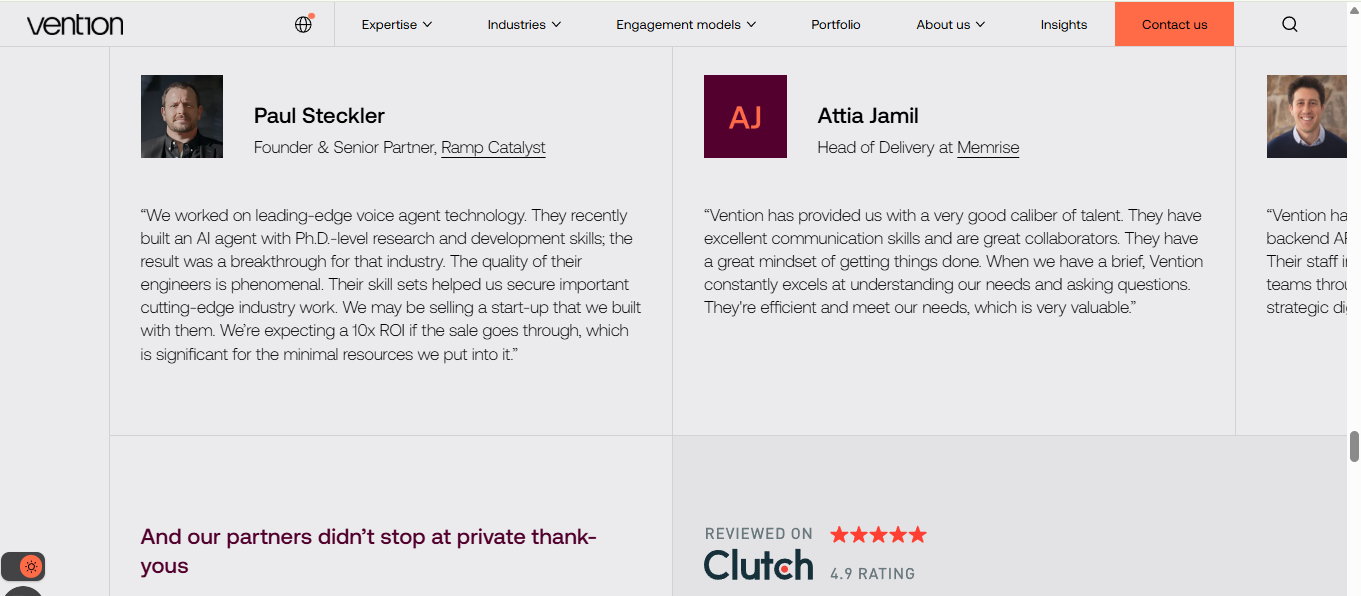
“Vention had a surprisingly good talent pool on their staff. They delivered fast, high-quality code and closed tickets and bugs extremely quickly. The team felt like part of our internal staff.”
— Jesse Boyes, CTO, H3R3, Inc. Vention Clutch – Verified Review
HatchWorks AI
- Eval-harness ownership: Not publicly claimed; confirm in the contract.
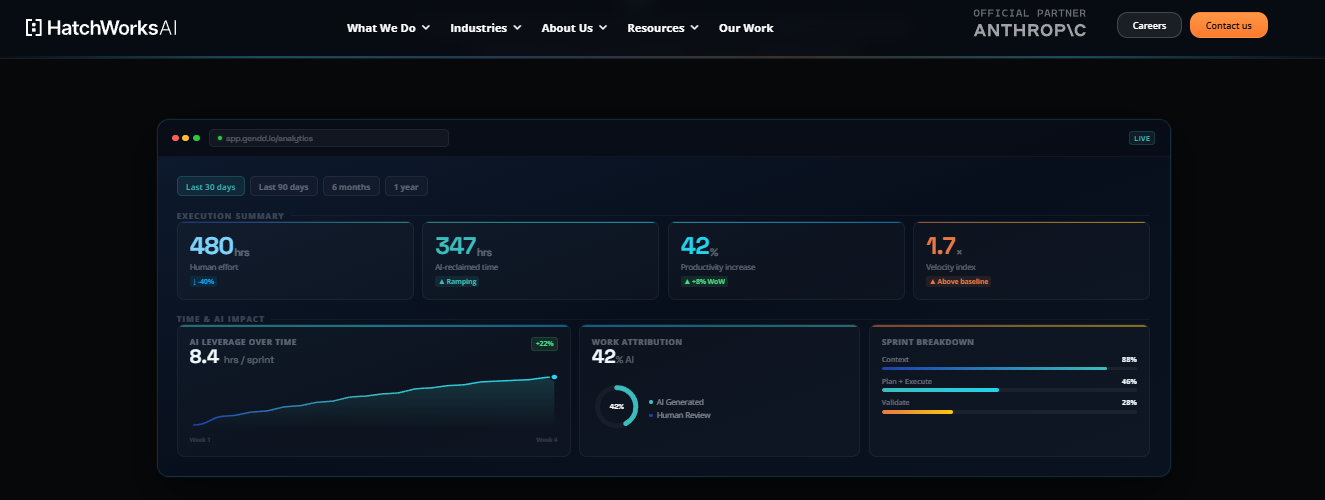
- Model-agnosticism: Markets a “Generative-Driven Development” method across LLMs.
- Data isolation: Varies by engagement; not a published default.
- IP and weight ownership: Standard work-for-hire; confirm weight ownership explicitly.
- Red-team and observability handover: Not publicly detailed.
- Drift and retraining SLA: Varies by engagement.
- Positions around an explicit “Generative-Driven Development” framework on its own site.
- Nearshore LatAm delivery base for time-zone-aligned product engineering.
- Cross-industry SaaS and healthcare product work.
“90%+ accuracy of chat responses from user questions. Their commitment to get the end product right and to be flexible when the situation required.”
— Josh Horton, Director of Data, Analytics & AI, Cox2M (IoT) HatchWorks AI Clutch – Verified Review
Diffco AI
- Eval-harness ownership: Research-style work; confirm who keeps datasets and benchmarks.
- Model-agnosticism: Builds custom and foundation-model solutions.
- Data isolation: Varies by engagement.
- IP and weight ownership: Custom models can carry complex ownership; confirm explicitly.
- Red-team and observability handover: Not publicly detailed.
- Drift and retraining SLA: Varies; prototype focus over long-term run.
- Computer-vision and applied-ML focus.
- Prototype-to-product engineering.
- Healthcare, biotech, and retail use cases.
“We saw meaningful results across the board: the project was completed on schedule, stayed within budget, and immediately improved our platform’s performance and reliability.”
— Jacob Hokinson, CPO, Gitcha Diffco AI Clutch – Verified Review
BlueLabel
- Eval-harness ownership: Not publicly claimed; confirm in the contract.
- Model-agnosticism: Builds on mainstream LLMs over enterprise data.
- Data isolation: Builds a unified data layer over existing records; isolation terms vary.
- IP and weight ownership: Custom-build; confirm weight and asset ownership explicitly.
- Red-team and observability handover: Not publicly detailed.
- Drift and retraining SLA: Varies by engagement.
- Built an AI assistant on a manufacturing ERP that unified roughly 40 years of records, including about 390,000 orders, 9,400 clients, and 3,700 products.
- Encoded a 40-year specialist’s playbooks into the assistant to reduce reliance on tribal knowledge.
- Reduced AI consulting client dispatch calls by over 50% in a separate telecom automation engagement.
“Functioning prototype that had the buy-in from the clinicians and was technically ready to integrate with our full stack. What stood out most was how quickly they got to know us as a customer.”
— Anonymous, Chief of Staff to the CEO, Healthcare Technology Company BlueLabel Clutch – Verified Review
Achievion Solutions
- Eval-harness ownership: POC work; confirm who keeps datasets and acceptance tests.
- Model-agnosticism: Builds custom data-science models and LLM features.
- Data isolation: Varies by engagement.
- IP and weight ownership: POC outputs usually transfer; confirm weights explicitly.
- Red-team and observability handover: Not publicly detailed.
- Drift and retraining SLA: Varies; POC focus, not long-term run.
- Delivered an AI platform MVP that ran a beta with over 150 users for a design company.
- Built a health-data MVP, beta, and website for a research-data company.
- Developed a Python data-science recommendation algorithm for an education nonprofit pilot.
“We had a Beta test run of the MVP with over 150 users. Showed that we had a MVP that worked. We were impressed with their ability to deliver a high-quality, polished MVP.”
— Anonymous, Partner, Design Company Achievion Solutions Clutch – Verified Review
Trigent Software
- Eval-harness ownership: QA depth helps; confirm who owns AI eval suites specifically.
- Model-agnosticism: Works across mainstream stacks and LLMs.
- Data isolation: Varies by engagement.
- IP and weight ownership: Typically client-owned under managed terms; confirm weights.
- Red-team and observability handover: QA strength is a plus; AI-specific red-teaming not detailed.
- Drift and retraining SLA: Managed-services structure can support it; confirm scope.
- Long-running offshore delivery and QA practice.
- Managed-services and staff-augmentation models.
- Cross-industry enterprise client base.
“I’m most impressed by their unbelievable understanding of our complex requirements. When ordering a truck, there are billions and billions of combinations available. Trigent understands that, which makes them extremely effective.”
— Jim Pirie, Chief Engineer, Navistar International Trigent Software Clutch – Verified Review
SOLTECH
- Eval-harness ownership: Not publicly claimed; confirm in the contract.
- Model-agnosticism: Custom-build approach across mainstream LLMs.
- Data isolation: Varies by engagement.
- IP and weight ownership: Custom-build typically transfers; confirm weights.
- Red-team and observability handover: Not publicly detailed.
- Drift and retraining SLA: Varies by engagement.
- Established US custom software delivery.
- AI features added onto product builds.
- Healthcare, logistics, and SaaS work.
“SOLTECH’s customer service distinguishes them from the competition. The team goes above and beyond to meet our needs.”
— Kattie Henderson, Manager of Software Project Mgmt, Neptune Technology Group SOLTECH Clutch – Verified Review
DOOR3
- Eval-harness ownership: Not publicly claimed; confirm in the contract.
- Model-agnosticism: Works across mainstream LLMs for app features.
- Data isolation: Varies by engagement.
- IP and weight ownership: Custom-build typically transfers; confirm weights.
- Red-team and observability handover: Not publicly detailed.
- Drift and retraining SLA: Varies by engagement.
- Long enterprise UX and application track record.
- Design-led engineering engagements.
- Enterprise, finance, and healthcare clients.
“DOOR3’s communication is key. It feels like a true partnership; it feels like a team within our company. Their openness to understanding what we do is impressive. It’s a niche industry with complicated financial products.”
— Tara York, Managing Director, Luma Financial Technologies DOOR3 Clutch – Verified Review
Six Feet Up
- Eval-harness ownership: Engineering-led builds; confirm test-suite ownership in the contract.
- Model-agnosticism: Python-native, works across model and data stacks.
- Data isolation: Experience with isolated and governed cloud environments.
- IP and weight ownership: Custom-build typically transfers; confirm weights.
- Red-team and observability handover: Cloud-governance focus is a plus; AI-specific terms vary.
- Drift and retraining SLA: Varies by engagement.
- Long-standing Python and data-engineering specialism.
- Work in governed and cloud-isolated environments.
- Government, research, and SaaS clients.
“The measurable outcomes included the creation of a proof-of-concept product that met our rigorous testing phases and demonstrated the potential for scalability.”
— Brad Fruth, Director of Innovation, Becks Hybrids Six Feet Up Clutch – Verified Review
Sidebench
- Eval-harness ownership: Not publicly claimed; confirm in the contract.
- Model-agnosticism: Works across mainstream LLMs.
- Data isolation: Varies by engagement; HIPAA-aware work suggests some rigor.
- IP and weight ownership: Studio builds typically transfer; confirm weights.
- Red-team and observability handover: Not publicly detailed.
- Drift and retraining SLA: Varies; studio favors build over long-term run.
- Design-led venture-studio engagements.
- Product strategy, design, and build under one roof.
- Healthcare, public sector, and enterprise work.
“I’m impressed by Sidebench’s professionalism in project management. I’m also impressed by their design stage, in which we planned the entire project in terms of integrations, workflows, and UI. The product they’ve helped us create has been exceptional.”
— Anonymous, Executive, BrilliSkin Sidebench Clutch – Verified Review
Q2. What is enterprise AI development, and why did 95% of pilots stall before production?
Enterprise AI development builds AI into the systems a large, often regulated, organization already runs, not a standalone chatbot. Most 2025 pilots stalled because teams optimized the model and ignored the integration layer. An agent that only reads data is a fancy search box. Production needs write access to CRMs, tickets, and provisioning. The model was never the bottleneck. The nervous system connecting it to your systems was.
🧠 Enterprise AI is not consumer AI
Let me define it plainly. Consumer AI is a chatbot you open in a browser tab. It answers, you copy the text, and you move on.
Enterprise AI development is different. It wires the model into the systems your business already runs. That means your customer data, your core, and your audit trail. The model is maybe 10% of the job. The other 90% is connecting it safely to systems that cannot go down, which is exactly what proper AI integration services address.
⚠️ The stalled-pilot graveyard
I have watched too many pilots die in the gap between demo and production. The demo dazzles a boardroom. Then someone tries to ship it onto a core with thousands of custom fields, and it stops.
The pattern is always the same. Teams spend months arguing about which model to use. Meanwhile, the data layer is a mess, and the legacy core resists every change. The first thing I look at on an AI integration call is not the model. It is the data layer and the core underneath it.
🔌 The nervous system, not the brain
Here is the reframe that matters. We have been obsessing over the brain and ignoring the nervous system. Even the smartest model is useless when it gets bad data or cannot act reliably.
An estimated 95% of enterprise generative AI pilots delivered no measurable return. The cause was rarely the model. It was integration: the agent could read, but it could not safely write to your CRM, open a ticket, or provision a user. A read-only agent is just expensive search, which is why AI agent development services have to cover write access, not just retrieval.
✅ The questions that actually decide it
So the real questions are not “which model.” They are integration, ownership, and what happens after go-live. Can the system act safely inside your stack? Do you own what gets built? Who fixes it when accuracy drifts?
The build-vs-buy trap hides here too. Build it carelessly, and you become “Chief Integration Officer forever,” maintaining every API mapping alone after the vendor leaves. The criteria in the next two sections test exactly that, and a focused IT audit surfaces the same risk early.
Q3. Eval-harness ownership and model-agnosticism: who proves the system works, and can you switch models?
An eval harness is the test suite, golden datasets, and scoring logic that prove an AI system behaves. Eval-harness ownership means you keep it, not the vendor. Model-agnostic means your system can swap or route between GPT, Claude, Gemini, Llama, or a small purpose-built model without a rebuild. Without both, you cannot prove the system works or leave the vendor who built it.
📏 What an eval harness actually is
Think of an eval harness as a permanent exam for your AI. The golden dataset is the answer key. The scoring logic grades each new version against it.
Own that exam, and you can prove the system still works next year. The vendor who keeps it holds your proof hostage. NIST’s Generative AI Profile treats this kind of ongoing measurement as a core “measure and manage” function, not a one-time test, and it is something our AI development services hand to the client by default.
⚠️ Why “almost right” is the expensive failure
Here is the failure mode I watch for. Almost right is more expensive than completely wrong. Wrong gets caught. Almost right passes code review, ships, and sits for six months before anyone notices.
That risk is real with AI-written code. One benchmark found 10.8 issues per AI-generated pull request, against 6.4 for human ones. Without your own eval harness, you cannot catch the slow drift before it reaches a customer or an auditor, a concern we cover in our work on vibe coding security risks.
🔀 Model-agnostic versus locked in
Model-agnostic means your system is not married to one provider. You can route simple tasks to a cheap small model and hard ones to a frontier model. Gartner expects small, task-specific models to be used three times more than general large language models by 2027.
I will name the contradiction openly. The search results still default to “use the biggest LLM,” while the analyst forecast points the other way. I could be wrong, but the pattern I see is that routing by complexity cuts cost sharply while holding quality, so betting everything on one giant model looks like the weaker call. That is also why IT cost optimization belongs in the model conversation from day one.
✅ Two clauses to put in your RFP
Make these contractual, not verbal.
- Eval ownership assigned to the buyer. The test suite, golden datasets, and scoring logic are yours at handover, in writing.
- Portability proven, not promised. The vendor demonstrates the system running on a second model before sign-off.
At Teamvoy, the test logic stays with the client by default, because a system you cannot independently verify is one you do not really own. If you want a peer view before you sign, our AI consulting team will walk the clauses with you.
Q4. Data isolation, IP and weight ownership, and drift SLAs: whose asset is it after go-live?
Data isolation means your data is segregated by tenant, kept in the right jurisdiction, and never silently training shared models. IP and weight ownership decides who owns the fine-tuned model when the contract ends. Deloitte found unclear ownership is a top blocker to scaling. A drift SLA defines the accuracy threshold that triggers retraining, the cadence, and who pays. Without these, you inherit a degrading black box.
🔒 Data isolation and residency
Isolation is an auditable fact, not a promise. Single-tenant keeps your data in its own environment. Shared-tenant mixes it with others, which regulators under GDPR, HIPAA, and DORA will question.
Weak isolation has a real cost. Researchers describe a “lethal trifecta”: sensitive read access, untrusted external content, and an outbound channel. Chain those, and a prompt-injected email can locate an SSH key (a server access credential) and exfiltrate data in minutes, a risk we treat as central in regulated banking and fintech work.
📜 IP and model-weight ownership
Ask one blunt question: when the contract ends, who owns the fine-tuned model and its weights? The weights are the trained parameters, the actual asset you paid to build.
Demand a clause assigning IP and weights to you on final payment. Legal guidance on AI licensing treats this as the central term, not boilerplate. The asset you funded should be the asset you own, and our full-cycle AI agent development hands that asset to the client.
🛡️ Red-teaming and observability handover
Red-teaming means attacking your own system before someone else does. Deploy “angry agents” that try to break it, or the human and the agent will just agree while the server burns.
NIST’s Generative AI Profile lists more than 400 concrete actions for exactly this kind of testing and monitoring. At handover, insist on receiving the logs, dashboards, and a circuit breaker. One unmonitored loop, with no circuit breaker, ran up a “$4,200 nap” while nobody watched, the kind of gap our regulator-ready AI work in fintech is built to close.
⏰ Drift and retraining SLAs
Models degrade as the world changes. This is drift. A drift SLA names the accuracy threshold that triggers action, the review cadence, and who pays for retraining.
Deployment guidance frames clear triggers to retrain, tune, or replace a model as standard practice. Get those triggers in writing, and keep cloud optimization in view, because retraining cost lives on your infrastructure bill.
✅ Your Monday-morning RFP checklist
Put these lines in the contract, not the kickoff call.
- Isolation: single-tenant environment, named data residency, no training on your data.
- Ownership: IP and model weights transfer to you on final payment.
- Security: red-team report and observability dashboards delivered at handover.
- Drift: written accuracy threshold, retraining cadence, and named cost owner.
Across the regulated engagements I have led at Teamvoy, isolation and ownership are treated as auditable facts. That is the line between a partner and a demo-seller. The honest limit: retrofitting clean isolation onto a messy legacy core takes longer than a model demo ever suggests, which is why technology modernization often has to come first.
Q5. How do you tell a production AI partner from a demo-seller, and what should it cost?
A demo-seller optimizes for the pitch. A production partner optimizes for the system that still works in eighteen months. The tells: they hand you the eval harness and observability, assign IP and weights to you, name a senior lead who stays, and write a drift SLA. Expect roughly a $10K assessment to $500K+ for a production platform, but compare on accountability, not a sticker price.
🔍 Five tells that separate the two
A demo is easy to fake. A maintainable production system is not. These five tells map straight to the six pillars from the earlier sections.
- ✅ Eval handover: they give you the test suite and golden datasets, not just a model.
- ✅ Ownership in writing: IP and model weights transfer to you on final payment.
- ✅ A named senior lead: one accountable engineer who stays, not a rotating bench, the model behind our AI engineers.
- ✅ Observability at handover: logs, dashboards, and a circuit breaker you control.
- ✅ A written drift SLA: an accuracy threshold, a retraining cadence, and a named cost owner.
⚠️ Maintainability is the real test
Here is where cheap gets expensive. Vibe coding (shipping AI-generated code fast without structure) is a technical-debt factory. It lacks the connective tissue a system needs to survive.
The model also has no memory of your codebase, like the lead character in “Memento.” AI is a multiplier, but night-vision goggles on someone who never held a weapon are useless and dangerous. The cheapest engagement that produces unreadable code is the most expensive one you will ever buy, a pattern we unpack in our piece on the tech debt avalanche.
💰 What it should cost
Pricing varies, so treat these as ranges, not quotes. Published market figures cluster in clear bands.
- A scoped assessment or audit: roughly $10K to $50K, over a few days to a few weeks, the territory of a focused IT audit.
- A bounded pilot or first milestone: roughly $50K to $150K, over weeks, not months.
- A production platform: $150K to $500K and up, over several months.
I keep pricing off the comparison table on purpose. Custom-quote work creates false comparability, where a low number hides the integration and maintenance bill coming later, something we break down in our AI integration cost guide.
💸 The hidden cost drivers
Three costs surprise buyers after signing. Watch them early.
- Token billing: poorly designed agents can hit a quadratic billing curve as context grows.
- Cloud shock: running elastic infrastructure with a static data-center mindset carries a real penalty, which is why cloud optimization matters early.
- Integration upkeep: every connection you build is one you maintain forever.
Across the engagements I have led at Teamvoy, the honest limit is this: a 2-week Sharp Sprint ships a meaningful first milestone, not a finished platform. Anyone promising a finished product in two weeks is selling the demo, the opposite of real AI development services.
Q6. What standards and compliance evidence should an enterprise AI partner produce?
A credible enterprise AI partner maps its work to named standards, not marketing. Expect alignment with the NIST AI Risk Management Framework’s Generative AI Profile, a documented MLOps lifecycle with monitoring and retraining, and evidence for the regimes you operate under: DORA, PCI-DSS, HIPAA, GDPR, and BaFin. Auditable governance is a deliverable, not a slide.
📋 The NIST GenAI Profile is the baseline
Start by asking which framework the work maps to. The NIST AI RMF Generative AI Profile governs the real risks: confabulation (confident wrong answers), data privacy, IP leakage, and information security.
It is not a slogan. It carries a catalog of more than 400 concrete actions, covering the red-teaming and drift monitoring discussed earlier. A partner who cannot point to it is improvising your governance, the gap our regulator-ready AI work in fintech is built to close.
🔄 MLOps as auditable practice
Next, ask how the model is run after launch. MLOps (the discipline of operating models in production) turns governance into evidence.
A documented lifecycle includes version control, live monitoring, drift detection, and a retraining trigger. Each step leaves a record an auditor can follow. When I sit in a regulated delivery, that traceable record is what auditable delivery actually looks like, not a verbal readout in a meeting, and it is core to our AI consulting work.
🏛️ Mapping evidence to your regulator
Finally, match the evidence to the regime you operate under. The artifact a regulator accepts is specific.
| Regime | Evidence to ask for |
|---|---|
| DORA | Operational resilience and incident-response records |
| PCI-DSS | Cardholder data isolation and access logs |
| HIPAA | Protected health data segregation and audit trails |
| GDPR | Data residency and lawful-basis documentation |
| BaFin | Outsourcing and model-governance documentation |
Ask for the written report and the traceable controls, not a confident summary. At Teamvoy, we treat that evidence as the deliverable, because in fintech and healthcare, the document is the difference between passing an audit and failing one. The honest limit: standards alignment reduces risk, it does not erase it. That is the same discipline behind our healthcare and banking and fintech delivery.
Q7. Which kind of enterprise AI partner does your situation call for?
Match the partner to your situation, not a brand. A burned CTO inheriting a broken system needs accountability and an owned eval harness. A founder on a legacy core needs modernization without a rewrite. A regulated IT director needs auditable, standards-mapped delivery. A vibe-coded founder needs stabilization and code people can actually read. The right kind of partner is the one built for your exact pressure.
🧭 The burned CTO
You inherited a system the last vendor left broken. What you need first is accountability, a named senior lead who owns the outcome and does not hand you off. The pillar that matters most here is eval-harness ownership, because it is your proof the fix actually holds. If that is you, our guide on updating systems nobody understands will sound familiar.
🏗️ The founder on a legacy core
Your product scaled, and the architecture drifted with it. You need modernization without a rewrite, the slow, careful work of stabilizing a system while it keeps running. I will be honest, though: sometimes the core is too far gone, and a rewrite is the right call. A good partner tells you which case you are in before taking your money, which is the whole point of our technology modernization work.
🏛️ The regulated IT director
You operate under DORA, HIPAA, or BaFin, with a deadline and a board watching. You need auditable, standards-mapped delivery, where every control leaves a record. The pillar that matters most is data isolation and ownership, because in a regulated stack, those are facts an auditor checks, not promises. Proof of that discipline sits in our trade surveillance re-engineering for a global exchange.
⚡ The vibe-coded founder
You built fast with Cursor, Replit, or freelancers, and it worked until it did not. Now velocity has stalled, and nobody fully understands the code. You need rescue, not a rewrite: stabilization and code a team can read. Build your own platform only if you have a dedicated platform team and your core is genuinely unique. The risks here are what we cover in our work on vibe coding security risks.
Where my view sits right now is simple. The teams that win the next two years will not be the ones with the flashiest model. They will be the ones who picked a partner built for their exact pressure. At Teamvoy, that pressure is regulated systems, legacy cores under strain, and rescues other vendors decline. If that sounds like your situation, the door is open for a real technical conversation, so contact us when you are ready.