TL;DR
- There is no single best AI/ML development company, only the best fit for your situation: net-new build, AI integration on a legacy core, or rescuing a stalled pilot.
- Evaluate vendors on six criteria: MLOps maturity, model ownership terms, KPI-verified outcomes, senior-engineer caliber, time to first model, and production readiness.
- MLOps maturity runs from level 0 (manual) to level 4 (automated retraining); the difference shows up at 2 a.m., not in the demo.
- Ownership has four layers: source code, trained weights, training data, and pipeline tooling; lock-in usually hides in retained weights and proprietary orchestration.
- AI washing sells human or scripted work as autonomous AI; the Builder.ai collapse, around 700 engineers behind the curtain, is the cautionary case.
- In regulated industries, demand auditable delivery mapped to NIST AI RMF, ISO 42001, SOC 2, and the EU AI Act, and break the lethal trifecta in agent designs.
Q1: Which AI/ML Development Companies Are Worth Evaluating in 2026, and How Should You Compare Them?
There is no single best AI/ML development company. There is only the best fit for your situation. This guide assesses nine service vendors, the firms you hire to build and ship, not ML product platforms like OpenAI or Databricks that you license. I score each on MLOps maturity, model ownership terms, KPI verified outcomes, senior engineer caliber, time to first model, and production readiness. The right partner depends on your reality. Are you building net new, integrating AI into a regulated legacy core, or rescuing a stalled pilot? In 2025, roughly 95% of enterprise GenAI pilots returned no measurable dollar, so I weighted production proof over pitch decks.
🧭 Why This Choice Carries Real Risk
I have led delivery at Teamvoy for twelve plus years, across 150+ projects in fintech, insurance, and healthcare. The pattern I see most is a multi year bet on the wrong partner. The collapse of the $1.5 billion startup Builder.ai is the cautionary tale here. Court filings reportedly showed it leaned on around 700 human engineers doing work sold as autonomous AI.
That is the trap. A demo always works. A production system under real data and real load is a different animal. So I assess vendors on what survives after launch, not what sparkles in a sales call. If your current system is the problem, our IT audit services exist to surface exactly that.
📋 Our Evaluation Criteria
I picked six criteria that actually change an AI/ML purchase decision. I skipped the generic ones.
- MLOps maturity: Can the firm take a model from notebook to production and keep it running, with monitoring, retraining, and rollback?
- Model ownership terms: Do you own the source code, the trained weights, and the data, or do you rent access forever?
- KPI verified outcomes: Are results tied to a baseline and a real number, not a vague “efficiency gain”?
- Senior engineer caliber: Does a senior lead own your system, or do junior engineers cycle through it?
- Time to first model: How fast does a working model appear, and what does that speed hide?
- Production readiness: Does the work hold up under regulatory load, security pressure, and live traffic?
👥 Who This Guide Is For
I wrote this for three readers in particular.
- The CTO who inherited a broken AI build and needs a credible path forward without repeating the mistake.
- The technical founder integrating AI into a legacy core, who does not want a disruptive rewrite or a loss of authorship.
- The enterprise IT director inside a regulated environment, facing a compliance deadline and needing auditable delivery.
If the second reader is you, our approach to technology modernization is built to avoid the rewrite trap.
🗂️ The Nine Companies at a Glance
Each firm here exists for a different situation. This is not a ranked league table.
- Teamvoy: Best for AI integration on a regulated legacy core where downtime is a compliance event.
- HatchWorks AI: Best for generative AI and RAG MVPs that need structured, sprint based delivery.
- Valere: Best for founders building a net new, multi tenant AI native SaaS product on cloud infrastructure.
- BlueLabel: Best for unlocking decades of operational data into an AI assistant on a legacy ERP.
- Azumo: Best for nearshore AI and data engineering augmentation in a US aligned timezone.
- Vention: Best for scaling an existing AI product with a large staff augmentation talent pool.
- DOOR3: Best for enterprise AI products needing heavy UX and product design depth.
- Diffco AI: Best for custom machine learning and applied data science prototypes.
- Imaginovation: Best for full team custom builds where product scope is still forming.
📊 Master Comparison Table
| Company | Best For | Engagement Model | Industry Depth & Compliance Coverage |
|---|---|---|---|
| Teamvoy | Regulated fintech, insurance, or healthcare integrating AI into a legacy core with an existing engineering team | Long term partner (4+ year average engagement) | Banking, fintech, insurance, healthcare, manufacturing; experienced with regulated, always on systems and auditable delivery |
| HatchWorks AI | GenAI and RAG MVPs needing structured agile delivery and clean handover | Project and deliver, sprint based | IoT, logistics, drone infrastructure; not positioned as a regulated industry specialist |
| Valere | Net new AI native SaaS products on AWS needing multi tenant architecture | Product build partner | GovTech, business development, construction; AWS native, tenant isolation experience |
| BlueLabel | Turning legacy ERP and decades of records into an AI assistant | Project and deliver consulting plus build | Manufacturing, software; legacy data layer modernization focus |
| Azumo | Nearshore AI and data engineering augmentation | Staff augmentation (nearshore) | Cross industry; not positioned as a named regulator specialist |
| Vention | Scaling an existing AI product with extra engineering capacity | Staff augmentation | Cross industry, social AI, fintech; broad talent pool, augmentation model |
| DOOR3 | Enterprise AI products needing deep UX and product design | Project and deliver | Enterprise software, financial services; UX led delivery |
| Diffco AI | Custom ML models and applied data science prototypes | Project and deliver | Healthcare, retail, automotive; applied ML focus, regulated coverage not publicly claimed |
| Imaginovation | Full team custom builds where scope is still forming | Project and deliver | Healthcare, retail; full stack custom development |
Teamvoy
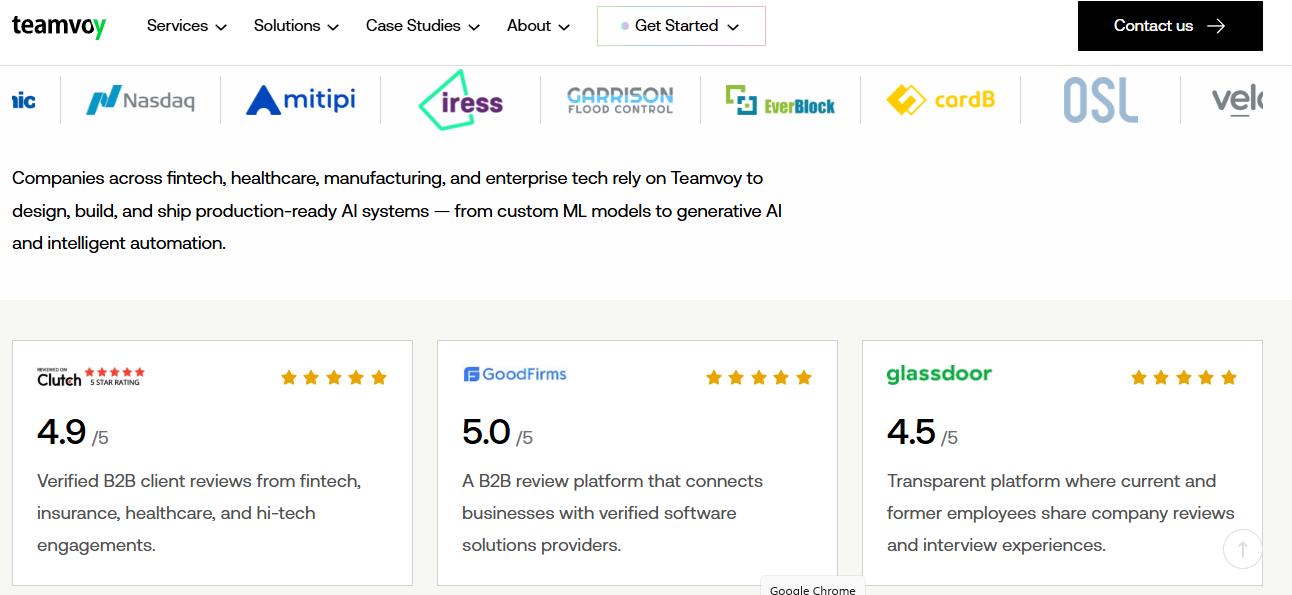
- MLOps maturity: Uses agentic AI across delivery; integrates AI into live, always-on production stacks.
- Model-ownership terms: Full-cycle build with the client owning the system; ownership-first delivery.
- KPI-verified outcomes: Streaming client reports fewer issues and better user experience post-integration.
- Senior-engineer caliber: A senior technical lead owns the system end to end, with a team behind them.
- Time-to-first-model: Varies by engagement; speed measured to production, not to demo.
- Production-readiness: Built for systems where downtime is a regulatory event, not an inconvenience.
- Integrated AI and modernized a legacy stack for a video streaming platform, with fewer issues and better UX reported, starting January 2025.
- Four-year fintech partnership with Bitspark across cryptocurrency, trading, and mission-critical wallet systems running 24/7.
- Two-year blockchain build with Iress in wealth management, from proof of concept to scaled product.
“Teamvoy’s work has resulted in fewer issues and a better user experience. We’re impressed with their involvement in processes and quick completion of work.”
— Dmytro Maryanych, Manager, Takflix (VOD streaming) Teamvoy Clutch – Verified Review
“I can confidently say that we would not be where we are today without Teamvoy’s support. Understanding of blockchain and quality of coding.”
— Gordon Little, Managing Director, Iress (financial services) Teamvoy Clutch – Verified Review

HatchWorks AI
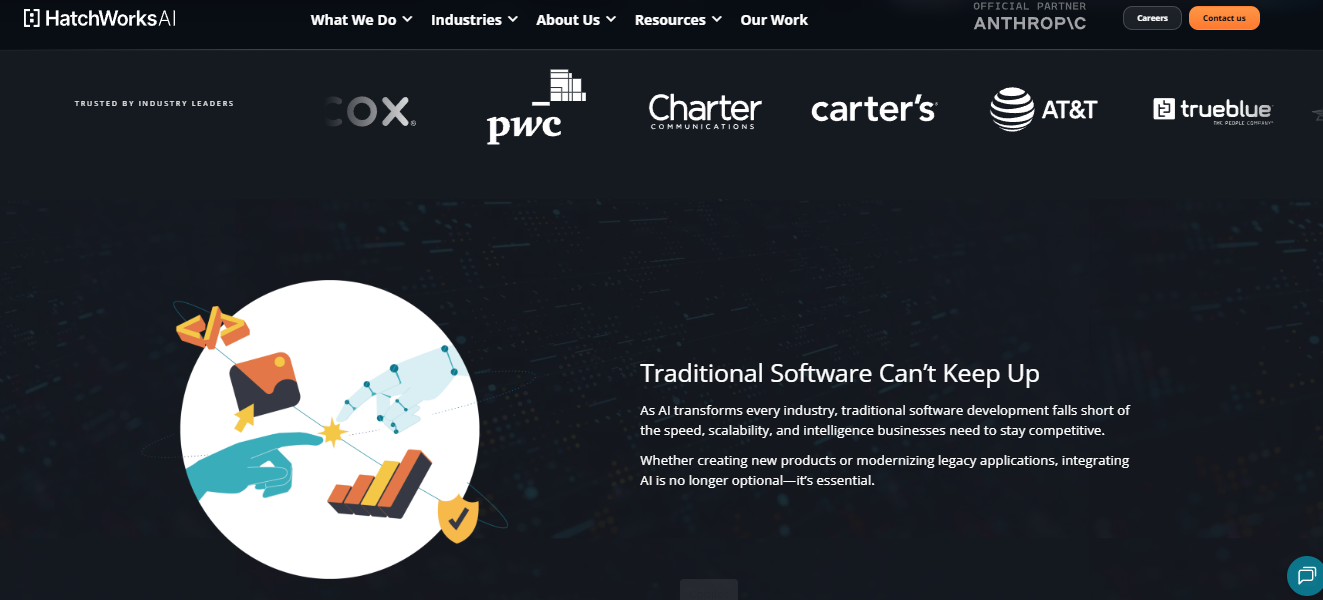
- MLOps maturity: Structured agile delivery with Sprint 0 for architecture, environment, and data pipelines.
- Model-ownership terms: Project-and-deliver with detailed handover documentation to replicate work.
- KPI-verified outcomes: Built a chat assistant answering user questions with over 90% accuracy.
- Senior-engineer caliber: Small assigned teams (2-5); client praised high technical quality and lead PM.
- Time-to-first-model: Delivered a production-ready MVP over a defined 16-week engagement.
- Production-readiness: Deployed a working RAG MVP to a live GCP environment with UAT.
- Designed a RAG chat assistant for an IoT company answering questions with over 90% accuracy.
- Built and deployed a production-ready air-traffic MVP for DronePort Network in a 16-week GCP engagement.
- Ingested ADS-B Exchange data into a warehouse and connected it to an LLM-powered chatbot.
“90% accuracy of chat responses from user questions. Their commitment to get the end product right and to be flexible when the situation required.”
— Josh Horton, Director of Data, Analytics & AI, Cox2M (IoT) HatchWorks AI Clutch – Verified Review
Valere
- MLOps maturity: Runtime model and prompt selection via AWS AppConfig, deploying new models without redeployment.
- Model-ownership terms: Builds the client’s own codebases; client operates the live product.
- KPI-verified outcomes: A client platform now generates capture reports in ~1 hour versus 4-6 weeks manually.
- Senior-engineer caliber: Described by a client as opinionated developers, “not a project a staffing firm could deliver.”
- Time-to-first-model: Hit non-negotiable MVP deadlines gating an early-access launch.
- Production-readiness: Multi-tenant isolation, production in its own VPC, RAG on Amazon Bedrock.
- Built WinMoreBD.ai, a live, revenue-generating AI-native platform for federal contractors.
- Cut capture-intelligence report time from 4-6 weeks of manual work to roughly one hour.
- Delivered three coordinated codebases (TypeScript, Python AI pipeline, React/Next.js) on AWS.
“Valere delivered a team of intelligent, creative, and opinionated developers who are open to change. This is not a project that a staffing firm could deliver.”
— David Huff, CEO & Co-Founder, WinMoreBD.ai (GovTech) Valere Clutch – Verified Review
BlueLabel
- MLOps maturity: Built a modern data layer unifying 40 years of records to feed the AI assistant.
- Model-ownership terms: Project-and-deliver with post-implementation monitoring and optimization.
- KPI-verified outcomes: Cut expert lookup time by about 75%; one client reduced dispatch calls over 50%.
- Senior-engineer caliber: Engaged team includes AI engineer, architect, and CTO-level involvement.
- Time-to-first-model: Weeks-long discovery phase before iterating in sprints.
- Production-readiness: Indexed 390,000 orders and 9,400 clients into a searchable, live assistant.
- Unified 40+ years of manufacturing ERP data (390,000 orders, 9,400 clients, 3,700 products) into an AI assistant.
- Reduced expert lookup time by about 75% for core workflows like order tracking.
- For a telecom-services client, cut dispatch calls by over 50% and saved roughly $10,000 a month.
“Functioning prototype that had the buy-in from the clinicians and was technically ready to integrate with our full stack. What stood out most was how quickly they got to know us as a customer.”
— Anonymous, Chief of Staff to the CEO, Healthcare Technology Company BlueLabel Clutch – Verified Review
Azumo
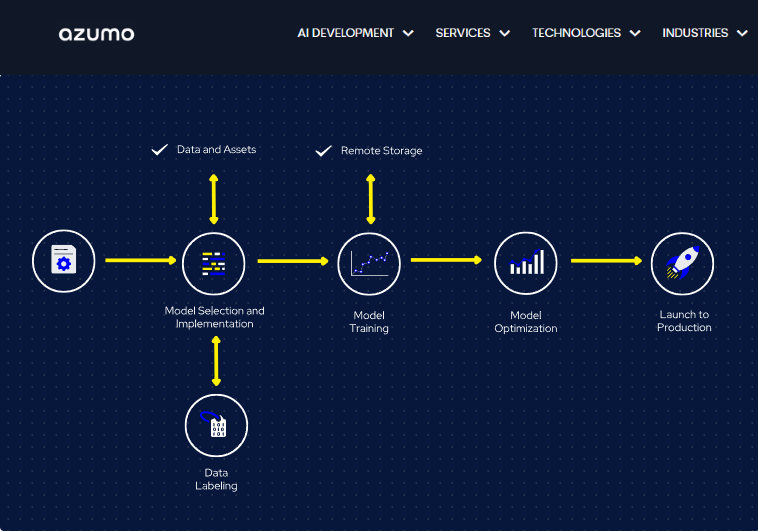
- MLOps maturity: Handles pipeline automation and migrations; built conversational apps on a client AI platform.
- Model-ownership terms: Augmentation model; the client owns the platform and the work.
- KPI-verified outcomes: Offloaded React and automation work, letting a client reallocate internal engineers.
- Senior-engineer caliber: Each engineer is vetted, and the client interviews them before onboarding.
- Time-to-first-model: Flexible resourcing scaled up and down against short-term milestones.
- Production-readiness: Migrated a financial-services SQL Server to Azure SQL with minimal disruption.
- Built conversational applications on a Fortune 100 customer’s stack for an AI SaaS company, nlx.ai.
- Migrated an on-premise SQL Server to Azure SQL for a financial-services firm with minimal disruption.
- Delivered Python, Django, and React work plus pipeline automation for a sports-analytics company.
“I have been wildly impressed with them. Their ability to learn and work with our platform to quickly build conversational applications, and their ability to source qualified staff.”
— Michael Butler, Director of Partnerships, nlx.ai (conversational AI) Azumo Clutch – Verified Review
Vention
- MLOps maturity: Provides AI and platform engineers to extend an existing pipeline and team.
- Model-ownership terms: Augmentation; the client retains ownership of system and code.
- KPI-verified outcomes: Client-reported delivery against scaling milestones; outcome detail varies by engagement.
- Senior-engineer caliber: Deep bench, but seniority depends on who is staffed to your account.
- Time-to-first-model: Fast ramp via a large pre-vetted talent pool.
- Production-readiness: Strong when paired with a client-side architect owning the system.
- Scaled engineering capacity for venture-backed and enterprise AI products across multiple sectors.
- Provides AI, data, and full-stack engineers under a flexible augmentation model.
- Used by teams needing to extend an existing roadmap rather than start net-new.
“Vention had a surprisingly good talent pool on their staff. They delivered fast, high-quality code and closed tickets and bugs extremely quickly. Their employees felt like our employees.”
— Jesse Boyes, CTO, H3R3, Inc. (Social AI) Vention Clutch – Verified Review
DOOR3
- MLOps maturity: AI delivered inside broader enterprise software builds, not as a standalone ML practice.
- Model-ownership terms: Project-and-deliver; deliverables transfer to the client.
- KPI-verified outcomes: Track record in enterprise UX and product; AI-specific KPIs vary by engagement.
- Senior-engineer caliber: Strong product and design leadership on enterprise accounts.
- Time-to-first-model: Discovery-led; design and product framing come before the model.
- Production-readiness: Solid for enterprise app delivery where UX is the primary risk.
- Long history of enterprise software and product-design engagements.
- UX-led delivery for complex internal and customer-facing applications.
- Best suited to AI features embedded in larger product builds.
“DOOR3’s communication is key. It feels like a true partnership; it feels like a team within our company. Their openness to understanding what we do is impressive. It’s a niche industry with complicated financial products.”
— Tara York, Managing Director, Luma Financial Technologies DOOR3 Clutch – Verified Review
Diffco AI
- MLOps maturity: Builds custom ML models and prototypes; production-pipeline depth varies by project.
- Model-ownership terms: Project-and-deliver; built artifacts transfer to the client.
- KPI-verified outcomes: Applied-ML focus across healthcare, retail, and automotive use cases.
- Senior-engineer caliber: Data-science-led teams for model development.
- Time-to-first-model: Strong on getting a working model or prototype in front of you quickly.
- Production-readiness: Hardening to production should be scoped explicitly.
- Custom ML and computer-vision work across healthcare, retail, and automotive.
- Applied data-science prototypes that move from concept to working model.
- Model-development focus rather than full enterprise delivery.
“We saw meaningful results across the board: the project was completed on schedule, stayed within budget, and immediately improved our platform’s performance and reliability.”
— Jacob Hokinson, CPO, Gitcha Diffco AI Clutch – Verified Review
Imaginovation
- MLOps maturity: AI delivered within full custom software builds; standalone ML-ops depth varies.
- Model-ownership terms: Project-and-deliver; deliverables transfer to the client.
- KPI-verified outcomes: Custom web and mobile builds with AI features across multiple sectors.
- Senior-engineer caliber: Full-team model covering design, build, and delivery.
- Time-to-first-model: Suited to early scope where the product is still forming.
- Production-readiness: Reasonable for net-new builds; less focused on regulated legacy cores.
- Custom web and mobile development with AI features across healthcare and retail.
- Full-cycle design-to-delivery for early-stage products.
- Best fit when you need a single team to carry a new build.
“What impressed me the most was their attention to detail. They didn’t just focus on getting the job done; they ensured that it was user-friendly, visually appealing, and optimized for performance.”
— Alfredo Merino, Founder, TalentedIQ (Recruitment Tech) Imaginovation Clutch – Verified Review
Q2: What Does “MLOps Maturity” Actually Mean When You’re Hiring a Development Company?
MLOps maturity is how reliably a company can take a model from notebook to production and keep it working. That includes retraining, monitoring, rollback, and drift detection, not just the build. Microsoft’s maturity model runs from level 0 (no automation, manual scripts) to level 4 (fully automated retraining). When hiring, maturity tells you whether you are buying a demo that degrades in three months or a system that survives real traffic and data shift.
🧩 The Gap Between “Built a Model” and “Run a Model”
Most teams confuse “we built a model” with “we run a model.” Those are different jobs. A model that scores 95% in a notebook can quietly rot the moment live data shifts under it.
The first thing I look at on an AI call is not the model. It is the data layer and the legacy core. A clever model on a messy data pipeline fails faster than a plain one on a clean pipeline, which is why our data engineering work comes before any model talk.
🪜 Reading the Maturity Ladder
The ladder is simpler than vendors make it sound. Google Cloud frames it as CI, CD, and CT: continuous integration, continuous delivery, and continuous training. Here is the practical difference between a low and a high rung.
- Level 1 (manual): A model is hand deployed once. No retraining trigger. No alerting. It works until the data drifts, then nobody notices for weeks.
- Level 3 (automated): A CI/CD pipeline ships the model, everything is version controlled, and integration tests run before release.
- Level 4 (full): Retraining fires automatically off live metrics, with A/B testing built in.
A level 1 deployment looks identical to a level 3 one in a demo. The difference only shows up at 2 a.m., and our AI development services are built around the higher rungs of that ladder.
🌙 What Happens at 2 a.m.
I have watched an on call engineer feed an outage to an AI tool that kept saying “restart the server.” It said it six times. The real cause was a database connection pool drained by a batch cron job. That is tribal knowledge, not a model output.
Maturity lives in the runbook and the monitoring, not in the pitch. An “almost right” answer is more expensive than a clearly wrong one, because it sends you chasing the wrong fix, a pattern we see often during IT audit services.
✅ Three Questions to Test Real Maturity
Run these in the sales call, before you sign.
- Retraining cadence: How and when does the model retrain, and what triggers it?
- Monitoring and alerting: What fires an alert when accuracy drops, and who gets paged?
- Rollback path: When a bad model ships, how fast can you revert, and is it one command or a weekend?
If a vendor answers these with specifics, you are likely near level 3. If they answer with adjectives, you are buying level 1 with a level 4 invoice. At Teamvoy, maturity shows up in the handover document and the on call plan, because we run these systems for years, not weeks, as part of our approach to AI integration services.
Q3: Who Owns the Model, the Weights, and the Code, and Why Do Ownership Terms Decide Your Future?
Model ownership terms decide whether you own a system or rent access to one. Check four things explicitly in the contract: source code, trained model weights, the training and fine tuning data, and the pipeline tooling. Many vendors transfer the app but keep the weights or the orchestration layer. Full IP transfer with source code access is the difference between an asset and a leash.
⚠️ You Can Pass an Audit and Still Not Own Your System
Here is a trap I see often. A founder passes a security audit, feels safe, and only later learns they do not own the part that matters. The app is theirs. The model that makes the app valuable is not.
Ownership is not one thing. It is four layers, and lock in usually hides in the two you forget to ask about, something we flag early during AI consulting.
🔑 The Four Ownership Layers
Name each one in the statement of work, in writing.
- Source code: The application code. Usually transferred, so people assume the rest is too.
- Trained weights: The actual learned model. Sometimes retained by the vendor, which means you cannot redeploy without them.
- Training and fine tuning data: Your data, plus the curated set used to tune. This is your moat. Guard it.
- Pipeline and orchestration tooling: The glue that runs everything. If it is proprietary, you are tied to the vendor’s runtime forever.
Lock in rarely lives in the code. It lives in retained weights and a proprietary orchestration layer you cannot run yourself, a risk we address through clean system integration.
📜 Contract Clauses to Demand
Ownership is a contract problem before it is a technical one. Standards like ISO/IEC 42001 push for clear AI governance and accountability, and your SOW should match that intent.
- Full IP transfer: Source code, weights, and fine tunes assigned to you on payment.
- Source escrow: A neutral third party holds the code if the vendor disappears.
- No proprietary runtime dependency: The system must run on open or owned tooling, not a black box only the vendor can operate.
🛠️ Why I Push Ownership First
I have seen the worst version of this: a hand off of authorship to a vendor who never understood the original product. The client could not hire into their own system. Every change went back through the people who built the lock in, the exact scenario our technology modernization work is designed to undo.
There is a real trade off, so be honest with yourself. Building your own integration layer means you maintain it forever. Only do that if you have a platform team and your core systems are genuinely unique. At Teamvoy, we deliver ownership first so a client can hire engineers into the system later, without us in the room. The specification and the pipeline outlive any single batch of code.
Q4: How Do You Tell Real Production AI From “AI Washing” and Demoware?
AI washing is selling human or scripted work as autonomous AI. The tell is not the demo, because demos always work. It is what happens under real data, real load, and real edge cases. Ask for production metrics, on call ownership, and failure mode handling, plus a live system you can probe. If a vendor cannot show monitoring and rollback, you are buying a demo with a markup.
🎭 The Demo Lies, on Purpose
Most buyers judge AI by the demo. That is exactly the wrong test. A demo is a controlled room with the lights set just right.
Production is the opposite. It is messy data, traffic spikes, and edge cases nobody scripted. The gap between those two worlds is where most AI projects quietly die, and where our proof of concept services separate signal from theater.
💸 The Builder.ai Cautionary Case
The canonical failure here is Builder.ai. The London startup, once valued at $1.5 billion and backed by a reported $450M from Microsoft, sold an AI assistant called “Natasha” that supposedly built apps autonomously.
In reality, around 700 human engineers in India wrote the code by hand. The practice ran for roughly eight years before it surfaced in May 2025, and the company collapsed into bankruptcy with nearly 1,000 layoffs. They promised a machine and sold a workforce. That is AI washing at full scale, the kind of risk we help fintech teams avoid with regulator ready AI.
“Builder.ai faked AI with 700 engineers, now faces bankruptcy.” Reddit Thread
🔥 Autonomy Without Guardrails Is a Liability
Even real automation bites without limits. I have seen an agent stuck in an infinite retry loop against a CRM, with no circuit breaker. It ran for six hours overnight and burned thousands in API bills before anyone woke up.
“Autonomous” without guardrails is not a feature. It is an open tab on your credit card. After fifteen years shipping production systems, this is the work I trust least when it is undersold and over promised, which is why our AI agent development services start with circuit breakers and error budgets.
✅ The “Is This Real?” Checklist
Run this on Monday, before the contract.
- Production metrics: Can they show live accuracy, latency, and error rates from a real deployment?
- On call ownership: Who gets paged at 2 a.m., and is it a named human?
- Failure mode handling: What happens when the model is wrong, and where are the circuit breakers?
- A live system to probe: Can you test the real thing, not a sandbox with fixed inputs?
- Monitoring and rollback: Is there drift detection and a one command revert?
If the answers are specific, the AI is probably real. If they are glossy, you are paying for a demo. Teamvoy gets called in after this goes wrong, on vendor rescues and AI built MVPs that hit their limits, and the fix always starts with the five questions above. Trust is built through results, not presentations.
Q5: Should You Build an In-House ML Team or Hire a Development Company?
Build in-house when machine learning (ML) is your core product and you can fund a standing platform team. Hire a company when you need production capability faster than you can recruit, or when the job is integrating AI into an existing system. The hidden cost of building is permanent maintenance: you own every schema, mapping, and retry path forever. Most companies should hire to ship, then transfer ownership and hire into it.
🧮 When Each Path Wins
The decision is not about talent. It is about who carries the maintenance burden after launch. Build your own integration layer, and you become Chief Integration Officer forever.
I only tell a founder to build in-house when two things are true at once. ML is genuinely their core product, and their systems are unique enough that no partner shortcut exists. Otherwise, writing the code is the cheapest part. Making it correct, and keeping it correct, is the expensive part, which is where our AI development services focus.
📊 Build vs Hire vs Hybrid
| Factor | Build In-House | Hire a Company | Hybrid (Hire, Then Own) |
|---|---|---|---|
| Time to first model | Slow (hiring cycle) | Fast | Fast |
| Total cost | High, fixed payroll | Project scoped | Scoped, then internal |
| Maintenance burden | Yours forever | Vendor (lock in risk) | Transfers to you |
| IP and control | Full | Depends on contract | Full on transfer |
| Regulated industry risk | High if green team | Lower if proven | Lower, with handover |
Read it by stage. A Series A team rarely affords a standing platform team, so hiring to ship is usually right. A mid-market firm often runs hybrid. A large enterprise with unique core systems can justify building, often alongside dedicated AI engineers.
🔁 The Hybrid Path: Hire to Ship, Transfer to Own
The path I trust most is hire to ship, then transfer ownership and hire into the system. You get production speed now without a permanent staffing bet. Then your own engineers grow into the codebase, supported by our AI integration services.
Tooling does not change this math. Cursor and Copilot make the engineers you have more effective, but only if those engineers know how to fight. At Teamvoy, our model is a senior lead who owns the system, then hands it over clean so your team can run it without us. That is why our engagements average four plus years; we stay until the transfer is real, not theoretical, the same discipline behind our technology modernization work.
Q6: How Should Regulated Industries Evaluate an AI/ML Partner, and Map Production-Readiness to NIST, ISO 42001, SOC 2 and the EU AI Act?
In regulated industries, evaluate auditable delivery, not just model accuracy. Confirm named standard experience (SOC 2, PCI-DSS, HIPAA, GDPR, DORA, BaFin, and PSD2). Ask how the partner maps production-readiness to governance frameworks like the NIST AI RMF, ISO/IEC 42001, and the EU AI Act. The biggest new risk is the “lethal trifecta”: an agent with read access to private data, untrusted input, and an external channel.
⚠️ The Deadline and the Data Exfiltration Risk
Here is the bind I see in fintech and healthcare. A compliance deadline is fixed, and an AI feature could quietly leak the very data you must protect. Both are true at once.
The first thing I look at on a regulated AI call is not the model. It is the data layer and what the agent can touch. Accuracy means nothing if the system can be tricked into handing data away, a risk we map during IT audit services.
🔓 The Lethal Trifecta
The “lethal trifecta” is a simple, dangerous combination. An agent has read access to sensitive data, processes untrusted external input, and has an outbound channel to send things.
I have seen a demo where a mock email carried a hidden instruction, a prompt injection. The agent read it, found a developer’s private key, and tried to send it out, all in about five minutes. Remove any one leg of the trifecta, and the attack fails. That is the control to design for first, and it shapes how we build AI agents.
🗂️ Mapping Production-Readiness to the Frameworks
Auditable delivery means your controls line up with named frameworks. Here is the practical mapping I use.
- NIST AI RMF 1.0: Govern, Map, Measure, and Manage. Use it to put AI risks into your risk register and incident response.
- ISO/IEC 42001 and 27001: A documented AI management system, plus information security controls.
- AICPA SOC 2: Evidence that controls operate over time, not just on paper.
- EU AI Act: For high-risk systems, a documented risk management system, data governance, logging, and human oversight, with core obligations enforceable from August 2026.
✅ The Vendor Selection Checklist
Ask these before you sign, in writing.
- Which named standards have you delivered against, and can you show audit artifacts?
- How do you break the lethal trifecta in agent designs?
- Who owns on call, and will a senior engineer stay through go live?
At Teamvoy, we work in regulated delivery where downtime is a reportable event, across banking and fintech and healthcare. We do not hand off to a junior team and exit before the system goes live. That is the part regulators actually test.
Q7: What Should You Get in Writing Before You Sign: KPIs, Ownership, and the Read-Run-Extend Exit Test?
Before signing, get three things in writing. How outcomes are measured (named KPIs with a baseline and a target), who owns the system and source, and the on-call and handover plan after launch. Engineering pricing is custom quoted everywhere, so compare value and accountability, not headline rates. The best exit test: can your own team read, run, and extend the system without the vendor in the room?
📉 Why the Contract Matters More Than the Pitch
The numbers explain the urgency. MIT’s July 2025 NANDA report found that 95% of enterprise GenAI pilots delivered no measurable return, despite $30 to $40 billion in spend. Only about 5% of custom tools reached production.
That is what a contract without KPIs buys you. Free or fast AI code is the most expensive debt you can take on, because someone has to support it later, a lesson at the heart of our AI consulting.
📝 The Pre-Signing Checklist
Put each of these in the statement of work.
- KPIs with a baseline: A named metric, today’s number, and the target. No baseline means no proof.
- Ownership and source: Source code, weights, data, and tooling assigned to you on payment.
- On call and handover: Who answers at 2 a.m., and what the transfer plan looks like.
- The read-run-extend exit test: Can your team read it, run it, and extend it alone?
For that last test, I use three questions on any handover. Does the code reuse existing patterns? Does it follow your conventions? Can a developer explain it without reading the AI’s comments? These same checks guide our system integration handovers.
🤝 A Note, Founder to Founder
If you have read this far, you already know the shape of partner your situation calls for. A stalled pilot needs different help than a net new build. A regulated core needs different help again.
That is the honest read I would give a peer over coffee. Teamvoy exists for the systems that have to keep working, and we would rather you pick the right fit than the loudest pitch. If you want that conversation, our door is open at contact us. Trust is built through results, not presentations.