TL;DR
- AI software development solutions split into model labs that sell the brain and build partners that ship and maintain your actual system.
- A 2025 MIT study found 95% of enterprise generative AI pilots delivered no measurable return, because partners ship demos, not production systems.
- Evaluate partners on six axes: production deployment rate, model IP ownership, MLOps practice, eval rigor, compliance engineering, and handover quality.
- Pricing is custom-quote everywhere; the real surprises are operational, like agent retry loops that quietly burn thousands in API charges overnight.
- Match the partner to your situation: burned CTO, legacy-core founder, regulated IT director, or vibe-coded founder each need a different kind of help.
- Almost-right code is more expensive than completely wrong code, because it passes review, ships, and compounds quietly before it bites in production.
Q1. How Should You Evaluate AI Software Development Solutions in 2026?
Picking an AI software development partner is not like buying a tool. You are handing someone write access to a system your business depends on. Get it wrong, and you inherit code nobody can read, a model you do not own, and a compliance gap you discover during an audit. The stakes are highest in regulated work, where downtime is a reportable event, not an inconvenience. This guide rates fifteen kinds of partner on what actually survives production: deployment rate, model ownership, MLOps practice, evaluation rigor, compliance engineering, and handover quality. It is written for the CTO, founder, or IT director who has been burned before. If you are weighing a stalled pilot, our AI consulting work starts at exactly these six questions.
⚠️ Why most AI pilots never reach production
Here is the number that should frame every vendor conversation. A 2025 MIT study found that 95% of enterprise generative AI pilots delivered no measurable financial return. Not 50%. Ninety-five.
The pilots do not fail because the model is weak. They fail because the partner shipped a demo, not a system. The first thing I look at on an AI integration call is not the model. It is the data layer and the legacy core underneath it. That is where AI either pays back or quietly stalls.
⭐ Our Evaluation Criteria
I rate each kind of partner on six axes. These are the things that separate a system that keeps working from one that breaks the week after the vendor leaves.
- Production deployment rate: Does their AI work reach live production and stay there, or stall at the demo? This predicts your outcome better than any model list.
- Model IP ownership: After the engagement, who owns the weights, fine-tunes, prompts, and training data? You should own them, not just the source code.
- MLOps practice: Do they run automated pipelines, drift monitoring, and reproducible builds (MLOps means the discipline of shipping and maintaining models in production), or is it manual and fragile?
- Evaluation rigor: Can they prove a model works with tests and evals before it ships, instead of “it looked right in the demo”?
- Compliance engineering: Can they build auditability in for named regimes (DORA, PCI-DSS, HIPAA, GDPR), not bolt it on after?
- Handover quality: Can your team read, run, and extend the system after they exit, or are you locked in forever?
✅ Who This Guide Is For
I wrote this for three people I meet often. You may recognize yourself in one of them.
- The Burned CTO. You inherited a system a previous vendor walked away from. You need stabilization and a credible path forward, not another round of the same mistake.
- The Technical Founder on a legacy core. You built the product early, it worked, the company scaled. Now the system is hard to change and harder to scale, and you need AI integration without a disruptive rewrite. This is where our technology modernization work lives.
- The Vibe-Coded Founder. You built fast with Cursor, Replit, or Vercel v0 (AI-assisted coding tools), got traction, and now production is unstable with code nobody fully understands.
📋 The Field Map: Which Partner Fits Which Situation
This is not a ranking. Each company exists for a different situation. Match the situation to your own.
- Teamvoy: Best for regulated fintech, insurance, or healthcare systems needing AI integration or legacy modernization without a rewrite.
- HatchWorks AI: Best for teams wanting “generative-driven development” pods to accelerate feature delivery.
- Azumo: Best for nearshore AI and data engineering augmentation at predictable cost.
- DOOR3: Best for enterprise UX-heavy custom software with a strategy front end.
- BlueLabel: Best for AI assistants layered onto legacy ERP and operational data.
- Vention: Best for scaling embedded engineering pods fast alongside an in-house team.
- NineTwoThree AI Studio: Best for AI MVPs and product design from concept to launch.
- Achievion Solutions: Best for AI proof-of-concept and MVP validation before a larger build.
- Diffco AI: Best for applied AI and machine learning R&D-style builds.
- Trigent Software: Best for high-volume QA, testing, and offshore delivery capacity.
- SOLTECH: Best for Southeast US custom software with long-term support.
- Orases: Best for custom business applications and AI training for non-technical teams.
- Sidebench: Best for venture-style product builds in healthcare and public sector.
- Valere: Best for product strategy plus build for funded startups.
- Scopic: Best for distributed-team custom software at lower price points.
🗂️ Master Comparison Table
| Company | Best For | Engagement Model | Industry Depth & Compliance Coverage |
|---|---|---|---|
| Teamvoy | Regulated systems needing AI integration or modernization without a rewrite | Long-term partner (4+ yr avg) | Fintech, insurance, healthcare; BaFin, PSD2, DORA, SOC 2, PCI-DSS, HIPAA, GDPR |
| HatchWorks AI | Accelerating feature delivery with GenAI pods | Long-term partner / staff aug | Healthcare, fintech, SaaS; HIPAA, SOC 2 (varies by engagement) |
| Azumo | Nearshore AI and data engineering augmentation | Staff augmentation | SaaS, media, fintech; SOC 2 (regulated depth varies) |
| DOOR3 | Enterprise UX-heavy custom software | Project-and-exit / long-term | Enterprise, finance, healthcare; HIPAA, SOC 2 (varies) |
| BlueLabel | AI assistants on legacy ERP and operational data | Project-and-exit | Manufacturing, consumer, SaaS; limited named regulatory scope |
| Vention | Scaling embedded engineering pods fast | Staff augmentation | SaaS, startups, fintech; SOC 2 (regulated depth varies) |
| NineTwoThree AI Studio | AI MVPs and product design to launch | Project-and-exit | Consumer, fintech, health; regulated depth varies |
| Achievion Solutions | AI proof-of-concept and MVP validation | Project-and-exit | SaaS, health data, education; not deeply regulated |
| Diffco AI | Applied AI and ML R&D-style builds | Project-and-exit | SaaS, health, consumer; regulated depth varies |
| Trigent Software | High-volume QA, testing, offshore capacity | Staff augmentation / project | Enterprise, retail; broad but not AI-regulated-specific |
| SOLTECH | Southeast US custom software with support | Long-term partner | SMB, enterprise; not deeply regulated |
| Orases | Custom business apps and AI training | Project-and-exit | Insurance, healthcare, manufacturing; varies |
| Sidebench | Venture-style builds in health and public sector | Project / long-term | Healthcare, public sector; HIPAA |
| Valere | Product strategy plus build for funded startups | Project-and-exit | Fintech, SaaS, startups; varies |
| Scopic | Distributed-team custom software at lower cost | Project-and-exit | SMB, healthcare, manufacturing; varies |
The cards below go deeper. I am opening with the first seven. Note one honest limit before you read: pricing is custom-quote across every company here, so I do not rank on price, and any “cheap vs expensive” table you see elsewhere is misleading you.
Teamvoy
- Production deployment rate: Ships AI into live regulated systems, with post-release support, not pilots.
- Model IP ownership: System and code stay with the client; built for ownership transfer.
- MLOps practice: Agentic AI used across delivery; senior lead owns the pipeline.
- Evaluation rigor: Senior technical lead accountable end to end, not a junior pod.
- Compliance engineering: BaFin, PSD2, DORA, SOC 2, PCI-DSS, HIPAA, GDPR in scope.
- Handover quality: Built to be read and extended; modernizes without a rewrite.
- Four-year fintech engagement with Bitspark, covering crypto trading, wallets, and mission-critical 24/7 systems.
- AI integration and legacy-stack modernization for Takflix, a live streaming platform, ongoing since January 2025.
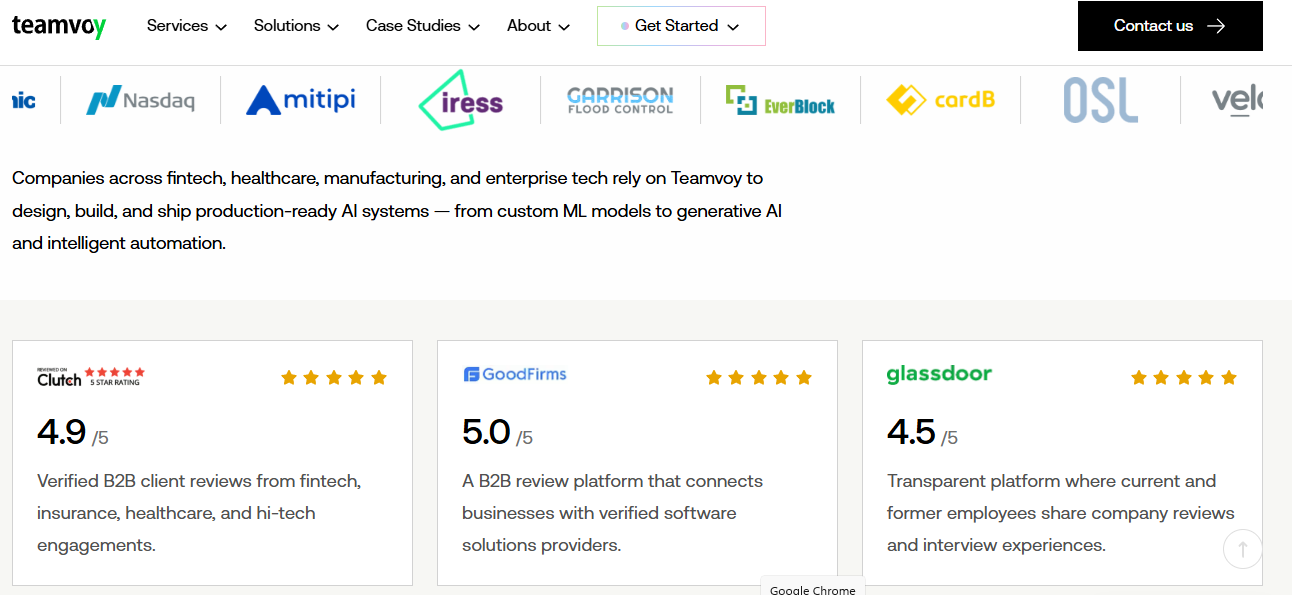
- Named proof points in regulated and hi-tech work include Nasdaq and Market Access Direct.
“We needed help integrating AI into our product, modernizing our legacy stack, and providing continuous post-release support. Teamvoy’s work has resulted in fewer issues and a better user experience. They deliver on time.”
— Dmytro Maryanych, Manager, Takflix (streaming) Teamvoy Clutch – Verified Review
“Their team helped us create a proof of concept and minimum viable product, then helped us build a talented team and bring the product to scale. I can confidently say that we would not be where we are today without Teamvoy’s support.”
— Gordon Little, Managing Director, Iress (financial services / blockchain) Teamvoy Clutch – Verified Review
HatchWorks AI
- Production deployment rate: Strong on shipping features fast with AI-assisted pods.
- Model IP ownership: Client-owned deliverables; confirm terms per contract.
- MLOps practice: “Generative-driven development” framework; depth varies by team.
- Evaluation rigor: Process-led; eval discipline tied to the assigned pod.
- Compliance engineering: HIPAA and SOC 2 work cited; not its core selling point.
- Handover quality: Pod model; ownership transfer depends on engagement length.
- Positions around nearshore GenAI delivery pods for product teams.
- Publishes its own framework content on generative-driven development.
- Clutch profile reflects product and AI engagement work.
“90%+ accuracy of chat responses from user questions. Their commitment to get the end product right and to be flexible when the situation required.”
— Josh Horton, Director of Data, Analytics & AI, Cox2M (IoT) HatchWorks AI Clutch – Verified Review
Azumo
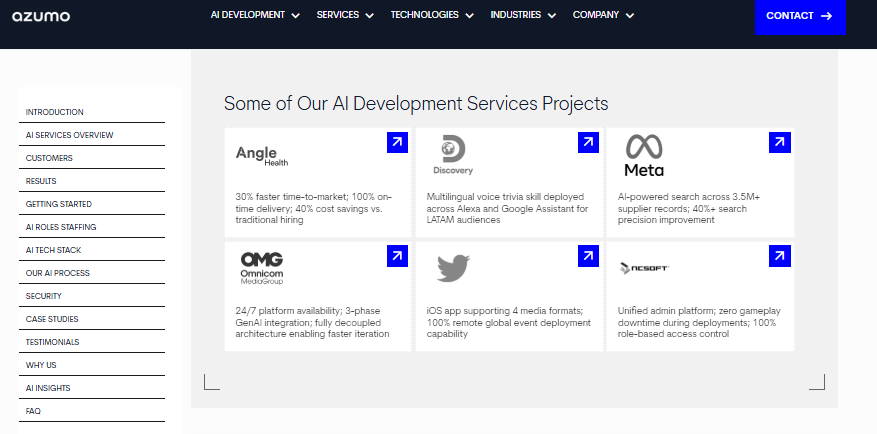
- Production deployment rate: Augments your team’s delivery; output tracks your own process.
- Model IP ownership: Staff-aug model; IP typically sits with the client.
- MLOps practice: Data-engineering depth is a genuine strength here.
- Evaluation rigor: Depends on your internal standards, since engineers embed in your team.
- Compliance engineering: SOC 2 cited; deep regulated-finance scope varies.
- Handover quality: Augmentation means knowledge stays partly with the vendor’s people.
- Long track record in AI, data engineering, and application development.
- Nearshore model aimed at US clients wanting overlap hours.
- Clutch profile reflects sustained augmentation engagements.
“They meet the timelines for the delivery of each use case across each phase of the engagement. This engagement has no defined end date. They have also helped on other projects as well.”
— Michael Butler, Director of Partnerships, nlx.ai Azumo Clutch – Verified Review
DOOR3
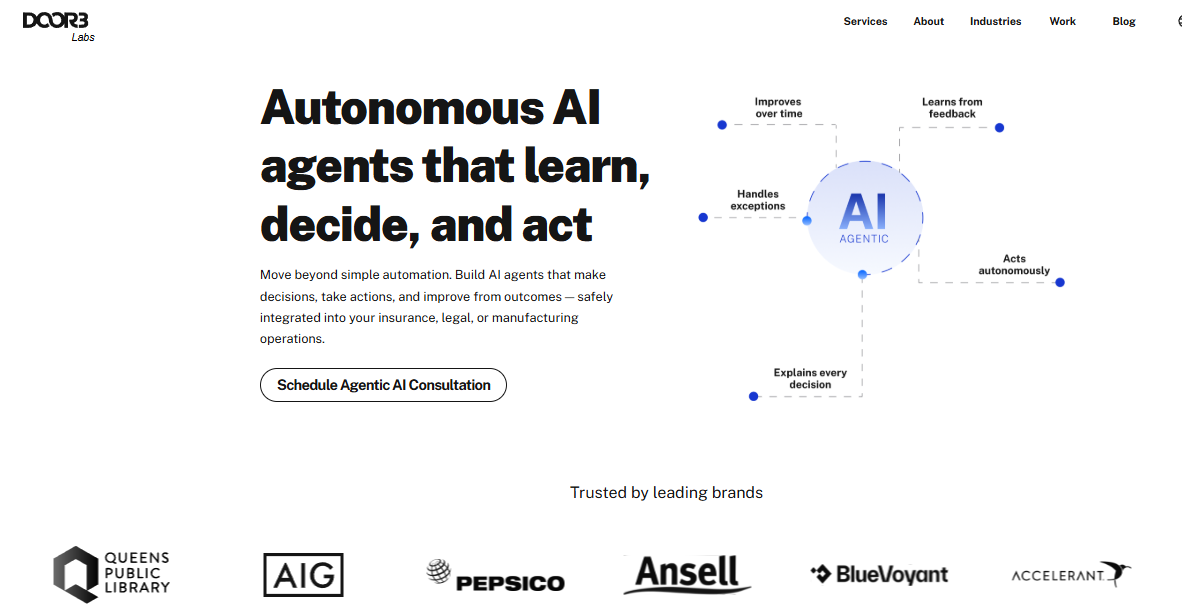
- Production deployment rate: Solid record on enterprise custom builds reaching production.
- Model IP ownership: Client-owned deliverables on custom engagements.
- MLOps practice: Software-engineering led; AI/MLOps is not the core identity.
- Evaluation rigor: Strong discovery and UX-research front end.
- Compliance engineering: HIPAA and SOC 2 work cited; depth varies by sector.
- Handover quality: Documentation-led delivery suits enterprise handover.
- Long-standing enterprise custom-software and UX consultancy.
- Works across finance, healthcare, and enterprise workflow systems.
- Clutch profile reflects enterprise-grade engagements.
“DOOR3’s communication is key. It feels like a true partnership; it feels like a team within our company. Their openness to understanding what we do is impressive. It’s a niche industry with complicated financial products.”
— Tara York, Managing Director, Luma Financial Technologies DOOR3 Clutch – Verified Review
BlueLabel
- Production deployment rate: Shipped a working AI assistant on a live manufacturing ERP.
- Model IP ownership: Project delivery; confirm IP transfer in the contract.
- MLOps practice: Built a modern data layer unifying 40 years of records.
- Evaluation rigor: Outcome-tracked (cut expert lookup time ~75% on core workflows).
- Compliance engineering: Limited named regulatory scope publicly claimed.
- Handover quality: Project model; long-term ownership transfer varies.
- Unified ~390,000 orders, 9,400 clients, and 3,700 products into a searchable data layer for a manufacturer.
- Encoded a 40-year specialist’s playbooks into assistant behavior to cut tribal-knowledge reliance.
- Separately reduced dispatch calls 50%+ for a telecom-field client using OpenAI-based automation.
“Functioning prototype that had the buy-in from the clinicians and was technically ready to integrate with our full stack. What stood out most was how quickly they got to know us as a customer.”
— Anonymous, Chief of Staff to the CEO, Healthcare Technology Company BlueLabel Clutch – Verified Review
Vention
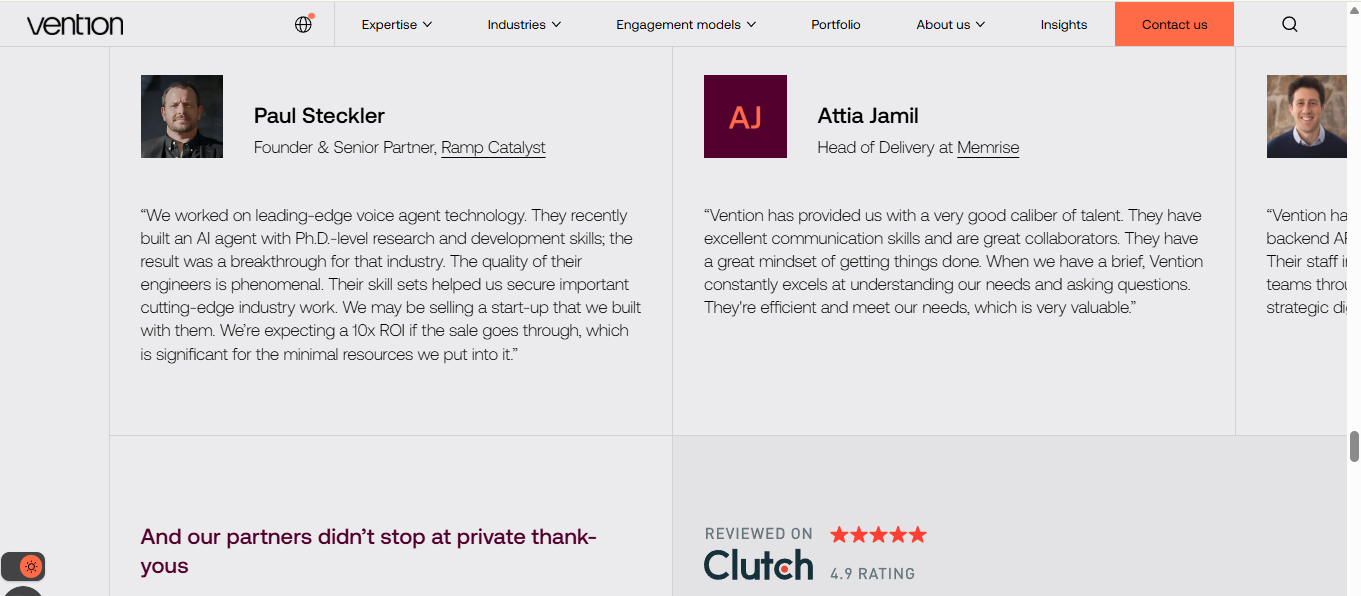
- Production deployment rate: Engineers ship inside your sprints; output tracks your process.
- Model IP ownership: Augmentation; IP and code stay with the client.
- MLOps practice: Depends on your internal pipeline, not Vention’s.
- Evaluation rigor: Measured by your team’s standards (PRs merged, features shipped).
- Compliance engineering: SOC 2 typical; deep regulated scope varies.
- Handover quality: People are embedded, so knowledge partly leaves when they do.
- Engineers fully embedded and productive in a B2B SaaS client’s pods within ~8 weeks.
- Covered backend, frontend, and QA across customer-facing features.
- Strong, repeat-engagement reviews on account management and responsiveness.
“Vention had a surprisingly good talent pool on their staff. They delivered fast, high-quality code and closed tickets and bugs extremely quickly. Their employees felt like our employees.”
— Jesse Boyes, CTO, H3R3, Inc. Vention Clutch – Verified Review
NineTwoThree AI Studio
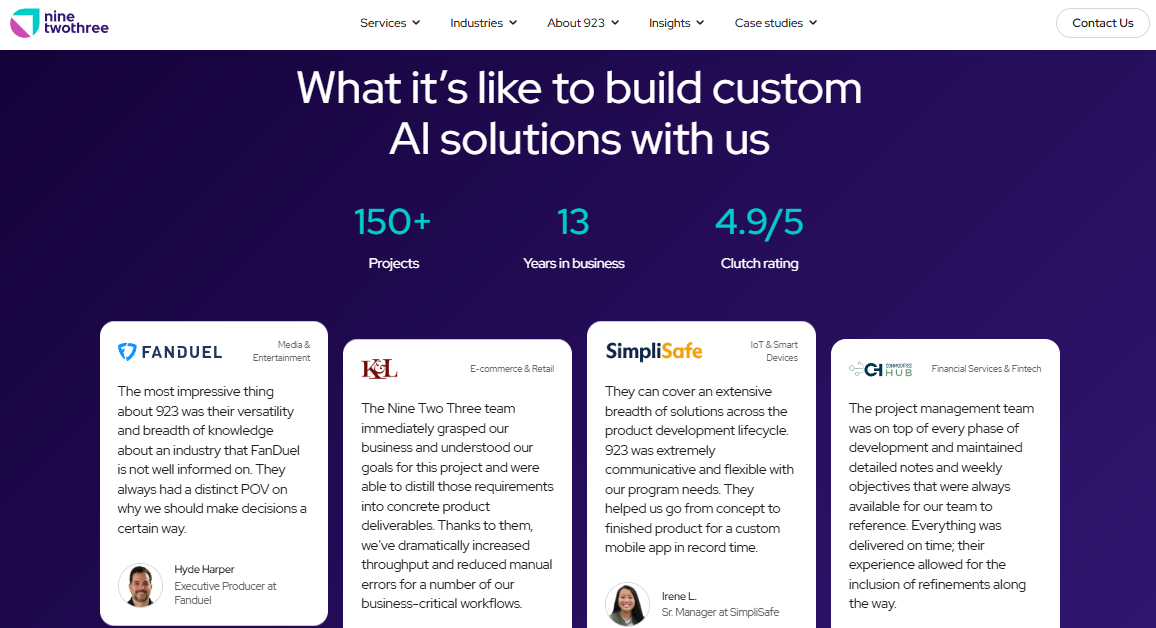
- Production deployment rate: Ships polished MVPs and prototypes to launch.
- Model IP ownership: Client-owned deliverables on product builds.
- MLOps practice: Product-and-design led; AI engineering tied to the build.
- Evaluation rigor: User research and milestone reviews are a strength.
- Compliance engineering: Regulated depth varies by project.
- Handover quality: Strong design artifacts; plan support past launch.
- Delivered a complete mobile UI and clickable prototype, helping a client hit 4+ stars on app reviews.
- Ran consumer research that fed detailed user insights into milestone reviews.
- Concept-to-finished-product delivery cited as fast and high quality.
“What was most impressive was their depth of experience and expertise for every phase of development. This allowed for problem solving and enhancements throughout the development and helped to turn a good idea into a great deliverable.”
— William Hess, Co-CEO & Head of Research, PRC Macro NineTwoThree AI Studio Clutch – Verified Review
Achievion Solutions
- Production deployment rate: Ships POCs and MVPs that reach beta testing.
- Model IP ownership: Client-owned deliverables on custom builds.
- MLOps practice: Data-science and Python builds; lighter on heavy MLOps.
- Evaluation rigor: One client flagged QA gaps caught only at handoff.
- Compliance engineering: Not positioned for deeply regulated regimes.
- Handover quality: US-based PM plus offshore engineers; plan support past launch.
- Built an AI design-platform POC and MVP that ran a beta with 150+ users.
- Delivered an MVP, beta, and website for a health-data company.
- Built a Python recommendation algorithm for an education nonprofit’s pilot.
“We had a Beta test run of the MVP with over 150 users. Showed that we had a MVP that worked. We were impressed with their ability to deliver a high-quality, polished MVP.”
— Anonymous, Partner, Design Company Achievion Solutions Clutch – Verified Review
Diffco AI
- Production deployment rate: Strong; ships production-ready V2 platforms.
- Model IP ownership: Client-owned deliverables on custom builds.
- MLOps practice: Real refactoring and infrastructure-modernization track record.
- Evaluation rigor: Architecture-led; contributes to design decisions.
- Compliance engineering: Regulated depth varies by project.
- Handover quality: Provides technical docs and post-deployment support.
- Refactored a real-estate platform’s codebase and modernized infra for a V2 launch; uptime and deploys improved.
- Took an AI landscape-design product from concept to production-ready V2 on schedule.
- Integrated third-party shipping APIs and optimized backend for a logistics platform.
“We saw meaningful results across the board: the project was completed on schedule, stayed within budget, and immediately improved our platform’s performance and reliability.”
— Jacob Hokinson, CPO, Gitcha Diffco AI Clutch – Verified Review
Trigent Software
- Production deployment rate: Output tracks your release process; it is capacity.
- Model IP ownership: Client-owned; staff-aug delivery model.
- MLOps practice: General software/QA depth; AI-specific MLOps not the core.
- Evaluation rigor: QA and testing are the headline strength here.
- Compliance engineering: Broad enterprise coverage; not AI-regulated-specific.
- Handover quality: Long-running offshore model; document ownership transfer.
- Decades-long enterprise QA and software-services track record.
- Scales large offshore teams for testing and maintenance.
- Clutch profile reflects sustained enterprise delivery work.
“I’m most impressed by their unbelievable understanding of our complex requirements. When ordering a truck, there are billions and billions of combinations available. Trigent understands that, which makes them extremely effective.”
— Jim Pirie, Chief Engineer, Navistar International Trigent Software Clutch – Verified Review
SOLTECH
- Production deployment rate: Ships and supports custom software long-term.
- Model IP ownership: Client-owned deliverables on custom engagements.
- MLOps practice: General software engineering; AI is a growing area, not the core.
- Evaluation rigor: Process-led delivery with ongoing support.
- Compliance engineering: Not positioned for deeply regulated regimes.
- Handover quality: Support-oriented model suits clients wanting continuity.
- Long-running custom-software and support track record.
- Onshore delivery aimed at Southeast US clients.
- Clutch profile reflects sustained custom-build engagements.
“SOLTECH’s customer service distinguishes them from the competition. The team goes above and beyond to meet our needs.”
— Kattie Henderson, Manager of Software Project Mgmt, Neptune Technology Group SOLTECH Clutch – Verified Review
Orases
- Production deployment rate: Solid record shipping custom business applications.
- Model IP ownership: Client-owned deliverables on custom builds.
- MLOps practice: Software-led; AI offering includes team training.
- Evaluation rigor: Structured delivery and discovery process.
- Compliance engineering: Works in insurance and healthcare; depth varies.
- Handover quality: Adds AI training for non-technical teams, easing adoption.
- Long-standing custom business-application firm.
- Works across insurance, healthcare, and manufacturing workflows.
- Clutch profile reflects sustained mid-market delivery.
“What normally would take 15 to 20 minutes for a well trained quoting person to accurately make loan documents in the insurance space now takes 30 seconds. Truly the best investment I think I have ever made.”
— Adam McCroskie, Owner, Lending Company Orases Clutch – Verified Review
Sidebench
- Production deployment rate: Ships venture-grade products to launch.
- Model IP ownership: Client-owned deliverables on product builds.
- MLOps practice: Product-and-strategy led; AI tied to the build.
- Evaluation rigor: Strong discovery and product-strategy front end.
- Compliance engineering: HIPAA experience via healthcare work.
- Handover quality: Studio model; plan long-term support separately.
- Established LA product studio with healthcare and public-sector work.
- Strategy-led builds from concept to launch.
- Clutch profile reflects product and innovation engagements.
“I’m impressed by Sidebench’s professionalism in project management. I’m also impressed by their design stage, in which we planned the entire project in terms of integrations, workflows, and UI. The product they’ve helped us create has been exceptional.”
— Anonymous, Executive, BrilliSkin Sidebench Clutch – Verified Review
Valere
- Production deployment rate: Ships products for funded startups to launch and scale.
- Model IP ownership: Client-owned deliverables on product builds.
- MLOps practice: Product-led; AI engineering tied to the engagement.
- Evaluation rigor: Strategy-and-design front end is a strength.
- Compliance engineering: Fintech exposure; regulated depth varies.
- Handover quality: Plan support past launch, as with most studios.
- Product studio focused on fintech, SaaS, and startup builds.
- Strategy-plus-engineering model from concept to scale.
- Clutch profile reflects funded-startup product work.
“Valere’s AI capabilities are the real deal. Many firms claim generative AI expertise, but Valere’s team has demonstrated actual competency in prompt engineering, output validation, and iterative model refinement. The team doesn’t oversell what AI can do.”
— Chris Brown, Co-Founder, GetOnyx Valere Clutch – Verified Review
Scopic
- Production deployment rate: Ships custom software across many verticals.
- Model IP ownership: Client-owned deliverables on custom builds.
- MLOps practice: General software engineering; AI is one of many offerings.
- Evaluation rigor: Process-led across a large distributed workforce.
- Compliance engineering: Broad but not regulated-AI-specific.
- Handover quality: Distributed model; confirm continuity and docs.
- Long-established distributed software-development firm.
- Works across healthcare, manufacturing, and SMB software.
- Clutch profile reflects high project volume.
“I was very impressed with the comprehensiveness of Scopic’s services. We had needs that crossed into different areas, but they had the full set of skills that we needed to achieve our goals for this project.”
— Josh Polster, CEO, Mediphany Scopic Clutch – Verified Review
Q2. What Are AI Software Development Solutions, and How Do Build Partners Differ From Model Labs?
AI software development solutions are services that use AI, including generative AI, machine learning, natural language processing (NLP, software that reads and writes human language), and computer vision, to build, change, and maintain production software. They split into two kinds. Foundation-model labs sell the model. Build partners ship and maintain your system. Most pilots stall because the AI acts like a read-only wiki bot, with no memory of your architecture, and never earns safe write access.
🧠 The category, in plain language
Strip the hype, and the category covers five capabilities. Generative AI writes code and text. Machine learning predicts from data. NLP handles language. Computer vision reads images. MLOps (the discipline of shipping and running models reliably) holds it all together.
Most vendors can demo the first four. The fifth is where projects live or die. Hidden technical debt in machine-learning systems is real and well documented, and it hides in the plumbing, not the model. This is exactly where our AI development services start, with the data layer first.
⚠️ Read-only bot versus safe write access
Here is the failure mode I see most. A team bolts a chatbot onto their docs. It answers questions, looks smart in the demo, and changes nothing. It is a read-only wiki bot.
The hard part is write access: letting AI touch the real system safely. Think of the film Memento, where the lead has no short-term memory. An AI with no memory of your architecture cannot be trusted to act on it. Getting to safe write access is the heart of our AI integration services.
🔌 Why a build partner is not a model lab
This trips up real buyers. You search for an AI development partner, and the list names NVIDIA, OpenAI, or Meta. Those are model labs. They build the brains, not your system.
A build partner does the unglamorous work: integration, the data layer, and the legacy core. I call this the nervous system. We obsess over the brain and ignore the wiring that carries the signal. Even a top-tier model is useless when it gets fed bad data, and system integration is the most overlooked bottleneck on every engagement I have run.
✅ The better question to ask
So reframe the question. Stop asking “which model?” Start asking “which partner can give AI safe write access to my system without breaking it?”
That is where Teamvoy sits, on stacks already under pressure where the data layer and the legacy core are the first two questions, not the model. If you want a sounding board before committing, our AI consulting work starts there. The honest limit: giving AI safe write access on a messy stack takes longer than the demo suggests, and sometimes the data layer has to be fixed first.
Q3. How Do You Judge Build Quality: MLOps Maturity, Eval Rigor, and AI Technical Debt?
Judge build quality on three things. MLOps maturity (automated pipelines, drift monitoring, and reproducible builds, graded by Google’s levels 0 to 2). Eval rigor (proving a model works with tests, not vibes). And resistance to AI technical debt. The worst outcome is “almost right” code, because it passes review, ships, and then compounds quietly for months before it bites.
🧪 MLOps maturity and eval rigor, defined
MLOps maturity asks one question: can they rebuild and redeploy your model on demand, automatically? Level 0 is manual and fragile. Level 2 is fully automated, with monitoring that catches drift (when a model quietly gets worse as data shifts).
Eval rigor is the proof step. Can they show the model works with a test suite, before it ships? “It looked right in the demo” is not an eval. Pairing this discipline with data engineering is what keeps a model honest after launch.
❌ The anti-patterns: dumb RAG and vibe coding
Watch for “dumb RAG,” where a system dumps your whole hard drive into the model’s context and hopes. Past roughly 40% of the context window, models enter a dumb zone where accuracy falls off. More context is not more intelligence.
Then there is vibe coding, building fast by prompting and shipping whatever runs. It is a technical-debt factory. Security firm research found thousands of high-impact vulnerabilities and data leaks across vibe-coded apps, and over 5,000 such apps were found exposing sensitive data. We have written before on these vibe coding security risks.
🔍 Almost right is more expensive than completely wrong
Here is the thesis the category avoids. Completely wrong code fails loudly, so you fix it. Almost-right code passes review and rots.
GitClear’s analysis of 211 million lines found copy-paste code surged and refactoring collapsed as AI adoption rose, with churn and duplication climbing year over year. I have seen a pull request with 11 ESLint rules disabled to make it pass. That is taping over the warning light, not fixing the engine. This is the slow build of a tech debt avalanche.
⭐ The three-question PR test
So here is the litmus I use on every pull request, and you can use it Monday.
- Can the author explain why this code exists, not just what it does?
- What did they delete or simplify, not just add?
- What breaks if this assumption is wrong?
At Teamvoy, a senior engineer owns this review discipline, because AI that ships fast still needs people who can read the code in production. The honest limit: this slows the demo down, and that is the point.
Q4. Who Owns the Model IP, and What Does Compliance Engineering Require?
Model IP ownership decides who controls your weights, fine-tunes, prompts, and training data after the partner leaves. Many engagements quietly leave you Chief Integration Officer forever. Compliance engineering means building auditability in, not bolting it on, mapped to named regimes: DORA and PCI-DSS in payments, BaFin and PSD2 in EU banking, HIPAA and GDPR for health and personal data, plus NIST AI RMF and ISO/IEC 42001.
🔑 The ownership blind spot
You will check that you own the source code. Most buyers forget the model. Who owns the fine-tuned weights, the prompts, and the training data when the contract ends?
If the answer is “the vendor,” you do not own your AI. You rent it. Across the multi-year engagements I have run, authorship matters as much as code, and I will not hand it to a partner who does not understand the product. This ownership-first stance shapes how we approach technology modernization.
⚠️ The build-versus-buy integration trap
Building everything in-house sounds safe. It is not, unless you have a dedicated platform team and your core systems are genuinely unique. Otherwise, you become Chief Integration Officer forever, maintaining glue code nobody else can read.
Compliance has the same trap. “Compliant” means nothing without a named regime attached. I once watched a prompt-injection attack exfiltrate an SSH key in minutes, which is not a clever demo, it is a reportable security event. For teams in payments and EU banking, our banking and fintech practice maps this work to the right regime.
📋 The regimes you actually map to
Auditable AI delivery means tracing every decision back to a standard. Here is the map I use.
- Payments: PCI-DSS for card data, DORA for operational resilience in the EU.
- EU banking: BaFin and PSD2 for authorization and access.
- Health and personal data: HIPAA Security Rule, GDPR for EU residents.
- AI governance: NIST AI RMF 1.0 and ISO/IEC 42001, plus the EU AI Act.
For health and personal data specifically, our healthcare work treats compliance as a daily engineering discipline, not a launch checklist.
✅ What to demand in the contract
So ask for three things up front. An explicit IP-assignment clause covering weights, fine-tunes, and training data. Audit evidence (logs, model cards, and eval records), not promises. And a named accountable lead who does not exit before go-live.
This is core Teamvoy territory: regulated systems where downtime is a regulatory event, with a senior lead accountable through the audit, not gone before it. An IT audit is often the fastest way to surface where the gaps are. The honest limit: full auditability adds cost and time, and on a fragile legacy core, the documentation work often comes before any AI ships.
Q5. Why Does Production Deployment Rate Predict Your Outcome Better Than Any Demo?
Production deployment rate is the share of a partner’s AI work that reaches and survives in live production, not the share that demos well. With 95% of enterprise generative-AI pilots delivering no measurable return, a partner’s deployment track record predicts your outcome better than their model list. Ask how many engagements went live, stayed live, and were handed to a team that can maintain them.
⚠️ Demos lie, production tells the truth
A demo is a controlled stage. Production is the real world, at 2 AM, under load. MIT’s Project NANDA studied this and found that despite $30 to $40 billion in enterprise spending, only about 5% of pilots reached real value.
The gap is not the model. McKinsey’s 2025 survey found 88% of organizations now use AI, but only about a third have scaled it past experiments. Adoption is easy. Deployment is hard, which is why our AI integration services start with what survives go-live, not what wins the demo.
🌙 The 2 AM restart doom-loop
Here is what the gap looks like in practice. A server starts failing. An AI assistant tells the on-call engineer to restart it. They do. It fails again.
The AI says restart again. Six times around the loop, no fix. A senior engineer wakes up, looks once, and sees the database connection pool is exhausted in thirty seconds. That is tribal knowledge, the kind a model with no memory of your system simply does not have, and surfacing it is part of every IT audit we run.
✅ Senior ownership is the deployment multiplier
So AI is a force multiplier, and that is the catch. Night-vision goggles make a trained soldier deadlier. Hand them to someone who never held a weapon, and they are useless, even dangerous.
The same is true here. AI multiplies a senior engineer who already understands your system. It multiplies the confusion of a team that does not. The deployment gap, where pilots stall and inherited systems break, is exactly where Teamvoy’s technology modernization work lives, with a senior lead accountable through go-live, not gone before it. The honest limit: a strong deployment record raises your odds, it does not erase the work of fixing a fragile stack first.
Q6. What Does AI Software Development Cost in 2026, and Where Do the Hidden Bills Come From?
AI software development pricing is custom-quote across every serious partner, so any clean price table is false comparability. The real surprises are operational, not contractual. One agent stuck in a retry loop ran up roughly $4,200 in API charges in six hours while the developer slept. Budget for guardrails, not just the build.
💸 Why a price table would be lying to you
I will not hand you a tidy cost comparison, because it would be dishonest. Custom engineering depends on your stack, your data, and your compliance scope. Two “AI integrations” can differ tenfold in real cost.
Published API rates are public, so start there for the model bill itself. The trap is everything around the model, which no price page shows, and which our AI consulting work is built to expose before you sign.
🔥 The $4,200 nap and the quadratic billing bomb
Agent loops bill per token, and tokens compound. Picture an agent left running overnight with no circuit breaker, a simple rule that halts a process after a cost or retry limit. It retries, re-reads its whole context each time, and the meter spins.
That is the quadratic billing bomb. A 20-step agent loop is not twice the cost of 10 steps, it is far more, because each step re-pays for all the context before it. The bill grows with the square of the work, not in a straight line, which is why disciplined AI agent development bakes in limits from the start.
⏰ Routing and the scream test
So treat cost control as engineering, not procurement. Two moves pay back fast.
- Route by complexity: send easy requests to a small cheap model and only hard ones to a large model, which can cut model bills sharply.
- Run the scream test: to find zombie infrastructure (servers nobody owns but everyone pays for), quietly turn one off and wait 48 to 72 hours to see who screams.
This is the efficiency discipline we work with at Teamvoy: circuit breakers, model routing, and cost guardrails built in, because your money is real and finite. For stacks where the cloud bill is the bleed, our IT cost optimization work targets exactly this. The honest limit: guardrails add upfront engineering time, which a cheap quote conveniently leaves out.
Q7. How Do You Match Your Situation to the Right Kind of AI Development Partner?
Match the partner to your situation, not to a ranking. A burned CTO needs accountable senior ownership. A technical founder on a legacy core needs modernization without a rewrite. A vibe-coded founder needs someone who can read code nobody understands and make it production-ready. The right kind of partner is situation-specific.
🧭 Situation and industry, mapped to fit
Start with the pain, then match the kind of partner. Here is the map I use.
- Burned CTO, inherited system: a senior-lead partner who owns the system end to end, not a body shop that hands you off.
- Technical founder, legacy core: an incremental modernizer who stabilizes first, before any rewrite talk.
- Vibe-coded founder, unstable MVP: an engineer who can read AI-built code and harden it for production.
- Industry fit: fintech, insurance, healthcare, and manufacturing reward partners fluent in regulated, long-running systems; retail and SaaS often reward speed-focused product studios.
For teams in regulated finance, our banking and fintech practice is built around exactly these long-running systems. The discipline that separates the good ones is simple. The specification is the product. State machines, decision tables, and detailed requirements do the hard thinking before any code is written.
🔧 What I have gotten wrong
I will lower my own defenses here. Early on, I treated some integration choices as one-size-fits-all, and that cost us time. The honest answer to “which integration approach” is usually “it depends,” on your data, your latency, and who maintains it after launch.
That humility is the point. Legacy modernization without a rewrite is not always possible, and a good partner tells you when it is not, instead of selling you the rewrite anyway. When it is possible, our system integration work is where that incremental path gets built.
🚪 An open door, not a pitch
So here is my close, and it is not “book a demo.” If you are staring at a stalled pilot, an inherited system, or an AI-built MVP that wobbles in production, tell me what you are building and what broke.
The simplest next step is a 3-to-5-day AI & System Readiness Audit, which maps your risk surface and a prioritized plan against the six axes in this guide. It names the gap, it is not the full fix, and we will say so plainly. Teamvoy is the rescue-not-rewrite, senior-lead option for regulated, legacy, and under-pressure systems, stated as a fit, not a finish line. The simplest way in is to talk to our team about what broke.
Free · 3 to 5 days
WHERE THIS IS HANDLED
We read your stalled AI build against these six axes and tell you what’s actually wrong.
If a pilot won’t reach production or you’ve inherited code nobody can explain, our AI & System Readiness Audit maps the gap in 3 to 5 days, no rewrite pitch, no sales process.