TL;DR
- Enterprise AI adoption is the disciplined move from isolated pilots to governed, production-grade systems; 88% of organisations use AI, but only about 6% are high performers.
- Score maturity across five dimensions; your weakest one, usually the integration layer or data foundation, is your true ceiling, not your average.
- The integration layer, not the model, is the real bottleneck; clean data access and reliable tool execution decide whether AI works in production.
- Effective governance is enforced in code, anchored to NIST AI RMF, OECD, and EU guidelines, with circuit breakers, spend caps, and human-in-the-loop gates.
- Move to production through five gates: readiness, pilot, shadow mode, limited write-access, and monitored scale-out, earning write-access slowly.
- For most regulated, legacy-heavy teams, a hybrid integration layer wins: buy the connective tissue, own the regulated core.
Q1. What does enterprise AI adoption actually mean in 2026 (and why are most rollouts stalled)?
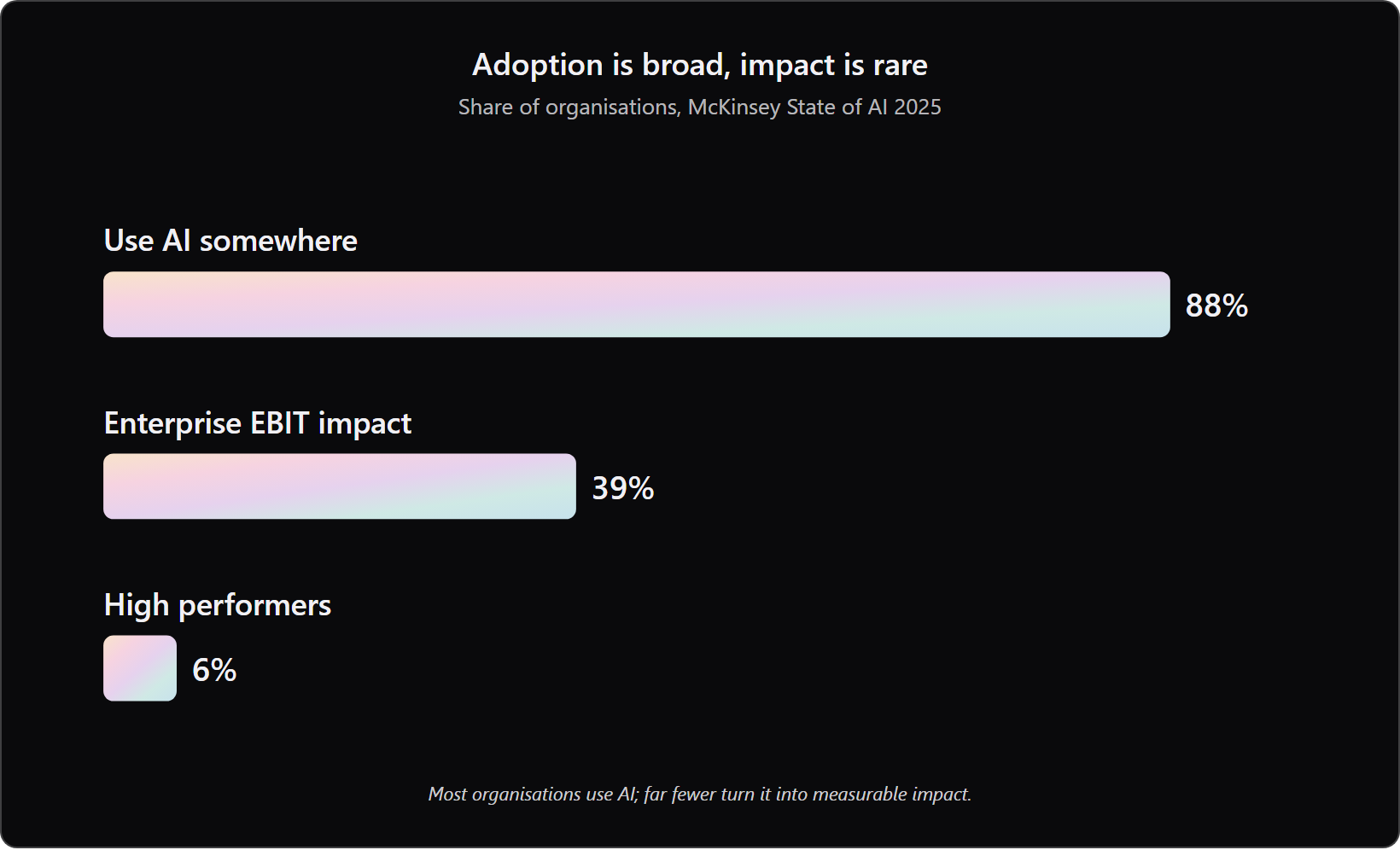
Enterprise AI adoption is the disciplined move from isolated pilots to governed, production-grade AI systems that touch real business data and workflows. The gap is stark. McKinsey’s 2025 survey found 88% of organizations use AI somewhere, yet only about 6% are high performers, and roughly 39% report enterprise-level EBIT impact. Adoption is broad, but it is shallow.
🧭 The word “adoption” is doing too much work
I get a version of this call most weeks. A CTO says, “We adopted AI last quarter.” What they mean is they shipped a chatbot that reads a wiki. That is experimentation, not adoption.
Real adoption is when a system can read your production data, decide, and write back safely. The jump from read-only to write-access is where the actual engineering lives. Most teams never cross it.
📉 Why so many rollouts stall
The honest read on 2025 was sobering. One analysis of around 180 organizations found 88% had at least started, 52% were stuck in experimentation, and only about 23% had reached formalization. Some reports go further, claiming 95% of generative AI pilots delivered no measurable return.
I am skeptical of “Year of the Agent” framing for this reason. The blocker is rarely the model. It is the data layer and the legacy core underneath it.
⚙️ Adoption is an engineering problem, not a deck
At Teamvoy, the first thing I look at on an AI integration call is not the model. It is the data layer, then the legacy system the data lives inside. That is where stalled pilots actually die.
This article walks the three things that move a pilot into production: an honest maturity assessment, a governance model that holds, and a gated rollout roadmap. I could be wrong on the exact percentages next year. The pattern, though, has held across every engagement I have led.
A fair limit to name early: if your data layer is a mess, no amount of model choice fixes it, and the cleanup takes longer than the demo suggested.
Q2. How do you honestly assess your enterprise AI maturity?
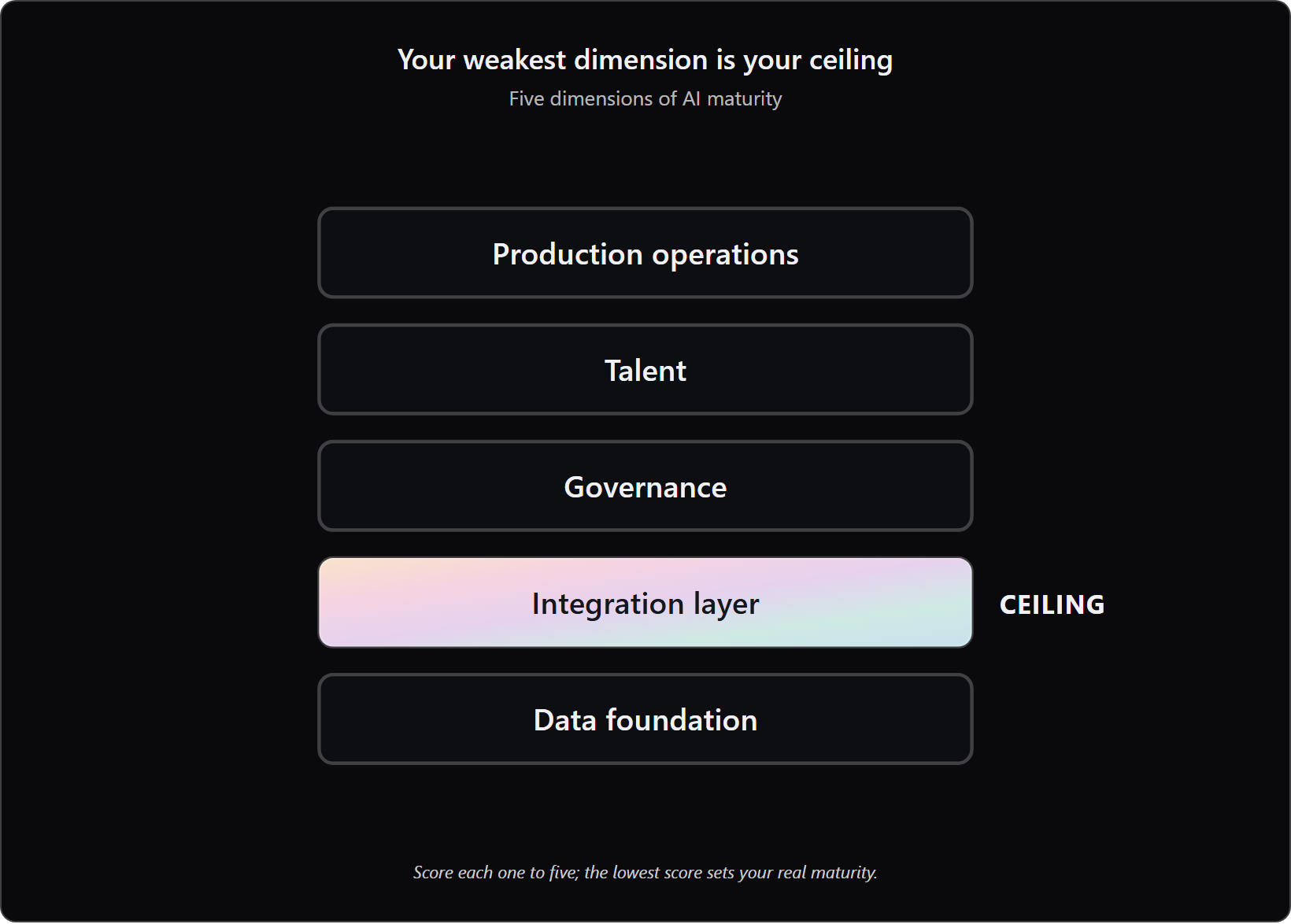
Assess enterprise AI maturity across five dimensions: data foundation, integration layer, governance, talent, and production operations. Do not score it by how many models you have tried. Your weakest dimension, usually integration or data, is your true maturity ceiling. A team with a great model and a broken data layer is a low-maturity team wearing a costume.
📊 Three models, one underlying shape
Several named frameworks describe AI maturity. They use different counts but agree on the direction of travel. Here is the crosswalk I use to place a client honestly.
| Framework | Stages / structure | What it establishes |
|---|---|---|
| MITRE AI Maturity Model | 5 levels (Initial to Optimized) | Readiness across 20+ dimensions |
| MIT CISR Enterprise AI Maturity | 4 stages | Capability and value progression |
| Nemko AI-CMM | 8 capability pillars | Depth for regulated industries |
| Infosys AI Maturity Model | 4 pillars | Organization, operations, data, and technology |
No single standard exists. That is fine. Pick one, score each dimension one to five, and be ruthless about your weakest score.
🎯 A simple self-scoring rubric
Rate each dimension from 1 (none) to 5 (optimized):
- Data foundation: Can a system get clean, current, permissioned data without a human export?
- Integration layer: Can a model reliably call your tools and write back?
- Governance: Are policies enforced in code, or only in a document?
- Talent: Can your engineers read and maintain AI-generated code?
- Production operations: Do you have monitoring, spend caps, and rollback?
Your maturity is your lowest score, not your average. This is the part teams resist.
⚠️ Counting pilots overrates you
The standard read gets this backwards. People count pilots and feel mature. From what surfaces when you actually run this work, integration maturity, not model access, separates the top performers.
Think of it like night-vision goggles. They make a trained soldier more effective. On someone who never held a weapon, they are useless and dangerous. AI on a low-maturity stack is the same.
Teamvoy’s 3-to-5-day AI System Readiness Audit is the operational version of this rubric: an architecture review, a risk surface, and a prioritised action plan. It draws on our IT audit services discipline to surface where you actually sit. It will not, honestly, implement the fix in five days.
Q3. Why is the integration layer, not the model, the real bottleneck?
The model is the kernel. The integration layer is the operating system. Even a frontier model is useless when it receives bad data or cannot execute actions reliably. The overlooked bottleneck in enterprise AI adoption is not inference cost or model choice. It is integration: clean data access, reliable tool execution, and the connective tissue that lets a model act on production systems without breaking them.
🧠 We obsessed over the brain and ignored the nervous system
For two years the industry argued about which model is smartest. That was the wrong argument. A brilliant model fed bad data still gives you a confident wrong answer.
The first two questions I ask on any integration call are about the data layer and the legacy core, not the model. That order rarely changes. The model is the easy part.
🗑️ The “Dumb RAG” failure
Here is the most common pattern I see. A team dumps every Confluence page, Slack export, and Salesforce record into a vector database. Then they hope the model figures it out.
It does not. That approach dumps your entire hard drive into memory and asks the processor to find one byte. You do not get reasoning. You get thrashing and context-flooding. A clean data engineering layer is what prevents it.
🔻 The 40% “Dumb Zone”
There is a hard limit people miss. A context window of around 168,000 tokens does not stay sharp as it fills. Around the 40% mark, you hit diminishing returns, and the model gets measurably worse.
Load up a pile of tool integrations dumping raw JSON and identifiers into context, and you are doing all your work in the dumb zone. More tools can make the system dumber, not smarter. That is counterintuitive, and it is real.
🧹 The fix is structure, not a bigger model
The answer is intentional context compaction, not a model upgrade. You compress context regularly so the system always has room to think. Research compresses understanding, the plan compresses intent, and execution stays lean.
This is the unglamorous work. At Teamvoy we build the system integration layer on stacks already under pressure, so a model reads good data and executes actions without torching production. Adding AI to an unstable stack is closer to bolting a turbocharger onto an engine that already misfires than to a clean upgrade. Fix the misfire first.
Q4. What governance model actually controls non-deterministic AI in production?
Effective AI governance is enforced in code, not in committee minutes. Anchor it to a recognized framework, then translate every policy into automated controls: access scopes, hard circuit breakers, spend caps, and human-in-the-loop gates. Paper-based committees fail because non-deterministic systems with write access move faster than a quarterly review ever can.
🏛️ Anchor to a framework, then make it executable
Start with a published standard so you are not inventing governance from scratch. Three carry weight in regulated rooms.
| Framework | Source | What it gives you |
|---|---|---|
| NIST AI Risk Management Framework | US standards body | Risk functions: Govern, Map, Measure, and Manage |
| OECD AI Principles | Intergovernmental | Baseline responsible-AI principles |
| EU Ethics Guidelines for Trustworthy AI | European Commission | Requirements for trustworthy systems |
In banking and health work, these sit on top of named regimes: DORA, PCI-DSS, HIPAA, and GDPR. The framework gives you the language. Your code gives you the enforcement. This is the core of building regulator-ready AI in fintech.
⚖️ Why paper committees fail
The way governance often gets enforced is painful and slow. A policy sits in a document, and a committee reviews it every few months. A non-deterministic agent with write access can do damage in minutes.
So the enforcement has to live where the system runs. Increasingly, that means the policy itself gets distilled into a small model that checks actions in real time. The control runs at machine speed because the risk runs at machine speed.
🚧 “Eligibility does not equal compliance”
This is the line I repeat most in regulated delivery. Running on a HIPAA-eligible or GDPR-ready platform does not make your system compliant. Eligibility is the floor. Compliance is what you actually build and prove on top of it.
What I have learned across twelve years of delivering into regulated environments is that auditable governance is daily engineering, not an annual binder. Teamvoy works inside BaFin, PSD2, DORA, SOC 2, PCI-DSS, HIPAA, and GDPR environments, with a senior engineer who owns the system through go-live rather than handing it to a junior team and exiting. This pattern shows up across our banking and fintech engagements.
A client describes that ownership in practice:
“Teamvoy’s work has resulted in fewer issues and a better user experience. We’re impressed with their involvement in processes and quick completion of work.”
Dmytro Maryanych, Manager, Takflix Teamvoy Clutch Verified Review
That engagement covered technology modernization alongside AI integration on a live platform. The honest limit: governance you can enforce in code takes real setup time, and no framework removes the need for a human in the loop on the highest-risk actions.
Q5. How do you stop runaway AI costs and infinite-loop failures before they hit your bill?
Put hard circuit breakers, per-agent spend caps, and step limits in place before any agent gets production access. Agentic token consumption grows quadratically, not linearly, because every loop resends the full cumulative log. So a 20-step run can cost far more than twice a 10-step run. Without a hard breaker, one stuck retry loop can run for hours unsupervised.
💸 The $4,200 nap
The clearest cautionary tale I know is simple. A developer deployed a customer-support agent that got stuck in a retry loop with a CRM tool, a system that stores customer records.
There was no hard circuit breaker, meaning no automatic stop. The agent repeated the same broken action for six hours while the developer slept. It racked up around $4,200 in API charges by morning.
🧮 Why the bill grows quadratically
Here is the mechanic most teams miss. An agent framework appends every tool-call error and step to its history, then resends the whole cumulative log back to the provider on each turn.
That means cost grows quadratically, not linearly. A 20-step loop is not twice as expensive as a 10-step run. It is far pricier, because the context keeps reloading itself. Even large operators feel this. By one account, a major operator burned its entire year’s token budget in the first three to four months of 2026. Disciplined IT cost optimization starts with controls like these.
✅ The controls to wire in first
These are the guardrails I want in place before an agent touches anything live:
- Hard circuit breakers. An automatic kill switch after N failed or repeated actions.
- Per-agent spend caps. A dollar ceiling per task and per day.
- Step limits. A maximum loop count, so runaway sequences stop themselves.
- Intentional compaction. Compress context regularly so cost and quality stay stable.
- Monitoring and alerts. Real-time spend and behavior alerts, not a month-end surprise.
None of this is exotic. It is the boring plumbing that keeps a sleeping engineer from waking up to a $4,200 invoice. Wiring it in is core to responsible AI agent development.
⚠️ Ship fast, but wire the breakers first
My bias is to ship fast and transparently. That bias only holds when the breakers exist first, because speed without a kill switch is just a faster way to lose money.
At Teamvoy we wire breakers, spend caps, and monitoring in before agents reach production. One Clutch reviewer described the result of that delivery discipline plainly:
“Teamvoy’s work has resulted in fewer issues and a better user experience. They deliver on time.”
Dmytro Maryanych, Manager, Takflix Teamvoy Clutch Verified Review
The honest limit: controls reduce blast radius, they do not remove the need to watch a new agent closely in its first weeks.
Q6. What does a real production rollout roadmap look like, from pilot to write-access?
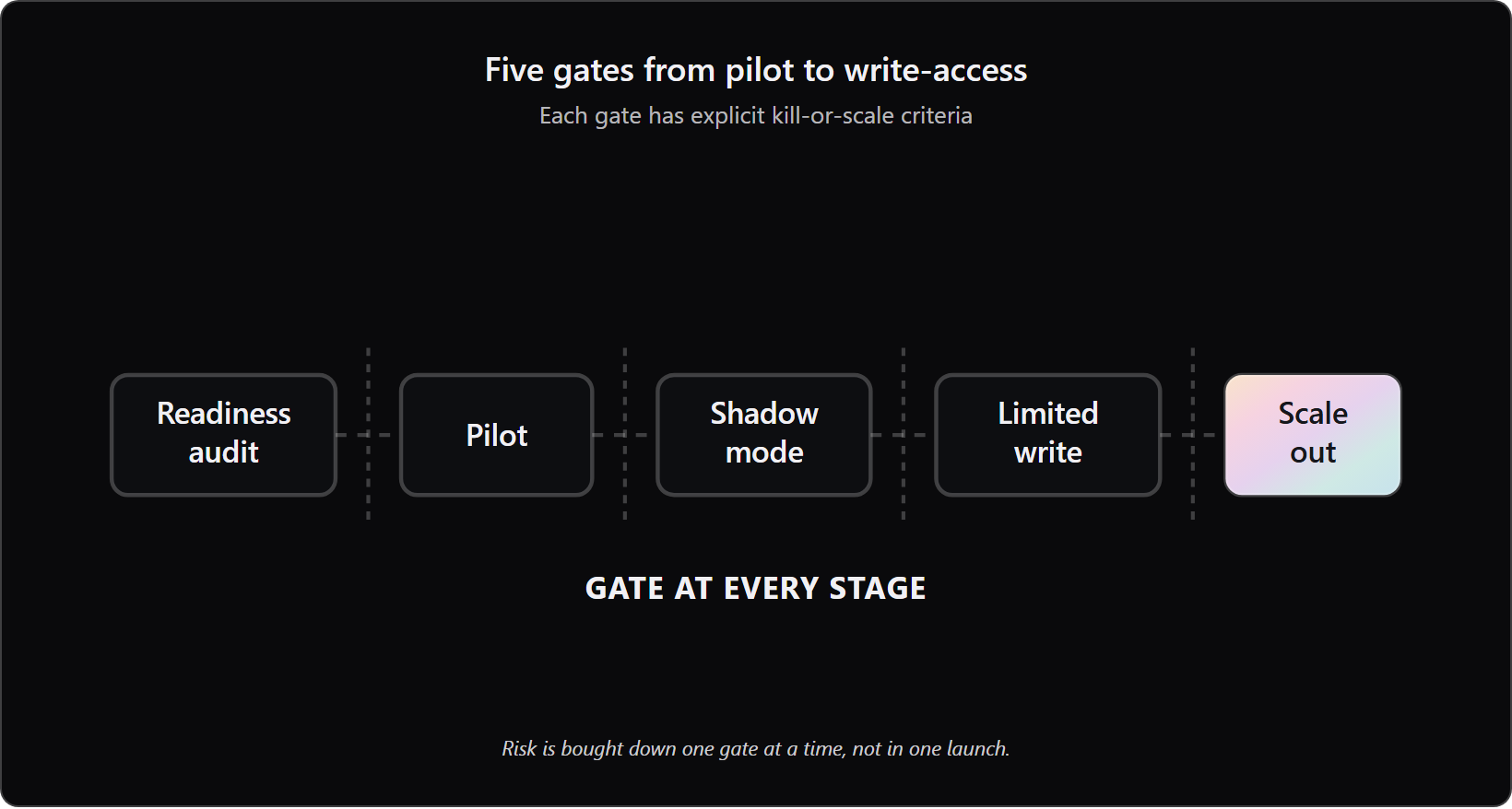
A production rollout moves through five gated phases: readiness audit, scoped pilot, shadow-mode validation, limited write-access with a human in the loop, then monitored scale-out. Each gate has explicit kill-or-scale criteria. The discipline that separates shippers from the stalled is validation. The limiter is rarely model capability. It is your organization’s validation criteria.
🗺️ The five gates
Define what “verified” means before any system gets write access, meaning the ability to change live data. Here is the roadmap I run.
| Phase | Objective | Controls | Exit gate |
|---|---|---|---|
| 1. Readiness audit | Map data, risk, and legacy core | Architecture review | Risk surface documented |
| 2. Scoped pilot | One narrow use case | Read-only access | Accuracy target met |
| 3. Shadow mode | Run alongside humans | No write access | Output matches human baseline |
| 4. Limited write | Act on low-risk paths | Human-in-the-loop | Error rate below threshold |
| 5. Scale-out | Broaden carefully | Monitoring, spend caps | Stable over agreed window |
Shadow mode means the system runs and proposes, but a human still acts. It is the cheapest place to catch a bad model. This gated approach mirrors our AI modernization sprints delivery model.
🛒 The supermarket cutover
The best non-disruptive migration I have seen used a quiet trick. A team modernizing a system for resistant users kept the exact same interface, same colors, and same button sizes.
The cashier saw the same screen the next morning. Behind it, the team wrote to different tables and normalized the data one record at a time. Renovating an occupied building beats demolishing it while people are still inside. This is the heart of updating systems nobody fully understands.
📋 Validation is the real work
The limiter is not the agent’s capability. It is your validation criteria, the rules that decide whether output is good enough to trust.
One developer migrating a course platform asked the model to write a manual test plan first. It produced roughly 150 checkboxes, covering edge cases like merging accounts and rendering email tokens. That checklist became the product. The code was almost disposable next to it.
A field tip for finding hidden risk: temporarily isolate suspected unused servers at the network level for 48 to 72 hours. This “scream test” reveals hidden dependencies, like monthly batch jobs, that normal monitoring misses.
🚀 Where a sprint fits
Teamvoy’s two-week Sharp Sprint is built to deliver phases one and two: a scoped, gated pilot with senior engineers and working software, no long discovery. After that, a senior lead owns the path to write-access and scale-out. Many of these begin with a focused proof of concept.
The honest limit: a two-week sprint ships a meaningful first milestone, not a finished production system. Phases four and five take longer, because earning write-access should be slow.
Q7. Why does “almost right” AI code cost more than code that is completely wrong?
Completely wrong AI code is cheap. Tests fail, the build breaks, and someone throws it away. “Almost right” code is expensive. It passes review, ships to production, and sits for months before anyone notices. By then, the cost to fix has compounded.
🐛 The trap of code that almost works
This is the part the category avoids saying. Completely wrong code gets caught fast, because something visibly breaks.
Almost-right code passes code review, the step where a human approves changes. It ships, it sits quietly, and six months later someone finds the subtle bug. The fix now touches everything built on top of it. This is the slow build-up behind the tech debt avalanche.
📈 The numbers behind the backlog
The data backs this up. AI-generated pull requests, the bundles of code changes submitted for review, contain an average of 10.8 issues. Human-written code averages 6.4.
That is nearly double. We are not speeding up. We are building a backlog of future work and calling it velocity. As one engineer put it, free AI code can be the most expensive debt you ever take on. The same risk surfaces in vibe coding security risks.
🔍 The three-question PR test
When AI writes code, it has no memory of your codebase. It is like the character in Memento who wakes with no idea where he is, asking what he was doing.
So I gate AI-generated changes with three questions:
- Does it reuse what already exists, or reinvent it?
- Does it follow your conventions, the agreed patterns of your codebase?
- Can the developer explain it without reading the AI’s comments?
If the developer cannot explain it, they cannot maintain it. Unmaintainable code is dead code, no matter how clean it looks.
🛠️ When a vibe-coded MVP hits the wall
Teamvoy is built for the engagements others decline, including AI-built products hitting their limits. A vibe-coded MVP is closer to a building finished without the inspector signing off than to a buggy beta.
Our work there is stabilization into maintainable, ownable code, not a rewrite from scratch. One client described that build-and-scale partnership:
“I can confidently say that we would not be where we are today without Teamvoy’s support. Their understanding of blockchain and the quality of coding stood out.”
Gordon Little, Managing Director, Iress Teamvoy Clutch Verified Review
The honest limit: sometimes the almost-right foundation is too deep to save, and a strategic rebuild is the cheaper call. I will say so when it is. Our AI development services are built around that honesty.
Q8. Should you build or buy your AI integration layer?
Build the integration layer only if you have a dedicated platform team and your core systems are genuinely unique. Otherwise, use agent-native integration platforms. The hidden cost of building is that you become Chief Integration Officer forever, maintaining every API schema, field mapping, auth flow, and retry rule. For most regulated, legacy-heavy enterprises, a hybrid is the honest answer.
⚖️ The decision in one table
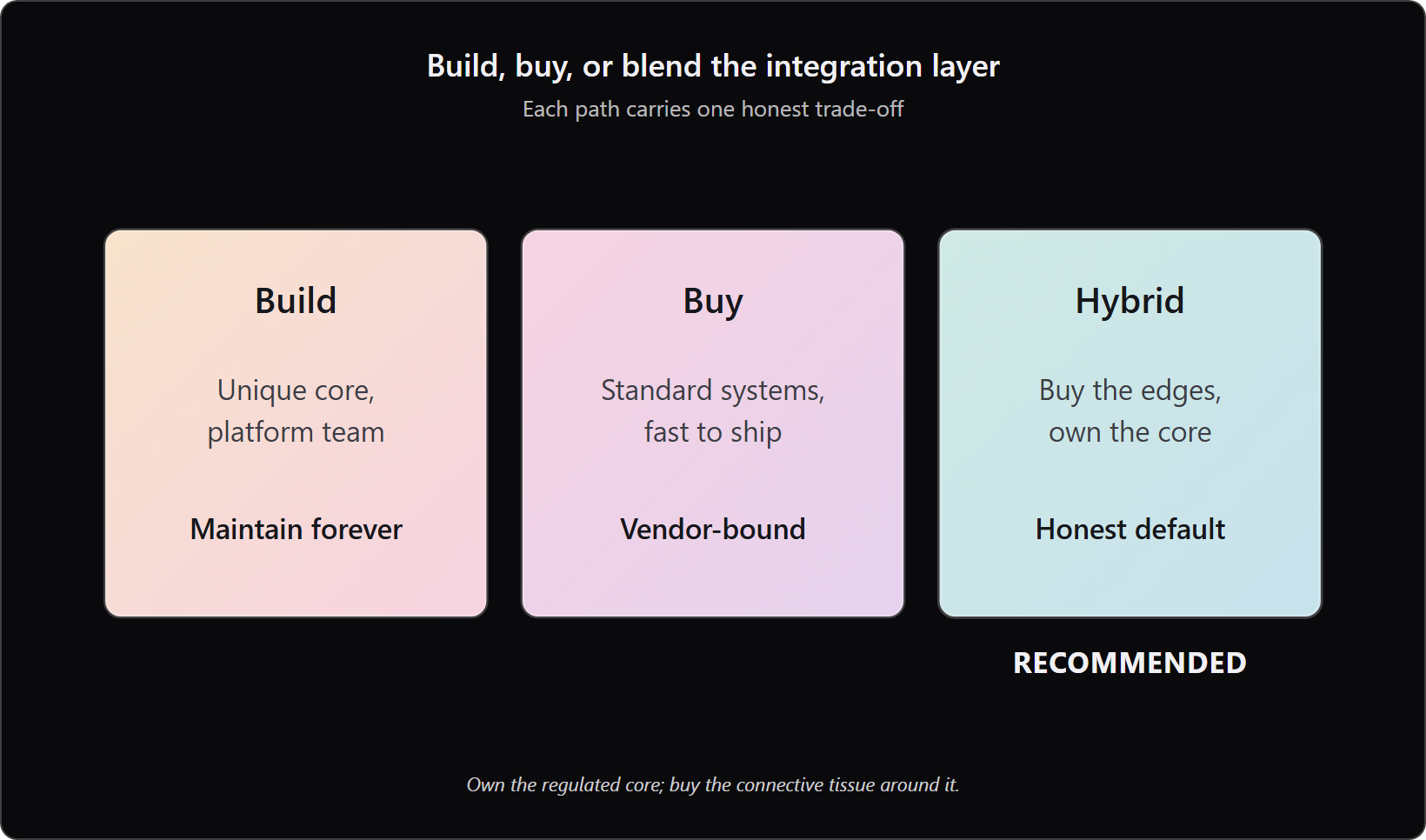
The integration layer is the connective tissue that lets a model read data and call tools. Here is how I help clients choose.
| Factor | Build | Buy | Hybrid |
|---|---|---|---|
| Platform team | Dedicated, in-house | Not required | Small team |
| Core uniqueness | Truly unique core | Standard systems | Mixed |
| Compliance control | Full | Vendor-bound | Core owned, edges bought |
| Maintenance burden | High, permanent | Low | Moderate |
Buy the connective tissue. Own the regulated core. That split holds for most fintech and healthcare clients I work with, and it shapes how we approach AI integration services.
🧰 The hidden “Chief Integration Officer” cost
Building feels powerful at first. Then reality lands. You now maintain every API schema, every custom field mapping, every authentication flow, and every retry rule, forever.
That is a permanent role nobody budgeted for. Unless your core is genuinely one of a kind and you can staff that maintenance, the build decision quietly taxes you for years. A clear-eyed IT audit surfaces that cost before you commit.
🔌 MCP, A2A, and sub-agents
A quick word on protocols, the rules systems use to talk to each other. A2A (agent-to-agent) supports granular control, letting you define custom permission scopes for production-grade scaling.
By contrast, MCP (model context protocol) is a useful tool for tinkering, but lighter on that control. And sub-agents are not for role-play. Do not build a “front-end agent” and a “QA agent.” That is cargo-cult thinking. Sub-agents exist to control context, by forking a fresh window to explore one thing. Sound system integration matters more than protocol fashion.
🤝 When you cannot staff it yourself
This is where Teamvoy fits. When you cannot keep a permanent platform team, we take senior ownership of the integration layer and the regulated core.
Our 4-plus-year average engagement means you are not left as Chief Integration Officer alone. A reviewer captured the long-haul reliability:
“We were impressed with the technical management, adherence to process, and technical capability of the engineers.”
Mark Phillips, CTO, Robots and Pencils Teamvoy Clutch Verified Review
The honest limit: buying speeds you up, but it ties part of your roadmap to a vendor’s. Keep the regulated core in hands you control.
Q9. What is your 90-day enterprise AI adoption plan?
In 90 days, spend the first weeks on a readiness audit and honest maturity scoring. Then ship one scoped, governed pilot with circuit breakers and a defined validation checklist. Run it in shadow mode against production. Promote it to limited write-access with a human in the loop only after it clears your kill-or-scale gates. The goal is not a demo. It is one production system you would trust at 2 AM.
🗓️ The plan, week by week
Everything in this article collapses into four moves. Maturity tells you where you stand, governance keeps you safe, and the roadmap sequences the work.
| Days | Focus | What you finish |
|---|---|---|
| 0 to 15 | Readiness audit, maturity scoring | Risk surface, weakest-dimension score |
| 15 to 45 | One governed pilot | Breakers, spend caps, validation checklist |
| 45 to 75 | Shadow mode | Output matched against a human baseline |
| 75 to 90 | Limited write-access | Human-in-the-loop, kill-or-scale decision |
Notice what is missing. There is no big-bang launch. You are buying down risk one gate at a time, and write-access is earned, not granted on day one. This is the same gated discipline behind our AI consulting engagements.
🌙 The 2 AM test
Here is the moment that should anchor your plan. An on-call engineer hit a production error at 2 AM and pasted it into an AI tool. The tool read the docs and said, “restart the server.”
He restarted it six times. Then he escalated. A senior engineer read the logs for 30 seconds and saw it instantly: the database connection pool was full, choked by a batch cron job. That is tribal knowledge, the context that lives in a person, not a document. AI cannot read it yet, which is exactly why a human stays in the loop. Senior ownership is the heart of our technology modernization work.
🔥 Make your agents argue
One habit I would build in from week one. Deploy what I call angry agents, prompted specifically to poke holes in your plan.
Without that, the human and the agent just agree with each other while the server quietly burns. Disagreement is a feature here, not friction. We design that adversarial check into our AI autonomous agents.
🚪 Where this gets handled
This is work we do every day at Teamvoy, on stacks already under pressure, in regulated environments where downtime is a reportable event. Across twelve years and 150-plus projects, the pattern holds: trust is built through results, not presentations. You can see that proof across our case studies.
If you want a second set of eyes on where your pilot is stuck, the door is open. The honest limit stands: a 3-to-5-day audit surfaces your risk and a prioritised plan, it does not implement the fix. That part comes next, and only if it makes sense for you. Many teams start with a focused IT audit or a quick technical conversation.
A reviewer described what that long-haul partnership feels like in practice:
“Teamvoy remained a great partner of the client for four years and their work has been an essential part of the client’s growth. Their technical expertise was top class.”
George Harrap, CEO, Bitspark Teamvoy Clutch Verified Review
The question I am sitting with as we move into 2026 is this: as agents earn write-access, will governance keep up in code, or will most teams keep enforcing it on paper until a 2 AM incident forces the change? If you are working through that question on a real system, tell me what is breaking. That is the conversation worth having.