

One engineering org we audited this spring was spending $11,400 a month on Claude Code seats and could not tell us, with a straight face, what cycle-time metric had moved. Another was running Codex across 40 engineers and had quietly leaked three internal repos into ChatGPT contexts before anyone noticed. Both teams had picked the “right” tool. Neither had picked the right deployment. That gap — between buying an agent and operating one — is what this guide is about.
By mid-2026, the question is no longer whether your engineering org will adopt an agentic coding tool. The question is which one — and how to deploy it without burning six figures of token spend, leaking source code, or watching your senior engineers babysit an over-eager bot. For most CTOs evaluating the space, the shortlist comes down to two names: OpenAI Codex and Anthropic’s Claude Code. They sit at the top of every benchmark leaderboard, every Reddit thread, and every “what we actually use” post from staff engineers. They also represent two genuinely different bets on what an AI coding agent should be.
This guide is the codex vs claude code comparison we wish existed when we started rolling these tools out across regulated-industry clients at Teamvoy — banks, insurers, healthcare platforms, and exchanges where “just try it on prod” is not an option. We will cover architecture, the 2026 pricing reset, real-world benchmarks, governance, and the deployment patterns we now recommend by default. If you are a CTO trying to decide where the next $200,000 of AI tooling budget goes, this is for you.

- Claude Code is a local, terminal-first agent that lives inside your developers' machines, runs against your real codebase, and excels on long, multi-file refactors and tightly coordinated parallel agent teams.
- OpenAI Codex (the 2026 version, not the deprecated 2021 API) is a cloud-native agentic environment, embedded inside ChatGPT, that spins up sandboxed containers per task and is optimized for async, fire-and-forget delegation.
- After the April 2026 pricing reset, both tools sit at roughly the same headline price point — Anthropic Max and OpenAI Pro both land at $100/mo and $200/mo tiers — but per-task economics differ wildly. A documented Express.js refactor came in at ~$15 on Codex vs ~$155 on Claude Code, while blind code reviewers preferred Claude Code's output 67% of the time.
- On contamination-resistant benchmarks, Claude Opus 4.7 still leads SWE-bench Pro (64.3% vs 58.6%). On SWE-bench Verified and Terminal-Bench 2.0, GPT-5.5-powered Codex now leads narrowly.
- Most mature engineering orgs we work with end up running both — Claude Code as the primary builder inside the codebase, Codex as the async reviewer and the on-ramp for non-staff developers.
- If you only read one section, scroll to The CTO Decision Matrix. Everything else is the reasoning behind it.
Why This Comparison Matters Now
The In 2025, AI coding assistants were a productivity tweak. In 2026 they are a budget line, a security review, and an org-design question rolled into one. Three things changed since the start of the year: Codex became a real product (not the deprecated 2021 autocomplete API) with cloud sandboxes, parallel task queues, and GPT-5.5 under the hood; Claude Code shipped Agent Teams that coordinate multiple instances through shared task files and git worktrees; and both vendors restructured pricing in April 2026 around a $20 / $100 / $200 per-seat ladder. For a CTO, the chatgpt codex vs claude code decision now sits next to choices like Snowflake vs Databricks or Datadog vs New Relic. It is a platform bet with multi-year consequences. Getting it wrong means either an expensive migration in 12 months or shadow-tool sprawl across teams.
What Each Tool Actually Is in 2026
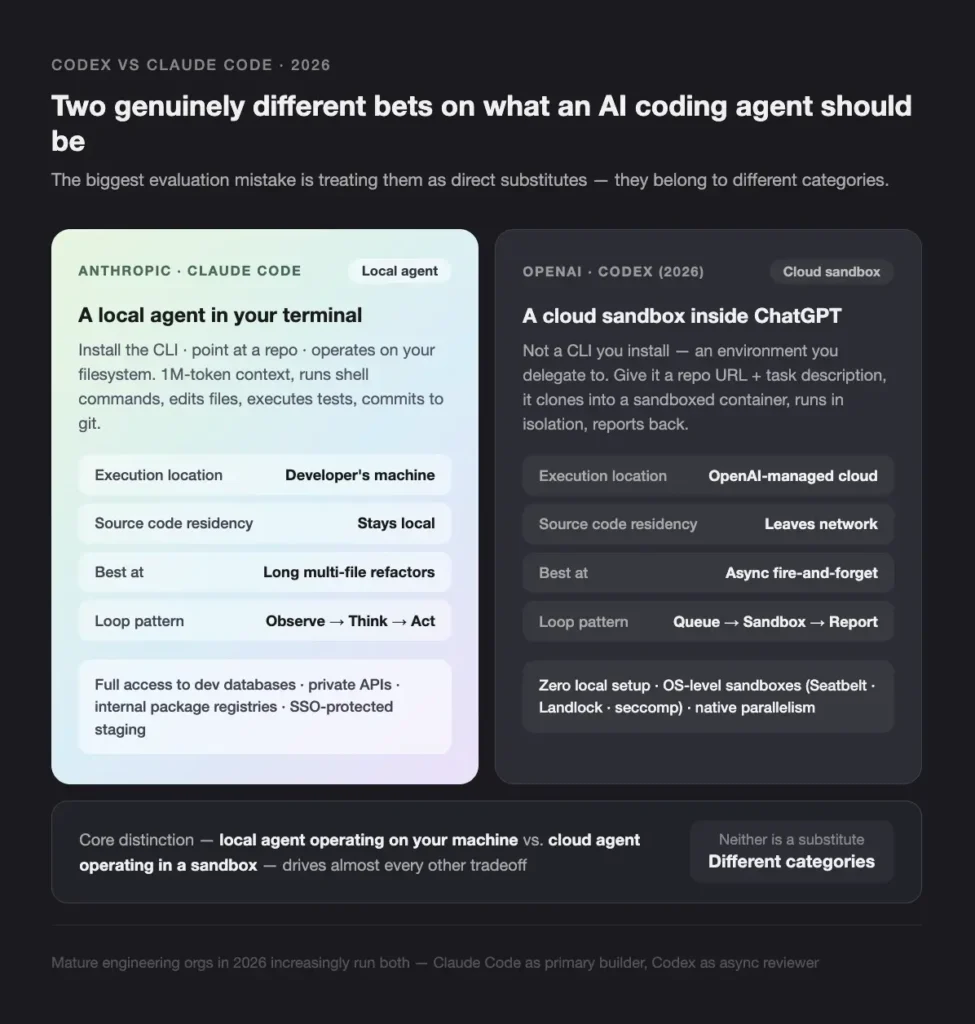
Before any codex vs claude feature table, you have to be clear on what category each tool belongs to. The biggest mistake we see in vendor evaluations is treating them as direct substitutes when they are not.
Claude Code — A Local Agent in Your Terminal
Claude Code is Anthropic’s agentic coding tool. You install the CLI, point it at a repo, and it operates directly on your filesystem. It reads your entire codebase (up to a 1M-token context window), runs shell commands, edits files, executes tests, and commits to git. It is optimized for Claude Opus and Sonnet but increasingly works as a model-agnostic runtime.
Architecturally, Claude Code is closest to what we would describe in our own framework as an autonomous AI agent in a developer workflow — a system that follows the “Observe – Think – Act – Observe” loop, maintains context across long sessions, and triggers real actions like opening PRs, updating tickets, or running test suites.
OpenAI Codex — A Cloud Sandbox Inside ChatGPT
Codex in 2026 is not a CLI you install. It is an environment you delegate to. You give it a repo URL and a task description; it clones the repo into a sandboxed cloud container, runs jobs in isolation, and reports results back inside ChatGPT. It is tightly integrated with ChatGPT’s browsing tool, image generation, and the broader plugin ecosystem.
OpenAI also ships a Codex CLI as a separate front-end, which is what most “codex cli vs claude code” comparisons refer to. The CLI lets developers fire jobs from the terminal, but the execution still happens in OpenAI-managed sandboxes by default, with optional local execution modes.
That core difference — local agent operating on your machine vs cloud agent operating in a sandbox — drives almost every other tradeoff in this comparison.
Architecture: Local vs Cloud
This is where the openai codex vs claude code debate gets real.
Claude Code: Your Machine, Your Codebase
Because Claude Code runs locally, it inherits everything good and bad about your developers’ machines.
What you gain: full access to your local environment — running dev databases, private APIs, internal package registries, SSO-protected staging endpoints; zero file-upload friction across million-line monorepos; native fit with existing toolchains; and real shell access for installing dependencies, running migrations, and executing long-lived processes the same way a human engineer would.
What you give up: setup is your problem — if a junior engineer’s Docker config is broken, Claude Code inherits the chaos. Source code stays on the developer’s machine, which is usually what you want, but it means consistent security controls (DLP, EDR, sandboxing) have to exist on every laptop. Long-running tasks tie up the machine unless you provision dedicated Claude Code workstations.
Codex: Clean Containers, Repeatable State
Codex spins up a fresh sandbox for every task. You hand it a repo, it clones, runs, reports back.
What you gain: zero local setup — a PM or a designer can kick off a Codex task without touching a terminal; reproducible builds from a known state, which matters when you are debugging an agent’s behavior; OS-level sandboxing (Seatbelt on macOS, Landlock and seccomp on Linux) that enforces safety at the kernel level; and native parallelism — queue ten tasks and they run concurrently without anyone’s MacBook fan spinning up.
What you give up: no access to your local database, your VPN-only staging API, or environment variables that live on a developer’s machine unless you wire those into the sandbox explicitly. Source code leaves your network for the duration of the task — a real procurement question for regulated industries. And it is less reliable on workflows that depend on long-lived, stateful local services.
CTO read: if your engineering culture is “everyone’s laptop is the production-like environment,” Claude Code is the natural fit. If your culture is “everyone develops in remote containers anyway,” Codex sandboxes are a better match.
Parallel Agents and Agent Teams
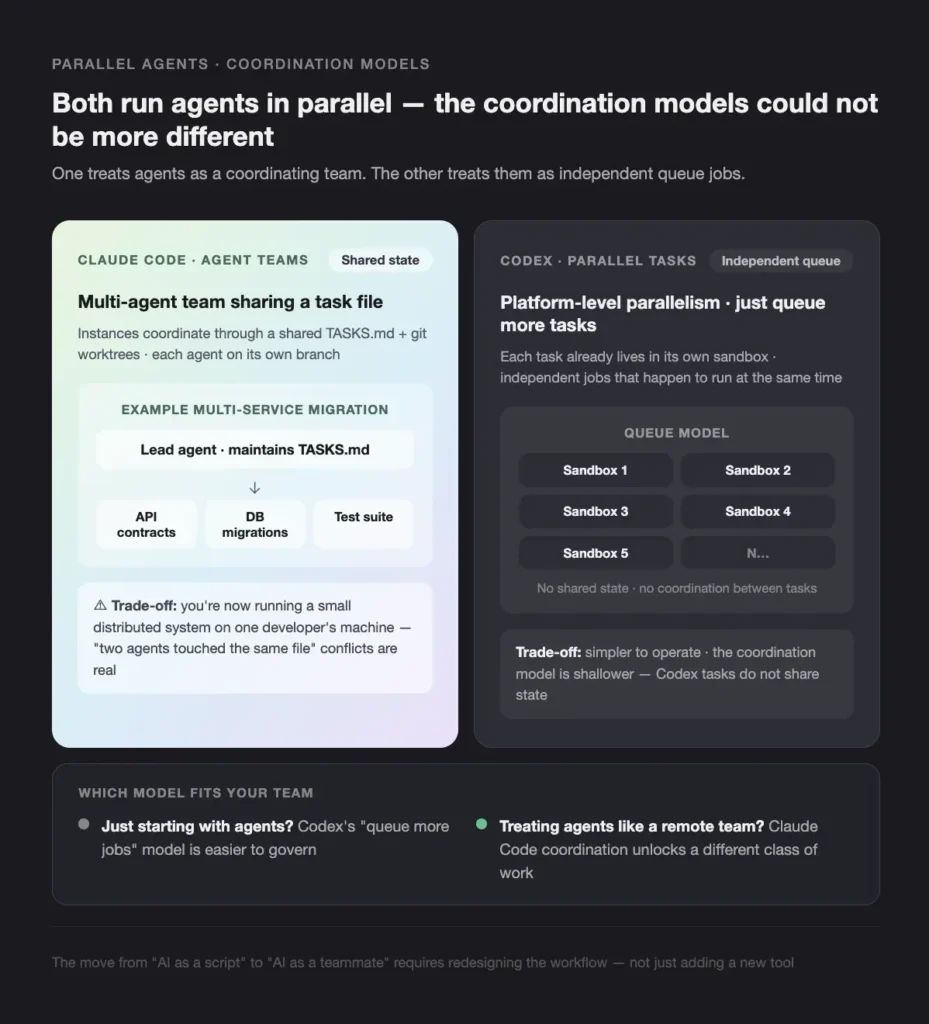
Both tools support running multiple agents in parallel, but the models could not be more different.
Low-code is built for:
Claude Code Agent Teams are multiple instances sharing a task file in real time, typically combined with git worktrees so each agent operates on its own branch. A “lead” agent maintains the task list; “worker” agents pick up subtasks, mark them in progress, and hand work back when done. We have used this for multi-service migrations — one agent on API contracts, one on database migrations, one on the test suite, all coordinating through a shared TASKS.md. The catch: you are now operating a small distributed system on a single developer’s machine. Conflicts and “two agents touched the same file” failure modes are real.
Codex Parallel Tasks handle parallelism at the platform level. Because each task already lives in its own sandbox, you just queue more tasks — independent jobs that happen to run at the same time. Simpler to operate, but the coordination model is shallower. Claude Code Agent Teams share state and coordinate; Codex tasks do not.
For an engineering org just starting with autonomous coding agents, Codex’s “queue more jobs” model is easier to govern. For a team that has matured past that — and is ready to treat agents the way it treats a small remote team — Claude Code’s coordination model unlocks a different class of work. This is the same architectural shift we describe in our playbook on building AI agents into your CI/CD pipeline: the move from “AI as a script” to “AI as a teammate” requires you to redesign your workflow, not just add a new tool.
Computer Use, Browser Automation, and the GUI Frontier
This is where Claude Code currently has the clearest advantage in the claude code vs codex comparison.
Claude Code’s computer use lets the agent control a GUI directly — clicking buttons, filling forms, navigating desktop apps and web UIs that do not expose an API. For regulated workflows where critical systems still live behind 1990s-era admin panels, this is one of the few viable automation paths. Combined with Playwright integration for structured browser automation, Claude Code can drive real end-to-end workflows.
Codex’s browser capabilities flow through ChatGPT’s built-in browsing tool. That gives it strong research-augmented coding — pulling docs, checking package versions, looking up the latest framework changes — but it does not yet expose general GUI control. Codex can browse the web for context; it cannot click through your insurer’s claims-management UI for you.
For most pure software engineering tasks, this gap does not matter. For ops-adjacent engineering work — vendor portal automation, third-party admin tools, legacy enterprise software — it matters a lot.
Plugin and Skill Ecosystems
Claude Code Skills and Plugins
Claude Code’s extensibility model is a two-tier system: Skills are reusable behavior templates (“deploy to staging,” “run our internal test suite,” “generate a PR summary in our format”), and Plugins bundle Skills together with MCP server integrations into something close to a domain-specific agent. Both can be installed from a marketplace or built privately and shared inside an org.
For a CTO, the practical implication is that you can encode your team’s tribal knowledge — coding standards, deployment runbooks, review checklists — as reusable Skills. That is closer to durable institutional memory than “we have a really good prompt in a Notion doc.”
Codex Tool Ecosystem
Codex inherits ChatGPT’s broader plugin and tool ecosystem — web browsing, Python execution, third-party connectors, and a growing set of partner integrations. The surface area is wide, but it is not coding-specific in the way Claude Code’s Skills are.
If your team already lives in ChatGPT, Codex slots in with zero new vocabulary to teach. If you want fine-grained, coding-specific extensibility — and you are prepared to invest in building Skills — Claude Code goes deeper.
Benchmarks and Real-World Performance (May 2026)
Headline benchmark numbers move every six weeks. As of the May 2026 cycle, the picture looks like this:
| Benchmark | Codex (GPT-5.5) | Claude Code (Opus 4.7) | Notes |
|---|---|---|---|
| SWE-bench Verified | 88.7% | 87.6% | Codex narrowly leads after the GPT-5.5 launch. |
| Terminal-Bench 2.0 | 82.7% | (trails) | Codex leads on terminal-task benchmarks. |
| SWE-bench Pro (contamination-resistant) | 58.6% | 64.3% | Claude leads on the harder, leak-resistant set. |
| Blind code-quality reviews | 25% preferred | 67% preferred | Human reviewers prefer Claude’s diffs 2-to-1. |
The headline benchmarks tell you what these tools can do on curated tasks. The blind-review numbers tell you what your senior engineers will think when they actually merge the PR.
Cost-per-task is the third axis nobody puts in slide decks. In a documented Express.js refactor, the same job came in at roughly $15 on Codex versus ~$155 on Claude Code. That ratio is not constant — it widens on agentic tasks where Claude Code runs many tool calls — but the direction is clear: Codex is cheaper per task; Claude Code is more expensive but produces cleaner output. For a CTO, the right way to read this is not “which one wins.” It is “which one wins for which class of work.”
Pricing After the April 2026 Reset
Both vendors restructured pricing in April 2026 around a shared $20 / $100 / $200 ladder:
| Tier | OpenAI (Codex access) | Anthropic (Claude Code access) |
|---|---|---|
| Entry | Go — $8/mo | — |
| Plus | Plus — $20/mo | Pro — $20/mo |
| Pro | Pro — $100/mo (5× Plus, GPT-5.5 Pro) | Max 5× — $100/mo |
| Power | Pro — $200/mo (20× limits) | Max 20× — $200/mo |
For working engineers using these tools daily, the realistic budget is $100/mo per seat, with $200/mo for senior engineers running parallel agent workflows. Across a 50-person engineering org that is $60–120k/year in tooling — before any incremental API spend for self-hosted runners or CI integrations.
There is also a noteworthy cross-product wrinkle: in 2026, OpenAI restricted some forms of third-party Claude access through Codex subscriptions. If your team was using Codex as a wrapper for Claude calls, check the current terms before you renew.
Security, Compliance, and the Regulated-Industry View
For CTOs in banking, fintech, insurance, healthcare, or any DORA / HIPAA / SOC 2 environment, the codex vs claude decision has a procurement layer that does not show up in feature comparisons.
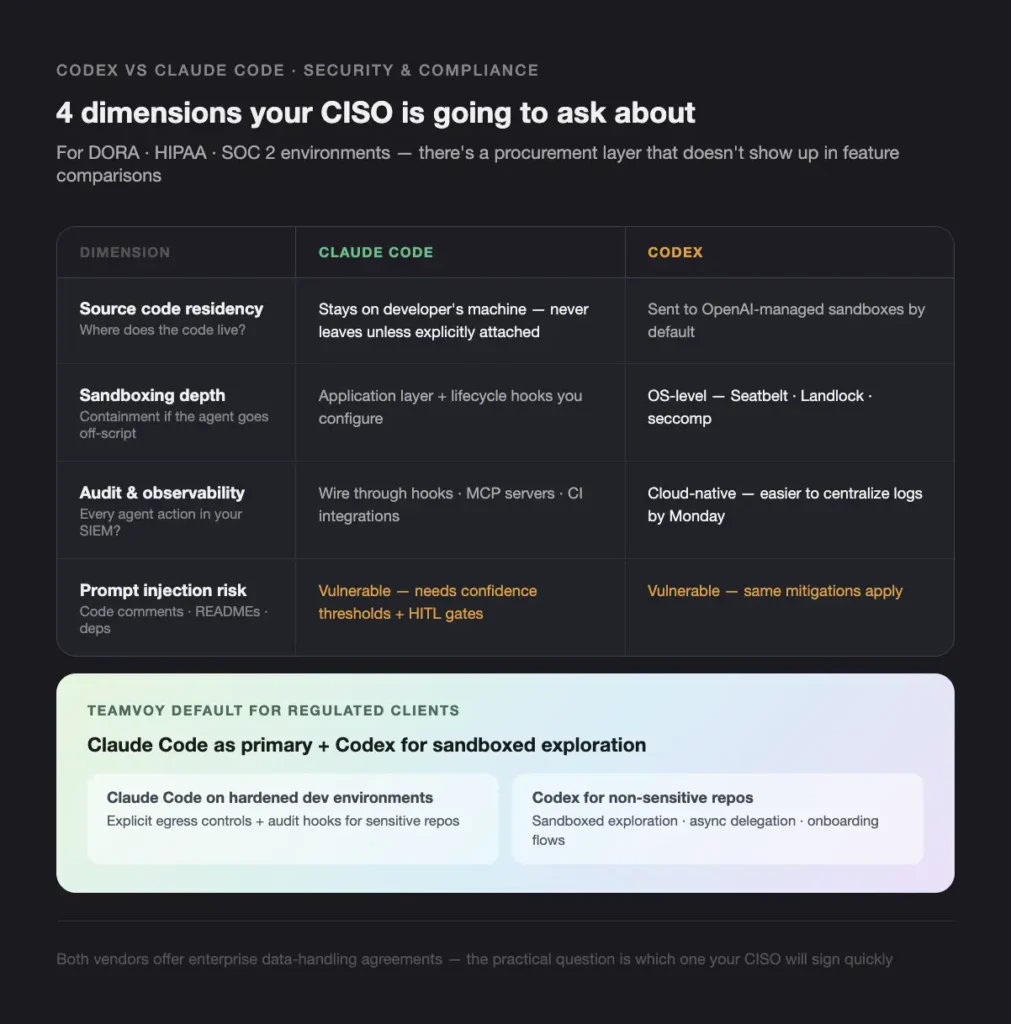
Source code residency. Claude Code runs locally, so source never leaves the developer’s machine unless they explicitly attach a snippet. Codex’s default mode sends code to OpenAI-managed sandboxes. Both vendors offer enterprise data-handling agreements; the practical question is which one your CISO will sign quickly.
Sandboxing depth. Codex’s OS-level sandboxes (Seatbelt, Landlock, seccomp) are strong primitives. Claude Code’s safety model leans on the application layer and on hooks you configure into the agent’s lifecycle. If your agent has write access to production-adjacent systems, sandbox depth matters.
Audit and observability. Claude Code’s local execution makes centralizing audit logs harder by default; Codex’s cloud sandboxes make it easier. If your security team wants every agent action in your SIEM by Monday, Codex gets you there faster. With Claude Code you wire up centralized logging through hooks, MCP servers, and CI integrations.
Prompt injection and data exfiltration. Both tools are vulnerable to prompt injection through code comments, README files, and dependency metadata. The mitigations — confidence thresholds, sandboxed test environments, human-in-the-loop gates — are detailed in our CI/CD playbook and apply identically to both tools.
For regulated clients, our default is Claude Code on hardened developer environments with explicit egress controls and audit hooks, plus Codex for sandboxed exploration on non-sensitive repos.
The CTO Decision Matrix
If you only screenshot one part of this article, screenshot this.
| If your priority is… | Pick |
|---|---|
| Complex multi-file refactors in an existing codebase | Claude Code |
| Async, fire-and-forget delegation of well-scoped tasks | Codex |
| Coordinating multiple agents on one project | Claude Code (Agent Teams) |
| Onboarding non-staff engineers fast | Codex |
| GUI automation against legacy systems | Claude Code (computer use) |
| ChatGPT-native workflow for a team already living in ChatGPT | Codex |
| Source code never leaving the developer’s machine | Claude Code |
| OS-level sandboxing for high-risk repos | Codex |
| Cheapest per-task economics on simple jobs | Codex |
| Highest blind-review code quality on hard jobs | Claude Code |
| Encoding your team’s tribal knowledge as reusable behaviors | Claude Code Skills |
| Running coordinated agent teams in regulated environments | Both — with a deployment plan |
The honest answer for most mid-to-large engineering orgs in 2026 is both. Use Claude Code as the primary builder for senior engineers working inside your real codebase. Use Codex as the async layer — for triage, code review, repetitive fixes, and onboarding new contributors who do not yet have a full local setup.
How Teamvoy Deploys These Agents in Practice
Across regulated-industry engineering teams in fintech, insurance, and healthcare, we have rolled out Claude Code, Codex, and hybrid setups often enough that five patterns are now our defaults.
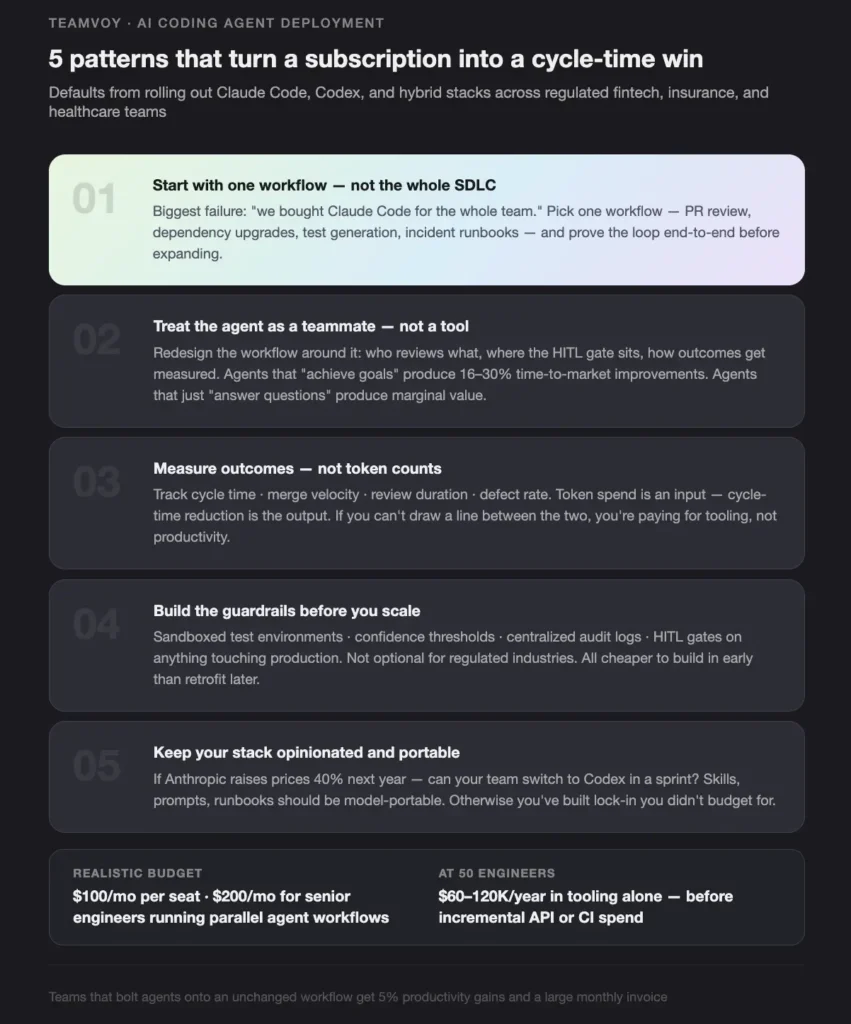
Start with one workflow, not the whole SDLC. The biggest failure mode we see is “we bought Claude Code for the whole team.” Pick one workflow — automated PR review, dependency upgrades, test generation, incident runbooks — and prove the loop end-to-end before expanding. McKinsey’s research is clear that high-performing teams scale AI across at least four use cases over time, but they almost always start with one.
Treat the agent as a teammate, not a tool. Redesign the workflow around it — who reviews what, where the human-in-the-loop gate sits, and how outcomes get measured. As we argue in What Are Autonomous AI Agents? , agents that just “answer questions” produce marginal value; agents that “achieve goals” inside your workflow produce the 16–30% time-to-market improvements McKinsey documents.
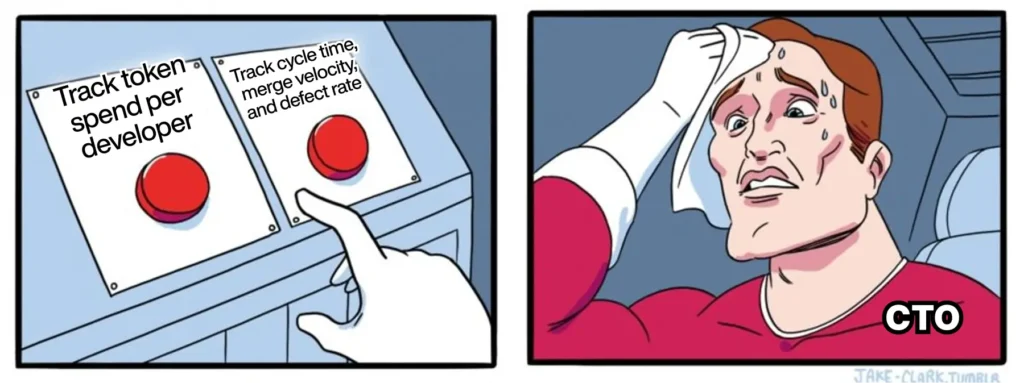
Measure outcomes, not token counts. Track cycle time, merge velocity, review duration, defect rate. Token spend is an input; cycle-time reduction is the output. If you cannot draw a line between the two, you are paying for tooling, not productivity.
Build the guardrails before you scale. Sandboxed test environments, confidence thresholds, centralized audit logs, and human-in-the-loop gates on anything touching production. None of this is optional for regulated industries; all of it is cheaper to build in early than to retrofit later.
Keep your stack opinionated and portable. If Anthropic raises prices 40% next year, can your team switch to Codex in a sprint? If not, you have a lock-in you did not budget for. Skills, prompts, and runbooks should be model-portable.
Each of these patterns needs the agent wired into repositories, CI pipelines, and ticketing that already exist, which is the same work as any other AI integration services engagement.
Where Teamvoy Comes In
We help engineering teams in regulated industries deploy autonomous AI agents inside their real codebases — Claude Code, Codex, or hybrid stacks — with the guardrails, observability, and workflow redesign that turn a tooling subscription into a measurable cycle-time win.
Three resources that pair with this article: What Are Autonomous AI Agents? on how agents differ from assistants; Building AI Agents Into Your CI/CD Pipeline on safe deployment, confidence thresholds, and human-in-the-loop gates; and the AI Engineering Agents service overview on how we build context-engineered agents inside your security perimeter.
For a 30-minute conversation with a senior AI engineer, not a sales rep, about how Claude Code, Codex, or both fit your stack, book a Quick Start session.
The Bottom Line
The codex vs claude code decision in 2026 is not a feature comparison — it is an org-design question. Local execution and cloud sandboxing reflect different theories of how AI agents fit into a software team, and both are defensible. For a CTO, the cleanest mental model: Claude Code is the senior engineer’s teammate — local, deep, expensive per task, and unbeaten on hard multi-file work. Codex is the team’s async assistant — cloud-sandboxed, cheap per task, ideal for delegated work that does not need real-time coordination. Most engineering orgs need both. The interesting question is how you wire them into your SDLC.
Do not treat this as a one-time procurement decision. Treat it as a 12-month program: pick one workflow, instrument it, prove the loop, expand. Teams that get the most out of these tools redesign their processes around them. Teams that bolt them onto an unchanged workflow get 5% productivity gains and a large monthly invoice.