

Last quarter, a Series B fintech CTO sat down at a kickoff and asked us a one-line question: “Anthropic vs OpenAI, or Google — which one do we standardize on for the next two years?” He expected a name. He got a 40-minute conversation about workload classes, eval-harness ownership, and which trade-off his board would tolerate when the model breaks at 3 a.m. He left with a different question: not which lab to pick, but which trade-off to accept. That gap, between picking a model and committing to a platform bet, is what most “anthropic vs openai” comparisons miss.
The Anthropic vs OpenAI debate gets framed in the press as a two-horse race. It is not. By mid-2026, the honest shortlist is three. Treating the choice as Anthropic vs OpenAI alone is how teams end up with a context-window ceiling six months in, or a Workspace integration debt they did not budget for. We have watched it happen on three engagements this year.
- Added Claude Fable 5 (Anthropic's new Mythos-class flagship), revised Claude context-window figures, and added OpenAI's August GPT-5.6 updates, including GPT-5.6 Cybe
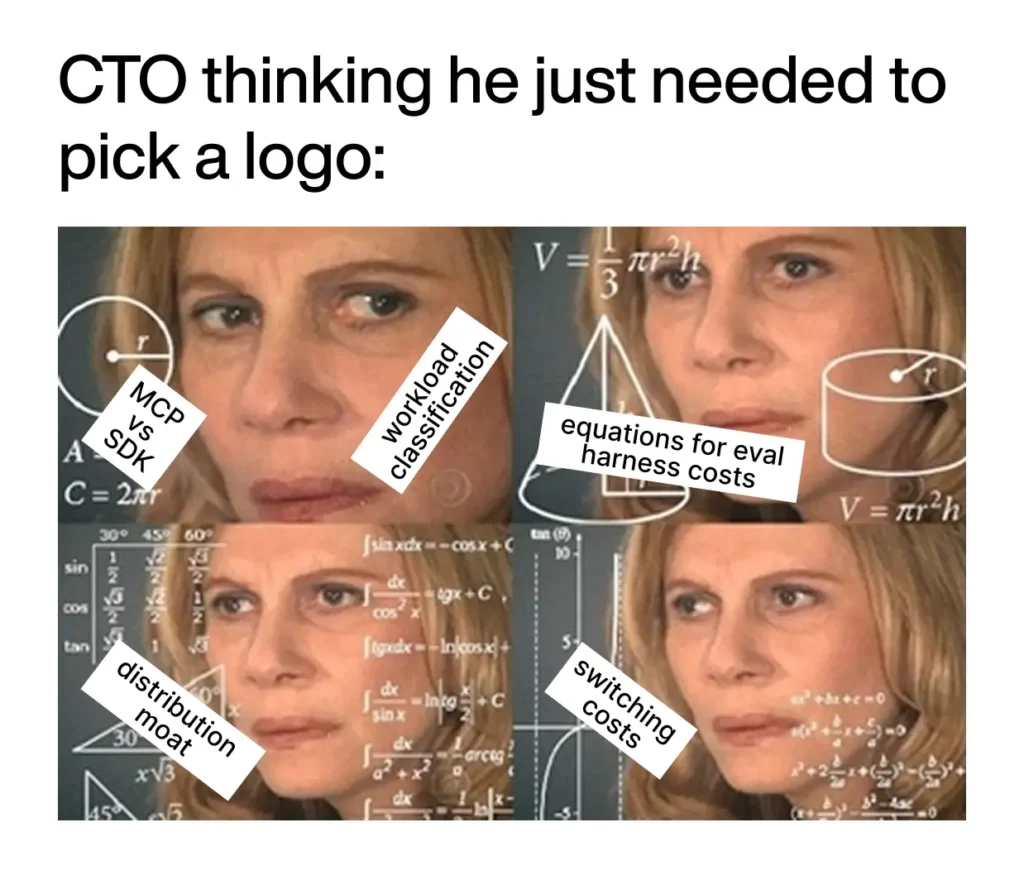
The other thing the Anthropic vs OpenAI framing misses is the cost of the decision itself. In 2024, switching providers was a one-line API change. In 2026, it is a 6- to 10-week senior engineering effort: rewriting the agent loop, re-tuning the eval harness, re-validating tool calls, and re-running the compliance review. A wrong default in Q2 becomes a re-platform in Q4, with no new product shipped in between.
A third thing the Anthropic vs OpenAI conversation skips: who in your org owns the choice. The model decision touches engineering (latency, eval harness, tool layer), security (data residency, audit trail, prompt injection), finance (per-token spend, retry rates, eval overhead), and product (which features ship on which surface). If any of those four functions is missing from the table, the choice tends to get re-litigated within 90 days.
This guide, Anthropic vs OpenAI, covers what each lab is actually betting on, how the model lines compare in 2026, agent tooling (MCP vs OpenAI Agents SDK vs Google’s ADK), pricing patterns, distribution and lock-in, and the deployment patterns we now recommend by default.
- Anthropic bets on safety as infrastructure. In the Anthropic vs OpenAI comparison, Claude is the default pick for sensitive workflows where errors carry regulatory or contractual cost: fintech KYC, insurance underwriting, healthcare intake, payer-side claims review. Ships the Model Context Protocol (MCP) as an open standard for agent-to-tool connections, which keeps the tool layer portable across vendors.
- OpenAI bets on vertical integration. ChatGPT distribution, the Agents SDK, the Responses API, and reasoning models (o-series) form a single stack. Largest developer community in 2026. The OpenAI vs Anthropic split usually breaks here: pick OpenAI for consumer reach, frontier-reasoning workflows, and the lowest day-one engineering lift.
- Google bets on platform depth and data access. Gemini ships with native Google Search grounding, a 1M-token production context window (now matched by Anthropic's Claude Fable 5), the Agent Development Kit (ADK), and the Agent2Agent (A2A) protocol. The honest OpenAI vs Google question is whether your team already lives in Workspace. If yes, Gemini's defaults map to your reality with the least integration debt.
- There is no clear winner in Anthropic vs OpenAI vs Google. The capability gap between the three labs is narrowing each quarter. The bigger differentiator for most teams is which existing stack fits the AI workload class, which trade-offs hurt least at scale, and which lab's defaults survive your next compliance review.
- Most mature teams we work with run two providers with a thin orchestration layer that routes per workflow. Single-vendor commitment costs less to operate and more to migrate out of. Multi-vendor workflows cost more to operate and less to migrate when the next price cut, quality jump, or audit constraint lands. The right answer is rarely binary.
Why does the Anthropic vs OpenAI choice matter for CTOs in 2026?
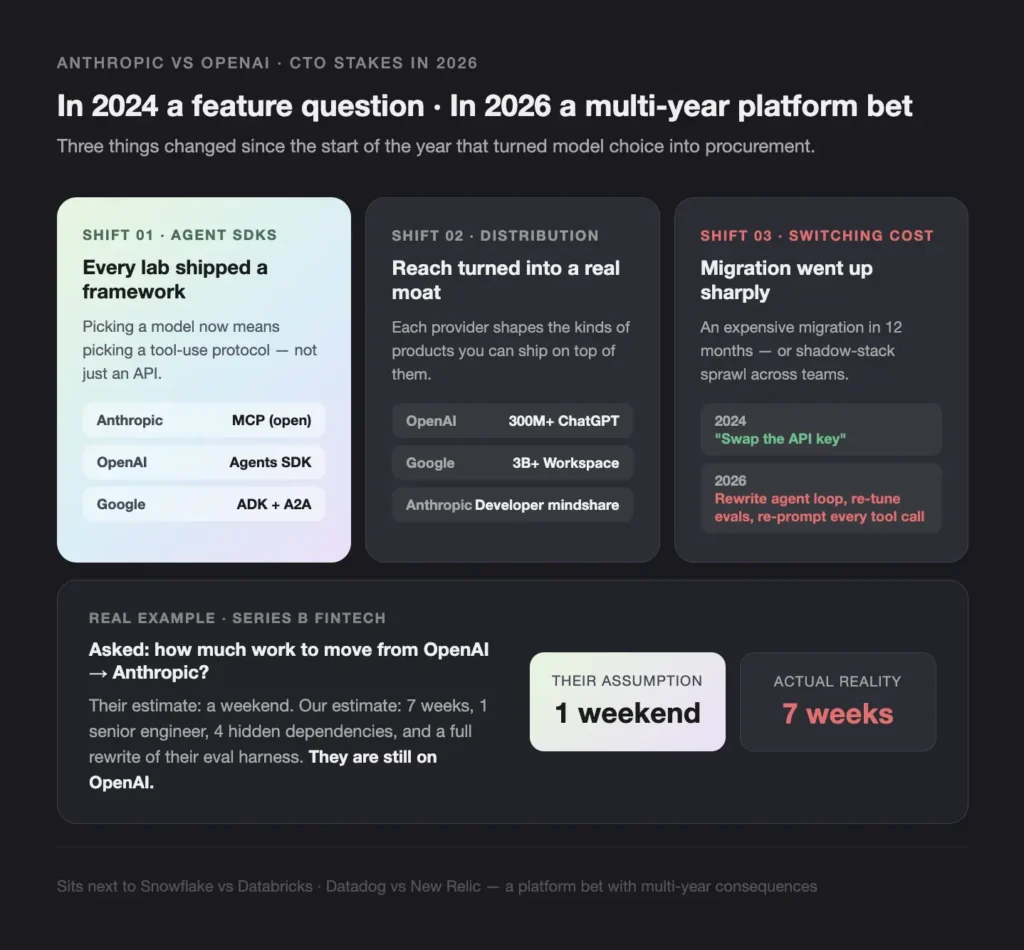
In 2024, the Anthropic vs OpenAI choice was a feature question. In 2026, it is a platform bet with multi-year consequences. Three things have changed since the start of the year, and each one reshaped the conversation in a different direction.
First, every major lab shipped an agent SDK or framework: Anthropic doubled down on MCP, OpenAI shipped the Agents SDK with handoffs and guardrails primitives, and Google launched ADK and A2A. Picking a model now means picking a tool-use protocol, which is why the Anthropic vs OpenAI debate is really an MCP-vs-Agents-SDK debate underneath.
Second, distribution turned into a real moat. OpenAI has 300+ million ChatGPT users. Google has Workspace and Search. Anthropic has Claude.ai and the developer community around Claude Code. Each one shapes the kinds of products you can ship on top, and each one shifts the OpenAI vs Anthropic calculus depending on who your end user is.
Third, switching costs went up. A 2024 migration was “swap the API key.” A 2026 migration is “rewrite the agent loop, re-tune the eval harness, re-prompt every tool call.” The Anthropic vs OpenAI decision now sits next to choices like Snowflake vs Databricks or Datadog vs New Relic. Getting it wrong means an expensive migration in 12 months or shadow-stack sprawl across teams.
What is each AI lab actually betting on: Anthropic Vs OpenAI and Google?
OpenAI’s August releases sharpen the vertical-integration thesis. GPT-5.6 now ships in named variants — Sol (with a user-controllable reasoning-effort slider), Luna (the free-tier default), and Cyber, a security-testing model available only to vetted partners such as CrowdStrike and Cloudflare through OpenAI’s Daybreak defense service. Like Anthropic’s Mythos program, the frontier labs are converging on gated access for dual-use capability — which means “which model can we actually get” is becoming a procurement question, not just a benchmark question.
Before any feature table, the strategic bets each lab is making determine which one fits which use case. The labs are not direct substitutes.
Anthropic: safety as infrastructure
Anthropic optimizes for predictability and minimal autonomous action. Claude follows instructions, asks before acting, and produces output that is easier to audit. The company ships open standards (MCP) instead of closed platforms. Compliance teams sign off on Claude faster than on most alternatives.
The trade-off: narrower enterprise integration than Google, smaller distribution footprint than OpenAI. If your buyer is a Head of Risk or a regulator, this is the bet that maps to your reality.
OpenAI: vertical integration
OpenAI controls the full stack: the frontier model, reasoning models (o-series), the Agents SDK, the Operator (autonomous browser), the ChatGPT consumer surface, and the broader plugin ecosystem. Pick OpenAI and you get the largest developer community, the most mature API, and the only frontier model with 300+ million consumer users to learn from.
The trade-off: safety story is less explicit. Vertical integration means more lock-in to one vendor’s choices. If you ship a consumer product or you care about frontier reasoning, this is the bet that maps to your reality.
Google: platform depth and data access
Gemini ships with native Google Search grounding for real-time accuracy, a 1M-token context window for long-document workloads, deep Workspace integrations (Gmail, Docs, Sheets, Drive, Calendar), Project Mariner for autonomous web interaction, and the Agent Development Kit (ADK) with the Agent2Agent (A2A) protocol for multi-agent orchestration.
The trade-off: narrower adoption outside the Google Cloud and Workspace footprint. If your team already runs on Workspace, or your workload involves very large documents or real-time search, this is the bet that maps to your reality.
How do Claude, GPT, and Gemini compare in 2026?
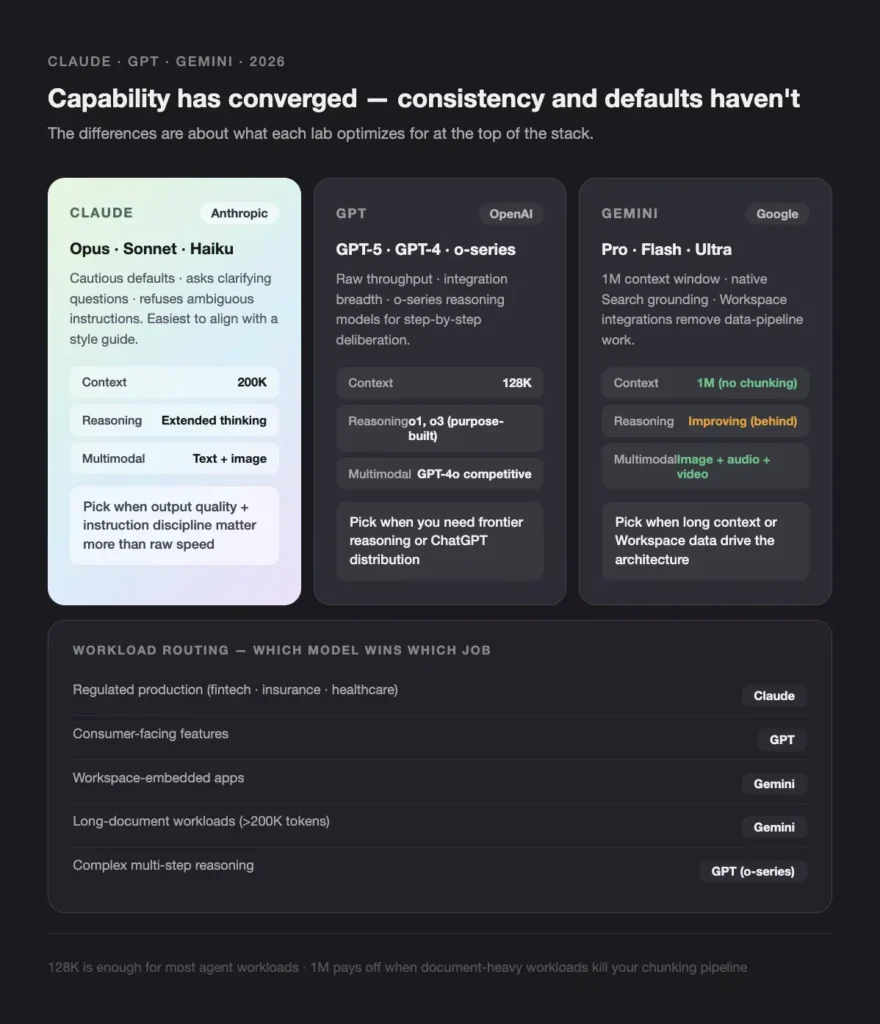
The model lines have converged on capability. The differences are about consistency, defaults, and what each lab optimizes for at the top of the stack.
Claude (Opus, Sonnet, Haiku)
Claude Opus is Anthropic’s flagship. Extended thinking mode for hard reasoning tasks. Strong on long context (200K tokens). Default behavior is cautious: it will ask clarifying questions and refuse ambiguous instructions. Senior engineers report it is the easiest model to align with a specific style guide or output contract.
What Claude Fable 5 changes.
In June 2026, Anthropic broke its own three-tier structure. Claude Fable 5 is the first “Mythos-class” model — a tier above Opus, priced at $10 per million input tokens and $50 per million output. Two things matter for a platform decision. First, context: Fable 5 carries a 1M-token window with 128K output, which removes Gemini’s long-standing context advantage over Claude. Second, structure: the same underlying model also ships as Claude Mythos 5, a safeguards-lifted variant restricted to approved cyber-defense and biomedical organizations. Anthropic is now running a two-track release — a generally available flagship with dual-use safety measures, and a gated version for vetted partners — with Opus 4.8 acting as the automatic fallback when Fable’s safeguards decline a request. If your workloads sit anywhere near security research or life sciences, that access model is now part of the vendor evaluation, not a footnote.
Use Claude when output quality and instruction-following discipline matter more than raw speed.
GPT (GPT-5, GPT-4, o-series)
GPT-5 leads on raw throughput and integration breadth. The o-series reasoning models (o1, o3) handle problems that require explicit step-by-step deliberation: complex math, planning, multi-step debugging. The Responses API replaced the older Assistants API in 2026 and unified the tool-use story.
Use GPT when you need frontier reasoning, large existing developer mindshare, or ChatGPT distribution.
Gemini (Pro, Flash, Ultra)
Gemini’s 1M-token context window is genuinely useful, not a benchmark stunt. Native Search grounding means the model can answer “what happened yesterday” without a custom retrieval layer. Workspace integrations remove the data-pipeline work for teams already living in Google’s stack.
Use Gemini when context length, real-time grounding, or Workspace data access drive the architecture.
Which model to pick for which workload
| Workload | First pick | Why |
|---|---|---|
| Regulated production (fintech, insurance, healthcare) | Claude | Instruction-following, audit-friendly output |
| Consumer-facing features | GPT | Distribution, frontier reasoning, ecosystem |
| Workspace-embedded apps | Gemini | Native Gmail, Docs, Drive, Calendar access |
| Long-document workloads (>200K tokens) | Gemini | 1M context, no chunking |
| Complex multi-step reasoning | GPT (o-series) | Purpose-built reasoning models |
| Coding agents | Claude (Code) or GPT (Codex) | See codex vs claude code comparison |
Which agent framework should you pick: MCP, OpenAI Agents SDK, or Google ADK?
Picking a model is half the decision. The other half is the agent framework you commit to.
Model Context Protocol (Anthropic)
MCP is an open standard for connecting agents to tools, data sources, and external services. Anthropic published the spec and the reference servers. The protocol is model-agnostic: you can run an MCP server in front of Claude, GPT, or Gemini. This is the closest thing to a “USB-C for AI” the industry has shipped.
Bet on MCP if you want to avoid framework lock-in. Build your tool catalog as MCP servers and you can switch the model underneath without rewriting the integrations.
Agents SDK and Responses API (OpenAI)
OpenAI’s Agents SDK ships with primitives for agents, handoffs (one agent delegating to another), guardrails (input and output filters), and tracing. The Responses API replaced Assistants and unified the tool-use surface. The combination is tightly coupled to OpenAI’s model line: switching models inside the SDK is one line of code; switching to a non-OpenAI model is a rewrite.
Bet on the OpenAI stack if you are committing to OpenAI for the next two years and you want the most mature, most documented agent dev path.
Agent Development Kit and A2A (Google)
Google’s ADK is built for multi-agent systems. The Agent2Agent (A2A) protocol lets agents from different runtimes coordinate. Native integration with Google Cloud, Workspace, and Vertex AI. Strong fit for teams that already deploy in GCP and want first-class multi-agent orchestration.
Bet on ADK if multi-agent coordination is core to your architecture and your stack is Google-aligned.
What we recommend by default
For new builds in regulated production, we recommend MCP plus a thin orchestration layer. The MCP investment pays off the first time you need to switch models for cost, quality, or compliance reasons. The OpenAI Agents SDK is easier to ship the first version on but harder to migrate out of.
Context window, reasoning, and multimodal: how do the three labs compare?
The headline numbers shift every quarter. The pattern that holds:
Cost per million tokens: changes too often to quote here. Run your own benchmarks on your own workload. The vendor’s pricing page is the only source of truth, and even that changes monthly.
Context window: Context length is no longer Gemini’s moat. Claude Fable 5 matches the 1M-token window (Claude Sonnet and Opus tiers remain at 200K), Gemini holds 1M across its Pro line, and GPT-5.6 remains behind on raw window size but compensates with retrieval tooling in the Responses API. The practical question has shifted from “who has the biggest window” to “what does a full window cost per call” — at Fable 5’s input pricing, a fully loaded 1M-token prompt is roughly $10 before the model writes a word.
Reasoning models: OpenAI’s o-series remains the strongest pick for problems where the model needs to deliberate (multi-step debugging, planning, math). Claude with extended thinking is close on most tasks. Gemini’s reasoning offering is behind both but improving.
Tool use latency: GPT and Claude are within 10 to 15% of each other on most production loops. Gemini’s first-call latency is faster on Google Cloud, slower on AWS or Azure.
Multimodal: Gemini leads on native multimodal (image, audio, video). GPT-4o is competitive. Claude is text-and-image only as of mid-2026.
How much does it cost to run Claude, GPT, or Gemini in production?
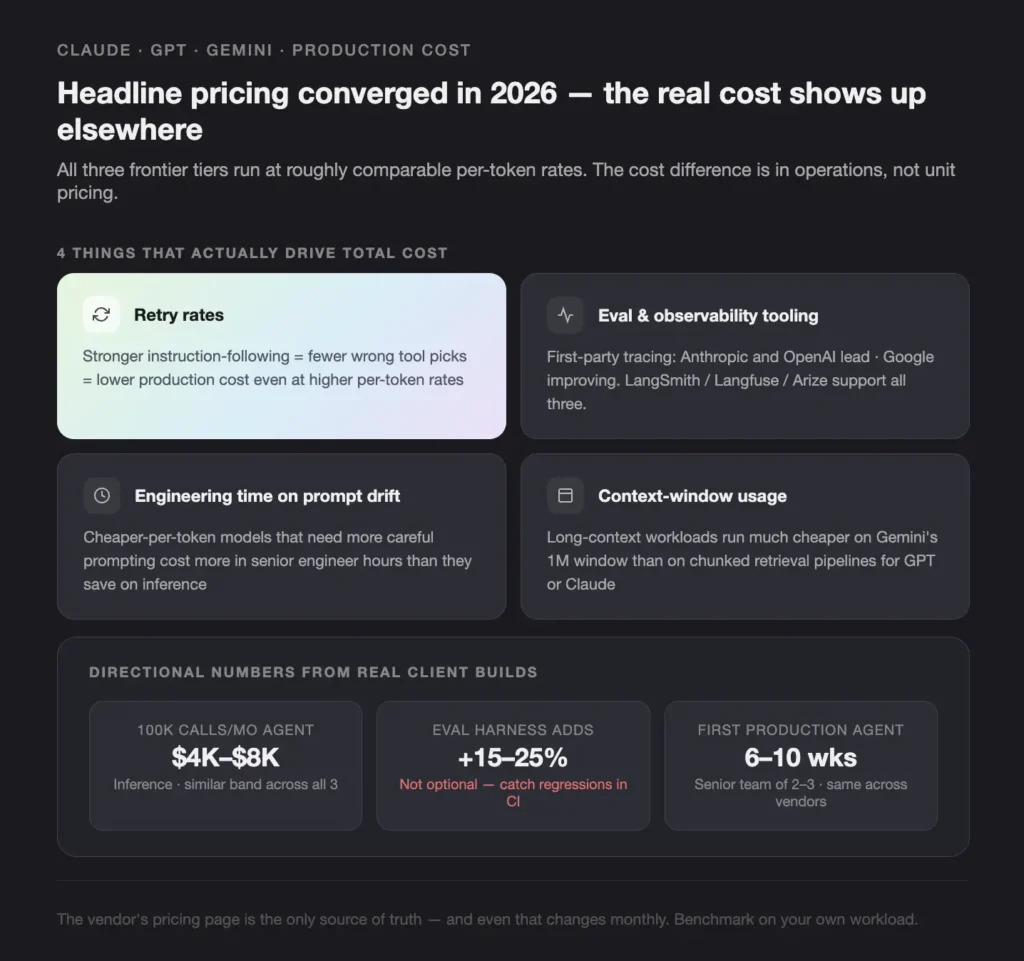
The headline pricing converged in 2026. All three labs offer a frontier tier at roughly comparable per-token rates. The real cost difference shows up in operations, not in unit pricing.
What actually drives total cost
- Retry rates when the model picks the wrong tool. A model with stronger instruction-following needs fewer retries. Fewer retries means lower production cost even at higher per-token rates.
- Eval and observability tooling. Anthropic and OpenAI both have first-party tracing. Google’s tooling is improving but lags. Third-party tooling (LangSmith, Langfuse, Arize) supports all three.
- Engineering time spent on prompt drift. Cheaper per-token models that need more careful prompting cost more in senior engineering hours than they save on inference.
- Context-window usage. Long-context workloads run much cheaper on Gemini’s 1M window than on chunked retrieval pipelines for GPT or Claude.
One dated-but-concrete pricing note: Anthropic’s promotional pricing on Claude Sonnet 5 ends August 31, 2026 – $2/$10 per million tokens becomes $3/$15, a 50% increase. If your cost model was built on the promo rate, re-run it. The directional $4,000–8,000/month estimate for 100K monthly Sonnet calls lands at the top of that band, or above it, at the new rate.
Directional numbers from real client builds
We do not quote vendor prices here because they change monthly. For a directional sense from real client builds:
- A production agent running 100,000 calls per month on Claude Sonnet costs roughly $4,000 to $8,000 in inference. The same workload on GPT-5 lands in a similar band. On Gemini, slightly lower on long-context workloads, slightly higher on short calls.
- An eval harness adds 15 to 25% to inference cost. Not optional. Catch a regression in CI, not in production.
- Engineering time to set up the first production-grade agent: 6 to 10 weeks for a senior team of 2 to 3. Same range across all three vendors.
What is the lock-in risk for each AI vendor: Anthropic Vs OpenAI, and Google?
The thing that gets discussed least in OpenAI vs. Anthropic comparisons is what comes with the model: distribution, partner ecosystem, and switching cost.
Distribution
Anthropic: Claude.ai and the developer ecosystem. Less consumer reach, more developer mindshare. Strong B2B brand in the engineering community.
OpenAI: ChatGPT consumer surface (300M+ users). Plugin ecosystem. ChatGPT Enterprise as an enterprise SaaS surface. The clearest “build a feature, ship it to users on day one” path.
Google: Workspace (3B+ users). Search. Android. Strong fit for products that live inside Google’s surfaces or sell into Workspace customers.
Lock-in shape
| Lock-in dimension | Anthropic | OpenAI | |
|---|---|---|---|
| Framework | Open (MCP) | Tighter (Agents SDK) | Tighter (ADK + GCP) |
| Distribution | None to lock in | ChatGPT ecosystem | Workspace ecosystem |
| Cloud | Cloud-agnostic | Tighter to Azure | Tighter to GCP |
| Switch cost (12-month-old agent) | Low to medium | Medium to high | Medium to high |
The pattern: Anthropic’s bets reduce lock-in. OpenAI’s and Google’s bets increase it in exchange for distribution and integration depth.
Which AI vendor should a CTO pick in 2026? The decision matrix
If you have to commit to a single provider for the next 12 months, this is the decision pattern we see hold up in real engagements.
| If your priority is… | Pick | Why |
|---|---|---|
| Regulated production, predictable output, audit-friendly | Anthropic | Instruction-following, MCP, compliance-friendly default behavior |
| Consumer reach, frontier reasoning, largest ecosystem | OpenAI | ChatGPT distribution, o-series reasoning, mature API |
| Workspace-native apps, long-context documents, multimodal | 1M context, native Workspace, Project Mariner | |
| Avoiding vendor lock-in | Anthropic + MCP | Open standard, model-agnostic tool layer |
| Shipping a coding agent | Anthropic (Claude Code) or OpenAI (Codex) | See codex vs claude code comparison |
| Multi-agent orchestration as a first-class concern | Google ADK or Anthropic MCP | ADK is built for it, MCP makes it portable |
| Lowest engineering operations burden | OpenAI | Most documented, most mature SDK, largest community |
No row wins cleanly. The right call depends on which trade-off costs the least in your situation.
How do you run a multi-model strategy without picking a single vendor?
Most mature teams we work with end up running two model providers, with a thin orchestration layer that lets them pick per workload. The pattern:
- Build the tool catalog as MCP servers. One investment, three models can call into it.
- Pick one frontier provider as the default. Usually the one that fits the largest workload class.
- Use the second provider for cases where the first one consistently underperforms. Long-context loads on Gemini, complex reasoning on OpenAI o-series, audit-sensitive workflows on Claude.
- Wrap model calls in an internal client that abstracts the provider. When the next price cut or quality jump happens, switching is a config change, not a refactor.
- Run an eval harness that scores all candidate models on your real prompts, not the vendor benchmarks. Re-run it monthly.
This pattern costs more to operate than a single-vendor commitment. It costs much less to migrate out of. For teams shipping AI as a core part of the product, the multi-vendor pattern is the safer long-term bet.
For teams shipping AI as a single feature on top of a non-AI product, the single-vendor pattern is fine. Pick the one that fits the use case and revisit in 12 months.
The bottom line: Anthropic vs OpenAI vs Google in 2026
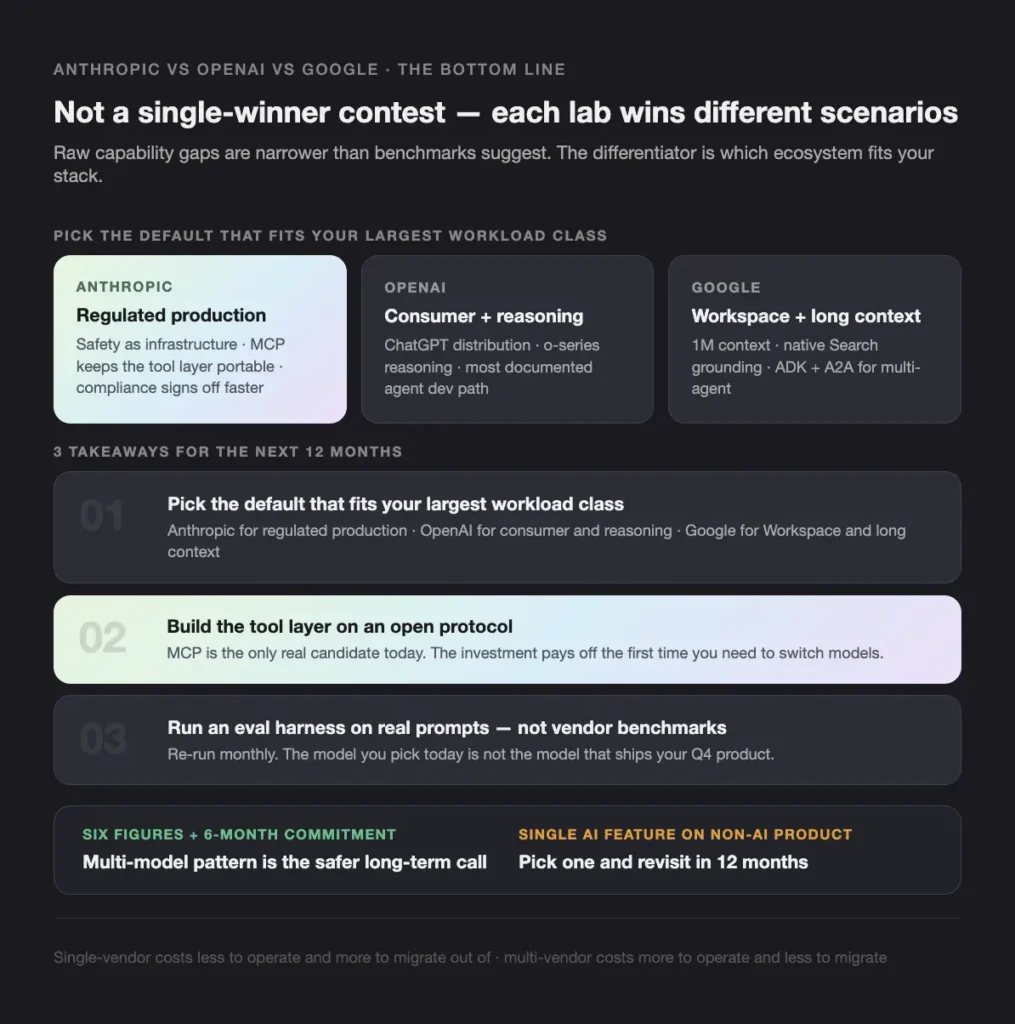
Anthropic vs OpenAI vs Google is not a single-winner contest in 2026. Each lab is making a different bet, each bet wins in different scenarios, and the gap on raw capability is narrower than the public benchmarks suggest. The bigger differentiator is which ecosystem fits your existing stack and which trade-offs hurt least.
Three things to take away:
- Pick the default that fits the largest workload class. Anthropic for regulated production. OpenAI for consumer and reasoning. Google for Workspace and long context.
- Build the tool layer on an open protocol. MCP is the only real candidate today. The investment pays off the first time you need to switch models.
- Run an eval harness on real prompts, not vendor benchmarks. Re-run monthly. The model you pick today is not the model that ships your Q4 product.
If you are at the point where this decision is six figures of token spend and a six-month engineering commitment, the multi-model pattern is usually the safer call. If you are shipping a single AI feature on top of a non-AI product, pick the one that fits and revisit in 12 months.
How Teamvoy helps CTOs ship production AI agents
Teamvoy is an AI agent development company. We design, build, and operate production AI agents on top of Anthropic, OpenAI, and Google models. The same senior engineer who designs the agent writes the code, owns the eval harness, and is on the call when the model breaks.
If you are about to commit budget to a single provider, or you are stuck on a closed framework and need to rebuild on open standards, we can help. Start with one of three entry points:
- AI Agent Readiness Audit (3 to 5 days). We review your stack or your plan, surface the production risks, and deliver a clear action plan.
- Sharp Sprint (two weeks, fixed scope). For teams that already know what to build.
- 15-min Technical Call (this week). Direct line to a senior AI agent engineer.
Talk to an engineer or read more on AI agent development services and the hidden costs of AI agents.
FAQ
Sources and further reading
OpenAI Agents SDK documentation
Model Context Protocol specification (Anthropic)