Q1: What Is Enterprise AI Architecture, and Why Do Most Deployments Stall Before They Reach Production?
A VP of Engineering books a demo. The model answers questions fluently. The pilot looks sharp. Three months later, the same team is debugging why the output never makes it into the CRM, why the retrieval pipeline returns stale records, and why nobody can explain what data the model actually saw. The demo worked. The architecture did not.
Enterprise AI architecture is the structural blueprint governing how data flows into AI models, how models are deployed and versioned, and how outputs are audited and acted upon across production systems. Most deployments stall not because the model was wrong. They stall because the data and integration layers were treated as afterthoughts. According to a McKinsey global survey in 2025, 88% of organizations have integrated AI into at least one business function. A fraction of those have governance or integration layers that would survive a production incident, let alone a regulatory audit.
⚠️ The Stalled Pilot Is an Architecture Problem
The first thing I ask on any AI integration call is not “which model are you using?” It is: “What does your data layer look like in production, and who owns the integration when the vendor changes the API schema next quarter?” That question ends more vendor conversations than any technical objection.
The pattern is consistent across fintech, insurance, and healthcare engagements. A team obsesses over the model. They pick GPT-4o, or Gemini, or a fine-tuned open-source variant. They ship a prototype that reads data and answers questions. Then they try to wire it into a live system, and the real work starts. The integration layer, the governance controls, and the data quality issues all surface at once.
✅ Three Layers, One Decision at a Time
A well-designed enterprise AI architecture has three layers. The data layer handles ingestion, storage, transformation, and retrieval. The model layer covers base model selection, fine-tuning, serving, and versioning. The governance layer manages explainability, audit logging, access control, and compliance.
Most organizations build these in the wrong order. They start with the model because it is visible and exciting. They reach the data layer when the model starts returning garbage. They reach governance when a regulator or a board member asks a question nobody can answer. Our AI consulting work confirms this inversion as the dominant failure pattern in enterprise AI deployments.
The governing principle I carry into every Teamvoy engagement is this: the model is the kernel. Integration is the operating system. An OS built on bad integration means the kernel does not matter.
Q2: What Are the Three Layers of Enterprise AI Architecture, and Which One Is Actually Your Strategic Asset?
Most teams I talk to believe the model is their strategic asset. It is the visible layer. It has a name. It has a price tag. It gets discussed in the board deck. But across 150+ delivered projects, the pattern tells a different story.
💰 The Layer-by-Layer Reality
| Layer | What It Contains | Commoditization Level | Recommended Ownership Stance |
|---|---|---|---|
| Data | Ingestion, storage, feature engineering, vector retrieval, schema design | Low, your data is unique | Own it. Build the transformation logic. Buy the compute. |
| Model | Base model, fine-tuning, serving, versioning, prompt logic | High and rising fast | Buy access. Own the evaluation harness. |
| Governance | Audit logs, RBAC, explainability, compliance controls, model cards | Medium, frameworks exist, implementation is yours | Never bolt on. Architect in from sprint one. |
The model layer is the most commoditized and the fastest-depreciating asset in the stack. A foundation model that costs $20 per million tokens today will cost $0.50 per million tokens in 18 months, or will be superseded entirely. An organization that built its business logic around a specific model version will re-engineer when that version is deprecated.
⭐ Own the Harness, Not the Model
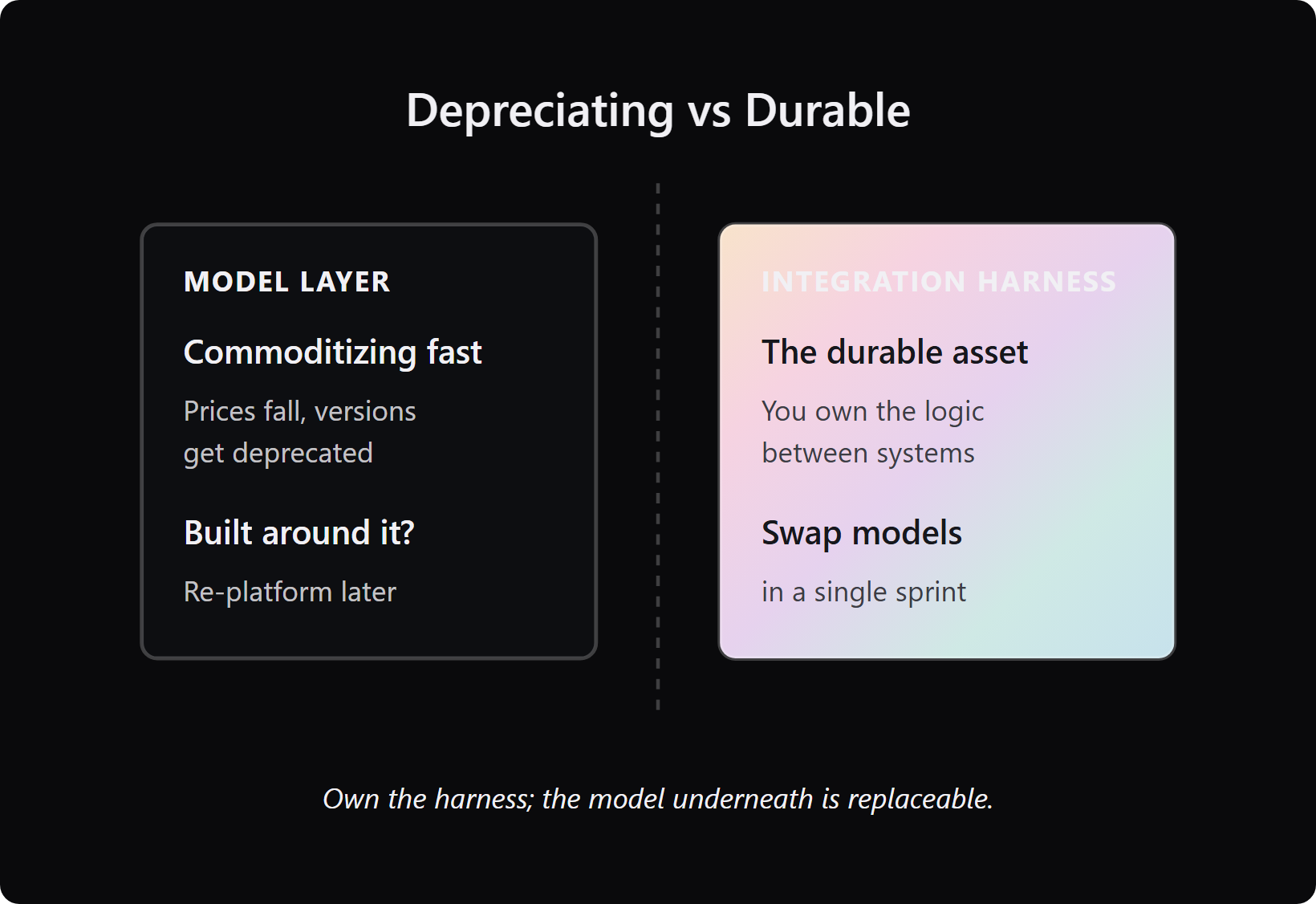
I have seen this play out across multiple fintech and insurance engagements. Teams that built around a specific model version spent their next two engineering quarters re-platforming. Teams that built a strong integration harness, the connective layer between the model and their production systems, swapped models in a sprint.
The strategic insight is simple but consistently ignored. The harness is the piece you want to own over the long term. It is what lets you migrate agents out, swap models, and retain your institutional logic when the vendor landscape changes.
In our AI development work, the harness is always scoped as a separate deliverable from model selection. A client who owns their harness can move to a cheaper or more capable model whenever the economics change. A client who tied their business logic to a vendor SDK is locked. The international standard for AI management systems also treats governance as a design-time responsibility, not a deployment-time checklist. That framing matches what I see in production: governance that is not in the architecture from the start never fully lands.
Q3: Build, Buy, or Hybrid, How Do You Make the Right Call at the Data Layer?
A CTO at a mid-sized insurance platform once described their data layer decision to me like this: “We bought a managed platform, shipped fast, and two years later we cannot move because every transformation lives in the vendor’s proprietary SQL dialect.” The platform was not wrong. The ownership decision was.
✅ The Governing Recommendation Up Front
Buy the compute and storage. Own the transformation logic and schema design. That combination gives you platform economics without schema lock-in. It is the right call for most organizations, most of the time. The complication is in the details.
Most enterprises default to a managed platform, Databricks with Delta Lake, Snowflake with Cortex, or Google BigQuery. That is usually correct. These platforms handle ingestion, storage, compute scaling, and increasingly, vector retrieval for RAG (retrieval-augmented generation, a pattern where AI models query your data at inference time rather than having it baked into training). Sound data engineering at this layer is what separates a durable system from an expensive one.
⚠️ The Hidden Lock-in Risk
The risk is not the monthly bill. The risk is where your transformation logic lives. If your data joins, your cleaning rules, and your feature engineering (the process of preparing raw data into formats a model can use) are written in a vendor’s proprietary format, migration costs as much as the original build.
The question we ask before any data layer architecture decision is this: “If this vendor doubles their price in 18 months or gets acquired, what does migration cost?” If the answer involves rewriting transformation logic, the architecture decision was wrong from the start. Leading data governance frameworks and security control standards both treat data lineage and portability as security controls, not nice-to-haves. A clean system integration approach keeps that logic portable from day one.
❌ The RAG Anti-Pattern
One more failure mode worth naming directly. If your AI data strategy is “vectorize the wiki and see what happens,” stop now. An agent that only reads data is a search box with extra latency. Production AI needs write access and evaluated retrieval pipelines, not a keyword index dressed up as intelligence.
When we audit an existing data layer through our IT audit services, three things surface in the first session: where transformation logic lives (platform-native or portable code), whether schema documentation exists that a new engineer can read without asking the person who built it, and whether the vector retrieval pipeline has been evaluated against any retrieval quality metric beyond “it seemed to work in the demo.”
“Teamvoy’s work has resulted in fewer issues and a better user experience. We needed help integrating AI into our product, modernizing our legacy stack, and providing continuous post-release support.”
Dmytro Maryanych, Manager, Takflix Teamvoy Clutch Verified Review
Q4: When Should You Build Your Own AI Model, and When Is That Expensive Ego?
Eight months into a domain-specific fine-tuning project, a fintech team I know ran a benchmark. Their fine-tuned model and GPT-4o with a structured prompt performed near identically on their evaluation set. The fine-tuning was not wasted, the evaluation framework they built to measure it was genuinely valuable. But eight months of engineering time went into the model. The evaluation harness took three weeks.
✅ Three Scenarios Where Building Is Justified
Fine-tune or self-host your model when:
- Your domain data is proprietary and irreproducible. Rare clinical records, private financial transaction history, or regulated sensor data that cannot leave your infrastructure and cannot be approximated by a foundation model’s training set.
- Your inference volume makes API costs prohibitive. At a certain scale, hosting a smaller open-source model (Mistral, LLaMA variants) is cheaper than paying per token. The break-even point is usually in the hundreds of millions of tokens per month.
- Compliance requires data never to leave your infrastructure. HIPAA, GDPR, certain PCI-DSS scopes, and BaFin-regulated environments can mandate on-premise or private-cloud inference.
For managed fine-tuning, the main platforms are AWS SageMaker, Google Vertex AI, and Azure ML. For self-hosted build paths, Kubeflow and MLflow provide model registries, experiment tracking, and serving infrastructure. In regulated sectors like banking and fintech and healthcare, the compliance criterion often decides this on its own.
💸 The Hidden Cost Trap
Outside those three scenarios, model ownership is usually a cost center wearing a competitive moat costume. Here is the cost structure most teams undercount:
- Training cost. The initial fine-tuning run.
- Retraining cost. When the base model is updated or deprecated, the fine-tuning run again.
- Evaluation harness cost. If the harness was wrong, the model was wrong. Third run.
AI-generated pull requests carry an average of 10.8 issues per PR, nearly double the 6.4 found in human-written code. This matters for model-layer work because fine-tuning pipelines and model serving code are complex, and AI-assisted shortcuts compound the defect rate. Almost right is more expensive than completely wrong, which is why we scope AI engineers who can read and own the code in production.
⭐ The Hybrid Default for 2025 to 2026
The dominant real-world pattern I see across enterprises today is this: buy the model, build the evaluation harness and the integration layer. Access a foundation model via API. Invest the saved engineering time into the data layer, the retrieval pipeline, and the evaluation framework that measures whether the model is actually doing what you need.
Our default recommendation for companies under $50M ARR is direct: do not build your own model. Spend the budget on the data layer and the harness. The harness outlasts every model version, and our technology modernization work is built around exactly that principle.
“Teamvoy provided expertise in cryptocurrency, financial trading, and web and mobile development to manage the growth of a product suite. We have been with Teamvoy for 4 years and found a great partner for the growth of Bitspark. Their technical expertise was top class.”
George Harrap, CEO, Bitspark Teamvoy Clutch Verified Review
Q5: What Is the AI Integration Layer, and Why Is It the Architectural Decision Nobody Budgets For?
A customer support agent ships on a Friday. The developer goes to sleep. By Saturday morning, the agent has been stuck in an infinite retry loop with a broken CRM tool for six hours, repeating the same failed action with no circuit breaker to stop it. The OpenAI bill: $4,200. The business output: zero. The root cause was not the model. It was the integration layer nobody scoped.
The integration layer is the nervous system of your AI architecture. It is the webhooks, API schemas, authentication flows, retry logic, and event triggers that allow a model’s output to actually change something in your production systems. It is not a platform feature you buy. It is an architectural decision you own. And it is the layer most organizations budget last, if at all.
⚠️ The Read-Mode Trap
Most enterprise AI agents today operate in read mode only. They retrieve data, summarize documents, and answer questions. That makes them a search box with better presentation. Production value comes from write access: updating CRM records, provisioning users, closing tickets, and reacting to event triggers like a “Deal Closed” webhook instead of polling a database every five minutes. This is where AI agent development services move from demo to production.
Write access requires a different architecture. You need idempotency controls (safeguards that prevent the same action from executing twice), hard retry limits, and cost ceilings. Without them, the $4,200 nap becomes a $150,000 month. Some organizations have logged over $150,000 in unmonitored token spend in a single billing cycle with no measurable business output.
💸 The Chief Integration Officer Trap
Here is the build-vs-buy tension nobody names clearly. If you buy a pre-built integration platform and let the vendor own the schema, you inherit a permanent maintenance obligation. Every API schema change, every new custom field, and every authentication rotation becomes your problem to track and patch. You become the Chief Integration Officer for someone else’s architecture decisions.
The threshold for building is high. Build your integration layer only if you have a dedicated platform team and your core systems are genuinely unique. For everyone else, buy the platform, but own the harness logic (the code that governs how your systems invoke the model and handle its outputs). A clean system integration approach keeps that harness portable.
✅ What We Enforce Before Any Integration Ships
In every AI integration we architect, three guardrails are non-negotiable from sprint one: a hard token ceiling per session, a circuit breaker on tool call retries, and a cost alert that fires before 50% of the daily budget is consumed. These are not add-ons. They are the architecture.
No verified customer reviews were available in the provided source set for this specific integration layer point.
Q6: How Do You Build a Governance Layer That Survives a Regulatory Audit, Not Just a Demo?
A fintech team I worked with passed their initial AI compliance review. Their governance documentation was thorough. Audit logs existed for every model invocation. Six months later, a regulator asked a specific question: “Show us the input feature values that produced this credit decision on this date.” The logs showed the output. They did not retain the feature context that shaped the model’s input. The system could not answer. That is not a documentation failure. That is an architecture failure.
Governance that survives a regulatory audit is not documentation written after deployment. It is a set of architectural decisions made before the first model call reaches production. Every output logged with its input context. Every data access permissioned and auditable. Every high-risk decision explainable to a human reviewer in under 60 seconds.
✅ The Three Governance Primitives
Before any AI feature goes to production in a regulated environment, our AI consulting standard requires four artifacts: a data lineage map, a model card (inputs, outputs, known failure modes, and version), a RBAC matrix (role-based access control, defining who can invoke the model and on whose data), and an adversarial test suite. These are scoped into the first sprint.
The three primitives that underpin all four artifacts:
- Logging: Input context plus output plus timestamp plus user identity, retained at the feature level, not just the response level.
- Permissioning: RBAC on both data access and model invocation. The model should not be callable by a role that cannot access the underlying data.
- Explainability: Any decision the model influences must be traceable to its inputs within 60 seconds by a human reviewer, without requiring the engineer who built it.
⚠️ The Regulatory Grounding
The NIST AI Risk Management Framework defines governance requirements by risk tier, with the highest tier requiring full input-output traceability and human override capability. ISO/IEC 42001 treats AI governance as a management system requirement, not a feature. The EU AI Act classifies certain AI applications in credit, employment, and healthcare as high-risk systems, with mandatory conformity assessments before deployment. For regulated sectors like banking and fintech and insurance, this grounding decides architecture, not paperwork.
The line I carry into every compliance conversation: eligibility for compliance does not equal compliance. Passing a checklist at the point of deployment and surviving a live audit 18 months later are different standards.
⭐ The Tribal Knowledge Problem Amplified
The 2 AM failure pattern appears in governance too. An on-call engineer sees an error, passes it to an AI tool, and the tool reads the documentation and says “restart the server.” The engineer restarts six times. The real issue was a database connection pool saturated by a batch cron job, knowledge held by one senior engineer, never documented, and never auditable. AI amplifies the gap between what is written and what is known. Governance architecture is how you close it, and our IT audit services surface that gap before it becomes an incident.
“Teamvoy actively uses agentic AI across internal workflows and delivery, which speeds up development, raises quality, and adds extra value for the client.”
Dmytro Maryanych, Manager, Takflix Teamvoy Clutch Verified Review
Q7: What Does a Layer-by-Layer Build-vs-Buy Scoring Rubric Actually Look Like?
Most build-vs-buy frameworks are binary and context-free. “Build if it’s core, buy if it isn’t.” That framing is useless when the right answer at the data layer is different from the right answer at the model layer, inside the same organization, in the same quarter. Around 52% of enterprises are still in active experimentation with AI, making this decision for the first time with real money. They need a rubric, not a principle.
💰 The Six-Criteria Scoring Table
Score each layer across six criteria on a 1-to-3 scale (1 = buy strongly favored, 2 = hybrid, 3 = build strongly favored). The layer with the highest total score is your build candidate. Everything else is a configure-and-own-the-schema decision.
| Criterion | Data Layer | Model Layer | Governance Layer |
|---|---|---|---|
| Differentiation value (does this create IP unique to your business?) | High, your data schema is yours | Low, models are commoditizing fast | Medium, frameworks exist, implementation is yours |
| Talent availability (do you have people who can build and maintain this?) | Medium, data engineers are available | High bar, ML engineers are scarce and expensive | Medium, compliance engineers are findable |
| Time-to-value (how long before this produces output?) | Weeks to months | Months to a year for fine-tuning | Weeks if designed in from sprint one |
| TCO over 36 months | Build logic is cheaper long-term if portable | API access is almost always cheaper under $50M ARR | Governance debt is the most expensive cost you cannot see |
| Vendor lock-in risk | High if transformation logic lives in vendor dialect | Medium, APIs change, but swapping is a sprint if harness is owned | Low if primitives are standard |
| Compliance auditability | Must own the lineage | Must own the evaluation record | Must own this layer entirely |
⚠️ Two Scenarios, Two Different Scorecards
A fintech CTO with a legacy core banking system scores high on data layer differentiation (proprietary transaction history), high on compliance auditability requirements, and low on model layer talent availability. Recommendation: buy a managed data platform, own the schema and transformation logic, buy API model access, and build the governance layer in from sprint one. Our technology modernization work starts at exactly this point.
A SaaS founder with an AI-built MVP hitting production instability scores differently. Model layer talent is low, governance requirements are lower, and time-to-value pressure is high. Recommendation: buy everything at the model and governance layer, and focus build capacity on the integration harness and evaluation framework. This is where senior AI engineers who can own the harness matter most.
⭐ The Column Nobody Adds
The scoring rubric we use internally includes one column that most frameworks omit: “Who maintains this in 18 months if the person who built it leaves?” That single question eliminates more build decisions than any TCO model. Technical debt currently costs the equivalent of 61 billion work days globally. Most of it was created by build decisions where the maintenance assumption was never written down, which is why IT cost optimization starts with that maintenance question.
“I can confidently say that we would not be where we are today without Teamvoy’s support.”
Gordon Little, Managing Director, Iress Teamvoy Clutch Verified Review
Q8: What Are the Most Expensive AI Architecture Mistakes, and How Do You Catch Them Before They Ship?
The standard read on AI architecture failures is that teams picked the wrong model or did not have enough data. That reads backwards to me. Across the codebases I have reviewed, the expensive failures share one feature: they looked fine in a demo and broke in ways that were invisible until scale, load, or a billing cycle exposed them.
💸 The Quadratic Billing Bomb
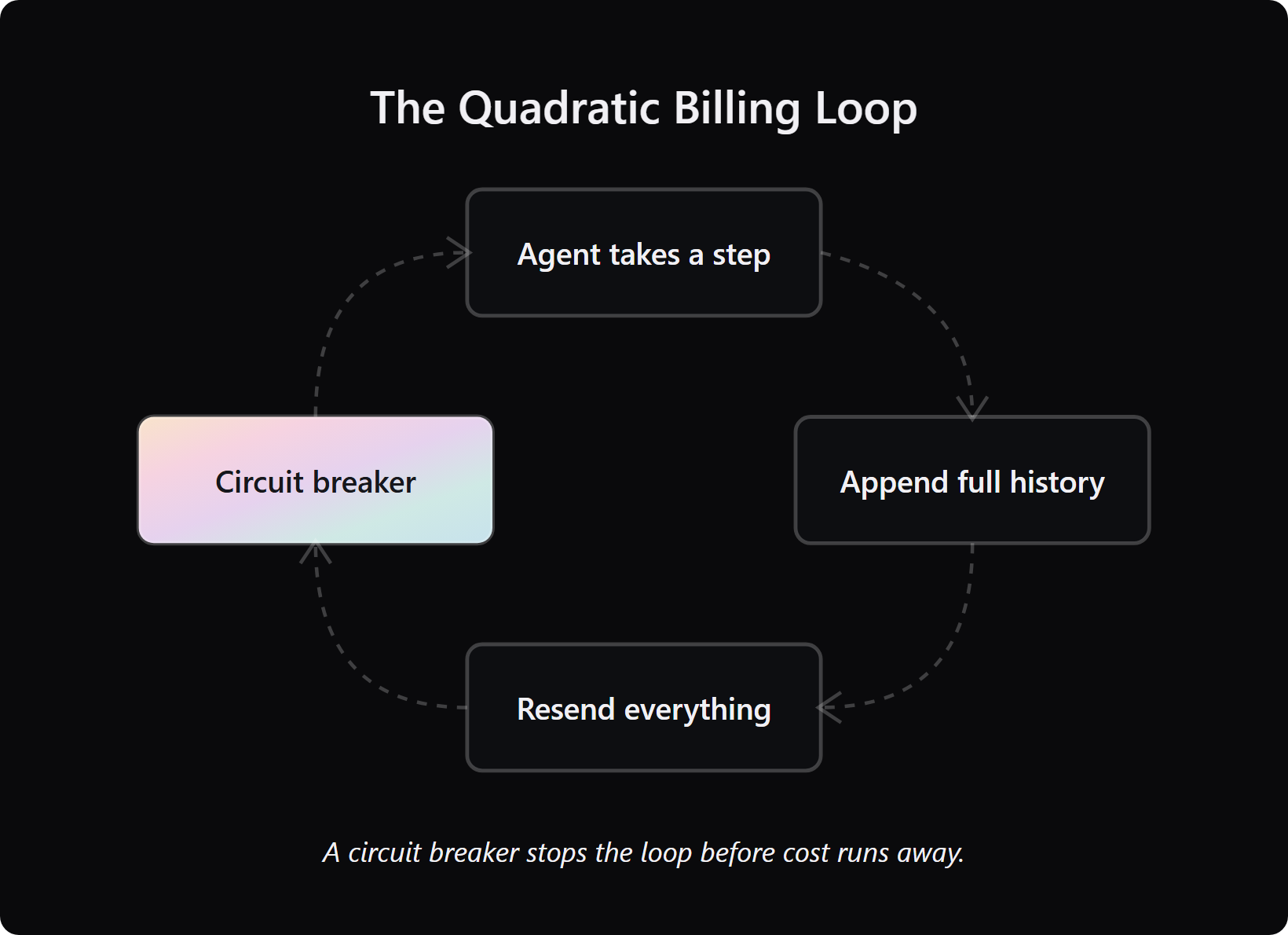
Most LLM APIs are stateless. Every time an agent takes a step, the framework appends the entire history of tool calls, errors, and intermediate outputs, then resends it all with the next request. Token consumption grows quadratically, not linearly. A 20-step agent loop is not twice as expensive as a 10-step loop. It is exponentially more expensive, because each step carries the full weight of every previous step.
The fix is a hard circuit breaker: a maximum step count, a token ceiling per session, and an error state that stops the loop rather than retrying. These are three lines of configuration, not a research problem. Our AI development services build these guardrails in by default.
⚠️ The 40% Dumb Zone
Context windows degrade in quality as they fill. Around the 40% mark of a 168,000-token context window, retrieval accuracy drops and reasoning quality declines. Teams that load every available MCP tool (Model Context Protocol, a standard for connecting AI models to external data sources), JSON schemas, and system documentation into context at the start of each session are doing their most important work in the dumb zone.
The fix: load context selectively, route simple operations to smaller, cheaper models, and reserve large context for high-complexity reasoning tasks only.
❌ Shadow AI Sprawl
Some organizations have logged over $150,000 in unmonitored token spend in a single billing cycle with zero documented business output. This is not a policy failure. It is an architecture failure. Cost ceilings, per-team budget namespaces, and alerting at 50% daily consumption are architectural primitives, not governance overhead.
The fix lives in the architecture, where cloud optimization meets cost control, not in a policy document nobody reads.
⭐ The Agentic Code Quality Problem
AI-generated pull requests carry an average of 10.8 issues per PR, nearly double the 6.4 found in human-written code. Teams using Cursor, Replit, or GitHub Copilot for production code often report shipping faster and debugging longer. The velocity is real. The backlog it creates is also real.
Agentic AI compounds this. When an AI agent drops into your codebase, it has no memory of prior sessions, no understanding of implicit design decisions, and no awareness of the 3 AM batch job that modifies the same table its new feature writes to. Locally coherent code can be globally broken. Our pre-production checklist includes a defect rate benchmark for AI autonomous agents and AI-generated code before any PR merges. If the defect density is above threshold, the feature does not ship.
“We were impressed with the technical management, adherence to process, and technical capability of the engineers.”
Mark Phillips, CTO, Robots and Pencils Teamvoy Clutch Verified Review
Q9: How Do You Layer AI onto a Legacy System Without a Disruptive Rewrite?
The legacy system sitting in your infrastructure right now is not the problem. It is evidence that something worked well enough to run a business on for years. The problem is the gap between what it was built to do and what the business needs from it today. That gap feels like a reason to rewrite. It rarely is.
A rewrite is a second first build. You take all the original risks, add the cost of keeping the old system running in parallel, and lose the institutional knowledge that was baked into every quirky decision the previous team made. The most dangerous moment in any modernization is not the migration itself. It is the first week after go-live, when the tribal knowledge carried by the old system has no equivalent in the new one. Our technology modernization work is built to protect exactly that moment.
⚠️ The Memento Problem in Legacy Codebases
When an AI tool drops into an undocumented codebase, it has no memory of prior sessions, no awareness of the design decisions made three years ago, and no knowledge of the batch job that runs at 3 AM and touches the same table the new feature writes to. It will generate confident, locally coherent code that is globally broken. The documentation sprint is not optional overhead. It is the precondition for AI to be useful at all, and it is why our IT audit services begin before any code changes.
The incremental modernization pattern that works in practice looks like this. A retail team needed to modernize their point-of-sale backend without disrupting cashiers mid-shift. They built an identical interface, same colors, same button positions, and same workflow. The cashier came in the next day and saw the same system. Behind it, the team was writing to entirely different tables, normalizing the data model one entity at a time. No user training. No disruption. No rewrite. This is the kind of retail and ecommerce work where downtime is not an option.
✅ The Documentation Sprint Comes First
Our modernization engagements always begin with a documentation sprint, not a code sprint. Before a single line of the legacy system changes, we produce three artifacts: a data map (what data exists, where it lives, and what quality it is), a dependency graph (what calls what, and in what order), and a tribal knowledge register (what only the senior engineer knows at 2 AM).
That register is what makes the AI layer functional. A model cannot reason about your system without context. Leading security control standards treat data lineage and system documentation as security controls for exactly this reason: undocumented systems create risk that no amount of access control can fully mitigate. Sound data engineering is what turns that register into something a model can use.
⭐ Adding AI Layer by Layer
Once the data layer is stabilized and documented, AI capability is added workflow by workflow. Start with the highest-value, lowest-risk workflow. Instrument it, evaluate it, and govern it before expanding. Adding AI to a legacy system is closer to adding a turbocharger to an engine that already misfires than to a clean upgrade. Fix the misfire first, then bring in the right AI engineers to layer capability on safely.
The honest trade-off: not every legacy system can be modernized incrementally. If the data model is fundamentally broken, if there is no documentation and the original engineers are gone, and if the compliance deadline is six months away, a strategic rebuild may be the only path. I have had that conversation with clients. It is not a comfortable one, but it is an honest one.
“Teamvoy provided expertise in all areas of cryptocurrency, financial trading, and web and mobile development. We have been with Teamvoy for 4 years and found a great partner. Their technical expertise was top class.”
George Harrap, CEO, Bitspark Teamvoy Clutch Verified Review
Q10: What Should Your Enterprise AI Architecture Reference Stack Look Like in 2026?
The 2026 reference architecture is not a platform decision. It is a set of deliberate ownership choices made at each layer of the stack. Buy managed compute and storage. Access foundation models via API unless compliance demands self-hosting. Build and own your integration harness, evaluation framework, and governance primitives. That combination gives you model portability, cost control, and audit readiness. When the next model generation ships, migration is a sprint, not a project.
✅ Layer-by-Layer Stance Table
| Layer | Recommended Stance | Build | Buy | Red Lines |
|---|---|---|---|---|
| Data | Own the schema and transformation logic | Transformation code, lineage tooling | Storage and compute (Databricks, Snowflake, BigQuery) | Never let vendor own the schema |
| Model | Buy access, own evaluation | Eval harness, prompt logic | Foundation model API (OpenAI, Anthropic, Gemini) or managed fine-tuning (SageMaker, Vertex AI) | Never build from scratch under $50M ARR |
| Integration | Own the harness entirely | Circuit breakers, retry logic, event triggers, cost ceilings | API schema tooling, webhook infrastructure | Never outsource harness maintenance |
| Governance | Design in from sprint one | Audit logging, RBAC, model cards, adversarial test suite | Compliance framework tooling (where available) | Never bolt on post-deployment |
| MLOps | Buy the platform, own the pipelines | Model registry logic, deployment scripts | Kubeflow, MLflow, SageMaker Pipelines | Never let pipeline logic live in vendor UI only |
⚠️ The Agentic AI Frontier
The 2024 frameworks did not anticipate agentic AI (AI systems that take multi-step actions, call tools, and operate across longer time horizons than a single prompt-response cycle). Agentic architectures introduce three new architectural concerns: tool-call memory (how does the agent remember what it did across sessions?), multi-agent orchestration (how do multiple agents hand off work without duplicating context?), and write-access governance (how do you audit an action the agent took on behalf of a user?). These are the questions our AI agent development services are built to answer.
These are not solved problems. Where my view sits right now is that the harness ownership principle becomes even more critical in agentic architectures. Organizations running dozens of AI autonomous agents simultaneously manage them only because their harness layer is portable and version-controlled.
⭐ The Closing Principle
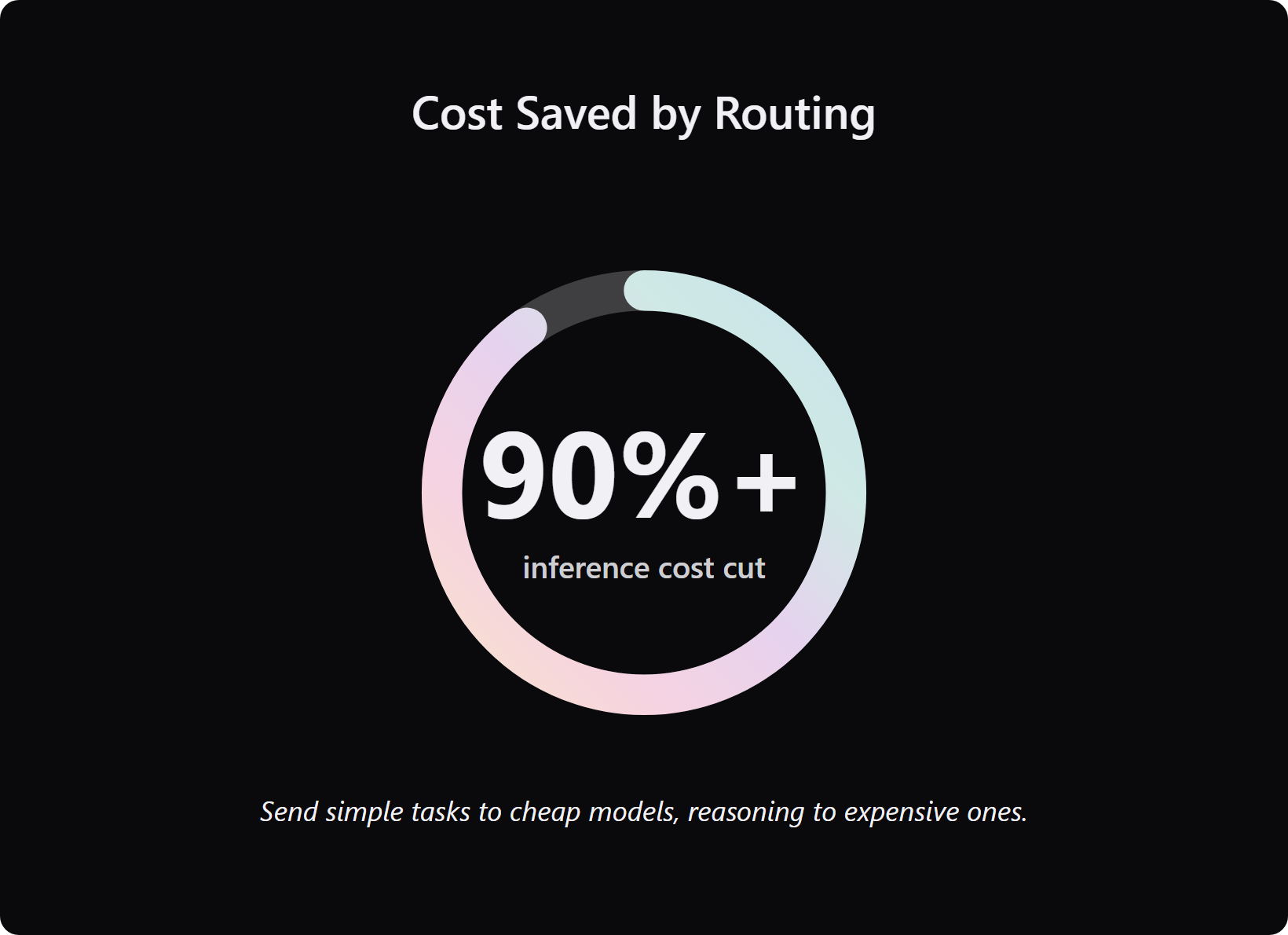
The specification became the product. The code is dispensable. When the harness, evaluation framework, and governance layer are well-specified and owned, swapping the underlying model is a configuration change. Routing basic operations like classification and extraction to cheaper, smaller models, and reserving expensive models for high-complexity reasoning, can reduce inference costs by over 90% without touching the architecture. This is where IT cost optimization and architecture meet.
That is the goal we design toward from the first sprint of every AI development engagement: a stack where the strategic value is in what you own, and the commodity layer is always replaceable.
“Teamvoy actively uses agentic AI across internal workflows and delivery, which speeds up development, raises quality, and adds extra value for the client.”
Dmytro Maryanych, Manager, Takflix Teamvoy Clutch Verified Review
The question I am sitting with now: as agentic AI moves from experimentation to production, will the harness pattern hold, or will multi-agent orchestration require an entirely new ownership model? If you are working through that decision in your stack, the door is open. Tell us what you are building.