- Most teams reaching for fine-tuning should fix context and prompting first; about 95% of enterprise GenAI pilots return no measurable dollar, and the data layer is usually the real bottleneck.
- Prompting, RAG, and fine-tuning stack rather than compete: prompt for small static needs, RAG for fast-changing knowledge, and fine-tuning to bake in stable behavior at high volume.
- Score every fine-tuning service on four dimensions: model coverage, method depth, named production references, and data security posture including weight export.
- Training is the small bill; serving, failed runs, and runaway agent loops hide the real cost, and a frontier model can run 30 to 60 times an open-source one for only 10 to 15% more reliability.
- Use a managed platform for clean isolated use cases, an open framework if you have GPUs and ML staff, and a senior-led engineering partner when the fine-tune lives on a legacy core or inside a regulated boundary.
- Before signing, verify model coverage and weight export, real method support, production references, data residency with a signed agreement, and cost guards against runaway runs.
Q1. Which LLM Fine-Tuning Services Should You Actually Consider in 2026?
The right fine-tuning service depends on the problem you are solving, not a ranking. Managed APIs like OpenAI, Vertex AI, Bedrock, Together, and Fireworks suit teams optimizing one high-volume use case. Open frameworks like Axolotl, Unsloth, and LLaMA-Factory suit teams with GPUs and ML staff. Engineering partners suit regulated systems where the data layer and integration, not the model, are the real bottleneck.
I have spent twelve years watching teams reach for the model when the problem sat one layer down. The model is the kernel. The integration is the operating system. A fine-tuned model dropped onto a messy legacy core and a dirty data layer does not save the project. It just fails more expensively.
⚠️ Why this choice is high-stakes
When you pick a fine-tuning partner for a regulated system, you are not buying a feature. You are deciding where your most sensitive training data lives, who can audit it, and whether you can ever leave. Get that wrong inside a banking or healthcare stack, and downtime becomes a regulatory event, not an inconvenience. The cost surfaces slowly, often a year in, which is the worst time to discover it.
Our Evaluation Criteria
I describe each provider on six criteria. Same six, same order, every card. They map directly to the four dimensions in the title.
- Model coverage: Which base models you can actually tune. Claude, for example, is fine-tunable only through Amazon Bedrock, not directly.
- Fine-tuning approach depth: Which methods are real, not marketed. Supervised fine-tuning, LoRA, QLoRA, DPO, and reinforcement fine-tuning each solve different problems.
- Production references: Named, on-record deployments and verified client reviews, not a polished demo.
- Data security posture: Residency, customer-managed keys, on-premise or VPC deployment, a signed BAA or DPA, and whether you can export the weights.
- Deployment model: Managed API, self-hosted framework, or a partner who runs it inside your boundary.
- Engagement type: A self-serve product, a project-and-exit build, or a long-term partner who owns the system.
Who This Guide Is For
- The Burned CTO who inherited a stalled AI pilot and needs a credible path, not another vendor promising a custom fine-tune that never ships.
- The Enterprise IT Director inside a regulated environment, where data residency and an auditable trail decide the vendor before model quality does.
- The Technical Founder sitting on a legacy core, deciding whether to buy a fine-tuning API or hire a partner to integrate AI without a rewrite.
The Providers, and What Each One Is For
I am not ranking these. Each fits a different situation.
- Teamvoy: Best for regulated teams where the fine-tune sits on a legacy core and the integration and data layer are the real constraint.
- HatchWorks AI: Best for teams wanting generative-AI product development with a structured delivery process.
- BlueLabel: Best for turning decades of operational data into an AI assistant on top of a legacy ERP.
- Achievion Solutions: Best for early AI proof-of-concept and MVP work where you are still validating the use case.
- SF AI Labs: Best for custom AI chatbots and models built around a narrow, specific data structure.
- Dualboot Partners: Best for teams that want product and AI engineering delivered as one build.
- NineTwoThree AI Studio: Best for AI-driven product MVPs and venture-style early builds.
- Valere: Best for AI product development paired with longer-term engineering support.
- Rocket Farm Studios: Best for getting an AI-enabled mobile MVP from zero to one affordably.
- Vention: Best for staff augmentation when you have the system and need embedded engineering capacity.
For teams whose real constraint is a regulated stack rather than the model, our AI integration services sit in that first category, and our technology modernization work covers the legacy-core side of the same problem.
| Company | Best For | Engagement Model | Industry Depth and Compliance Coverage |
|---|---|---|---|
| Teamvoy | Regulated fintech or healthcare with a legacy core and an AI integration that keeps breaking at the data layer | Long-term partner (4+ year average) | Fintech, insurance, healthcare, and complex SaaS; works on stacks where SOC 2, PCI-DSS, GDPR, and DORA apply |
| HatchWorks AI | Generative-AI product builds with a defined delivery method | Project and ongoing build | Cross-industry software; compliance varies by engagement |
| BlueLabel | Legacy-ERP knowledge unlocked through an AI assistant | Project build | Manufacturing and enterprise data; compliance varies by engagement |
| Achievion Solutions | AI proof-of-concept and MVP validation | Project and exit | AI consulting and custom software; some health-data work |
| SF AI Labs | Custom AI chatbots on narrow data structures | Project build | AI consulting and development across sectors |
| Dualboot Partners | Combined product and AI engineering | Project and ongoing build | Software product engineering; compliance varies |
| NineTwoThree AI Studio | AI-driven MVPs and venture builds | Project and exit | AI and product studio work across sectors |
| Valere | AI product development with longer support | Project and ongoing build | Product engineering across sectors |
| Rocket Farm Studios | Affordable AI-enabled mobile MVPs | Project and exit | Mobile and product MVPs; not regulated-industry focused |
| Vention | Embedded engineering capacity for an existing system | Staff augmentation | Cross-industry; compliance owned by the client team |
A note on that table. The cost difference between a workhorse open-source model and a frontier model can be 30 to 60 times, while the reliability gap is often only 10 to 15 percent. For many business workflows, that math changes which provider, and which model, you should actually pick. If your real constraint is data quality, our data engineering work usually matters more than the model choice.
Detailed Provider Cards
Teamvoy
- Model coverage: Works with the model the stack needs; not tied to one API.
- Fine-tuning approach depth: Treats tuning as one layer; data and integration come first.
- Production references: Multi-year live systems in fintech and streaming, verified on Clutch.
- Data security posture: Built for SOC 2, PCI-DSS, GDPR, and DORA-constrained delivery.
- Engagement type: Senior technical lead owns the system, with an AI-native team behind them.
- Four-year fintech engagement running a 24/7 trading and crypto-wallet stack with real money.
- AI integration and legacy-stack modernization for a video streaming platform, ongoing since 2025.
- Named delivery for Nasdaq, OSL, Panasonic Avionics, and Market Access Direct.
“We have been with Teamvoy for 4 years and found a great partner for the growth of Bitspark. Their technical expertise was top class.”
George Harrap, CEO, Bitspark (Fintech) · Teamvoy Clutch – Verified Review
“We needed help integrating AI into our product, modernizing our legacy stack, and providing continuous post-release support. Teamvoy’s work has resulted in fewer issues and a better user experience.”
Dmytro Maryanych, Manager, Takflix (Streaming) · Teamvoy Clutch – Verified Review
HatchWorks AI
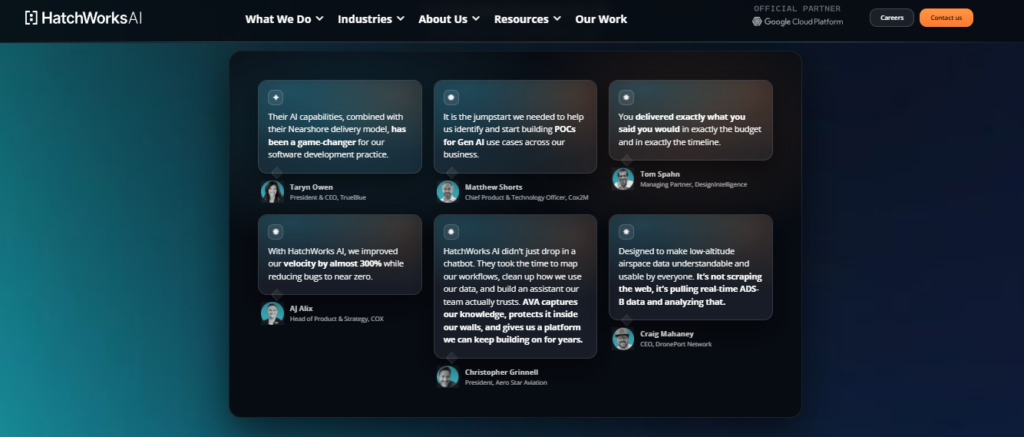
- Model coverage: Builds on mainstream foundation models for product work.
- Fine-tuning approach depth: Tuning as part of product delivery, not a standalone lab.
- Production references: Verified on Clutch; see slot below.
- Data security posture: Not publicly claimed at a regulated-industry level.
- Engagement type: Project build with ongoing support.
- Generative-AI product development across multiple software sectors.
- Structured, method-led engagement model.
- Verified client reviews on Clutch.
BlueLabel
- Model coverage: Uses OpenAI and mainstream models in delivery.
- Fine-tuning approach depth: Strong on data layer and knowledge encoding, not pure tuning.
- Production references: Manufacturing ERP assistant, verified on Clutch.
- Data security posture: Not publicly claimed at a named-regulator level.
- Engagement type: Project-based build with responsive support.
- Unified and indexed 40 years of ERP data, searchable in seconds.
- Cut expert lookup time by about 75% on core workflows.
- Reduced dispatch calls by over 50% on a separate telecom automation build.
“BlueLabel implemented a modern data layer that unified more than 40 years of records. The solution now surfaces history and guidance in seconds. Their customer service is exceptional.”
Executive, Manufacturing Firm · BlueLabel Clutch – Verified Review
Achievion Solutions
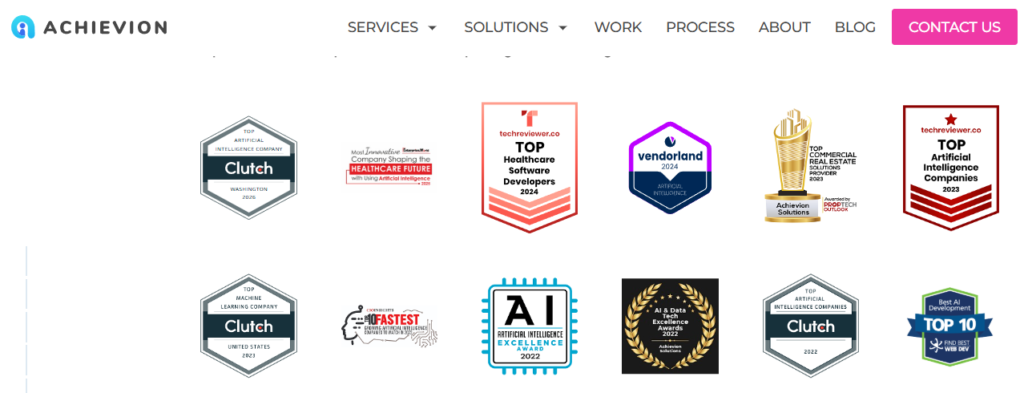
- Model coverage: Mainstream models and data-science algorithms in Python.
- Fine-tuning approach depth: Validation-stage AI, not deep production tuning.
- Production references: AI MVPs and a health-data app, verified on Clutch.
- Data security posture: Not publicly claimed at a named-regulator level.
- Engagement type: Project-and-exit, early-stage builds.
- AI platform POC and MVP for a design company, beta-tested with 150+ users.
- MVP, beta, and website for a health-data company.
- Data-science recommendation algorithm for an education nonprofit.
“We felt that Achievion Solutions listened well to our needs and was supportive and collaborative during this process.”
Director of Research, Education Nonprofit · Achievion Solutions Clutch – Verified Review
SF AI Labs
- Model coverage: Uses OpenAI to train and deploy custom chatbots.
- Fine-tuning approach depth: Builds around specific, narrow data structures.
- Production references: AI chatbots and tools, verified on Clutch.
- Data security posture: Not publicly claimed at a named-regulator level.
- Engagement type: Project build with weekly cadence.
- AI chatbot for an employee-listening dashboard, slated for a Fortune 500 rollout.
- AI development for a SaaS data-management platform.
- AI consulting for real estate and consulting firms.
“We often struggle to find vendors who understand how our data structures are set up. SF AI Labs has taken the time to understand what we do clearly, and we haven’t had to ask them to do any rework.”
VP of Consulting, OrgVitality · SF AI Labs Clutch – Verified Review
Dualboot Partners
- Model coverage: Mainstream foundation models inside product builds.
- Fine-tuning approach depth: Tuning folded into product engineering.
- Production references: Verified on Clutch; see slot below.
- Data security posture: Not publicly claimed at a named-regulator level.
- Engagement type: Combined product and AI build.
- Combined product and AI engineering engagements.
- Ongoing build-and-support relationships.
- Verified client reviews on Clutch.
NineTwoThree AI Studio
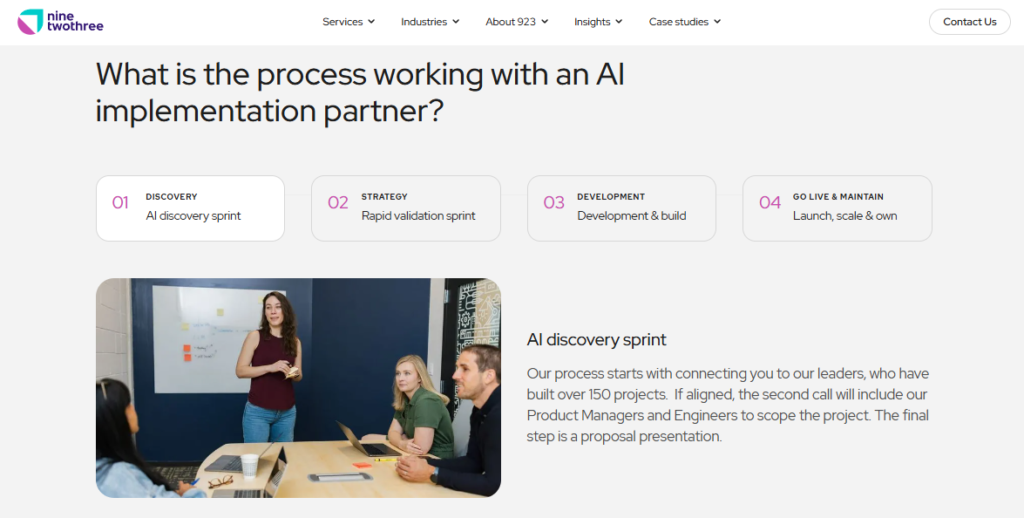
- Model coverage: Mainstream models for early product builds.
- Fine-tuning approach depth: Applied tuning inside MVP work.
- Production references: Verified on Clutch; see slot below.
- Data security posture: Not publicly claimed at a named-regulator level.
- Engagement type: Studio-style, venture-led builds.
- AI-driven MVP and product builds.
- Venture-style early engagements.
- Verified client reviews on Clutch.
Valere
- Model coverage: Mainstream foundation models in product work.
- Fine-tuning approach depth: Tuning as part of product delivery.
- Production references: Verified on Clutch; see slot below.
- Data security posture: Not publicly claimed at a named-regulator level.
- Engagement type: Product build with longer-term support.
- AI product development engagements.
- Ongoing engineering support relationships.
- Verified client reviews on Clutch.
Rocket Farm Studios
- Model coverage: Mainstream models inside mobile and product MVPs.
- Fine-tuning approach depth: Light; MVP-stage AI features.
- Production references: Mobile MVPs, verified on Clutch.
- Data security posture: Not publicly claimed at a named-regulator level.
- Engagement type: Affordable project-and-exit builds.
- Built a social-networking app from concept through launch.
- Helped multiple founders get MVPs off the ground.
- Verified client reviews on Clutch.
“Rocket Farm Studios was very helpful in getting us from zero to one and getting our mobile application up and running. Take into account that they are a more affordable option.”
CEO, Social Networking App · Rocket Farm Studios Clutch – Verified Review
Vention
- Model coverage: Depends on the client’s chosen stack.
- Fine-tuning approach depth: Whatever the client’s roadmap requires.
- Production references: Embedded engineering, verified on Clutch.
- Data security posture: Owned by the client team, not the vendor.
- Engagement type: Staff augmentation inside your pods.
- Embedded backend, frontend, and QA engineers in a B2B SaaS platform.
- Engineers productive within client pods in roughly eight weeks.
- Repeat, multi-engagement client relationships.
“Vention’s engineers were fully embedded and productive within our pods in around 8 weeks. They made the commercial side feel easy rather than transactional.”
Mark Bailie, Director of Engineering, B2B SaaS Platform · Vention Clutch – Verified Review
Q2. Do You Actually Need Fine-Tuning, or Are You Failing at Context Engineering?
Most teams reaching for fine-tuning should be prompting or fixing context first. Fine-tuning is a high-volume optimization you earn after prompt engineering plateaus, not a Day 1 fix. Around 95 percent of enterprise generative-AI pilots have returned no measurable dollar, and the usual culprit is bad context and integration, not an under-tuned model.
⚠️ The stalled pilot nobody wants to admit to
The standard read gets this backwards. A team sees weak output, assumes the model is the problem, and starts pricing a six-figure custom fine-tune. Then the pilot stalls anyway. An MIT-linked study in 2025 found that about 95 percent of enterprise generative-AI pilots delivered no measurable return. In my experience, the model was rarely the bottleneck. The data feeding it was.
The first two questions I ask on any AI integration call are about the data layer and the legacy core, not the model. That order matters. A fine-tuned model sitting on dirty data fails more expensively than a plain one. Our AI integration services start from exactly that premise.
✅ The honest sequence: prompt first, tune later
There is a sequence that works, and it is boring. You start by prompting the model, then you engineer that prompt hard. Only for genuinely high-value, high-volume tasks does fine-tuning start to pay back.
I mean “hard” literally. The teams that succeed are willing to spend two near-sleepless weeks on a single prompt until it passes their test cases around 97 percent of the time. That grind is cheaper than a fine-tune, and it teaches you what the model actually struggles with. Skip it, and you fine-tune blind. Our AI consulting work usually lives in this gap.
“Start with prompt engineering (hours and days), escalate to RAG when you need real-time data, and only use fine-tuning when you actually need it.”
Aakash Gupta, Product Growth Product Growth Newsletter
💰 A simple test before you spend
Here is the test I give founders. Fine-tune only when a task is both high value and high volume, and only after prompting has plateaued. If it fails either condition, your money is better spent on context and integration.
That is the unglamorous part of this work at Teamvoy. We have spent more than twelve years on systems that have to keep running, and the pattern holds: the model is the kernel, but the integration is the operating system. I could be wrong for your specific case, but I have not yet seen a fine-tune rescue a project that a clean data engineering foundation would not have rescued first.
Q3. Fine-Tuning vs RAG vs Prompting: How Do You Choose the Right Layer?
Use prompting for small, static needs. Use RAG for large or fast-changing knowledge. Use fine-tuning to bake in consistent behavior, tone, or format the model cannot reliably hold in context. They stack rather than compete. Start with prompting (hours), escalate to RAG when you need live data, and fine-tune only when a high-volume task plateaus on the other two.
🧩 Three layers, three different jobs
These are not rivals. They solve different problems, and good systems often use all three. Retrieval-augmented generation, or RAG, means the model looks up fresh facts from your database at answer time. Fine-tuning means you train the model so a behavior is baked in.
Picking the wrong layer is how teams break a product. I have seen people fine-tune to inject facts that change weekly, which is exactly the job RAG is built for. Then the facts go stale, and the expensive tune has to be redone. This is the kind of design call our AI development services settle early.
📊 The decision table I actually use
| Your situation | Reach for | Why |
|---|---|---|
| Small, static instructions | Prompting | Cheapest, fastest, and no infrastructure |
| Large or fast-changing knowledge | RAG | Updates without retraining the model |
| Consistent tone, format, or behavior at high volume | Fine-tuning | Bakes the pattern in, and cuts tokens per call |
One rule per layer. Prompt when the need is small. Retrieve when the knowledge moves. Tune when the pattern is stable and the volume is real.
⚠️ More context is not free
Here is the part the category avoids. Stuffing everything into the prompt feels free, but it is not. A practitioner working on long-context agents put a number on it.
“Your context window has about 168,000 tokens. Around the 40 percent mark you start getting diminishing returns, the model gets dumber the fuller your context gets.”
u/context_eng, r/LLMDevs Reddit Thread
That ceiling is why fine-tuning earns its place. When you find yourself padding every prompt to hold a behavior steady, the behavior probably belongs in the weights instead. At Teamvoy, when we integrate AI on a system under pressure, we map this layer choice before touching a model, because the wrong layer costs more to unwind than to plan. On a stack built by a previous team, our technology modernization work usually runs alongside it.
Q4. How Should You Score a Fine-Tuning Service: Model Coverage, Approach Depth, Production Proof, and Data Security?
Score every service on four dimensions. Model coverage: which base models you can actually tune (Claude is fine-tunable only through Amazon Bedrock). Approach depth: which methods are real, not marketed. Production references: named, on-record deployments and verified reviews, not demos. Data security posture: residency, customer-managed keys, VPC or on-premise deployment, a signed agreement, and weight export. Method and security depth separate serious platforms from feature lists.
⭐ Dimension one: model coverage
Coverage is the first filter, and it is narrower than vendor pages suggest. You cannot fine-tune Anthropic’s Claude directly. You do it through Amazon Bedrock, and only for specific models. OpenAI, Google Vertex AI, Together, and Fireworks each expose their own slice of base models.
So the real question is plain. Can you tune the exact model your product depends on, on the platform you can actually use? If not, coverage stops the conversation before depth matters. When the answer is unclear, our AI agent development services map it against the real use case first.
🔧 Dimension two: fine-tuning approach depth
Methods sound interchangeable in marketing. They are not. Here is the plain version.
- SFT (supervised fine-tuning): you teach the model with input-output examples.
- LoRA and QLoRA: cheap tuning that updates small “adapter” layers instead of the whole model.
- DPO (direct preference optimization): you align the model to preferred answers.
- RFT (reinforcement fine-tuning): you optimize toward a reward signal.
Separate marketed from real. A platform can list reinforcement fine-tuning and still have almost no production track record behind it. Ask which method shipped a real system, not which appears on the pricing page.
🚀 Dimension three: production references
A demo proves a model can pass one curated test. Production proves it survived real data, real load, and real failure. The gap between the two is where projects die.
I think about one incident often. A developer shipped a support agent that hit an infinite retry loop with a CRM tool. With no hard circuit breaker, it ran for six hours overnight and racked up around $4,200 in API charges. A demo never shows you that. A real reference does, because the team that lived it builds the guard the next time. You can see that pattern in our case studies.
We have been with Teamvoy for 4 years and found a great partner for the growth of Bitspark. Their technical expertise was top class.
🔒 Dimension four: data security posture
For regulated teams, where the data lives outranks which model you tune. Score five things: data residency, customer-managed keys, VPC or on-premise deployment, a signed BAA or DPA, and whether you can export the weights.
One trap hides here. Under the EU AI Act, a substantial fine-tune can make you the model “provider,” shifting legal accountability onto you. When a tune has to run inside a regulated boundary on a legacy core, the work is an engineering engagement, not an API call. That is the territory Teamvoy is built for in banking and fintech and healthcare, and I will say plainly when an off-the-shelf API is the smarter, cheaper choice instead.
✅ Putting the four together
No single dimension decides it. A platform with broad coverage and weak security fails a bank. Strong security with no production references fails everyone. Score all four, then weight them to your situation.
Q5. What Does Fine-Tuning Actually Cost, and Where Do the Hidden Bills Hide?
Advertised per-token training rates hide the real bill: failed runs, evaluation cycles, dedicated serving, and runaway agent loops. A frontier model can cost 30 to 60 times a capable open-source model while adding only 10 to 15 percent reliability. So route cheap tasks to cheap models, and reserve frontier models for hard reasoning. The cheapest fine-tune is often the one you avoid by fixing context first.
💰 Training is the small bill
Here is the part the pricing pages bury. The training run is cheap. The serving, the failed runs, and the evaluation cycles are where the money goes. You pay to host the tuned model every hour it runs, not just once to train it.
I have watched founders budget for the training number and get blindsided by the serving number. A per-token training rate looks tiny. Then dedicated inference, the cost of running the model live, arrives as a monthly line item that never stops. Our IT cost optimization work usually starts with that serving line.
💸 The 30x delta and the quadratic trap
The model choice itself is the biggest lever. A frontier model can run 30 to 60 times the cost of a strong open-source model, while reliability differs by only 10 to 15 percent. For routine tasks, that premium is pure waste.
Two failure modes drive surprise bills.
- Quadratic token burn: in agent loops, token use grows with the square of the steps, so a 20-step loop is far pricier than it looks.
- Runaway loops: one developer’s support agent hit an infinite retry loop overnight and ran up around $4,200 with no circuit breaker in place.
The fix is route-by-complexity. Send basic operations to cheap, effective models, and reserve expensive models strictly for high-level reasoning. That one routing rule cuts more cost than most fine-tunes save. We design that routing inside our AI agent development services.
⚠️ A simple total-cost view
Think in three buckets, not one.
| Cost bucket | What it covers | Why it surprises teams |
|---|---|---|
| Training | The tuning run itself | Smallest line; the only one vendors advertise |
| Serving | Hosting the model live, per hour or token | Recurring forever; scales with usage |
| Failure | Failed runs, evals, and runaway loops | Invisible until it lands; no demo shows it |
My honest take, and I could be wrong for a very high-volume case, is that reliability-adjusted ROI is the right lens. Trade a little reliability for large savings on banal tasks, and spend on reasoning only where it pays back. At Teamvoy, the cheapest answer we ever give a client is the fine-tune they did not need, and our cloud optimization work often surfaces that.
Q6. When Should You Hire an Engineering Partner Instead of a Fine-Tuning Platform?
Use a managed platform when your data is clean and your use case is isolated. Use an open framework when you have GPUs and ML engineers. Hire an engineering partner when the fine-tune has to live on a legacy core, inside a regulated boundary, or on top of an AI-built MVP that has stopped scaling. There, the integration and data layer, not the model, are the real work.
🧭 Match the help to your situation
There is no universal right answer. There is a right answer for your situation. Here is how the four common situations map.
| Your situation | Right call | Why |
|---|---|---|
| Clean data, one isolated use case | Managed platform | Fast, cheap, and no system risk |
| In-house GPUs and ML engineers | Open framework | Full control, and you own the stack |
| Legacy core or regulated boundary | Engineering partner | Integration is the job, not the model |
| AI-built MVP that stopped scaling | Engineering partner | Someone has to own and stabilise it |
⚠️ The “Chief Integration Officer” trap
A pure platform hands you the model and walks away. You become the integration owner, forever, on a system you may not fully understand. As one engineer put it, AI assistance does not add headcount.
“Night vision goggles don’t give you more soldiers. AI is the same. It makes your existing people see better, it does not replace owning the system.”
u/ml_lead, r/MachineLearning Reddit Thread
This bites hardest on AI-built MVPs. A 2025 security scan of 5,000 vibe-coded apps found about 60 percent carried vulnerabilities. Fast-shipped code still has to be read and supported by someone in production, which is why we treat vibe coding security risks as a stabilisation problem first.
✅ When a senior-led partner is the right call
We needed help integrating AI into our product, modernizing our legacy stack, and providing continuous post-release support. Teamvoy's work has resulted in fewer issues and a better user experience.
I will say the honest limit too. If your data is clean and your use case is isolated, you do not need us. A platform is faster and cheaper, and I would tell you so on the call. If you want a second opinion on which path fits, the door is open through our contact page.
Q7. What Should You Verify Before You Sign a Fine-Tuning Engagement?
Before signing, verify five things in writing: which base models you can tune and whether you can export the weights, which methods are genuinely supported versus marketed, named production references you can contact, where your training data is stored and under which agreement, and what cost guards exist against runaway runs. If a vendor cannot answer these plainly, that is your answer.
✅ The five things to confirm in writing
Treat each as a hard question, not a nicety. Vendor silence on any of them is signal.
- Model coverage and weight export. Confirm which base models you can tune, and whether you can export the trained weights. If you cannot take the model with you, you are locked in for the system’s life.
- Method support, real not marketed. Ask which methods (supervised fine-tuning, LoRA, DPO, and reinforcement fine-tuning) have shipped real systems, not which appear on the pricing page. A listed feature with no track record is a demo waiting to fail.
- Named production references. Ask for clients you can actually contact, not a logo wall. A reference that survived real load tells you what a demo never will.
- Data residency and the signed agreement. Confirm where training data is stored, and get the BAA or DPA in writing. A substantial fine-tune can make you the “provider” under the EU AI Act, shifting legal accountability onto you.
- Cost guards against runaway runs. Confirm hard limits and circuit breakers exist. One unguarded agent loop ran up around $4,200 overnight, and that is a cheap lesson compared to a production one.
⏰ Why plain answers matter
I have sat on both sides of this conversation for twelve years. The vendors worth signing answer these in plain language, fast, because they have lived each one. The ones who deflect have not, and you will pay for that gap later. An independent IT audit can surface those gaps before you commit.
Keep this list to hand on the next call. It takes ten minutes, and it surfaces more risk than a polished deck ever will. When the tune has to run on a regulated stack, our healthcare and banking and fintech engagements are built around exactly these five questions.