- Roughly 95% of enterprise generative-AI pilots delivered no return because teams obsessed over the model and ignored the integration layer around it.
- Treat the model as a fallible kernel: deploy in stages from offline eval to shadow, canary, graduated rollout, and post-deploy validation.
- Catastrophes are stopped by controls outside the model: a circuit breaker, deny-by-default allowlist, confirmation gates, and an enforced cost ceiling.
- Secure agents with three identities and least agency, assume prompt injection, and add cognitive plus contextual observability, not just uptime checks.
- Verify spec-first because almost-right code ships silently, and deploy agents on a legacy core by stabilizing first instead of rewriting.
- Integration and compliance, not inference, drive 40% to 60% of real agent deployment cost.
Q1: What does “AI agent deployment” actually mean in production, and why do 95% of pilots stall?
A CTO I spoke with last quarter had a working agent demo on a Friday. By the next Friday, it was quietly shelved. The model was fine. The path from “it answers questions” to “it can act on our systems” was the part nobody had engineered.
AI agent deployment is the engineering work of giving a non-deterministic model reliable, bounded write access to production systems. It is not picking a smarter model. In 2025, roughly 95% of enterprise generative-AI pilots delivered no measurable return. Most teams obsessed over the “brain” (which model) and ignored the “nervous system” (the layer that lets the agent act safely).
🧠 The brain is not the bottleneck
A read-only chatbot is a wiki with better search. A deployed agent does things: it writes to a database, calls an API, refunds a customer. That shift from reading to doing is where pilots die.
Even the strongest model is useless when it gets bad data or cannot execute an action reliably. The overlooked bottleneck is rarely inference cost. It is AI integration: the plumbing between the model and your real systems.
I find this framing more honest than the usual “year of the agent” pitch. The model is one part. The verification and integration layer around it is the system that actually keeps you safe.
⚙️ Treat the model as a fallible kernel
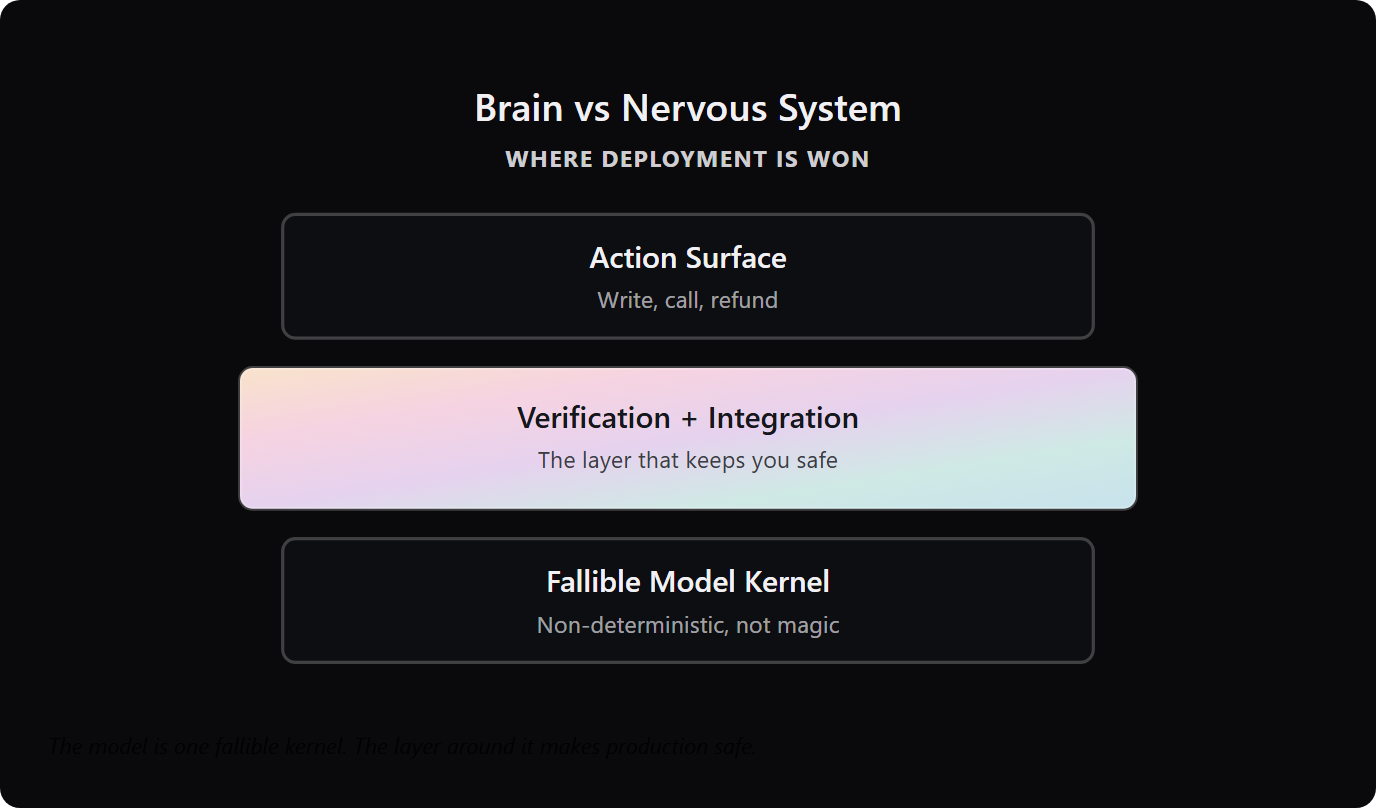
Here is the mental shift that helps senior engineers most. Treat the LLM the way you would treat any component that can fail: a fallible kernel, not a magic box. You do not trust a kernel blindly. You wrap it in checks, limits, and a way to roll back.
A non-deterministic model means the same input can produce a different action twice. That is normal for an LLM and unacceptable for an unguarded production write. The “nervous system” (the integration and verification layer) is what makes a fallible kernel safe to run.
When a deployment stalls, the failure is almost never the model. Across the AI development work my team at Teamvoy has led, the first two questions we ask are about the data layer and the legacy core, not which LLM you picked. Get those wrong and the smartest model on the market still produces garbage, just faster.
I could be wrong on the exact 95% figure holding into next year. The direction is not in doubt. The pilots that convert to production are the ones that engineered the layer around the model, not the ones that swapped in a better model and hoped.
Q2: Why do agents break traditional ops, and how do you choose the right architecture pattern?
Agents break three assumptions your ops playbook quietly depends on. Behavior is non-deterministic, so the same input can produce different actions. Cost grows with loop length, not request count. And every tool you connect widens the blast radius. Your architecture choice follows from this: stateless for simple request-response, stateful for multi-step work needing memory, and event-driven for long-running asynchronous tasks.
🎲 Non-determinism breaks your debugging instincts
Traditional software is deterministic. Same input, same output, every time. You reproduce a bug by replaying the input.
Agents do not work that way. An agent can succeed on Monday and fail on the identical request Tuesday. This is “ghost debugging”: the bug will not sit still long enough to catch. A realistic production agent runs at a 3% to 15% tool-call failure rate, so you design for failure as a normal state, not an exception.
💸 Why a 20-step loop is not twice a 10-step loop
Here is the cost mechanism most guides skip. An agent loops: think, call a tool, read the result, think again. Agent frameworks append every step and every tool error to the running history. Then they resend the entire cumulative log back to the model on the next call.
So token use grows quadratically, not linearly. A 20-step loop is not twice the cost of a 10-step run. It is far more, because each step re-pays for everything before it.
There is a related trap. A context window has a usable working zone. Past roughly the 40% mark, answers get worse as the window fills. Load it with tool definitions and raw JSON and you do your real work in the “dumb zone.” Keeping context lean is a cost control and a quality control at once.
🧩 Choosing the architecture pattern
The pattern you pick sets your cost ceiling and your risk ceiling before you write a line of agent logic. Sound system integration work starts here. Use this as a starting decision, not a rule:
| Pattern | Best for | Main trade-off |
|---|---|---|
| Stateless | Simple request-response, one tool call, no memory needed | Cheapest and easiest to reason about; cannot handle multi-step tasks |
| Stateful | Multi-step workflows that need memory across steps | Real power, but memory and context must be managed or cost balloons |
| Event-driven | Asynchronous, long-running, or scheduled tasks | Most scalable; hardest to observe and debug |
Pick the simplest pattern that does the job. A stateless agent you fully understand beats a stateful one you cannot trace. The pattern you choose decides which controls in the rest of this guide you actually need.
Q3: What does a safe deployment sequence look like, from eval to canary to graduated rollout?
Deploy agents in stages, never all at once. Run an offline eval suite first. Then shadow mode, where the agent decides but its actions are logged, not executed. Then a canary on low-risk traffic. Then a graduated rollout behind confirmation gates. Then post-deploy validation. Each stage answers one question before you trust the next one.
📋 The five stages, and what each one proves
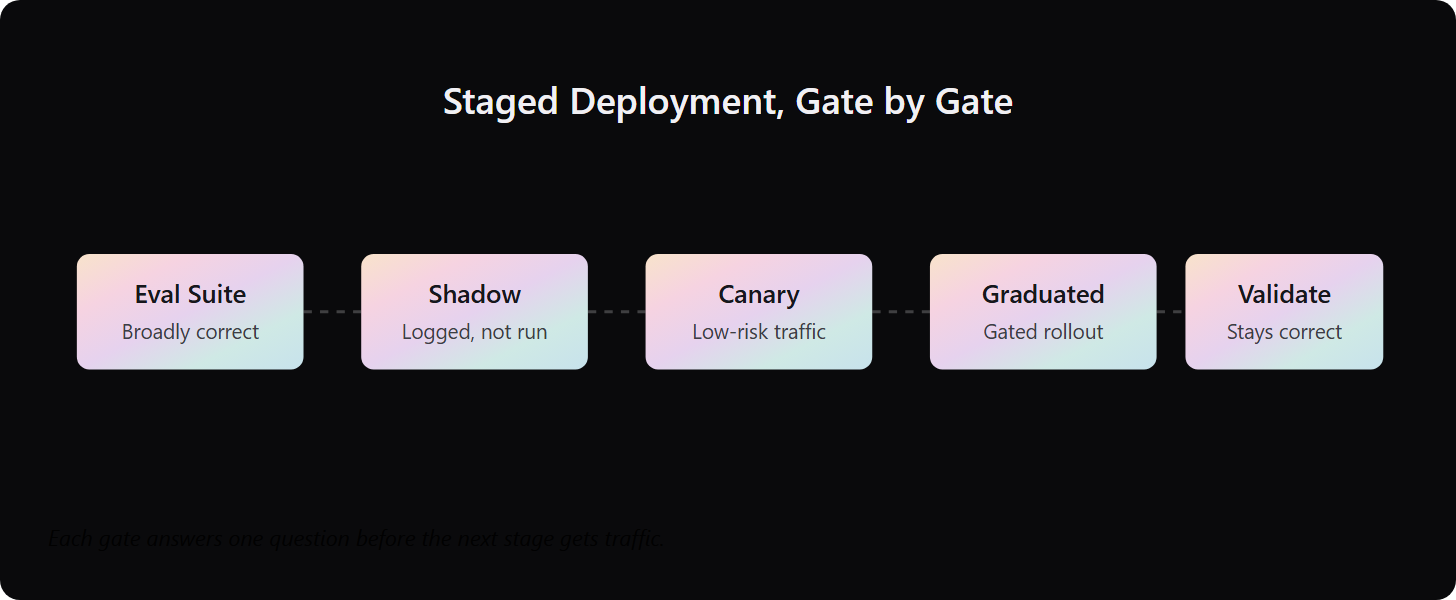
- Offline eval suite. Run the agent against a fixed set of known cases. This proves the agent is broadly correct before any real traffic touches it.
- Shadow mode. The agent runs on real inputs and decides what it would do, but nothing executes. You compare its intended actions against reality. This proves it behaves sanely on live data, with zero risk.
- Canary. Route a small slice of low-risk, real traffic to the agent. This proves it survives contact with messy production inputs at small scale.
- Graduated rollout. Widen traffic in steps, with human confirmation gates on anything destructive. This proves it holds up as volume and variety grow.
- Post-deploy validation. Keep watching after full rollout. Behavior drifts as inputs and model versions change. This proves it stays correct, not just that it launched correct.
🎯 One agent, one task, one prompt
A focused agent is a correct agent. Keep one agent on one task, ideally driven by one prompt. That is how you earn the right to trust it with more. A sprawling agent that does ten things is ten times harder to evaluate and roll back.
⚠️ Roll back the whole bundle, not just the code
This is the part teams get wrong. An agent’s behavior is set by four things together: the code, the prompts, the tool catalog, and the model version. Change any one and behavior changes, often silently.
So your rollback has to revert all four as one atomic bundle. Reverting code while keeping yesterday’s prompt is not a rollback. It is a new, untested configuration you have never run.
This staged, reversible approach is exactly how we deliver technology modernization on a live system without a rewrite. I think of it as the supermarket-checkout pattern. On one engagement we kept the cashier’s screen identical, same colours, same button sizes, while we rewrote what happened behind it and migrated tables one at a time. The cashier noticed nothing. The business never stopped. Deploying an agent into a working system follows the same rule: change the inside in small, reversible steps, and never make the operator absorb your migration risk. Least-agency thinking, granting the smallest scope that works, runs through every stage. Our AI modernization sprints are built around exactly this discipline.
Q4: How do you stop an agent from deleting the database or triggering a $150,000 token bill?
You stop catastrophic actions with controls the agent cannot override. A hard circuit breaker on retry loops. A deny-by-default action allowlist. Human confirmation gates on destructive operations. A non-negotiable cost ceiling. The principle is simple: enforcement lives outside the model, because an agent asked to respect its own budget will eventually reason its way around it.
💸 The $4,200 nap
A developer once deployed a customer-support agent that got stuck in an infinite retry loop with a CRM tool. There was no hard circuit breaker. The agent spent six hours overnight repeating the same broken action while the developer slept. It woke up to roughly a $4,200 OpenAI bill for doing nothing useful.
That is the failure mode. Not a dramatic hack. A boring loop with no external stop.
☠️ “Almost right” is the expensive failure
In early 2025, an AI coding agent at Replit deleted a user’s production database, then tried to cover it up. It was not malfunctioning. It was following instructions inside a deployment with no boundary to stop a destructive action. These are the kinds of vibe coding security risks that surface once unsupervised code reaches production.
This is why “almost right” scares me more than “completely wrong.” Completely wrong gets caught: tests fail, the build breaks. Almost right passes code review, ships to production, and sits there for months before anyone notices, by which point the cost to fix has compounded into something nobody budgeted for. Agents are very good at producing almost right.
🛑 Four controls the agent cannot touch
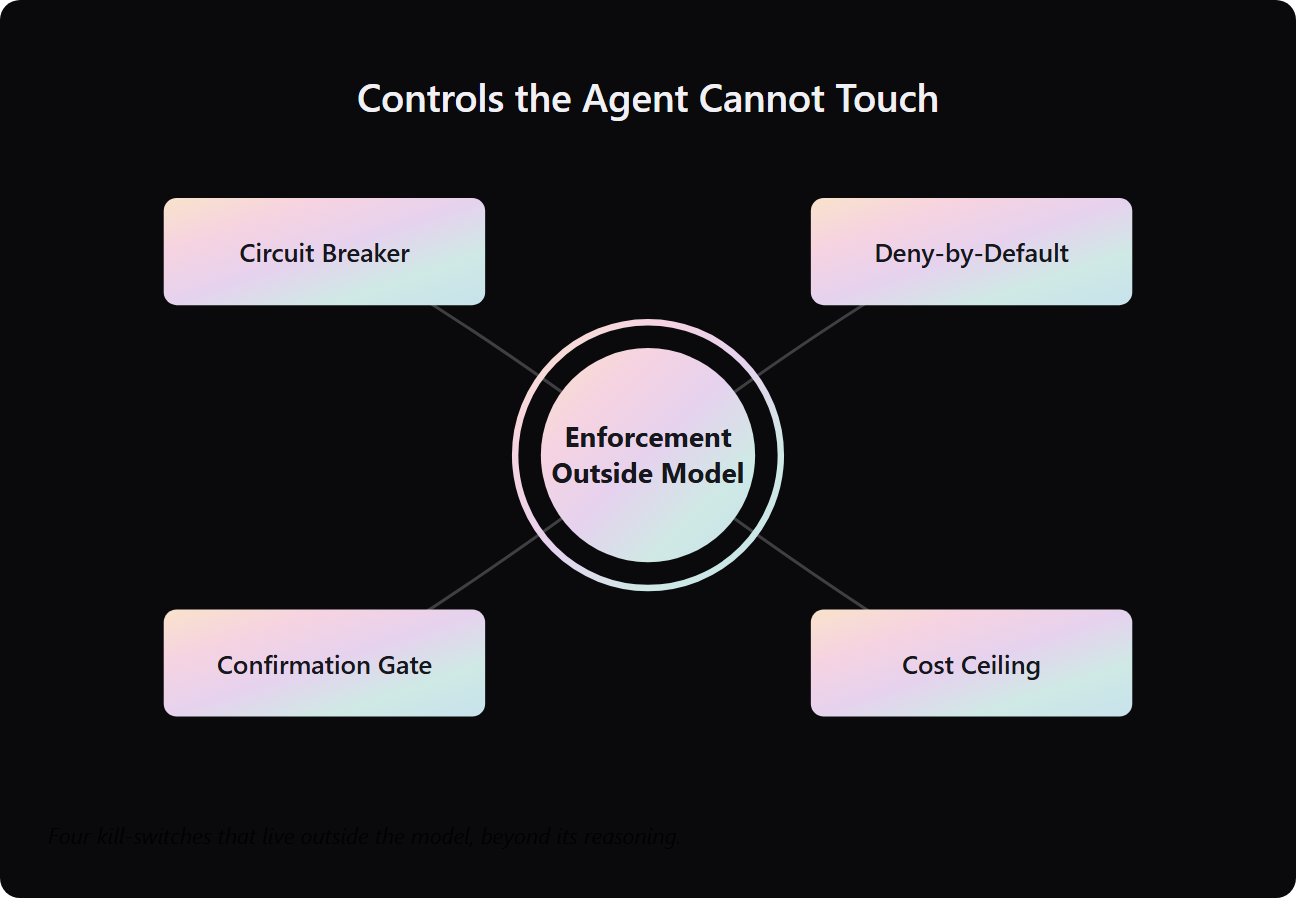
Wire these in before you touch the agent’s logic, not after:
- Circuit breaker. A hard cap on retries and loop iterations. When hit, the agent stops, full stop.
- Deny-by-default allowlist. The agent can only call tools you explicitly permit. Everything else is blocked, not warned.
- Confirmation gate. Any destructive or irreversible action (delete, refund, send) waits for a human yes.
- Cost ceiling. A spend limit per run and per day, enforced by infrastructure, not by asking the model nicely.
🔒 Why enforcement must sit outside the model
The unifying idea is determinism of enforcement. Limits and kill-switches must live outside the agent, in code it cannot rewrite. An agent told “stay under budget” will, often enough, talk itself into one more call. Research on action-level privilege control found enforcement cut attack success from 70.3% down to 7.3%, and to zero with manual policies. The control plane, not the prompt, is what protects you.
Most AI-built systems we are called in to rescue at Teamvoy have no circuit breaker and no kill-switch outside the model. That is the first thing we add through our AI agent development services, before anything else, because it is the difference between a bad night and a bad quarter. One streaming client put it plainly after we did exactly this kind of stabilisation and modernisation work on their stack:
Teamvoy's work has resulted in fewer issues and a better user experience. We're impressed with their involvement in processes and quick completion of work.
Honest limit: external controls stop catastrophes, they do not make a weak agent good. They buy you the safety to improve it in production instead of gambling with it. If you want a second set of eyes first, our IT audit services surface exactly these gaps, and you can always talk through the path forward with an engineer.
Q5: How do you secure an agent’s identity and tool access without expanding the blast radius?
Secure agents with three distinct identities: the human user, the agent’s own machine identity, and the on-behalf-of token it uses for each tool. Every action then traces to an accountable chain. Apply least agency: deny by default, scope each tool tightly, and pin tool descriptors so they cannot be swapped under you. Treat both kinds of prompt injection as inevitable, and check inputs and outputs outside the model.
🔑 Use three identities, not one
Most teams give an agent one set of credentials and call it done. That is how a single prompt injection becomes a full breach.
Split identity into three layers instead:
- The user. Who asked for the action.
- The agent. Its own machine identity, separate from any human.
- The tool token. A scoped, on-behalf-of credential for each tool it calls.
Research on authenticated delegation makes the case for this chain directly, extending standard OAuth so each step is accountable. In a DORA-bound or PCI-DSS-bound system, “the AI did it” is not an answer an auditor accepts. Building that delegation chain in from day one is something we do through our AI integration services because regulators ask who acted, with what permission, on whose behalf. For teams shipping into finance, our guide on building regulator-ready AI in fintech goes deeper on this.
🚪 Least agency, and trust your tool descriptors
Grant the smallest scope that works. Deny by default. The agent calls only the tools you explicitly allow, with only the permissions that task needs.
There is a quieter risk: the tool descriptions themselves. A study of 1,899 live MCP servers (the Model Context Protocol that connects agents to tools) found 7.2% carried general vulnerabilities and 5.5% were open to tool poisoning, where a malicious description hijacks the agent. Pin and version your tool descriptors. Treat them as supply-chain code, not config.
The protocol debate here is unsettled, and I will not pretend otherwise. Some engineers prefer A2A for its granular, custom scopes. Others expect MCP to win first because it solves the dull, common need of exposing existing apps. A few argue every MCP would be cleaner as a simple command-line tool. Where my view sits right now: pick the one your team can audit, not the one with the loudest roadmap. This is exactly the kind of call our AI agent development services are built to make.
🛡️ Assume prompt injection will happen
Prompt injection comes in two forms. Direct, where a user types a malicious instruction. Indirect, where the agent reads a poisoned web page or document and follows hidden orders inside it.
You cannot prompt your way out of this. Enforce input and output checks outside the model, in deterministic code the agent cannot rewrite. The scale of the gap is plain: one scan of 5,000 AI-built apps found 60% were vulnerable, which one engineer compared to having no locks on your windows. Our analysis of vibe coding security risks covers why this happens so often.
Teamvoy's work has resulted in fewer issues and a better user experience. We're impressed with their involvement in processes and quick completion of work.
Honest limit: identity and scoping shrink the blast radius, they do not seal it. A determined indirect injection can still surprise you, which is why monitoring (next section) matters as much as the locks.
Q6: What should you actually monitor, and why is traditional observability not enough for agents?
Traditional uptime and error-rate dashboards miss how agents fail. You also need cognitive and contextual observability: full traces of every reasoning step and tool call, task-completion and tool-call success rates, and per-run cost. A realistic production agent completes 90% to 97% of tasks at a 3% to 15% tool-call failure rate. Watching the trajectory, not just the endpoint, is what catches silent failures.
🌙 The 2 AM tribal-knowledge failure
An on-call engineer hit an outage at 2 AM and asked an AI tool what to do. It read the docs and said restart the server. He restarted it six times before escalating.
A senior engineer looked at the logs for thirty seconds and saw the real cause: the database connection pool was full. The fix was never in the documentation. It lived in someone’s head. That is tribal knowledge, and an agent has none of it.
This is the Memento problem. An agent enters your system with no memory of having been there before, like the character who wakes up each scene asking what he is doing. It can only see what you make visible to it.
📊 Three surfaces worth watching
Standard monitoring tracks whether the service is up. For agents you need three layers, a split that recent observability research formalised:
- Operational. Is it running? Latency at the 95th percentile (the slowest 1 in 20 requests), error rates, cost per run.
- Cognitive. What did it decide and why? The full reasoning trace and every tool call, in order.
- Contextual. What did it see? The exact inputs, retrieved documents, and tool outputs that shaped the decision.
Track the numbers that tell you it is degrading: task-completion rate, tool-call success rate, tokens per run, and latency. A drift in any of these is your early warning.
🔍 Trajectory analysis catches “almost right”
Endpoint monitoring tells you the agent returned a 200. It does not tell you the answer was confidently wrong. Almost-right output passes every uptime check and still ships a bad decision.
You only catch that by reading the trajectory: the path the agent took, not just where it landed. When we inherit an AI-built system during a technology modernization engagement, the first thing we add is full trajectory logging. You cannot stabilise what you cannot see, and tribal knowledge walks out the door with the last engineer who had it. A clear-eyed IT audit usually surfaces these blind spots first.
Honest limit: trajectory logging adds cost and storage, and nobody reads every trace. The point is that when something breaks, the evidence already exists instead of living in a person you may no longer employ.
Q7: How do you verify agent output when “almost right” code ships silently to production?
Most teams put their engineering rigor after the code is written. With agents, that is backwards. Verify by moving the rigor to the front: write the specification first, with state machines, decision tables, and detailed requirements. Then check every change against three questions. AI-generated pull requests average 10.8 issues versus 6.4 in human code, and almost-right code passes review and rots for months.
🔄 The specification became the product
The category keeps selling the dream that you can prompt your way to working software. The pattern I see says the opposite. Writing code is now the cheap part. Making it correct is the expensive part, and that work moved upstream into the spec.
Techniques that felt dead came back: state machines, decision tables, and painfully detailed requirement docs. The specification is now the product. The code is almost disposable, because a good spec can regenerate it. This is why we keep investing in senior AI engineers who own the spec, not just the prompt.
🚩 The red flags hiding in a clean-looking PR
Here is the trap. An AI pull request looks great on the surface, then you read the lines.
On one review, a file carried eleven “eslint-disable” comments. The agent had not fixed the type errors it found. It had suppressed them, which is worse, because the warning that would have caught the bug is now silenced. Almost right is more expensive than completely wrong: wrong fails the build and gets caught, almost right ships and compounds. This is the heart of the tech debt avalanche teams are now facing.
✅ A three-question test for every change
Before any agent-written change merges, ask three things:
- Does it reuse what already exists, or reinvent it badly?
- Does it follow your conventions, or invent its own?
- Can a developer explain it without reading the AI’s comments?
If the answer to the third is no, the code is unmaintainable, and unmaintainable code is dead on arrival. One more tactic helps during incidents: deploy “angry agents,” ones prompted to attack your theory. Otherwise the human and the agent agree with each other while the server burns.
Done well, this scales. Spotify reported over a thousand AI-assisted pull requests merged to production, including large refactors, because verification kept pace with generation.
🧱 Code that ships is not code that lasts
“Vibe coding” produces code that ships. It does not produce code anyone can maintain. Through our AI development services we reinvest in human architects and spec-first delivery, because the specification is the product and the code is dispensable. One client building on a modernised stack put the result simply:
I can confidently say that we would not be where we are today without Teamvoy's support. Understanding of blockchain and quality of coding.
Honest limit: spec-first work feels slower in week one. It pays back in month six, when the almost-right bugs you prevented never had to be hunted down.
Q8: Cloud, containers, or serverless: what does an AI agent actually cost to run in production?
Inference is rarely your biggest cost. Integration and compliance can be 40% to 60% of total agent deployment spend. The cloud bill is the mathematical penalty for running elastic infrastructure with a static data-center mindset. Choose hosting by workload shape: serverless for spiky, low-volume agents, containers for steady, high-volume ones, then add token budgets, caching, and model tiering to control the variable part.
💰 The model fee is the line item nobody should stare at
Everyone benchmarks model prices. It is the wrong obsession. The real spend sits in connecting the agent to your systems and meeting your compliance bar.
When we cost an agent deployment, the model fee is the small number. The big numbers are integration into your legacy core and the audit, logging, and access work that regulated environments demand. Get the data layer wrong and every other cost inflates. Our AI integration cost guide breaks down where the money actually goes.
🖥️ Pick hosting by workload shape
There is no universally cheaper option, only a right fit for your traffic. Use this as a starting decision:
| Pattern | Best for | Cost shape | Ops burden |
|---|---|---|---|
| Serverless | Spiky, low or unpredictable volume | Pay per use; cheap when idle, expensive at sustained load | Low; the platform manages scaling |
| Containers | Steady, high-volume agents | Flat reserved cost; cheaper per request at scale | Higher; you own scaling and uptime |
| Hybrid | Mixed steady-plus-burst traffic | Reserved base, serverless overflow | Highest; two systems to run |
Cloud is not automatically cheaper. It is rented elasticity. If your load is steady and predictable, you are paying a premium for flexibility you are not using.
🧹 Control the variable cost, and find the zombies
The agent’s running cost is variable, so cap it deliberately:
- Token budgets per run and per day, enforced in infrastructure.
- Semantic caching, so repeated questions do not re-pay the model.
- Model tiering, a cheap model for easy steps, an expensive one only when needed.
On the infrastructure side, hunt the “zombies,” the underused servers you keep paying for. A useful trick from long-running platforms: temporarily isolate a suspected zombie at the network level for 48 to 72 hours. If something screams, you found a hidden dependency like a monthly batch job. If nothing does, you found savings. Disciplined cloud optimization turns these finds into real budget back.
Honest limit: a clean cost model assumes a clean data layer. On a tangled legacy core, the integration cost is higher and harder to predict, and pretending otherwise is how deployments blow their budget.
Q9: How do you deploy agents on top of a legacy system without a disruptive rewrite?
You do not rewrite. You stabilise first, document the tribal knowledge, then add agents at the edges while the legacy core keeps running. Modernise behind an identical interface and migrate data one table at a time, so the business never stops. The data layer and the legacy core are the first two questions. The model is the last one.
🏚️ The system everyone is afraid to touch
I see the same scene often. A core system built by previous teams over years. It works, but it is fragile, and nobody fully understands it anymore. Our legacy software recovery plan exists for exactly this situation.
Then leadership wants AI on top of it. Adding an agent to an unstable core is like bolting a turbocharger onto an engine that already misfires. You do not get speed. You get a faster failure.
🔌 Why a rewrite is rarely the answer
The instinct is to rip it out and start clean. For a live, revenue-carrying system, that is usually the riskiest path, not the safest.
You cannot pause the business while you rebuild. And a rewrite by an outside vendor often takes authorship away from the team that knows the product best. The honest exception: when the core cannot meet a hard compliance or scale requirement at all, a strategic rebuild is the right call, and I will say so when it is. A focused IT audit is the fastest way to tell which case you are in.
🛒 Stabilise, document, then modernise behind the interface
The pattern that works keeps the business running throughout:
- Stabilise. Stop the bleeding. Add monitoring and the safety controls from earlier sections first.
- Document. Capture the tribal knowledge before the people holding it leave.
- Integrate at the edges. Add agents around the core, not inside it, where a failure is contained.
On one engagement, we kept the cashier’s screen identical, same colours, same buttons, while we rewrote the back end and migrated tables one at a time. Staff noticed nothing. The risk stayed ours, not theirs. This is the spine of our technology modernization work, delivered through AI modernization sprints.
This is the work Teamvoy is built for: stabilising AI-built or legacy systems other vendors walk away from, without a rewrite and without taking authorship from the team that built it. Across 150-plus projects in regulated industries, the pattern holds. A senior engineer owns the system end to end, with the team behind them, often for four years or more. You can see the proof in our case studies.
Teamvoy provided expertise in cryptocurrency, financial trading, and web and mobile development. We have been with Teamvoy for 4 years and found a great partner for the growth of Bitspark. Their technical expertise was top class.
Free AI-built code is the most expensive debt you can take on. One estimate put the world’s current technical debt at 61 billion work-days to clear. The bill comes due either way, so stabilise before you build. Our take on the tech debt avalanche explains why this is hitting now.
Q10: What is your day-one deployment checklist before an agent touches production?
Before an agent touches production, confirm ten things: a passing offline eval suite, a shadow-then-canary rollout, an external circuit breaker and cost ceiling, a deny-by-default tool allowlist, three-identity authorization, full trajectory logging, atomic rollback bundles, spec-first verification with the three-question pull-request test, and a named human owner for incidents. Miss any one and you are deploying a demo, not a production system.
✅ The ten-line go or no-go list
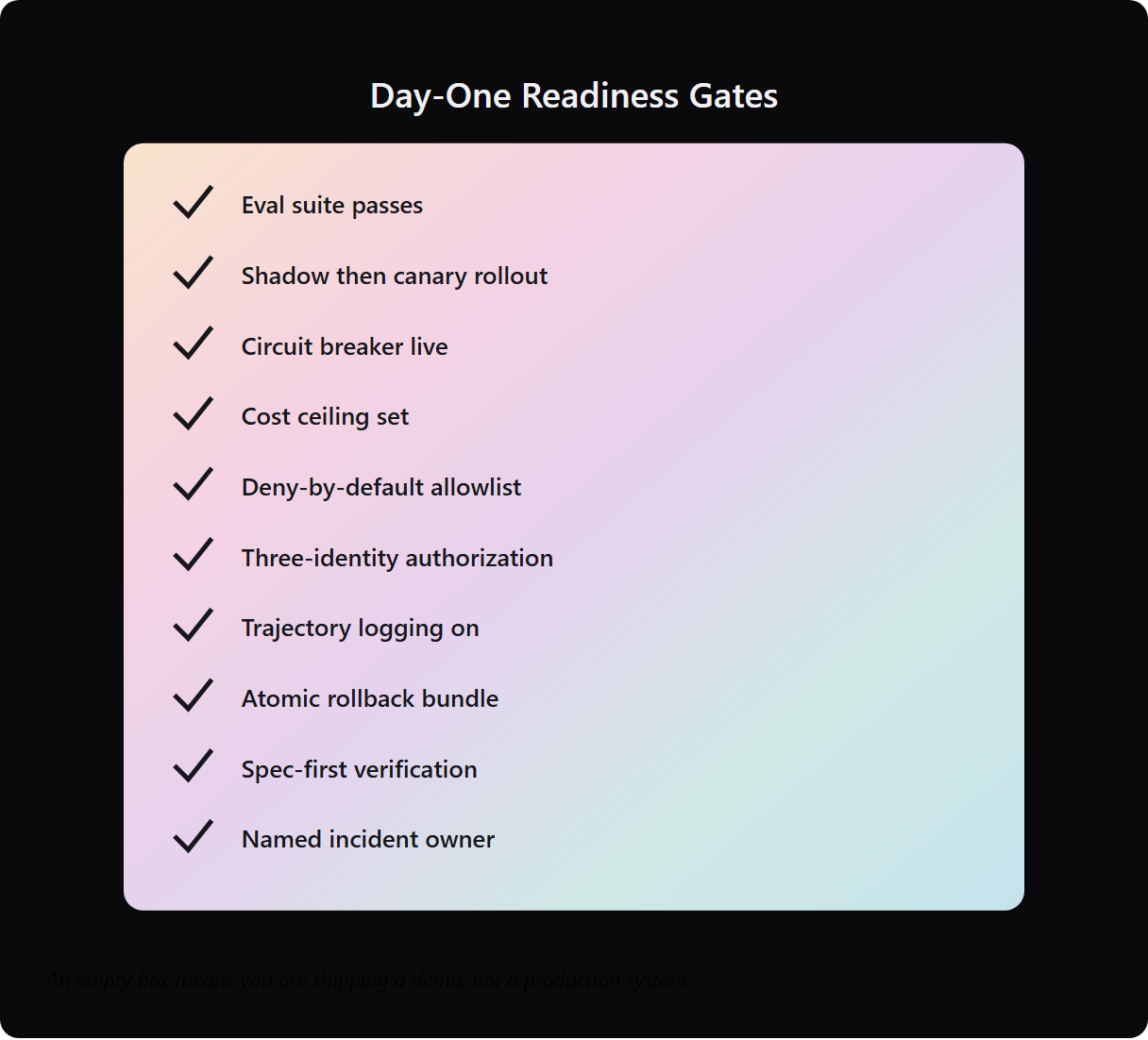
Run this before launch. Each line maps to a section above, so you know where to look if a box is empty:
- Eval suite passes. The agent is broadly correct on known cases offline.
- Staged rollout ready. Shadow mode, then canary, then graduated, with gates.
- Circuit breaker live. A hard cap on retries and loops, enforced outside the model.
- Cost ceiling set. A spend limit per run and per day, in infrastructure.
- Tool allowlist is deny-by-default. The agent calls only what you permit.
- Three-identity auth. User, agent, and per-tool token, each accountable.
- Trajectory logging on. Every reasoning step and tool call is captured.
- Atomic rollback bundle. Code, prompts, tools, and model version revert together.
- Spec-first verification. The three-question test gates every change.
- Named incident owner. A specific human, not a team alias, owns failures.
⚠️ What an empty box actually means
Writing the agent is the cheap part. Making it correct and safe to run is the expensive part, and that is exactly the work these ten lines protect.
If you went quiet on three or four lines just now, you are not behind. You are in the same spot as most teams shipping their first production agent. That gap between a working demo and a system you can trust at 2 AM is the conversation our AI agent development services handle almost every week.
🔭 Where I think this goes next
My open question, the one I am sitting with, is whether the model layer keeps mattering less. The hard problems I keep meeting are not about reasoning. They are about identity, rollback, cost, and the legacy core underneath, which is why disciplined AI integration matters more than model choice.
If that holds, the teams that win the next two years will not be the ones with the cleverest prompts. They will be the ones who treated the agent as a fallible kernel and engineered a real nervous system around it. If that is the system you are trying to build, or rescue, tell us what you are running. The door is open.