TL;DR
- Most generative AI consulting companies can demo a chatbot; few can ship and keep an agent running inside a regulated production system.
- Sort firms by situation, not rank: global integrators for board-level programs, AI-native boutiques for greenfield speed, engineering partners for legacy and regulated cores.
- Judge vendors on four milestones: production-grade RAG, reliable agentic workflows, regulated-environment delivery, and hallucination control with grounding and human review.
- Budget mostly disappears into integration, cloud run-time, and agent loops, not the model; most failed pilots fail at data and integration.
- The clearest red flag is code nobody can explain; ask who owns the system after go-live and demand production proof over demos.
- Name your situation in one line, then make every shortlisted firm prove it against the milestones; the right partner falls out of criteria, not brand.
Q1: Which generative AI consulting companies actually ship production systems in 2026, and how should you read this list?
Fifteen firms credibly do generative AI consulting in 2026, but they are not interchangeable. Each is built for a different situation. This guide assesses them on six criteria that separate production work from demoware: AI delivery model, data-layer and legacy-core depth, production-grade RAG, agentic reliability controls, regulated-industry experience, and senior-lead ownership. Read it as a field map, not a ranked league table. The right partner depends on your system, not their logo.
🗺️ How I built this map
I have spent twelve years running delivery at Teamvoy, across 150-plus projects in banking, insurance, healthcare, and complex SaaS. So I am not writing this as a marketer ranking logos. I am writing it as a founder who has picked up systems other vendors walked away from.
Here is the pattern I see. Most buyers shop for a model. The model is the easy part. The hard part is the data layer feeding it and the legacy core it has to live inside. A demo hides both. Production exposes both. That gap between a clean prototype and a system that survives audit is exactly why technology modernization work matters more than model selection.
⚠️ Why this choice is high-stakes
Choosing this kind of partner is not like buying a tool you can swap next quarter. You are choosing who owns a system that has to keep working, often for years, sometimes inside a regulated environment where downtime is a reportable event. Get it wrong, and “almost right” code sits in your codebase for six months before anyone notices the cost.
That gap between adoption and value is real. Stanford’s 2025 AI Index reports that around 78% of organizations used AI in 2024. Yet McKinsey’s 2025 survey found only a small share of companies, roughly the high-performer minority, capture significant financial value. The firms below are sorted by which gap they help you close, not by who is “best.” If you want help closing it, our AI consulting work starts exactly here.
Our Evaluation Criteria
I picked these six because they decide whether a generative AI project survives contact with production. They are the same six applied to every company below, in the same order.
- AI delivery model: Does the firm only advise, or does it build and ship the system into production? Advice you cannot deploy is a slide deck.
- Data-layer and legacy-core depth: Can they assess the data feeding the model and the old system it must integrate with? This is where most pilots quietly die.
- Production-grade RAG: RAG (Retrieval-Augmented Generation, where the model answers using your own retrieved documents) must be engineered, not a dump of every file into one database.
- Agentic reliability controls: When an agent takes actions, are there circuit breakers, scoped permissions, and retry limits? Action without guardrails is a liability.
- Regulated-industry experience: Have they shipped under named regimes (HIPAA, GDPR, SOC 2, PCI-DSS, DORA, BaFin)? Compliance is learned in delivery, not in a brochure.
- Senior technical lead ownership: Does a senior engineer own your system end to end, or do junior staff cycle through it? “We keep getting handed off” is the most common pain I hear.
Who This Guide Is For
You will get the most from this if you recognize yourself in one of these situations.
- A CTO who inherited a generative AI build a previous vendor started and abandoned, and now needs a credible path forward without repeating the mistake.
- A technical founder or IT director inside a regulated environment (fintech, healthcare, insurance) facing a compliance deadline or a board mandate to scale AI past read-only pilots.
- A founder whose AI-assisted or vibe-coded prototype got traction, then hit production instability nobody on the team can fully explain.
For readers in a regulated vertical, our banking and fintech, healthcare, and insurance work shows what auditable delivery looks like in each context.
The 15 Companies at a Glance
Each line names the situation the company is genuinely built for. No rankings, no scores.
- Teamvoy: Best for regulated systems and legacy cores that need AI integration without a rewrite, owned by a senior lead over a long engagement.
- HatchWorks AI: Best for teams that want a generative AI and RAG product designed and built with structured agile delivery.
- Valere: Best for funded startups building a vertical AI-SaaS product with a production RAG pipeline from scratch.
- Vention: Best for venture-backed teams needing senior staff augmentation to ship AI features fast.
- Azumo: Best for nearshore AI and data engineering capacity on a defined build.
- NineTwoThree AI Studio: Best for product teams turning an AI concept into a launched MVP.
- Diffco AI: Best for science-heavy and applied machine-learning builds.
- Dualboot Partners: Best for scale-ups needing embedded product and AI engineering teams.
- DOOR3: Best for enterprise UX-led software with AI features layered in.
- Frogslayer: Best for mid-market companies building a custom AI-enabled product to grow revenue.
- SOLTECH: Best for Southeast US companies wanting a local custom-software partner adding AI.
- GenAI.Labs USA: Best for organizations wanting an AI strategy and roadmap before they build.
- Imaginovation: Best for SMBs building a custom AI-enabled web or mobile platform.
- Trigent Software: Best for enterprises needing broad QA, testing, and AI engineering capacity.
- Sidebench: Best for venture-studio-style builds of new AI products with design depth.
Master Comparison Table
Pricing sits inside each card below, not here. Engineering work is custom-quoted across every firm, so a price column would invent a comparison that does not exist.
| Company | Best For | Engagement Model | Industry Depth and Compliance Coverage |
|---|---|---|---|
| Teamvoy | Regulated, legacy systems needing AI integration without a rewrite | Long-term partner (4+ yr avg) | Fintech, healthcare, insurance; BaFin, PSD2, DORA, SOC 2, PCI-DSS, HIPAA, GDPR |
| HatchWorks AI | RAG and generative AI products built with agile delivery | Project and embedded teams | IoT, tech, drone and airspace; compliance not publicly emphasized |
| Valere | Vertical AI-SaaS with production RAG built from scratch | Project to product partner | AI-SaaS, regulated verticals; AWS Bedrock-based builds |
| Vention | Senior staff augmentation for AI feature delivery | Staff augmentation | Tech, AI startups; compliance varies by engagement |
| Azumo | Nearshore AI and data engineering capacity | Staff augmentation and project | Software, data; compliance varies by engagement |
| NineTwoThree AI Studio | AI concept to launched MVP | Project and product | SaaS, mobile; compliance varies by engagement |
| Diffco AI | Science-heavy applied ML builds | Project | Healthcare, deep tech; compliance varies |
| Dualboot Partners | Embedded product and AI engineering teams | Long-term embedded teams | SaaS, fintech; compliance varies by engagement |
| DOOR3 | Enterprise UX-led software with AI features | Project and long-term | Enterprise, finance; compliance varies |
| Frogslayer | Custom AI-enabled product for mid-market growth | Project to product partner | Mid-market, logistics; compliance varies |
| SOLTECH | Local Southeast US custom software with AI | Project and staffing | SMB, enterprise; compliance varies |
| GenAI.Labs USA | AI strategy and roadmap before building | Advisory and project | Manufacturing, medical; strategy-led |
| Imaginovation | Custom AI-enabled web and mobile for SMBs | Project | SMB, healthcare; compliance varies |
| Trigent Software | Broad QA, testing, and AI engineering capacity | Staff augmentation and project | Enterprise, retail; compliance varies |
| Sidebench | Venture-studio AI product builds with design depth | Product partner | Healthcare, public sector; compliance varies |
Teamvoy
- AI delivery model: Build-and-ship, full-cycle into production, not advice alone.
- Data-layer and legacy-core depth: First two questions on any AI call; core strength.
- Production-grade RAG: Built into live regulated systems, not demo chatbots.
- Agentic reliability controls: Agentic AI used across delivery with audit-aware guardrails.
- Regulated-industry experience: BaFin, PSD2, DORA, SOC 2, PCI-DSS, HIPAA, GDPR.
- Senior technical lead ownership: A senior engineer owns the system end to end.
- AI integration and legacy-stack modernization for a streaming platform, with agentic AI across delivery, ongoing since January 2025.
- Four-year technical partnership for a Hong Kong fintech across crypto trading, wallets, and always-on systems.
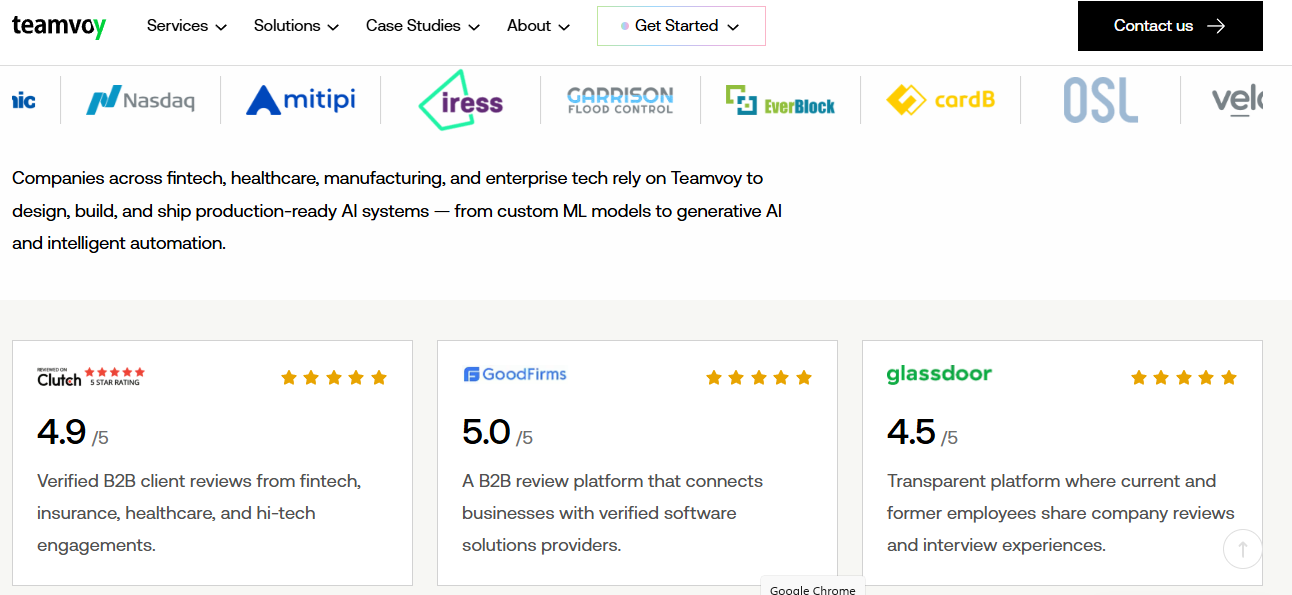
- Named work referenced with Nasdaq, OSL, Panasonic Avionics, and Market Access Direct.
“Teamvoy actively uses agentic AI across internal workflows and delivery, which speeds up development, raises quality, and adds extra value for the client. Their work has resulted in fewer issues and a better user experience.”
— Dmytro Maryanych, Manager, VOD Streaming Service (AI Integration & Legacy Modernization) Teamvoy Clutch – Verified Review
“We have been with Teamvoy for 4 years and found a great partner for the growth of Bitspark. Their technical expertise was top class.”
— George Harrap, CEO, Bitspark (FinTech) Teamvoy Clutch – Verified Review
HatchWorks AI
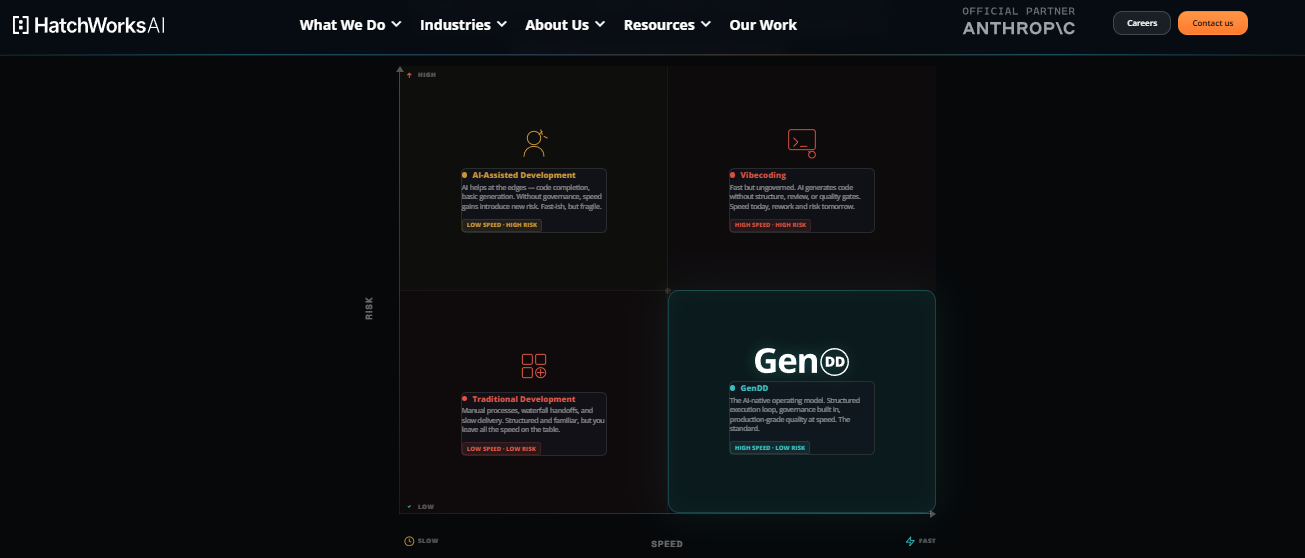
- AI delivery model: Build-and-ship, designs and deploys RAG products.
- Data-layer and legacy-core depth: Strong on data pipelines for new builds.
- Production-grade RAG: Demonstrated, a chat assistant at over 90% accuracy.
- Agentic reliability controls: Not publicly emphasized.
- Regulated-industry experience: Not publicly emphasized.
- Senior technical lead ownership: Small focused teams with strong PM.
- RAG-based chat assistant for an IoT company answering at over 90% accuracy.
- Production-ready MVP querying air-traffic data in natural language on GCP.
“HatchWorks AI delivered a chat assistant that responded to user questions with over 90% accuracy. Their commitment to get the end product right and to be flexible when the situation required impressed us.”
— Josh Horton, Director of Data, Analytics & AI, Cox2M/GearTrack/Kayo HatchWorks AI Clutch – Verified Review
Valere
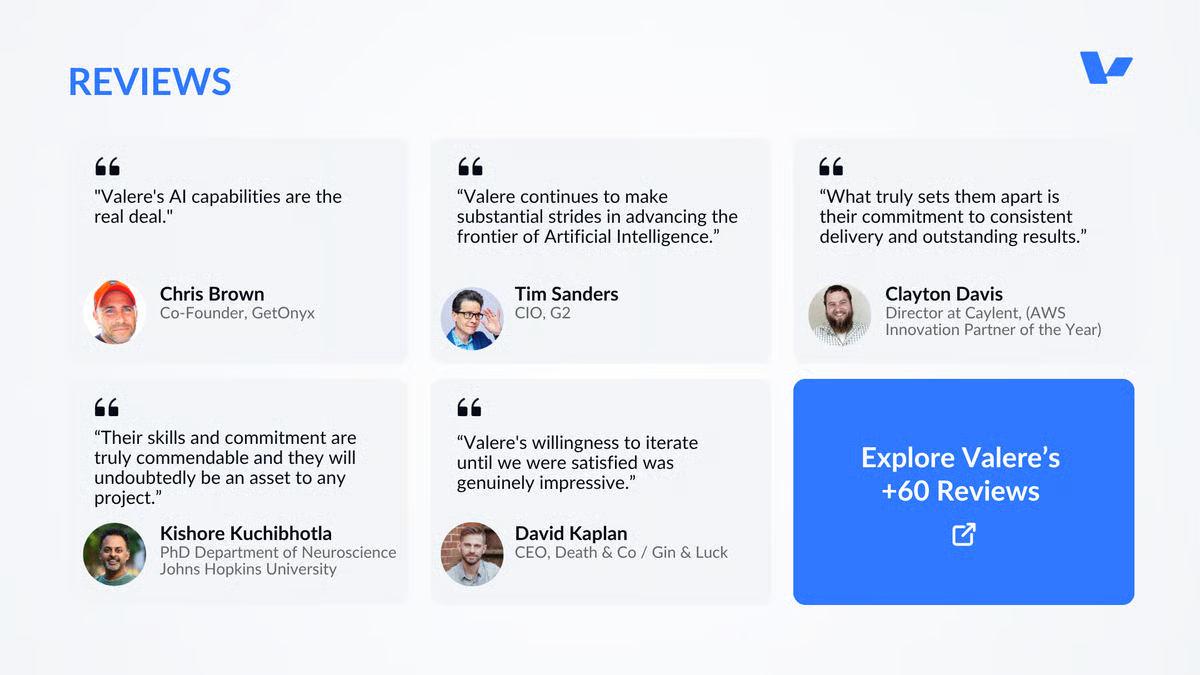
- AI delivery model: Build-and-ship, designs full multi-tenant AI platforms.
- Data-layer and legacy-core depth: Strong on greenfield data and pipeline design.
- Production-grade RAG: Multi-stage RAG pipeline on Amazon Bedrock, runtime model selection.
- Agentic reliability controls: Event-driven backbone with audit logging.
- Regulated-industry experience: Builds for regulated verticals; named-regime depth not detailed.
- Senior technical lead ownership: Integrated team alongside client CTO.
- Live, revenue-generating AI-SaaS for federal business-development intelligence.
- Capture reports in about one hour that previously took four to six weeks.
“Valere built a conversational Bid Assistant as a multi-stage retrieval-augmented generation pipeline on Amazon Bedrock… The architectural decisions are performing well in production. This is not a project that a staffing firm could deliver.”
— David Huff, CEO & Co-Founder, WinMoreBD.ai (AI-SaaS) Valere Clutch – Verified Review
Vention
- AI delivery model: Staff augmentation; engineers embed into your team.
- Data-layer and legacy-core depth: Capable, but scoped to your direction.
- Production-grade RAG: Built by embedded engineers; depends on your architecture.
- Agentic reliability controls: Varies by engagement.
- Regulated-industry experience: Varies by engagement.
- Senior technical lead ownership: You retain ownership; they supply talent.
- React front ends, QA, and infrastructure for a social-AI startup.
- Over 100 bugs fixed in one week, lifting day-one retention by an estimated 2 to 3%.
“Vention had a surprisingly good talent pool on their staff. They delivered fast, high-quality code and closed tickets and bugs extremely quickly. Their employees felt like our employees.”
— Jesse Boyes, CTO, H3R3, Inc. (Social AI) Vention Clutch – Verified Review
GenAI.Labs USA
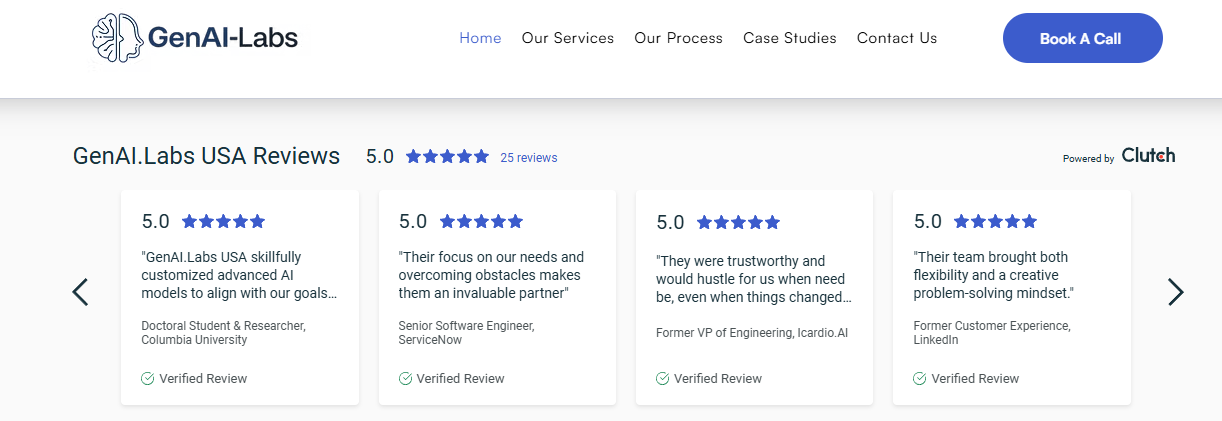
- AI delivery model: Advisory-first, with build follow-through on some engagements.
- Data-layer and legacy-core depth: Assesses opportunity; less focused on legacy cores.
- Production-grade RAG: Some AI-tool builds; RAG depth not publicly detailed.
- Agentic reliability controls: AI agents referenced; controls not detailed.
- Regulated-industry experience: Manufacturing and medical clients; named-regime depth unclear.
- Senior technical lead ownership: Small teams, strategy-led.
- AI and automation roadmap for a lighting manufacturer.
- An internal AI summarization tool for a medical-technology company.
“What stood out most was their ability to connect high-level AI strategy with real business needs. They did not treat AI like a buzzword exercise.”
— Anonymous, COO, Lighting Manufacturer (Manufacturing) GenAI.Labs USA Clutch – Verified Review
Imaginovation
- AI delivery model: Build-and-ship custom web and mobile with AI features.
- Data-layer and legacy-core depth: Solid integration work with third-party APIs.
- Production-grade RAG: Not publicly emphasized.
- Agentic reliability controls: Not publicly emphasized.
- Regulated-industry experience: Healthcare clients; named-regime depth unclear.
- Senior technical lead ownership: Team-as-extension model praised by clients.
- Recruitment platform built for a recruitment-tech company.
- Custom software with complex third-party API integrations for a healthcare company.
“What impressed me the most was their attention to detail. They work incredibly well together as a team… it almost feels like they’re my employees.”
— Alfredo Merino, Founder, TalentedIQ (Recruitment Tech) Imaginovation Clutch – Verified Review
Azumo
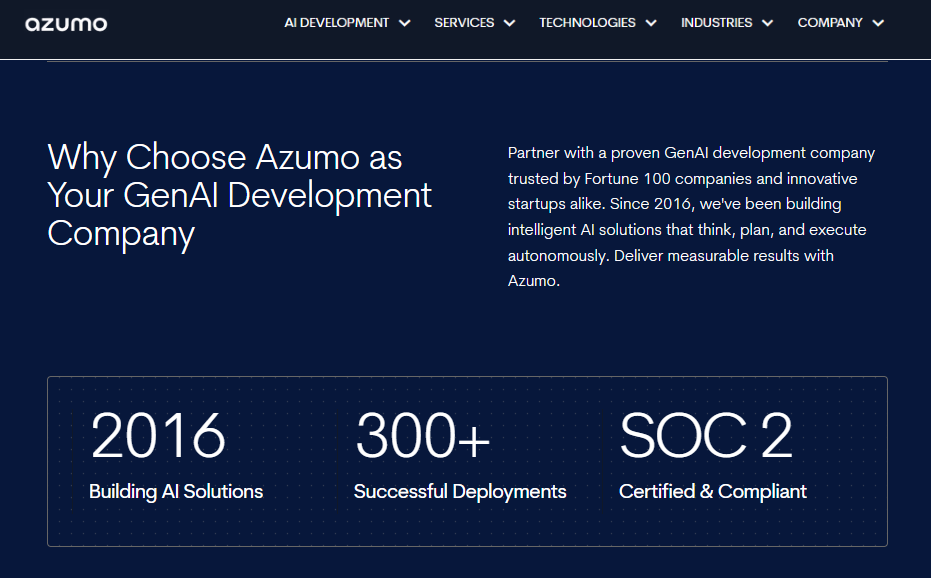
- AI delivery model: Build capacity plus nearshore augmentation.
- Data-layer and legacy-core depth: Data engineering is a stated strength.
- Production-grade RAG: Builds LLM and RAG features; depth varies by engagement.
- Agentic reliability controls: Varies by engagement.
- Regulated-industry experience: Varies by engagement.
- Senior technical lead ownership: Team-based, client-directed.
- Publicly listed AI, data, and software engagements across software and data clients.
“They meet the timelines for the delivery of each use case across each phase of the engagement. This engagement has no defined end date. They have also helped on other projects as well.”
— Michael Butler, Director of Partnerships, nlx.ai Azumo Clutch – Verified Review
NineTwoThree AI Studio
- AI delivery model: Build-and-ship, concept to launched MVP.
- Data-layer and legacy-core depth: Strong on new product data design.
- Production-grade RAG: Builds LLM features; RAG depth varies by project.
- Agentic reliability controls: Varies by engagement.
- Regulated-industry experience: Varies by engagement.
- Senior technical lead ownership: Studio model with product leadership.
- Publicly listed AI and mobile product launches across SaaS clients.
“What was most impressive was their depth of experience and expertise for every phase of development. This allowed for problem solving and enhancements throughout the development and helped to turn a good idea into a great deliverable.”
— William Hess, Co-CEO & Head of Research, PRC Macro NineTwoThree AI Studio Clutch – Verified Review
Diffco AI
- AI delivery model: Build-and-ship custom ML and AI solutions.
- Data-layer and legacy-core depth: Strong data-science foundation.
- Production-grade RAG: Builds LLM and ML features; RAG depth varies.
- Agentic reliability controls: Varies by engagement.
- Regulated-industry experience: Healthcare and deep-tech clients.
- Senior technical lead ownership: Science-led teams.
- Publicly listed applied-ML and AI builds across healthcare and deep-tech clients.
“We saw meaningful results across the board: the project was completed on schedule, stayed within budget, and immediately improved our platform’s performance and reliability.”
— Jacob Hokinson, CPO, Gitcha Diffco AI Clutch – Verified Review
Dualboot Partners
- AI delivery model: Build-and-ship via embedded product and AI teams.
- Data-layer and legacy-core depth: Capable across product builds.
- Production-grade RAG: Builds AI features; depth varies by engagement.
- Agentic reliability controls: Varies by engagement.
- Regulated-industry experience: SaaS and fintech clients.
- Senior technical lead ownership: Embedded-team model.
- Publicly listed embedded product and AI engagements across SaaS and fintech clients.
“What was most impressive and unique was how seamlessly the Dualboot team integrated with Primoprint. They never felt like a separate entity — we collaborated with them just as we would with our own internal team.”
— Jen Manning, COO, Primoprint Dualboot Partners Clutch – Verified Review
DOOR3
- AI delivery model: Build-and-ship enterprise software with AI layered in.
- Data-layer and legacy-core depth: Enterprise integration experience.
- Production-grade RAG: Builds AI features; RAG depth varies.
- Agentic reliability controls: Varies by engagement.
- Regulated-industry experience: Enterprise and finance clients.
- Senior technical lead ownership: UX and engineering leadership.
- Publicly listed enterprise software and UX engagements across finance and enterprise clients.
“DOOR3’s communication is key. It feels like a true partnership; it feels like a team within our company. Their openness to understanding what we do is impressive. It’s a niche industry with complicated financial products.”
— Tara York, Managing Director, Luma Financial Technologies DOOR3 Clutch – Verified Review
Frogslayer
- AI delivery model: Build-and-ship custom AI-enabled products.
- Data-layer and legacy-core depth: Capable across custom builds.
- Production-grade RAG: Builds AI features; depth varies by engagement.
- Agentic reliability controls: Varies by engagement.
- Regulated-industry experience: Mid-market and logistics clients.
- Senior technical lead ownership: Product-partner model.
- Publicly listed custom-product engagements across mid-market clients.
“Test cases defined the success of the project; ultimately we hit 80% success early on in the project (within 2 weeks) and by the end of the project we hit our 95% target.”
— Kenneth Croft, IT Manager, Q Investments Frogslayer Clutch – Verified Review
SOLTECH
- AI delivery model: Build-and-ship custom software with AI features.
- Data-layer and legacy-core depth: Capable across business systems.
- Production-grade RAG: Builds AI features; depth varies by engagement.
- Agentic reliability controls: Varies by engagement.
- Regulated-industry experience: SMB and enterprise clients.
- Senior technical lead ownership: Local team model.
- Publicly listed custom-software and staffing engagements across US clients.
“SOLTECH’s customer service distinguishes them from the competition. The team goes above and beyond to meet our needs.”
— Kattie Henderson, Manager of Software Project Mgmt, Neptune Technology Group SOLTECH Clutch – Verified Review
Trigent Software
- AI delivery model: Capacity-led engineering, QA, and AI builds.
- Data-layer and legacy-core depth: Broad enterprise engineering experience.
- Production-grade RAG: Builds AI features; depth varies by engagement.
- Agentic reliability controls: Varies by engagement.
- Regulated-industry experience: Enterprise and retail clients.
- Senior technical lead ownership: Capacity model; client-directed.
- Publicly listed QA, testing, and engineering engagements across enterprise clients.
“I’m most impressed by their unbelievable understanding of our complex requirements. When ordering a truck, there are billions and billions of combinations available. Trigent understands that, which makes them extremely effective.”
— Jim Pirie, Chief Engineer, Navistar International Trigent Software Clutch – Verified Review
Sidebench
- AI delivery model: Build-and-ship new AI products, studio-style.
- Data-layer and legacy-core depth: Strong on greenfield product design.
- Production-grade RAG: Builds AI features; depth varies by engagement.
- Agentic reliability controls: Varies by engagement.
- Regulated-industry experience: Healthcare and public-sector clients.
- Senior technical lead ownership: Product and design leadership.
- Publicly listed AI product and design engagements across healthcare and public-sector clients.
“I’m impressed by Sidebench’s professionalism in project management. I’m also impressed by their design stage, in which we planned the entire project in terms of integrations, workflows, and UI. The product they’ve helped us create has been exceptional.”
— Anonymous, Executive, BrilliSkin Sidebench Clutch – Verified Review
Q2: What does a generative AI consulting company actually do, and where does the real work sit?
A generative AI consulting company helps you decide where generative AI adds leverage, then either advises or builds the system that delivers it. The work splits into strategy (use-case selection, readiness, governance) and engineering (data pipelines, RAG, agents, integration, deployment). The hard part is rarely the model. It is the data layer and the legacy core feeding it. Firms that only advise leave you to build the part that actually breaks.
🧩 The two halves of the job
Strategy work picks the use cases, checks readiness, and sets governance rules. Engineering work builds the pipelines, the retrieval, the agents, and the deployment.
Some firms stop at the slide deck. Others ship the running system. That gap matters most when you need delivery, not advice. Buying a roadmap when you needed working software is a common, expensive mismatch, which is why our AI development services are built to ship, not just to advise.
🧠 The model is the kernel, integration is the OS
Here is the analogy I keep coming back to. A frontier model is like a kernel, the small core at the center of an operating system. Powerful, but useless on its own.
The model only does useful work when it sits inside a real system. It needs clean data going in. It needs reliable actions coming out. Feed it messy data, and even the best model gives confident, wrong answers. RAG (Retrieval-Augmented Generation, where the model answers using your own retrieved documents) only works if the retrieval is sound, and that is fundamentally an AI integration services problem.
🔍 The two questions I ask before the model
The first thing I look at on an AI integration call is not the model. It is the data layer, then the legacy core. I have learned this the hard way across twelve years of delivery.
So I ask two things first. What shape is your data in, and what does the old system underneath actually do? Those two answers tell me which kind of firm you need. At Teamvoy, we treat both as the real project, because that is where the time and risk live. Most companies still use generative AI in only a pocket of the business, not across it. Closing that gap is integration work, not model shopping, and it usually starts with focused data engineering.
Q3: Why do most enterprise generative AI pilots stall before production?
Adoption is near-universal while value is rare. Stanford’s AI Index puts enterprise AI use around 78%, yet McKinsey finds only about 5.5% of companies capture significant financial return. Pilots stall because a demo and a production system are different engineering problems. One impresses once. The other must stay reliable, observable, secure, and maintainable. The gap is integration, data quality, and accountability, not model capability.
📊 The gap that runs through this whole guide
Hold these two numbers side by side. About 78% of organizations reported using AI in 2024, up from 55% a year earlier. Yet only around 5.5% see real financial returns, per McKinsey’s survey of 1,993 companies.
That is the gap this entire guide is about. Almost everyone has adopted. Almost no one has captured value. The firms worth your time are the ones that close it, which is the whole premise behind our AI consulting work.
💸 Why “almost right” costs more than wrong
A demo only has to work once, in front of an audience. A production system has to work at 2 AM when nobody is watching.
“Almost right” is more expensive than completely wrong. A system that is clearly broken gets fixed fast. One that is subtly wrong ships bad answers for months before anyone notices the bill. That cost compounds quietly, inside your codebase and your customer trust, and it is exactly the kind of risk a short IT audit services engagement is designed to surface.
⚠️ The forecasts disagree, and that is the point
The forecasts contradict each other, so read them with care. Gartner expects strong agentic adoption by 2028, while other widely cited research found many pilots returning near-zero measurable return. I am flagging that tension, not resolving it.
Here is what I have seen behind the numbers. Across rescue engagements, the pattern is a vendor that won on slides and exited at go-live. The demo was real. The production discipline was missing. When we pick up that kind of stalled work, the fix usually looks more like technology modernization than a fresh build.
✅ Four milestones that de-risk the choice
So treat the rest of this guide as a checklist. Four milestones separate firms that demo from firms that ship.
- Production-grade RAG: engineered retrieval, not a document dump.
- Agentic reliability: action-taking agents with hard safety controls.
- Regulated-environment delivery: auditable work under named regimes.
- Hallucination control: grounding and evaluation, not hope.
At Teamvoy, these four are the questions we expect a serious buyer to ask us. If a vendor cannot answer them with specifics, the pilot will likely stall. That is the de-risking lens for every section that follows, and it is the same lens behind our banking and fintech delivery work.
Q4: What do production-grade RAG and safe agentic workflows actually look like?
Production-grade RAG is engineered retrieval, with scoped sources, chunking, ranking, evaluation, and grounding a model can reason over. It is not a dump of every document into one vector database. Agentic workflows let the model take actions, so they need hard circuit breakers, scoped permissions, retry limits, and observability. The danger is the “Lethal Trifecta”: private-data access, untrusted input, and write access that can leak it. Both are engineering disciplines, not demos.
📚 What “production-grade RAG” really means
RAG retrieves your own documents and feeds them to the model before it answers. That is the idea from the original 2020 paper. The trouble is most teams build “dumb RAG.”
Dumb RAG means dumping everything into one vector database (a store that finds text by meaning, not keywords). It is like dumping your whole hard drive into memory and hoping the right file surfaces. Real RAG scopes the sources, splits documents sensibly, ranks results, and tests retrieval quality, which is the engineered core of our AI agent development services.
🔎 Why retrieval quality decides the answer
I have watched a team dump all their Confluence pages, Slack history, and Salesforce records into one index. The demo looked great. In production, it surfaced the wrong document at the wrong moment.
The fix was not a bigger model. It was engineered retrieval and provenance, knowing which source an answer came from. This kind of confabulation is a named risk to manage, not a quirk to ignore, and it is one reason our healthcare work treats source provenance as a first-class requirement.
🤖 Agentic means action, so controls are the product
An agentic workflow lets the model take actions, like calling tools or writing to systems. The moment software can act, the safety controls become the product, not a nice-to-have.
That means hard circuit breakers, scoped permissions, retry limits, and observability (the ability to see what the agent did and why). Without retry limits, an agent can loop overnight and run up a large bill while everyone sleeps. Building those guardrails is central to how we deliver AI autonomous agents.
🔒 The Lethal Trifecta and how to scope it
The sharpest agentic risk is the “Lethal Trifecta.” It is three things in one system: access to private data, exposure to untrusted input, and the ability to write or send data out.
Put all three together, and a poisoned input can quietly exfiltrate your data. The defense is scoping. Cut one leg of the trifecta, limit permissions, and log every action. Agentic RAG, where the agent decides what to retrieve, raises the bar further, and getting it right inside a live stack is a system integration discipline.
⚖️ Where it genuinely depends
Some choices are real trade-offs, not settled answers. Different agent-coordination patterns suit different jobs, and I would not claim one wins everywhere.
I lean toward using sub-agents to control context, not to act out human-style roles. From what surfaces when you actually run these systems, that keeps behavior predictable. When we build agentic delivery at Teamvoy, retrieval quality and action control are the engineering work, because they tie straight to hallucination control and auditability. The buyer questions that verify both milestones are simple: ask for provenance, evaluation, circuit breakers, and scoped permissions, the same checks we apply when we hire AI engineers onto a regulated build.
Q5: How do you evaluate a generative AI consulting partner for a regulated environment?
In a regulated environment, evaluate the partner on auditable delivery, not capability claims. Ask which named regimes they have shipped under, such as DORA, PCI-DSS, BaFin, HIPAA, GDPR, and SOC 2, and how they handle data residency, model provenance, and hallucination control under audit. The failure mode is a firm that AI-washes a deck, hands the build to a junior team, and exits before go-live.
🏛️ The situation you are actually in
You are not buying AI for fun. There is a board mandate, or a deadline tied to DORA, PCI-DSS, BaFin, or HIPAA. In these worlds, downtime is a reportable event, not an inconvenience.
So the bar is different. The system has to keep working, and you have to prove how it works. That proof is the job, day by day, on the engineering side, and it sits at the center of our banking and fintech delivery.
⚠️ The two failure modes to watch
I have picked up the aftermath of both. One IT director told me their previous consultancy sold a polished deck, then handed the build to a junior team and left six months before go-live. The system sat half-finished between vendors.
The second failure mode is AI-washing. A firm rebrands old work as “AI” on a slide, with no provenance and no evaluation behind it. Both look fine in a sales meeting. Neither survives an audit, which is why we start most of these engagements with focused IT audit services.
✅ What auditable delivery actually looks like
Auditable delivery means you can answer hard questions with evidence, not faith. Where does the data live (residency)? Which model produced this answer (provenance)? How do you catch a wrong answer before it ships (hallucination control)?
Use a shared vocabulary so the audit goes smoothly. A recognized AI risk-management framework gives one structure for naming and managing these risks. Treat confabulation as a named risk to control, and align to an AI management-system standard auditors recognize. At Teamvoy, this is the territory we work in, modernizing live regulated systems without a full rewrite, the way you swap a supermarket’s checkout software one register at a time while the store stays open, which is the heart of our technology modernization work and our insurance delivery.
🔍 The questions that expose a non-accountable partner
Ask these on the first call. The answers separate ownership from hand-off.
- Which named regimes have you shipped production systems under, and on which projects?
- Who owns the system at go-live, a senior lead or a rotating junior team?
- Show me how you log provenance and catch a wrong answer before a user sees it.
If you want regulator-ready delivery on a live stack, that is the work behind our AI integration services.
Q6: Big consultancy, boutique AI shop, or engineering partner, which kind fits your situation?
Big consultancies bring brand cover and breadth, but often hand off to junior teams and exit at go-live. Boutique AI shops move fast, yet can leave a “shadow agent” layer nobody can maintain. Engineering partners stay accountable through production and into support. Pick by situation: a board-visibility strategy piece favors the first, a contained experiment the second, a regulated long-running system that has to keep working favors the third.
🧭 The three archetypes, honestly
Each kind is good at something and weak at something else. None is “best.”
- Big consultancy: strong brand cover and breadth. The risk is a junior delivery team and an exit at go-live.
- Boutique AI shop: fast and current on models. The risk is a “shadow agent” layer (undocumented automation) nobody can maintain later.
- Engineering partner: stays accountable into production and support. The trade-off is that it suits long commitments, not quick experiments.
🎯 Matching the kind to your situation
Here is how I map the four common situations to the fitting kind.
| Your situation | Kind that usually fits | Not recommended for |
|---|---|---|
| Board-visibility strategy piece | Big consultancy | A regulated system that must stay live |
| Contained, low-risk experiment | Boutique AI shop | A core system with audit exposure |
| Regulated, long-running system | Engineering partner | A one-week throwaway prototype |
| Rescue of an unstable AI build | Engineering partner | A team wanting only a fresh slide deck |
A burned CTO and a founder with a fragile legacy core both sit in the bottom rows. That is the kind Teamvoy is built for, the engagements others decline, and it is the spirit of our AI development services.
🩹 The shadow-agent and vibe-coding caveat
One warning from the field. AI-assisted “vibe coding” ships fast but often lacks the connective tissue a robust system needs. Research on 5,600 vibe-coded apps found roughly one-third carried serious security flaws, with cross-site scripting about 2.74 times more likely than in human-written code.
A simple maintainability test helps. Can the developer explain the code without the AI’s comments? If not, you have bought a liability, not an asset. Building in-house has its own caveat: you become the integration owner forever, so build only with a dedicated platform team and genuinely unique core systems. This is exactly the territory our system integration work was built to handle.
AI Consulting
WHERE THIS IS HANDLED
We help teams figure out where generative AI fits their stack, and where it adds risk before it adds leverage.
If you are weighing which kind of partner your situation calls for, this is work we do every day, the door’s open for a look at yours.
Q7: How do you build a defensible shortlist and decide who to call first?
Build the shortlist backwards from your risk. Start with the milestone your system cannot fail on, whether regulated delivery, production RAG, or agent safety, and cut any firm that cannot show evidence for it. Then match the survivors to your situation: rescue, modernization, contained experiment, or board-visibility strategy. On the first call, ask what they would do in your first 30 days, not what they have done for others.
🪜 Sequence by the risk you cannot afford
Do not start with logos. Start with the one milestone your system cannot fail on.
Pick that milestone first, then cut hard. If a firm cannot show evidence for it, they leave the list, however good the rest looks. This is a de-risking checklist, not a beauty contest, and it is the same discipline behind our AI agent development services.
🗂️ Match the survivors to your situation
Now match who is left to your real situation. The right engagement shape follows from it.
- Rescue or unstable build: start with a short audit that surfaces risk and an action plan, not a full fix.
- Legacy modernization: a long-term partner who stays through production.
- Contained experiment: a short sprint that ships one meaningful milestone, not a finished product.
- Board-visibility strategy: a strategy-led firm, with a clear plan for who builds after.
Most buyers are earlier than they admit. The majority are still stuck in pilots, with only the high-performer minority capturing real value. Knowing where you actually sit keeps the shortlist honest, and a quick proof of concept often tells you more than another vendor meeting.
🤝 The first call, and what I would listen for
On the first call, the strongest signal is forward, not backward. Ask what they would do in your first 30 days on your system, and who owns it.
A real answer is specific about your data layer and your legacy core, and it names a senior lead who stays. Vague answers about “autonomous co-workers” tell you they are selling the demo. Where my view sits right now is simple: judge a partner on the work they would do next week, not the deck they show today. If you read your own system in that description, that is the conversation worth having, and our door is open through a quick conversation with our team.