- Legacy platform modernization moves an aging production system to a maintainable footing through rehosting, replatforming, refactoring, or re-architecting, without breaking what the business runs on today.
- Most projects stall on architecture and the data layer, not the AI model; a firm demos cleanly on a small module then chokes on an undocumented legacy core.
- Evaluate firms on three axes: incremental refactoring track record, AI tooling proven on a full production repo, and genuine depth in your specific stack.
- Regulated regimes like DORA, PCI-DSS, HIPAA, and BaFin demand traceable, reversible, continuously available delivery, which rules out big-bang rewrites.
- De-risk the first 90 days with scream tests, angry agents, hard circuit breakers, and an integration layer that earns safe write-access.
- Match the partner kind to your situation; only 16% of large modernization efforts finish on time, so accountability through go-live matters most.
Q1. How should you choose a legacy platform modernization firm in 2026?
Picking the wrong modernization partner is not a sunk cost you absorb in a quarter. It is a multi-year mistake that lives inside your core system, and you often do not feel it until the partner is gone. Choose on three things the marketing will not tell you: a real refactoring track record (not rewrites), AI tooling proven on a full production repo (not a demo), and genuine depth in your specific legacy stack modernization, whether that is COBOL, AS/400, SAP, or .NET Framework. The wrong firm leaves you with a half-migrated core nobody on your team can fully read.
I have spent twelve years at Teamvoy doing this work inside fintech, insurance, and healthcare. The pattern is consistent. Modernization rarely fails on code. It fails on architecture, accountability, and a partner who stops at the demo. One engineer I respect, David Leitner, calls architectural modernization “open heart surgery on a legacy system,” where the whole job is keeping the patient alive. That framing is right. A modernization engagement that breaks the live system helps nobody, no matter how clean the new stack looks.
The numbers back the caution. McKinsey found that only 16% of large-scale IT modernization projects finish on time and on budget. On the AI side, an MIT-linked study widely cited in 2025 reported that 95% of enterprise generative-AI pilots delivered no measurable financial return. So the question is not “who is the best firm.” It is “which kind of partner does my situation actually call for.” This guide gives you that map.
1.1 Our Evaluation Criteria
I picked criteria that change the outcome of a modernization engagement, not vanity metrics. Here is what each one assesses and why it matters.
- Refactoring track record (incremental vs rewrite-first): Can the firm modernize in waves while the business keeps running, or does it default to a risky big-bang rewrite?
- AI-assisted tooling depth (production vs demoware): Does the firm’s AI integration tooling run against your full codebase, or only a clean sample that flatters the demo?
- Legacy-stack depth: Has the firm actually shipped your stack (COBOL, AS/400, SAP, .NET Framework), or is it learning on your dime?
- Regulated-industry coverage: Does the firm understand named regimes like DORA, PCI-DSS, HIPAA, and BaFin, where downtime is a reportable event?
- Engagement model and accountability: Does a senior engineer own the system through go-live, or do juniors cycle through with nobody accountable after delivery?
1.2 Who This Guide Is For
This is written for technical buyers in a specific bind, not a general audience. You will recognize yourself in one of these.
- 🧯 The Burned CTO who inherited a system a previous vendor broke, exited, or made worse, and needs a credible path forward without repeating the mistake.
- 🏗️ The Technical Founder sitting on a product they built years ago that now resists every change, and who wants modernization without a full rewrite or a hand-off of authorship.
- ⚖️ The Enterprise IT Director inside a regulated environment with a board mandate or a compliance deadline, who needs accountable delivery, not consultants who hand off to juniors and exit.
1.3 The 10 Firms at a Glance + Master Comparison Table
This is not a ranked league table. Each firm exists for a different situation. The “best for” line is the situation each one genuinely fits.
- Teamvoy: Best for regulated platforms needing incremental modernization without a rewrite, led by a senior technical owner.
- DOOR3: Best for enterprises modernizing a complex internal tool or platform where deep discovery and UX restructuring come first.
- Azumo: Best for nearshore data and cloud migration work, like moving an on-premise SQL core to a managed cloud database.
- BlueLabel: Best for putting an AI layer on top of a legacy ERP to unlock decades of trapped operational data.
- Vention: Best for venture-backed teams scaling fast that need senior engineers slotted into an existing system quickly.
- HatchWorks AI: Best for teams that want AI-assisted “generative-driven development” baked into the delivery process.
- Diffco AI: Best for AI-heavy product builds where machine learning is the core of the modernized system, not a bolt-on.
- Trigent Software: Best for enterprises wanting a large, established offshore partner for long-running application maintenance and modernization.
- Dualboot Partners: Best for scale-ups needing an embedded product-and-engineering team to modernize and ship in parallel.
- SOLTECH: Best for US-based custom software modernization where local presence and hands-on management matter.
| Company | Best For | Engagement Model | Industry Depth & Compliance Coverage |
|---|---|---|---|
| Teamvoy | Regulated platforms needing incremental modernization without a rewrite | Long-term partner (4+ yr avg), senior technical lead owns the system | Fintech, insurance, healthcare; BaFin, PSD2, DORA, SOC 2, PCI-DSS, HIPAA, GDPR, FCA, NHS Digital |
| DOOR3 | Enterprises restructuring a complex internal tool or platform | Project-and-exit, discovery-led, US-based | Fintech, enterprise, retail; UX and platform depth, compliance varies by engagement |
| Azumo | Nearshore data and cloud migration of a legacy core | Staff augmentation + managed services, nearshore | Financial services, sports, SaaS; cloud migration focus, regulated coverage not strongly claimed |
| BlueLabel | AI layer on top of a legacy ERP to unlock trapped data | Project-and-exit, product-and-AI build | Healthcare, manufacturing, SaaS; HIPAA exposure via healthcare work, broader compliance varies |
| Vention | Venture-backed teams scaling an existing system fast | Staff augmentation, nearshore, senior engineers | Fintech, healthtech, startups; broad coverage, compliance varies by engagement |
| HatchWorks AI | AI-assisted “generative-driven development” in delivery | Long-term partner + nearshore staffing | SaaS, healthcare, fintech; AI-delivery focus, compliance varies by engagement |
| Diffco AI | AI-heavy builds where ML is the core of the system | Project-and-exit, AI/ML specialist | Real estate, SaaS, startups; ML product depth, regulated coverage not strongly claimed |
| Trigent Software | Large, established offshore partner for long-running maintenance | Long-term partner + offshore staffing | Enterprise, ISV, retail; broad QA and app-maintenance depth, compliance varies |
| Dualboot Partners | Scale-ups needing an embedded product-and-engineering team | Embedded long-term team | Fintech, SaaS, enterprise; product-led, compliance varies by engagement |
| SOLTECH | US-based custom software modernization with local management | Project-and-exit + staffing, US-based | SMB and mid-market across industries; US-based delivery, compliance varies |
1.4 Detailed Provider Cards
Teamvoy
- Refactoring track record: Incremental, rescue-not-rewrite; modernizes while the live system keeps running.
- AI-assisted tooling depth: Uses agentic AI across delivery, with senior human review on every change.
- Legacy-stack depth: Picks up undocumented systems built by prior teams across fintech and insurance.
- Regulated-industry coverage: BaFin, PSD2, DORA, SOC 2, PCI-DSS, HIPAA, GDPR, FCA, NHS Digital.
- Engagement and accountability: Senior technical lead owns the system; 4+ year average engagement.
- Four-year technical partnership with a Hong Kong fintech, running mission-critical cryptocurrency and trading systems live 24/7.
- AI integration and legacy-stack modernization for a video streaming platform, with fewer issues and faster delivery reported by the client.
- Named work referenced in Teamvoy’s positioning includes Nasdaq, OSL, Panasonic Avionics, and Market Access Direct.
“We have been with Teamvoy for 4 years and found a great partner for the growth of Bitspark. Their technical expertise was top class.”
George Harrap, CEO, Bitspark (Fintech) · Teamvoy Clutch – Verified Review
“We needed help integrating AI into our product, modernizing our legacy stack, and providing continuous post-release support. Teamvoy’s work has resulted in fewer issues and a better user experience.”
Dmytro Maryanych, Manager, Takflix (Streaming) · Teamvoy Clutch – Verified Review

DOOR3
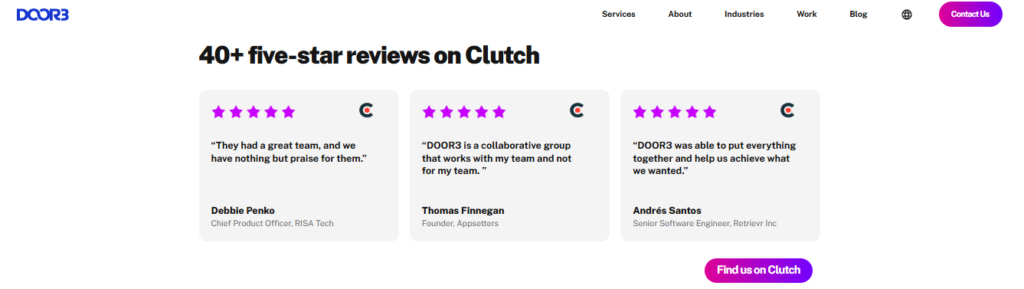
- Refactoring track record: Strong on discovery and platform restructuring; less a deep-legacy-core specialist.
- AI-assisted tooling depth: Not strongly claimed as a core delivery method.
- Legacy-stack depth: Modern web stacks (React, Strapi, AWS); not a mainframe or COBOL house.
- Regulated-industry coverage: Fintech and enterprise experience; named-regime depth varies by engagement.
- Engagement and accountability: Principal consultant involved early; US-based, on-time and on-budget delivery praised.
- Four-week UX audit plus a 12-week design engagement for a fintech platform, cutting time-to-value after launch.
- MVP design and build for a web app using Figma, React, Strapi, and Stripe, delivered on time and on budget.
- Clients consistently cite discovery and expectation-setting per sprint as the standout strength.
“DOOR3’s communication is key. It feels like a true partnership, it feels like a team within our company. Their openness to understanding what we do is impressive. It’s a niche industry with complicated financial products.”
Tara York, Managing Director, Luma Financial Technologies (Fintech) ·
Azumo
- Refactoring track record: Practical legacy cleanup during migration; cloud-and-data focus over deep re-architecture.
- AI-assisted tooling depth: Builds conversational and AI applications; tooling not the headline claim.
- Legacy-stack depth: On-premise SQL Server to Azure SQL, Python, Django, React.
- Regulated-industry coverage: Financial-services clients; named-regime depth not strongly claimed.
- Engagement and accountability: Nearshore time-zone overlap; flexible resourcing praised by clients.
- Migrated an on-premise SQL Server to Azure SQL for a financial-services firm with minimal disruption.
- Updated and cleaned up legacy code tied to the migrated database.
- Provided Python, Django, and React staff augmentation for a sports-analytics company.
“We successfully migrated our systems with minimal disruption and we are well situated to consider new frameworks for future products. Azumo puts a premium on quality.”
Narayan Chowdhury, Managing Director, Franklin Park (Financial services) · Azumo Clutch – Verified Review
BlueLabel
- Refactoring track record: Adds a modern layer over legacy systems rather than re-architecting the core.
- AI-assisted tooling depth: Strong; builds production AI assistants on real operational data.
- Legacy-stack depth: Integrates with legacy ERP and decades of operational records.
- Regulated-industry coverage: Healthcare exposure (HIPAA-adjacent); broader named-regime depth varies.
- Engagement and accountability: Responsive, ownership-led teams cited repeatedly by clients.
- Built an AI assistant on a legacy manufacturing ERP, indexing 40 years of data across roughly 390,000 orders, 9,400 clients, and 3,700 products.
- Reduced expert lookup time by about 75% on core workflows.
- Delivered an AI automation that cut a software firm’s dispatch calls by over 50% and costs by about $10,000 a month.
“BlueLabel successfully connected and indexed over 40 years of ERP and operational data. We feel fortunate to have found such a dedicated partner.”
VP, Manufacturing Company (Manufacturing) ·
Vention
- Refactoring track record: Strong engineering muscle to slot into an existing system; not a rescue specialist by positioning.
- AI-assisted tooling depth: Growing AI practice; varies by team assigned.
- Legacy-stack depth: Broad modern-stack coverage; deep mainframe work not the headline.
- Regulated-industry coverage: Fintech and healthtech clients; named-regime depth varies by engagement.
- Engagement and accountability: Senior engineers placed quickly; accountability sits with your team, not theirs.
- Large engineering bench used by venture-backed startups and established firms across fintech and healthtech.
- Positioned around rapid senior-engineer placement into existing product teams.
- Public review detail for a legacy-modernization engagement was not available in my source set.
HatchWorks AI
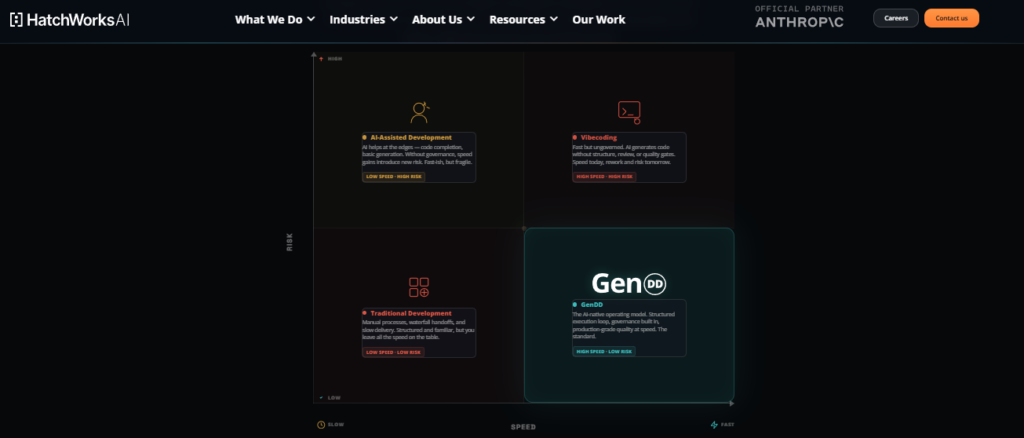
- Refactoring track record: Frames modernization through AI-assisted delivery; incremental approach varies by project.
- AI-assisted tooling depth: Core to positioning; “generative-driven development” is the headline method.
- Legacy-stack depth: Modern stacks and AI; deep mainframe work not the focus.
- Regulated-industry coverage: Healthcare and fintech clients; named-regime depth varies by engagement.
- Engagement and accountability: Nearshore teams with an AI-delivery process layered in.
- Positions “generative-driven development” as a structured delivery method across SaaS and healthcare.
- Nearshore engineering teams with an AI-assisted process.
- A legacy-modernization-specific verified review was not available in my source set.
Diffco AI
- Refactoring track record: Builds new AI-centered systems more than it refactors old cores.
- AI-assisted tooling depth: Strong; machine learning is the product, not an add-on.
- Legacy-stack depth: Modern AI/ML stacks; not a legacy-mainframe specialist.
- Regulated-industry coverage: Startup and SaaS clients; named-regime depth not strongly claimed.
- Engagement and accountability: Partnership-style collaboration cited by clients.
- Custom software development for a real-estate platform, working as a close product partner.
- ML-centered product work for startups and SaaS companies.
- Positioned around AI as the system’s foundation rather than a later integration.
“It feels like a true partnership. Their ability to ask the right questions about a niche industry with complicated products always amazes me.”
Jacob Hokinson, CPO, Gitcha (Real estate) ·
Trigent Software
- Refactoring track record: Strong on incremental, perpetual upgrades; documents and refactors legacy reporting and BI workbooks.
- AI-assisted tooling depth: Growing AI and low/no-code practice; not the core selling point.
- Legacy-stack depth: Deep on enterprise stacks like Tableau-to-Power BI and SAP HANA-to-Datasphere migrations.
- Regulated-industry coverage: Enterprise and manufacturing clients; named-regime depth varies by engagement.
- Engagement and accountability: Embedded teams over multi-year relationships; clients describe them as “part of us.”
- Built and maintains a “mass customization” engine for truck-maker Navistar, handling billions of feature combinations across about 24 upgrades a year.
- Migrated 44 analytics dashboards from Tableau to Power BI for a manufacturer, with only 12 defects reported.
- Engaged for a SAP HANA to SAP Datasphere conversion on the same account.
“I’m most impressed by their unbelievable understanding of our complex requirements. We’ve had other companies look at the requirements of this system, and they told us they couldn’t do it. Trigent continues to do it quite successfully.”
Jim Pirie, Chief Engineer, Navistar International (Automotive) ·
Dualboot Partners
- Refactoring track record: Modernizes while shipping new product in parallel; less a deep-legacy-core rescue specialist.
- AI-assisted tooling depth: Growing AI practice within product delivery; varies by engagement.
- Legacy-stack depth: Modern product and cloud stacks; not a mainframe house.
- Regulated-industry coverage: Fintech and SaaS clients; named-regime depth varies by engagement.
- Engagement and accountability: Embedded product-and-engineering pods that act as an extension of the client team.
- Positioned around embedded product-and-engineering teams for fintech and SaaS scale-ups.
- Build-and-scale model that runs modernization and roadmap delivery in parallel.
- A legacy-modernization-specific verified review was not available in my source set.
SOLTECH
- Refactoring track record: Custom software modernization for SMB and mid-market; incremental approach varies by project.
- AI-assisted tooling depth: Emerging AI practice; not the headline offering.
- Legacy-stack depth: Custom web and mobile stacks; not a mainframe specialist.
- Regulated-industry coverage: Broad industry mix; named-regime depth varies by engagement.
- Engagement and accountability: US-based teams with hands-on, local project management.
- US-based custom software development across SMB and mid-market clients.
- Combines project delivery with staffing for ongoing support.
- A legacy-modernization-specific verified review was not available in my source set.
Q2. What does “legacy platform modernization” mean, and why do most projects stall?
Legacy platform modernization brings an aging production system onto a maintainable, scalable footing through one of four paths, rehosting, replatforming, refactoring, or re-architecting, without breaking what the business runs on today. Most projects stall not on code but on architecture. A firm demos cleanly on a small module, then chokes on a 300,000-line COBOL or .NET core full of undocumented dependencies. The model was never the bottleneck.
The four paths in plain English
Modernization is not one thing. It is a choice between four moves, each with a different cost and risk. Gartner’s widely used framework names seven “Rs,” but four cover most real decisions.
- Rehost: Lift the system and shift it to the cloud as-is. Fastest, cheapest, changes almost nothing inside.
- Replatform: Move it and swap a few components, like a managed database, without rewriting the core.
- Refactor: Clean up and restructure the existing code so it is easier to change, while keeping behavior the same.
- Re-architect: Redesign the system’s structure, often into smaller services. Highest cost, highest risk, biggest payoff.
⚠️ Why the path matters more than the tool
Pick the wrong path and the budget evaporates. I have watched teams re-architect a system that only needed a rehost to hit a data-center lease deadline. The reverse is worse: rehosting a system that needed real refactoring just moves the mess to a more expensive address.
Why pilots stall on the legacy core
The stall is rarely the AI model. It is the integration into a system nobody fully documented. AI adoption is now a top-three reason enterprises modernize at all, per industry analysts. But a model is only as good as the data it can reach, and a legacy core often hides that data behind undocumented dependencies.
Here is the honest version. A vendor shows you a clean demo on a 200-line sample. Then the same tooling meets your real repo, where one function quietly calls a 2008-era service nobody can find the owner of. The demo worked. Production did not.
🔍 The first two questions are not the model
On any modernization or AI-integration call at Teamvoy, the first thing I look at is not the model. It is the data layer and the legacy core. Can the system expose clean, reliable data? Can we change one part without breaking three others? If the answer is no, no model fixes that.
This is also where read-only versus write-access becomes an architecture decision, not a feature toggle. A bot that only reads data is low-risk. A bot with write access to a fragile core can corrupt the very system you are trying to save. We map that risk before touching a model, because the cost of getting it wrong lands in production, not in the demo.
What this means for you on Monday
Before you evaluate any firm or tool, answer two questions yourself. Which of the four paths does your situation actually call for? And is your data layer clean enough for AI to read without making things worse? If you cannot answer those, that gap is your real first project, not the model selection.
Q3. The three axes that actually separate firms: refactoring track record, AI tooling depth, and legacy-stack fit
Three axes separate a firm that ships from one that stalls. Refactoring track record: do they cut over incrementally, or rewrite-first and pray? AI tooling depth: does the tooling run on your full repo, or a clean 200-line sample? Legacy-stack fit: have they actually shipped your COBOL, AS/400, or SAP core? Brand names answer none of these.
3.1 Refactoring track record
The test question is simple. Do they modernize incrementally while the system stays live, or do they stop everything for a big-bang rewrite? The incremental approach has a name engineers use: the Strangler Fig pattern. You build the new system around the old one, route traffic over piece by piece, and retire the old code only once the new path is proven.
⚠️ The deadline trap
There is a hard rule I hold. If you have under 60 days before a forced move, like a data-center lease ending, default to a rehost. Trying to refactor mid-flight under that pressure guarantees broken services. The path has to match the clock, not the ambition.
3.2 AI tooling depth: production vs demoware
The test question: does their AI tooling run against your full, messy codebase, or only a flattering sample? This matters because AI-generated code carries measurable risk. Veracode’s 2025 study tested over 100 models across 80 real-world tasks and found 45% of AI-generated code introduced an OWASP Top 10 security vulnerability.
✅ The three-question pull-request test
Every AI-assisted change at Teamvoy gets reviewed by a senior engineer against three questions. Could existing code have been reused instead? Does it follow our conventions? Can a human explain it without the AI’s comments? If a change fails any one, it does not ship.
I will hedge one claim I have earned the right to make. AI is a genuine force multiplier, but only behind senior review. Without it, you are not moving faster. You are shipping debt faster. The discipline is the same one we apply across our AI development services, where every change is owned by a person who can read it.
Teamvoy is extremely responsive and the team has a deep knowledge of the customer's needs. The care and interest they showed are what makes Teamvoy special.
3.3 Legacy-stack fit
The test question: have they actually shipped your specific stack, or are they learning on your system? Depth here is not optional. A team that has never touched an AS/400 will not spot the hardcoded connection to it buried in your order flow.
🔍 Mapping the stack to the right fit
Different cores call for different strengths. This is a starting map, not a rule.
| Legacy core | Where depth usually sits |
|---|---|
| Mainframe (COBOL, AS/400) | Specialist mainframe migration tooling and engineers with hands-on history |
| .NET Framework | AI-assisted refactoring agents (e.g. GitHub Copilot’s modernization flow) plus senior review |
| SAP or regulated core | A senior boutique that audits dependencies before cutting over |
💸 Vibe coding as a debt factory
Operators feel this on the ground. One put it bluntly:
“AI lets you build 80% of an app in a weekend. The other 20% is the part that keeps you up at night, and it takes six months.”
u/Jolly-Variation8970, r/ExperiencedDevs Reddit Thread
We audit the legacy core for these traps first: a scream test to find what breaks when a service goes quiet, dependency mapping, and incremental cut-over. The brand on the contract answers none of these three axes. The work does.
Q4. Big-4 consultancy vs AI-native boutique: which kind does your situation call for, and what will it cost?
Pick the Big-4 systems integrator for procurement-friendly scale, global headcount, and a board-defensible name, if you can absorb $1M to $3M minimums and junior teams behind the partner. Pick an AI-native boutique for senior engineers who stay on the system and read the code the last team wrote. Either way, costs hide in cloud shock and runaway AI-token bills, not the rate card.
The fork, stated honestly
The choice is rarely about quality of engineers. It is about model. A Big-4 systems integrator gives you scale and a name your board already trusts. Forrester’s 2024 analysis places large integrators like Infosys and Wipro among the leaders for sheer modernization capacity.
⚠️ The mid-market contradiction
Here is the contradiction worth naming. Big systems integrators market themselves as mid-market friendly, yet practitioner reality often means seven-figure minimums and 18-to-36-month timelines. If you are a Series B founder, that math may not fit your runway, no matter how good the deck looks.
Where the real cost hides
The rate card is the part everyone watches. The danger is the part nobody budgets for.
- Cloud shock: The penalty for running elastic cloud infrastructure with a static, data-center mindset. Lift-and-shift without re-architecting can multiply your bill.
- Quadratic token bills: Agentic AI loops can grow token consumption fast. An agent stuck in a retry loop overnight is a real, expensive event.
- “Almost right” code: This is the costliest of all. Almost-right code ships, sits in production for six months, then fails. The cost to fix has compounded the whole time.
💰 Budget for architecture, not just hours
So put your money where the risk is. Budget for the data-layer work and the guardrails, like circuit breakers that stop a runaway agent, not just for build hours. Free AI code is often the most expensive debt you can take on. This is also why cloud cost discipline belongs in the plan from day one, not after the first invoice shock.
Which kind fits which persona
Match the partner to your actual situation, not the brand.
| Your situation | Partner kind that usually fits |
|---|---|
| Burned CTO, inherited a broken system | Boutique focused on accountability and rescue |
| Technical founder with a legacy product | Senior ownership without an authorship hand-off |
| Enterprise IT director, compliance deadline | Partner with named regulated-industry depth |
| Vibe-coded founder hitting limits | Team that stabilizes and reads the existing code |
🔍 Where Teamvoy sits
Teamvoy is the senior-lead, long-engagement boutique kind, built for Burned CTOs and Technical Founders. A senior engineer owns the system, the average engagement runs 4+ years, and we build circuit breakers and complexity routing into autonomous agent work by default. We quote only after a paid audit, because guessing the number before seeing the core is how budgets break. For founders weighing the spend, our technology modernization work is built to modernize incrementally rather than bill for a rewrite.
One contrarian note to close on. AI did not replace the developer. It replaced the delusion that software is easy. The winners I see reinvest in human architects, then point AI at the work behind them.
Q5. How do regulated industries (DORA, PCI-DSS, HIPAA, BaFin) change the modernization decision?
In regulated environments, modernization is an audit trail, not just an engineering decision. DORA, PCI-DSS, HIPAA, and BaFin require every change to be traceable, every migration reversible, and the system continuously available. That rules out big-bang rewrites and rules in incremental, documented cut-overs, led by a partner who stays accountable through go-live, not one who hands off to a junior team and exits before the auditor arrives.
Compliance turns modernization into accountability
In a regulated system, downtime is not an inconvenience. It is a reportable event. DORA (the EU’s Digital Operational Resilience Act) treats operational outages as something you must withstand and explain. PCI-DSS governs card data, HIPAA governs health records, and BaFin oversees German financial firms.
⚠️ What auditable delivery actually means
Auditable delivery is not a deck. It is three concrete things, day to day, on the engineering side.
- Traceability: Every change is logged, attributed, and tied to a reason an auditor can read.
- Reversibility: Every migration can roll back cleanly, so a bad cut-over does not become an outage.
- Continuous availability: The system keeps serving while you modernize it underneath.
These three constraints are why a big-bang rewrite is usually the wrong call here. You cannot take a regulated platform offline for six months and call it modernization. Our banking and fintech work is built around exactly this constraint.
Why bots cannot own a regulated system
Here is a scene I have watched play out. An on-call engineer hits an outage at 2 AM, pastes the error into an AI tool, and the tool says “restart the server.” They restart it six times. Nothing improves.
🔍 Tribal knowledge is not in the model
A senior engineer reads the logs for thirty seconds and sees it: the database connection pool was full. That is tribal knowledge, the kind earned by living inside a system, and no model holds it for your specific platform. In a regulated environment, that judgment is what stands between you and a reportable failure.
What I have learned across regulated delivery is that the dividing line is accountability through go-live. Across the modernization engagements I have led inside fintech, the partners who survive audits are the ones who own the system after launch. At Teamvoy, a senior technical lead stays accountable past go-live, with named regulated coverage across BaFin, PSD2, DORA, SOC 2, PCI-DSS, FCA, NHS Digital, and HIPAA, the same depth we bring to insurance and healthcare platforms.
I have fully relied on Teamvoy’s technical decisions and it worked well. We would not be where we are today without Teamvoy’s support.
What to demand from a partner
If you are an IT director facing a compliance deadline, ask three questions before you sign. Who is personally accountable for the system after go-live? Can they show traceable, reversible delivery on a regulated system? And will the senior engineer in the room actually stay on your account? If those answers wobble, the auditor will find out before you do. A focused IT audit is the cheapest way to surface those answers early.
Q6. How do you de-risk the first 90 days and avoid a 2 AM split-brain disaster?
De-risk before you modernize. Run a 48-to-72-hour scream test to isolate zombie servers and surface hidden batch jobs. Deploy “angry agents” prompted to attack your own theory, so the team and the AI do not agree each other into a fire. Put a hard circuit breaker on every agent loop. Build the integration layer first, because that nervous system is what earns safe write-access to an AS/400 or SAP core.
The first 90 days are for stabilizing, not rebuilding
The biggest mistake I see is modernizing a system you have not stabilized yet. You cannot safely change what you do not understand. So the first phase is diagnosis, not construction.
⏰ Step 1: Run a scream test
Pick a server you suspect is unused and quietly isolate it for 48 to 72 hours. If nobody screams, it was a zombie. If something breaks, you just found a hidden dependency or batch job nobody documented. Either way, you learned the truth cheaply.
⚠️ Step 2: Deploy “angry agents”
When a team and an AI assistant both agree on a fix, that agreement can be a trap. So we run what I call angry agents: an AI prompt told to poke holes in our own theory. Otherwise the human and the tool nod along while the server burns. This discipline is core to how we approach autonomous agent work.
Guardrails before write-access
A read-only integration is low-risk. A system with write-access to a fragile core can corrupt it. So you earn write-access by building guardrails first.
🛑 Step 3: Put a hard circuit breaker on every loop
An autonomous agent stuck in a retry loop can run for hours unsupervised. I know of one that burned roughly $4,200 overnight while the developer slept. A hard circuit breaker, a fixed cap on steps or spend, turns a disaster into a logged stop.
🔧 Step 4: Build the integration layer first
Think of the integration layer as the system’s nervous system. It is the clean, controlled path through which any change reaches the legacy core. We build that layer, with logging and rollback, before granting write-access to an AS/400 or SAP system. That sequence is what prevents a 2 AM split-brain, where two parts of the system disagree about the truth. Robust system integration is the foundation that makes the rest safe.
What this means for you
Stabilization before modernization is Teamvoy’s default sequence, and it is something you can start Monday. Run one scream test this week on a server you are unsure about. The point is not speed. Per DORA’s State of DevOps research, high-performing teams recover from incidents far faster precisely because they invest in this kind of discipline first. Earn the right to write before you write, the same principle behind our incremental modernization approach.
Q7. What separates a partner who survives your legacy core from one who stalls at the demo?
The partner who survives your core treats your data layer and legacy stack as the first two problems, keeps a senior engineer accountable through go-live, and uses AI as a force multiplier behind human review. The one who stalls leads with a model demo and hands off to juniors. Match the kind to your situation: a rescue, a drifting founder-built core, a compliance deadline, or an unstable AI-built MVP.
We have been obsessing over the brain and ignoring the nervous system
The whole category fixates on the model, the “brain.” The standard read gets this backwards. The hard part of modernization was never the brain. It is the nervous system: the integration, the data layer, and the legacy code that carries every signal.
🔍 Why architectural judgment outlasts any tool
A specification, the clear statement of what the system must do, is becoming the durable asset. The code is increasingly dispensable, regenerable by tooling. So the thing that survives your core is not a clever model. It is architectural judgment about what to keep, what to change, and what to never touch.
The numbers raise the stakes. McKinsey found only 16% of large IT modernization efforts finish on time and on budget. A partner who stalls at the demo is how you join the other 84%. The data layer is where that judgment either holds or breaks.
Match the kind to your situation
This is not a ranking. It is recognition. Find yourself below.
| Your situation | The survivor-partner kind |
|---|---|
| You inherited a broken system | One built for rescue and accountability |
| Your founder-built core is drifting | Senior ownership, no authorship hand-off |
| You face a compliance deadline | Named regulated-industry depth, accountable past go-live |
| Your AI-built MVP is unstable | A team that reads and stabilizes existing code |
Teamvoy is one kind of survivor-partner: regulated, senior-led, rescue-not-rewrite. I will be honest about the limit, though. A rewrite is sometimes the right call, and a two-week sprint ships a first milestone, not a finished system.
💬 Where I am sitting with this
AI did not replace the developer. It replaced the delusion that software is easy. The teams I watch win are the ones reinvesting in human architects and pointing AI at the work behind them. If you are staring at a legacy core that is blocking your next move, that is the work we do every day, and the door is open for a conversation about it.