
- The best generative AI implementation service depends on what you are protecting; when models get write-access to production data, judge the integration layer, not the model.
- Around 95% of enterprise GenAI pilots stall because teams tune the model and ignore the data layer, the legacy core, and ownership.
- Production systems run named patterns like RAG, Self-RAG, GraphRAG, and agentic orchestration, mapped to NIST AI RMF functions Govern, Map, Measure, and Manage.
- Consulting-only partners deliver a strategy; build-and-ship partners own code into production, with costs from roughly $50K for a proof-of-concept to $2M+ for a production system.
- Legacy and AI-generated code can be stabilized and modernized incrementally without a rewrite, keeping the business running while the backend changes.
- Choose a partner by your situation, then ask for production references, the integration pattern they ship, and their NIST AI RMF mapping.
Q1. Which Generative AI Implementation Service Fits Your Situation?
The best generative AI implementation service depends on what you are protecting. If non-deterministic models will get write-access to production data, judge the integration layer, not the model. This guide assesses ten kinds of partner on production references, named integration and RAG or agentic patterns, NIST AI RMF posture, regulated-industry depth, and whether they ship or only advise, so you match a partner to your situation, not a ranking.
Introduction
Picking a generative AI partner is not a low-stakes call. The money is already moving: Gartner forecast global GenAI spend of $644 billion in 2025, up 76.4% in a year. Yet MIT found 95% of enterprise GenAI pilots returned no measurable P&L impact, and only 5% reached production at scale. The gap is rarely the model. It is the data layer, the legacy core, and who owns the system at 2 a.m. This guide judges each kind of partner on production references, named integration patterns (RAG, agentic), NIST AI RMF posture, regulated-industry depth, and whether they ship or only advise. It is written for the CTO, founder, IT director, or senior engineer choosing a partner they will live with.
Our Evaluation Criteria
I sat inside this work for twelve-plus years at Teamvoy, across 150-plus delivered projects. The first thing I check on any AI integration call is not the model. It is the data layer and the legacy core. These six criteria reflect that.
- Ship or advise: Does the partner deliver production code, or stop at strategy decks? A pilot that never ships is the 95% failure case.
- Data layer and legacy core depth: Can they assess your data quality and your existing stack before recommending a model? This is where pilots stall.
- Named integration patterns: Do they name how they build (RAG, fine-tuning, agentic workflows), or speak in vague “AI capabilities”?
- NIST AI RMF posture: Can they map the 12 GenAI risk categories in NIST AI 600-1 to Govern, Map, Measure, and Manage?
- Regulated-industry depth: Do they hold real experience with HIPAA, SOC 2, PCI-DSS, GDPR, or finance regulators (SEC, FINRA, BaFin)?
- Engagement length and ownership: Does a senior lead own the system long-term, or do junior staff cycle through?
Who This Guide Is For
- CTOs and IT directors whose first GenAI pilot stalled and who now need a partner that ships into production, not another proof of concept.
- Technical founders sitting on a legacy core, wondering where AI pays back and where it adds risk faster than value.
- Senior engineers in regulated environments (health, finance, insurance) who must give a model write-access to real data without tripping a compliance event.
The Ten Kinds of Partner at a Glance
No rankings here. Each firm exists for a different situation.
- Teamvoy: Best for regulated systems and AI integration on a stack already under pressure, where the data layer and legacy core are the first questions.
- HatchWorks AI: Best for teams wanting a generative-AI-driven “GenDD” delivery model with nearshore engineering.
- Azumo: Best for nearshore AI and data engineering teams augmenting an existing roadmap.
- Diffco AI: Best for early-stage product teams needing applied ML and AI features built fast.
- Dualboot Partners: Best for scale-ups embedding AI into existing software with co-build teams.
- Valere: Best for founders wanting product strategy plus AI build under one roof.
- NineTwoThree AI Studio: Best for venture-backed teams shipping AI MVPs and agentic features.
- SOLTECH: Best for Southeast US mid-market firms wanting custom software with AI add-ons.
- Vention: Best for larger orgs needing scaled, vetted engineering pods with AI capability.
- DOOR3: Best for enterprises pairing UX-heavy product design with AI integration.
Master Comparison Table
| Company Name | Best For | Engagement Model | Industry Depth & Compliance Coverage |
|---|---|---|---|
| Teamvoy | Regulated systems and AI integration on a legacy stack under pressure, with an existing team | Long-term partner (4+ year average) | Banking, insurance, healthcare, fintech; works with HIPAA, GDPR, SOC 2, PCI-DSS, SEC, FINRA contexts |
| HatchWorks AI | Teams wanting a GenAI-driven delivery model with nearshore squads | Long-term partner / staff augmentation | Healthcare, fintech, SaaS; SOC 2, HIPAA contexts claimed |
| Azumo | Augmenting an existing AI or data roadmap nearshore | Staff augmentation / project | Cross-industry; compliance varies by engagement |
| Diffco AI | Early-stage applied ML and AI feature builds | Project-and-exit / build | Healthcare, fintech, retail; compliance varies |
| Dualboot Partners | Scale-ups embedding AI into live software via co-build | Long-term partner / co-build | Fintech, insurance, healthcare; SOC 2, HIPAA contexts |
| Valere | Product strategy plus AI build under one roof | Project / long-term partner | Fintech, media, retail; compliance varies |
| NineTwoThree AI Studio | Venture-backed AI MVPs and agentic features | Project / studio build | Healthcare, fintech, logistics; HIPAA contexts claimed |
| SOLTECH | Southeast US mid-market custom software with AI add-ons | Project-and-exit / long-term | Healthcare, logistics, finance; HIPAA, SOC 2 contexts |
| Vention | Scaled vetted engineering pods with AI capability | Staff augmentation / pods | Fintech, healthcare, retail; SOC 2, HIPAA, GDPR contexts |
| DOOR3 | Enterprise UX-heavy product design plus AI integration | Project / long-term partner | Finance, healthcare, enterprise; compliance varies |
Detailed Provider Cards
Teamvoy as the partner for a regulated system or AI on a stack already under pressure, the open door is a 3-to-5-day audit that surfaces your data-layer and legacy-core risks with an action plan, or a 30-minute technical call through our contact page. The audit names the risk; it is not a full implementation.
Teamvoy
- Ship or advise: Ships production code; full-cycle delivery, not strategy decks.
- Data layer and legacy core depth: First questions on any AI call, before the model.
- Named integration patterns: Agentic AI used across delivery; RAG and integration work.
- NIST AI RMF posture: Risk-aware delivery aligned to regulated-industry controls.
- Regulated-industry depth: Banking, insurance, healthcare, fintech experience.
- Engagement and ownership: Senior lead owns the system; 4+ year average.
- AI integration plus legacy modernization for a video streaming platform, with agentic AI across delivery (Takflix, ongoing since Jan 2025).
- Four-year technical partnership building a 24/7 cryptocurrency and trading platform (Bitspark).
- Two-year build of a private blockchain product from PoC to scale (Iress).
“Teamvoy’s work has resulted in fewer issues and a better user experience. We’re impressed with their involvement in processes and quick completion of work.”
Manager, VOD Streaming Service (AI Integration & Legacy Modernization) · Clutch verified review
“We have been with Teamvoy for 4 years and found a great partner for the growth of Bitspark. Their technical expertise was top class.”
CEO, FinTech Company (Hong Kong) · Clutch verified review

HatchWorks AI
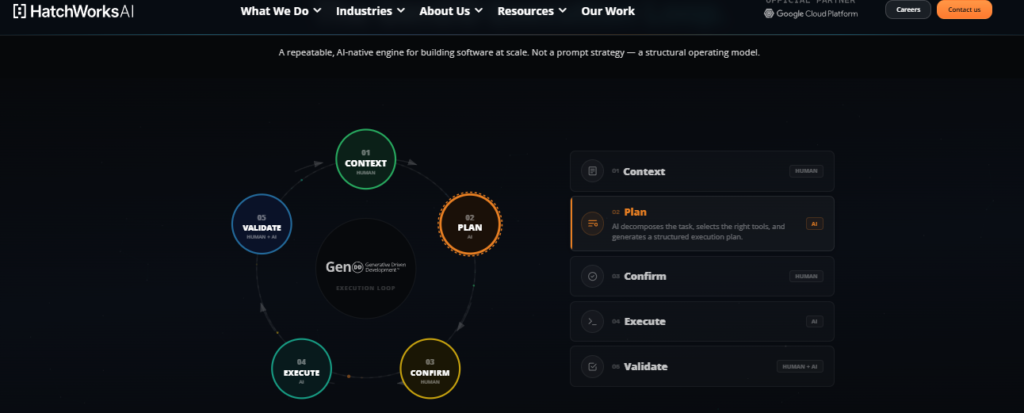
- Ship or advise: Ships; positions a generative-driven development delivery model.
- Data layer and legacy core depth: Build-focused; depth varies by engagement.
- Named integration patterns: GenAI and agentic features within product builds.
- NIST AI RMF posture: Not publicly mapped to NIST AI 600-1.
- Regulated-industry depth: Healthcare and fintech work claimed; SOC 2 contexts.
- Engagement and ownership: Squad-based; nearshore continuity.
- Publishes GenAI delivery case studies on its own site.
- Nearshore engineering pods across US time zones.
- Specific named-client AI metrics: verify on their site.
Azumo
- Ship or advise: Ships via embedded engineers on your roadmap.
- Data layer and legacy core depth: Data engineering is a core service line.
- Named integration patterns: ML, NLP, and data pipeline work.
- NIST AI RMF posture: Not publicly mapped to NIST AI 600-1.
- Regulated-industry depth: Cross-industry; compliance varies by engagement.
- Engagement and ownership: Augmentation; you own the system.
- Published AI and data engineering case studies.
- Nearshore delivery across US time zones.
- Named-client specifics: verify on their site.
Diffco AI
- Ship or advise: Ships AI features and prototypes quickly.
- Data layer and legacy core depth: Build-focused; less suited to heavy legacy.
- Named integration patterns: ML models, computer vision, AI feature work.
- NIST AI RMF posture: Not publicly mapped to NIST AI 600-1.
- Regulated-industry depth: Healthcare and fintech work; compliance varies.
- Engagement and ownership: Project-based; senior ownership varies.
- Published applied-AI case studies on its own site.
- Computer vision and ML project portfolio.
- Named-client metrics: verify on their site.
Dualboot Partners
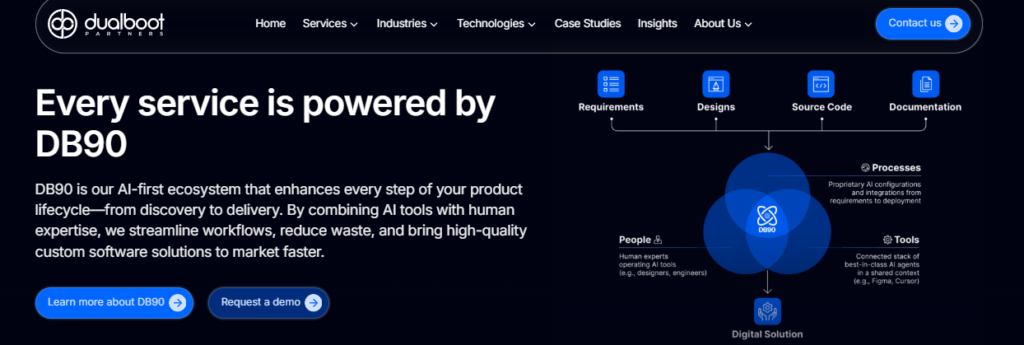
- Ship or advise: Ships via co-build teams alongside your engineers.
- Data layer and legacy core depth: Works inside live software; depth varies.
- Named integration patterns: AI embedded into existing product workflows.
- NIST AI RMF posture: Not publicly mapped to NIST AI 600-1.
- Regulated-industry depth: Fintech, insurance, healthcare work; SOC 2 contexts.
- Engagement and ownership: Shared ownership in a co-build model.
- Published scale-up case studies on its own site.
- Co-build engagements with in-house teams.
- Named-client metrics: verify on their site.
Valere
- Ship or advise: Both; pairs product strategy with AI build.
- Data layer and legacy core depth: Product-led; legacy depth varies.
- Named integration patterns: AI features within new product builds.
- NIST AI RMF posture: Not publicly mapped to NIST AI 600-1.
- Regulated-industry depth: Fintech, media, retail; compliance varies.
- Engagement and ownership: Project and longer-term options.
- Published product and AI case studies on its own site.
- Strategy-plus-build engagement portfolio.
- Named-client metrics: verify on their site.
NineTwoThree AI Studio
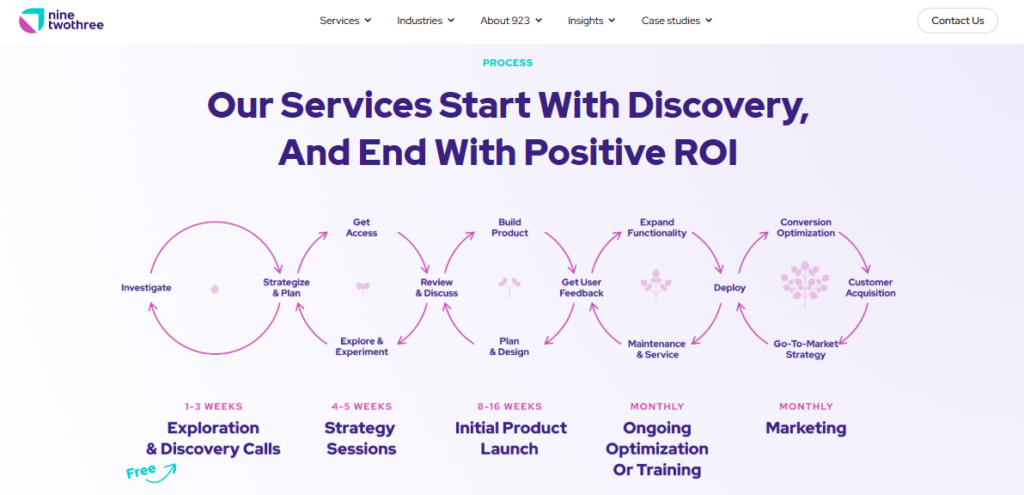
- Ship or advise: Ships AI MVPs and agentic features.
- Data layer and legacy core depth: MVP-focused; less legacy-heavy.
- Named integration patterns: Agentic workflows, RAG, AI features.
- NIST AI RMF posture: Not publicly mapped to NIST AI 600-1.
- Regulated-industry depth: Healthcare, fintech, logistics; HIPAA contexts.
- Engagement and ownership: Studio model; senior involvement varies.
- Published AI MVP case studies on its own site.
- Agentic and RAG project portfolio.
- Named-client metrics: verify on their site.
SOLTECH
- Ship or advise: Ships custom software with AI add-ons.
- Data layer and legacy core depth: Custom-software depth; AI is additive.
- Named integration patterns: AI features layered onto custom builds.
- NIST AI RMF posture: Not publicly mapped to NIST AI 600-1.
- Regulated-industry depth: Healthcare, logistics, finance; HIPAA, SOC 2 contexts.
- Engagement and ownership: Project and longer-term partner options.
- Long US operating history with published case studies.
- Mid-market custom software portfolio.
- Named-client AI metrics: verify on their site.
Vention
- Ship or advise: Ships via vetted engineering pods at scale.
- Data layer and legacy core depth: Capacity is the strength; depth varies by pod.
- Named integration patterns: AI and ML capability across pods.
- NIST AI RMF posture: Not publicly mapped to NIST AI 600-1.
- Regulated-industry depth: Fintech, healthcare, retail; SOC 2, HIPAA, GDPR contexts.
- Engagement and ownership: Augmentation; you retain system ownership.
- Large engineer network and published case studies.
- Pods across fintech, healthcare, and retail.
- Named-client AI metrics: verify on their site.
DOOR3
- Ship or advise: Ships; pairs UX design with engineering and AI.
- Data layer and legacy core depth: Enterprise integration experience; depth varies.
- Named integration patterns: AI integrated into enterprise product workflows.
- NIST AI RMF posture: Not publicly mapped to NIST AI 600-1.
- Regulated-industry depth: Finance, healthcare, enterprise; compliance varies.
- Engagement and ownership: Project and longer-term partner options.
- Long enterprise consulting history with published case studies.
- Design-led enterprise product portfolio.
- Named-client AI metrics: verify on their site.
Q2. Why Do 95% of Enterprise GenAI Pilots Stall, and What Are the Risks of Write-Access in Production?
Pilots stall because teams tune the model and ignore the integration layer, the “nervous system” that feeds clean data and executes actions safely. Write-access then turns a helpful agent into a liability: a runaway retry loop can burn thousands in API spend overnight, and a single prompt-injection can exfiltrate a secret in minutes. The bottleneck is not inference cost. It is integration without guardrails.
⚠️ The demo-to-production cliff
A demo runs on clean, hand-picked data. Production does not. That gap is why MIT found 95% of enterprise GenAI pilots returned no measurable P&L impact.
Most teams obsess over the model. The standard read gets this backwards. The model is the kernel; the integration layer is the operating system around it.
🔌 The integration layer is the real bottleneck
Even a top model is useless when it gets bad data or cannot execute actions reliably. RAG (retrieval-augmented generation, feeding the model your own data) only helps if that data is clean. The first thing I look at on an AI integration call is not the model. It is the data layer and the legacy core.
When we pick up a stalled pilot, the failure is rarely the prompt. It is a brittle pipeline feeding the model stale or wrong records. Fix the nervous system, and the same model suddenly looks smart.
💸 What write-access actually risks
Giving an agent write-access (the right to change data or trigger actions) is where pilots turn into incidents. The named failure modes are concrete, not hypothetical.
- Runaway cost: An agent stuck in an infinite retry loop can run for hours unattended and burn thousands in API spend before anyone wakes up.
- Data theft: Prompt injection (hidden instructions inside input) is the top agentic risk. One arXiv study cut attack success from 73.2% to 8.7% only after layering defenses.
- Quadratic cost growth: Token spend can grow with the square of context length, not linearly, so “just add more context” gets expensive fast.
NIST’s GenAI Profile (AI 600-1) names exactly these risks, including confabulation, data privacy, and misuse. None of them are model-quality problems. They are integration and control problems.
✅ Turn each risk into a procurement question
You do not need fear to act. You need three questions for any partner, including us at Teamvoy.
- Where is the circuit breaker that stops a runaway agent, and who set the spend cap?
- Who owns the audit trail when the agent writes to production data?
- What gets human approval before the agent executes a sensitive action?
In our engagements, we start with the data layer and the legacy core before we discuss a model. The circuit breaker is built before write-access is ever granted. A clean answer to those three questions tells you more than any model benchmark. If your pilot is stuck here, our AI development services begin at exactly this layer.
The pattern behind these answers has a name, and that is what the next section covers.
Q3. What Integration Patterns and NIST AI RMF Posture Separate Production Systems from Demos?
Production GenAI runs on named patterns: RAG and its variants Self-RAG, Corrective RAG, Adaptive RAG, and GraphRAG, plus agentic orchestration with bounded tool calls. Governance runs on NIST’s AI RMF, the four functions Govern, Map, Measure, and Manage, with the 2024 GenAI Profile naming risks like confabulation and data leakage. A credible partner shows which pattern they ship and where their delivery maps to each function. Eligibility does not equal compliance.
🧩 The named patterns that actually ship
A demo says “we use AI.” A production system names its pattern. At Teamvoy, we judge partners, and ourselves, on which specific pattern they run and why. Our AI agent development services name the pattern before the model.
| Pattern | What it solves | When to use | Production caveat |
|---|---|---|---|
| Self-RAG | Model rewrites the query and checks its own retrieval | Adaptive Q&A on messy queries | Extra model calls add latency |
| Corrective RAG (CRAG) | Filters or rejects weak retrieved chunks | When wrong context is costly | Needs a tuned relevance scorer |
| Adaptive RAG | Routes simple vs complex queries differently | Mixed query difficulty | Routing logic adds complexity |
| GraphRAG | Retrieves over a knowledge graph, not flat text | Connected, relational data | Graph build and upkeep is real work |
| Agentic orchestration | Bounded tool calls with control flow | Multi-step actions | Untrusted output must not call tools directly |
⚠️ Architecture and the “dumb zone”
These patterns stack into a layered architecture: retrieve, rank, generate, verify. Latency adds up at each layer, so caching and tight chunking matter. Strong data engineering is what keeps each layer fast.
One field detail is worth knowing. Past roughly the 40% context-fill mark, many models get less accurate, not more. More context is not free; it can make the system dumber.
📋 NIST AI RMF as a procurement lens
NIST AI RMF 1.0 organizes risk into four functions: Govern, Map, Measure, and Manage. The 2024 GenAI Profile maps GenAI-specific risks onto them. Each function becomes a vendor question.
| NIST function | What it covers | Question to ask a partner |
|---|---|---|
| Govern | Policies, roles, accountability | Who owns AI risk decisions on this system? |
| Map | Context, intended use, limits | What use cases are explicitly out of scope? |
| Measure | Testing, evals, monitoring | How do you measure quality on real data? |
| Manage | Treatment, incident response, rollback | What is the rollback plan when it fails? |
✅ Eligibility does not equal compliance
Worth flagging a contested point honestly: some researchers argue voluntary frameworks like AI RMF can become “compliance theater” without teeth. I do not fully resolve that here; it is a real debate.
What I am confident of, from delivering into BaFin, DORA, PCI-DSS, and HIPAA contexts, is this. Eligibility does not equal compliance. At Teamvoy, we check whether the chosen pattern survives the legacy core, and whether the Manage function (audit trails, rollback, human-in-the-loop) is a delivery requirement, not a feature you bolt on later. For regulated stacks, this is where our banking and fintech experience matters most.
Q4. How Do You Move a GenAI Pilot to Production Without It Breaking on Your Real Data?
Moving to production is a phased path, not a flip: scope a narrow use case, prove it on real (not sample) data, add evals and guardrails, then harden for scale and hand over with support. The step that kills pilots is skipping evaluation and post-go-live ownership. Ask any partner who maintains the system after launch, and what their definition of “done” includes beyond a working demo.
⏰ Five phases, not one flip
A pilot that works in a sandbox is not a production system. The jump breaks when teams treat go-live as a switch instead of a sequence.
- Scope a narrow use case. Pick one workflow with a measurable outcome. Expected result: a clear yes or no on value.
- Prove it on real data. Run it on your messy production data, not a clean sample. Expected result: you see where it actually fails.
- Add evals and guardrails. Build tests for quality and limits on what the agent can do. Expected result: failures get caught before users do.
- Harden for scale. Fix latency, cost, and edge cases under real load. Expected result: it survives a busy day, not just a demo.
- Hand over with support. Document it and keep maintaining it. Expected result: it still works in six months.
A focused proof of concept is how we de-risk phases one and two before committing to scale.
🔍 Why evaluation is the make-or-break gate
The phase most teams skip is evaluation. Automation works when you can specify the objective and verify the output against it. No verification, no safe automation.
Evals (automated tests that score AI output) are how you know the system is right, not just confident. Skip them, and you are shipping on vibes. That is the quiet reason pilots die on real data.
🧠 The memory problem and handover
There is a second trap: handover. A model has no memory of your system between sessions, a bit like the character in Memento who cannot form new memories.
So the knowledge has to live in documentation and code, not in someone’s head. At Teamvoy, our definition of “done” is a system that keeps working after we hand it over, documented, with evals and rollback in place. A clean handover is also where careful technology modernization pays off. A 2-week Sharp Sprint ships a meaningful first milestone here, not a finished product.
✅ The one question that filters partners
Before you sign, ask one thing: who maintains this after launch? An advisor who exits at go-live leaves you owning code you did not write.
This is where our work shows, not a deck. The proof is whether the system survives, which is the kind of feedback that surfaces in client reviews.
“Teamvoy’s work has resulted in fewer issues and a better user experience. We’re impressed with their involvement in processes and quick completion of work.”
Manager, VOD Streaming Service (AI Integration & Legacy Modernization) Teamvoy Clutch Verified Review
If you want a phased path on your own stack, the open door is a 3-to-5-day IT audit that surfaces your data-layer risks and a go-live action plan, or a 30-minute technical call through our contact page. The audit names the risk; it is not a full implementation.
Q5. Consulting or Build-and-Ship: Which Model Do You Need, and What Should It Cost?
Consulting-only partners deliver a strategy; build-and-ship partners own the code into production and stay accountable. Choose by your bottleneck: advice if you do not know where to start, delivery if the pilot will not survive your legacy core. Engagements run roughly $50K for a proof-of-concept to $2M+ for production, always custom-quoted. The budget leaks are runtime, like quadratic token billing and cloud shock, not the build.
🔀 Two models, two different jobs
These are not the same purchase. One sells you a plan; the other owns the outcome.
| Dimension | Consulting-only | Build-and-ship |
|---|---|---|
| Deliverable | Strategy, roadmap, advice | Working code in production |
| Accountability | Ends at the report | Stays through go-live |
| Who maintains it | You do | The partner can |
| Choose when | You lack direction | The pilot must survive your stack |
I will say the unpopular part plainly. Consulting-only is the right call when you genuinely do not know where to start. If the problem is execution on a fragile core, advice alone leaves you stuck, which is where our AI development services begin.
💰 Where the budget actually leaks
The build is rarely what blows the budget. The runtime does. Two leaks show up again and again.
- Quadratic token billing. Token cost can grow with the square of context length. “Just add more context” gets expensive fast.
- Cloud shock. Running elastic AI infrastructure with a static data-center mindset carries a real cost penalty.
A simple discipline helps: right-size compute before you scale, not after. Cut excess capacity first, then replicate. At Teamvoy, we quote custom and cap runtime cost before go-live, because the leak is rarely the build, and disciplined cloud optimization is where that control starts.
💸 What it costs, honestly
Pricing is custom across every serious partner, so a fixed price list misleads. The honest ranges look like this.
- Proof-of-concept: roughly $50K.
- Production system: $2M+, depending on scale and compliance.
A note on market data. Gartner forecast $644 billion in GenAI spend for 2025, yet failure rates stay high. Big spend does not mean safe spend. The number to watch is your runtime bill, not the market’s headline, which is why our IT cost optimization work targets the bill, not the demo.
⚖️ Build only when it makes sense
A blunt rule from the field: build in-house only if you have a dedicated platform team and your core is genuinely unique. Otherwise you become “Chief Integration Officer” forever, maintaining glue code nobody else can read. Clean system integration is the alternative to that trap.
“Azumo puts a premium on quality. They value honest communication, and they care about their clients’ products.”
Managing Director, Financial Services Company Azumo Clutch Verified Review
What I am sitting with is this: the partners who cap runtime cost upfront earn more trust than the ones quoting the lowest build. If you want a runtime-cost read on your own stack, a focused proof of concept is the place to start that conversation.
Q6. Can a Partner Stabilize AI-Generated or Legacy Code and Modernize It Without a Rewrite?
Yes. The right partner stabilizes first and modernizes incrementally instead of rewriting. AI debt hides as “almost right” code: studies report AI pull requests carry more issues than human ones, and suppressed linter errors slip through review. One approach keeps an identical user interface while rebuilding the backend and normalizing tables one at a time. Rescue beats rewrite when the business cannot stop.
⚠️ Why “almost right” is the expensive kind
The most dangerous AI code is not broken. It runs, it looks fine, and it is subtly wrong. Almost right is more expensive than completely wrong, because nobody catches it until production does.
AI-generated debt has a signature. Watch for code that suppresses its own warnings, like a file stuffed with linter-disable comments hiding eleven real errors. Free AI code is the most expensive debt you can take on, a risk we cover in depth on vibe coding security risks.
✅ A three-question review gate
Before any AI-written pull request merges, run it through three questions. This is a gate you can use this week.
- Can the author explain every line, including why, not just what?
- Are any errors or warnings suppressed instead of fixed?
- Does it write to the right data, or just produce the right-looking screen?
That third question matters most. A reported “60% of vibe-coded apps” carried security flaws, often because the screen looked correct while the data layer did not. Solid data engineering is what closes that gap.
🔧 Rescue, not rewrite, in practice
When we pick up a system the previous team built, we do not start by deleting it. We stabilize first, then modernize behind a stable surface, the approach behind our technology modernization work.
One pattern works well, sometimes called the strangler fig. You keep the exact same user interface, identical buttons and colors, while quietly rewriting the backend underneath. You normalize the messy database one table at a time, so the business never stops. We unpack this in detail in our guide on updating systems nobody understands.
AI helps here, but it needs a steady hand. Think of it as night-vision goggles: a real force multiplier, but you still need the discipline to aim it. That discipline is the whole job.
🧭 This work fits four kinds of reader
Rescue-not-rewrite is core Teamvoy territory. It usually fits one of four situations: a burned CTO inheriting a system, a technical founder stuck on a legacy core, a vibe-coded founder whose AI MVP broke in production, or an enterprise IT director under a compliance deadline. A rewrite is sometimes still the right call when the core cannot be saved; I will say so when it is. For regulated stacks, our banking and fintech experience shapes how we sequence the work.
Q7. How Do You Choose the Right Generative AI Implementation Partner for Your Situation?
Start from your situation, not a ranking. Burned CTOs need evidence and accountability; technical founders need modernization without a rewrite; enterprise IT directors need auditable, regulated delivery; vibe-coded founders need stabilization first. Across all four, ask the same three questions: can they show production references, which integration pattern do they ship, and where does their delivery map to NIST AI RMF? The right partner answers all three plainly.
🧭 Match the partner to your situation
There is no universal best. There is only the right fit for where you are standing.
| Your situation | What to prioritize | The one question that matters most |
|---|---|---|
| Burned CTO inheriting a system | Evidence, accountability, ownership | Who owns this after go-live? |
| Technical founder on a legacy core | Modernization without a rewrite | Can you change it without stopping the business? |
| Enterprise IT director, regulated | Auditable delivery, NIST posture | Where does delivery map to Govern, Map, Measure, and Manage? |
| Vibe-coded founder, broken MVP | Stabilization first, then features | Can you read and document code you did not write? |
✅ The three questions that cut through
Across all four situations, the same three questions separate a real partner from a good demo. Ask them out loud.
- Can you show production references, not just slides?
- Which integration pattern do you actually ship?
- Where does your delivery map to NIST AI RMF?
The integration layer is the nervous system; the model is just one organ. A partner who gets that will answer all three without flinching, which is exactly the posture behind our AI integration services.
Where I land is simple. The most expensive code your AI writes is the code that almost works, and the right partner is the one who reads it, owns it, and keeps it running. At Teamvoy, if your system already carries weight and you need it to keep working while it changes, that is the work we do. Tell us what broke through our contact page, or start with a focused IT audit that surfaces the risk and an action plan.