TL;DR
- The best AI implementation partner is the one whose delivery model fits your situation, not the loudest brand or the longest client logo wall.
- Most enterprise AI pilots stall on integration, not the model. ISG found only 31% of use cases reached production in 2025.
- A real production track record survives a 2 a.m. batch job. Demoware passes a sales meeting. Ask for incident history, not a highlight reel.
- Costs spiral at the integration layer through unmonitored agent loops and quadratic token billing, not at the model itself.
- In regulated industries, audit and a senior who owns the system through go-live are delivery requirements, never paperwork.
- Match the archetype to your need: consultancy for scale, boutique for hard systems, staff-augmentation for capacity you already lead.
Q1. 10 Best AI Implementation Partners for Enterprises in 2026 (Criteria, Who This Guide Is For, and the Field Map)
The best AI implementation partner in 2026 is the one whose delivery model matches your situation, not the loudest brand. Most enterprise pilots stall on integration, the layer that lets non-deterministic, agentic models touch production safely, not on model choice. This guide assesses ten partners on AI delivery model, integration and data-layer depth, regulated-industry track record, engagement length, and proof of production work over demoware.
🧭 Why I wrote this as a field note, not a ranking
I have spent twelve years at Teamvoy delivering into banking, insurance, healthcare, manufacturing, and complex SaaS, and the pattern repeats. A partner ships a demo that wows the board, then the project dies in the gap between the model and the production system. I started as an engineer, not a salesperson, so I read this market the way I read a codebase: where does it break under load. This is a map of which kind of partner fits which situation, not a league table telling you who to call.
Our Evaluation Criteria
I picked criteria that actually change the buying decision for AI work on a real, running system. I left out anything that looks good on a slide but tells you nothing.
- AI delivery model: Does the partner only advise, or do they build and ship to production? Consulting-only firms hand you a strategy; you still need someone to write the code. This is the difference between AI consulting and full AI development services.
- Integration and data-layer depth: Can they wire a model into your data and tools safely, with monitoring and limits? This is the “nervous system” most pilots never build, and it is the heart of AI integration services.
- Regulated-industry track record: Have they delivered under named rules like SOC 2, PCI-DSS, HIPAA, GDPR, or DORA? Audit is a delivery requirement, not paperwork.
- Engagement length: Do they stay, or do they exit before go-live? AI on a critical system needs an owner past launch day.
- Senior technical lead ownership: Does one accountable senior own the system, or do junior engineers cycle through? This decides who answers at 2 a.m.
- Proof of production over demoware: Can they show a deployed system under real load, not a staged demo? A demo passes a meeting; production survives a batch job.
Who This Guide Is For
I wrote this for three readers I meet often, usually after a hard year.
- The Burned CTO who inherited a system a previous vendor walked away from, and cannot risk a second wrong pick. For them, updating systems nobody understands is the daily reality.
- The Enterprise IT Director inside a regulated environment, working against a compliance deadline like DORA, PCI-DSS, or HIPAA, who needs banking and fintech delivery done to audit.
- The Technical Founder sitting on a legacy core that is hard to change, who wants AI added without a disruptive rewrite, through technology modernization rather than a teardown.
The Field Map: Which Partner Fits Which Situation
No numbers, no stars. Each firm exists for a different situation, so I describe the situation, not a rank.
- Teamvoy: Best for regulated systems and legacy cores where AI must be integrated on a stack already under pressure, with a senior lead who stays.
- HatchWorks AI: Best for generative-AI and RAG assistants built with a structured, sprint-based delivery model and clear handover docs.
- SF AI Labs: Best for turning advanced AI concepts into working production tools when the data structures are unusual.
- Imaginovation: Best for full custom software builds where AI sits inside a larger product and UX matters.
- Achievion Solutions: Best for AI proof-of-concept and MVP work, validating use cases before a full build.
- Azumo: Best for nearshore AI and data engineering capacity added to an existing engineering team.
- Valere: Best for product-led AI builds that need design, engineering, and a go-to-market view together.
- Vention: Best for scaling a vetted engineering bench fast when you already own technical leadership.
- Dualboot Partners: Best for co-building AI products alongside an in-house team over a longer runway.
- NineTwoThree AI Studio: Best for AI-enabled MVPs and ventures that need fast validation with senior product input.
Master Comparison Table
| Company Name | Best For | Engagement Model | Industry Depth & Compliance Coverage |
|---|---|---|---|
| Teamvoy | Regulated systems and legacy cores needing AI on a stack under pressure | Long-term partner (4+ year average) | Banking, insurance, healthcare, complex SaaS; SOC 2, PCI-DSS, HIPAA, GDPR, PSD2, DORA in scope |
| HatchWorks AI | GenAI and RAG assistants with structured sprint delivery | Project and ongoing development | IoT, drone, advertising tech; compliance coverage not publicly claimed |
| SF AI Labs | Advanced AI concepts turned into production tools | Project-based, with post-implementation support | Consulting, real estate, SaaS data; on-prem options for employee-data security needs |
| Imaginovation | Full custom builds with AI inside a larger product | Project and long-term build | Healthcare, recruitment tech, retail; HIPAA-adjacent healthcare work, not formally claimed |
| Achievion Solutions | AI proof-of-concept and MVP validation | Project-based (POC to MVP) | Design, health data, education; compliance not publicly claimed |
| Azumo | Nearshore AI and data engineering capacity | Staff augmentation and project | SaaS, media, finance-adjacent; compliance varies by engagement |
| Valere | Product-led AI builds with design and GTM | Project and product partnership | Fintech, media, enterprise SaaS; compliance varies by engagement |
| Vention | Scaling a vetted engineering bench fast | Staff augmentation / dedicated teams | Fintech, healthcare, retail; HIPAA and SOC 2 experience, varies by team |
| Dualboot Partners | Co-building AI products with an in-house team | Long-term product partner | Fintech, insurance, enterprise SaaS; SOC 2-aware delivery, varies by engagement |
| NineTwoThree AI Studio | AI-enabled MVPs and venture validation | Project-based studio model | Healthcare, fintech, logistics; compliance varies by engagement |
Detailed Provider Cards
The cards below use the same criteria, in the same order, for every firm. Where something is not publicly verifiable, I say so plainly rather than guess. The data-layer and the legacy core are the first two questions I ask on any AI call, not the model, so that is the lens here. For regulated builds, that lens connects directly to building regulator-ready AI in fintech.
Teamvoy
- AI delivery model: Build-and-ship on running systems, agentic AI used in delivery, not advice only.
- Integration and data-layer depth: Data layer and legacy core assessed first, before any model choice.
- Regulated-industry track record: Banking, insurance, healthcare work; SOC 2, PCI-DSS, HIPAA, GDPR, PSD2 in scope.
- Engagement length: 4+ year average; built for partnership, not project-and-exit.
- Senior technical lead ownership: A senior engineer owns the system end to end, AI-native team behind.
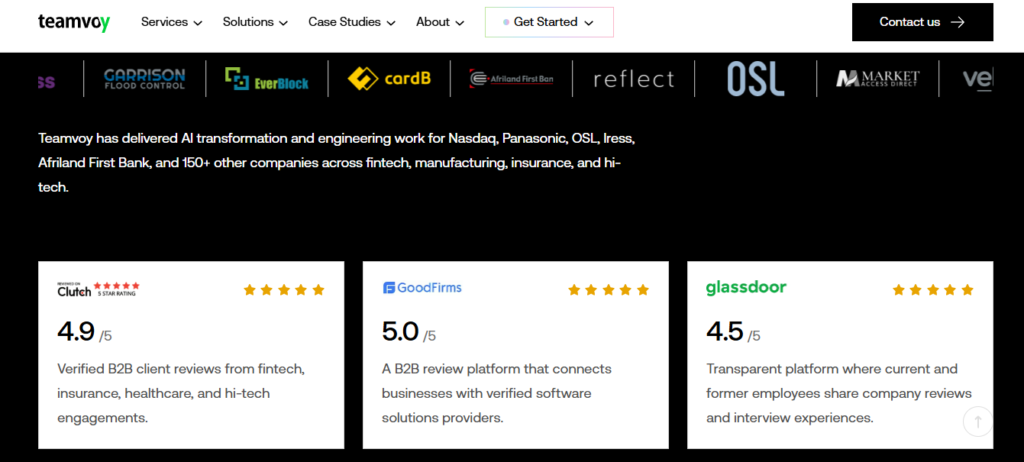
- Proof of production over demoware: Named work for Nasdaq, OSL, Panasonic Avionics, Market Access Direct.
- AI integration and legacy modernization for a streaming platform, with continuous post-release support (Takflix, ongoing since 2025).
- Four-year build of a 24/7 cryptocurrency trading platform handling real money (Bitspark).
- Blockchain proof-of-concept to scaled product, sustained across an acquisition (Iress).
“Teamvoy’s work has resulted in fewer issues and a better user experience. We’re impressed with their involvement in processes and quick completion of work.”
Manager, VOD Streaming Service Teamvoy Clutch Verified Review
“I can confidently say that we would not be where we are today without Teamvoy’s support. I highly recommend Teamvoy to anyone looking for a knowledgeable and reliable partner.”
Managing Director, Iress (Financial Services) Teamvoy Clutch Verified Review

HatchWorks AI
- AI delivery model: Build-and-ship, with GenAI and RAG assistants taken to production.
- Integration and data-layer depth: Builds data pipelines and warehouses; integrates LLMs into a chat layer.
- Regulated-industry track record: Not publicly claimed; visible work is IoT, drone, and advertising tech.
- Engagement length: Typically fixed-scope sprints (a 16-week MVP is documented), not multi-year by default.
- Senior technical lead ownership: Strong project-management lead per client reviews; senior continuity varies.
- Proof of production over demoware: A documented production-ready MVP querying air-traffic data in natural language.
- RAG chat assistant for an IoT company answering user questions at over 90% accuracy.
- Production-ready MVP on GCP processing ADS-B air-traffic data via natural-language queries.
“Project management was great. They kept us well informed on progress, ensured that the handover documentation was detailed to replicate work if needed, and all items were delivered on time and on budget.”
Director of Data, Analytics & AI, IoT Company HatchWorks AI Clutch Verified Review
SF AI Labs
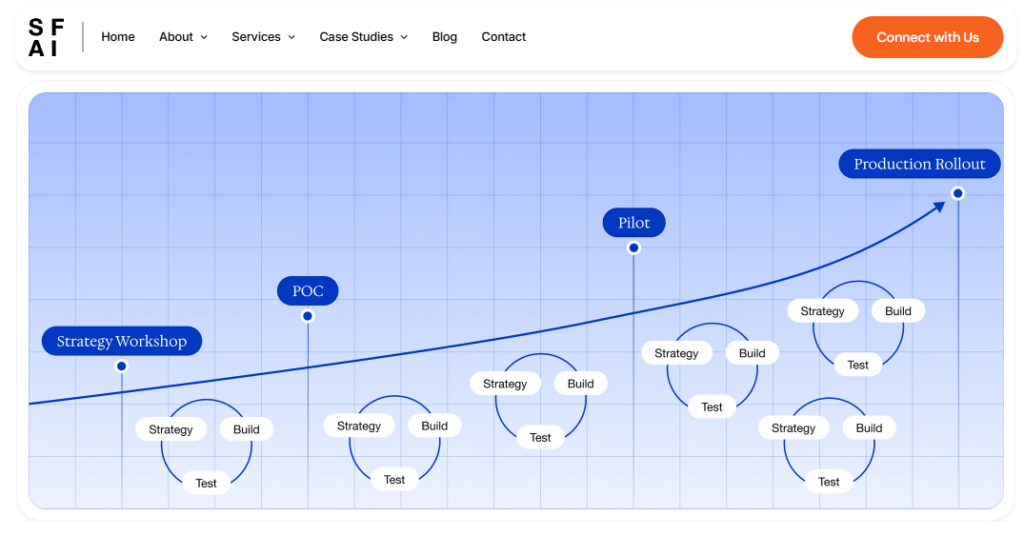
- AI delivery model: Build-and-ship, from a strategy session through to a deployed tool.
- Integration and data-layer depth: Builds data pipelines, annotation workflows, and on-prem options for sensitive data.
- Regulated-industry track record: Handles employee-data security needs via on-prem builds; formal certifications not publicly claimed.
- Engagement length: Project-based with offered post-implementation support; long-term default not stated.
- Senior technical lead ownership: Founders Dirk and Arthur work directly with clients, a real continuity signal.
- Proof of production over demoware: Chatbots and lead-scoring models reported in real-world operation, low rework.
- AI chatbot for a consulting firm’s reporting dashboard, with an on-prem OpenAI build for employee-data security.
- AI lead-scoring and sourcing solution with a secure, scalable data pipeline and production models.
“What stood out most was SFAI’s depth in advanced AI. They clearly knew how to design, build, and deploy complex AI systems in a practical way, and they were able to turn sophisticated models and workflows into tools that actually worked in real-world operations.”
VP of Consulting, OrgVitality SF AI Labs Clutch Verified Review
Imaginovation
- AI delivery model: Build-and-ship, with AI sitting inside a larger custom product.
- Integration and data-layer depth: Handles complex third-party API integration and database structure design.
- Regulated-industry track record: Healthcare and recruitment-tech work; formal compliance certifications not publicly claimed.
- Engagement length: Project-based, with reviewers describing long, partner-like relationships.
- Senior technical lead ownership: Reviewers describe a team that operates like an extension of their own.
- Proof of production over demoware: Healthcare and recruitment platforms delivered on time, full UI/UX and database.
- Full software solution for a healthcare company, including UI/UX and database structure.
- Recruitment platform and app built around a candidate-centric model.
“We’ve worked with several developers/partners to complete large and complex website builds. Imaginovation was the best partner we’ve had. They do not lose sight of the big picture, and they maintain a mentality to problem solve and find a solution.”
COO & Product Manager, Everflex Health Imaginovation Clutch Verified Review
Achievion Solutions
- AI delivery model: Build-and-ship for early-stage validation, POC through MVP.
- Integration and data-layer depth: Builds data-science algorithms and AI UI/UX; deep-integration scope is lighter.
- Regulated-industry track record: Health-data and education work; formal compliance not publicly claimed.
- Engagement length: Project-based, sometimes spanning restarts; not built around multi-year ownership.
- Senior technical lead ownership: CEO stays close to clients; reviewers note PM consistency can vary.
- Proof of production over demoware: MVPs validated with real users, including a 150-user beta.
- AI platform POC and MVP for a design company, beta-tested with over 150 users.
- Health-data application MVP, beta, and website delivered against agreed tasks.
“We felt that Achievion Solutions listened well to our needs and was supportive and collaborative during this process. They had some room for improvement in their QA process.”
Director of Research & Data Science, Education Nonprofit Achievion Solutions Clutch Verified Review
Azumo
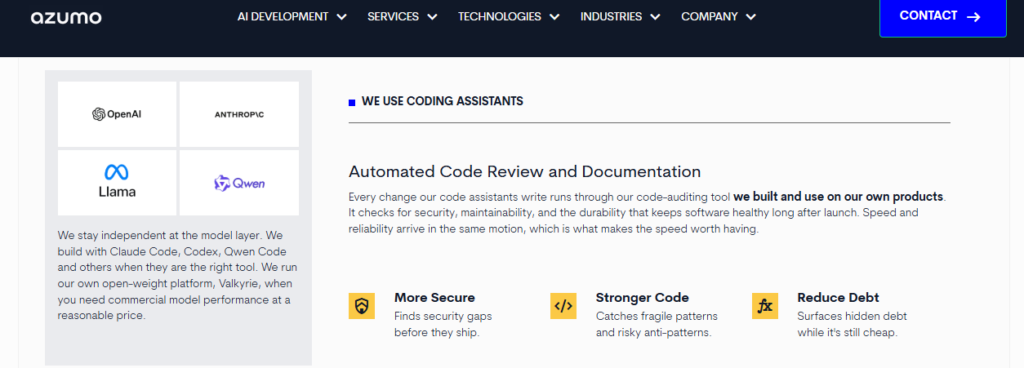
- AI delivery model: Build-and-ship capacity, often plugged into an existing engineering team.
- Integration and data-layer depth: Data engineering is a core strength; depth scales with the team you book.
- Regulated-industry track record: Varies by engagement; not positioned as a named-compliance specialist.
- Engagement length: Flexible, from staff augmentation to longer project work.
- Senior technical lead ownership: Depends on the team composition you contract.
- Proof of production over demoware: Established nearshore delivery across SaaS and media clients.
- Nearshore AI and data-engineering delivery for SaaS and media products.
- Team augmentation models aligned to US working hours.
Valere
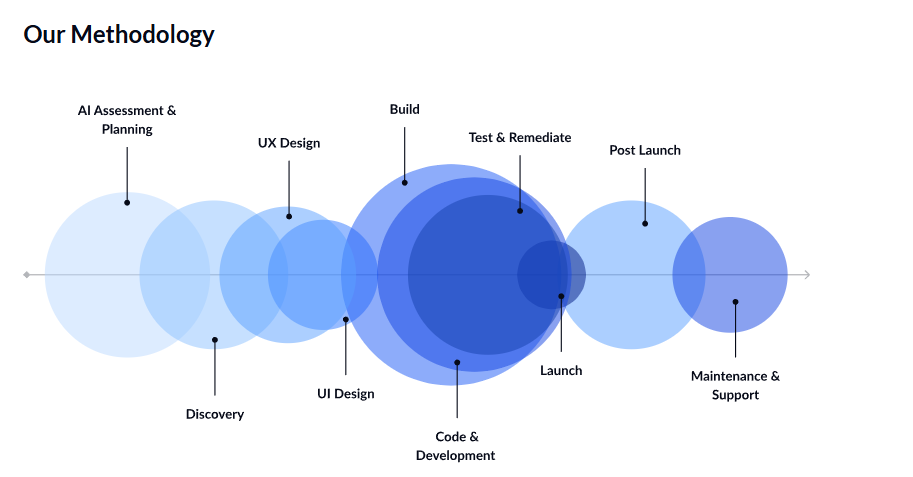
- AI delivery model: Build-and-ship, with a product and go-to-market lens around the engineering.
- Integration and data-layer depth: Covers full-stack builds; depth varies by engagement.
- Regulated-industry track record: Fintech and enterprise SaaS exposure; named-compliance depth varies.
- Engagement length: Project and product-partnership models.
- Senior technical lead ownership: Product-led teams; confirm senior continuity per engagement.
- Proof of production over demoware: Launched AI-enabled products across fintech and media.
- AI-enabled product builds spanning design, engineering, and launch.
- Fintech and media product work.
Vention
- AI delivery model: Build-and-ship capacity via dedicated, vetted engineering teams.
- Integration and data-layer depth: Capable across stacks; depth scales with the team you contract.
- Regulated-industry track record: Fintech and healthcare experience; HIPAA and SOC 2 exposure varies by team.
- Engagement length: Flexible, from short augmentation to longer dedicated teams.
- Senior technical lead ownership: You typically retain leadership; Vention supplies the bench.
- Proof of production over demoware: Large vetted talent pool with broad delivery history.
- Dedicated teams across fintech, healthcare, and retail products.
- Fast ramp of vetted engineers onto existing roadmaps.
Dualboot Partners
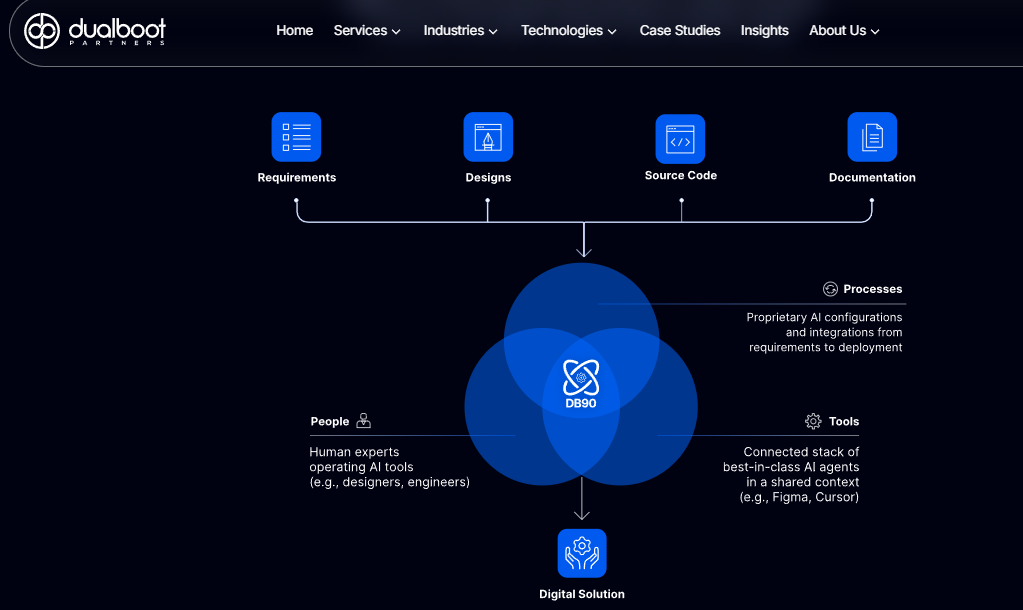
- AI delivery model: Build-and-ship, co-developing with your in-house team rather than replacing it.
- Integration and data-layer depth: Full-product builds; depth scales with the engagement.
- Regulated-industry track record: Fintech and insurance exposure; SOC 2-aware delivery varies by engagement.
- Engagement length: Built for longer product partnerships.
- Senior technical lead ownership: Shared ownership model with your team.
- Proof of production over demoware: Co-built products across regulated-adjacent sectors.
- Co-built AI and software products in fintech and insurance.
- Longer-runway partnerships with client engineering teams.
NineTwoThree AI Studio
- AI delivery model: Build-and-ship for AI-enabled MVPs and new ventures.
- Integration and data-layer depth: Solid for new builds; legacy-core depth is not the focus.
- Regulated-industry track record: Healthcare, fintech, and logistics exposure; compliance depth varies.
- Engagement length: Project-based studio engagements.
- Senior technical lead ownership: Senior product input is part of the studio model.
- Proof of production over demoware: Shipped AI-enabled MVPs across multiple sectors.
- AI-enabled MVPs across healthcare, fintech, and logistics.
- Fast validation cycles for new ventures.
📌 How to read this map
Notice what the strong reviews have in common: a clear owner, detailed handover, and a team that learned the data before building. Those are the signals that separate a partner who ships from one who demos. The rest of this guide unpacks each criterion so you can test it yourself, starting with why so many pilots stall before they ever reach production. If your blocker is a legacy core, our take on AI modernization sprints covers the delivery model in depth.
A quick word of honesty before you go further. Every firm here is real and capable in its lane, and I left some review slots open rather than invent quotes I could not verify. Match the lane to your situation, not the logo to your fear, and you will avoid the second wrong pick. When you want to pressure-test a shortlist against your own stack, our team is happy to talk it through, and you can see how this plays out in our case studies.
Q2. Why do most enterprise AI pilots stall before they reach production?
Most enterprise AI pilots stall because the model was never the hard part. The hard part is integration: giving an agentic, non-deterministic system reliable, monitored write-access to production data and tools. Without that nervous system, a pilot stays a read-only wiki bot. ISG found only 31% of use cases reached production in 2025, and the gap is almost always the layer between the model and the business.
🧠 Most people think the bottleneck is the model. It isn’t.
The standard read gets this backwards. Teams pick a model, build a demo, and feel done. Then the demo meets a real workflow and nothing happens, because it can read but cannot safely act.
I call that the read-mode trap. A pilot that only answers questions is a wiki bot, not an agent. The moment you ask it to write to a system, the safety and integration work begins. This is exactly where our AI integration services start.
⚠️ The dollar-zero pilot
The numbers back the trap. MIT’s NANDA “GenAI Divide” report found that about 95% of generative AI pilots delivered no measurable profit-and-loss impact in 2025, across 300 projects. That is a P&L finding, not proof the technology cannot work, and it is worth reading carefully before quoting.
ISG’s 2025 study is the more useful signal for builders. It found 31% of studied use cases reached full production, double the 2024 figure. Progress is real, but most use cases still sit in experimentation, stuck in read mode because no one trusts them with write-access yet. If your blocker is a brittle legacy core, our view on updating systems nobody understands covers the recovery plan.
🔧 Integration is the nervous system
We have spent years obsessing over the brain (the model) and ignoring the nervous system (integration). A strong model fed bad data, or unable to execute an action reliably, is useless in production. It is not glamorous work, but it is what separates a demo from a system that ships. Solid data engineering is the precondition, not an afterthought.
Think of night-vision goggles. Hand them to someone who has never held a weapon, and you have created risk, not capability. AI is the same: power without the surrounding system to aim it safely is a liability.
✅ What this means for you Monday
When we take on an AI engagement at Teamvoy, the model is the last question, not the first. The first two are the data layer and the legacy core, because that is where pilots live or die. That is the heart of our AI consulting approach.
So demand proof a partner ships write-access systems, not slide decks. Ask to see one agent that writes to production, with monitoring and limits, running today.
Q3. What separates a real production track record from impressive demoware?
A production track record means systems running under real load, with real users, after the launch team left, not a staged demo. The tell is whether a partner can show a deployed system handling write-access safely, with monitoring, rollback, and circuit breakers. Demoware passes a sales meeting; production survives a batch job at 2 a.m. Ask for the incident history, not the highlight reel.
🎭 The demo is the easy 80%
A demo shows the happy path. It runs once, on clean data, with the founder driving. Production is the other 80%: edge cases, bad input, retries, and the 2 a.m. batch job no one is watching.
Here is the contrast I keep coming back to. Demoware is built to be seen. A production system is built to be left alone and still work. Getting there is the job of full AI development services, not a prototype.
🏠 The kitchen-remodel audit gap
Think of a kitchen remodel. The inspector approves it Monday. By Wednesday, a contractor adds a new gas line that was never inspected. The system that passed review is no longer the system people actually use.
Software works the same way. The app that passed code review is rarely the app running in production a month later. That gap is where “almost right” code quietly rots, and it is why an honest IT audit looks at the running system, not the repo.
⚠️ Almost right is more expensive than completely wrong
Code that is completely wrong fails loudly and gets fixed fast. Code that is almost right passes review, ships, and sits in your codebase for six months before anyone notices. The cost to fix compounds the whole time.
This matters more in the AI-tooling era. CodeRabbit’s December 2025 study of 470 pull requests found AI-generated PRs averaged 10.83 issues each, against 6.45 for human-written code, roughly 1.7 times more. More code ships faster, and more of it is subtly wrong. We see this directly in our technology modernization work.
🔍 Three questions to ask about a named system
Most of our work at Teamvoy starts where demoware ended: we take over and stabilize systems a previous team built, so we see the gap directly. When a partner names a production system, I ask three things.
- What broke after launch, and how did you find out? (Tests their monitoring and honesty.)
- Who supported it once the build team rolled off? (Tests ownership versus project-and-exit.)
- Show me rollback and circuit breakers in that system. (Tests whether write-access was made safe.)
Trust is built through results, not presentations. A partner who can answer those three has a track record. One who only has a highlight reel has demoware. Our case studies are where we show the work, not the deck.
Q4. How should you evaluate integration depth, and where do AI costs actually spiral?
Evaluate integration by how a partner gives a model safe write-access: how it wires to your data and tools, where circuit breakers sit, and how token cost is capped. Costs spiral here, not at the model. Unmonitored agent loops and quadratic billing turn budgets into surprises. Probe build-versus-buy (building makes you Chief Integration Officer forever) and the lethal trifecta: sensitive-data access, untrusted input, and an external communication channel.
💸 The $4,200 nap
An agent in an infinite retry loop is the cheapest expensive lesson you will ever learn. One team left an agent running against a CRM overnight. It hit an error, retried, and looped for six hours with no hard circuit breaker. The morning bill was about $4,200.
A circuit breaker is a hard stop: a rule that kills the process after N retries or M dollars. If a partner cannot show you theirs, the budget is not yours to control. Capping that risk is part of our IT cost optimization practice.
📈 The quadratic billing bomb
Token cost (the per-word charge for AI input and output) does not grow in a straight line. In a multi-step agent loop, each step can re-read the whole prior context. So a 20-step loop is far pricier than 10 steps, not double.
There is also a quality cost. Past roughly 40% of a model’s context window, accuracy drops into a “dumb zone.” Context compaction (trimming what the model re-reads each step) controls both the bill and the errors. This is core to sound AI agent development.
⚠️ The lethal trifecta
Security researcher Simon Willison named the combination that turns an integration into a breach. Three ingredients together are the danger:
- Access to sensitive data (it can read your private records).
- Exposure to untrusted input (it reads content an attacker controls).
- An external communication channel (it can send data out).
Any two are survivable. All three in one agent means a malicious input can read your data and exfiltrate it. I check for this trifecta before I check the model. In regulated settings, that discipline connects directly to building regulator-ready AI in fintech.
🏗️ Build-versus-buy, honestly
Building your own integration platform makes you Chief Integration Officer forever. You own every API change, every breakage, every upgrade. I only recommend building when you have a dedicated platform team and a genuinely unique core. Otherwise, free AI code is the most expensive debt you can take on, the kind we unpack in the tech debt avalanche.
✅ The integration and cost-control checklist
Integration on stacks already under pressure is core Teamvoy territory, so this is the checklist I actually run, data layer first.
- Circuit breakers on every agent loop, with hard retry and spend caps.
- Token caps and context compaction, budgeted and monitored from day one.
- Write-access scoped, logged, and reversible (rollback that works).
- The lethal trifecta broken by design, not by hope.
Budget for monitoring up front. It is the line item that decides whether AI adds leverage or adds risk.
Q5. What does real post-launch support look like, and why do most engagements end too early?
Real post-launch support means the people who built the system stay long enough to own its failures: monitoring drift, capping token spend, and carrying the tribal knowledge no runbook captures. Most engagements end too early because consultants hand off to a junior team and exit before go-live. The test: will the senior who designed it still be reachable when a connection pool fills at 2 a.m.?
⏰ The 2 a.m. 503
Picture the on-call engineer at 2 a.m. The site is throwing 503 errors, which means the server is refusing requests. They ask the AI assistant what to do.
It says “restart the server.” They restart it. Twenty minutes later, the errors return, and the AI says “restart the server” again. This is the support gap our AI integration services are built to close.
🧠 The tribal-knowledge gap
The AI is stuck because it has no memory of your system. It is like the character in Memento, stepping into the same moment over and over, asking “what am I doing here?”
A senior who built the system reads the logs for thirty seconds and knows the truth. A nightly batch job filled the database connection pool, and restarting only resets the clock. That is tribal knowledge, and no AI and no junior on their first week has it. Keeping that knowledge in-house is the point of technology modernization done right.
✅ What an accountable support model covers
Here is what I got wrong early in my career: I treated launch as the finish line. It is the start of the part that actually matters.
Real post-launch support, the model we run at Teamvoy, covers a short list that decides whether a system survives.
- Monitoring for drift, so quality and cost are watched, not assumed.
- Hard caps on token spend, so no overnight loop becomes a surprise bill.
- A senior who designed the system staying reachable, not a junior team inheriting it cold.
We work on engagements other vendors decline, including production outages and vendor rescues, because someone has to own the 2 a.m. call. Our average engagement runs past four years for exactly this reason, as our case studies show.
“Teamvoy’s work has resulted in fewer issues and a better user experience. We’re impressed with their involvement in processes and quick completion of work.”
Manager, VOD Streaming Service Teamvoy Clutch Verified Review
“I can confidently say that we would not be where we are today without Teamvoy’s support. They helped us bring the product to scale, and our collaboration continued even after the company was acquired.”
Managing Director, Iress (Financial Services) Teamvoy Clutch Verified Review
Q6. Which AI implementation partner fits regulated industries like fintech, banking, and healthcare?
In regulated industries, the right partner treats audit and accountability as delivery requirements, not paperwork. That means demonstrable practice against DORA, PCI-DSS, SOC 2, HIPAA, GDPR, the EU AI Act, and NIST AI RMF, plus a senior lead who owns the system through audit cadences. A partner who hands off to a junior team before go-live is a compliance risk, not just a delivery one.
⚠️ The deadline behind the deadline
An IT Director in a bank does not have a launch date. They have an audit date. The two are not the same, and missing the second one is a regulatory event.
So the first question is not “can you build it.” It is “can you prove how it was built, to an auditor, six months from now.” AI write-access makes this harder, because a non-deterministic system has to be logged and explainable. This is the core of our banking and fintech delivery.
📋 Named standards mapped to delivery
The standards are not interchangeable, and a real partner can map each to a delivery practice. This is the scope I work within, summarized in the table below.
| Standard | What it governs | What it demands from delivery |
|---|---|---|
| DORA | Operational resilience in EU finance | Tested failover, incident reporting, and third-party risk control |
| PCI-DSS | Cardholder data | Scoped access, encryption, and audit logging |
| HIPAA | US health data | Access controls, audit trails, and breach handling |
| GDPR | EU personal data | Lawful basis, data minimization, and the right to erasure |
| EU AI Act | AI risk tiers | Risk classification, documentation, and human oversight |
| NIST AI RMF | AI governance | Map, measure, manage, and govern AI risk |
The EU AI Act and NIST AI RMF mapping is where many AI shops go quiet. Naming a model is easy; documenting how it is governed under a risk tier is the actual regulated work, which is why we wrote about building regulator-ready AI in fintech.
🔧 Change without downtime
Regulated change happens on a live system, under strict audit cadences. I think of the supermarket-UI trick: the front end looks identical to users while, behind it, you write to new tables and normalize the data one at a time.
That is zero-downtime modernization, and it is core Teamvoy territory across insurance, healthcare, and banking. The honest limit: this care takes longer than a model demo suggests, and a clean data layer is the precondition. Where that data layer does not exist yet, building it is the first invoice, not the model, and sound data engineering comes first.
The regulated-buyer checklist is short: demonstrable practice against your named standards, audit logging on all AI write-access, a risk-tier mapping under the EU AI Act, and a senior who stays through the audit, not just the build.
Q7. Which kind of partner does your situation call for, and what should you ask before signing?
Pick a global consultancy for scale and board cover if you can absorb junior-heavy delivery. Pick a boutique engineering firm when the system is hard and you need a senior who reads your code and stays. Pick fractional or staff-augmentation when you have leadership and just need capacity. The wrong match, not the wrong brand, burns most CTOs twice. Before signing, demand a supported production system, named circuit breakers, and code your team can explain.
🧭 Match the archetype to your situation
I am neutral on firms and opinionated on categories. Three archetypes cover most of the market.
- Global consultancy. Best when you need scale and board-level cover, and can absorb junior-heavy delivery with senior oversight thin on the ground.
- Boutique engineering firm. Best when the system is hard, the stakes are high, and you need a senior who reads your code and stays. This is the Teamvoy archetype, rescue-not-rewrite, for the Burned CTO and the Vibe-Coded Founder.
- Fractional or staff-augmentation. Best when you already own technical leadership and just need reliable hands, such as when you hire AI engineers to extend your team.
💸 The vibe-coded trap
A founder once told me proudly that the MVP was “vibe-coded” overnight with an AI tool. It shipped. Six months later, no one on the team could explain it, and it could not be safely changed, exactly the pattern we cover in vibe coding security risks.
The fix is not less AI. It is engineering rigor moved earlier: the specification becomes the product, and the rigor that used to apply after the code now applies before it, in the specs. That discipline runs through our AI development services.
✅ The Monday-morning vetting checklist
Ask these before you sign. The red flag is hesitation on any of them.
- Show me one production system you still support today. (No supported system is the biggest tell.)
- Who owns it at 2 a.m., by name? (A role, not a person, means hand-off-and-exit.)
- Show me your circuit breakers and token caps. (Blank looks mean uncapped budgets.)
- Can my team explain this code without the AI’s comments? (If not, it is unmaintainable.)
- How do you handle write-access safely? (Tests the lethal-trifecta awareness.)
- What happens when your senior lead rolls off? (Tests continuity.)
One heuristic I rely on: deploy an “angry agent,” a reviewer whose only job is to poke holes. Otherwise, the human and the agent just agree with each other while the server burns. This is the kind of judgment our AI consulting brings to a build.
Where my view sits right now is simple. The brand on the invoice matters far less than whether one senior will own your system through its worst night. If that is the conversation you want to have, with no sales process attached, the door is open, so talk it through with us whenever you are ready.