TL;DR
- Data platform modernization moves a legacy estate onto Snowflake, Databricks, or Fabric while the business keeps running and the data becomes AI-ready.
- Most AI pilots stall at the integration layer, not the model; roughly 95% of enterprise GenAI pilots delivered no measurable return.
- Judge partners on modernization approach, certification depth, governance ownership, regulated track record, and accountability after go-live, not on logos.
- Certifications like SnowPro, Databricks Professional, and DP-700 signal competence but never guarantee governance readiness; eligibility does not equal compliance.
- Hot storage at petabyte scale can pass 100,000 dollars a month, so cost ceilings and human-in-the-loop write gates belong in scope before go-live.
- The right partner fits your specific situation: a burned CTO, a legacy-core founder, a regulated IT director, or a vibe-coded founder.
Q1. How Do You Choose a Data Platform Modernization Partner Without Repeating the Last Mistake?
Choosing a data platform modernization partner is a high-stakes, multi-year decision, and the wrong call rarely shows up on day one. It surfaces later as a stalled pilot, a six-figure cloud bill, or a regulated-system outage. Judge partners on modernization approach, certification depth, governance ownership, regulated-industry track record, engagement length, and accountability after go-live, not on logos.
Why this choice carries so much weight
A few years back, a Head of Data pinged me at midnight. Their Snowflake migration was “done,” but a nightly job had silently double-loaded a fact table for three weeks. Nobody caught it. The dashboards looked fine. The numbers were wrong.
That is the real risk in this work. The failure is quiet, and it compounds.
The macro picture backs this up. Roughly 95% of enterprise generative-AI pilots have failed to deliver measurable return, according to an MIT report widely covered in 2025. The platform is rarely the reason. The integration layer underneath it usually is.
💡 What I look at first
Across the modernization work I have led inside fintech and insurance, the first thing I check on a call is not the model, and not even the platform. It is the data layer and the legacy core. Get those two wrong and every clever thing you build on top inherits the mess.
Our Evaluation Criteria
I picked five criteria that actually move this decision. Each one maps to a way these engagements go wrong.
- Modernization approach (incremental vs. rewrite): Can the partner modernize while the business keeps running, or do they default to a risky big-bang rewrite?
- Platform certification depth: Does the team hold current SnowPro, Databricks, or Microsoft Fabric (DP-700) credentials, and do those certified people stay on your engagement?
- Governance architecture ownership: Who owns lineage, access control, and auditability on Unity Catalog, Snowflake Horizon, or Microsoft Purview?
- Regulated-industry track record: Has the partner delivered under named regimes like PCI-DSS, SOC 2, HIPAA, GDPR, or DORA, where downtime is a regulatory event?
- Engagement length and accountability: Does a senior lead own the system after go-live, or does the team exit before the hard part?
⚠️ One honest trade-off
Incremental modernization is usually the safer path, but not always. When a core is too entangled to isolate, a rewrite is the right call. A good partner tells you which situation you are in before the contract, not after. This is exactly the judgment our IT audit services are built to surface early.
Who This Guide Is For
This guide is written for three readers in particular.
- A Burned CTO who inherited a half-migrated data platform from a vendor who left, and needs to stabilize it without another bad bet.
- A technical founder sitting on a legacy data core that worked at small scale but now blocks every AI feature on the roadmap.
- An enterprise IT director in a regulated environment facing a modernization mandate or a compliance deadline like DORA, with no room for handoff-and-exit consultants.
The Partners At A Glance
Each partner below fits a different situation. There is no ranking here. The right one depends on your data estate, your team, and your regulatory exposure.
- Teamvoy: Best for regulated platforms modernized incrementally by a senior-led team that stays accountable after go-live.
- HatchWorks AI: Best for teams that want a Generative-AI and RAG layer built on top of a structured data warehouse.
- NineTwoThree AI Studio: Best for first-time AI/ML builders who need help structuring historical data before modeling.
- SF AI Labs: Best for complex, production-grade AI systems where data structures are unusual or domain-specific.
- Azumo: Best for nearshore data engineering and AI augmentation on a flexible, fast-onboarding team.
- DOOR3: Best for enterprise data platform and UX work where internal stakeholders are many and the domain is complex.
- Vention: Best for venture-backed and mid-market teams scaling a data platform with on-demand engineering capacity.
- Dualboot Partners: Best for companies modernizing alongside an existing internal team rather than handing off.
- Imaginovation: Best for custom data-driven product builds where design and database structure are tightly coupled.
- JetRockets: Best for mid-market firms building a bespoke data-backed platform with long-term support in mind.
Master Comparison Table
| Company | Best For | Engagement Model | Industry Depth & Compliance Coverage |
|---|---|---|---|
| Teamvoy | Regulated platforms modernized incrementally with senior ownership | Long-term partner (4+ year average) | Fintech, insurance, healthcare; PCI-DSS, SOC 2, HIPAA, GDPR, DORA, PSD2 in scope |
| HatchWorks AI | GenAI and RAG built on a structured warehouse | Project and staff augmentation | IoT, advertising, drone/aviation data; compliance not publicly emphasized (verified Clutch) |
| NineTwoThree AI Studio | First-time AI/ML with messy historical data | Project (concept to MVP) | Automotive, security, consumer apps; compliance varies by engagement (verified Clutch) |
| SF AI Labs | Production-grade complex AI systems | Project (milestone-based) | SaaS, consulting, real estate; compliance not publicly claimed (verified Clutch) |
| Azumo | Nearshore data engineering and AI augmentation | Staff augmentation / nearshore | SaaS, media, enterprise data; SOC 2 commonly referenced (verify per engagement) |
| DOOR3 | Enterprise data platforms with heavy UX needs | Project and long-term partner | Enterprise, financial services; compliance varies by engagement |
| Vention | Scaling data platforms with on-demand capacity | Staff augmentation | Venture-backed, fintech, healthcare; SOC 2, HIPAA referenced (verify per engagement) |
| Dualboot Partners | Modernizing alongside an internal team | Long-term partner / co-build | SaaS, fintech, enterprise; compliance varies by engagement |
| Imaginovation | Custom data-driven product builds | Project and ongoing | Healthcare, recruitment, e-commerce; compliance varies by engagement (verified Clutch) |
| JetRockets | Bespoke data-backed platforms with long-term support | Long-term partner | Healthcare staffing, fintech, SaaS; compliance varies by engagement (verified Clutch) |
Teamvoy
- Modernization approach: Incremental, rescue-not-rewrite while the system stays live.
- Certification depth: Senior leads own the platform; certified engineers stay on the engagement.
- Governance ownership: Auditable delivery treated as a deliverable, not a toggle.
- Regulated track record: Fintech, insurance, healthcare; PCI-DSS, SOC 2, HIPAA, GDPR, DORA, PSD2.
- Accountability: Senior technical lead owns the system after go-live, 4+ year average.
- Modernized a legacy stack and integrated AI for the Takflix streaming platform, with fewer issues and continuous post-release support.
- Four-year technical partnership with fintech Bitspark across exchanges, wallets, and 24/7 trading systems.
- Named work referenced with Nasdaq and Market Access Direct in regulated environments.
“Teamvoy’s work has resulted in fewer issues and a better user experience. They deliver on time. We’re impressed with their involvement in processes and quick completion of work.”
Manager, Takflix (AI Integration & Legacy Modernization) · Teamvoy Clutch – Dmytro Maryanych Verified Review
“We have been with Teamvoy for 4 years and found a great partner for the growth of Bitspark. Their technical expertise was top class.”
CEO, Bitspark (FinTech) · Teamvoy Clutch – George Harrap Verified Review
HatchWorks AI
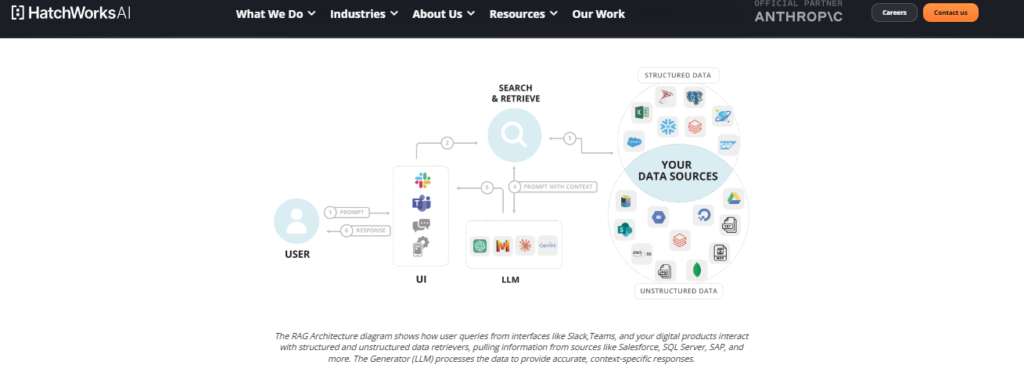
- Modernization approach: Builds AI and RAG layers on top of structured data warehouses.
- Certification depth: Not publicly claimed for Snowflake, Databricks, or Fabric.
- Governance ownership: Strong handover documentation; deep governance not the focus.
- Regulated track record: IoT, advertising, aviation data; compliance not emphasized.
- Accountability: Structured agile delivery with clear sprints and demos.
- Built a chat assistant for an IoT company reaching over 90% response accuracy.
- Delivered a production-ready airspace data MVP ingesting ADS-B air traffic data into a warehouse.
NineTwoThree AI Studio
- Modernization approach: Helps clients structure historical data before modeling.
- Certification depth: Not publicly claimed for the major platforms.
- Governance ownership: Pragmatic; recommends lower-risk rollouts over full replacement.
- Regulated track record: Automotive, security, consumer; compliance varies.
- Accountability: Met timelines, escalated blockers early, explained AI/ML clearly.
- Built a repair-order scoring model reaching 75-80% accuracy from a small dataset.
- Delivered a custom mobile app and prototype rated over 4 of 5 in app reviews.
SF AI Labs
- Modernization approach: Designs and deploys complex AI on existing data structures.
- Certification depth: Not publicly claimed for the major platforms.
- Governance ownership: Focused on practical model deployment over governance frameworks.
- Regulated track record: SaaS, consulting, real estate; compliance not claimed.
- Accountability: Clear milestones, regular check-ins, delivered ahead of timelines.
- Built a client-facing chatbot adopted by a Fortune 500 organization.
- Delivered complex AI systems for a SaaS data-management platform on time.
Azumo
- Modernization approach: Adds data-engineering and AI capacity to an existing team.
- Certification depth: Verify platform certifications per engagement.
- Governance ownership: Typically follows the client’s governance model.
- Regulated track record: SaaS, media, enterprise; SOC 2 commonly referenced.
- Accountability: Augmentation model, so ownership stays largely with the client.
- Long-standing nearshore delivery across data engineering and AI/ML work.
- Publicly references SOC 2-aligned practices (confirm scope per engagement).
DOOR3
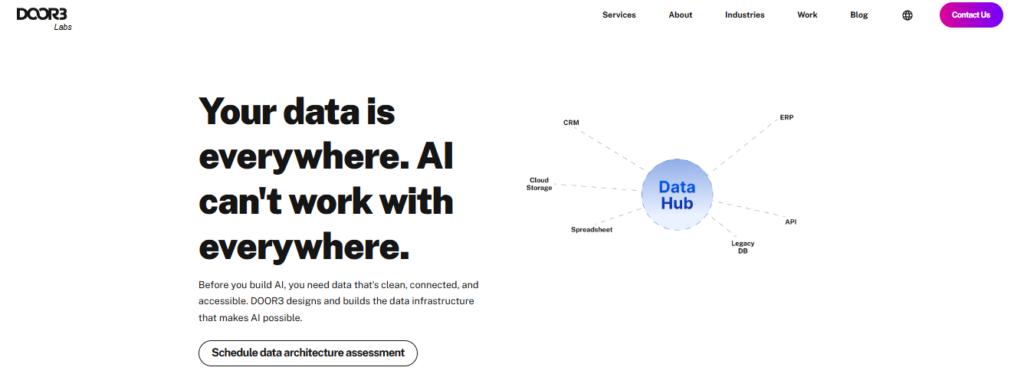
- Modernization approach: Enterprise data platform work with heavy UX and stakeholder needs.
- Certification depth: Verify platform certifications per engagement.
- Governance ownership: Experienced with complex enterprise data domains.
- Regulated track record: Enterprise and financial services; confirm scope.
- Accountability: Suited to multi-stakeholder programs that need coordination.
- Long track record on enterprise software and data-heavy platforms.
- Experience navigating complex internal stakeholder environments.
Vention
- Modernization approach: On-demand engineers to scale a data platform.
- Certification depth: Verify platform certifications per engagement.
- Governance ownership: Typically operates inside the client’s governance setup.
- Regulated track record: Venture-backed, fintech, healthcare; SOC 2, HIPAA referenced.
- Accountability: Augmentation model with client-side ownership.
- Broad delivery across startup and mid-market data and product work.
- References SOC 2 and HIPAA-aligned practices (confirm scope per engagement).
Dualboot Partners
- Modernization approach: Modernizes alongside an internal team rather than replacing it.
- Certification depth: Verify platform certifications per engagement.
- Governance ownership: Shared model with the client’s own engineers.
- Regulated track record: SaaS, fintech, enterprise; confirm scope.
- Accountability: Co-ownership designed to leave the internal team stronger.
- Delivery across SaaS and fintech modernization programs.
- Track record working embedded with client engineering teams.
Imaginovation
- Modernization approach: Builds custom data-driven products and their database structure.
- Certification depth: Verify platform certifications per engagement.
- Governance ownership: Owns database design within product scope.
- Regulated track record: Healthcare, recruitment, e-commerce; confirm scope.
- Accountability: On-time delivery and a collaborative, embedded feel.
- Built a full healthcare software platform including UX and database structure.
- Delivered a recruitment platform praised for attention to detail and performance.
JetRockets
- Modernization approach: Builds bespoke data-backed platforms with room to grow.
- Certification depth: Verify platform certifications per engagement.
- Governance ownership: Designs for future bolt-on features and roles.
- Regulated track record: Healthcare staffing, fintech, SaaS; confirm scope.
- Accountability: Flexible, responsive, and oriented to long-term support.
- Built a mobile-first scheduling platform for a physician staffing firm with role-based functions.
- Expanded scope mid-project into timekeeping and future invoicing without disruption.
Q2. What Does “Data Platform Modernization” Actually Mean in 2026, and Why Do Most AI-Ready Pilots Stall?
Data platform modernization is the work of moving a legacy data estate onto a cloud-native platform, Snowflake, Databricks, or Microsoft Fabric, while keeping the business running and making it AI-ready. In 2026 the bottleneck has shifted from storage and compute to the integration layer that lets non-deterministic AI touch petabyte-scale data safely. Most pilots stall because teams obsess over the model and ignore that layer.
🧱 What the work actually is
Let me define it plainly. A “data estate” is all the places your data lives: databases, warehouses, files, and the pipes between them.
Modernization moves that estate onto a platform built for the cloud, then makes it “AI-ready,” which just means clean, governed, and queryable by a model. The first thing I look at on a modernization call is never the model. It is the data layer and the legacy core.
Those two answers decide everything downstream. A clean data layer makes AI feel easy. A messy one makes the same demo take months.
🧠 The nervous system, not the brain
Here is the analogy I keep coming back to. The model is the brain. The integration layer is the nervous system that lets the brain move anything.
Right now, most teams are trying to run a powerful model on top of plumbing that was never built for it. As one practitioner put it, we have been obsessing over the brain while ignoring the nervous system, and even a top model is useless when it gets bad data or cannot run an action reliably. It is like running modern apps on bare silicon with no operating system in between.
I could be wrong on the exact split, but the pattern I see in production is consistent. The model rarely fails. The connection between the model and the data fails, which is where our AI integration services start every engagement.
⚠️ Why pilots stall: the “dumb RAG” trap
Most stalled pilots share one root cause. Teams dump everything into a vector database (a store that lets a model search by meaning) and hope the model sorts it out.
One engineer described it well: companies dumped all their Confluence docs, Slack history, and Salesforce data into a vector store and expected the model to figure it out. You do not get reasoning from that. You get thrashing and context-flooding, where the model drowns in noise and returns confident nonsense.
This is why I treat modernization as stabilise, document, then modernise, not rewrite. At Teamvoy, we map the legacy core and the data flows first, because an AI feature bolted onto an ungoverned estate is a stalled pilot waiting to happen, a pattern we cover in depth in our guide on updating systems nobody understands. The research backs the caution: messy data and unclear ownership are named risks in serious modernization guidance.
The honest limit here is simple. Cleaning a data layer takes longer than the model demo suggests, and anyone who tells you otherwise has not shipped one.
Q3. Snowflake vs Databricks vs Fabric: Which Platform Fits Which Modernization Situation, and Who Should Own the Integration Layer?
Snowflake suits SQL-first warehousing and governed data sharing. Databricks suits machine learning and large-scale data engineering on a lakehouse. Microsoft Fabric suits teams already standardized on Power BI and OneLake. There is no universal winner. Build your integration layer only with a dedicated platform team and genuinely unique systems; otherwise buy, because building makes you “Chief Integration Officer forever.”
📊 The three platforms at a glance
A “lakehouse” mixes a data lake (raw files) with a warehouse (structured tables) in one place. A “warehouse” is tuned for fast SQL on structured data. Keep that distinction in mind as you read.
| Dimension | Snowflake | Databricks | Microsoft Fabric |
|---|---|---|---|
| Core architecture | Cloud data warehouse | Lakehouse on Spark | Unified suite on OneLake |
| Best-fit workload | SQL analytics, data sharing | ML, heavy data engineering | Power BI-centric analytics |
| Governance catalog | Horizon | Unity Catalog | Microsoft Purview |
| Where it struggles | Heavy ML pipelines | SQL-only simplicity | Multi-cloud beyond Microsoft |
🎯 When to choose each one
Pick Snowflake when your team thinks in SQL, and your priority is governed analytics and data sharing across partners. It rewards teams who want warehousing to “just work.”
Pick Databricks when machine learning and large-scale pipelines are central, and you have engineers comfortable in Spark and notebooks. Pick Fabric when you already live inside Power BI and the Microsoft stack, and OneLake’s single storage layer removes friction you actually feel. Our data engineering team works across all three.
One honest contradiction worth naming: some comparisons call platform governance roughly a tie, while governance specialists argue the centralized catalogs are pulling ahead. I would not resolve that for you. I would test it against your own access-control needs before committing, which is exactly what a focused IT audit surfaces.
🔌 Who should own the integration layer
Here is the contrarian part most vendors skip. The platform matters less than the integration layer you build on top of it.
If you build that layer yourself, you become Chief Integration Officer forever. You maintain every API schema, field mapping, authentication flow, and retry path, a real and ongoing engineering tax. The honest rule: build only if you have a dedicated platform team and your core systems are genuinely unique.
There is also a quiet trap I call the memory problem. When AI enters a codebase it has never seen, it has no memory of why things were built that way, like a stranger waking up each morning with no past.
That is why we treat the integration layer as the real operating system. At Teamvoy, we build and document that layer through our system integration work, so the client is not trapped owning every mapping alone. Whoever owns the integration layer owns the platform’s reliability, and that ownership should be a deliberate choice, not an accident.
Q4. Which Certifications and Governance Models Actually Signal a Competent Partner?
Check for SnowPro Advanced, the Databricks Certified Data Engineer Professional, and Microsoft’s DP-700, but read them as competence signals tied to exam-domain weights, not guarantees, because a certified team is not automatically a governance-ready team. On governance, the platforms diverge: Databricks uses Unity Catalog, Snowflake uses Horizon (with Purview interoperability), and Fabric leans on Purview. Eligibility does not equal compliance.
🎓 The certifications worth checking
A certification is a verified exam pass, nothing more and nothing less. It tells you someone learned the platform, not that they have shipped under pressure.
| Certification | Platform | What it validates | What it does NOT validate |
|---|---|---|---|
| SnowPro Advanced | Snowflake | Architecture, engineering, admin depth | Real regulated-delivery experience |
| Certified Data Engineer Professional | Databricks | Pipelines, tooling, Delta Lake | Heavy governance design |
| DP-700 | Microsoft Fabric | Ingest, transform, secure in Fabric | Multi-platform estate fluency |
⚠️ Why the badge is only half the story
The detail people miss is exam weighting. Each exam emphasizes some domains and barely touches others.
The Databricks Professional exam, for instance, weights data processing and tooling heavily, while security and governance carry a much lighter share. So a certified engineer may be strong on pipelines and thin on governance. That gap is exactly where regulated systems break.
My tip from twelve years of regulated delivery: ask who on the team holds the credential, and whether that person stays on your engagement. The accountability gap regulated buyers fear is a certified name used to win the pitch, then swapped for juniors. At Teamvoy, the certified architect who scopes the work is the one who stays accountable through it, because auditable governance is a deliverable, not a feature toggle. We carry that posture across banking and fintech and healthcare engagements.
🛡️ Governance: the real selection axis
Governance is how you control who sees what, track where data came from, and prove it to an auditor. Each platform handles it differently.
| Capability | Unity Catalog (Databricks) | Horizon (Snowflake) | Purview (Fabric) |
|---|---|---|---|
| Lineage tracking | Strong | Strong | Strong |
| Dynamic data masking | Yes | Yes | Yes |
| Row / column security | Yes | Yes | Yes |
| Cross-platform federation | Lakehouse Federation | Horizon plus Purview link | Native to Microsoft |
| Regulated fit | High | High | High in Microsoft estates |
🔗 The interoperability detail that matters
Most teams run more than one platform within a few years. That makes cross-platform governance the quiet deciding factor.
Snowflake Horizon connects with Microsoft Purview, so a mixed estate can keep one governance view. Here is the line I hold onto: eligibility does not equal compliance. A platform being capable of governance does not mean your setup is governed, and “almost right” governance code can pass review, ship, and sit wrong in production for months before anyone notices. If that risk is sitting in your stack right now, that is precisely the work our AI consulting team is built to de-risk.
Q5. What Does Data Platform Modernization Cost to Run, and How Do You Keep AI Write-Access From Breaking It?
The trap is “cloud shock,” the mathematical penalty for running elastic infrastructure with a static data-center mindset. Hot storage at petabyte scale can run past $100,000 a month, and that math should be on the table before anyone signs.
⚠️ Three ways AI write-access goes wrong
I have seen the same failures repeat once AI gets write-access to core data. Each has a control that prevents it.
First, the runaway bill. An agent naps in a retry loop overnight and burns thousands before anyone wakes. The control is a hard cost ceiling that kills the job at a set spend, which is the kind of guardrail our cloud optimization work puts in place from day one.
Second, the silent outage. A pipeline carried tribal knowledge nobody documented, and it failed at 2 a.m. with no one who understood it. The control is documentation as a deliverable, plus a human-in-the-loop gate on writes, an approach we detail in our work on updating systems nobody understands.
🧨 The “almost right” problem
The third failure is the quiet one. AI-built code that is almost right is more expensive than code that is completely wrong.
Wrong code fails loudly and gets caught. Almost-right code passes review, ships, and sits in production for months before the cost surfaces. The control is a hard circuit breaker and a senior engineer who can actually read what shipped, because code from Cursor, Replit, or a freelancer still has to be supported by someone, a risk we unpack in our guide on vibe coding security risks. Keeping spend predictable also depends on disciplined IT cost optimization.
ModernizeWHERE THIS IS HANDLED
We modernize legacy data platforms incrementally, without a rewrite, while the business keeps running.
If a legacy core is blocking your move to Snowflake, Databricks, or Fabric, this is work we do every day, and the door’s open.Talk to a technical lead →
Q6. Which Modernization Partner Fits Your Exact Situation?
Match the partner to your situation, not to a ranking. A burned CTO stabilizing an inherited platform needs an accountable senior-led team. A technical founder on a legacy core needs incremental modernization without a rewrite. A regulated IT director needs named-regulator delivery experience. A vibe-coded founder needs a team that can read code nobody understands. The right partner fits your specific failure mode.
🧩 Situation to partner-kind map
There is no single best partner, only the right fit for the problem in front of you. Here is how the four common situations map.
| Your situation | The partner kind it calls for |
|---|---|
| Burned CTO, inherited a half-migrated platform | A senior-led team that stays accountable after go-live, not a body shop that hands you off. Teamvoy sits here. |
| Technical founder, scaled past a legacy core | Incremental modernization without a rewrite, stabilise first, then migrate. Teamvoy sits here too. |
| Enterprise IT director, regulated mandate | A team with real named-regulator delivery (HIPAA, PCI-DSS, DORA), where auditable governance is a deliverable. |
| Founder with “vibe-coded” AI output in production | A team that can read and support code nobody on staff understands, then make it safe. |
🎯 Why fit beats ranking
The cost of the wrong fit is rarely loud. It shows up as “almost right” work that passes review, then quietly breaks six months later.
It also shows up as tribal knowledge that walks out the door when a junior cycles off your account. That is the accountability gap I would screen for hardest, and it is why our IT audit services start by mapping what only one person knows. If your mandate is regulated, our banking and fintech team has delivered under exactly those regimes.
So I would not close this tab asking who is best. I would close it knowing what kind of partner your situation calls for, then test two or three against that shape. Where my view sits right now is that the situation, not the logo, should drive the shortlist, and I am genuinely curious which of these four you are sitting in. When you are ready to pressure-test a shortlist, our team is one conversation away.
Q7. Frequently Asked Questions on Data Platform Modernization
How long does a data platform modernization take?
It depends on the state of your legacy core and data layer, not on the platform you pick. A scoped readiness audit takes three to five days, while a full incremental modernization runs across months because cleaning and governing the data layer is the slow part. Anyone promising a fast cutover has not accounted for the data layer, which is where our data engineering team spends most of its time.
Should we build or buy our integration layer?
Buy unless you have a dedicated platform team and genuinely unique core systems. If you build it yourself, you become Chief Integration Officer forever, maintaining every API schema, field mapping, and retry path as an ongoing tax. We handle that layer through our system integration work so the burden does not sit with one person on your side.
How do we keep AI from running up a massive cloud bill?
Set a hard cost ceiling that kills any job at a defined spend, and gate write-access behind a human-in-the-loop review. Hot storage at petabyte scale can pass $100,000 a month, so the ceiling and the gate belong in scope before go-live, not after the first runaway bill.
Is our team a fit if we just want extra engineers?
If you only need short-term staffing, a pure augmentation vendor is a better fit than we are. We are built for long, senior-led engagements where a technical lead owns the system after go-live, so for regulated and high-stakes platforms, our AI consulting and healthcare teams are where we do our best work.