

Key takeaways:
AI integration in 2026 spans a 6x cost range — USD 40,000–80,000 for a single-system integration and USD 120,000–250,000 for a multi-system integration. The spread is real and predictable: the cheaper end is one LLM, one workflow, one production system; the upper end is multi-vendor LLM, three or more systems, regulator-aware documentation, and an eval scaffold that survives audit. Most CTOs hit the wall not because the integration is expensive, but because the scope wasn’t defined before signing.
This piece names what each tier actually includes, the three traps that double the bill, and the procurement moves that compress 12 weeks of work into 8 without losing scope.
- A USD 40K and a USD 250K AI integration can sound identical in a proposal — the difference lies in system count, regulator depth, and eval scaffold scope.
- Run cost (LLM API + infra) is separate from build cost. Vendors that bundle them usually hide a year-two surprise.
- A 30–40% reduction in manual work is the benchmark Teamvoy targets on a typical first integration. It assumes the integration ships through a proper eval suite — not a notebook.
- The cheapest legitimate AI integration is the one where in-house owns the workflow design, and outside owns the integration scaffold.
- A paid 2-week integration discovery sprint is the single procurement move that pays back most reliably — it prevents the week-10 architecture rework that doubles the bill.
Introduction
A Series C fintech CFO emailed Teamvoy in March with one line: “We’ve been quoted between USD 60K and USD 290K to integrate AI into our CRM and core platform. Same RFP. Which one is right?” None of them was wrong, in the strict sense — the scopes were different in ways nobody had drawn out. But the spread was telling: AI integration in 2026 is not one thing. It’s at least two distinct engagements (single-system and multi-system), and within each tier, the spread is driven by integration depth, regulator surface, and eval scaffold scope. This piece is the cost model that resolves the spread. It names what USD 40,000–80,000 actually buys, what USD 120,000–250,000 adds, and where most integration budgets get blown.
What is AI integration in 2026 — and why does cost vary 6x for the same buzzword?
AI integration in 2026 means connecting a production AI workflow (ML model, GenAI assistant, NLP service, computer-vision pipeline, or agentic workflow) to your existing systems of record — typically your ERP, CRM, data warehouse, ticketing system, or core platform. The integration is rarely the model layer itself. It’s the bridge.
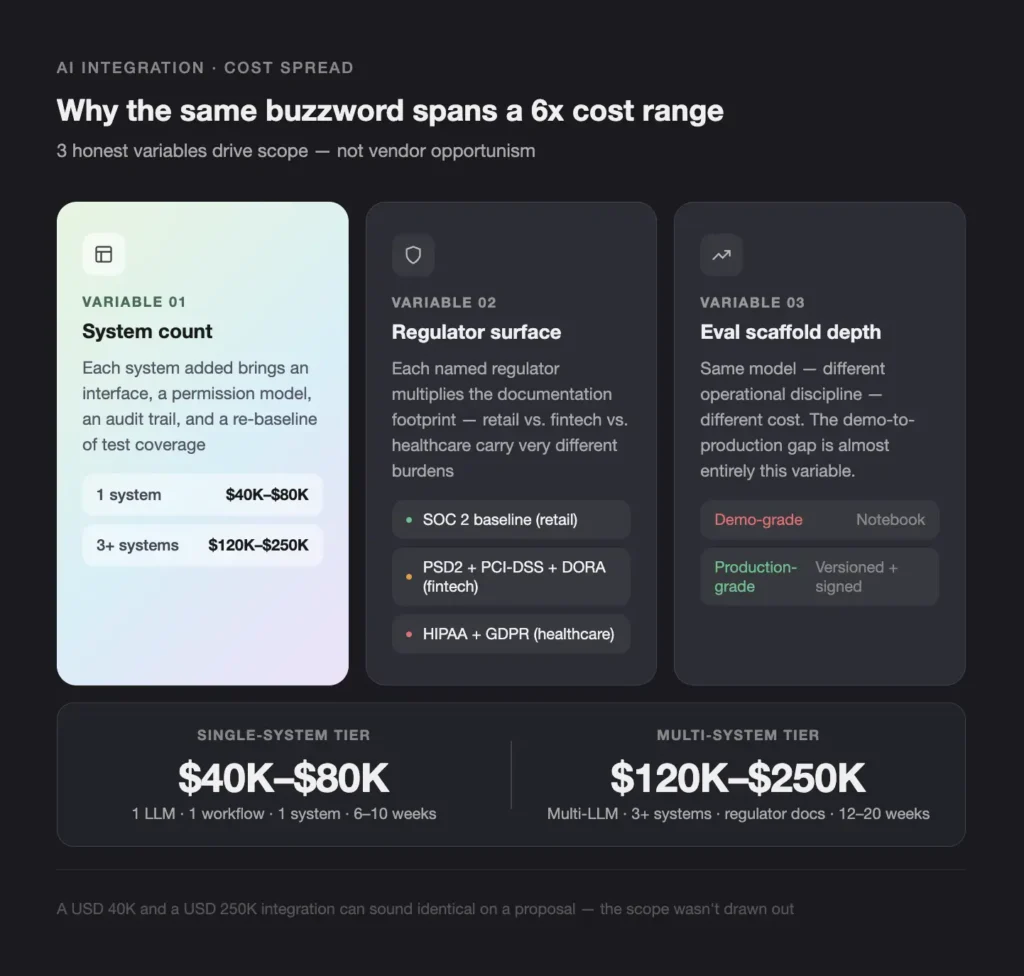
The 6x cost spread comes from three honest variables that drive scope:
- System count. Connecting an LLM to one CRM is a different engagement from connecting it to a CRM, an ERP, and a data warehouse. Each added system includes an interface, a permission model, an audit trail, and a re-baseline of test coverage.
- Regulator surface. A retail integration carries SOC 2 baseline. A fintech integration entails compliance with PSD2, PCI DSS, DORA, and GDPR. A healthcare integration adds HIPAA. Each named regulator multiplies the documentation footprint.
- Eval scaffold depth. A demo-grade eval is a notebook. A production-grade eval — the one that catches faithfulness drift before a customer escalation — is a versioned set with a named owner and a signoff log. Same model, different operational discipline, different cost. We covered this in detail in LLM observability and evals for fintech in production.
Teamvoy’s AI integration services page lists the two tiers up front: USD 40,000–80,000 for single-system and USD 120,000–250,000 for multi-system. That published transparency is rare for an integration services agency — and the rest of this piece walks through what each tier actually includes.
What does a USD 40,000–80,000 single-system AI integration include?
A single-system integration in this range gives you one production AI workflow wired into a single named system of record. The build window is 6–10 weeks. The team typically consists of 2–3 senior engineers plus a delivery lead. The deliverable is a workflow that ships to production with eval coverage and a documented operational runbook.
What’s typically included at this tier:
- One production AI workflow scoped to a single business outcome (customer-support assistant on CRM, document-understanding pipeline on ERP, fraud-explanation agent on case-management).
- One LLM provider — commercial API by default (OpenAI, Anthropic, or Google), open-weights on-prem when data residency or compliance forces it.
- One system integration — API/SDK against the named system of record with the appropriate auth model (OAuth, mTLS, IP allowlisting).
- A versioned eval suite built in parallel with the workflow, running on every release, with the four production metrics instrumented (faithfulness, refusal, latency, drift).
- A dashboard with the four metrics + token-spend telemetry, in your existing observability stack (Grafana, Datadog, or whatever the in-house team runs).
- Documentation footprint sized to SOC 2 baseline — vendor risk register entry, access controls review, incident runbook with rollback path.
- Knowledge handover — runbook, architecture doc, and the eval suite in your repos. The in-house team owns the workflow after handover. Not the vendor.
What’s typically NOT included at this tier — and that’s by design, not omission:
- Multi-vendor LLM routing (single provider only)
- Custom integration with more than one system of record
- Regulator-specific documentation for DORA, PSD2, MiFID II, NYDFS Part 500, or HIPAA (SOC 2 baseline only)
- Full quarterly eval-refresh process (one signoff at delivery; the in-house team owns the refresh cadence after)
- Ongoing support contract after handover (typically scoped as a separate retainer)
The 6–10 week window is calendar weeks, not effort weeks. It assumes a 60–80% senior-engineer team and an in-house counterpart available 2–3 hours per week for architecture reviews. Teams under that engagement intensity slip into the 10–14 week range.
What does a USD 120,000–250,000 multi-system AI integration include?
A multi-system integration in this range delivers a production AI workflow that spans 3+ systems of record, often with regulator-specific documentation. The build window is 12–20 weeks. The team typically consists of 4–6 senior engineers, plus delivery and risk leads.
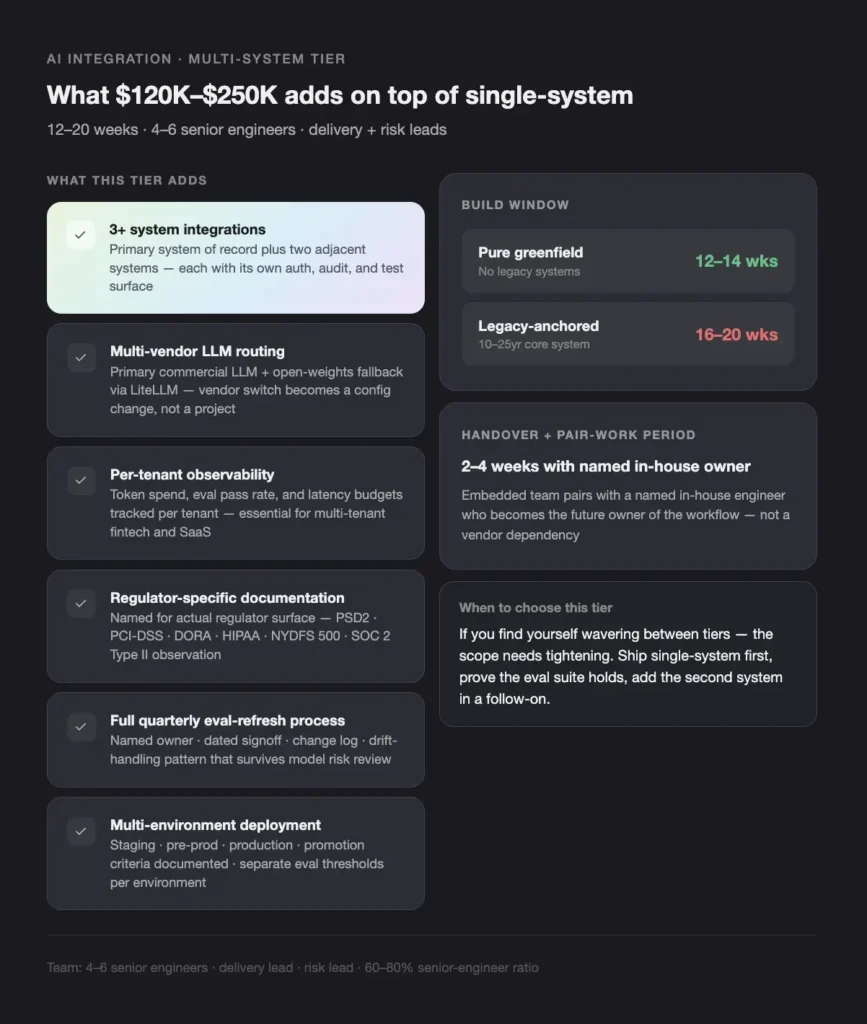
What this tier adds on top of the single-system scope:
- 3+ system integrations — typically a primary system of record (ERP or core) plus two adjacent systems (CRM + data warehouse, ticketing + claims engine, etc.). Each added system brings its own auth, audit, and test surface.
- Multi-vendor LLM routing — typically a primary commercial LLM plus an open-weights fallback on-prem, routed via LiteLLM or a similar gateway. Vendor switch becomes a config change, not a project.
- Per-tenant observability — for multi-tenant fintech and SaaS products where data residency or commercial isolation matter. Token spend per tenant, eval pass rate per tenant, and latency budgets per tenant. The hidden run-cost traps make this layer essential at this scale.
- Regulator-specific documentation — named for the actual regulator surface (PSD2, PCI-DSS, DORA, MiFID II, BaFin for fintech; HIPAA + GDPR for healthcare; NYDFS Part 500 for NY-licensed entities; SOC 2 Type II observation window).
- Full eval-refresh process — a quarterly cadence with named owner, dated signoff, change log, and a documented drift-handling pattern that survives model risk review.
- Multi-environment deployment — staging, pre-prod, and production, with promotion criteria documented per environment. Often with separate eval thresholds per environment.
- Knowledge handover plus an operational hand-off period — typically 2–4 weeks of pair-work between the embedded team and a named in-house engineer who is the future owner of the workflow.
The 12–20 week window assumes one of the integrated systems is a legacy core (10–25 year-old banking system, ERP, or claims engine). Pure greenfield multi-system integration without legacy can run in the 12–14 week range. Legacy-anchored integration runs 16–20 weeks. Want the transparent estimate scoped to your specific stack? Talk to a Teamvoy engineer in a 45-minute discovery call
Where do most AI integration budgets get blown in 2026?
Three traps double the bill, in roughly the order they hit. Each is predictable and avoidable, and each shows up in vendor proposals before the engagement starts if you read for them.
Scope creep through the regulator-readiness layer. “We also need this aligned to PSD2 and the EU AI Act” is added six weeks into the build, after the eval suite is half-built against neither. The eval-set provenance has to be rebuilt against the framework, and the bill grows by a quarter. Avoidable: name the regulator surfaces in the SOW in week one, not week six. If the workflow is high-risk under any named regulator, the documentation has to be designed in, not bolted on. See building regulator-ready AI in fintech for the artifact set examiners actually read.
Integration discovery skipped. The pilot connected to a sandboxed copy of the data; production has to connect to the actual core system, the legacy fraud engine, and the data residency setup nobody mapped in scoping. Integration architecture gets reworked in week ten, two engineers get pulled off feature work, and the bill grows by a third. A paid two-week integration discovery sprint before the build SOW is the cheapest insurance available against this trap.
Eval suite built last. Teams that build evals after the workflow is “working” produce evals biased toward what already passes, miss the regression classes that will actually break the model in production, and rebuild the eval set in month three at full cost. Build the eval set in parallel with the workflow. Failing this, integration teams typically discover the bias around the time the first regulator-facing release ships — exactly the wrong moment to discover it. The pattern is documented in why most AI pilots in fintech fail to reach production.
How do you pick between single-system and multi-system scope?
The honest answer is: by what your buyer-side workflow actually requires, not by what your AI committee voted on. Three named workflows that drive the right tier:
| Workflow | Right tier | Rationale |
|---|---|---|
| Customer-support assistant reading from CRM only | Single-system (USD 40K–80K) | One read path; CRM-resident data; no payment surface |
| Document-understanding pipeline writing to ERP | Single-system (USD 60K–80K) | Write path adds review steps; still one system |
| GenAI customer-support spanning CRM + core banking + AML triage | Multi-system (USD 180K–250K) | Three systems, PSD2 + PCI-DSS + DORA surface, multi-tenant isolation |
| Claims-FNOL automation across claims engine + policy admin + payment | Multi-system (USD 150K–220K) | Three systems, NAIC Model Laws + Solvency II surface, HITL checkpoints |
| Fraud-explanation agent reading transaction monitoring + writing to case mgmt | Multi-system (USD 140K–200K) | Two systems with regulator-facing explanation requirement bumps to multi-system tier |
| Internal analyst copilot reading data warehouse only | Single-system (USD 40K–60K) | One read, no production writes, light SOC 2 surface |
The decision is rarely close. If you find yourself wavering between single-system and multi-system, the scope probably needs to be tightened — most “multi-system” demands start as feature-creep on a single-system foundation. Ship the single-system version first, prove the eval suite holds, add the second system in a follow-on engagement.
How should you sequence an AI integration to ship value before the bill grows?
The sequencing pattern that consistently lands at the low end of the published range, in any tier:
- Weeks 1–2: Paid integration discovery sprint. Architecture document + named risks register + cost-baseline confirmation. This deliverable closes 90% of the gap between a USD 80K integration and a USD 180K one when the integration scope was actually multi-system but the proposal said single-system.
- Weeks 3–6: Workflow + eval suite in parallel. Build the AI workflow against the named system. Build the eval suite against the same release cadence. Block the release on regression. The eval suite is the contract between the buyer and the engineer.
- Weeks 7–9: Regulator-readiness documentation. Vendor risk register, access privilege review, retention design. Sized to the named regulator surface from the SOW (not added later).
- Weeks 10–12: Production cutover with rollback. Canary traffic, model rollback runbook, on-call training, and knowledge handover begin.
- Weeks 13+: Handover and retainer-or-transition decision. Single-system integrations end here. Multi-system extends to weeks 16–20 to add the second and third systems on the foundation already in place.
The savings from an unchecked engagement range from the high five figures to the mid six figures for most fintech AI integrations. The first checkpoint — the paid discovery sprint — is the single highest-ROI procurement move available, and it costs a fraction of what the rework would.
How does Teamvoy scope an AI integration honestly?
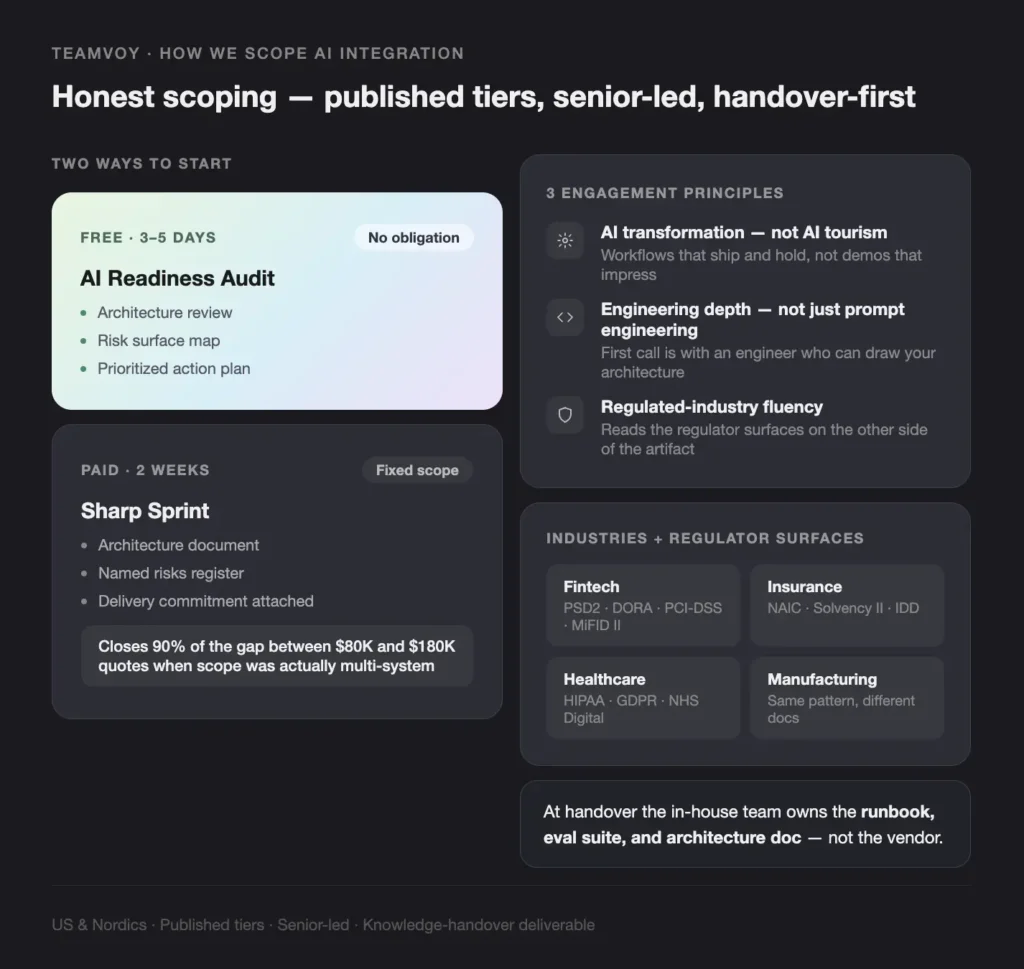
Teamvoy works against the published tiers — USD 40K–80K single-system, USD 120K–250K multi-system — and starts every engagement with a free AI Readiness Audit (3–5 days, no obligation) or a Sharp Sprint (paid, 2 weeks, fixed scope). The free audit produces an architecture review, a risk surface map, and a prioritized action plan. The Sharp Sprint is the paid integration discovery in two weeks — same deliverable shape, with delivery commitment attached.
The engagement model is senior-led: every first-call conversation is with an engineer who can draw your architecture on a whiteboard, not an account manager. The handover deliverable is explicit — when the engagement closes, the in-house team owns the runbook, the eval suite, and the architecture document. Not the vendor.
The team works across fintech (PSD2 · DORA · PCI-DSS · MiFID II · BaFin), insurance (NAIC · Solvency II · IDD), healthcare (HIPAA · GDPR · NHS Digital), and manufacturing — same engineering pattern, different documentation surface. Teamvoy’s three pillars run through every engagement: AI transformation (not AI tourism), engineering depth (not just prompt engineering), and regulated-industry fluency.
If you have a quote you want a layered cost read on, or you want to scope an integration against your stack, book a 45-minute discovery call or start with the free AI Readiness Audit.
Conclusion
AI integration in 2026 spans USD 40K–250K because the work spans 1–3 systems, one regulator to seven, and a notebook eval to a regulator-acceptable scaffold. The published tiers — USD 40,000–80,000 single-system, USD 120,000–250,000 multi-system — are honest. The CFOs who consistently spend less are not the ones who shop hardest on day rate; they are the ones who insist on a paid integration discovery sprint, layered quotes, named senior-engineer ratios, and regulator-readiness as a discrete line. The procurement moves that hold the bill honest cost a small fraction of the build. Skip them and the same integration runs 30–60% over. Apply them and the bill lands inside the published range with the eval suite the buyer wanted in week one.