

Key takeaways:
EPAM, the Big-4, and most analyst reports will not tell a fintech CTO what a production AI workflow actually costs in 2026. Reddit threads on the topic trade in anecdotes that are usually wrong by an order of magnitude in one direction or another. This piece publishes the ranges Teamvoy sees across active fintech engagements, broken into the four cost layers (model, eval and observability scaffold, regulator-readiness, integration), the traps that double the bill, and the procurement moves that reliably bring it back down.
- The model layer is rarely the biggest cost line. Integration and regulator-readiness usually are.
- A USD 250K production AI workflow and a USD 1.4M one can do the same thing — the difference is scope honesty, not capability.
- Eval and observability scaffold is the line item teams under-budget most reliably and pay for most expensively.
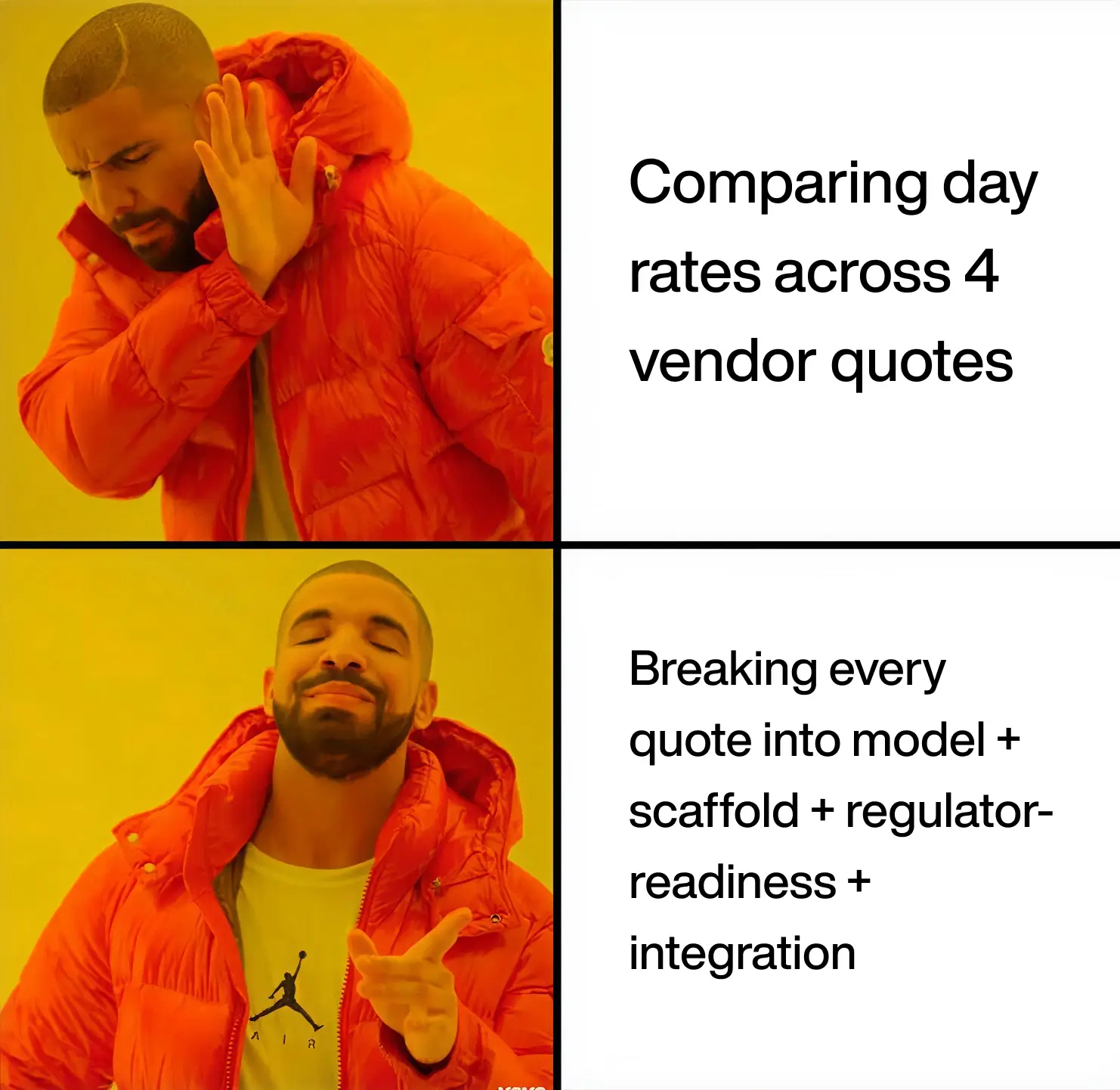
- Procurement teams that compare day rates instead of loaded cost per outcome routinely overspend by 30–60%.
- The cheapest fintech AI workflows are the ones where the in-house team owns the scaffold and the outside team owns the model surface.
Introduction
A Series C fintech CFO emailed a Teamvoy delivery lead in March 2026 with a single line: “We’ve been quoted between USD 180K and USD 2.1M for the same project from four vendors. Which one is right?”
None of them was right, in the strict sense. The scopes were different in ways nobody had drawn out. But the spread told the real story, which is that fintech AI procurement in 2026 still runs on quotes, not on cost models.
This piece is the cost model. It names the four layers, publishes the ranges Teamvoy sees, calls out the traps that double the bill, and gives a CFO or CTO the structure to read any future quote against an honest baseline.
What actually drives the cost of a production AI workflow in fintech?
Most fintech AI quotes are written as if the model is the work. It usually is not.
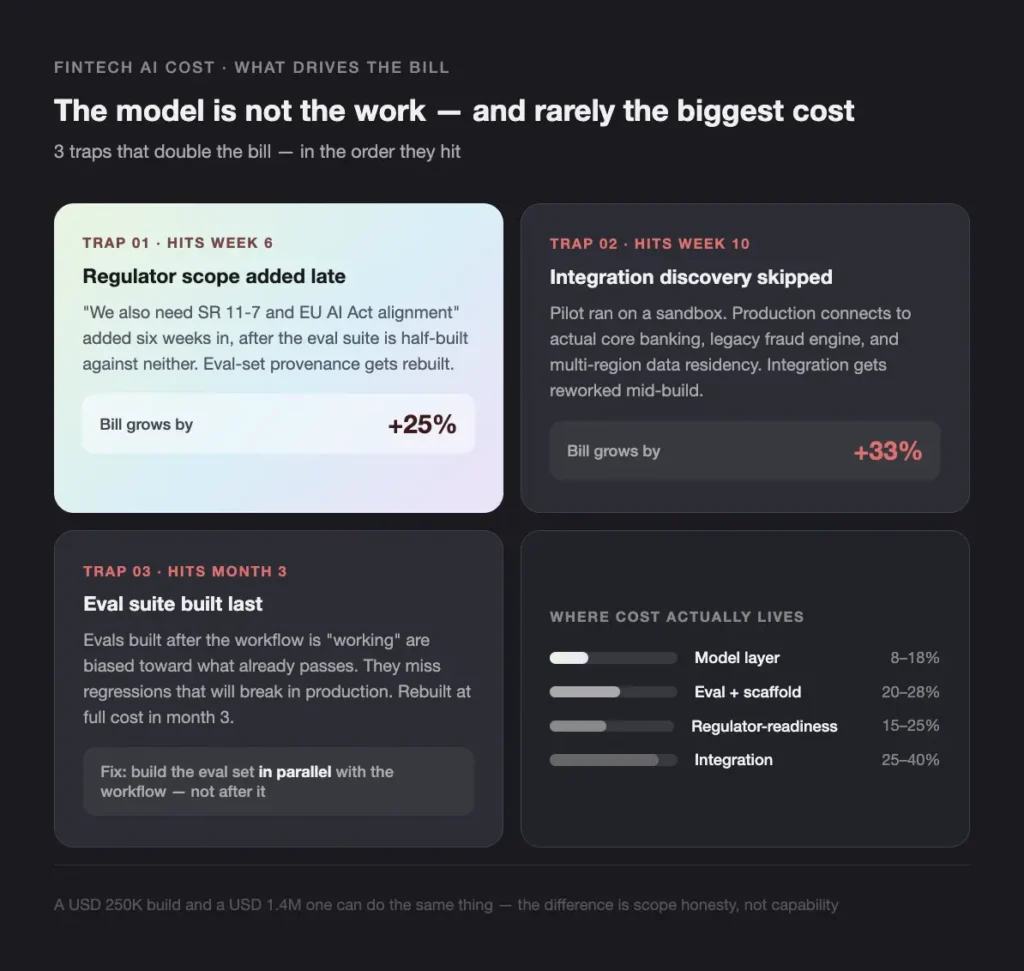
Across the AI delivery engagements Teamvoy has run inside regulated fintech in the past 24 months, the cost of a production workflow breaks across four layers — and the model layer is consistently the smallest of them. Integration usually dominates, regulator-readiness routinely surprises, and the eval and observability scaffold is the line item under-budgeted most reliably.
This is the same operating-system-around-the-model gap that separates closed pilots from production wins, and it is the source of most of the cost variance between vendor quotes. We covered the production-failure pattern in why most AI pilots in fintech fail to reach production; the cost version of it is the same gap, priced.
Where do most fintech AI budgets get blown in 2026?
Three traps double the bill, in roughly the order they hit. Each is predictable, each is avoidable, and each shows up in vendor proposals before the engagement starts if you know where to look.
Scope creep through the regulator-readiness layer. “We also need this aligned to SR 11-7 and the EU AI Act” gets added six weeks into the build, after the eval suite is half-built against neither. The eval-set provenance has to be rebuilt against the framework, and the bill grows by a quarter. Treat regulator scope as a scoping decision in week one, not a discovery in week six. If the workflow is high-risk, name the regulator surfaces in the SOW and design the eval-set provenance around them from the start — the regulator-ready AI in fintech playbook walks through the artifacts in detail.
Integration discovery skipped. The pilot connected to a sandboxed copy of the data; production has to connect to the actual core banking system, the legacy fraud engine, and the data residency setup nobody mapped in scoping. Integration architecture gets reworked in week ten, two engineers get pulled off product work, and the bill grows by a third. A paid two-week integration discovery before the build SOW is the cheapest insurance against this trap.
Eval suite built last. Teams that build evals after the workflow is “working” produce evals biased toward what already passes, miss the regression classes that will actually break in production, and rebuild the eval set in month three at full cost. Build the eval set in parallel with the workflow.
Which four cost layers does every fintech AI quote need to break out?
A fintech AI build is four cost layers. Any vendor quote that does not split them is hiding a scope assumption you cannot read.
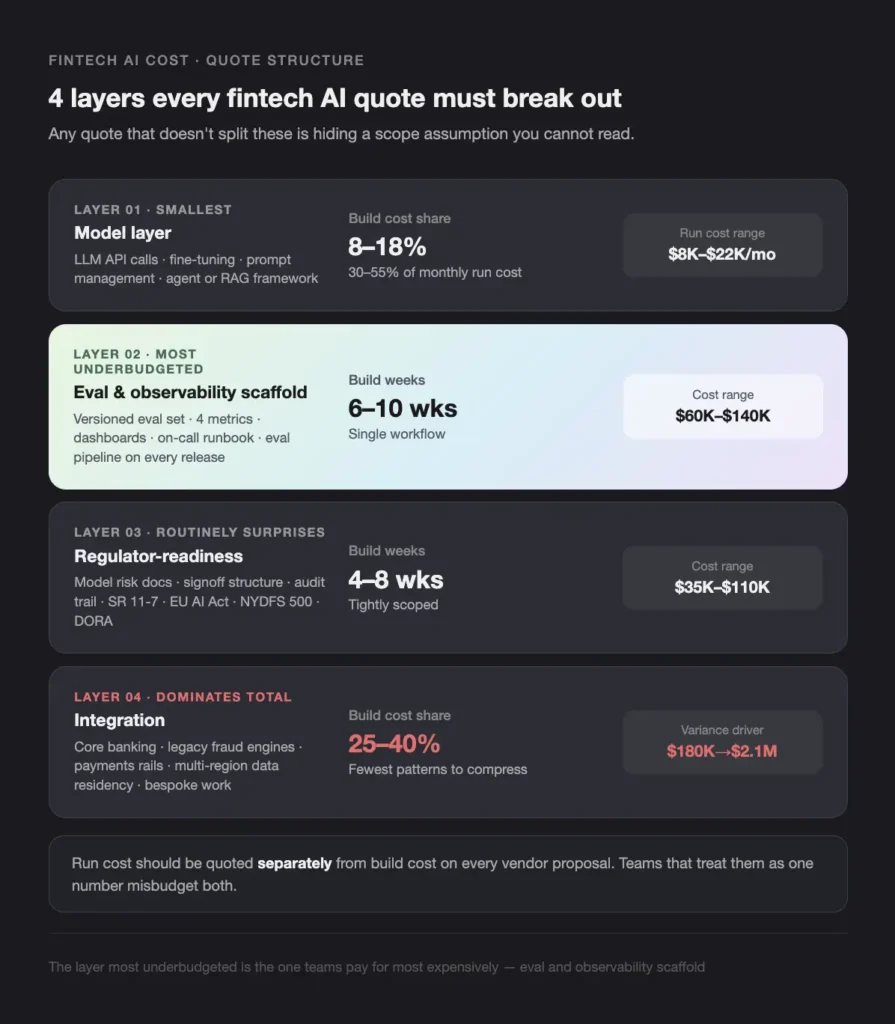
Model layer. LLM API calls, fine-tuning runs if any, prompt management, the agent or RAG framework. For most fintech workflows running on commercial APIs (OpenAI, Anthropic, Google), the model layer is 8–18% of total build cost and 30–55% of monthly run cost. Open-weights deployments shift the cost from API spend to infrastructure spend; the total stays in roughly the same band. The run-cost side often surprises teams later — see the hidden run-cost traps in AI agents for the per-tenant observability layer this layer must also catch.
Eval and observability scaffold. The versioned eval set, the four production metrics (faithfulness, refusal, latency, drift), the dashboards, the on-call runbook, and the eval pipeline that runs on every release. This is the layer teams under-budget most reliably. Typical build is 6–10 engineering weeks for a single workflow; cost lands between USD 60K and USD 140K (EUR 56K–131K) depending on team composition.
Regulator-readiness. Model risk documentation, signoff structure, eval-set provenance, audit trail, and alignment to whichever framework the workflow has to clear — SR 11-7, the EU AI Act, NYDFS Part 500, DORA. For a single high-risk workflow inside a bank, this is 4–8 weeks of focused work and lands between USD 35K and USD 110K (EUR 33K–103K) when scoped tightly. Scoped loosely it becomes a six-figure outlier.
Integration. The hardest layer to compress because it has the fewest patterns. Connecting a GenAI workflow to a 15-year-old core banking system, an old payments rail, a legacy fraud engine, or a multi-region data residency setup is bespoke work. Integration consistently runs 25–40% of total build cost and is the line item that drives the variance between the USD 180K and the USD 2.1M quotes the CFO above received.. The right column is the bar that earns a clean pass at a model risk committee.
What does the realistic 2026 cost range actually look like by workflow type?
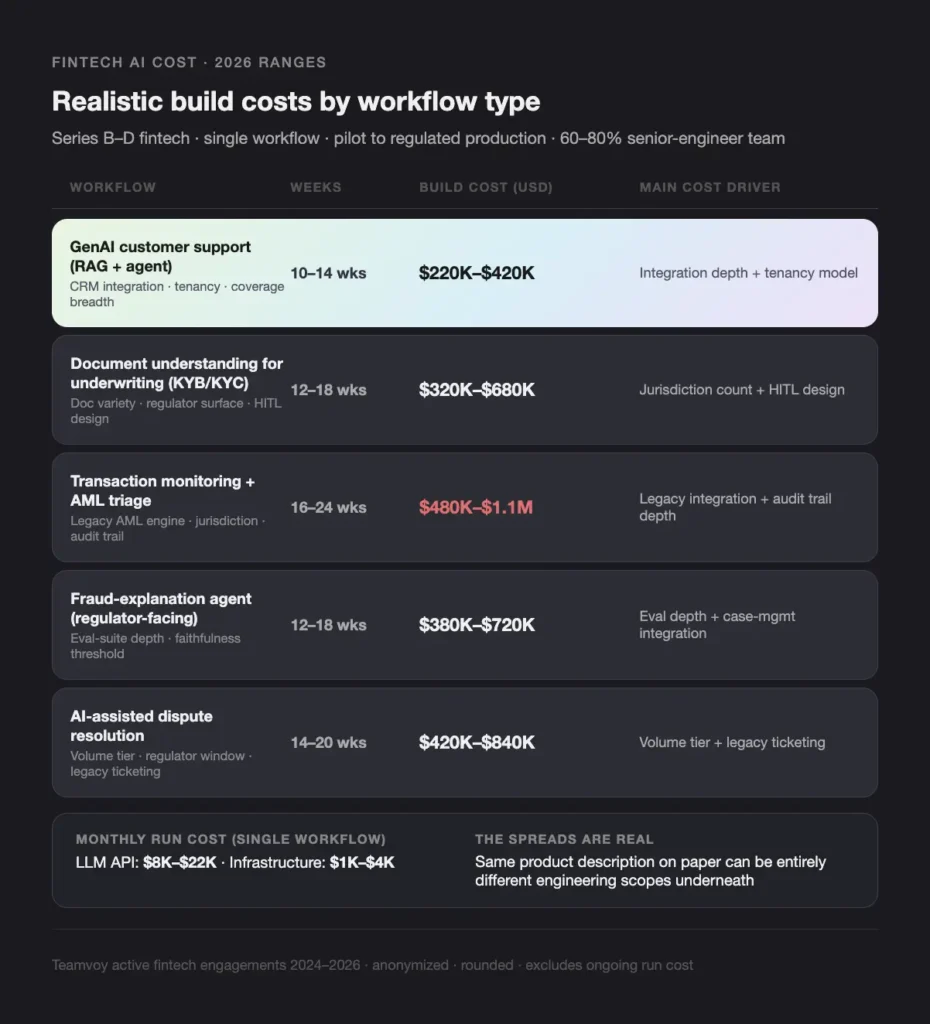
The numbers below are working ranges across active Teamvoy fintech engagements, anonymized and rounded. They assume a mid-market fintech (Series B–D, 30–150 engineers), a single workflow being moved from pilot to regulated production, and a 60–80% senior-engineer team. They do not include ongoing run cost — that is its own model.
| Workflow | Build window | Build cost range | Drivers of the spread |
|---|---|---|---|
| GenAI customer support assistant (RAG + agent) | 10–14 weeks | USD 220K–420K (EUR 206K–393K) | Integration depth with CRM and policy library; tenancy model; tier-1 coverage breadth |
| Document understanding for underwriting (KYB / KYC) | 12–18 weeks | USD 320K–680K (EUR 300K–636K) | Document type variety; regulator surface (jurisdiction count); human-in-the-loop design |
| Transaction monitoring + AML triage assistant | 16–24 weeks | USD 480K–1,100K (EUR 449K–1,029K) | Legacy AML engine integration; jurisdiction count; audit-trail design |
| Fraud-explanation agent (regulator-facing) | 12–18 weeks | USD 380K–720K (EUR 355K–673K) | Eval-suite depth; explanation faithfulness threshold; integration to case-management |
| AI-assisted dispute resolution workflow | 14–20 weeks | USD 420K–840K (EUR 393K–786K) | Volume tier; regulator response window; legacy ticketing integration |
The spreads are real and not a function of vendor opportunism. A USD 220K customer-support workflow and a USD 420K one in the same row can be the same product description on paper and entirely different engineering scopes underneath.
A note on run cost. After build, the largest monthly cost line for most workflows above is LLM API spend, which scales with traffic and is almost always underestimated at scoping time. For the customer-support workflow row, monthly API cost in 2026 typically lands between USD 8K and USD 22K depending on volume tier. Infrastructure (Postgres, vector DB, observability) is usually USD 1K–4K per month for a single workflow at this scale on a major cloud provider. Run cost should be quoted separately from build cost on every vendor proposal; teams that treat them as one number misbudget both.
How do you build a build-cost model your CFO will trust?
A CFO does not want a single quote. They want a model with three numbers — a low, mid, and high case — and a sensitivity analysis on the inputs that move them. The fintech AI teams that close cleaner procurement cycles produce that model themselves rather than asking a vendor to produce it.
A workable approach, in four moves:
- Start from the four cost layers, not the vendor’s headline number. Pull every quote apart into model, scaffold, regulator-readiness, and integration. The numbers that survive that decomposition are the ones to trust.
- Set anchor ranges from the workflow-type table. Use the published ranges as the outside bound on the build cost. A quote that lands two standard deviations outside the range — without a documented scope difference — is mispriced.
- Run sensitivity on the three drivers that move cost most. Integration depth, regulator surface count, and senior-engineer ratio. Each shifts total cost by 20–40% in real engagements. Sensitivity on day rate alone is not a model.
- Add a run-cost projection at three traffic tiers. Low, mid, and high. The CFO needs the 12-month operating cost in the same view as the build cost, or they will misjudge the engagement’s total.
The output is one page. It is also the page that resolves the difference between a four-bid range of USD 180K–2.1M and a defensible procurement decision. The fast version of this conversation is what our guide to choosing an AI vendor for fintech covers; the layered cost-model view is the procurement-side companion.
Which procurement moves keep production AI fintech costs honest?
Four concrete moves keep cost honest without sacrificing scope. Each is small. Together they routinely close 30–60% of the cost gap between the high-end and low-end quotes a fintech receives for the same project.
- Separate build cost from run cost. Every quote should split the two. Run cost should include LLM API spend, infrastructure, and ongoing observability tooling, projected at low, mid, and high traffic tiers.
- Demand a senior-engineer ratio on paper. Below 50% is a red flag on AI work; ask for named CVs, not blended headcount. The ratio is the single strongest predictor of delivery velocity and the line item most invisible in a day-rate comparison.
- Run a paid two-week integration discovery before the full SOW. The deliverable is an architecture document and a named risks register. The cost is a small fraction of the build and is worth more than any case-study slide.
- Quote regulator-readiness as a discrete line item. It should not be bundled into “general engineering.” Pricing it separately forces both vendor and client to scope it honestly and prevents the regulator-readiness scope-creep trap.
A note on outside-team economics. A senior nearshore AI engineer focused on a single workflow over a two-quarter build runs roughly USD 60K–110K all-in (EUR 56K–103K) depending on geography and seniority. The same role inside a large US consultancy lands closer to USD 220K–320K loaded per engineer over the same window. The trade is real, and it shows up most visibly in the senior-engineer ratio — which is why the second procurement move above matters more than the headline day rate.
How should you sequence cost reviews against a production AI build?
Re-baselining cost is not a sign of poor planning; not re-baselining is. Three checkpoints across an 8–16 week build catch the most common cost drifts before they compound.
- End of week two — integration discovery review. After the paid integration discovery sprint, re-baseline against the actual data and system surfaces, not the pilot’s sandbox. Most integration-driven overruns are caught here if the discovery sprint happened.
- End of week six — eval scaffold review. The eval suite has run end-to-end at least once. Confirm coverage against the regulator surface and the four production metrics. If the eval scaffold is more than 20% above estimate, the regulator-readiness scope was probably under-quoted.
- Regulator-readiness review (typically week 8–10). The model risk artifact is in draft. Review the audit-trail design and signoff structure against the chosen framework. Late changes here are the most expensive class of cost drift.
The three checkpoints take a combined four hours of CFO/CTO time across the build. The savings against an unchecked engagement land in the high five figures to mid six figures on most fintech AI workflows. Inside the broader LLMOps stack, the tooling-stack choices made early in the build also drive long-term cost; see our LLMOps tooling reference for the open-source vs commercial trade-offs that compound over the run cost.
What does cost discipline look like at the end of the engagement?
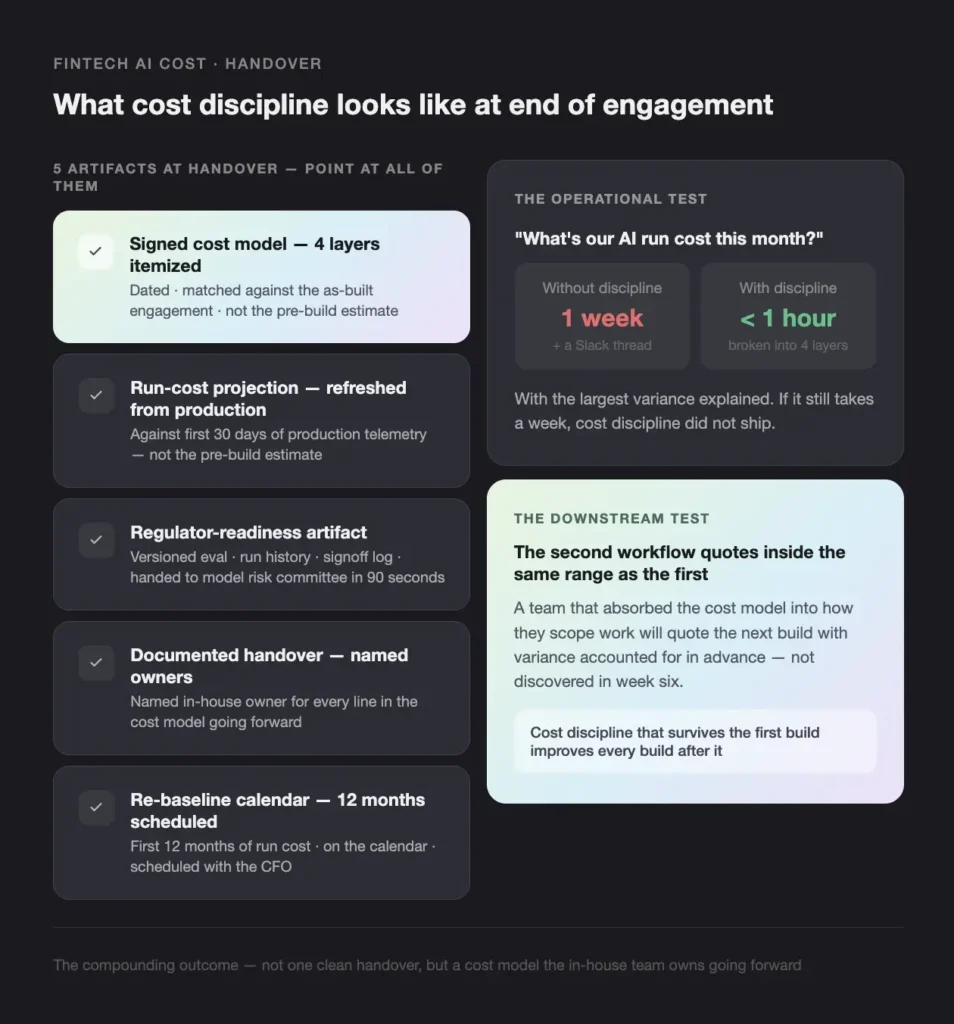
A fintech team that finishes a production AI build with cost discipline should be able to point at five artifacts at handover:
- A signed cost model with the four layers itemized, dated, and matched against the as-built engagement.
- A run-cost projection refreshed against the first 30 days of production telemetry — not the pre-build estimate.
- A regulator-readiness artifact (versioned eval, run history, signoff log) the team can hand to a model risk committee in 90 seconds.
- A documented handover that names the in-house owner of every line in the cost model going forward.
- A re-baseline calendar for the first 12 months of run cost, scheduled with the CFO.
The operational test sharpens the picture. The next time finance asks “what’s our AI run cost this month?” the engineering team should produce a number broken into the four layers within an hour, with the largest variance explained. If it still takes a week and a Slack thread to answer that question at the end of the build, cost discipline did not ship. The downstream test is the next engagement. A team that absorbed the cost model into how they scope work will quote the second workflow inside the same range as the first, with the variance accounted for in advance. That is the compounding outcome — cost discipline that survives the first build improves every build after it.
How does Teamvoy help fintech CFOs and CTOs scope production AI honestly?
Teamvoy sits with fintech CFOs and CTOs to break a production AI build into the four cost layers, set honest ranges by workflow type, and design the procurement moves that hold the bill in line. The engagement model is senior-led and explicitly scoped so the in-house team owns the cost model after handover — not a vendor.
The delivery team works across fintech in the United States and the Nordics, with regulator-surface fluency across SR 11-7, the EU AI Act, NYDFS Part 500, DORA, and the internal model risk committees that read the artifacts on the other side. Teamvoy’s three pillars run through every engagement: AI transformation (not AI tourism), engineering depth (not just prompt engineering), and regulated-industry fluency. If you are mid-procurement on a fintech AI engagement and want a layered cost read on a quote you already have, Teamvoy’s delivery team will sit with your CTO and CFO for 45 minutes and walk it through with you. Book a Teamvoy cost review →
Conclusion
A production AI workflow in regulated fintech in 2026 is not a fixed-price product and not a black box. It is four cost layers, three predictable traps, four procurement moves, and three checkpoints that hold the bill honest. The CFOs and CTOs who consistently spend less are not the ones who shop hardest on day rate. They are the ones who insist on layered quotes, named senior-engineer ratios, paid integration discovery, and regulator-readiness as a discrete line. The ones who overspend by 30–60% almost always skipped one of those moves.