

Key takeaways:
Most production LLM failures inside fintech are not model failures. They are observability failures: nobody noticed the refusal rate climbed for two weeks, the faithfulness score on the customer-support eval dropped after a quiet API change, the latency budget broke when traffic shifted onto a different model variant.
The fix is not a smarter model — it is a stack that measures the right four metrics, surfaces them to the right people, and produces artifacts an internal model risk committee will accept.
- Production LLM observability is four metrics, not forty: faithfulness, refusal rate, latency budget, drift.
- An eval set you re-run on every release is worth more than a benchmark you ran once at launch.
- A regulated buyer’s risk team will read your eval signoffs before they read your model architecture.
- On-call for an LLM workflow is different from on-call for a service — the failure modes are statistical, not binary.
- Open-source tooling (Promptfoo, RAGAS, LiteLLM) covers most of the stack until a dedicated LLMOps lead exists.
Introduction
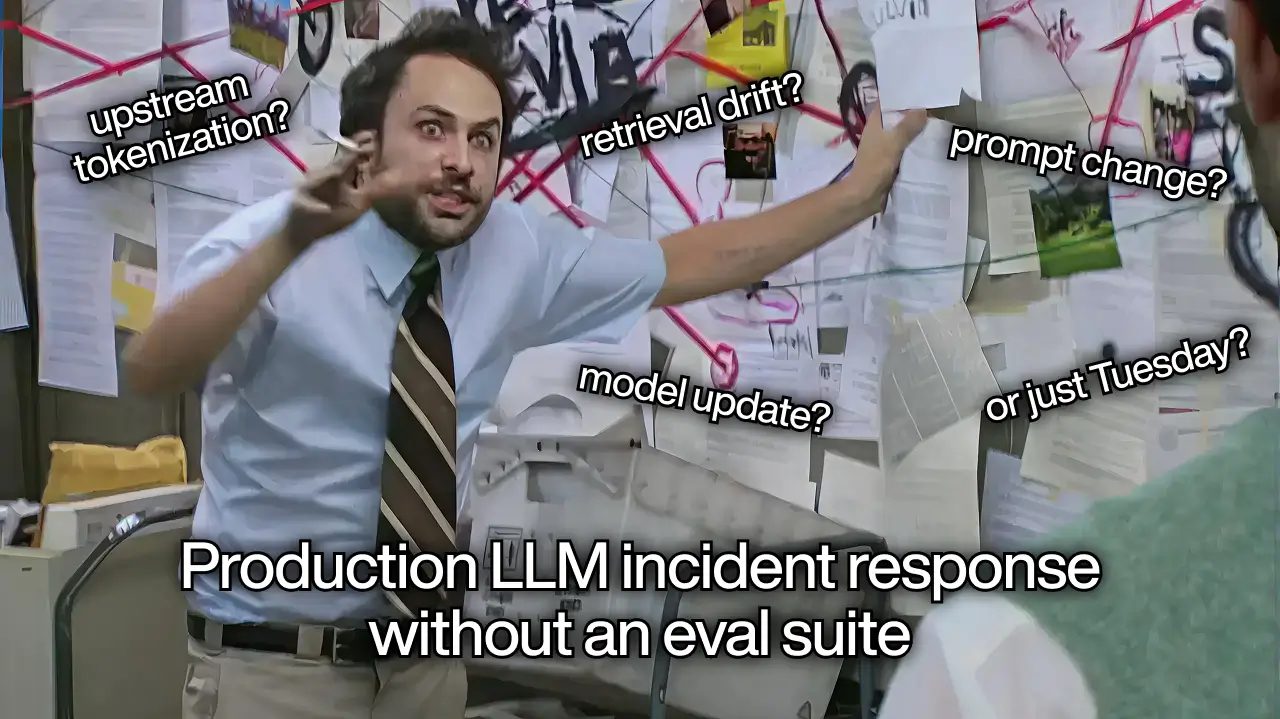
A fintech head of AI emailed Teamvoy in March with one screenshot: a Slack thread between three engineers trying to figure out, in real time, whether a 14% spike in customer-support escalations was a model regression, a retrieval regression, a prompt regression, or a coincidence. They eventually traced it to a vendor model update that quietly changed tokenization for currency strings. The model was fine. The observability was not. This piece is for the head of AI, the VP of engineering, and the risk officer who do not want their next operational incident to look like that. It names the four metrics, the eval pattern, and the on-call structure Teamvoy builds for production LLM workflows in regulated fintech environments.
What does LLM observability actually mean in a regulated fintech context?
Application observability — logs, metrics, traces — answers the question “is the service up?” LLM observability answers a different question: “is the service still doing what we told the regulator it does?”
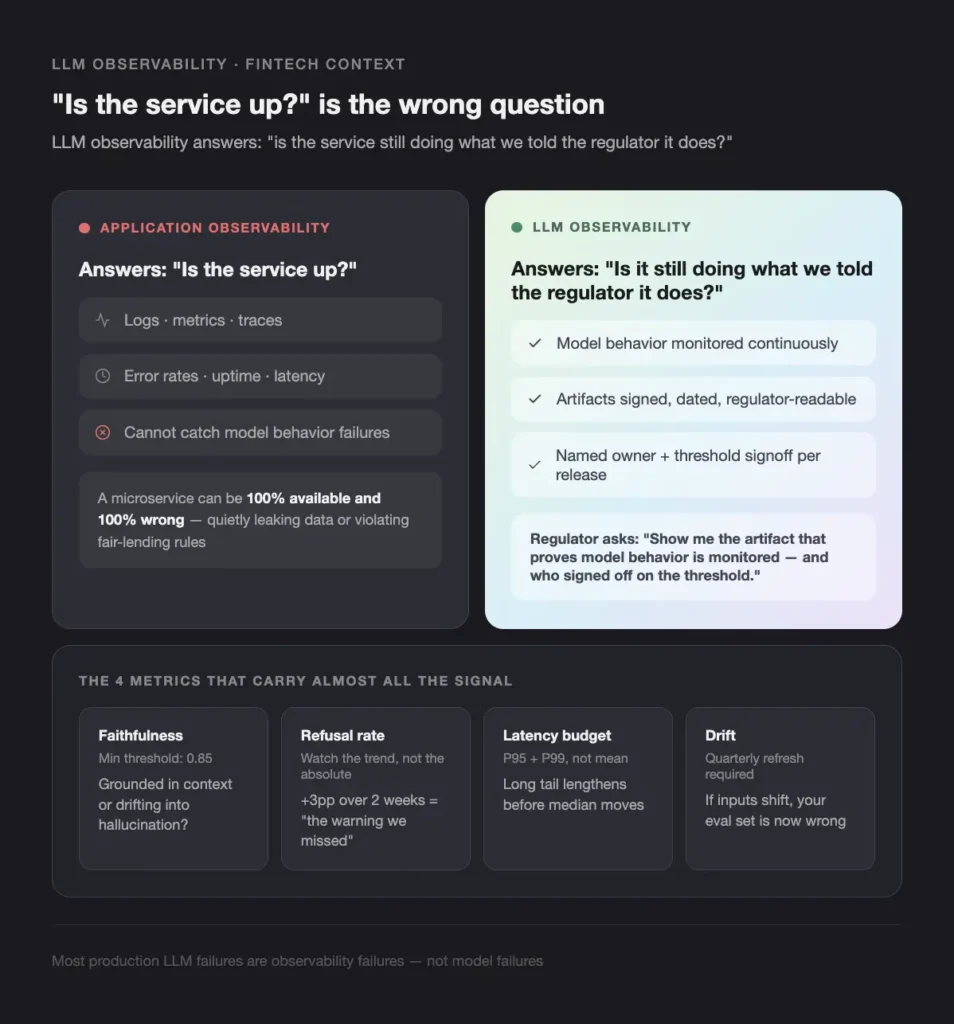
Those are not the same. A microservice can be 100% available and 100% wrong in a way that quietly degrades trust, leaks data, or violates fair-lending rules — and the standard observability stack will not catch any of it.
The regulator framing matters here. An internal model risk committee inside a US bank, an EU AI Act compliance team, or a NYDFS examiner is not going to ask whether your stack uses Prometheus. They are going to ask: “show me the artifact that proves the model behavior is monitored, and show me who signed off on the threshold.”
That artifact has to exist before it is asked for. Most fintech AI teams discover this two weeks before an examination. The teams that ship cleanly build it as part of the deployment, not as an afterthought — the same pattern that separates closed pilots from production wins, which we covered in why most AI pilots in fintech fail to reach production.
Where do most fintech teams get LLM observability wrong in 2026?
Three failure modes show up in almost every fintech LLM stack Teamvoy audits. Naming them once saves a quarter of remediation later.
Treating LLM observability as a logging problem. Application logs answer “did the service run?” They cannot answer “did the model behave correctly?” Teams that ship a logging-heavy stack and call it observability hit the wall the first time a model risk committee asks for an artifact and the team produces a log query.
Building the eval set after the workflow is “working.” Evals built against existing output bias themselves toward what already passes. They miss the regression classes that actually break the model in production — currency tokenization shifts, refusal-rate drift, fairness-sensitive failure modes. Build the eval set in parallel with the workflow, not after it.
Treating the eval suite as a notebook, not a versioned artifact. This is the single most common reason an eval suite fails a regulator review. A Jupyter notebook in a repo is not a versioned eval set with a named owner and a signoff log. The fix is editorial discipline, not a tooling change.
All three fail the same way: the model risk committee asks for the artifact and the team produces a paragraph plus a follow-up meeting. The artifact has to exist before it is asked for. Compare the failure shape to the regulator-ready AI pattern we documented for fintech — the gap is always one of the three above.
Which four metrics catch the LLM regressions your dashboard misses?
Across the production LLM workflows Teamvoy operates inside regulated fintech, four metrics carry almost all the signal. Anything else — token spend, refusal-by-category, eval pass rate per release — is a derived metric that helps diagnose one of these four when it moves.
Faithfulness. Is the model’s output grounded in the retrieved context, or has it drifted into hallucination? Watch the floor. Most regulated workflows we operate hold a 0.85 minimum, with the threshold reviewed and resigned every quarter.
Refusal rate. How often the model declines to answer. The number itself is workflow-specific — a customer-support agent might tolerate 8%, a fraud-explanation agent might tolerate 2%. The trend matters more than the absolute. A quiet climb of 3 percentage points over two weeks is what model risk committees describe in retrospect as “the warning we missed.”
Latency budget. Time-to-answer against the agreed envelope, with variance. Mean latency hides everything. P95 and P99 are what break customer trust, and the way they break is rarely a flat increase — it is a long tail that lengthens before the median moves.
Drift. Is the distribution of inputs or outputs shifting against your eval set? If yes, the eval set is now wrong, and you need a quarterly refresh process — not a one-off panic when the eval results stop matching production.
How do you build an eval suite that survives a model risk review?
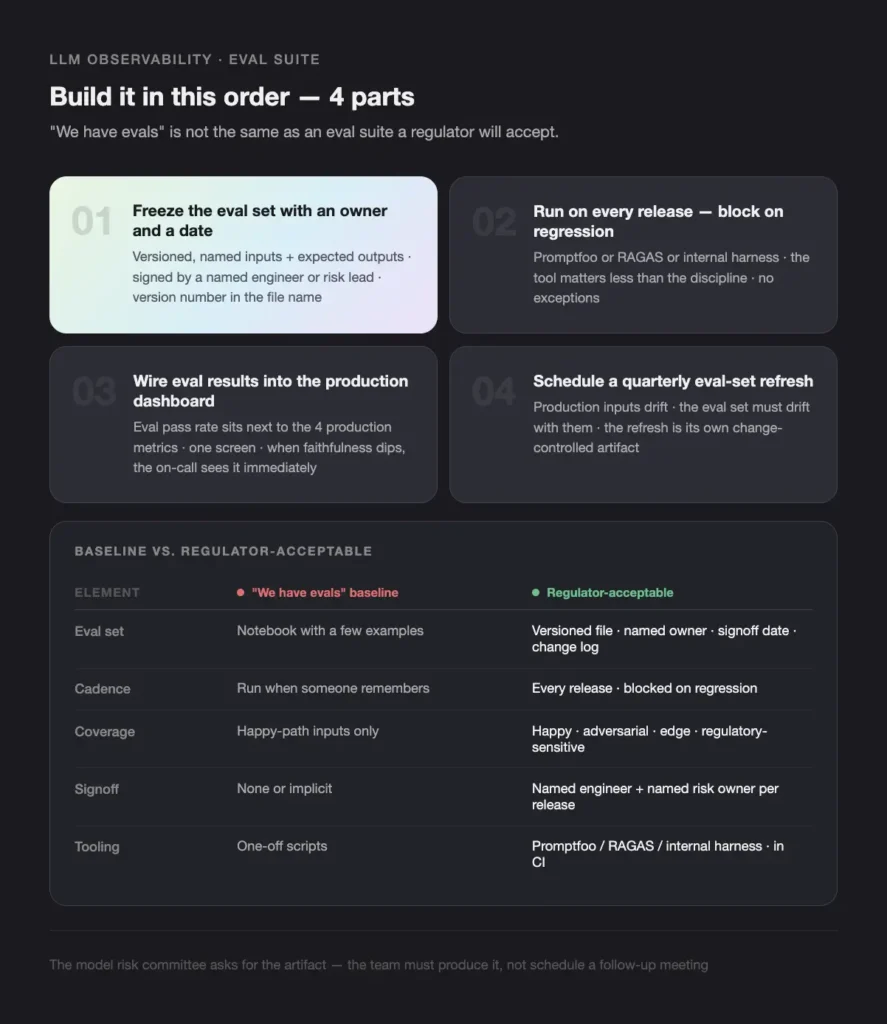
There is a four-part pattern that survives both real production incidents and a regulator’s read-through. It works for retrieval-augmented workflows, agentic workflows, and pure generation workflows; only the eval content changes between them. Build it in this order.
- Freeze the eval set with an owner and a date. A versioned, named set of inputs with expected outputs, signed off by a named engineer or risk lead, with the version number in the file name. If anyone changes it without a new version, the audit trail breaks.
- Run the eval set automatically on every release. Using Promptfoo or RAGAS or an internal harness; the tool matters less than the discipline. Block the release if a defined regression threshold is crossed.
- Wire eval results into the production dashboard. The eval pass rate per release should sit in the same dashboard as the four production metrics. When faithfulness dips in production, the engineer on-call should see in one screen whether the latest eval already caught it.
- Schedule a quarterly eval-set refresh. Production inputs drift; the eval set has to drift with them. The refresh is its own change-controlled artifact, with the same signoff discipline as the original.
The comparison below shows the difference between “we have evals” and an eval suite a regulator will accept. The right column is the bar that earns a clean pass at a model risk committee.
| Element | “We have evals” baseline | Regulator-acceptable eval suite |
|---|---|---|
| Eval set | A notebook with a few examples | Versioned file, named owner, signoff date, change log |
| Cadence | Run when someone remembers | Run on every release, blocked on regression |
| Coverage | Happy-path inputs only | Happy, adversarial, edge, regulatory-sensitive inputs |
| Metrics | Pass / fail | Faithfulness, latency, refusal, plus task-specific |
| Signoff | None or implicit | Named engineer + named risk owner per release |
| Drift handling | Reactive | Quarterly eval refresh, with a documented process |
| Tooling | One-off scripts | Promptfoo / RAGAS / internal harness, in CI |
A note on the open-source vs commercial trade. For most production fintech LLM workflows Teamvoy builds, the open-source stack — Promptfoo or RAGAS for evals, LiteLLM for routing, LangSmith or Langfuse for tracing, Grafana for dashboards — covers the ground. Commercial platforms become worth the cost when there are multiple production models across multiple regulated tenants and a dedicated platform team to operate them.Want the eval-set template Teamvoy uses for fintech engagements, with the four-metric dashboard schema and the on-call runbook structure? Read the regulator-ready AI in fintech guide.
Which LLMOps tools do Teamvoy’s production fintech stacks actually run on?
The short answer: the open-source stack covers the ground at Series B–D fintech scale. Teamvoy moves a workflow to commercial tooling only when there are multiple production models across multiple regulated tenants and a dedicated platform team to operate them. The default Teamvoy production stack for a fintech LLM workflow in 2026:
Layer | Default tool | When we swap |
|---|---|---|
| Evals (retrieval-heavy) | RAGAS | High-volume CI runs or custom metrics → internal harness |
| Evals (general LLM behavior) | Promptfoo | Same as above |
| Model routing / versioning | LiteLLM | Multi-region or custom routing → in-house gateway |
| Tracing | Langfuse (self-hosted) or LangSmith (cloud) | Strict data residency → Langfuse on-prem |
| Dashboards | Grafana on Prometheus | Bank already runs Splunk / Datadog → reuse |
| SOC 2 / compliance | Vanta or Drata | Enterprise running ServiceNow GRC → reuse |
| Vector store | pgvector or Weaviate | Volume above 100M vectors → managed vector DB |
The discipline matters more than the tool choice. Two teams running the same Promptfoo + Langfuse + Grafana stack ship dramatically different results based on whether the eval set is versioned, owned, and signed off per release. Pick the tools, then enforce the discipline. The same operating economics apply to the underlying model spend — see the hidden run-cost traps in AI agents for the per-tenant observability layer this stack must also catch.
When does the on-call pattern have to change for an LLM workflow?
A traditional on-call rotation is built around binary failure: the service is up or down, the error rate is in band or out. LLM workflows fail differently. Faithfulness can decay 6% over a week without a single alert firing on a traditional dashboard. Refusal rates can climb in a way that quietly damages customer experience long before anyone notices. The on-call structure that holds for an LLM workflow has three differences from a standard service rotation.
First, the runbook has to include statistical responses. When faithfulness drops below threshold, the answer is not “restart the service” — it is “roll back to the previous model version, page the eval owner, open the incident with the eval results attached.” That sequence has to be written down, because it is the wrong sequence to invent at 2am.
Second, the on-call engineer has to know how to read the eval suite. This is a training delta, not a tooling delta. Most production support engineers can read application logs; very few have seen a versioned eval set. The fix is to pair the eval owner with the on-call rotation for a quarter and let the patterns spread.
Third, the post-incident review for an LLM workflow has to feed the eval set. Every real production incident is also a missing test case. A team that fixes the bug without adding the case to the eval set will see the same regression class within a quarter. Teamvoy treats the eval-set update as part of incident closure, not a follow-up item.
How should you sequence the observability build before a regulator audit?
An 8–12 week sequence works for most fintech teams shipping a first regulator-facing LLM workflow. The order matters: each step builds the artifact the next step depends on.
- Weeks 1–2: Eval set v1 in version control. A named owner, a dated signoff, the four production metrics defined, the dashboard wireframed. Skip this and everything downstream becomes editing instead of building.
- Weeks 3–5: Eval suite running on every release. Promptfoo or RAGAS wired into CI. The dashboard live with faithfulness, refusal, latency, and drift instrumented. Regression block on every release.
- Weeks 6–8: Runbook drafted, on-call rotation trained. The three most likely LLM incident classes documented with rollback sequences in writing. The on-call engineer paired with the eval owner for at least two on-call cycles.
- Weeks 9–12: First quarterly eval refresh dry-run, model risk committee artifact prepared. Refresh the eval set against current production inputs. Produce the regulator-readable artifact: versioned eval, run history, signoff log, threshold rationale.
The sequence assumes a 4–6 person team with one founder-engineer or lead holding the observability roadmap while the rest continue product work. Pulling the whole team off product for the scaffold is a common over-correction — it slows the build instead of speeding it. The procurement frame for bringing in an embedded partner here is the same one we use for AI engineering decisions more broadly.
What does success look like for LLM observability at day 90?
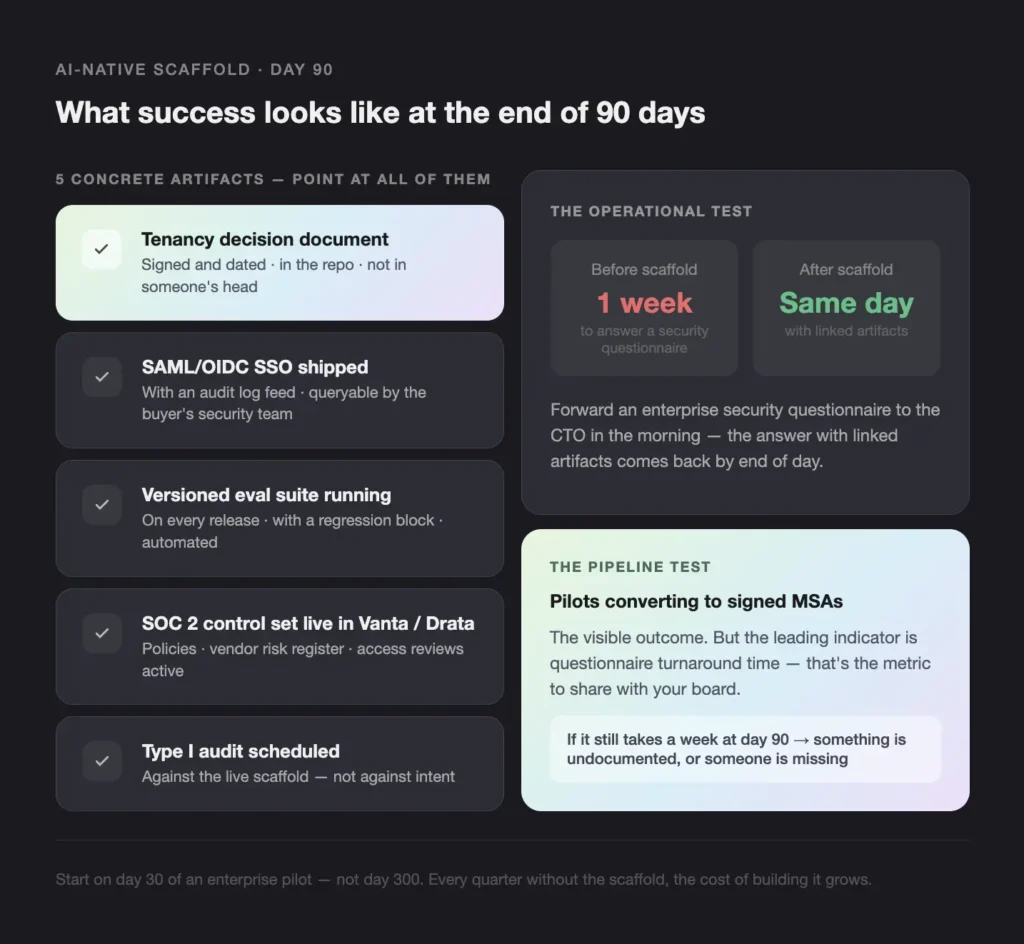
A fintech head of AI running this stack should be able to point at five concrete artifacts at the end of quarter:
- A versioned eval set in the repo, with a named owner and a signoff log per release.
- Faithfulness, refusal, latency, and drift metrics live in a single dashboard the on-call engineer reads.
- A documented runbook for the three most common LLM incident classes, with the rollback sequence in writing.
- A quarterly eval-refresh process scheduled, with the next refresh on the calendar.
- A model risk committee artifact the team can produce in 90 seconds when asked, not 90 minutes.
The operational test sharpens the picture. The next time a customer-support escalation spikes, the on-call engineer should know within 20 minutes whether the cause is a model regression, a retrieval regression, a prompt change, or upstream — and which release introduced it. If the answer still takes a day, the stack is not done; something is unmeasured or unowned. The downstream test is regulator-side. The next time a model risk committee asks for the eval signoff log, the team should produce it in one minute, dated, signed, with the relevant release version attached. That is the bar.
How does Teamvoy help fintech teams ship regulator-ready LLM observability?
Teamvoy embeds with fintech engineering teams to build exactly the stack this piece describes — the four-metric dashboard, the versioned eval suite, the regulator-acceptable signoff log, and the on-call runbook that reads statistical failure rather than binary failure. The engagement model is senior-led and explicitly designed around the handover deliverable. When the engagement closes, the in-house team owns the eval suite, the dashboards, the runbook, and the documented refresh process — not a vendor.
The delivery team works across fintech in the United States and the Nordics, with fluency across the regulator surfaces that read the artifacts on the other side: SR 11-7 model risk, the EU AI Act, NYDFS Part 500, DORA, and the internal model risk committees inside US and EU banks. Teamvoy’s three pillars run through every engagement — AI transformation (not AI tourism), engineering depth (not just prompt engineering), and regulated-industry fluency. If you are running a production LLM workflow with the eval suite in a notebook, book a Teamvoy observability review and we will scope an 8–12 week scaffold against your stack.
Conclusion
A production LLM in a regulated fintech context is an operational system, not a model. The teams that hold the regulator’s trust over years are the ones whose eval suite is signed, versioned, and run on every release, whose four production metrics are visible to the engineer on-call, and whose on-call rotation knows what to do when the metrics move. Most failures are observability failures. The fix is a stack, not a smarter model. Start it on the day the model goes to production, not the day before the audit.