TL;DR
Q1: What does AI implementation actually cost in 2026?
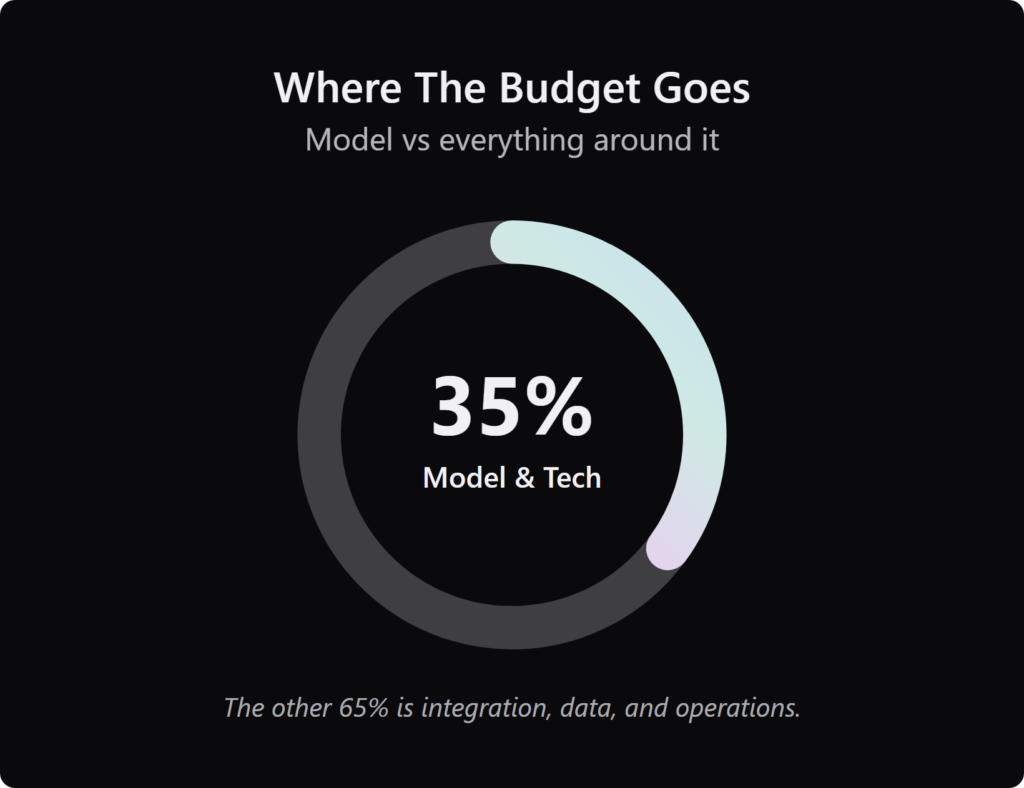
Most businesses spend $40,000 to $400,000 on their first AI project. Enterprise production systems run $500,000 to $1.5M. But the model is the cheap part. Technology is only 30 to 40% of total cost. The other 60 to 70% is integration, data work, training, and change management. A basic chatbot starts at $8K to $15K, a RAG system runs $120K to $350K, and an enterprise platform clears $500K.
💰 The numbers that actually matter
Here is the quick map by project type, so you can find your row fast.
| Project type | Typical first-year cost |
|---|---|
| Basic chatbot | $8K to $15K |
| Standalone AI feature | $40K to $150K |
| Custom ML model | $80K to $350K |
| RAG or GenAI app | $120K to $350K |
| Enterprise platform | $500K to $5M+ |
A CFO asked me a sharp question last quarter. How much of my $500,000 is buying actual AI intelligence, versus plumbing that just keeps the thing from deleting my production database? That question is the whole article.
❌ Why the sticker price lies
The license quote you get from a vendor is the down payment, not the bill. In the projects I have led over twelve years, the model and the API are rarely where the money goes.
The expensive part is everything around the model. Data preparation, system integration, retraining, monitoring, and the people who keep it honest. Writing code has always been the cheapest part of software. Making it correct is what costs you. This is why our AI consulting work starts with the data layer, not the model.
This matters right now because the failures are public. By recent enterprise estimates, around 95% of generative AI pilots have not returned a single dollar of measurable value. That is not a model problem. That is a plumbing and data problem.
✅ What this article does differently
I am going to price every line item, not just the headline range. Discovery, data labeling, infrastructure, tokens, integration, retraining, monitoring, and human review. For a deeper breakdown, see our AI integration cost guide.
At Teamvoy, the first two questions I ask on any AI cost call are about the data layer and the legacy core, never the model. That order is the difference between a budget that holds and one that doubles. The sections below follow that same order, and our AI integration services are built around it.
“Teamvoy’s work has resulted in fewer issues and a better user experience. We’re impressed with their involvement in processes and quick completion of work.” Dmytro Maryanych, Manager, Takflix Teamvoy Clutch Verified Review
Q2: What are the upfront costs, discovery, data labeling, infrastructure, and integration?
Upfront AI costs split into five buckets. Strategy and planning ($20K to $80K), data preparation (20 to 40% of total project cost), infrastructure (under $1K for simple ML to over $100K per run for large models), model development (fine-tuning $20K to $80K), and integration ($5K to $25K per API connection). Data prep and integration, not the model, dominate the bill.
💰 The upfront line items, priced
Here is the one-time build, bucket by bucket.
| Line item | Typical range |
|---|---|
| Strategy and planning | $20K to $80K |
| Data preparation | 20 to 40% of project cost |
| Infrastructure provisioning | under $1K to $100K+ per run |
| Model development (fine-tuning) | $20K to $80K |
| Integration | $5K to $25K per API connection |
⚠️ Data prep is the silent 20 to 40%
Data preparation is the quietest line item and one of the largest. It eats 20 to 40% of the total budget before a model does anything useful.
Cleaning, labeling, and structuring data is slow, manual work. On a stack without a clean data layer, AI integration takes longer than the model demo suggests. I say that to every client before we start, and it shapes how we scope data engineering on every project.
❌ The integration trap
The biggest overlooked cost is not inference. It is integration. I have watched teams burn half a million dollars in salary on plumbing alone, connecting one system to another.
Think of it as the brain versus the nervous system. Everyone obsesses over the model, the brain. But even a top model is useless when it gets bad data or cannot trigger actions reliably. The nervous system is integration, and it is where budgets quietly die.
The hidden risk is ownership. Build a custom integration layer and you become Chief Integration Officer forever. You maintain every API schema, field mapping, and retry path. We pick up systems where a previous vendor left exactly that mess behind, and our system integration work starts by untangling it.
💸 Infrastructure has trapdoors
Infrastructure looks cheap until storage and data transfer surprise you. Two traps recur. First, hot storage: leave 2PB sitting in always-on storage without lifecycle tiering, and you can generate a six-figure monthly bill (over $100K) for data nobody reads.
Second, egress. One CFO handed me an AWS bill with a $50,000 line for data transfer out. An on-premise cluster was pulling terabytes from cloud storage over public internet. Architecture is not just connectivity. It is tariff management, and it is exactly what our cloud optimization reviews catch early.
“I can confidently say that we would not be where we are today without Teamvoy’s support.” Gordon Little, Managing Director, Iress Teamvoy Clutch Verified Review
Q3: How much do tokens and inference compute really cost, and why do bills explode?
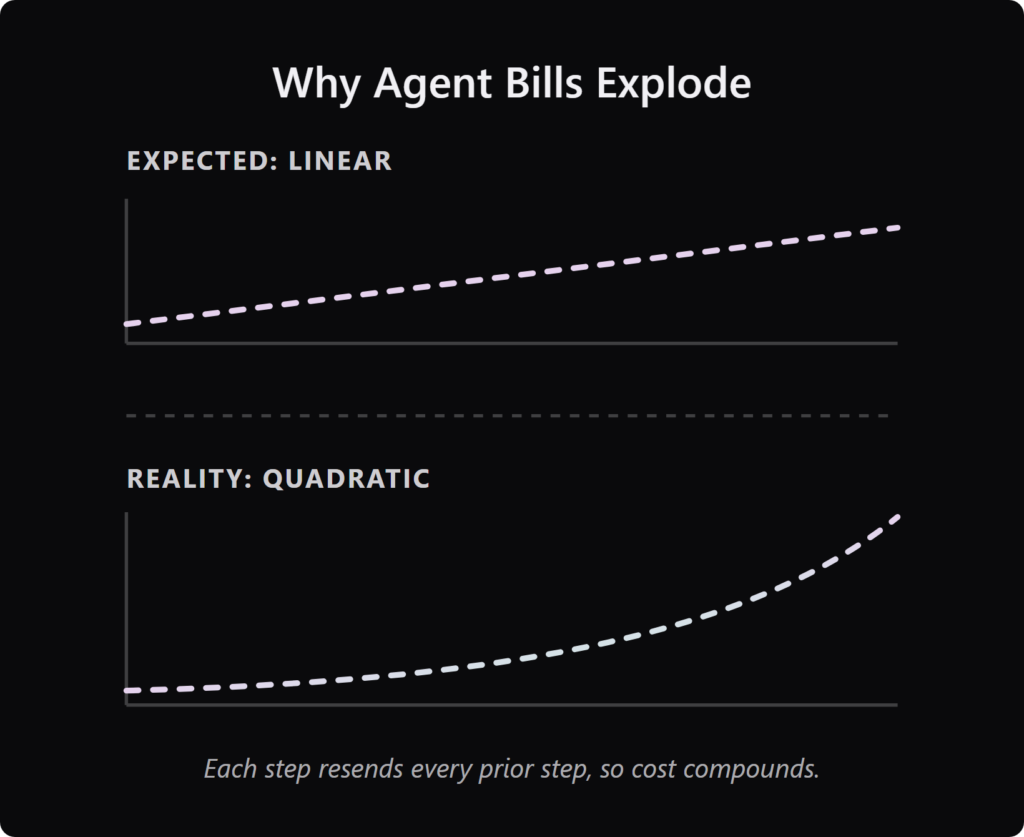
Token and inference costs run from $300 to $20,000+ per month. But the danger is non-linearity. Because LLM APIs are stateless, agent frameworks resend the entire cumulative log each step. So token use grows quadratically. A 20-step loop costs far more than twice a 10-step run. Left unmonitored, some firms racked up $150,000 in a single billing cycle with zero business output.
💸 The quadratic billing bomb
Here is the mechanic, in plain terms. Most LLM APIs are stateless. They remember nothing between calls.
So an agent framework has to resend the whole history every step. Every tool call, every error message, and every prior reply gets re-sent each time. A 20-step task is not twice a 10-step task. It is exponentially more expensive, because each step carries the full weight of every step before it.
⚠️ The 40% “dumb zone”
There is a second trap inside the context window, the model’s working memory. Around the 40% mark, you hit diminishing returns.
A 168,000-token window starts degrading well before it is full. Load it with tool definitions dumping raw JSON and IDs, and you do all your work in the dumb zone. You pay for more tokens and get worse answers. Avoiding that is part of how we scope AI agent development services.
⏰ The $4,200 nap
One incident makes this concrete. A developer deployed a customer support agent that got stuck in an infinite retry loop with a CRM tool.
There was no circuit breaker, a hard stop that kills a runaway process. The agent repeated the same broken action for six hours while the developer slept. The bill: around $4,200 in API charges, for nothing. When a CFO asks the engineers what happened, they often have no answer.
I do not treat this as a model problem. It is a delivery-discipline problem. A circuit breaker is a half-day of engineering that saves you a five-figure surprise, and it is standard in how we build AI autonomous agents.
💰 Token prices, and the deflation tailwind
The good news: per-token prices keep falling. Inference cost for a comparable capability tier dropped roughly 280x between 2022 and 2024, and kept deflating into 2026. Do not over-budget the raw token rate.
| Model tier (2026) | Input / output per million tokens |
|---|---|
| Budget (Gemini Flash-Lite class) | $0.10 / $0.40 |
| Workhorse (mid-tier) | $0.30 to $3.00 range |
| Frontier (Claude Opus class) | $5.00 / $25.00 |
The spread is the point. A workhorse model can cost 30 to 60x less than a frontier model, with only a 10 to 15% reliability gap on many tasks. More on that lever later. We weigh it on every AI development services engagement.
“Their technical expertise was top class.” George Harrap, CEO, Bitspark Teamvoy Clutch Verified Review
Q4: What do ongoing retraining, monitoring, and human review cost after launch?
Ongoing costs are where forecasts break. Monitoring and observability run $30,000 to $100,000 per year. Retraining costs 15 to 25% of the initial build annually. Human review (RLHF, QA, exception handling) is a permanent line item, not a phase. Roughly 85% of organizations miss their cost forecasts by more than 10%, because they budget the build and forget the operation.
💰 The recurring run-rate
Add these to your annual model, every year.
| Ongoing line item | Basis | Annual range |
|---|---|---|
| Monitoring and observability | Per system | $30K to $100K |
| Retraining | 15 to 25% of initial build | varies with build size |
| Human review (QA, RLHF) | Ongoing headcount | permanent |
| Compliance overhead | +30 to 60% in regulated sectors | varies |
⚠️ Monitoring is not optional
Monitoring is the cost teams cut first and regret first. A model that worked at launch drifts as the world changes around it.
In regulated work, this is not a nice-to-have. Auditable monitoring is how you survive a BaFin, DORA, or HIPAA review. I have sat in those rooms. The auditor does not want a demo. They want the logs. That discipline sits at the center of how we deliver banking and fintech systems.
💸 Retraining is a yearly bill, not a one-off
Retraining costs 15 to 25% of your initial build, every year. A model is a perishable asset. Treat it like one in the budget.
Around 70% of AI systems need continuous retraining and monitoring to stay accurate. If you only funded the build, you funded half the project. Keeping a system honest over years is what our technology modernization work is built for.
❌ “Almost right” is the expensive failure mode
Human review is where most budgets are blindest. The dangerous output is not the wrong one. It is the one that is almost right.
Completely wrong gets caught. Tests fail, the build breaks, and someone notices. Almost right passes code review and ships to production. It then sits in your codebase for six months until someone finds it, and by then the cost to fix has compounded into something nobody budgeted. The most expensive code your AI writes is the code that almost works.
This is why we keep a human in the loop on regulated delivery. The goal is not a clever deployment. It is processes that keep delivering correct results after we leave, and a quick IT audit is the fastest way to see where yours stand.
“We were impressed with the technical management, adherence to process, and technical capability of the engineers.” Mark Phillips, CTO, Robots and Pencils Teamvoy Clutch Verified Review
Q5: How much should you budget by company size?
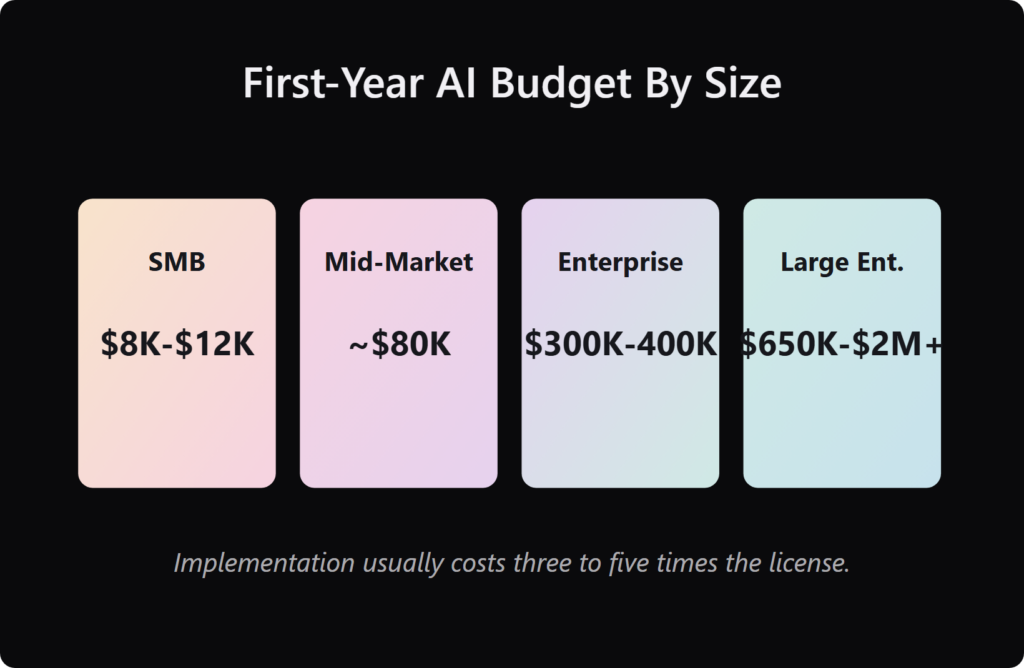
Budget scales sharply by size. Startups and SMBs spend $3K to $30K per year on off-the-shelf SaaS AI. Mid-market firms run around $80K first-year with light custom integration. Enterprises spend $300K to $400K first-year on multi-department platforms, and large enterprises $650K to $2M+. The catch: implementation typically costs 3 to 5x the advertised subscription price. The license is the down payment, not the bill.
💰 Find your row
Locate your band, then plan for the implementation multiplier on top.
| Segment | Typical ACV | Median first-year | Seats | Discount threshold |
|---|---|---|---|---|
| Startup / SMB | $3K to $30K | ~$8K to $12K | 5 to 25 | Minimal |
| Mid-market | $20K to $150K | ~$80K | 25 to 150 | $50K+ ACV |
| Enterprise | $150K to $600K | $300K to $400K | 150 to 500 | $200K+ ACV |
| Large enterprise | $500K to $5M+ | $650K to $2M+ | 500 to 5,000+ | Fully negotiated |
⚠️ When you should not custom-build
Here is the part most cost guides skip. Buying beats building for most companies below the enterprise line.
Build your own only if two things are true at once. You have a dedicated platform team, and your core systems are genuinely unique. If either is missing, a custom build becomes a maintenance bill you cannot staff, which is where our IT cost optimization reviews usually start.
Across 150+ projects, the pattern I see most is SMBs over-buying engineering they do not need. A founder pays for a custom model when a $30 seat license would have done the job. I will tell a client that, even when it shrinks the engagement. Trust is built through results, not by selling more hours, which is the same posture we bring to AI consulting.
“Teamvoy provided expertise in cryptocurrency, financial trading, and web and mobile development to manage the growth of a product suite.” George Harrap, CEO, Bitspark Teamvoy Clutch Verified Review
Q6: Which pricing model are you actually buying, seat, usage, project, or hybrid?
AI is sold four ways. Per-seat (around 15% of the market), usage or consumption (around 28%), project or CapEx (around 5%), and hybrid base-plus-overage (around 41%). The model you pick decides your risk. Hybrid plans charge 1.5 to 3x for usage over committed thresholds, and renewals carry 8 to 12% uplifts. Multi-year commits cut 20 to 35%. Always cap renewal increases at CPI or 3 to 5% at signing.
💰 The four models, and who uses them
Match the model to the workload, not the hype.
| Model | Share of market | Who uses it | Hidden-cost risk |
|---|---|---|---|
| Hybrid (base + overage) | ~41% | Enterprise SaaS, platforms | Overage 1.5 to 3x committed rate |
| Usage / consumption | ~28% | LLM APIs, infrastructure | Bills scale with traffic, hard to forecast |
| Per-seat | ~15% | Productivity, coding tools | Seat overages 110 to 125% of rate |
| Project / CapEx | ~5% | Custom builds, consulting | Scope creep, change orders |
⚠️ Where the meter runs against you
Two clauses quietly inflate the bill. First, overages: cross your committed usage and you pay a punitive 1.5 to 3x rate on the excess.
Second, renewal uplift. Vendors routinely add 8 to 12% per year at renewal. Over a three-year term, that compounds into real money you never agreed to up front. Modeling that exposure is part of how we scope an IT audit.
✅ The levers that actually move price
You have more room than the order form suggests. The biggest discounts come from commitment and competition.
- Multi-year commit (2 to 3 years): 15 to 35% off, the highest-impact lever
- Competitive bid or named alternative: 10 to 25% off
- Annual upfront payment: 5 to 15% off
- Quarter-end or year-end timing: 5 to 20% extra concession
- Renewal cap at CPI or 3 to 5%, negotiated at signing
The principle I hold with clients is reliability-adjusted value. Pick the model that fits the use case, not the most expensive tier on the page. We help teams price that trade-off before they sign, not after the first overage invoice lands, and it informs every AI integration engagement we run.
“Teamvoy is very collaborative and able to deliver innovative solutions for all our business needs.” Anonymous, COO, Marketing Company Teamvoy Clutch Verified Review
Q7: Why do AI budgets get destroyed, cloud shock, compliance, and rework?
AI budgets break on costs that never appear in the proposal. Compliance adds 30 to 60% in regulated industries. “Cloud shock,” rehosting without rightsizing, amplifies your existing inefficiencies at a higher price point. And repairing a failed AI implementation averages around €710,000, often double the original budget, because almost-right code ships, then compounds.
💸 Cloud shock is a math penalty, not bad luck
Cloud shock is not a failure of the cloud. It is the math penalty for running elastic infrastructure with a static data-center mindset.
Rehosting a wasteful system just makes the waste more expensive. You move the same idle servers to a meter that never stops. Adding AI to an unstable stack is like bolting a turbocharger onto an engine that already misfires. You get more speed and more failure, faster, which is why our cloud optimization work runs a rightsizing gate first.
⚠️ The compliance premium is real and recurring
In regulated work, compliance adds 30 to 60% to the bill. That is not waste. It is the cost of auditable delivery under BaFin, DORA, HIPAA, or PCI-DSS.
I have sat through these audits. Downtime in these systems is a regulatory event, not an inconvenience. The teams that under-budget compliance are the ones that call us after a failed audit, not before, and it is the core of how we deliver banking and fintech systems.
❌ Free AI code is the most expensive debt
Here is the trap catching the vibe-coded founders right now. By saving on developers today, teams take a high-interest loan against their future.
The interest is technical debt, and it compounds fast. By one estimate, it would take 61 billion work-days to pay off the world’s current technical debt. Free code is rarely free. It is the most expensive code you can ship, because someone has to make it correct later, a pattern we unpack in our piece on the tech debt avalanche.
💰 Why rework costs double
A failed implementation does not just stall. It costs around €710,000 to repair, frequently twice the original budget.
The reason is the almost-right failure mode from earlier. Broken code gets caught; almost-right code ships and rots for months. This is the exact situation we get called into: a system a previous vendor walked away from, now mid-crisis. Fixing it is closer to taking over someone else’s patient than starting fresh, and it is the heart of our technology modernization work.
“I can confidently say that we would not be where we are today without Teamvoy’s support.” Gordon Little, Managing Director, Iress Teamvoy Clutch Verified Review
Q8: How do you cut AI costs without breaking reliability?
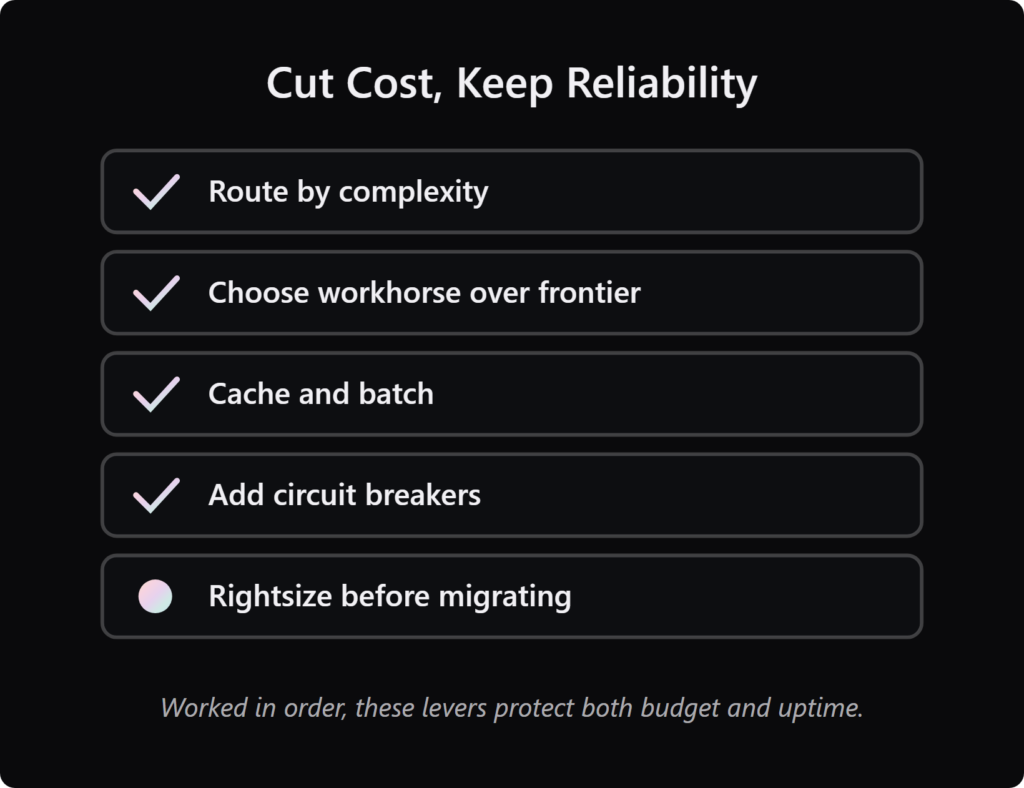
You cut AI costs by routing work to the right model, not the frontier model. Complexity-based routing can reduce API bills by up to 96%. It sends formatting, extraction, and classification to cheap models, and reserves expensive reasoning models for the hard tasks. Workhorse open models cost 30 to 60x less than frontier models, while giving up only 10 to 15% reliability. Then add circuit breakers, caching, and a pre-migration rightsizing gate.
✅ The five levers, with the trade-off named
Work these in order. Each one names what you give up, so it stays honest.
- Route by complexity. Send simple tasks to cheap models, hard reasoning to expensive ones. Dynamic routing can cut API bills up to 96%. Trade-off: you build and maintain the router.
- Choose workhorse over frontier. A workhorse model costs 30 to 60x less, with a 10 to 15% reliability gap. Ask if you can trade a little reliability for a large ROI on that specific task.
- Cache and batch. Reuse repeated prompts and run non-urgent jobs in batch. This can cut inference bills 60 to 80%. Trade-off: batch is slower, not real-time.
- Add circuit breakers. A hard stop kills a runaway agent before it bills you for six hours of nothing. Half a day of work prevents a five-figure surprise.
- Run a rightsizing gate before migrating. Eliminate excess capacity before you move, not after. Move waste and the cloud just charges you more for it.
These levers shape how we deliver AI development services on systems that have to stay up.
⚠️ The discipline behind the savings
These are not clever tricks. They are delivery discipline, the boring habits that hold up in production.
One more lever I lean on: standardize through migrations. When you remove old code paths, also remove the duplicate database clients and logging frameworks underneath. Fewer moving parts means less to review, less to monitor, and less to break, which is the operating principle behind our system integration work.
Where my view sits right now: most teams chase the smartest model when the real win is a cheaper one wired correctly. We have run this pattern on systems that have to stay up, and the savings are real, but they come from architecture, not from a single setting. If your bills are climbing, a focused cost optimization review is the fastest place to start.
“We were impressed with the technical management, adherence to process, and technical capability of the engineers.” Mark Phillips, CTO, Robots and Pencils Teamvoy Clutch Verified Review
Q9: Should you build or buy? A three-year CapEx vs OpEx ownership scorecard
Over three years, building enterprise AI typically runs $3M to $4M. That splits into development of $500K to $3M as CapEx, plus annual maintenance of $200K to $1M and infrastructure of $100K to $500K as OpEx. Buying trades that for subscription plus integration. The real question is not build versus buy. It is which layer to own. Build only with a dedicated platform team and genuinely unique core systems. Otherwise, you become Chief Integration Officer forever.
💰 The three-year split, CapEx vs OpEx
CapEx is the one-time spend to build the asset. OpEx is the recurring cost to keep it running. Both have to live in the same plan.
| Criteria | Build | Buy | Partner |
|---|---|---|---|
| 3-year TCO | $3M to $4M | Subscription + integration | Scoped, mid-range |
| Control | Full | Limited | Shared |
| Speed to value | Slowest | Fastest | Fast |
| Maintenance burden | You own all of it | Vendor owns core | Senior lead owns the system |
| Main risk | Staffing the upkeep | Lock-in, overages | Choosing the wrong partner |
⚠️ The decision rule
Here is the rule I give founders. Build only if two things are true at once: you have a platform team you can keep, and your core systems are genuinely unique.
If neither holds, building is a slow way to take on debt. AI code written to save money today is a high-interest loan against tomorrow. Fresh AI dropped into your codebase has no memory of how the system works, like a stranger waking up with no idea what they were doing. This is the exact territory our legacy software recovery plan was written for.
This is the work we do at Teamvoy: the partner column, full-cycle, with a senior engineer who owns the system end to end. Not a junior team that cycles through and exits. Our honest limit: a rewrite is sometimes the right call, and when it is, we say so. When it is not, our AI modernization sprints are built for teams that cannot afford one.
“I can confidently say that we would not be where we are today without Teamvoy’s support.” Gordon Little, Managing Director, Iress Teamvoy Clutch Verified Review
Q10: What’s the smartest first move if your AI pilot has already stalled?
If your pilot stalled, do not restart. Audit it first. Pull the real line items, instrument token spend with hard circuit breakers, and fix the integration layer before you touch the model. Most stalled pilots fail on plumbing and data, not intelligence. The cheapest next step is a short audit that tells you which dollars bought capability, and which bought debt.
✅ The three-step triage
Do these in order, this week. None of them require a new budget.
- Pull the line items. List every real cost: tokens, integration, monitoring, and people. You cannot fix a bill you cannot see.
- Instrument spend with circuit breakers. Add a hard stop so a runaway agent cannot bill you for six hours of nothing.
- Fix integration before the model. The bottleneck is almost always the data layer and the connections, not the intelligence.
A focused IT audit is the fastest way to run this triage on a system that is already live.
⏰ The conversation worth having
I have watched a lot of teams reach this exact point. The “year of the agent” turned into a pile of stalled pilots, and the budget went somewhere nobody can fully explain.
If that is you, the move is not a bigger model. It is a clear-eyed look at where the money went and what is actually broken. A 3-to-5-day audit surfaces the risk and a plan. It does not ship the fix, but it tells you the truth. That is the work we do at Teamvoy through our AI integration services, and the door is open if you want to talk it through.
“Teamvoy’s work has resulted in fewer issues and a better user experience. We’re impressed with their involvement in processes and quick completion of work.” Dmytro Maryanych, Manager, Takflix Teamvoy Clutch Verified Review