- No single AI app development company is best for everyone; the right partner depends on whether you are stabilising, modernising, or validating a system.
- Evaluate every vendor on four axes most roundups skip: IP rights, agentic maturity, compliance posture, and time-to-prototype.
- Beware AI washing; ask to see a production system under load and a failure the team survived, not a happy-path demo.
- Ownership is not automatic, so demand a present-tense assignment clause covering source code, prompts, and fine-tuned model weights.
- Time-to-prototype misleads buyers; measure time-to-production-readiness and maintainability, and budget for the multi-year cost of owning the system.
- The cheapest model over time is the one where someone is still accountable after go-live, not the fastest or lowest hourly rate.
Q1. Which AI app development company is right for your situation in 2026?
No single AI app development company is best for everyone in 2026. The right partner depends on your situation: a CTO stabilising a system someone else broke, a founder modernising a legacy core, an IT director facing a compliance deadline, or a founder whose AI-built MVP has stalled in production. This guide maps 14 firms against four axes most roundups skip: IP rights, agentic maturity, compliance posture, and time-to-prototype. Read it as a field note, not a league table.
🧭 Why this is a high-stakes call, not a vendor search
I have spent twelve years watching the wrong partner choice compound quietly. The damage rarely shows up on day one.
It shows up six months in, when the code nobody can read starts failing in production. As one engineer put it, “almost right” is the most expensive failure mode, because it passes code review, ships, and then “sits in your codebase for six months before anyone realizes it’s wrong.”
By then the cost to fix has compounded. So the real question is not “who builds AI apps.” It is “who leaves me with a system I can still own, audit, and hire into a year from now.”
⚠️ The “AI washing” problem you are actually screening for
Here is the uncomfortable part. A lot of “autonomous AI” delivery in 2026 is human teams doing manual work behind a marketing layer.
Gartner placed AI agents and AI-ready data among the fastest movers on its 2025 Hype Cycle, while generative AI slid into the trough of disillusionment. That gap, between the demo and the durable system, is what this guide helps you read.
Our Evaluation Criteria
I picked four criteria because they decide whether you own a durable system or inherit a liability. They are the four axes in the title, and every provider card below is assessed on the same four, in the same order.
- 💼 IP rights. Who owns the code, the prompts, and any fine-tuned model weights when the engagement ends. This is contractual, not automatic, and most buyers never check it.
- 🤖 Agentic maturity. Whether the firm ships real agent systems with guardrails (context control, circuit breakers, cost limits), or just wires up a chatbot and calls it autonomous.
- 🛡️ Compliance posture. Which named frameworks the firm can actually deliver under (SOC 2, ISO 42001, NIST AI RMF, HIPAA, GDPR, DORA, PCI-DSS), and whether that is proven or merely claimed.
- ⏰ Time-to-prototype. How fast the firm reaches a working prototype, and (more important) how honestly it separates a demo from a production-ready system.
Who This Guide Is For
- A CTO who inherited a broken or half-built system and needs a partner who stabilises rather than restarts. You are evidence-led and tired of “transformation” decks.
- A technical founder sitting on a legacy core who wants AI added without a risky rewrite or handing authorship to a vendor who does not understand the original product.
- An enterprise IT director in a regulated environment with a compliance deadline (DORA, HIPAA, PCI-DSS, BaFin) who needs auditable delivery, not a junior team that exits before go-live.
- A founder whose AI-assisted MVP (built with Cursor, Replit, Vercel v0, or freelancers) now has unstable production and code nobody fully understands.
The Companies in This Guide
These are kinds of partners, not ranks. Each line names the situation the firm genuinely fits.
- Teamvoy: Best for regulated or legacy systems that need AI added without a rewrite, under a senior lead who owns the system long-term.
- HatchWorks AI: Best for teams that want a structured “generative-driven development” process with US-nearshore delivery.
- Azumo: Best for nearshore AI and data engineering augmentation on an existing roadmap.
- NineTwoThree AI Studio: Best for founders going from concept to an AI-enabled MVP with strong product and UX support.
- BlueLabel: Best for enterprises layering an AI assistant onto a legacy ERP or manufacturing data stack.
- DOOR3: Best for mid-market and enterprise teams that want UX-led custom software with AI built in.
- Achievion Solutions: Best for early-stage AI proof-of-concept and MVP validation before a larger build.
- Orases: Best for US-based custom AI development and practical AI enablement for non-technical teams.
- Dualboot Partners: Best for scale-ups needing embedded product engineering with AI capability.
- Vention: Best for fast capacity scaling through embedded, sprint-cadence staff augmentation.
- HatchWorks-adjacent boutiques (Diffco AI, GenAI.Labs): Best for narrowly scoped applied-ML and generative builds.
- SOLTECH: Best for Southeast-US buyers wanting custom software with local accountability.
- Sidebench: Best for venture-style product design and build for enterprise innovation teams.
- Imaginovation: Best for SMB and mid-market web and mobile AI app builds on a fixed scope.
Master Comparison Table
| Company | Best For | Engagement Model | Industry Depth & Compliance Coverage |
|---|---|---|---|
| Teamvoy | Regulated or legacy systems needing AI without a rewrite | Long-term partner (4+ year average) | Fintech, insurance, healthcare, manufacturing, SaaS; delivery under SOC 2, PCI-DSS, HIPAA, GDPR, DORA, and PSD2 contexts |
| HatchWorks AI | Structured generative-driven development with nearshore teams | Long-term partner / staff augmentation | SaaS, healthcare, fintech; SOC 2-aware delivery |
| Azumo | Nearshore AI and data engineering augmentation | Staff augmentation | SaaS, media, finance; varies by engagement |
| NineTwoThree AI Studio | Concept-to-MVP with AI and product depth | Project-and-exit / product studio | Startups, healthcare, fintech; varies by engagement |
| BlueLabel | AI assistant on legacy ERP / manufacturing data | Project-and-exit | Manufacturing, enterprise; not typically regulated-finance scoped |
| DOOR3 | UX-led custom software with AI | Project-and-exit / long-term | Enterprise, healthcare, finance; varies by engagement |
| Achievion Solutions | Early AI PoC and MVP validation | Project-and-exit | Cross-industry, education, health data; varies by engagement |
| Orases | US-based custom AI build and team enablement | Project-and-exit / long-term | Insurance, healthcare, manufacturing; varies by engagement |
| Dualboot Partners | Embedded product engineering for scale-ups | Long-term partner / staff augmentation | SaaS, fintech; varies by engagement |
| Vention | Fast embedded capacity scaling | Staff augmentation | SaaS, startups, IT; varies by engagement |
| Diffco AI / GenAI.Labs | Narrow applied-ML and generative builds | Project-and-exit | Cross-industry; varies by engagement |
| SOLTECH | Custom software with Southeast-US accountability | Project-and-exit / long-term | Cross-industry; varies by engagement |
| Sidebench | Venture-style product design and build | Project-and-exit | Enterprise innovation, healthcare; varies by engagement |
| Imaginovation | SMB and mid-market AI web/mobile apps | Project-and-exit | SMB, retail, healthcare; varies by engagement |
Teamvoy
- IP rights: Full source, weights, and artifact ownership assigned to the client by contract.
- Agentic maturity: Runs agentic AI across internal delivery; treats guardrails and data layer first.
- Compliance posture: Delivers inside SOC 2, PCI-DSS, HIPAA, GDPR, DORA, and PSD2 contexts.
- Time-to-prototype: Fast first milestone via Sharp Sprint, with production-readiness named separately.
- Engagement model: Long-term partner, senior technical lead owns the system end to end.
- AI integration and legacy stack modernization for a video streaming platform, with continuous post-release support.
- Four-year fintech engagement building cryptocurrency, trading, and wallet systems running 24/7 for real money.
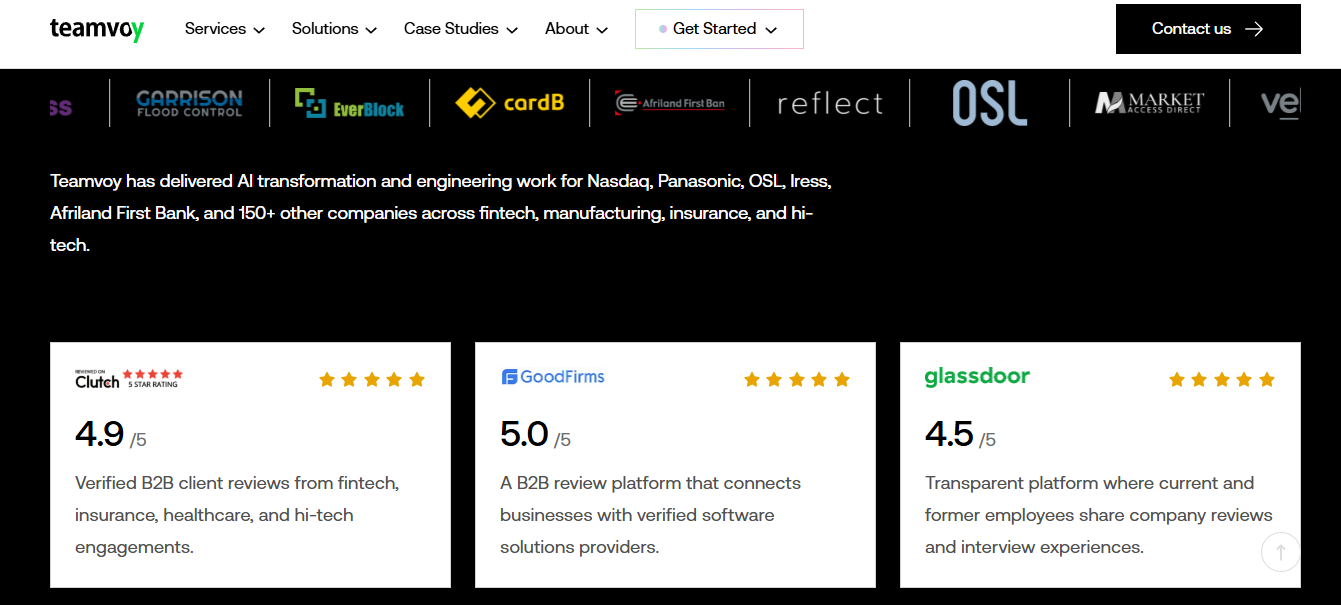
- Named delivery for clients including Nasdaq, OSL, Panasonic Avionics, and Market Access Direct.
“We have been with Teamvoy for 4 years and found a great partner for the growth of Bitspark. Their technical expertise was top class.”
— George Harrap, CEO, Bitspark (fintech) Teamvoy Clutch – Verified Review
“Teamvoy is a one-stop-shop. They will provide all the required skills, either in-house or by outsourcing, and Teamvoy can deliver fully, which is great. We were really impressed by their skills and speed for building great apps.”
— CEO, Social Network (Norway) Teamvoy Clutch – Verified Review
HatchWorks AI
- IP rights: Client ownership is standard for build engagements; confirm weights and prompts in contract.
- Agentic maturity: Markets a structured “generative-driven development” method; agent depth varies by project.
- Compliance posture: SOC 2-aware delivery; named regulated-finance scope not publicly detailed.
- Time-to-prototype: Fast, given a process built around generative tooling and nearshore pods.
- Engagement model: Long-term partner and staff augmentation.
- Publishes its generative-driven development framework and case work across SaaS and healthcare.
- Nearshore time-zone alignment for US clients running continuous sprints.
- Public positioning around measurable delivery-velocity gains.
“90%+ accuracy of chat responses from user questions. Their commitment to get the end product right and to be flexible when the situation required.”
— Josh Horton, Director of Data, Analytics & AI, Cox2M (IoT) HatchWorks AI Clutch – Verified Review
Azumo
- IP rights: Client ownership standard for augmentation; verify in the MSA.
- Agentic maturity: Strong on data and ML engineering; full agentic systems vary by engagement.
- Compliance posture: Varies by engagement; named regulated scope not publicly detailed.
- Time-to-prototype: Quick to staff, since the model is embedded engineers on your roadmap.
- Engagement model: Staff augmentation.
- Long track record in data engineering and ML-adjacent web builds.
- Latin-America nearshore delivery for US time zones.
- Public case work across SaaS, media, and finance support functions.
“They meet the timelines for the delivery of each use case across each phase of the engagement. This engagement has no defined end date. They have also helped on other projects as well.”
— Michael Butler, Director of Partnerships, nlx.ai Azumo Clutch – Verified Review
NineTwoThree AI Studio
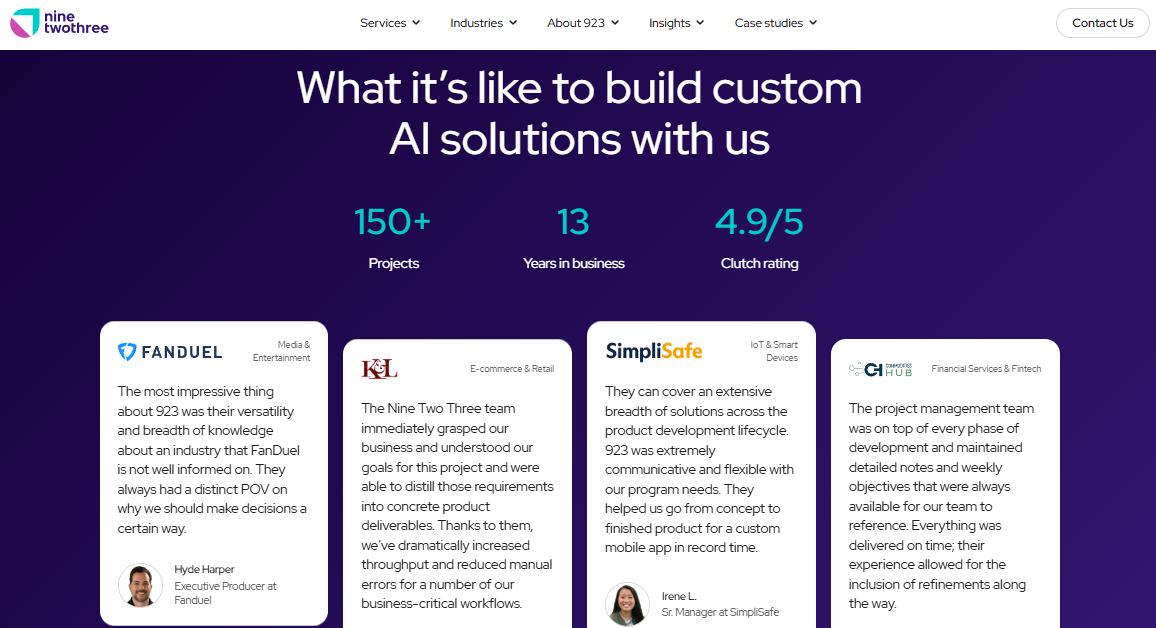
- IP rights: Client ownership standard for studio builds; confirm model artifacts in contract.
- Agentic maturity: Applied AI and ML inside products; agent guardrail depth varies by build.
- Compliance posture: Varies by engagement; named regulated scope not publicly detailed.
- Time-to-prototype: Fast, with strong product and UX support from concept to MVP.
- Engagement model: Project-and-exit product studio.
- Clutch-verified work delivering custom mobile UI with clickable prototypes and 4+ star app outcomes.
- Consumer research and user-insight delivery alongside engineering.
- Public AI and ML case studies across startups and healthcare.
“What was most impressive was their depth of experience and expertise for every phase of development. This allowed for problem solving and enhancements throughout the development and helped to turn a good idea into a great deliverable.”
— William Hess, Co-CEO & Head of Research, PRC Macro NineTwoThree AI Studio Clutch – Verified Review
BlueLabel
- IP rights: Client ownership standard for builds; confirm data and model artifacts in contract.
- Agentic maturity: Real assistant builds on enterprise data; full agent autonomy varies by project.
- Compliance posture: Enterprise delivery; named regulated-finance scope not publicly detailed.
- Time-to-prototype: Strong, given a repeatable approach to data-layer-first assistants.
- Engagement model: Project-and-exit.
- Unified 40+ years of ERP records (≈390,000 orders, 9,400 clients, 3,700 products) into a searchable layer.
- Cut expert lookup time by roughly 75% for core manufacturing workflows.
- Reduced reliance on tribal knowledge by encoding senior-specialist playbooks.
“Functioning prototype that had the buy-in from the clinicians and was technically ready to integrate with our full stack. What stood out most was how quickly they got to know us as a customer.”
— Anonymous, Chief of Staff to the CEO, Healthcare Technology Company BlueLabel Clutch – Verified Review
DOOR3
- IP rights: Client ownership standard for custom builds; confirm in the contract.
- Agentic maturity: AI added to custom software; dedicated agent systems vary by engagement.
- Compliance posture: Enterprise delivery across regulated clients; specific frameworks vary by engagement.
- Time-to-prototype: Solid, with heavy upfront UX discovery shaping the build.
- Engagement model: Project-and-exit and longer custom builds.
- Long enterprise track record across finance, healthcare, and B2B software.
- Strong UX research and design practice feeding engineering.
- Public case work on complex custom platforms.
“DOOR3’s communication is key. It feels like a true partnership; it feels like a team within our company. Their openness to understanding what we do is impressive. It’s a niche industry with complicated financial products.”
— Tara York, Managing Director, Luma Financial Technologies DOOR3 Clutch – Verified Review
Achievion Solutions
- IP rights: Client ownership standard for PoC and MVP builds; confirm in contract.
- Agentic maturity: Applied ML and AI platforms; full agentic depth varies by engagement.
- Compliance posture: Cross-industry, including health data; named frameworks vary by engagement.
- Time-to-prototype: A core strength, with PoC-to-MVP as the explicit offering.
- Engagement model: Project-and-exit.
- Built an AI-platform MVP beta-tested with over 150 users for a design company.
- Delivered MVP, beta, and website for a health-data application.
- Developed a Python data-science algorithm for an education nonprofit pilot.
“We had a Beta test run of the MVP with over 150 users. Showed that we had a MVP that worked. We were impressed with their ability to deliver a high-quality, polished MVP.”
— Anonymous, Partner, Design Company Achievion Solutions Clutch – Verified Review
Where this is handled
We pressure-test a partner’s AI claims against your actual stack before you sign.
If you are weighing vendors and want a second read on IP terms, agentic maturity, and compliance posture, our AI & System Readiness Audit is where that happens, with no sales process attached.
Request a readiness auditOrases
- IP rights: Client ownership standard for custom builds; confirm model artifacts in the contract.
- Agentic maturity: Practical AI features inside custom software; full agent systems vary by engagement.
- Compliance posture: US-based delivery across insurance, healthcare, and manufacturing; named frameworks vary.
- Time-to-prototype: Reliable, with a long custom-software delivery history behind it.
- Engagement model: Project-and-exit and longer custom builds.
- Two decades of custom software delivery across insurance, healthcare, and manufacturing.
- Public case work on workflow and process software with AI features.
- Clutch-verified delivery record with strong client-management ratings.
“What normally would take 15 to 20 minutes for a well trained quoting person to accurately make loan documents in the insurance space now takes 30 seconds. Truly the best investment I think I have ever made.”
— Adam McCroskie, Owner, Lending Company Orases Clutch – Verified Review
Dualboot Partners
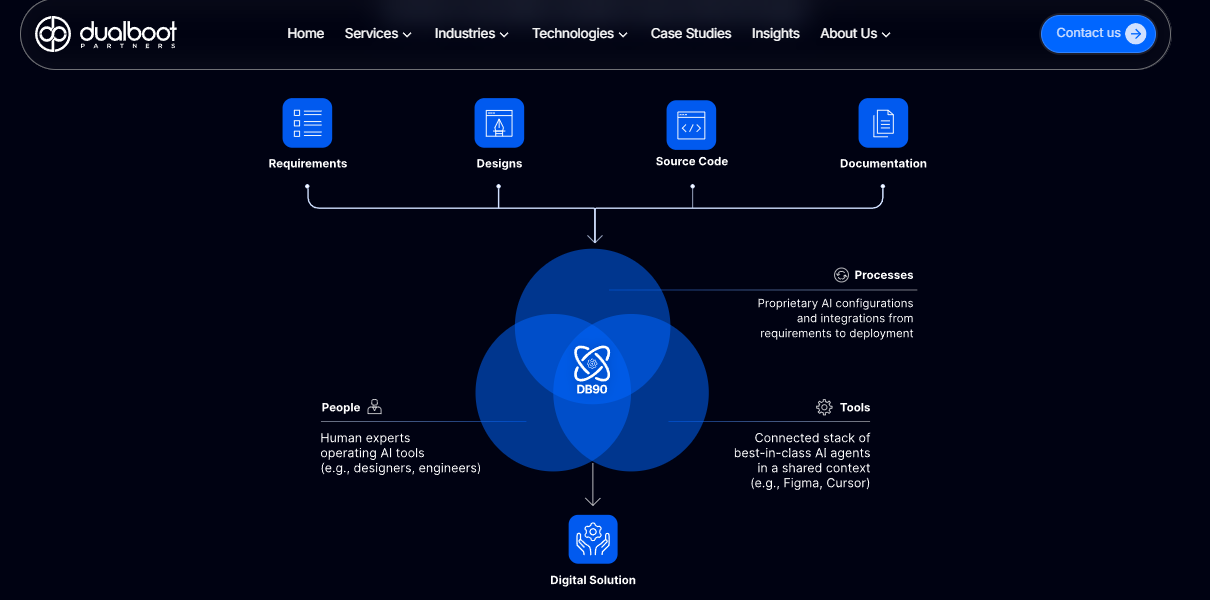
- IP rights: Client ownership standard for embedded engagements; confirm in the MSA.
- Agentic maturity: AI capability inside product teams; dedicated agent systems vary by engagement.
- Compliance posture: SaaS and fintech delivery; named regulated frameworks vary by engagement.
- Time-to-prototype: Fast, since teams embed directly into your existing roadmap.
- Engagement model: Long-term partner and staff augmentation.
- Public case work embedding engineering teams into growth-stage SaaS and fintech.
- Track record taking on products mid-flight rather than greenfield only.
- Clutch-verified delivery with strong willingness-to-refer scores.
“What was most impressive and unique was how seamlessly the Dualboot team integrated with Primoprint. They never felt like a separate entity — we collaborated with them just as we would with our own internal team.”
— Jen Manning, COO, Primoprint Dualboot Partners Clutch – Verified Review
Vention
- IP rights: Client ownership standard for augmentation; verify in the contract.
- Agentic maturity: Engineers across AI and web; agentic depth depends on who you staff.
- Compliance posture: Cross-industry delivery; named regulated scope varies by engagement.
- Time-to-prototype: Very fast to staff, given a large bench and sprint cadence.
- Engagement model: Staff augmentation.
- Long staff-augmentation history with startups and established software teams.
- Sprint-cadence embedded delivery across many stacks.
- Clutch-verified record across a high volume of engagements.
“Vention had a surprisingly good talent pool on their staff. They delivered fast, high-quality code and closed tickets and bugs extremely quickly. The team felt like part of our internal staff.”
— Jesse Boyes, CTO, H3R3, Inc. Vention Clutch – Verified Review
Diffco AI & GenAI.Labs
- IP rights: Client ownership standard for builds; confirm model weights and training data in contract.
- Agentic maturity: Focused applied-ML and generative work; full agent orchestration varies by project.
- Compliance posture: Varies by engagement; named regulated scope not publicly detailed.
- Time-to-prototype: Fast on narrow, well-defined problems.
- Engagement model: Project-and-exit.
- Public applied-ML and generative case work across several industries.
- Smaller teams that move quickly on a tight problem definition.
- Clutch-listed delivery for focused AI engagements.
“We saw meaningful results across the board: the project was completed on schedule, stayed within budget, and immediately improved our platform’s performance and reliability.”
— Jacob Hokinson, CPO, Gitcha Diffco AI Clutch – Verified Review
“Their combination of deep technical skill and professionalism as a firm. They are amazing at creative problem-solving, and their infrastructure makes it easy to understand what is happening and why.”
— Anonymous, Sr Machine Learning Engineer, Google  GenAI.Labs Clutch – Verified Review
SOLTECH
- IP rights: Client ownership standard for custom builds; confirm in the contract.
- Agentic maturity: AI added to custom software; dedicated agent systems vary by engagement.
- Compliance posture: Cross-industry US delivery; named regulated frameworks vary by engagement.
- Time-to-prototype: Steady, with a long custom-software delivery track record.
- Engagement model: Project-and-exit and longer custom builds.
- More than two decades of custom software delivery.
- Public case work across web, mobile, and AI-enabled builds.
- Clutch-verified delivery with strong local-client relationships.
“SOLTECH’s customer service distinguishes them from the competition. The team goes above and beyond to meet our needs.”
— Kattie Henderson, Manager of Software Project Mgmt, Neptune Technology Group SOLTECH Clutch – Verified Review
Sidebench
- IP rights: Client ownership standard for studio builds; confirm artifacts in the contract.
- Agentic maturity: AI inside new products; full agent systems vary by engagement.
- Compliance posture: Enterprise and healthcare delivery; named frameworks vary by engagement.
- Time-to-prototype: Strong, with venture-style discovery and rapid prototyping.
- Engagement model: Project-and-exit studio.
- Public product-build work with enterprise and healthcare clients.
- Strong design and strategy practice feeding engineering.
- Clutch-verified delivery on new-product engagements.
“I’m impressed by Sidebench’s professionalism in project management. I’m also impressed by their design stage, in which we planned the entire project in terms of integrations, workflows, and UI. The product they’ve helped us create has been exceptional.”
— Anonymous, Executive, BrilliSkin Sidebench Clutch – Verified Review
Imaginovation
- IP rights: Client ownership standard for fixed-scope builds; confirm in the contract.
- Agentic maturity: AI features inside web and mobile apps; agent systems vary by engagement.
- Compliance posture: SMB and mid-market delivery; named regulated frameworks vary by engagement.
- Time-to-prototype: Fast on well-defined SMB and mid-market scopes.
- Engagement model: Project-and-exit.
- Public web and mobile case work across retail, healthcare, and services.
- Fixed-scope delivery aimed at SMB and mid-market budgets.
- Clutch-verified record with strong client-communication ratings.
“Showcasing a strong understanding of our goals, Imaginovation transformed our concepts and vision into an intuitive, well-performing solution. The team delivers on time and promptly addresses needs and concerns.”
— Andrew Cherry, COO & Product Manager, Everflex Health Imaginovation Clutch – Verified Review
Q2. What separates a real production-AI partner from “AI washing” and demoware?
A real production-AI partner ships systems that keep working after the demo ends. “AI washing” is the opposite: human teams doing manual work behind an “autonomous” label, or a slick prototype that breaks the moment real data hits it. The tell is simple. Ask to see a production system under load and a failure it survived, not a happy-path demo.
❌ The fear: paying for autonomy, getting a body shop
I have sat on the buyer side of this with founders, and the fear is always the same. You pay for “agentic AI,” and what arrives is a large team doing manual work, dressed up as automation.
That fear is rational right now. The gap between a demo that dazzles and a system that survives Monday morning is where most budgets quietly disappear.
⚠️ The proof: most pilots never pay back
The numbers back the skepticism. One widely cited 2025 study found that roughly 95% of enterprise generative-AI pilots delivered no measurable return.
Gartner put generative AI in the “trough of disillusionment” on its 2025 Hype Cycle, the stage where reality catches up with the keynote. AI is a multiplier, not a miracle. Point it at a team that cannot already build, and you get speed in the wrong direction.
Here is the part vendors skip. When AI drops into your codebase, it has no memory of your system. It is like the character in Memento, waking up with no idea what happened yesterday, confidently acting anyway.
✅ The four tells to check on your next vendor call
Across the AI integration work we do at Teamvoy, the first question is never the model. It is the data layer and the legacy core, because that is where AI pays back or stalls.
Run these four checks before you sign:
- Show me production, not a demo. Ask for a live system under real load, with logs.
- Show me a failure you survived. A real partner has an incident story and a fix. Demoware has only happy paths.
- Who reads this code in a year? If nobody on your team can maintain it, you are buying debt.
- Does headcount scale with “AI” output? If “autonomous” work needs linear bodies, it is not autonomous.
I could be wrong on any single deal, but the pattern over twelve years is consistent. The partners worth hiring are calm about showing you their failures. That calm is the signal. If you want to see how we separate production-grade AI development from demoware, our case studies show systems running under real load.
Q3. Who owns the IP, code, and model weights when an AI app development company builds for you?
Ownership is not automatic. United States copyright law does not protect purely AI-generated output, and “work made for hire” (a legal rule where the hiring party owns the work) covers only narrow categories. Without an explicit, present-tense assignment clause, your vendor, or nobody, may hold rights to the code, the prompts, and any fine-tuned model weights. Get assignment in writing before work starts.
💼 The copyrightability gap nobody mentions
Here is the part that surprises founders. A work created entirely by AI, with no meaningful human authorship, cannot be copyrighted in the US.
The Copyright Office has held this position, and a federal court affirmed it in Thaler v. Perlmutter in 2025. So if a vendor “let the AI write it,” there may be no clean copyright to assign you at all. That is a gap in your title to your own product.
⚠️ Why “work for hire” is not enough
Many buyers assume “work for hire” covers everything. It does not. The doctrine applies only to specific categories under 17 U.S.C. section 101, and contractor code often falls outside it.
The fix is a present-tense assignment clause: the vendor assigns all rights to you, now, in writing. That clause must name the source code, the prompts, and any fine-tuned weights. Free AI-generated code without that paper trail is the most expensive debt you can take on.
There is a quieter risk too. Teams dump Confluence docs, Slack history, and Salesforce data into a vector database (a store that lets AI search by meaning) and hope the model sorts it out. That is not reasoning, that is context-flooding, and it leaks your proprietary data into places you did not intend.
✅ The four-clause IP checklist
Across regulated delivery at Teamvoy, an auditable chain of ownership matters as much as the code itself. Put these four in the contract:
- Present-tense assignment of all source code to you, effective on creation.
- Model artifacts named: fine-tuned weights, embeddings, and prompt libraries assigned explicitly.
- Training data rights: confirm what data trained the system and that you may keep using it.
- Third-party model licences passed through cleanly, with no hidden usage limits.
I am not your lawyer, and you should use one here. But in twelve years I have watched the IP conversation get skipped because the demo was exciting, and skipped IP is the clause that surfaces, painfully, the day you try to sell or raise. Our AI consulting work starts with exactly these ownership questions, and our guide to vibe coding security risks covers where AI-generated code quietly becomes a liability.
Q4. How do you read agentic maturity and compliance posture, what you can actually trust?
Agentic maturity is the discipline behind autonomous agents, not the demo. A mature partner controls the context window, enforces hard limits on runaway behavior, and governs cost. Compliance posture is how that partner proves auditable delivery, which named frameworks they genuinely deliver under, not which logos sit on a slide. Both are claims you verify, not take.
🤖 Agentic maturity is about control, not cleverness
An “agent” is software that takes actions on its own toward a goal. The clever part is easy to demo. The hard part is control.
Mature teams manage the context window, the amount of information the model can hold at once. Past roughly 40% of that window, models get measurably worse, so loading every tool and document in actually makes the agent dumber, not smarter.
⚠️ The failure modes that show real experience
Ask about failure, and you learn everything. Three real ones separate builders from demo teams:
- 💸 Quadratic billing. Agent loops resend the whole history on every step, so a 20-step run is not twice a 10-step run, it is far more expensive.
- ⏰ No circuit breaker. One team’s support agent hit an infinite retry loop overnight and ran up around $4,200 in API charges while everyone slept.
- ❌ Cargo-cult sub-agents. Splitting work into “frontend agent” and “QA agent” by role misses the point. Sub-agents exist to control context, not to play office.
Gartner places AI agent platforms at the peak of its 2026 Agentic AI Hype Cycle, with adoption rising fast. Peak hype is exactly when these guardrail questions matter most. This is the territory our AI agent development services are built for.
🛡️ Compliance posture: eligibility is not compliance
On the compliance side, the frameworks cover different things, and buyers conflate them constantly:
| Framework | What it actually covers |
|---|---|
| SOC 2 | Security and data-handling controls |
| ISO/IEC 42001 | A certified AI management system |
| NIST AI RMF | A voluntary AI risk framework, self-attested |
| HIPAA, GDPR, DORA, PCI-DSS | Sector-specific legal obligations |
Notice the contradiction worth flagging. NIST’s framework is voluntary self-attestation, while ISO 42001 is an independently certified standard. A vendor can claim “NIST-aligned” without anyone checking. Eligibility does not equal compliance.
✅ What auditable delivery actually looks like
What I have learned in twelve years of delivering into regulated environments is that compliance lives in daily practice, not the certificate. It looks like evidence trails, change control, and someone who can answer an examiner’s question in real time.
We have delivered inside SOC 2, PCI-DSS, HIPAA, GDPR, DORA, and PSD2 contexts at Teamvoy, and the unglamorous truth holds every time. The model gets the attention, but the data layer and the audit trail decide whether the system survives. We obsess over the brain and ignore the nervous system at our own cost. If you are building under a regulator’s eye, our healthcare delivery and regulator-ready AI in fintech work show what auditable delivery requires day to day.
Q5. Why does “time-to-prototype” mislead buyers, and what should you measure and budget instead?
Time-to-prototype measures the wrong thing. A prototype is cheap to fake and fast to ship, so a quick demo tells you almost nothing about whether the system survives production. Measure time-to-production-readiness and time-to-maintainability instead: can the code be safely deployed, and can your team read it in a year? That is why this guide carries no price column. Engineering cost is a multi-year number, not a sticker.
⚠️ Everyone sells speed, and a headline price
Every vendor pitches a fast prototype and a tidy number. Both are easy to produce and easy to misread.
The standard read gets this backwards. A demo that ships in a week can hide months of debt you inherit later.
💸 The hidden cost lives under the demo
Here is what speed conceals. AI tools produce code that runs but suppresses its own warnings.
I once reviewed a pull request (a proposed code change) that disabled eleven linter checks (automated code-quality alarms) just to pass. The code shipped. The problems did not leave, they hid. One survey found roughly 60% of 5,000 “vibe-coded” apps carried security flaws.
That debt compounds. The cost to fix it does not stay flat, it grows quietly while velocity collapses. Our tech debt avalanche piece walks through exactly how that compounding plays out.
✅ Measure readiness, not speed, and budget for years
The specification is now the product. With AI writing the lines, the rigor moves to the front of the build, where you decide what “correct” means.
Use this three-question test on any pull request a vendor shows you:
- Can you explain every line? If not, nobody owns it.
- What did it suppress to pass? Hidden warnings are deferred failures.
- Can a new engineer extend it safely? That is maintainability, the real cost driver.
Disciplined speed is possible. Spotify reported running over 1,000 pull requests through AI-assisted migrations with review gates intact, fast and controlled at once.
Across the work we do at Teamvoy, engineering pricing stays custom-quote for one honest reason. The number that matters is the four-year cost of owning the system, not the price of the first demo. Where my view sits right now is simple: budget for maintainability, because that is the bill that actually arrives. Our AI integration cost guide breaks down what different budgets actually buy, and our technology modernization work is built around that multi-year lens.
Q6. Which engagement model fits your situation, and what will it really cost over time?
The right engagement model depends on who owns the system after go-live. Five models dominate: project-and-exit, staff augmentation, freelance marketplace, fractional CTO, and long-term partner. Fast builds are cheap up front and expensive later if nobody owns the result. The real cost question is not the hourly rate. It is who is accountable when the system breaks at 2 a.m. two years from now.
🧭 The five models, in plain terms
Each model answers a different need. None is “best,” they fit different situations.
| Model | Best when you need | Owns the system after go-live? |
|---|---|---|
| Project-and-exit | A defined build with a clear end | No, you do |
| Staff augmentation | Extra hands on your roadmap | No, you do |
| Freelance marketplace | A small, contained task | No |
| Fractional CTO | Part-time senior direction | Direction, not the code |
| Long-term partner | A system that must keep running | Yes, shared and ongoing |
✅ Match the model to your situation
Map it to your reality:
- Validating an idea? Project-and-exit or a studio is enough.
- Have a strong internal lead? Staff augmentation fills seats fast.
- Running a regulated or legacy system that cannot go down? You want a long-term partner who owns it with you.
There is a measurable edge here. The 2025 MIT NANDA study found external partners deploying agentic AI succeeded at roughly twice the rate of internal-only builds.
💰 The accountability question is the real cost
Cheap and fast feels good in month one. The bill arrives in year two, when the team that built it is gone and nobody can read the code.
At Teamvoy, our genuine territory is the long-term end of this table: the engagements other vendors decline, like production outages, vendor rescues, and AI-built MVPs that hit their limits. A senior engineer owns the system end to end, across a 4+ year average engagement. That is not the right fit for a throwaway prototype, and I will say so on the call. You can see this in our case studies and the legacy software recovery work behind them.
I could be wrong on any single project. But the pattern over twelve years is consistent: the model that costs least over time is the one where someone is still accountable after go-live.
Q7. What should you ask an AI app development company before you hire?
Ask questions that map to the four axes: ownership, agentic maturity, compliance, and real cost. The best answers are specific, calm, and include a failure story. Vagueness or pure optimism is the warning sign. You are hiring someone to own a system under stress, so listen for how they handle disagreement and what breaks, not how confident the demo sounds.
✅ Five questions for your next vendor call
Use these five. Each has a “good answer” tell:
- Who owns the code, weights, and prompts when we are done? Good answer: a present-tense assignment clause, in writing.
- Show me a production system you stabilised after it broke. Good answer: a real incident, the root cause, and the fix.
- How do you stop a runaway agent? Good answer: circuit breakers, cost limits, and context control, named without prompting.
- Which compliance frameworks have you delivered under? Good answer: named, with evidence trails, not “we are aligned.”
- What happens to support after go-live? Good answer: a named owner, not a handoff.
🧪 Listen for how they handle being wrong
Here is a tell I trust. Ask whether they design for disagreement.
A serious partner runs “angry agents,” automated reviewers prompted to poke holes in a plan before it ships. The opposite is consensus while the server burns. As one engineer put it, “almost right” is the costliest failure, because it ships, then sits in your codebase for six months before anyone notices.
What I keep coming back to, after twelve years and 150+ projects at Teamvoy, is that trust is built through results, not presentations. So I will end with the question I am actually sitting with, and would genuinely like to hear your answer to: what are you building or stabilising right now, and where is it quietly breaking? If you want a second read on it, our door is open, no sales process attached, so start a conversation or book a quick readiness audit.