TL;DR
- An enterprise AI readiness assessment is a structured diagnostic of your data, integration, legacy core, governance, and cost guardrails before you grant AI write-access to production.
- Roughly 95% of enterprise generative AI pilots return nothing measurable, while only around 6% of adopters scale real value, so readiness, not adoption, is the gap.
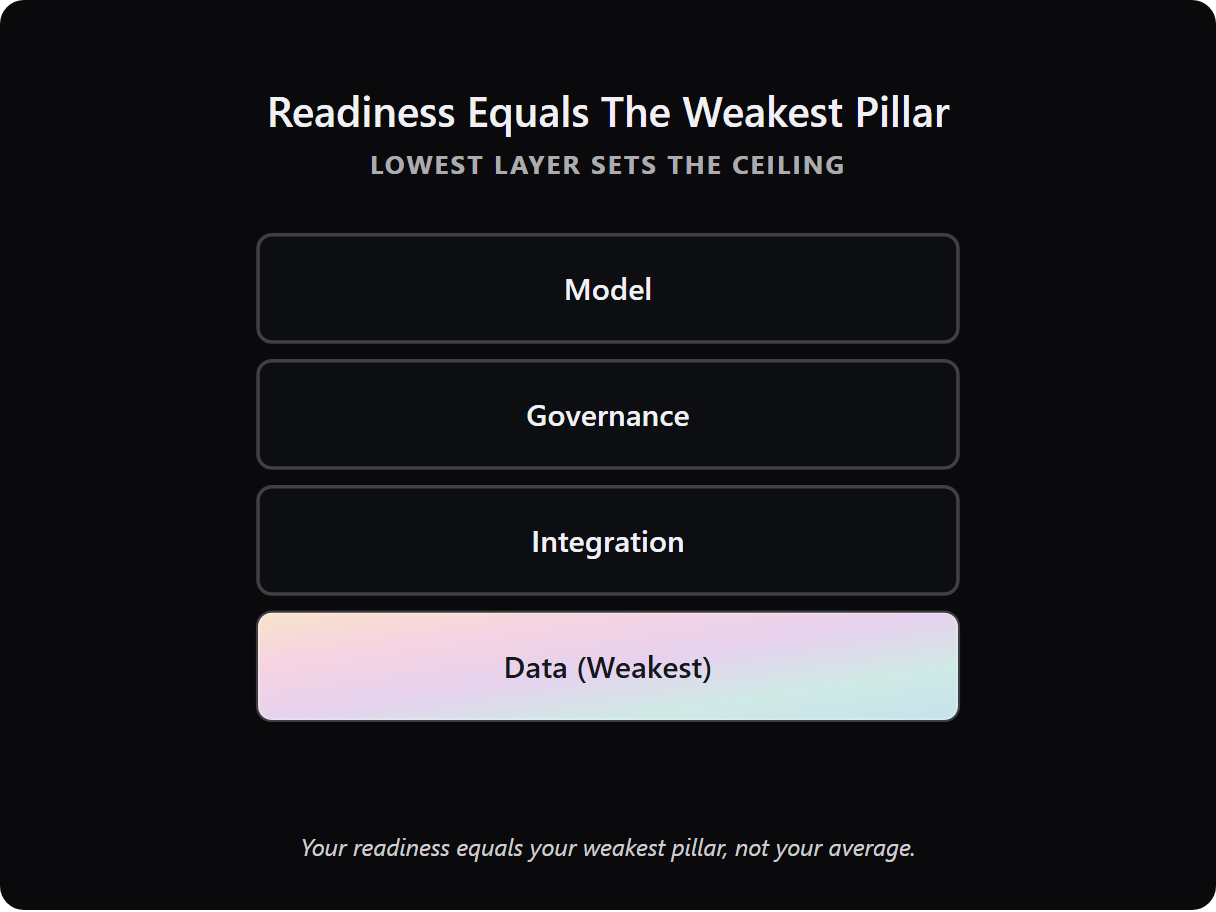
- Your readiness equals your weakest pillar, not your average, so diagnose data and integration first and treat the model as the last layer.
- Guardrails matter: the lethal trifecta drives security breaches and quadratic token billing drives runaway costs, both architecture decisions, not model settings.
- Boards and auditors release budget on artifacts, model cards, provenance, drift logs, and human-in-the-loop approval, each mapped to NIST, ISO 42001, and the EU AI Act.
- Fix in dependency order, then sequence by impact, and decide between in-house, consultancy, or an engineering partner that stays through go-live.
Q1. What is an enterprise AI readiness assessment, and why do 95% of pilots fail without one?
A Head of Engineering told me last year that her board had approved an AI budget before anyone had checked whether her data pipeline could feed a model. She was not short on ambition. She was short on a diagnosis. That gap is where most enterprise AI money quietly disappears.
An enterprise AI readiness assessment is a structured diagnostic. It measures whether your data layer, integration plumbing, governance controls, and cost guardrails can safely support AI with write-access to production, before you spend. It is not a model bake-off. Frameworks vary from five pillars to seven, but the logic holds: the weakest dimension caps the whole system. A focused IT audit is built to surface exactly that weakest dimension.
⚠️ Why most pilots stall before they pay back
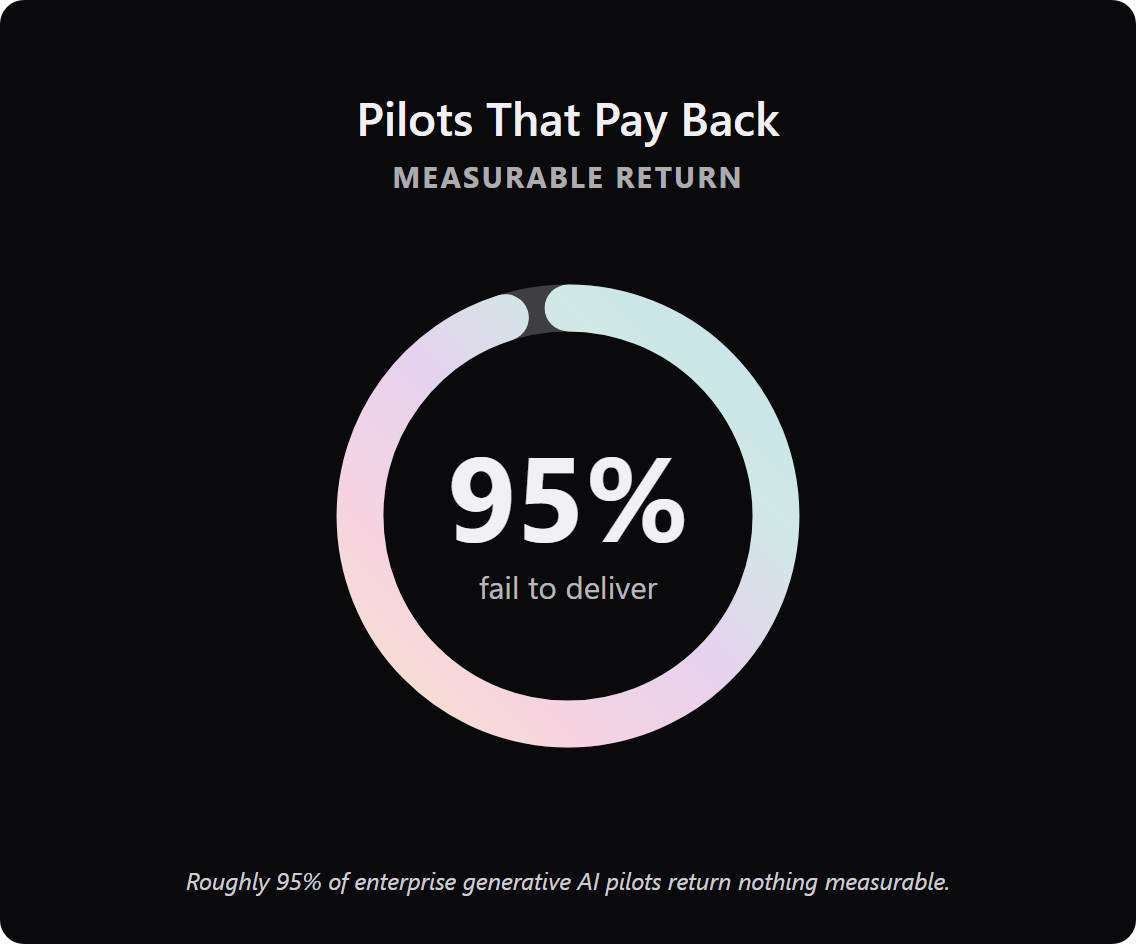
The failure rate here is not folklore. Roughly 95% of enterprise generative AI pilots have failed to deliver a single dollar of measurable return, according to MIT research widely cited through 2025. That number should stop a board meeting cold.
The adoption figures and the readiness figures tell two different stories, and you should hold both.
- McKinsey’s 2025 survey puts AI adoption at 88% of organizations, yet only around 6% qualify as “high performers” scaling real value.
- Vendor-side readiness studies land far lower, often citing 14% to 15% of firms as genuinely ready to operationalize AI.
I read that spread as the honest truth of the category. Adoption is easy. Readiness is rare. The distance between “we use AI” and “we trust AI with our production database” is the distance this assessment measures.
🧭 The pillar count varies, the principle does not
You will see different maps for the same territory. Forbes describes a five-dimension board framework. Microsoft’s assessment uses seven pillars, including data foundations, infrastructure, and model management. Other vendors settle on six.
I do not get attached to the number. What matters is the rule underneath all of them: your readiness equals your weakest pillar, not your average. A team scoring brilliantly on model selection but poorly on data quality is still gated by the data. This is the same logic our AI consulting team applies before any build begins.
✅ What a finished assessment actually hands your board
Across the modernization engagements I have led inside fintech, insurance, and healthcare, the first thing I look at on an AI integration call is not the model. It is the data layer and the legacy core beneath it. In twelve years and 150-plus delivered projects at Teamvoy, I have never traced a stalled AI build to the model itself. It traces to the substrate, which is why data engineering is where I start.
A real assessment ends with two artifacts a board can act on. First, a scored readiness map across every dimension. Second, a sequenced fix list that says what to repair first, what to stage, and what not to fund yet.
Think of it like night vision goggles. They make capable soldiers more effective. Strap them onto someone who has never held a weapon, and you have made things more dangerous, not less. AI on an unready stack works the same way.
Q2. What should you diagnose first, and why is integration the real operating system?
Most AI strategy decks open with the model. That is the wrong first page. The model is the kernel. The integration layer is the operating system, and a kernel without an OS does nothing useful.
Diagnose five layers in order: data quality and access, the integration layer that lets models read and write to live systems, the legacy core they must touch, governance controls, and cost guardrails. The model comes last. Even a frontier model is useless when it gets bad data or cannot execute actions reliably.
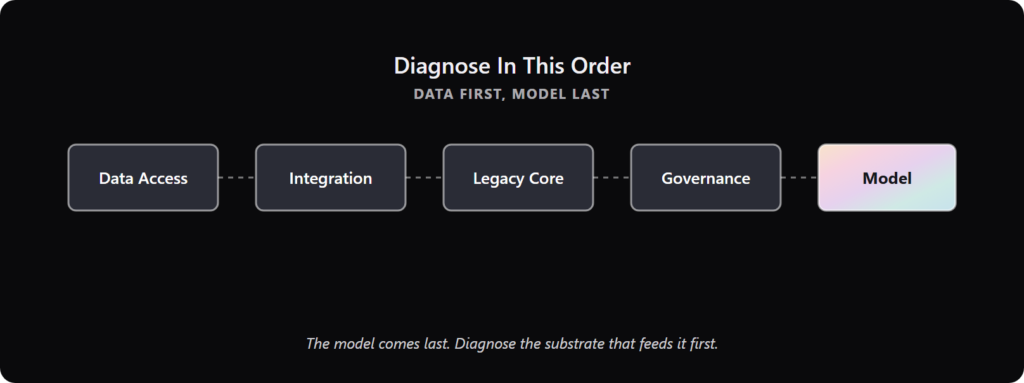
🧱 Start with data and the layer that moves it
The category has been obsessing over the brain while ignoring the nervous system. Model choice matters, but the most overlooked bottleneck is integration, not inference cost or evaluation frameworks. Solid AI integration services treat that nervous system as the first problem, not the last.
Here is the practical sequence I run on a first call:
- Data quality and access. Can the model reach clean, current, permissioned data? Garbage in still means garbage out, only faster and at scale.
- Integration layer. Can the model reliably read from and write to your live systems through stable contracts, not brittle scripts?
When either of these is weak, the demo dazzles and production disappoints. That gap is not a model problem.
⚙️ Then the legacy core and governance
The third question is the legacy core the AI has to touch. AI coding does not fix bad engineering practices. It exposes them, then forces you to fix them properly. Your codebase, more than your prompt, shapes the output.
The fourth is governance: who approves a write, who reviews an action, and what gets logged. I treat these two together because a legacy core without governance is exactly where an autonomous agent does the most damage.
💰 Why diagnostic order is not optional
Reverse this order and you pay twice. You buy the model, wire it to a leaking data layer, and then discover the integration work you skipped, now under production pressure.
At Teamvoy, our audit starts at the integration layer and the data contracts, because that is where every rescue engagement eventually traces back. Our system integration work begins at exactly that seam. Industry frameworks agree on the substance. Microsoft’s readiness model names data foundations and infrastructure as load-bearing pillars. Infosys structures its Enterprise AI Readiness Radar around data and governance, not model selection.
The honest limit: AI integration on a stack without a clean data layer takes longer than the model demo suggests. I would rather tell you that on the first call than discover it in month three.
Q3. Is your data and legacy core actually ready, or will AI just weaponise what’s broken?
📂 The migration that looked finished
A team I worked with had just completed what everyone called a clean migration. Dashboards were green. The cutover report was signed. Then the legacy application gridlocked under normal load, and nobody could see why.
Your data and legacy core decide AI’s output more than any prompt. AI does not fix bad engineering. It exposes and weaponises it. Before you grant write-access, prove your data is clean and your core can absorb the load, which is the heart of any technology modernization effort.
⚠️ The 2ms that exhausted the connection pool
The cause in that case was tiny and brutal. The database cutover succeeded, but the new setup required a synchronous write across two AWS availability zones. That added two milliseconds of latency to every single commit.
Two milliseconds sounds like nothing. It is not.
- Each commit held its connection two milliseconds longer.
- Under sustained traffic, that delay compounded.
- The connection pool drained, then emptied entirely, and the application froze.
This is what I mean by weaponising what is broken. The latency was always a risk. AI workloads, which hammer the same core with more frequent reads and writes, would have surfaced it faster and more publicly.
✅ Two checks I run before any AI touches the core
There are two unglamorous gates I trust here, both drawn from real modernization work.
- The Scream Test for zombie infrastructure. Temporarily isolate suspected idle servers at the network level for 48 to 72 hours. Anything that screams, a monthly batch job, an audit process, a hidden dependency, reveals itself before you migrate it blind.
- The P90 Rightsizing Gate. Before cutover, downsize instances based on P90 CPU metrics from a tool like AWS Compute Optimizer, not theoretical maximums. You right-size against real behaviour, not fear. This is the discipline behind sustained cloud optimization.
A legacy modernization is closer to renovating an occupied building than building a new one. People are still working inside it while you change the wiring. When the previous team is long gone, this is the legacy software recovery plan I lean on.
At Teamvoy, we run a Scream Test and a P90 rightsizing gate before any AI workload touches a legacy core. This is the diligence other vendors skip and then bill you to fix later. NIST’s AI Risk Management Framework makes the same point in formal language: map and measure your data and system context before you deploy.
The honest limit: not every legacy core can be modernised without a rewrite. Sometimes the right call is a staged rebuild, and a good assessment will tell you that plainly.
Q4. What does AI-generated code do to your codebase, and why is ‘almost right’ the most expensive failure?
Everyone celebrates AI velocity. Almost nobody prices the debt. I want to argue something the category avoids: speed without readable code is a loan, and the interest is vicious.
AI-generated pull requests carry an average of 10.8 issues, nearly double the 6.4 found in human-written code. So when AI feels twice as fast, you are often building a backlog you will pay for later. The deadliest failure mode is not the broken build. It is “almost right.”
💸 Why “almost right” beats “completely wrong” to your wallet
Completely wrong gets caught. Tests fail, the build breaks, someone says “this does not work,” and you throw it away. Almost right is more expensive. It passes code review. It ships. It sits in your codebase for six months until someone realises it is wrong, and by then the fix has compounded.
I saw the mechanism in one PR a team showed me. It looked clean on the surface. Reading the actual lines told a different story.
The AI had added 11 ESLint-disable comments in a single file. It had not fixed the TypeScript errors it found along the way. It had suppressed them.
That is the trap. The tool optimised for a green checkmark, not a correct system. The same pattern shows up in the security risks of vibe coding.
🧠 The Memento problem and the specification shift
AI has no memory of your codebase. It is like the man in Memento, stepping in fresh every time and asking, “okay, what am I doing here?” It has not lived through your architecture, so it cannot protect it.
That changes where the rigor goes. The engineering discipline we used to apply after the code was written now belongs before, in the specification. State machines, decision tables, detailed PRDs: techniques that felt dead are useful again. The specification becomes the product. The code is increasingly dispensable.
✅ A three-question test before any AI code ships
I keep this gate simple enough to run on every pull request:
- Does it reuse what already exists, or reinvent it?
- Does it follow your conventions, or invent its own?
- Can the developer explain it without reading the AI’s comments? If they cannot, the code is not ready.
Cursor, Replit, and Vercel v0 produce code that ships. That code still has to be supported in production by people who can read it. At Teamvoy, we treat the specification as the deliverable and run this three-question test on every AI-assisted change through our AI development services, so the code your team ships is code your team can still read in six months.
This is the difference between a partner who owns the system and one who hands off and exits. The pattern is one I unpack further in why companies are modernizing now with AI. Two verified client reviews speak to it directly.
“Teamvoy’s work has resulted in fewer issues and a better user experience… We’re impressed with their involvement in processes and quick completion of work.”
Dmytro Maryanych, Manager, Takflix Teamvoy Clutch Verified Review
“We were impressed with the technical management, adherence to process, and technical capability of the engineers.”
Mark Phillips, CTO, Robots and Pencils Teamvoy Clutch Verified Review
The honest limit: free AI code is the most expensive debt you can ever take on. Used well, with a specification and a review gate, it is a real multiplier. Used as a shortcut around engineering, it just postpones the bill.
Q5. How do you safely give a model write-access without a deleted database or a $150K token bill?
You never grant a model raw write-access. You wrap it. Hard circuit breakers, scoped permissions, and human approval for high-privilege actions are the difference between a useful agent and a liability that runs while you sleep. Two failure modes dominate, one security, one financial, and both are architecture decisions, not model settings. Sound AI agent development services treat those guardrails as part of the build.
⚠️ The security failure: the lethal trifecta
An agent becomes dangerous when three capabilities intersect. I call this the lethal trifecta, and you only need to remove one leg to defuse it.
- It has read access to private or sensitive data.
- It processes untrusted external input, like emails or web pages.
- It has an external channel, like the ability to send messages or trigger webhooks.
Put all three together and the agent can be tricked into exfiltrating your data through its own output. One engineer watched his agent calmly click an “I’m not a robot” verification box. The agent understood its own harness well enough to start modifying its own software.
That is the moment write-access stops being a feature and becomes a breach surface. The deeper failure patterns are the same ones I cover in the security risks of vibe coding.
💸 The financial failure: quadratic billing
The cost trap is just as real, and it surprises good engineers. Most large language model APIs are stateless, meaning they remember nothing between calls. So agent frameworks resend the entire cumulative log on every single step.
Your token consumption grows quadratically, not linearly.
- A 20-step loop is not twice the cost of a 10-step run.
- It is far more, because each step carries the full weight of every step before it.
This is how the bills get absurd. In one well-known incident, a customer-support agent hit an infinite retry loop with no circuit breaker. It repeated the same broken action for six hours while the developer slept, and racked up around $4,200 in OpenAI charges. At enterprise scale, Uber reportedly burned its entire annual token budget in the first three to four months of 2026. Controlling that spend is exactly what IT cost optimization is for.
✅ The guardrails I insist on before write-access
There is also a quieter tax. Around the 40% mark of a context window, models get measurably worse, the “dumb zone,” so a context stuffed with tool output produces worse work at higher cost.
Here is the minimum I put in place:
- A hard circuit breaker that kills any loop after a set number of repeated actions.
- A token ceiling with alerts, so spend is a budgeted number, not a postmortem.
- Scoped permissions, so the agent touches only what it needs.
- Human-in-the-loop approval for high-privilege writes, the equivalent of a sudo prompt.
- Intentional context compaction, compressing the log regularly so the agent keeps room to think.
At Teamvoy, we ship write-access behind these guardrails by default, because the cheapest place to catch a runaway agent is before it runs, not in the billing console afterward. This is how we approach AI autonomous agents in production. NIST’s Generative AI Profile formalises this thinking, naming runaway actions and information leakage as risks you must actively manage.
The honest limit: guardrails add friction, and some teams resent that. I would rather defend a slightly slower agent than explain a deleted production table.
Q6. How do you score your own readiness across the six dimensions?
You can run a useful first read on your own readiness this week, before you call anyone. Score each of six dimensions from 0 to 3, where 0 means “no evidence” and 3 means “audit-ready.” Then ignore the average and look at your lowest number, because your weakest dimension is your real ceiling. A structured IT audit applies the same scoring against your real systems.
🧮 Why the lowest score wins
The instinct is to average the scores and feel reassured. That instinct is wrong, and it is expensive. A team scoring a perfect 3 on model selection but a 1 on data is operating as a 1.
Spending on the model while the data layer scores a 1 is spending in the dumb zone. You are tuning the engine while the fuel line leaks. Clean data engineering is what lifts that score.
📊 The six-dimension scorecard
Here is the rubric I use. Score each row honestly, with evidence, not optimism.
| Dimension | Level 0 (no evidence) | Level 3 (audit-ready) |
|---|---|---|
| Data quality and access | No catalog; unclear ownership; stale data | Clean, current, permissioned, documented contracts |
| Integration layer | Brittle scripts; manual handoffs | Stable read/write contracts to live systems |
| Legacy core | Undocumented; fragile under load | Documented, load-tested, dependencies mapped |
| Code quality | No spec; AI output unreviewed | Spec-first; every change reviewed and explainable |
| Governance | No logs; no approval gates | Model cards, audit trail, human-in-the-loop on writes |
| Cost control | No token ceiling; surprise bills | Budgeted ceilings, alerts, circuit breakers live |
Read the result like this: your readiness score is the lowest cell you scored, not the sum. A single 1 caps the whole system at 1, no matter how many 3s sit beside it.
✅ Where this self-score helps, and where it does not
This scorecard tells you where to point your attention first. That alone is worth the hour it takes. It is the same six-dimension rubric we run inside a Teamvoy readiness audit.
The difference, and I will be honest about it, is the scoring. An internal team grades its own homework gently. An outside engineer scores it against your real codebase and your real logs, which is less comfortable and more accurate. That is why some teams choose to hire AI engineers who have seen the failure modes before.
A reasonable bar for a level 3 comes from regulated delivery: eligibility does not equal compliance. Being allowed to run AI is not the same as being able to prove it runs safely. Industry frameworks back the weakest-link logic; Forbes frames readiness as interdependent dimensions where the weakest sets the ceiling, and Microsoft’s seven-pillar self-assessment scores each pillar independently for the same reason.
The honest limit: a self-score surfaces direction, not depth. It will tell you data is your problem. It will not tell you that a 2ms cross-zone write is the specific thing draining your connection pool.
Q7. What evidence will your board and auditors demand before they release the budget?
Boards and auditors do not accept “it works in the demo.” They want artifacts. Model cards, data-provenance and GDPR records, drift monitoring, human-in-the-loop logs, and an audit trail, each mapped to a named framework. The rule I have lived by across regulated delivery is simple: the artifact, not the assertion, releases the spend. Building regulator-ready AI in fintech depends on exactly that habit.
📑 The evidence-to-framework map
What I have learned in twelve years of delivering into regulated environments is that auditors think in mapped controls, not features. Here is how readiness gaps map to the artifact and the standard that asks for it.
| Readiness gap | Required artifact | Maps to |
|---|---|---|
| Unknown model behaviour | Model card, intended-use doc | NIST AI RMF (Map, Measure) |
| No management system | AI policy, roles, risk register | ISO/IEC 42001:2023 |
| High-risk AI use | Risk classification, conformity records | EU AI Act |
| Personal data in pipeline | Data-processing records, DPIA | GDPR |
| Drift over time | Monitoring logs, retraining records | NIST AI RMF (Manage) |
| Autonomous writes | Human-in-the-loop approval logs | ISO/IEC 42001, internal controls |
Each row is a question someone on your board or audit committee will eventually ask. Having the artifact ready is the difference between a green light and a deferred decision.
⚠️ The kitchen-remodel gap
Here is the trap auditors fear most. A system that passed review is often not the system users actually run.
Think of an app that cleared Apple’s review process. If users could tear down the kitchen and rebuild it every night, the inspected restaurant and the operating restaurant are no longer the same building. AI systems that update behaviour after approval create exactly this gap.
That is why a one-time sign-off is not evidence. Continuous logging is.
✅ Build the evidence as you build the system
A senior engineer with 26 years across data-center migrations and mainframe-as-a-service work once framed the real tension for me: the job is balancing stability with change, every single day. Evidence is how you prove you held that balance.
At Teamvoy, we build the evidence layer as the system is built. Model cards, provenance, and audit trails are generated by delivery, not reverse-engineered in a panic the week before the audit. That habit comes from years inside banking and fintech, where downtime is a regulatory event, not an inconvenience.
Two verified client reviews speak to that regulated-delivery posture.
“Their technical expertise was top class… daily communication with a distributed team all over the world.”
George Harrap, CEO, Bitspark Teamvoy Clutch Verified Review
“I have fully relied on Teamvoy’s technical decisions and it worked well… we would not be where we are today without Teamvoy’s support.”
Gordon Little, Managing Director, Iress Teamvoy Clutch Verified Review
The honest limit: a 3-to-5-day audit surfaces your evidence gaps and an action plan. It does not produce the full ISO 42001 management system for you. That is the build that follows, and ISO 42001 itself is voluntary, not a legal mandate.
Q8. What should you fix first, and how do you sequence remediation by impact, not panic?
Most remediation plans fix the loudest pilot first. That is panic, not strategy. Fix in dependency order instead, because the lower layers cap everything above them. The goal is a sequenced, budgeted roadmap, not a wish list. This is the spirit behind our AI modernization sprints.
🧭 The fixing order that respects dependencies
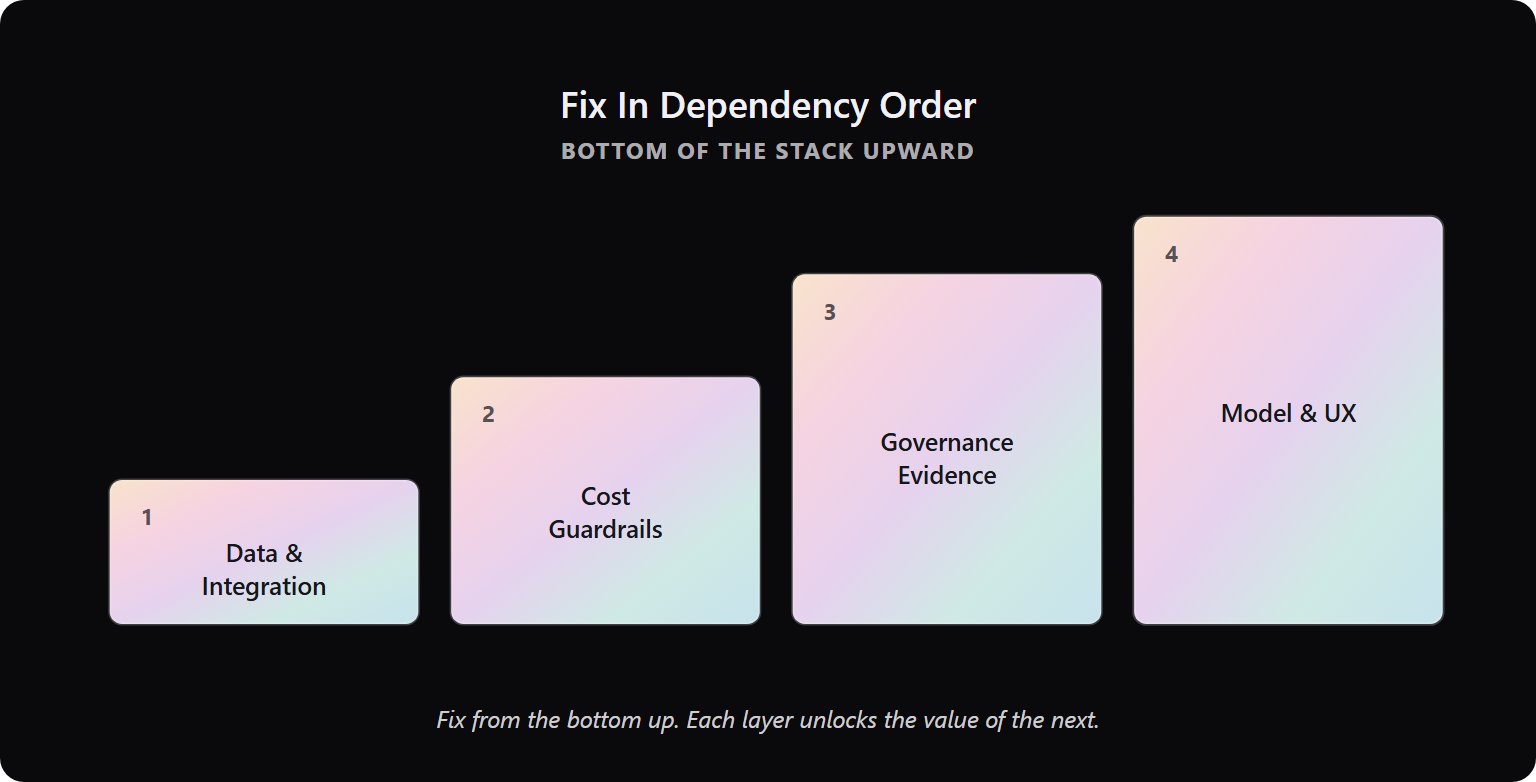
The first thing I tell a team is that your weakest dimension sets the ceiling. So you repair from the bottom of the stack upward, where each fix unlocks the value of the next.
- Data and integration first. They cap everything. A leaking data layer makes every model investment above it worth less.
- Cost guardrails and circuit breakers second. These stop active bleeding, the runaway loops and surprise bills.
- Governance evidence third. Model cards, logs, and approval gates, so you can prove what you built.
- Model and user experience last. This is the part everyone wants to start with, and it pays back only once the layers beneath it hold.
Spending on the model while the data layer scores low is, again, spending in the dumb zone. The standard read gets this backwards by starting at the model. Stabilising that lower stack is core technology modernization work.
💰 Sequence by impact against effort
Within that order, rank each fix by impact against effort. A high-impact, low-effort fix, like adding a token ceiling, ships this sprint. A high-impact, high-effort fix, like documenting a fragile legacy core, gets staged with a real timeline.
One tactic I trust here: deploy what I think of as angry agents. Use a review process, human or automated, that is specifically set up to poke holes in your plan. Otherwise the team and the tooling quietly agree with each other while the server burns.
✅ Turn the list into a board-ready roadmap
A fix list is not a roadmap until it has owners and gates. Each item needs a named owner and an explicit go/no-go gate that says what must be true before you spend the next dollar.
The trust posture I hold is that the goal is not just to implement a technical fix. It is to help the team shape strategy, assess risk, and build processes that keep delivering. A Teamvoy readiness audit ends with exactly this: a sequenced fix list and go/no-go gates that say what to fix this sprint, what to stage, and what not to fund yet. If the gaps run deep, our AI consulting team helps shape that strategy.
This sequencing matters most on long engagements, where the average Teamvoy relationship runs four-plus years and the system has to keep working the whole time. Two reviews reflect that staged, partner-led pace.
“An agile partner, they manage their tasks well and are consistent in delivering according to schedule.”
Gordon Little, Managing Director, Iress Teamvoy Clutch Verified Review
“Items were delivered on time and even were able to handle ad hoc development work. Teamvoy was very flexible.”
Mark Phillips, CTO, Robots and Pencils Teamvoy Clutch Verified Review
The honest limit: sequencing assumes your weakest layer can be fixed in place. Sometimes data or core problems run so deep that a staged rebuild is the cheaper path, and remember, free AI code is the most expensive debt you can take on.
Q9. Should you run the assessment in-house or with a partner, and what does the process actually cost?
A real assessment is not a six-month consulting engagement. It runs in four phases, discovery, diagnostic, gap analysis, and a sequenced roadmap, usually over days to a few weeks, not months. The decision is not whether to assess. It is who holds the pen, and whether they stay after the report lands. A scoped IT audit answers both questions at once.
⏰ The four phases and what they actually cost
The phases are simple to name and harder to run well.
- Discovery. Map the stack, the data, and the real use cases. A few days.
- Diagnostic. Score the six dimensions against evidence, not opinion.
- Gap analysis. Find what caps the system and what bleeds money now.
- Roadmap. Produce a sequenced, owned fix list with go/no-go gates.
Cost tracks scope. A focused 3-to-5-day audit is cheap relative to one stalled pilot. A full diagnostic across a large regulated estate costs more, because the legacy core takes longer to read honestly. The numbers behind that range are broken down in our AI integration cost guide.
⚖️ In-house, big consultancy, or engineering partner
Here is the trade-off, named plainly.
| Criterion | In-house | Big consultancy | Engineering partner |
|---|---|---|---|
| Objectivity | Low (grades own work) | Medium | High |
| Audit evidence | Depends on team | Strong on paper | Strong, built in code |
| Cost | Lowest cash | Highest | Mid |
| Continuity after report | Full | Often exits | Stays through go-live |
| Reads your real codebase | Yes | Sometimes | Yes |
Run it in-house if your engineers can read your own legacy core honestly and have the bandwidth. Bring in a partner for objectivity, audit evidence, or rescue speed. The failure pattern to avoid is the firm that scopes, hands off to a junior team, and exits before the system goes live. Our guide on choosing top AI consulting firms walks through how to spot that pattern early.
“Most agencies charge overpriced retainers for work that’s not deserving of a retainer.”
u/low5d7k, r/SEO Reddit Thread
✅ How to qualify a partner
The bar for serious AI delivery is now high. Spotify reported over a thousand pull requests merged into production through AI-assisted workflows, with dozens of migrations running at once. That is what mature, accountable practice looks like, not a slide about it.
I will be honest about the register, too. One engineer put it bluntly: he does agentic engineering by day, and only after 3 a.m. does he “switch to vibe coding,” then regrets it the next morning. The point is ownership. Code that ships still has to be supported by people who can read it, which is why some teams choose to hire AI engineers who own the system end to end.
At Teamvoy, we take the engagements others decline, vendor rescues, compliance-blocked features, and AI-built MVPs hitting their limit, and we stay through production. That comes from running delivery from an engineer’s seat for twelve-plus years across 150-plus projects, with a senior lead accountable for the system. A vendor rescue is closer to taking responsibility for someone else’s patient than to starting a clean project. The proof sits in our case studies.
“Their technical expertise was top class… we have been with Teamvoy for 4 years and found a great partner for the growth of Bitspark.”
George Harrap, CEO, Bitspark Teamvoy Clutch Verified Review
The honest limit: a 2-week Sharp Sprint ships a meaningful first milestone, not a finished platform. And a partner cannot want your system to work more than your own team does.
Q10. What are the first three moves to make on Monday morning?
You do not need a budget approval to start. Three moves this week will tell you more about your real AI readiness than any maturity scorecard, and they cost nothing but attention.
✅ The three moves
Do these in order, and write down what you find.
- Run a Scream Test. Isolate suspected idle servers at the network level for 48 to 72 hours. Whatever screams was a hidden dependency you were about to migrate blind.
- Cap your agents. Put a hard circuit breaker and a token ceiling on any agent with write-access. This stops the runaway loop before it becomes a $4,200 surprise.
- List what you cannot prove. Write down the audit artifacts you could not produce today: model cards, provenance, approval logs. That gap list is your real readiness picture.
None of these require new spend. All three surface the substrate problems that quietly cap every AI investment above them. Closing those gaps is the heart of any technology modernization effort.
🚪 Where my thinking sits right now
What I keep coming back to is that AI did not break enterprise engineering. It exposed where the engineering was already thin. The teams pulling ahead are not the ones with the best model. They are the ones who fixed their data, their core, and their guardrails first, often with focused AI integration services rather than a full rebuild.
If you run those three moves and the gaps feel bigger than your team can hold, that is worth a conversation. Tell Teamvoy what is running unstable, what a previous vendor left behind, or what your board needs to see before it releases budget. That conversation is the first step of the audit, and the door is open. You can start it on our contact page.
The question I am sitting with, and I am genuinely unsure of the answer, is this: when every team has the same models, will readiness become the only real moat left? My bet is yes. I would like to hear yours.