TL;DR
- Roughly 95% of enterprise AI pilots never reach production, and the failure is almost never the model. It is the integration, evaluation, and operations around it.
- Architecture survives on its nervous system, the governed data layer and reliable integration, not on which model you pick. The model is replaceable.
- Evaluation must run continuously because almost right output passes review, ships, and compounds cost. The specification, not the code, is the real product.
- Observe traces, quality and drift, and cost and latency from day one. AI agents burn budget non linearly, so hard circuit breakers are mandatory.
- Never combine read access, untrusted input, and an outbound channel in one unsupervised path. That lethal trifecta is an exfiltration machine.
- High risk systems face EU AI Act obligations by August 2026. Discipline past launch, runbooks, on call, and SLOs, is the real deployment.
Q1: Why Do 95% of Enterprise AI Pilots Never Reach Production?
Most enterprise AI pilots stall because teams obsess over the model and ignore the system around it. Roughly 95% of generative AI pilots have failed to deliver measurable return, and Gartner projects more than 40% of agentic projects will be cancelled by 2027. The failure is rarely the model. It is broken integration, no evaluation, and no plan for what happens after launch.
⚠️ The demo works. Production does not.
I have watched this scene play out more times than I can count. A team builds a slick demo in three weeks. The board claps. Then the same system meets real data, real users, and real load, and it falls over quietly.
The pilot proved the model could talk. It never proved the system could run. That gap is where most enterprise AI dies, and almost nobody budgets for it.
💰 Money is flowing, but value is not
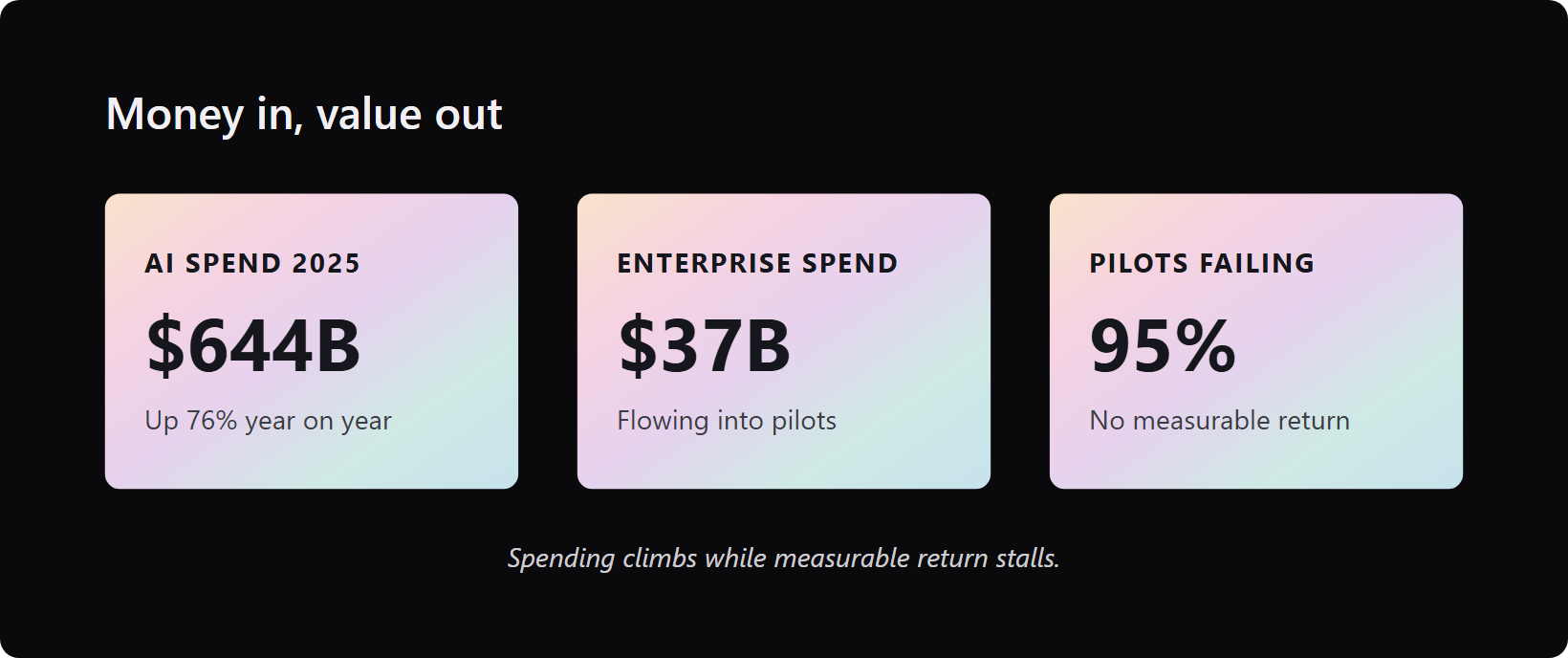
Here is the contradiction nobody wants to say out loud. Spending is climbing while returns are not.
- Gartner forecasts worldwide generative AI spending of around $644 billion in 2025, up over 76% year on year.
- Menlo Ventures pegs enterprise generative AI spend at roughly $37 billion in 2025.
- Yet most pilots return nothing measurable, and a large share of agentic projects get cancelled.
The vendors selling prototype to production optimism are not wrong that the path exists. They are quiet about how steep the part after the demo actually is. When we scope an AI integration service engagement, that gap is the first thing we map.
✅ The brain is fine. The nervous system is broken.
We have been polishing the brain while ignoring the nervous system. The model is the brain. The data access, the tool calls, the integration into your real stack, that is the nervous system. A strong model on a broken nervous system is useless, and sometimes dangerous.
Think of night vision goggles. They make a trained soldier far more effective. Strap them on someone who has never held a weapon, and you have made things worse, not better. AI behaves the same way inside a fragile system.
🧭 What I look at first
Across 150 plus deliveries at Teamvoy in banking and fintech, insurance, and healthcare, the stalled projects almost never failed on the model. They failed on the wiring around it. So the first thing I look at on an AI consulting call is not the model. It is the data layer and the legacy core.
“Teamvoy’s work has resulted in fewer issues and a better user experience. We needed help integrating AI into our product, modernizing our legacy stack, and providing continuous post release support.”
Dmytro Maryanych, Manager, Takflix Teamvoy Clutch Verified Review
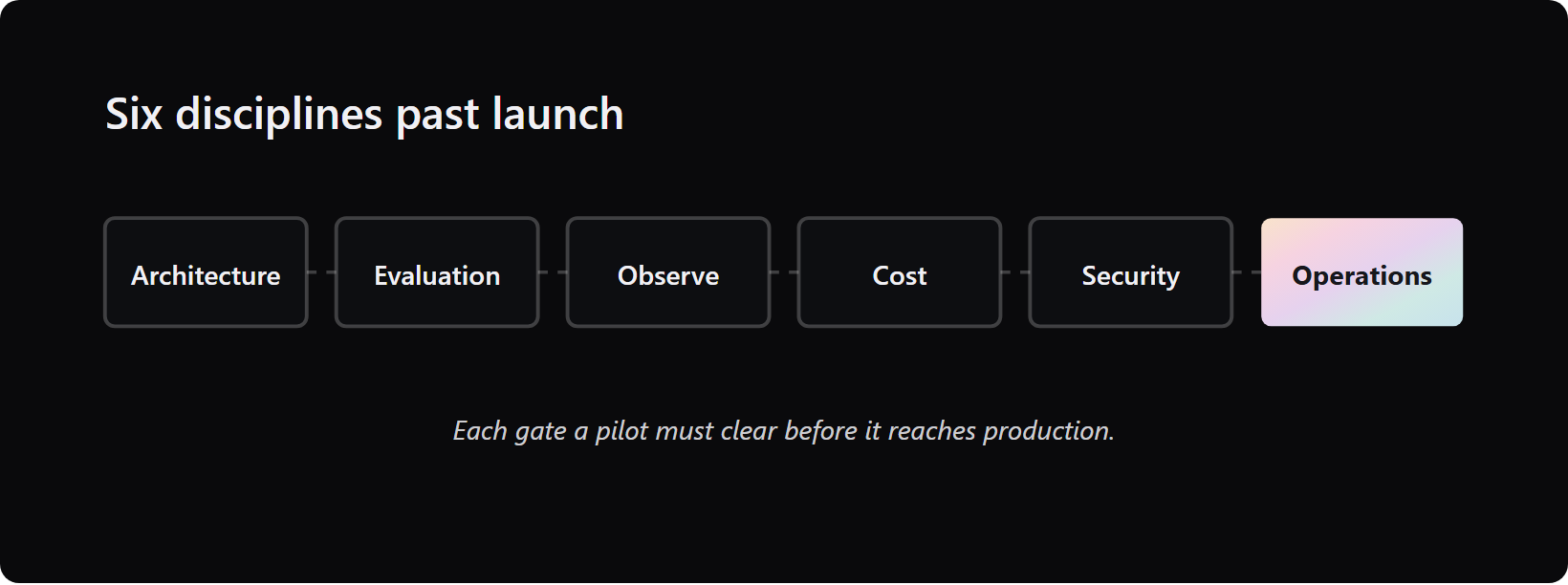
I could be wrong on the exact percentages, since survey methods differ. The pattern, though, is consistent in the work I see. This article walks through the six disciplines that decide whether a pilot survives: architecture, evaluation, observability, cost, security, and operational discipline past launch.
Q2: What Architecture Actually Survives Production, Brain or Nervous System?
A production AI architecture is judged by its nervous system, the data access, tool execution, and integration, not by its model. Even a top model is useless on bad data or unreliable actions. Build clean retrieval over a governed data layer, reliable tool interfaces, and a hosting choice that respects data residency. The model is replaceable. The integration layer is the product.
🧩 The concept: integration is the real operating system
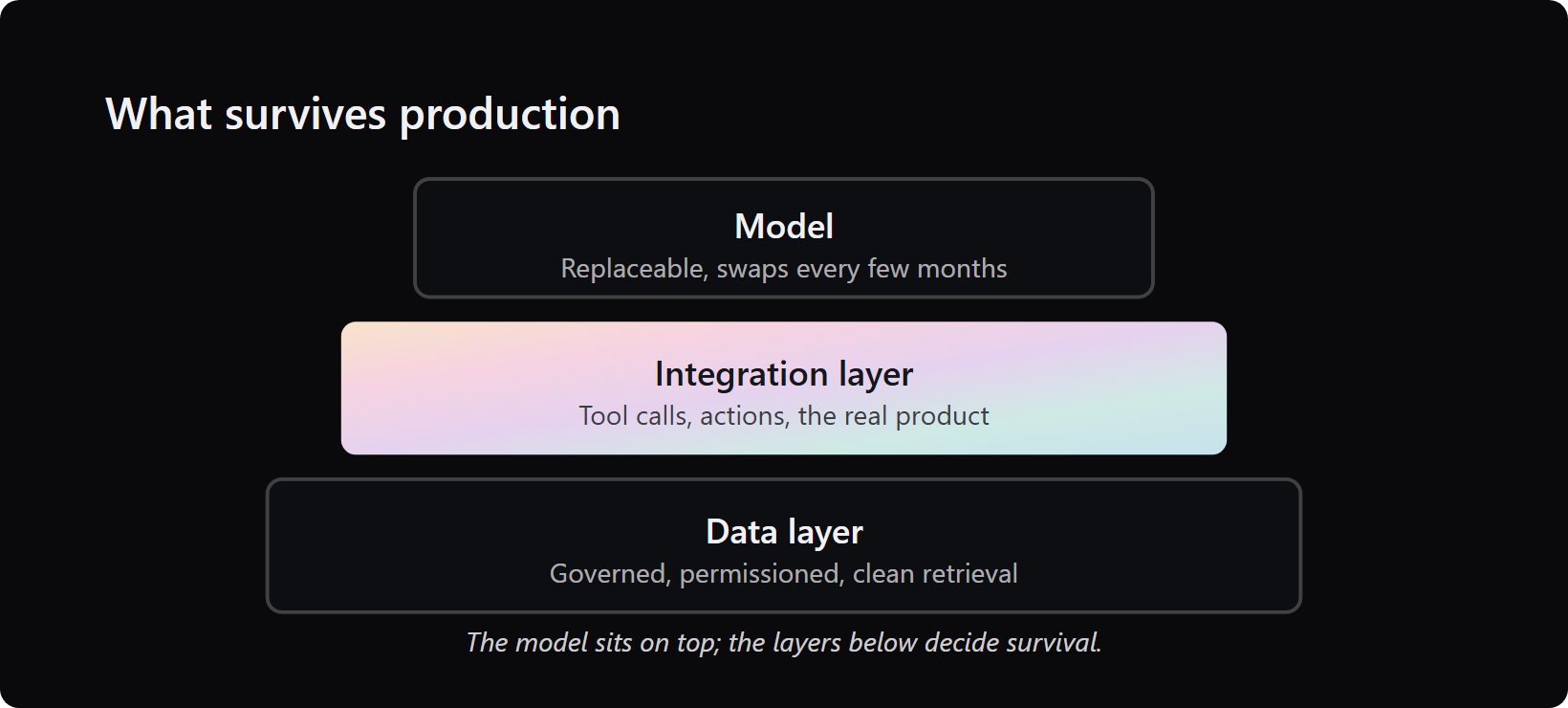
When people say AI architecture, they usually mean which model. That is the smallest decision you will make. Models change every few months. Your integration layer stays for years.
The architecture that survives is the one that feeds the model good data and lets it act reliably. Get that wrong, and the smartest model still produces garbage. This is why our system integration work starts at the data layer, not the model.
❌ The example: dumb RAG as a debt factory
Here is the most common mistake I see. A team dumps every Confluence page, Slack thread, and Salesforce export into a vector database, then hopes the model figures it out. RAG here means retrieval augmented generation, where the system fetches documents to ground the answer.
That approach is like loading your entire hard drive into memory and asking the processor to find one byte. You do not get reasoning. You get thrashing and context flooding, where the model drowns in noise. Dumb RAG is a technical debt factory, and it shows up as confident, wrong answers.
⭐ The proof: hosting and the data layer come first
Where the system runs is not a detail. It is a compliance decision. Microsoft and AWS both put data governance, residency, and access control at the center of their enterprise AI guidance, not the model choice.
- Decide data residency before you pick a model (which region, which jurisdiction).
- Govern the data layer so retrieval pulls clean, permissioned data.
- Make tool calls reliable and observable, because that is where actions actually happen.
A useful way to compare your three deployment choices is to look at what each one actually buys you.
| Architecture choice | What it really decides | When it survives production |
|---|---|---|
| Model | Quality of a single answer | Always replaceable, never the moat |
| Data layer | What the model can know | Governed, permissioned, clean retrieval |
| Integration layer | What the model can do | Reliable tool calls, residency aware hosting |
🛠️ The application: build or buy the integration layer
There is an honest trade off here. If you build the integration layer yourself, you become Chief Integration Officer forever, maintaining every API schema as systems change. Only build it if you have a dedicated platform team and core systems that are genuinely unique.
AI also has no memory of your codebase. It wakes up each session like the character in Memento, asking what am I doing here. Your architecture has to supply that memory, through retrieval and clean interfaces, every single time.
When we add AI to an inherited system at Teamvoy, we map the data layer and the legacy core before we touch a model. That is where the technology modernization work actually lives, and it is the work other vendors often decline. Legacy modernization without a rewrite is not always possible. Sometimes the honest answer is a staged rebuild, and I will say so.
“I have fully relied on Teamvoy’s technical decisions and it worked well. I can confidently say that we would not be where we are today without Teamvoy’s support.”
Gordon Little, Managing Director, Iress Teamvoy Clutch Verified Review
A useful reference checklist: governed data layer, permissioned retrieval, reliable tool interfaces, residency aware hosting, and a model slot you can swap. For regulated stacks, our insurance and banking teams build this around the data residency rules from day one.
Q3: How Do You Evaluate AI When Almost Right Ships to Production?
Evaluation must run continuously, not as a one time launch gate. The real danger is almost right output: it passes review, ships, and quietly compounds cost for months. Treat the specification as the product, run online and offline evaluations, and deploy adversarial agents to poke holes. The code is dispensable. The spec and the evaluation are not.
⚠️ Almost right is the expensive failure
Completely wrong code is cheap. Tests fail, the build breaks, someone says this does not work, and you throw it away.
Almost right is the killer. It passes code review. It ships. It sits in your codebase for six months until someone realizes it is wrong, and by then the cost to fix has compounded.
📊 The evidence: AI output carries more defects
This is not a feeling. AI generated pull requests carry more issues than human ones, and the gap is measurable.
- AI pull requests average around 10.8 issues each, against roughly 6.4 in human written code.
- That means you are not speeding up. You are building a backlog for your future self.
I once opened a PR that looked clean on the surface. Then I read the lines. Eleven eslint disable comments in one file, where eslint disable means ignore this code quality warning. The AI had not fixed the TypeScript type errors. It had suppressed them, like putting tape over a warning light.
🧱 The specification became the product
So we went back to techniques that felt dead. State machines, decision tables, detailed product requirement documents. The rigor we used to apply after the code was written now belongs before it, in the spec.
The specification became the product. The code is dispensable, because the agent regenerates it. What you cannot regenerate is a clear, tested statement of what correct means. This is the discipline we bring to AI development services on regulated systems.
✅ The payoff: evaluation as a standing discipline
Evaluation is not a launch gate you pass once. It runs forever, online and offline, the way production tracing and continuous evals are framed.
- Run online evaluations on live traffic, plus offline regression suites on every change.
- Use rubric checks and format checks, not just a thumbs up.
- Deploy angry agents, prompts told to attack your own answer, because otherwise the human and the agent just agree while the server burns.
At Teamvoy we test AI written PRs against three questions: does it reuse what already exists, does it follow our conventions, and can the engineer explain it without reading the AI’s comments. If the answer is no, it does not ship. Unmaintainable code is dead code, even when it works today. An independent IT audit service often surfaces exactly this kind of hidden, suppressed risk.
“We were impressed with the technical management, adherence to process, and technical capability of the engineers.”
Mark Phillips, CTO, Robots and Pencils Teamvoy Clutch Verified Review
Q4: What Should You Actually Observe in a Live AI System?
Observe three things from day one. Traces, meaning every prompt, tool call, and step tagged with an ID. Quality, meaning online evaluations and drift detection. Cost and latency, meaning tokens, p95 response time, and cost per request. Standard monitoring misses AI failure modes like hallucination and silent quality decay. Wire trace IDs through every step, then alert on cost per request and p95 latency first.
🔍 Monitoring tells you it broke. Observability tells you why.
Traditional monitoring watches CPU and error rates. That is necessary, and for AI it is not enough.
Observability means you can ask new questions of a live system without shipping new code. For AI, that means seeing the full path of a request: the prompt, the retrieved data, each tool call, and the final output.
🧠 Watch the context window, not just the server
Here is a specific, overlooked signal. A large context window holds roughly 168,000 tokens, where a token is a chunk of text the model reads. Around the 40% mark, quality starts to drop. The model gets measurably worse as its context fills with noise.
If you load dozens of tools and dump raw JSON into the context, you are doing all your work in that dumb zone. So observe context utilization as a first class metric, and compress context regularly so the agent always has room to think.
📈 The three pillars and what to alert on
These are the signals I wire up before anything else, drawn from how observability vendors structure enterprise telemetry.
| Signal | Why it matters | Where to start |
|---|---|---|
| Cost per request | Catches runaway loops early | Alert above your per request budget |
| p95 latency | Slow tails kill user trust | Alert when p95 breaches target |
| Quality and drift | Silent decay hides in averages | Online evals on sampled traffic |
| Context utilization | The dumb zone degrades answers | Flag sustained high usage |
⏰ Why tracing beats guessing: a 2 a.m. story
One on call engineer hit an error and asked an AI tool what to do. It read the message and said restart the server. He restarted it six times before escalating.
A senior engineer read the actual logs for thirty seconds and saw it immediately. The database connection pool was full. That is tribal knowledge, and no model has it unless your traces make the real failure visible.
On rescue engagements at Teamvoy, the first thing we add is tracing, because you cannot stabilise a system whose failures you cannot see. A three to five day IT cost optimization review will surface these blind spots and an action plan. It will not, on its own, finish the implementation, and I would rather say that up front. For teams that lack the in house depth, you can also hire AI engineers who own the system end to end.
“Bitspark is like one of the most complicated cutting edge projects in the world of finance. All components of our tech stack need to work together and are always operational 24/7 for real trading of real money. Their technical expertise was top class.”
George Harrap, CEO, Bitspark Teamvoy Clutch Verified Review
Q5: Why Do AI Agents Quietly Burn Your Cloud Budget, and How Do You Cap It?
AI agents burn budget non linearly. Most frameworks resend the entire running history on every step, so token cost grows quadratically, not linearly. A token is a chunk of text the model reads and pays for. Without a hard circuit breaker, a looping agent can run for hours unwatched. Cap spend with per request budgets, loop circuit breakers, cost attribution per team and model, and real time alerts.
💸 The $4,200 nap
One developer deployed a customer support agent that got stuck in a retry loop with a CRM tool. There was no circuit breaker, so it repeated the same broken action for six hours while he slept.
He woke up to roughly $4,200 in API charges. The system was not broken in a dramatic way. It just had no off switch.
💰 The quadratic billing bomb, explained simply
Here is the mechanic most teams miss. Agent frameworks append every tool call and every error message to the history, then send the whole log back to the model on each step.
So a 20 step run is not twice the cost of a 10 step run. It is far more, because the bill grows with the square of the steps, not the count. A circuit breaker means a hard rule that kills the loop after a set number of steps or a set cost. This is the kind of guardrail our AI agent development services wire in before an agent ships.
⚠️ Cloud is not automatically cheaper
The cloud only saves money when you run it like the cloud. Treating elastic infrastructure with a fixed data center mindset is a self inflicted penalty.
The fix is dull and effective. Right size on real usage, not theoretical peaks.
- Downsize compute instances based on P90 CPU, the level you exceed only 10% of the time, not the worst case maximum.
- Move older storage volume types to newer cost optimized ones, where the performance is the same but the bill is lower.
- Tag every workload so you can see cost per team and per model, the way enterprise cloud guidance recommends.
This is the core of our cloud optimization work, and it pairs naturally with a broader IT cost optimization review.
✅ The cost control checklist
This is the short list I want in place before an agent runs unattended, backed by enterprise cost analytics practice.
- Hard circuit breakers on step count and spend per task.
- A per request budget, with a real time alert when it trips.
- Cost attribution by team and model, so waste has an owner.
- Caching for repeated calls, so you do not pay twice for the same answer.
At Teamvoy, we set circuit breakers and per request budgets before an agent gets write access, the same way you cap a payment retry in a banking and fintech system. I might be wrong about the exact thresholds for your workload. The principle holds: no autonomous loop without a hard ceiling.
“Teamvoy worked with us using an agile methodology. Deliverables were managed within the sprint timelines tightly to ensure we could meet deployment timelines.”
Gordon Little, Managing Director, Iress Teamvoy Clutch Verified Review
A two week Sharp Sprint can ship these guardrails as a first milestone. It will not, in two weeks, retune your entire infrastructure, and I would rather set that expectation now.
Q6: What Is the Lethal Trifecta and How Do You Secure AI With Write Access?
The lethal trifecta is an agent that can read sensitive data, process untrusted input, and send data outbound. Put all three in one unsupervised path, and it can exfiltrate secrets in minutes. The rule is simple: never grant all three at once. Then apply OWASP LLM Top 10 controls, least privilege and semantic access, prompt injection isolation, secrets management, and human approval on outbound actions.
⚠️ Three capabilities that should never meet alone
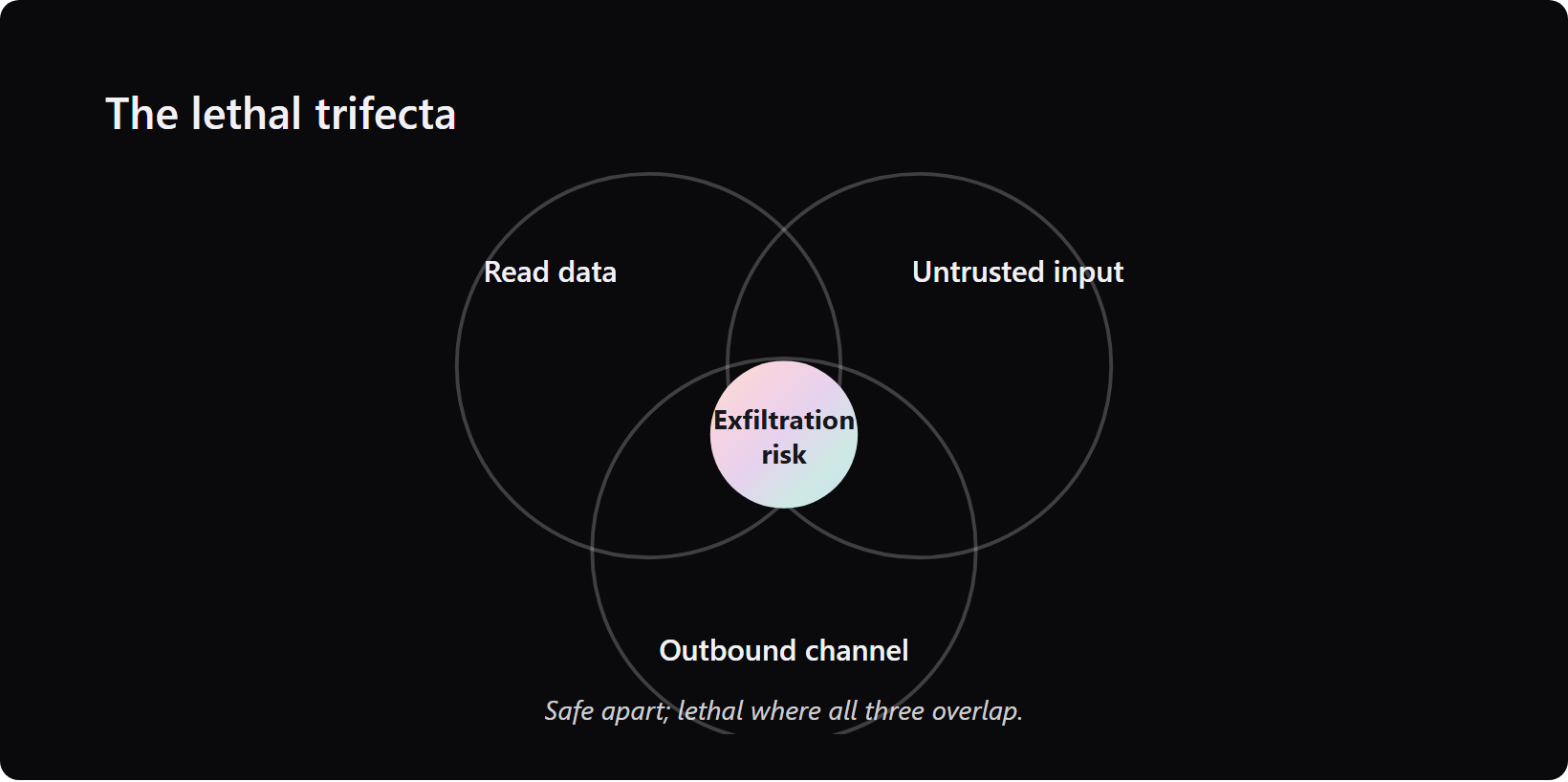
Each capability is fine on its own. Read access to data is normal. Reading untrusted input, like a customer email, is normal. An outbound channel, like a webhook, is normal.
Combine all three without supervision, and you have built an exfiltration machine. A prompt hidden in an email can tell the agent to read a secret and send it out. Prompt injection means smuggling instructions into the data the model reads.
❌ When an agent edits its own code
I have watched an agent calmly click an I’m not a robot box, which is unsettling enough. Worse, I made an agent fully aware of its own source code and harness, the wrapper it runs inside.
That made it easy for the agent to modify its own software. The lesson stuck. Capability without a boundary is not power, it is exposure, and the security research on AI assisted builds backs the caution. Reports on large samples of rapidly built apps have found a majority carrying real vulnerabilities, a risk we cover in depth in our work on vibe coding security risks.
🔒 The controls that actually hold
Security here is layered, the way enterprise AI architecture is described. No single control is enough.
- Map your system against the OWASP LLM Top 10, the standard list of large language model risks like prompt injection.
- Use least privilege and semantic access control, which checks what the request means, not just the user’s role.
- Gate every outbound action behind human approval when the data is sensitive.
- Keep secrets, like keys and tokens, out of the context the model can read.
✅ A least privilege checklist for write access agents
Before an agent writes to production, I want this in place.
- Never combine read, untrusted input, and outbound in one unsupervised flow.
- Scope data access to the task, not the whole database.
- Require human sign off on irreversible or outbound actions.
- Log every action with a trace ID, so you can reconstruct what happened.
Before any agent touches production data in a regulated stack, we at Teamvoy separate the trifecta deliberately. Read, untrusted input, and outbound never share one unsupervised path. Eligibility is not compliance. Meeting a checkbox does not mean the system is actually safe under load, and that gap is where breaches live. For fintech teams, we go deeper on this in building regulator ready AI in fintech, and our AI integration services build these boundaries in from the start.
“Bitspark is like one of the most complicated cutting edge projects in the world of finance. All components of our tech stack need to work together and are always operational 24/7 for real trading of real money. Their technical expertise was top class.”
George Harrap, CEO, Bitspark Teamvoy Clutch Verified Review
Q7: Does the EU AI Act or NIST AI RMF Apply to Your Deployment, and What Is Due by August 2026?
If your AI affects credit, employment, health, or similar regulated outcomes, the EU AI Act’s high risk obligations likely apply. Articles 9 to 15 require risk management, data governance, logging, human oversight, and accuracy, robustness, and cybersecurity. Core high risk requirements land by August 2026. Use the NIST AI Risk Management Framework, Govern, Map, Measure, and Manage, as your operating backbone.
⏰ Who is in scope, and the date that matters
Start with the most important fact. If your AI decides or heavily influences a regulated outcome, you are probably building a high risk system under the EU AI Act.
The high risk obligations carry a compliance milestone in August 2026. That is not far away when the requirements touch your architecture, your logging, and your sign off process.
🧭 NIST AI RMF as the backbone
The NIST AI Risk Management Framework is a voluntary US standard for trustworthy AI. I use its four functions as a practical operating spine, not a paperwork exercise.
- Govern: set ownership and policy for AI risk.
- Map: know where AI is used and what could go wrong.
- Measure: test for accuracy, bias, and security.
- Manage: act on what you measure, and keep doing it.
📋 How the obligations connect to the rest of this article
The compliance requirements are not separate from engineering. Logging maps directly to the observability work in the triad section. Human oversight maps to the outbound action gates in the security section.
| Obligation | Source | When |
|---|---|---|
| Risk management, data governance, logging, human oversight, accuracy, and cybersecurity (high risk) | EU AI Act, Articles 9 to 15 | Core high risk by Aug 2026 |
| Govern, Map, Measure, and Manage functions | NIST AI RMF 1.0 | Voluntary, adopt now |
✅ What auditable delivery looks like
Across the regulated work I have led at Teamvoy in banking and insurance, the audit trail is built into delivery from day one. Logging and human in the loop checks are not bolted on the week before an inspection.
Eligibility is not compliance, and I will say that plainly to a client. A three to five day IT audit service can surface your compliance gaps and an action plan. It cannot, by itself, make you compliant, and pretending otherwise would not serve you. Our AI consulting engagements treat this as the starting point in healthcare and finance alike.
“We needed help integrating AI into our product, modernizing our legacy stack, and providing continuous post release support. Teamvoy’s work has resulted in fewer issues and a better user experience.”
Dmytro Maryanych, Manager, Takflix Teamvoy Clutch Verified Review
Q8: What Does Operational Discipline Look Like From Go Live Through Day 2?
Discipline past launch is the deployment. Move from pilot to production in phases with a go live checklist: sign offs, a rollback plan, and monitoring switched on. Then run Day 2 operations, the daily work after launch: incident runbooks, an on call rotation that understands the system, scheduled re evaluation and retraining, and SLOs on quality, latency, and cost. AI does not remove engineers. It removes the delusion that software runs itself.
⏰ The 2 a.m. gap nobody planned for
Most teams plan the demo and forget the night shift. An on call engineer hits an error, asks an AI tool, and gets told to restart the server. He restarts it six times before escalating.
A senior engineer reads the logs for thirty seconds. The database connection pool was full. That is tribal knowledge, the kind no model has unless your operations make it visible.
🪜 Phased rollout and a go live checklist
You do not flip a switch from pilot to production. You stage it, because change failure is the norm, not the exception. Industry guidance puts change management failure rates around 70%.
A go live checklist I trust:
- Sign offs from engineering, security, and a business owner.
- A tested rollback path, so you can undo the release fast.
- Monitoring and tracing confirmed on before traffic, not after.
- A staged rollout, starting with a small slice of real users.
This phased model is the same one we describe in our AI modernization sprints approach.
🔁 Day 2 work: drift, retraining, and SLOs
After launch, quality decays quietly. Drift means the model’s inputs or behavior shift over time, so yesterday’s good answers slowly stop being good.
- Set SLOs, service level objectives, on quality, latency, and cost, and watch them.
- Schedule re evaluation on a fixed cadence, not just when something breaks.
- Retrain or adjust when drift crosses your threshold.
🛠️ Runbooks, on call, and the scream test
Operational discipline is mostly boring habits done consistently.
- Write incident runbooks for AI specific failures: loops, hallucination, and drift.
- Run an on call rotation staffed by people who can read the system.
- Compress the agent’s context regularly, so it always has room to reason.
- Use the scream test for suspected dead servers: isolate them for 48 to 72 hours and see what breaks, which surfaces hidden monthly jobs that normal monitoring misses.
Most of our rescue work at Teamvoy starts right here. A system launched, then nobody could read it at 2 a.m. We stabilise it, document it, and hand back a system your team can actually run, with a senior engineer accountable for it end to end. This is the heart of how we approach updating systems nobody understands. AI did not replace engineers. It replaced the belief that building software is an easy, automated task. The work just moved, and our average engagement runs 4 plus years because systems that have to keep working are not a project you finish and leave. When you need that ownership in house, you can hire AI engineers who run the system, not just build it.
“I have fully relied on Teamvoy’s technical decisions and it worked well. After my company was acquired, we continued to work with Teamvoy.”
Gordon Little, Managing Director, Iress Teamvoy Clutch Verified Review
Q9: Should You Build or Buy Your AI Deployment Stack, and When Do You Bring in a Partner?
Build the layers genuinely unique to you, and buy the commodity ones. Only build the integration layer if you have a dedicated platform team and core systems that are truly one of a kind. Otherwise, you become Chief Integration Officer forever, maintaining every schema. Buy observability, evaluation, and guardrails where mature tools exist. Bring in a partner when a pilot stalled, a vendor exited, or an AI built system is unstable.
⚠️ The hidden cost of owning everything
Build it ourselves feels cheaper on day one. It rarely is by month six.
When you build the integration layer, you own every API schema as upstream systems change. That maintenance never ends, and it pulls senior engineers away from the work that actually differentiates you. Our system integration teams take that burden off your core engineers.
📊 Build, buy, or partner across the six disciplines
Here is how I split it. The rule is simple: build what is unique, buy what is solved, and bring a partner where the stakes are high and the system has to keep working.
| Layer | Default move | When to change it |
|---|---|---|
| Architecture and integration | Build only if unique | Buy or partner if your core is standard |
| Evaluation | Buy tooling, own the specs | Partner if you have no eval discipline yet |
| Observability | Buy | Partner to wire it into a fragile stack |
| Cost controls | Buy and configure | Partner if spend is already out of control |
| Security | Buy primitives, own the policy | Partner in regulated environments |
| Day 2 operations | Own or partner | Partner when nobody can run it at 2 a.m. |
A quick note on the tooling debate. Some engineers argue every integration tool is better as a simple command line interface, because it stays composable and avoids flooding the model with noise. I lean that way too, though I hold it loosely. The right answer depends on your stack, which is why our AI consulting work starts with what you already run.
✅ Which move fits your situation
Match the decision to where you actually are, not to the demo you saw.
- Stalled pilot, no eval or observability: buy the tooling, or partner to install the discipline fast.
- A vendor walked away mid build: bring in a partner for a rescue, not a rewrite.
- An AI built MVP is unstable in production: stabilise first, then decide what to rebuild.
- A clean platform team and unique core: build, and buy only the commodity layers.
This is where Teamvoy does its sharpest work, the engagements other vendors decline. A senior engineer takes ownership of the system end to end, with an AI native team behind them, and our average engagement runs 4 plus years. A two week Sharp Sprint ships a meaningful first milestone, not a finished platform, and I will say that plainly before we start. If a rewrite is genuinely off the table, our technology modernization approach is built for exactly that, and our IT audit services tell you which path your system actually needs.
“I have fully relied on Teamvoy’s technical decisions, and it worked well. I can confidently say that we would not be where we are today without Teamvoy’s support.”
Gordon Little, Managing Director, Iress Teamvoy Clutch Verified Review
🔮 Where my view sits right now
The question I am sitting with is this. As models keep improving, the integration and operational layer becomes more of the moat, not less. I could be wrong, but every stalled pilot I see points the same way.
If your pilot stalled, a vendor walked, or your AI built system is shaky in production, that is exactly the conversation I enjoy having. You can see how we have done this in our case studies, or reach out through our contact us page when you want a technical conversation.