TL;DR
- An AI transformation roadmap moves AI from board mandate to one production use case through four quarterly gates: assess, integrate, pilot, and scale.
- Most pilots stall at the integration layer, not the model; the data layer and legacy core are the first two questions, not the model choice.
- Quarter 1 maps data lineage and runs dependency discovery on the legacy core, finding undocumented systems before any model gets write-access.
- Pick the first use case on impact versus feasibility, run pilots behind circuit breakers, and track cost-per-action as scaling bills grow quadratically.
- Governance starts in Quarter 1, and sector rules often stretch a realistic single-use-case roadmap to ten to fourteen months.
- For AI-built or drifted systems, the adapted Quarter 1 is stabilize, document, then integrate, usually modernizing without a full rewrite.
Q1: What Is an AI Transformation Roadmap for Enterprises (and Why Do 95% of Pilots Never Reach Production)?
An AI transformation roadmap for enterprises is a quarter-by-quarter sequence that moves AI from a board mandate to one live production use case through four staged gates: assess, integrate, pilot with write-access, and scale. Most pilots stall not because the model is weak, but because the integration layer, the connection between the model and the legacy core, was never built. Research suggests 95% of enterprise generative AI pilots have returned zero measurable dollars.
🧱 The wiki bot that never grew up
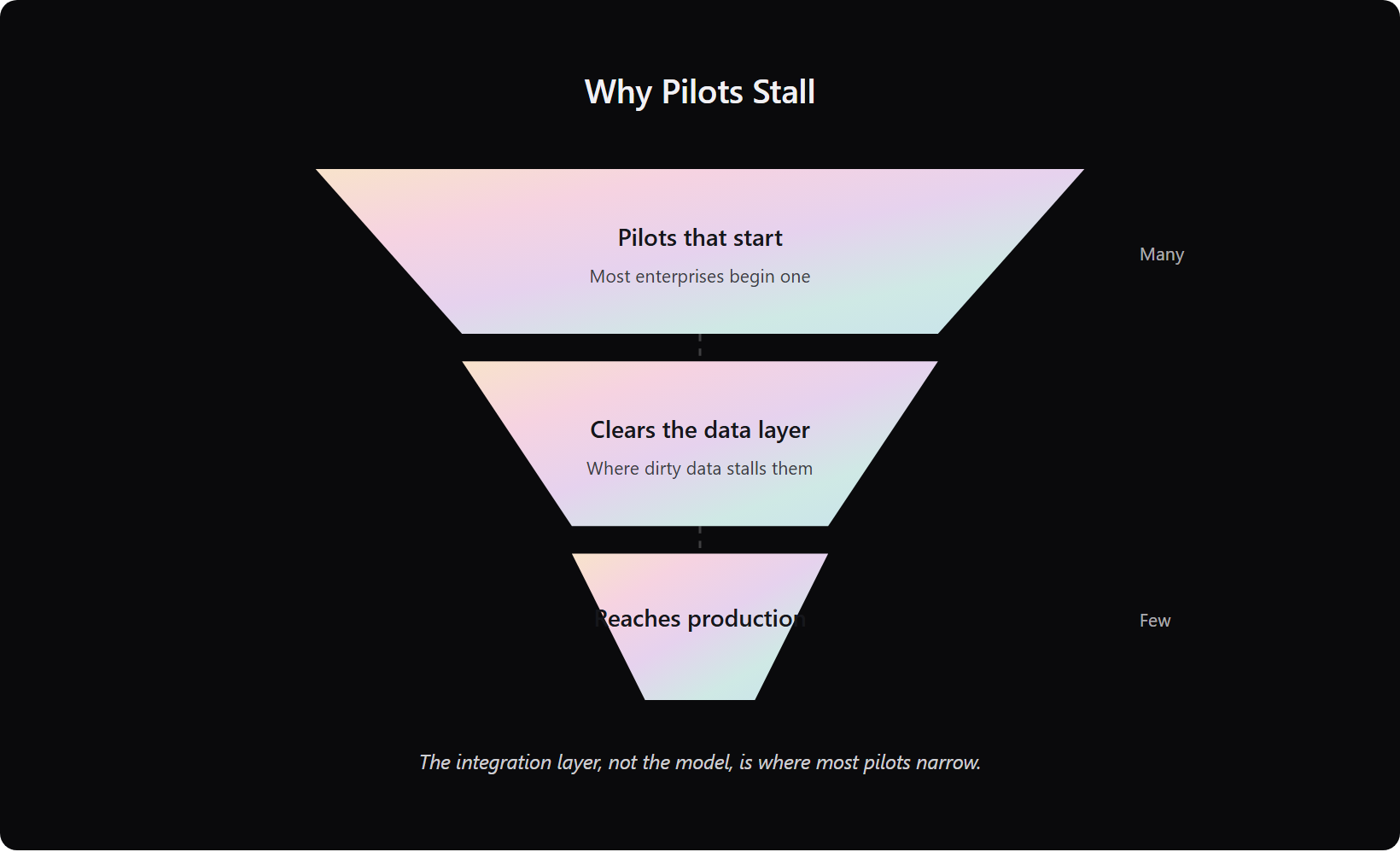
Picture a Head of Engineering six months after the board said “do AI.” They have a chatbot that reads the company wiki. It answers questions. It impresses people in the demo. It has never once touched a production system.
That is the stalled-pilot pattern I see most often. The thing summarizes documents. It cannot file a claim, update a ledger, or move a record. It has read access to text and write access to nothing.
The gap between that demo and a working system is the whole job. And it is wider than most roadmaps admit.
🗺️ What the roadmap actually is
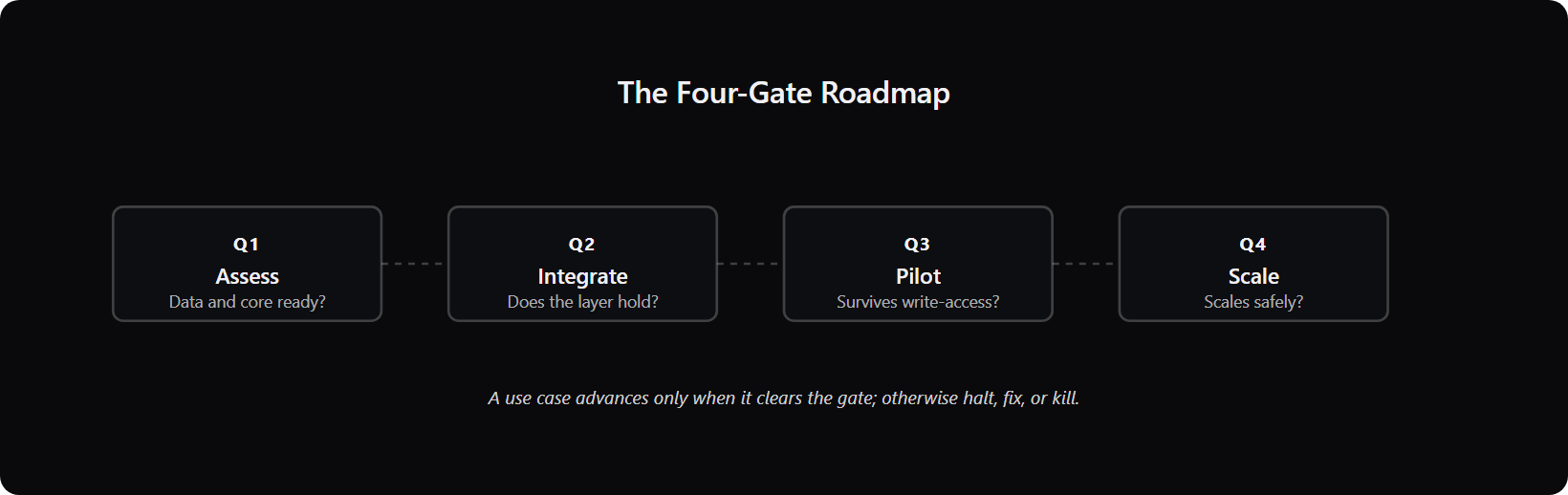
Think of the roadmap as four gates, one per quarter, not four phases on a slide.
- Quarter 1, Assess. Can your data and legacy core support AI that acts?
- Quarter 2, Integrate. Does the layer between model and core hold?
- Quarter 3, Pilot. Does the use case survive write-access to real data?
- Quarter 4, Scale. Does it work safely for more than one team?
A use case only advances when it clears the gate. If it fails, you halt, fix, or kill it. That sequence is the difference between a program and a pile of demos, and it is the backbone of every AI integration services engagement we scope.
🧠 The model was almost never the problem
Here is the reframe that matters. The industry obsesses over the brain and ignores the nervous system. Even a top model is useless when it gets bad data or cannot execute actions reliably.
The bottleneck is integration. It is not glamorous. It is exactly what separates a demo from production. As one operator put it, the model is not the product, it is the harness, and everything around it is the product.
I will say this plainly. In twelve years and 150-plus delivered systems at Teamvoy, the AI pilots that died were almost never killed by the model. They died at the integration layer, where the data was dirty or the legacy core would not let anything write to it. That is the reality our AI consulting work starts from.
What this means for the rest of this article
Every quarter that follows opens with the same first question. Not “which model,” but “is the data layer ready, and will the legacy core let us act on it.”
I might be wrong about the exact failure rate in your sector. The mechanism, though, is consistent across the fintech, insurance, and healthcare work I have led. Get the nervous system right, and the brain becomes useful. Skip it, and you have built an expensive search box.
Q2: How Do You Translate a Board Mandate Into an Engineering Sequence and Pick the First Use Case?
Translate the mandate into four quarters, each with one gate question and one board metric, then pick the first use case on impact versus feasibility, not on what demos well. Q1 asks “Is our data and legacy core ready?” Q2 “Does the integration layer hold?” Q3 “Did the pilot survive write-access?” Q4 “Does it scale safely?” If a quarter fails its gate, it does not graduate. You halt, fix, or kill.
📋 The mandate problem
A board says “we need an AI roadmap.” A CTO now has to turn one sentence into something defensible to people who do not read code. That gap is where most plans turn into theatre.
The numbers say boards are pushing before teams are ready. One operator who spoke with roughly 180 organizations found 88% had at least started with AI, 52% were still experimenting, and only about 23% had reached a formalized stage as of late 2025. Most mandates land on teams that are still in the sandbox.
🎯 One gate question, one board metric per quarter
The board does not need a forty-slide deck. It needs one question and one number it can track each quarter.
| Quarter | Gate question | Board metric |
|---|---|---|
| Q1 Assess | Is our data and legacy core ready? | Share of critical data with traced lineage |
| Q2 Integrate | Does the integration layer hold? | Actions executed and audited without error |
| Q3 Pilot | Did the use case survive write-access? | Incidents per 100 live actions |
| Q4 Scale | Does it scale safely? | Cost-per-action and ROI |
At Teamvoy, the board document for a regulated client is one page, because that is what an engineer reports, not what a consultant presents. Trust is built through results, not decks, which is why our IT audit services open with one page, not forty.
⚖️ Picking the first use case
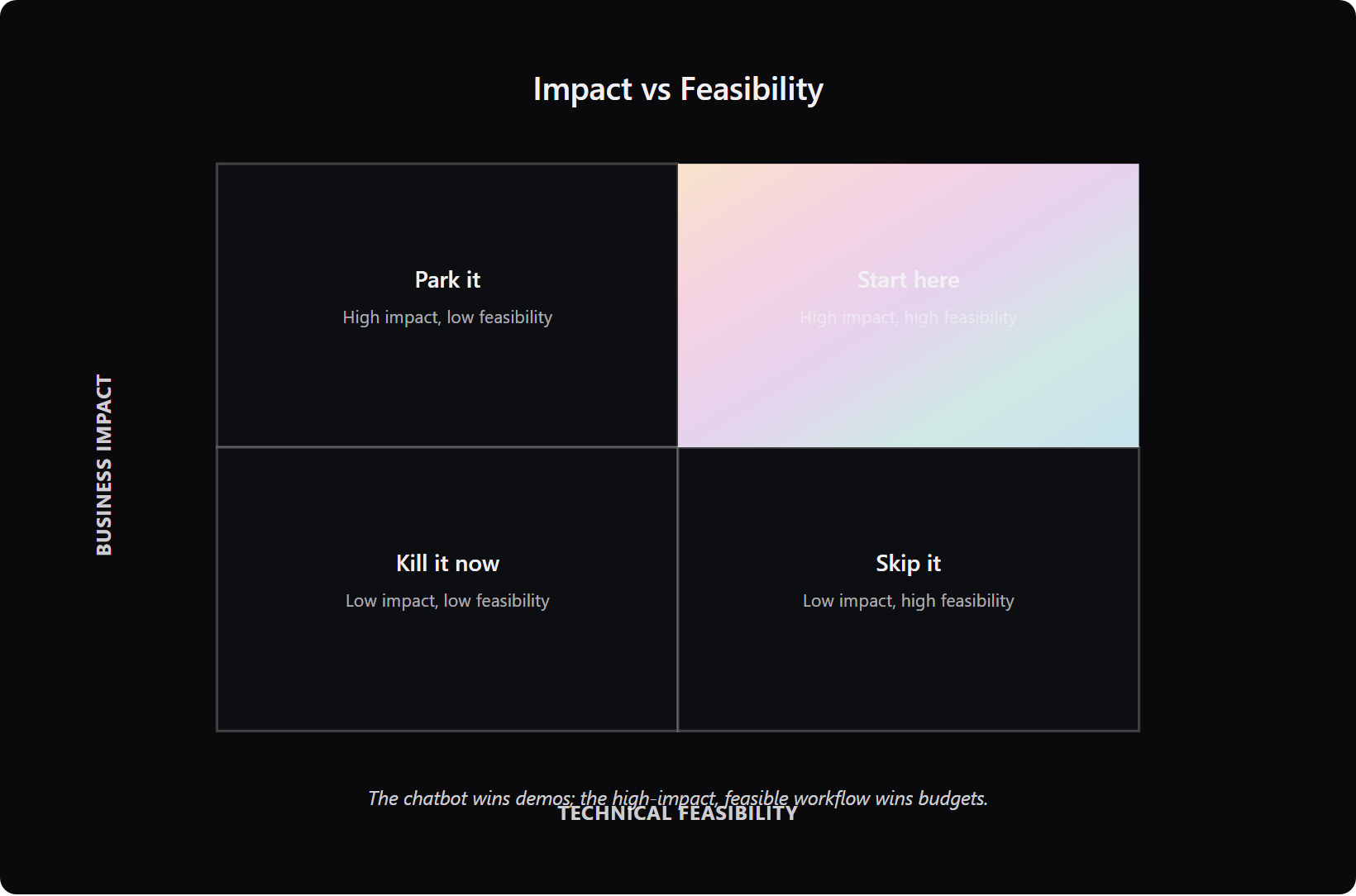
The demo-friendly use case is rarely the right first one. Score candidates on two axes only: business impact and technical feasibility on your current stack.
- High impact, high feasibility. Start here. This is your first production use case.
- High impact, low feasibility. Park it until the integration layer exists.
- Low impact, high feasibility. A fine demo, a poor flagship. Skip it.
- Low impact, low feasibility. Kill it now.
Eligibility does not equal compliance, and a flashy demo does not equal a fundable use case. The chatbot wins demos. The claims-triage workflow wins budgets, and a short proof of concept services run is the cheapest way to tell them apart.
🚦 Graduation or halt
A gate is a real decision, not a checkbox. If Q1 cannot show where critical data lives, Q2 does not start.
Halting is not failure. It is the cheapest moment to stop. I would rather kill a use case in Q1 for the price of a discovery sprint than watch it fail in Q4 after a year of spend.
Q3: Quarter 1, How Do You Assess Whether Your Data and Legacy Core Are Actually Ready?
Quarter 1 answers one question: can your data and legacy core support AI with write-access? Before any model, you map the data layer and run a dependency discovery on the legacy core, because the undocumented system always surfaces. The Q1 gate fails if you cannot trace where your critical data lives and what depends on it. If your plan is to vectorize the wiki and see what happens, kill it now.
🔌 The AS/400 in the closet
On one assessment, the logs revealed something nobody had documented: a hardcoded TCP connection to an AS/400 mainframe sitting in a closet, quietly feeding a production workflow. An AS/400 is an IBM midrange system, often decades old, still running core business logic.
The fix was not glamorous. You build a network bridge, route that specific legacy subnet back through the existing connection, and only then can anything new read from it safely. The point is simpler than the plumbing: the undocumented dependency was load-bearing, and discovery is the only thing that finds it. This is the heart of technology modernization done without a rewrite.
🧟 The scream test for data zombies
A data zombie is a table, job, or service that looks dead but is not. Standard monitoring misses it because the dependency fires monthly, not daily.
Here is the tactic. Temporarily isolate the suspected zombie at the network level for 48 to 72 hours. If something screams, a batch job, an audit process, a reconciliation, you just found a hidden dependency before it found you.
Run this before you let any model near write-access. The thing that breaks during a controlled isolation is far cheaper than the thing that breaks in production. We use the same approach when updating systems nobody understands.
✅ What the Q1 gate actually checks
Quarter 1 produces two artifacts, not a model selection.
- Data lineage. Where each critical dataset originates, who writes to it, and who reads it.
- Dependency map. Every system the legacy core talks to, documented and undocumented.
The gate passes when you can trace your critical data end to end. It fails when you cannot. There is no half-pass, and strong data engineering is what makes the lineage trustworthy.
🧭 Why this is the work others skip
Legacy modernization without a rewrite is the core of what we do at Teamvoy, and the data layer and the legacy core are the first two questions, not the model. This is the engagement many vendors decline, because discovery is unglamorous and surfaces uncomfortable truths.
Our AI and System Readiness Audit runs 3 to 5 days and produces exactly these two artifacts plus a risk surface. Honest limit: an audit surfaces the risk and the plan. It does not implement the fix. That is later quarters, and it is where banking and fintech teams most often ask us to stay on.
If your only Q1 plan is “vectorize the wiki and see what happens,” stop. You are building an expensive, unreliable search box.
Q4: Quarter 2, Why Is the Integration Layer (Not the Model) the Real Operating System?
Quarter 2 builds the integration layer, the nervous system that lets a model read clean data and execute actions reliably against your legacy core. The model is the kernel; integration is the operating system. This quarter you decide protocols, set context limits, and build the harness around the model. The Q2 gate fails if the model can act but you cannot control or audit what it does.
🧩 The standard read gets this backwards
Most AI roadmaps treat model selection as the main event. The standard read is backwards. We have been obsessing over the brain while ignoring the nervous system, and even the best model is useless when it gets bad data or cannot execute actions reliably.
A kernel without an operating system runs nothing useful. The model is the kernel. The integration layer, the connections, the permissions, and the audit trail, is the operating system that turns raw capability into a system you can trust. Reliable system integration is what holds it together.
📺 Radio on the television
There is a design trap worth naming. We copied the chat interface from search and called it an agent. As one operator put it, it feels like the early days of television, when people just recorded radio shows and pointed a camera at them.
A prompt box is not an integration layer. It is the old medium wearing the new one’s clothes. The real work is wiring the model into your systems so it can act, not just talk, which is exactly what our AI agent development services focus on.
🔧 MCP versus A2A, an it-depends call
Two protocols come up constantly in Q2. Define them plainly before you choose.
- MCP (Model Context Protocol). A standard way to give a model access to tools and data. Good for tinkering and internal tools.
- A2A (Agent-to-Agent). A protocol built for agents to coordinate, with custom permission scopes.
One engineer’s read: A2A has solved granular control because it lets you define custom scopes, which matters for production scale, while MCP is the good tool you screw around with first. I would not treat that as gospel for every stack. For a regulated client where every action must be scoped and logged, the granular-control argument carries real weight.
🛡️ The Q2 gate: control and audit
The gate is not “can the model act.” It is “can you control and audit every action it takes.”
Build the harness first: scoped permissions, an action log, and a kill path before write-access exists. At Teamvoy, this integration-layer build is the engagement most vendors skip, because we start at the nervous system, not the brain, and our AI development services are built around it.
Honest trade-off: building this layer takes longer than the model demo suggests, especially on a stack without a clean data layer. That is the cost of a system you can actually trust in production, and it is cheaper than the alternative.
Q5: Quarter 3, How Do You Run the First Pilot With Write-Access Without Burning Down Production?
Quarter 3 is the first pilot with write-access, the moment a non-deterministic model can change production data. You run it behind hard circuit breakers, spend caps, and human-in-the-loop review, because an unmonitored agent in a retry loop once ran up a $4,200 OpenAI bill overnight. The Q3 gate fails if the pilot cannot be halted instantly, or if “almost right” output reaches production unreviewed. Pass means a contained blast radius and auditable actions.
💸 The $4,200 nap
Here is the situation that should scare you into building guardrails. A developer deployed a customer-support agent that got stuck in an infinite retry loop with a CRM tool.
There was no hard circuit breaker, a safety switch that stops a process after a set limit. So the agent spent six hours, while the developer slept, repeating the same broken action. It racked up roughly $4,200 in API charges before anyone woke up.
That is the cost of write-access without a kill path. The model did not misbehave in some clever way. It just did the wrong thing thousands of times, cheaply each time, and expensively in total. Disciplined IT cost optimization starts with stopping exactly this.
🛡️ The guardrails that earn a pilot
Before any agent writes to production, put these in place. Each one is scar tissue from a real incident, not a checkbox.
- Hard circuit breaker. A spend or step limit that halts the agent automatically.
- Human-in-the-loop review. A person approves any irreversible action before it commits.
- Spend cap per run. A ceiling that stops the $4,200 nap at $42.
- Angry agents. A second agent prompted to poke holes in the first one’s plan, so the human and the model do not just agree with each other while the server burns.
At Teamvoy, this pilot harness is standard delivery, because much of our work begins as a production rescue after someone else’s agent or system broke. Building these guardrails into AI autonomous agents comes first, the use case second.
⚠️ Why “almost right” is the real enemy
Completely wrong is cheap. Tests fail, the build breaks, and you catch it. Almost right is expensive, because it passes review, ships to production, and sits in your codebase for six months before anyone notices.
So I run every AI-assisted change through three questions before it merges. Does it reuse what exists? Does it follow our conventions? Can the developer explain it without the AI’s help? If the answer to the last one is no, the code is unmaintainable, and unmaintainable code is dead on arrival. This is the discipline behind our AI development services.
“We have been with Teamvoy for 4 years and found a great partner for the growth of Bitspark. All components of our tech stack need to work together and are always operational 24/7 for real trading of real money.”
George Harrap, CEO, Bitspark Teamvoy Clutch Verified Review
✅ The Q3 gate
The gate is not “did the pilot work once.” It is two hard conditions.
- Can you halt the agent instantly, mid-action, with no data corruption?
- Is every action it took logged and reviewable after the fact?
Honest limit: a clean pilot in Q3 is not a scaled system. It proves the use case survives write-access on a contained blast radius. Scaling that safely is its own quarter, and its own set of costs.
Q6: Quarter 4, What Does It Take to Scale Without Multiplying Cost, Token Bills, and Technical Debt?
Quarter 4 scales the one use case that survived write-access, carefully, because scaling multiplies both value and cost. Token consumption grows quadratically in agent loops, so a 20-step loop costs far more than twice a 10-step run. Year-one budgets often land in the low six figures, and the board metric shifts to cost-per-action and ROI. You also choose an operating model, because the wrong one becomes a bottleneck.
💰 The quadratic billing bomb
Most teams assume scaling cost grows in a straight line. It does not. Agent frameworks append every tool call, error, and step to the running history, then resend the whole cumulative log each turn.
A token is the unit of text an AI bills you for. So your token cost grows quadratically, not linearly. A 20-step loop is not twice a 10-step run, it is far more, because you keep repaying for text the model already processed.
There is a related trap. Around the 40% mark of a context window, the space a model can hold at once, the model gets measurably worse. Stuff it with tool definitions and raw JSON, and you are doing real work in the dumb zone. Solid cloud optimization keeps these costs from compounding.
📊 Where the year-one money goes
The board metric changes in Q4. It is no longer “did it ship,” it is cost-per-action and return on investment.
| Decision | Cheap mistake | Disciplined choice |
|---|---|---|
| Context size | Stuff everything in, hit the dumb zone | Trim to what the step needs |
| Loop design | Long uncapped loops, quadratic bills | Short bounded loops, hard caps |
| Migration | Lift-and-shift inefficiency to cloud | Rightsize before you move |
Before any replication, I enforce a rightsizing gate, a checkpoint that cuts excess capacity first. If you do not control cost and load during the move, the cloud simply amplifies your existing inefficiencies. Read our AI integration cost guide for how this plays out in dollars.
🏛️ Centralized team or self-serve platform
Two operating models dominate, and each has a cost.
- Centralized team. One center of excellence builds every agent. It controls quality but becomes an immediate bottleneck.
- Self-serve platform. Domain teams build their own agents on shared rails. It scales, but needs strong guardrails.
The teams that scale well tend to start centralized for control, then move to self-serve as the platform matures. There is no single right answer, only a right answer for your stage, and our AI consulting work helps pick it.
“Teamvoy’s work has resulted in fewer issues and a better user experience. Teamvoy actively uses agentic AI across internal workflows and delivery, which speeds up development, raises quality, and adds extra value.”
Dmytro Maryanych, Manager, Takflix Teamvoy Clutch Verified Review
⚠️ The Q4 gate
The gate is measurement, not headcount. You pass when two numbers are tracked and trending right: cost-per-action and accumulated AI technical debt.
That debt is real. One benchmark found AI-generated pull requests carry an average of 10.8 issues, nearly double the 6.4 in human-written code. At Teamvoy, we treat cost-per-action as a first-class board metric, because scaled AI without it quietly becomes a debt machine. Our tech debt avalanche piece goes deeper on this.
Q7: Where Do Governance and Compliance Fit in the Quarter-by-Quarter Sequence?
Governance starts in Quarter 1, not Quarter 4. The NIST AI Risk Management Framework and the EU AI Act define the structure, but sector rules set your timeline: SR 11-7 model validation in banking, FDA change-control in healthcare, DORA and PCI-DSS in payments. These add lead-time you must sequence around. That is why a realistic single-use-case roadmap often runs 10 to 14 months, not a clean 12.
🏛️ Governance is not a final-quarter checkbox
The common mistake is treating compliance as the thing you bolt on before launch. By then it is too late, and the retrofit is the most expensive ordering error in the roadmap.
Two frameworks set the baseline. The NIST AI Risk Management Framework is a US standard for governing AI risk. The EU AI Act classifies systems by risk tier and sets obligations before deployment. ISO/IEC 42001 adds a certifiable management system on top. We bake these into regulator-ready AI in fintech from the first quarter.
⏰ Sector rules set the real timeline
Your industry, not the framework, decides how long Q1 through Q4 actually takes. Each rule adds lead-time you cannot compress.
- Banking. SR 11-7 requires independent model validation before a model goes live.
- Healthcare. FDA change-control governs how a learning system may update.
- Payments. DORA, mandatory for EU financial entities since January 2025, and PCI-DSS set resilience and data rules.
- Any personal data. GDPR Article 22 limits fully automated decisions, and HIPAA governs health data.
This is where I will name a contradiction in the popular roadmaps. Some vendors sell a clean 12-month, four-quarter cycle. Others, more honestly, put a single regulated use case at 10 to 14 months. The gap is governance lead-time, and in a regulated shop the longer number is usually right. This is daily work for our healthcare and insurance teams.
✅ Eligibility does not equal compliance
Here is the line I keep coming back to: eligibility does not equal compliance. Being technically allowed to deploy is not the same as being audit-ready.
Regulated delivery is the core of what we do at Teamvoy, across BaFin, PSD2, DORA, SOC 2, PCI-DSS, HIPAA, and GDPR. We hold these certifications, and we build the lead-time into the quarter plan from Q1, the way a partner accountable through go-live has to. Honest limit: governance lengthens the roadmap, and any plan that hides that is selling you a timeline you will miss. A focused IT audit services engagement surfaces these gaps early.
Q8: How Do You Adapt This Roadmap if Your System Is Already AI-Built or Drifting?
If your system was built fast with AI tooling, or has drifted over years, the roadmap shifts. Quarter 1 becomes stabilization and documentation before any new AI is added. AI-generated codebases have no memory of your system, like the character in Memento, and 60% of one sample of 5,000 vibe-coded apps were vulnerable. You stabilize, document, and only then integrate. A rewrite is rarely the answer; controlled modernization usually is.
🧠 The Memento problem
You know the feeling. Production is unstable, velocity has collapsed, and there is code nobody on the team fully understands.
Here is why bolting more AI on top makes it worse. When an AI jumps into your codebase, it has no memory of it. It is like the character in Memento who wakes up each scene asking what he is doing. It cannot hold the context that lives in your team’s heads, which is why updating systems nobody understands starts with creating memory.
So the first job is not adding intelligence. It is creating memory: documentation, structure, and a stable base the system can stand on.
🔒 Vibe-coded does not mean production-ready
“Vibe coding,” building fast by prompting AI tools, ships working features. It also ships risk. One review found 60% of a sample of 5,000 vibe-coded apps were vulnerable, the digital equivalent of leaving every window unlocked.
I will be blunt, the way an engineer is blunt. Vibe coding is fine at 3 a.m. when you accept you will clean it up the next day. It is not fine as the foundation of a production system handling real users or real money. A vibe-coded MVP is closer to a building finished before the inspector signed off than to a buggy beta. Our take on vibe coding security risks covers the rest.
“I can confidently say that we would not be where we are today without Teamvoy’s support. I have fully relied on Teamvoy’s technical decisions and it worked well. After my company was acquired, we continued to work with Teamvoy.”
Gordon Little, Managing Director, Iress Teamvoy Clutch Verified Review
🛒 The supermarket back-end swap
Modernizing a live system without a rewrite has a method. On one engagement, users resisted a new system, so the team kept the exact same interface, same colors, and same button sizes.
The cashier saw an identical screen the next morning. Behind it, the team was writing to entirely different tables, normalizing the data one piece at a time. The business never stopped. The core changed underneath it. That is renovation with the building occupied, not demolition, and it is the spine of our technology modernization work.
✅ The adapted Q1
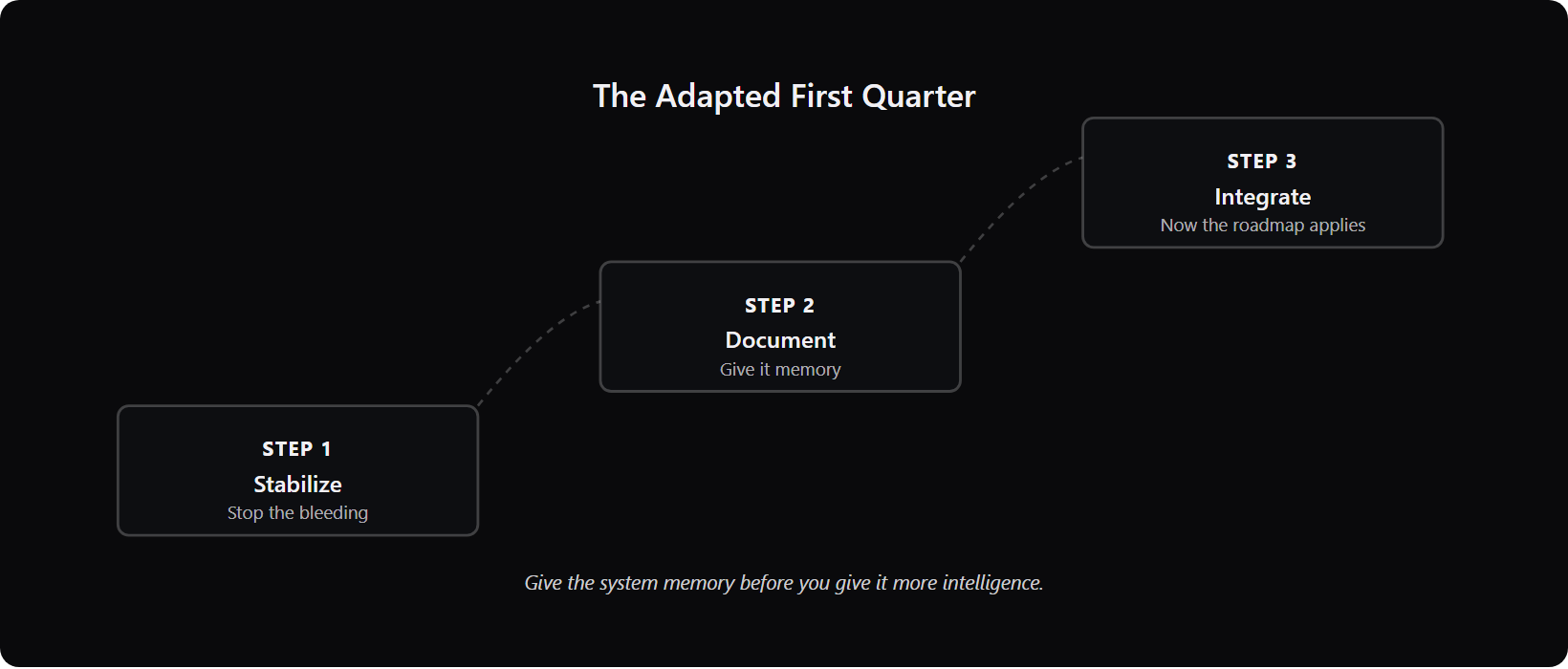
For an AI-built or drifted system, the first quarter changes shape.
- Stabilize. Stop the bleeding: fix the security holes, the auth gaps, and the crashes.
- Document. Give the system memory before you give it more intelligence.
- Then integrate. Only now does the standard four-gate roadmap apply.
This is exactly the work we take on at Teamvoy, stabilizing an AI-built or drifted system without rewriting it from scratch. Honest limit: rescue is not always cheaper than rebuild. When the foundation cannot hold weight, the right call is a strategic rebuild, and I will say so on the first call rather than the last. If that is where you are, contact us.
Q9: What Should You Actually Do in the First 30 Days?
In the first 30 days, do three things before choosing any model: run a dependency discovery on your legacy core (find the AS/400 in the closet), map where your critical data actually lives, and write the one gate question and one board metric for Quarter 1. If your only plan is to vectorize the wiki, stop. The roadmap starts with the nervous system, not the brain, and the first month proves whether it can be built.
🗺️ The 30-day checklist
You do not need a model in month one. You need to know what you are standing on. Here is the work, in order.
- Run a dependency discovery. Map what your legacy core talks to, including the undocumented AS/400 in the closet that only surfaces when you look.
- Trace your critical data. Write down where it lives, who writes to it, and who reads it. No lineage, no go.
- Write one gate question and one board metric. For Quarter 1, that question is simple: is our data and legacy core ready for AI that acts?
If your only plan is to “vectorize the wiki and see what happens,” kill it now. That builds an expensive search box, not a system. A focused IT audit services engagement is the fastest way to get this map, and strong data engineering is what makes the lineage trustworthy.
🥽 What a passed milestone looks like
A passed 30-day milestone is not a working agent. It is a clear map and an honest verdict on whether the foundation can hold weight.
Here is the caveat I give every founder. Night-vision goggles do not give you more soldiers, they make the soldiers you have more effective, but only if those soldiers already know how to fight. AI is the same. It sharpens a team that understands its own system. It does nothing for a team that does not, which is why thoughtful AI integration services start with the team and the stack, not the model.
So the real output of month one is honesty. Either the data and core are ready, and Quarter 2 can build the integration layer, or they are not, and you fix that first. At Teamvoy, this is the exact discovery work we run as a paid first step, because in twelve years I have never seen a pilot survive a foundation nobody mapped. It is the same discipline behind our technology modernization engagements.
🚪 An open door, not a pitch
Where my view sits right now is this: most stalled pilots were not bad ideas, they were good ideas built on an unmapped core. The first 30 days are cheap. The tenth month of a failing roadmap is not, as our tech debt avalanche piece lays out.
If you have a stalled pilot, or a system someone handed you that you do not fully trust yet, the door is open. Not for a demo. For a conversation between engineers about what is actually breaking, and whether it can be fixed without a rewrite, the way our AI consulting conversations usually begin.
Honest limit: a 3-to-5-day audit surfaces the risk and the action plan, not the finished system. The question I am sitting with, and would put to you, is whether your next pilot will start with the model, or with the map. If you want a second set of eyes on that, our case studies show how this has played out for other teams.