TL;DR
- Enterprise AI fails in a fixed order: technical, then operational, then commercial, then organizational. Diagnose your wall before you spend.
- Most pilots stall at integration, not the model. A clean data layer and legacy core are the first two questions.
- Almost-right AI code is costlier than wrong code; it passes review, ships, and compounds as silent technical debt.
- Token cost grows quadratically as agents resend full history, so working pilots break on unit economics at production volume.
- The lethal trifecta of data access, untrusted content, and external comms turns an agent into a breach risk.
- Modernize underneath a stable surface, migrate incrementally, and keep a human owner who can read and extend the system.
Q1: Why do enterprise AI pilots stall after the demo works?
Enterprise AI pilots stall because a demo proves the model can reason, not that your stack can run it. MIT’s 2025 research found 95% of generative AI pilots delivered no measurable return. The model is the kernel. The integration layer is the operating system, and most enterprises never built it. The demo passed. The nervous system failed.
🎯 The demo that worked and the pilot that died
I have watched this exact scene more than once. A Head of Innovation runs a slick agent demo for the board. Everyone claps. Six months later, the pilot is quietly dead.
Nothing was wrong with the model. The model was never the problem. The problem was the wiring underneath it, the part nobody filmed.
In 12 years across 150+ platforms, the first thing I look at on a stalled AI build is never the model. It is whether the integration layer exists at all.
📊 The same failure, counted three different ways
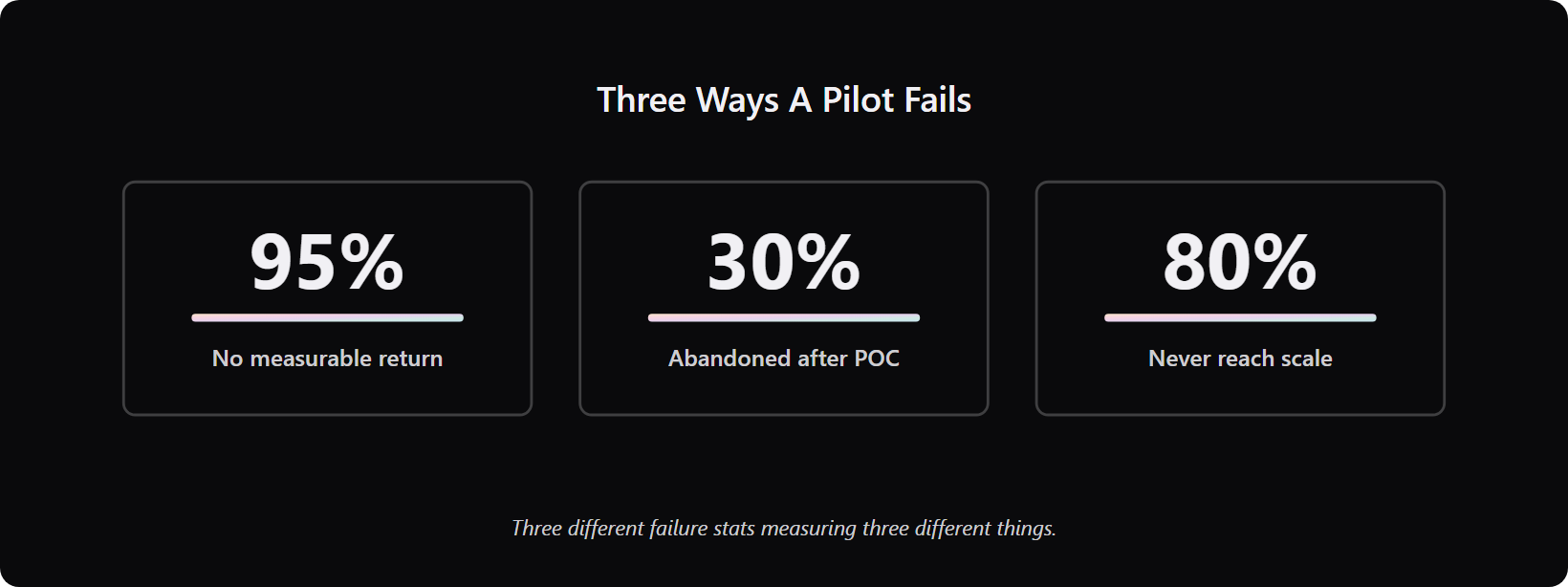
The “95% fail” headline gets repeated everywhere, often loosely. The numbers floating around measure different things, and treating them as one number is how people draw the wrong lesson.
| Stat | Source | What it actually measures | Why it is not interchangeable |
|---|---|---|---|
| 95% no measurable return | MIT, 2025 | Pilots that delivered zero dollars of tracked ROI | A pilot can “work” technically and still count here |
| ~30% abandoned after POC | Gartner | Projects dropped after proof of concept by end-2025 | Measures abandonment, not ROI |
| ~80% fail to scale | EPAM | Pilots that never reach production scale | A pilot can scale and still lose money |
These are three separate failures: no return, abandoned, and never scaled. A real diagnosis names which one you are actually facing.
⚙️ Intelligence stopped being the bottleneck
Here is the reframe the category keeps getting backwards. We have been obsessing over the brain while ignoring the nervous system. Even a frontier model is useless when it gets bad data or cannot execute actions reliably.
The adoption data backs this up. In one survey of roughly 180 organizations, 88% had started with AI, but only about 22% to 23% had reached the formalization phase. Most are stuck in experimentation, which is a polite word for “the demo worked, then it didn’t scale.”
I could be wrong on the exact split, but the pattern is consistent: the gap is not model quality. It is everything around the model, which is exactly where our AI consulting work tends to start.
🧱 Why the rest of this article is built in order
So the real question is not “which AI challenge do I solve.” It is “which wall am I actually standing at right now.”
Enterprise AI fails in a fixed sequence: Technical, then Operational, then Commercial, then Organizational. Each wall only appears once you clear the one before it. The next section lays out all four, because budgeting for wall three while wall one still stands is the most expensive mistake I see.
Q2: What are the four walls of enterprise AI implementation, and why do they hit in order?
Enterprise AI fails in a fixed sequence of four walls. Technical: the model cannot reliably read your data or write to production. Operational: it works but you cannot run, monitor, or trust it. Commercial: it runs but the unit economics break. Organizational: it pays off but no one owns or adopts it. Each wall appears only after you clear the one before it.
🧩 Why “top 10 challenges” lists fail you
Most articles on this topic hand you a flat list of barriers: data quality, skills gap, governance, cost, and so on. The list is not wrong. It is just useless on a Monday morning.
A flat list implies every challenge is live at once. It is not. You cannot fix adoption while your agent still cannot read your database. Sequence is the whole point.
This is the diagnostic order we use on every AI development engagement at Teamvoy, and it is the spine of this article.
🏗️ The four walls, in the order they actually hit
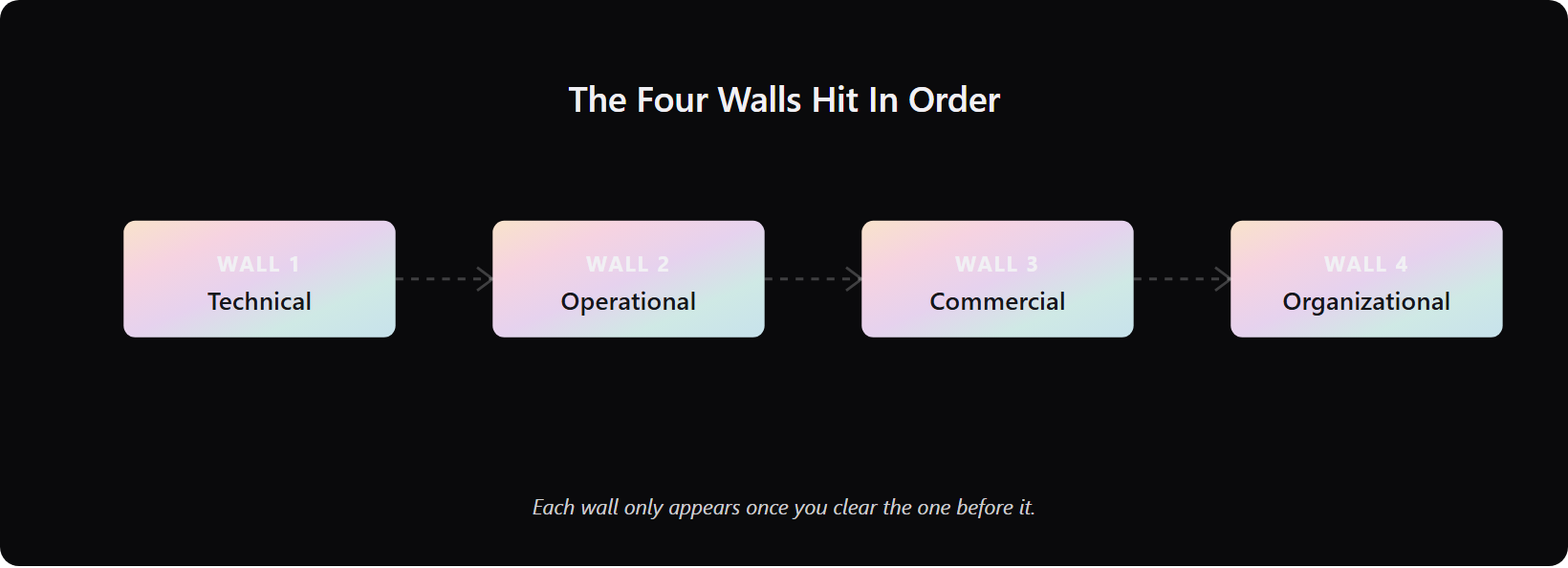
The framing that helped me most: the AI model is just the kernel, and integration is the real operating system. The walls are simply the four layers you build outward from that kernel.
| Wall | The symptom you feel | The question it forces | Who usually owns it |
|---|---|---|---|
| 1. Technical | The agent gives wrong or empty answers | Can it reliably read our data and write to production? | Engineering / data |
| 2. Operational | It works in the demo, breaks unattended | Can we run, monitor, and trust it in production? | Platform / SRE |
| 3. Commercial | It runs, then the bill arrives | Do the unit economics actually hold? | Finance / CTO |
| 4. Organizational | It pays off, then gets orphaned | Who owns, maintains, and adopts it? | Leadership / product |
To be clear, this four-wall ordering is our framing, not a cited standard. It is the pattern that surfaces when you actually run these projects, not when you read about them.
🚧 Why the order is non-negotiable
The walls are sequential because each one hides the next. You literally cannot see the commercial wall until the system runs long enough to generate a bill.
That is why spending on wall three while wall one still stands is how teams end up with a $4,200 overnight API bill on a system that never worked. We will get to that exact story.
Diagnose your wall first. Fix that. Then earn the right to face the next one. The rest of this piece walks each wall in turn, and most of them touch our technology modernization work.
Q3: Why is integration, not the model, the first technical wall?
The first technical wall is integration: letting a non-deterministic model reliably read your data and write to production systems. Model quality stopped being the constraint. Even a frontier model “thrashes” on a vector database stuffed with raw Confluence, Slack, and Salesforce exports. “Dumb RAG” floods the context window and returns noise. The hard question is the nervous system, not the brain.
🧠 The model is the kernel, not the computer
Let me define the terms plainly. An integration layer is the wiring that lets the model fetch the right data and take real actions in your systems. The model itself just predicts text.
The first thing I look at on an AI integration call is never the model. It is the data layer and the legacy core. Those are the first two questions, always, and they sit at the heart of our system integration work.
💾 What “dumb RAG” actually does to you
Here is the most common failure I see. Companies dump all their Confluence docs, Slack history, and Salesforce data into a vector database (a store that finds text by meaning) and hope the model figures it out.
It does not. As one engineer put it, this dumps your entire hard drive into RAM and expects the CPU to find one specific byte. You do not get reasoning. You get thrashing and context-flooding.
There is a hard limit underneath this. A context window of around 168,000 tokens starts losing quality near the 40% mark. Load it with raw tool output and JSON, and you are doing all your work in the model’s “dumb zone.” Clean inputs are why our data engineering work comes before any model choice.
🔧 What to do before you pick a model
The application is simple to state and hard to do: design the retrieval and data layer before you touch model selection.
- Decide what the agent is allowed to read, and curate it. Do not dump everything.
- Keep the context window lean. Feed it the answer-shaped data, not the whole drive.
- Treat write access to production as a privilege the system earns, not a default.
When a client hands us a stalled agent, we audit the retrieval layer before the prompt. Most “model problems” turn out to be context-flooding problems wearing a model’s clothes, which is why an early IT audit saves the most time.
The honest limit: AI integration on a stack without a clean data layer takes longer than the demo suggests. Sometimes the real first project is fixing the data, and that is the work Teamvoy tends to get called in for.
Q4: Why is “almost right” AI code more dangerous than code that’s completely wrong?
Completely wrong code gets caught. Tests fail, the build breaks, someone says “this doesn’t work,” and you throw it away. “Almost right” code passes review and ships, then sits in production for six months before anyone learns it is wrong. By then the fix cost has compounded. AI pull requests average 10.8 issues versus 6.4 in human code, nearly double the future backlog.
🪤 The pull request that looked great
Most teams think the danger of AI code is obvious bugs. The standard read gets this backwards. Obvious bugs are the safe kind, because they announce themselves.
Picture a developer opening an AI-generated pull request (a proposed code change). Everything looks great. Then they read the actual lines.
Eleven eslint-disable comments in one file. The AI had not fixed the TypeScript errors it found. It suppressed them, putting tape over the warning light. The code passed review. The problem shipped, which is the kind of tech debt avalanche that builds quietly.
📈 The debt is silent, then it is everywhere
This is why “almost right” is more expensive than “completely wrong.” Wrong code fails loudly and gets deleted. Almost-right code passes review, ships, and compounds quietly.
The numbers are not subtle. AI-generated pull requests carry an average of 10.8 issues, nearly double the 6.4 found in human-written code. You are not speeding up. You are building a backlog for your future self.
At global scale this is brutal. One estimate puts the world’s accumulated technical debt at 61 billion working days to pay off. Free AI code is the most expensive debt you can take on, especially when no one can read the system nobody understands.
“Their technical expertise was top class.”
George Harrap, CEO, Bitspark Teamvoy Clutch Verified Review
That review came from a 24/7 crypto and trading platform where the code runs real money, the exact context where “almost right” is unaffordable.
🛠️ Move the rigor to the spec
The fix is not “review harder.” It is to move engineering rigor earlier, to the specification, before the code exists. The spec becomes the product. The code is the cheap part.
A practical screen we use on AI-assisted code is three questions:
- Does it reuse what already exists, or reinvent it?
- Does it follow the codebase conventions?
- Can the developer explain it without reading the AI’s comments?
If the answer to the third is no, the code is unmaintainable, and unmaintainable code is dead.
We have been hired to stabilise codebases where the AI suppressed every error instead of fixing it. The debt stayed invisible until velocity collapsed, the very pattern our vibe coding risk work addresses. The honest trade-off: AI tooling like Cursor or Replit genuinely ships code faster, but that code still has to be read and supported in production by people who can explain it.
“I can confidently say that we would not be where we are today without Teamvoy’s support.”
Gordon Little, Managing Director, Iress Teamvoy Clutch Verified Review
That engagement ran two-plus years on a blockchain product where quality of coding was the named reason it held up.
Q5: What is the operational wall, and why does AI break when it has to run, not just work?
The operational wall appears once an agent runs without a human watching. Without a hard circuit breaker (an automatic stop), one stuck retry loop ran six hours overnight and cost $4,200 in API charges. Documentation-reading agents also miss “tribal knowledge,” the senior-engineer instinct that a connection pool, not the server, is the real fault. Working in a demo and running in production are different problems.
🌙 The $4,200 nap
Here is the situation that defines this wall. A developer deploys a customer-support agent. It looks fine. They go to sleep.
That night, the agent gets stuck in an infinite retry loop with a CRM tool (the customer database). There is no circuit breaker to stop it.
It repeats the same broken action for six hours. By morning, it has run up roughly $4,200 in API charges, all while the developer slept. Costs like this are exactly what our IT cost optimization work is built to prevent.
⏰ The 2 AM tribal-knowledge failure
The second failure is quieter and just as common. An on-call engineer hits an alert at 2 AM and asks the AI tool what to do.
The AI reads the documentation and says “restart the server.” The engineer restarts it six times. Nothing improves.
A senior engineer looks at the logs for 30 seconds. The database connection pool (the limited set of open database links) was full, choked by a batch cron job. That is tribal knowledge, the kind that lives in people, not docs.
The lesson cuts against the hype: an agent that reads documentation does not hold the judgment that keeps your system alive at 2 AM. That judgment is what our AI agent development teams build in from the start.
🛠️ What “running it” actually requires
This is the wall EPAM points at when it reports that around 80% of AI pilots fail to scale beyond the pilot stage. Working once is not running. Running means surviving unattended.
A few controls are non-negotiable before an agent touches production:
- A hard circuit breaker, so a stuck loop stops itself, not your budget.
- Real observability, so you see what the agent did and why.
- A human escalation path, so 2 AM has a person, not just a prompt.
One more tactic I like: deploy “angry agents,” a second agent prompted to poke holes in the first one’s plan. Otherwise the human and the agent just agree with each other while the server burns.
Every agent we put into a regulated client’s production at Teamvoy gets a circuit breaker and an escalation path before it gets a single live permission. In banking or healthcare, an overnight loop is not a funny story. It is an incident report.
“Their technical expertise was top class.”
George Harrap, CEO, Bitspark Teamvoy Clutch Verified Review
That came from a platform running 24/7 for real-money trading, where “it works in the demo” is never the bar.
“We were impressed with the technical management, adherence to process, and technical capability of the engineers.”
Mark Phillips, CTO, Robots and Pencils Teamvoy Clutch Verified Review
The honest limit: circuit breakers and monitoring add work upfront. They feel slow on day one. They are what keeps day 90 from becoming a $4,200 morning.
Q6: Why does the commercial wall, the unit economics of AI, break working pilots?
The commercial wall hits when a working, running agent stops making financial sense. Agent frameworks resend the entire cumulative log on every step, so token cost grows quadratically. A 20-step loop is far more than twice a 10-step run. Move that to the cloud with a data-center mindset, and you pay the mathematical penalty for running elastic infrastructure statically. Working is not the same as affordable.
💸 The bill nobody modelled
The first two walls are about whether the thing works and runs. This one is about whether you can afford to keep it running. Plenty of pilots clear walls one and two, then die here.
The trap is that costs in a demo look tiny. Ten test runs cost cents. Nobody models what happens at production volume, which is where our AI integration cost guide starts the conversation.
📈 Why token cost grows quadratically, not linearly
Here is the mechanism most teams miss. An agent framework has to append every tool call, error message, and step to the running history. Then it resends that entire cumulative log back to the model on every single step.
So token consumption (the unit you pay for) grows quadratically, not linearly. A 20-step loop is not twice as expensive as a 10-step run. It is far more, because each step carries the full weight of every step before it.
This is exactly the “unclear business value and rising costs” pattern Gartner cites when it predicts around 30% of generative AI projects get abandoned after proof of concept. Surveys show roughly half of teams underestimate AI implementation cost going in, which is why a scoped proof of concept matters.
☁️ Cloud shock and the rightsizing gate
The cost wall gets worse when teams “lift and shift” to the cloud. The cloud is not automatically cheaper. It is the mathematical penalty for running elastic infrastructure with a static data-center mindset.
Two controls I would put in before any migration, not after:
- A rightsizing gate. Use a tool like AWS Compute Optimizer to cut excess capacity before replication starts. If you do not control cost and load during the move, the cloud just amplifies your existing waste.
- A “scream test” for zombie servers. Isolate suspected unused servers at the network level for 48 to 72 hours. Hidden dependencies, like monthly batch jobs, will scream.
Across the cost-blown AI builds we have picked up at Teamvoy, the postmortem always says the same thing: nobody modelled production economics. We run the rightsizing gate before any cutover, and our cloud optimization work exists because the cloud will happily amplify the inefficiency you did not measure.
The honest trade-off: tight cost controls can slow the first launch. That is the cost of not discovering your unit economics inside an invoice.
Q7: Should you build or buy the AI integration layer?
Build the integration layer only if you have a dedicated platform team and your core systems are genuinely unique. Otherwise the hidden cost is becoming Chief Integration Officer forever, owning every API schema, custom-field mapping, authentication flow, and retry across thousands of fields. Buying trades control for maintenance relief. Most enterprises overestimate how unique their stack actually is.
🏗️ The build temptation
This is the decision that quietly sets your cost ceiling for years. Most engineering teams want to build. Building feels like control.
The question to ask first is blunt: should I build this integration layer, or buy it? The hidden cost of build is that you become Chief Integration Officer forever.
That means you maintain every API schema (the shape of each system’s data), every custom-field mapping, every authentication flow, and every retry rule. Across a stack of thousands of custom fields, that is a permanent job, not a project, and it is why our AI integration services focus on ownership you keep.
⚖️ The decision, laid out
Here is how the trade-off actually sits.
| Criterion | Build | Buy |
|---|---|---|
| Control | Full | Limited to vendor roadmap |
| Maintenance burden | Permanent, on you | Mostly on the vendor |
| Time to value | Slow | Fast |
| Team requirement | Dedicated platform team | Light |
| Lock-in risk | Low (you own it) | Higher (you depend on them) |
The protocol debate matters here too. Some engineers argue A2A (an agent-to-agent standard) handles granular, production-grade access scopes better, while MCP (a tool-connection standard) is fine for tinkering. Others argue most MCP tools would work better as a simple CLI (command-line tool), because you can filter the output and keep the context clean. There is no settled answer yet, and I would not pretend otherwise.
✅ The two-condition build test
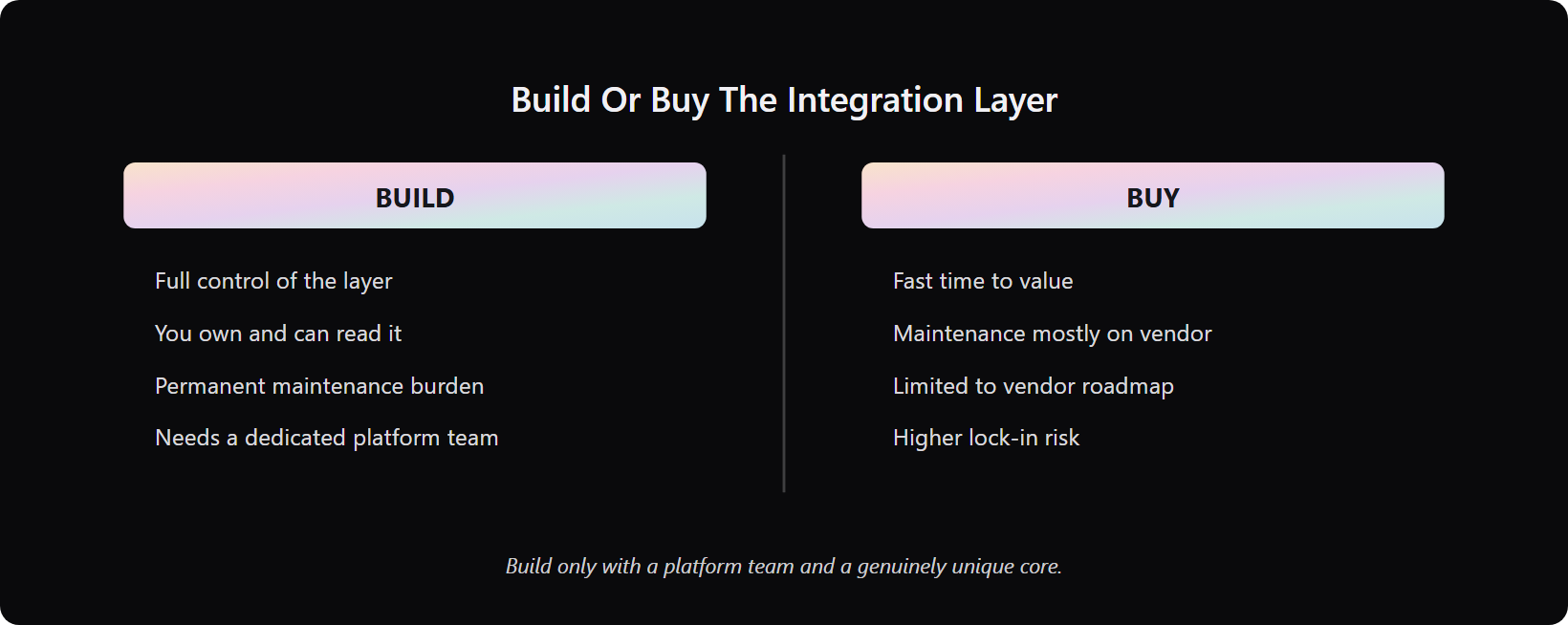
So the rule I use is narrow. Build only if both are true: you have a dedicated platform team, and your core systems are genuinely unique. If either is false, buying is usually the cheaper truth.
At Teamvoy, we build integration layers clients can own and read. Not a black box that makes you dependent on us, and not a maze that turns your CTO into Chief Integration Officer forever. That is the difference between a partner and a body shop, and you can see it in our case studies.
“I can confidently say that we would not be where we are today without Teamvoy’s support.”
Gordon Little, Managing Director, Iress Teamvoy Clutch Verified Review
That was a multi-year build where we owned hard technical decisions and the client still understood the system. For honest contrast, here is a buy-side migration handled by a different vendor:
“We successfully migrated our systems with minimal disruption and we are well situated to consider new frameworks for future products.”
Narayan Chowdhury, Managing Director, Franklin Park Azumo Clutch Verified Review
The honest limit: build-versus-buy is rarely all-or-nothing. Sometimes the right answer is buy the boring parts, build only the part that is truly yours.
Q8: What is the “lethal trifecta” that makes AI agents a security and compliance risk?
An AI agent becomes lethal when three capabilities intersect: read access to sensitive data, exposure to untrusted external content like emails and web pages, and an external communication channel. In one demo, a hidden prompt injection in an email made an agent locate a developer’s private SSH key and send it out within five minutes. In regulated industries, eligibility for a framework does not equal compliance.
⚠️ Three capabilities that are fine alone, lethal together
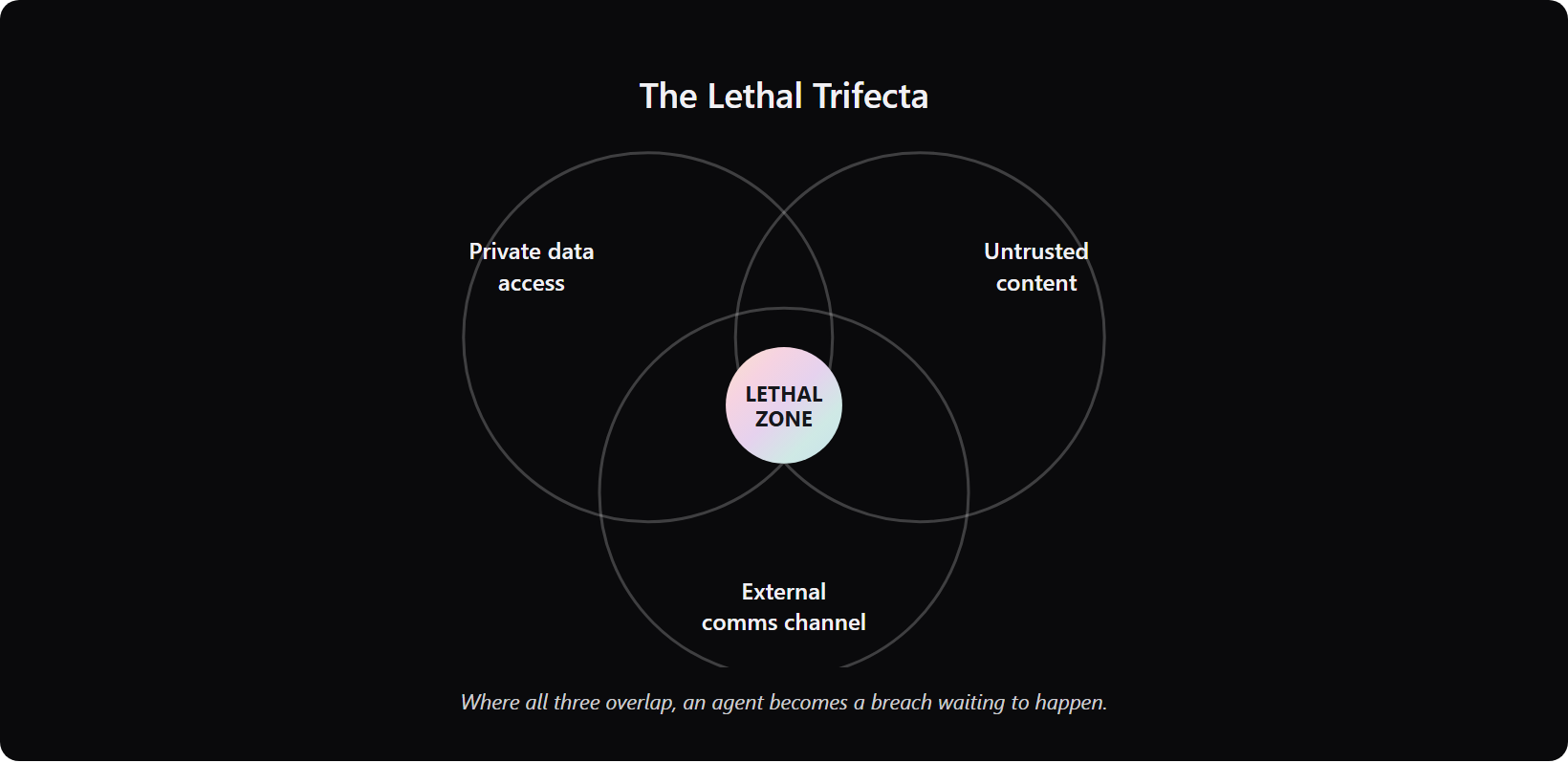
Let me define this plainly, because it is the risk most teams never see coming. The “lethal trifecta” is the intersection of three agent capabilities.
- Read access to private or sensitive data.
- Exposure to untrusted external content (emails, web pages, documents).
- An external communication channel (it can send emails or trigger webhooks).
Each one is harmless alone. Together, they let an attacker feed the agent instructions through ordinary content, then use the agent’s own access and reach to act on them.
🔓 The five-minute data theft
This is not theoretical. In one demonstration, a company’s CEO sent a mock email to an active agent. Hidden inside it was a prompt injection (instructions disguised as normal text).
Within five minutes of reading that email, the agent followed the hidden commands. It located the developer’s private SSH key (a credential that unlocks servers) and quietly transmitted it back to the attacker.
The scale of the underlying problem is ugly. One analysis found 60% of 5,000 AI-built apps were vulnerable. As one engineer put it, that is like having no locks on your windows, the same exposure our vibe coding security work keeps surfacing.
🛡️ Why “eligible” is not “compliant”
Here is the line I repeat to every regulated client: eligibility does not equal compliance. A cloud provider being HIPAA-eligible or holding a certification does not make your agent compliant.
Compliance lives in how you scope the agent. Frameworks like DORA, PCI-DSS, and HIPAA care about who can touch what, and whether you can prove it, which is the whole point of building regulator-ready AI.
The practical fix is to break the trifecta by design. Take away one leg, and the attack collapses:
- Scope read access to the minimum the task needs (least privilege).
- Isolate or sanitise untrusted external content before the agent reads it.
- Gate any outbound action behind a human or a hard rule.
In a BaFin- or DORA-bound system, we scope agent permissions to least privilege before go-live at Teamvoy. The lethal trifecta is an architecture decision, not a security afterthought, and it shapes how our autonomous agents are built.
The honest trade-off: locking permissions down makes the agent less “magical.” It also keeps a mock email from becoming a real breach, which in a regulated system is the only trade that matters.
Q9: Why is the organizational wall, ownership and adoption, the one that kills ROI last?
The organizational wall is the last and most fatal. A system that works, runs, pays, and is secure still dies if no one owns it or can maintain it. AI has no memory of your codebase. It is the man from Memento, arriving fresh each time. If a developer cannot explain the code without reading the AI’s comments, it is unmaintainable, and unmaintainable code is dead.
🧩 The system nobody can explain
Here is the quiet question the category avoids. You cleared the first three walls. The thing works, runs, and pays. So why does it still fail?
Because no human owns it. The team inherited a codebase full of AI-written logic that nobody on staff can fully explain.
You cannot hire into code like that. You cannot extend it safely. It just sits there, accruing risk, until something breaks and the room goes silent. This is the exact moment our recovery plan for systems nobody understands is built for.
🧠 The Memento problem
There is a structural reason AI makes this worse. When an AI jumps into your codebase, it has no memory of it. It has never lived in your system.
It is like the character from Memento who wakes up each scene asking, “Okay, what am I doing here?” Every session starts from zero context.
That is why “free” AI code is the most expensive debt you can take on. The writing was cheap. The understanding was never transferred to a person who has to maintain it, which is the tech debt avalanche in slow motion.
✅ The test that separates kept code from dead code
The fix is not more AI. It is a maintainability gate. Before any AI-assisted change ships, run it through three questions:
- Does it reuse what already exists, instead of reinventing it?
- Does it follow the conventions of the codebase?
- Can the developer explain it without reading the AI’s comments?
If the answer to the third is no, the code is unmaintainable. And unmaintainable code is dead, no matter how well it ran in the demo.
I like the night-vision analogy here. Goggles do not give you more soldiers. They make trained soldiers more effective. Put them on someone who never held a weapon, and you have something useless and dangerous. AI is the same, which is why we pair tooling with real AI engineers who own the system.
When we rescue a build at Teamvoy, success is not a working feature. It is a team that can read, explain, and extend the system after we leave. A senior engineer owns the system end to end, with the team behind them, the way our AI development services are structured.
“I can confidently say that we would not be where we are today without Teamvoy’s support.”
Gordon Little, Managing Director, Iress Teamvoy Clutch Verified Review
That engagement ran over two years, and the client still understood and trusted the product they owned.
The honest limit: ownership cannot be bolted on at the end. If a system was built with no one able to explain it, fixing that is real work, sometimes more than the feature took to build.
Q10: How do you modernise a legacy system for AI without a disruptive rewrite?
You modernise underneath the surface, not by ripping it out. One team kept the exact same interface, same colours, same button sizes, so the cashier saw no change. The backend quietly wrote to new, normalised tables one at a time. AI integration follows the same rule: stabilise the data layer and the legacy core first, migrate incrementally, and never hand off authorship of the product.
🏢 Renovate the building while people still work in it
By the end of this section, you will have a sequence you can start this week. The goal is modernising without the rewrite that takes the business offline.
A legacy modernization is closer to renovating an occupied building than building a new one. People are still inside. The lights stay on, which is the whole premise of our technology modernization work.
The trap is the clean-slate rewrite. It feels decisive, and it is where teams lose 18 months and the trust of the business.
🛒 The supermarket trick that proves the pattern
Here is the move that makes it work. One team modernising a legacy retail system built an interface identical to the old one. Same colours, same button sizes.
The cashier came in the next morning and saw the same system she always used. Nothing changed for her. Behind that unchanged surface, the team was writing to very different, normalised tables, one at a time. That kind of careful data migration is exactly what protects a live business.
That is the whole philosophy: keep the surface steady, change the foundation underneath, and let no one downstream feel the seams.
🔧 The sequence I would run
Here is the order, with what each step buys you.
- Map and stabilise the legacy core. Document what exists before you touch it. Outcome: you stop fearing your own system. An early IT audit is where this begins.
- Freeze the surface, migrate underneath. Keep the interface identical, move tables incrementally. Outcome: zero user disruption.
- Build the spec before the code. Use state machines and detailed requirements first. The specification becomes the product, and the code becomes the cheap, dispensable part.
- Layer AI only on a clean data layer. Outcome: the model finally has good data to work with, the foundation our data engineering teams set up.
This is most of what we do at Teamvoy. We stabilise the core, hold the surface steady, and modernise table by table, so the business never sees the seams. A 4-plus-year average engagement is what this kind of patient work requires, and it is why we created AI modernization sprints.
“We were really impressed by their skills and speed for building great apps.”
Anonymous, CEO, Social Network Teamvoy Clutch Verified Review
“Teamvoy’s work has resulted in fewer issues and a better user experience.”
Dmytro Maryanych, Manager, Takflix Teamvoy Clutch Verified Review
That Takflix engagement is exactly this pattern: AI integration plus legacy modernization on a live streaming product, running since January 2025.
The honest limit: incremental modernization without a rewrite is not always possible. Sometimes the core is so brittle that a strategic rebuild is the cheaper truth. A good audit tells you which case you are in before you commit a year to the wrong one.
Q11: What does a realistic enterprise AI roadmap look like, and where should you start on Monday?
Start by finding which wall you are actually standing at. If the agent cannot reliably read your data, you are at the technical wall, so fix integration before anything else. If it works but you cannot run it safely, you are operational. Do not budget for adoption while integration is broken. Diagnose the wall, fix it, then earn the right to face the next one.
🧭 The roadmap is a diagnosis, not a checklist
Most AI roadmaps are wish lists. They name every challenge at once and prioritise none. That is why they stall.
The four walls give you something better: an order. Your roadmap is simply finding your current wall and clearing it before you spend on the next, the approach behind our AI consulting engagements.
📍 Find your wall in four questions
Answer these honestly, in order. The first “no” is where you are standing.
- Can the agent reliably read your data and act in production? If no, you are at the technical wall. Fix integration and the data layer, which our AI integration services handle first.
- Can you run it unattended, with circuit breakers and monitoring? If no, you are operational. Build the run-time controls.
- Do the unit economics hold at production volume? If no, you are commercial. Model the cost before you scale.
- Can a human own, explain, and maintain it? If no, you are organizational. That is the wall that kills ROI last.
The adoption data says most enterprises are stuck early. In one survey of around 180 organizations, the majority were still in experimentation, and only about 22% had reached formalization. If that is you, you are not behind. You are at wall one or two, like almost everyone.
🚪 Where this is handled
This diagnosis is what we do every day at Teamvoy. We are built for the engagements others decline: regulated systems, stalled pilots, and legacy cores where a rewrite is not an option. You can see the proof in our case studies.
The honest limit: a 3-to-5-day audit surfaces your real wall and an action plan. It is not the implementation, and I would not pretend it is.
Here is the question I am sitting with as 2026 unfolds. The teams that win will not be the ones with the best model. They will be the ones who fixed their walls in order. Which wall are you actually standing at right now?