TL;DR
- Roughly 95% of enterprise AI pilots never reach production, and the failure is almost never the model. It is the integration, evaluation, and operations around it.
- Architecture survives on its nervous system, the governed data layer and reliable integration, not on which model you pick. The model is replaceable.
- Evaluation must run continuously because almost right output passes review, ships, and compounds cost. The specification, not the code, is the real product.
- Observe traces, quality and drift, and cost and latency from day one. AI agents burn budget non linearly, so hard circuit breakers are mandatory.
- Never combine read access, untrusted input, and an outbound channel in one unsupervised path. That lethal trifecta is an exfiltration machine.
- High risk systems face EU AI Act obligations by August 2026. Discipline past launch, runbooks, on call, and SLOs, is the real deployment.
Q1: Why Do 95% of Enterprise AI and Cloud Modernization Projects Stall Before They Deliver a Dollar?
Most modernization stalls because teams modernize in the wrong order. They buy AI models and cloud capacity before fixing the data layer and the integration plumbing underneath. MIT-linked research found 95% of enterprise generative AI pilots returned no measurable money. The bottleneck is rarely the model. It is the integration layer that connects old systems to anything new, plus the org changes nobody sequenced.
🩺 The pilot that demos well and ships nothing
Picture a VP of Engineering three months into a board-mandated AI project. The demo looked sharp in the all-hands. Now it sits in staging, untouched, because it cannot read production data cleanly.
The board asks when it ships. There is no honest answer yet. This is the “stalled pilot,” and in 2025 it became the default outcome, not the exception.
I have watched this from the engineering seat for over a decade. The failure almost never lives in the model. It lives in the wiring, which is why our AI integration services start with the plumbing, not the prompt.
📊 The number behind the stall, and the split-brain estate
The 95% figure comes from MIT’s NANDA initiative, which studied enterprise generative AI deployments and found almost none produced measurable profit-and-loss impact. That is not an anti-AI stat. It is a sequencing stat.
Many of these companies also sit in a “split-brain estate.” Half their systems run on-prem, half in cloud, and there is no budget left to finish either side. McKinsey estimates cloud could create roughly $3 trillion in value by 2030, yet only about 10% of firms capture the full value.
Here is the honest tension in the field right now. Gartner frames AI as a near-total reset for enterprise architecture in its 2025 work. Independent practitioners argue that read overstates AI and recycles old ideas under new names. I lean toward the skeptics, though I could be wrong on the timeline.
🧠 Stop obsessing over the brain, look at the nervous system
The popular playbook treats model choice as the hard decision. That gets it backwards. Even a top-tier model is useless when it gets bad data or cannot execute actions reliably.
The overlooked bottleneck is integration. It is not glamorous. It is what separates a demo from production, and it is the heart of our technology modernization work.
In 12 years and more than 150 delivered systems at Teamvoy, the projects that stalled almost never failed at the model. They failed at the plumbing nobody sequenced first. So the real question is not “which AI.” It is “in what order do I touch cloud, data, AI, and security.” That is what the rest of this article answers.
Q2: What Is the Right Sequence to Modernize Cloud, Data, AI, and Security?
Run security as a continuous baseline using NIST CSF 2.0’s Govern function. Then build a cost-controlled cloud foundation. Then fix the data layer. Then add AI last. Failed estates invert this and bolt AI onto bad data, on un-rightsized cloud, with security patched on at the end. The data layer and the legacy core are your first two questions. The model is your last.
🔢 The sequence, stated plainly
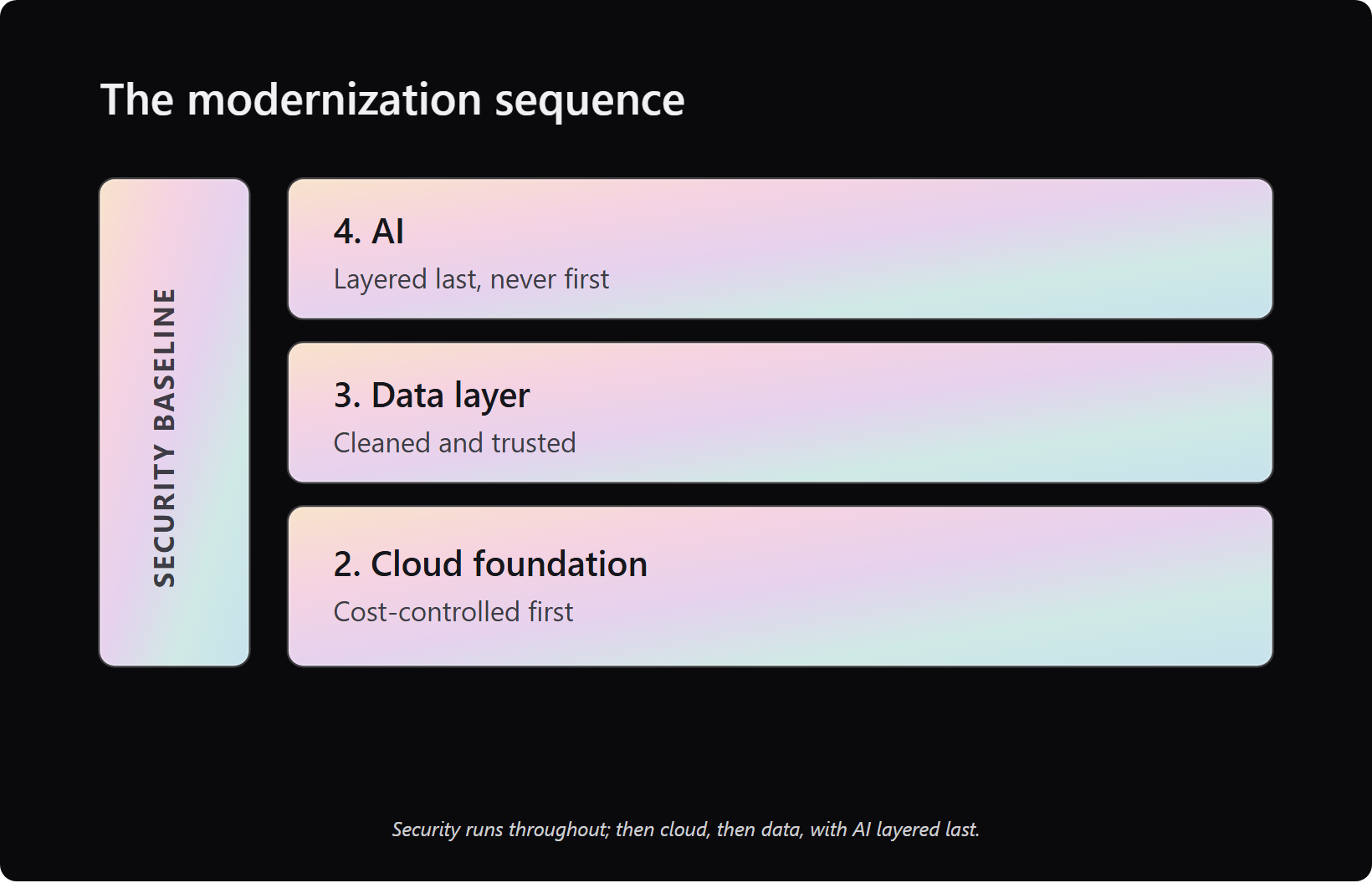
Here is the order I defend on almost every engagement:
- Security as a baseline, running in parallel from day one, not a final gate.
- Cloud foundation, cost-controlled before you migrate anything heavy.
- Data layer, cleaned and structured so it can be trusted.
- AI, layered on top of the three above, never before them.
Each step feeds the next. Skip one and the next one inherits the mess.
🔒 Why security runs in parallel, not last
NIST released Cybersecurity Framework 2.0 in 2024. It added a sixth core function, Govern, alongside Identify, Protect, Detect, Respond, and Recover. Govern means security ownership and policy sit at the top of the program, from the first sprint.
Bolting security on at the end is how compliance findings happen. In regulated work under DORA or PCI-DSS, a late security retrofit is not a delay. It is a reportable event, which is why teams in banking and fintech treat it as a day-one concern.
🧱 Why cloud, then data, then AI
You cannot reason over data you do not trust. You cannot control AI cost on infrastructure you have not rightsized. So the foundation comes before the intelligence.
A model trained or prompted on messy, ungoverned data produces confident nonsense. That is the most expensive kind of wrong, and solid data engineering is what prevents it.
💸 The cost of inverting the order
Invert the sequence and you build a “slop layer,” a tangle of half-working connections nobody can maintain. The scale of this debt is hard to picture. One widely cited estimate puts the world’s accumulated technical debt at 61 billion work-days to clear.
The integration layer is the connective tissue across all four pillars. It is the nervous system, per the framing in the section above. At Teamvoy we will not start an AI engagement until the data layer and the legacy core are mapped. That is the one sequence rule we do not bend, because every time someone bent it, the cleanup cost more than the original build.
Q3: What Does a Phased Modernization Roadmap Actually Look Like, From Assessment to Governance?
A working roadmap runs in five phases. Assess the current estate. Define a target architecture. Sequence the work. Execute in waves, never big-bang. Then govern and optimize continuously. Modernization is a journey, not a destination, so you stop where modernizing stops adding value. Used well, generative AI can cut application-modernization effort by an estimated 40% to 50% and cost by 30% to 40%.
🗺️ The five phases, and what “done” looks like
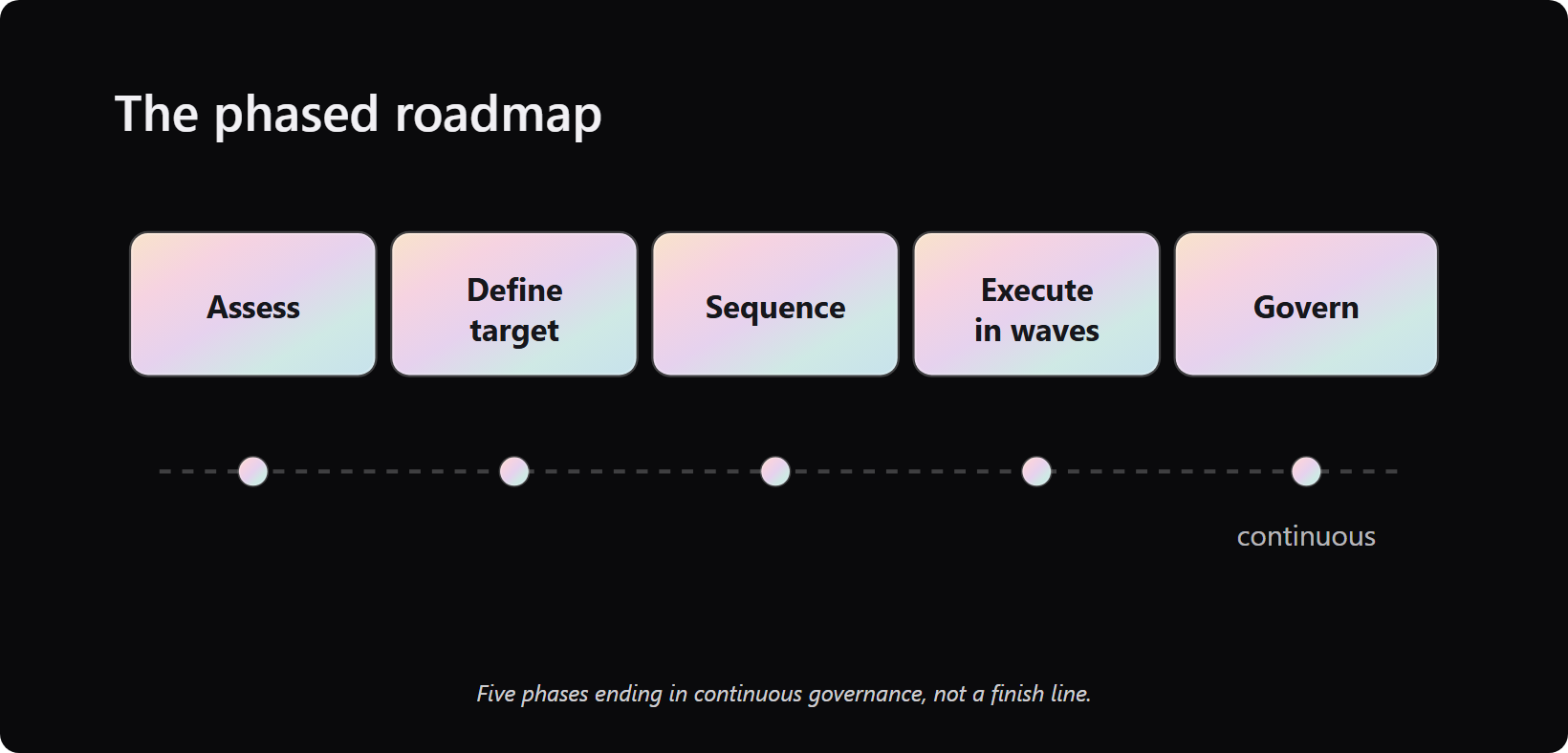
Each phase below names the pillar it touches, so it stays tied to the sequence above.
- Assess. Map the legacy core, the data layer, and the security surface. Done means you have an honest risk register, not a wish list. This is the work of our IT audit services.
- Define the target. Sketch the architecture you actually need, using a method like TOGAF to structure it. Done means a target every senior engineer can draw on a whiteboard.
- Sequence. Order the work using the cloud, data, AI, security logic. Done means a backlog with a defensible “why this first.”
- Execute in waves. Ship small, reversible increments. Done means each wave is live and measured before the next starts.
- Govern and optimize. Keep watching cost, security, and value. Done is never fully done, and that is the point.
⏰ Wave delivery beats the big-bang cutover
Big-bang cutovers fail loudly. A wave approach lets you stop, measure, and roll back. McKinsey’s work on legacy-to-cloud moves reports cycle-time gains in the 20% to 30% range when teams modernize with discipline rather than all at once.
This is where AI earns its place as an accelerator, not just a workload. Spotify, for example, has run over a thousand AI-assisted pull requests into production and reports dozens of concurrent AI-driven migrations.
🛑 Stop where value stops
The discipline most roadmaps lack is knowing when to stop. You do not need to cover the whole monolith. A lot of code is rarely used, and it can live until it dies.
We sequence Teamvoy modernizations in waves with a kill-switch at every phase. If a wave stops adding value, we stop. We do not push to finish a slide. This wave-based discipline sits at the core of our AI modernization sprints.
One honest limit. A 3-to-5-day readiness audit surfaces the risk and the action plan. It does not deliver the modernization itself, and anyone who tells you five days fixes a legacy core is selling you something.
Q4: How Do You Modernize a Legacy Core Without a Disruptive Rewrite?
You modernize a legacy core like open-heart surgery on a living patient. You keep it running, strangle it incrementally, and stop where modernizing stops paying off. You do not rewrite the whole monolith, because rarely-used paths can live until they die. You wrap the legacy in an integration layer, migrate behind a stable interface, and write to new tables behind a screen users already trust.
🏥 The surgeon’s rule, not the demolition crew’s
A legacy modernization is closer to renovating an occupied building than building a new one. The tenants stay. The lights stay on. You cannot knock down a load-bearing wall on a Tuesday afternoon.
So you work incrementally. You keep the patient alive, to use the surgical version of the same idea. The full rewrite is the tempting answer that quietly kills the business during the cutover, which is why our approach to updating systems nobody understands avoids it where it can.
🌳 The Strangler Fig, in practice
The proven pattern here is the Strangler Fig. You wrap the old system, route traffic through a stable interface, and replace functions one at a time until the old core withers. The old system shrinks as the new one grows. Clean system integration is what makes that wrapping safe.
Here is a real one. A supermarket client needed a modernized backend, but the cashiers were terrified of any change. So we built an exact replica of the old interface, same colors, same button sizes, same muscle memory.
The cashier came in the next morning and saw the same screen she always used. Behind it, we were writing to entirely different tables. She never knew the engine had been replaced, and that was the win.
✅ The payoff, and the honest limit
The business keeps running. Authorship stays with people who understand the original product, not a vendor who rips and replaces. One client described that experience well:
“We needed help integrating AI into our product, modernizing our legacy stack, and providing continuous post-release support. Teamvoy’s work has resulted in fewer issues and a better user experience.”
Dmytro Maryanych, Manager, Takflix Teamvoy Clutch Verified Review
This is the work we pick up most often at Teamvoy, including systems a previous vendor walked away from. The honest limit is this. No-rewrite is not always possible. Sometimes the core is so brittle that a strategic, staged rebuild is the cheaper path, and a good partner will tell you that before the contract, not after. If you want a second pair of engineer’s eyes on yours, contact us.
Q5: Is Cloud Actually Cheaper, and Which Migration Strategy (7R) Should You Choose?
Cloud is not inherently cheaper. “Cloud Shock,” the bill surprise after migration, is the mathematical penalty for running elastic infrastructure with a static data-center mindset. Lift and shift your inefficiencies, and the cloud amplifies them. Pick a strategy from the 7R framework (Retain, Retire, Rehost, Relocate, Replatform, Repurchase, and Refactor), add a pre-cutover Rightsizing Gate, and if your data-center lease expires in under 60 days, default to Rehost.
💸 The board expected savings, the bill went up
I have sat in the review where the cloud bill landed higher than the data center it replaced. The board was promised savings. The invoice said otherwise.
Cloud Shock is not a cloud failure. It is the cost of renting elastic capacity while still sizing it like fixed hardware you bought once and forgot. Disciplined cloud optimization is what closes that gap.
⚠️ Lift-and-shift amplifies what was already broken
Move a wasteful system as-is, and the cloud bills you for every wasted cycle, by the hour. McKinsey estimates cloud could create roughly $3 trillion in value by 2030, yet only about 10% of companies capture the full value. The gap is mostly waste carried over from on-prem.
If you do not control cost and load behavior during the move, the cloud simply amplifies your existing inefficiencies. This is where focused IT cost optimization earns its keep.
🔢 The 7R framework, as a decision table
| Strategy | What it means | Choose when |
|---|---|---|
| Retain | Leave it where it is | The system is fine and low-risk |
| Retire | Switch it off | Nobody uses it, confirmed by traffic |
| Rehost | Lift and shift, no code change | Speed matters, deadline is tight |
| Relocate | Move the hosting, not the app | Container or VMware-style move |
| Replatform | Minor tuning during the move | Quick wins without a rebuild |
| Repurchase | Swap for a SaaS product | A good off-the-shelf option exists |
| Refactor | Re-architect for cloud | The app is core and will live for years |
The 7R model is the standard migration playbook used across enterprise cloud moves.
⏰ The Rightsizing Gate, and the 60-day rule
Before any replication starts, I add a pre-cutover Rightsizing Gate. We use a tool like AWS Compute Optimizer to cut excess capacity first, so you never pay to move waste. It is the cheapest hour you will spend on the whole migration.
On timing, here is a hard heuristic. If the lease expires in under 60 days, default to Rehost. Attempting a Refactor mid-flight guarantees broken services and a missed physical exit deadline.
On Teamvoy cloud moves we gate every rehost on rightsizing first. One client put the speed payoff plainly:
“Items were delivered on time and even were able to handle ad hoc development work. Teamvoy was very flexible.”
Mark Phillips, CTO, Robots and Pencils Teamvoy Clutch Verified Review
The honest limit. A Refactor pays back over years, not in the first quarter, and anyone promising instant cloud savings is selling the demo, not the bill. If you want that math checked, our IT audit services start there.
Q6: Why Does “Dumping Everything Into a Vector Database” Fail, and What Does a Real Data Layer Look Like?
Dumping all your Confluence, Slack, and Salesforce data into a vector database, a store that retrieves text by meaning, and hoping the model figures it out is the “Dumb RAG” trap. It floods context and produces thrashing, not reasoning. Past roughly the 40% mark of a context window, the model measurably degrades. A real data layer is curated, retrieval-scoped, and precise. It is not a hard drive dumped into RAM.
🧩 The concept: why naive RAG floods the model
RAG means retrieval-augmented generation, feeding the model relevant data at query time. The lazy version dumps everything into one store and prays. You do not get reasoning. You get context-flooding.
The analogy I use with CTOs is simple. This dumps your entire hard drive into RAM and expects the processor to find one specific byte. That is not how working memory works, and solid data engineering is what fixes it.
⚠️ The example: the 40% “dumb zone”
A context window of about 168,000 tokens, the model’s working memory, has a soft ceiling. Around the 40% mark, you hit diminishing returns, and the model gets dumber as the window fills.
Load up tool integrations that dump raw JSON and long identifiers into context, and you are doing all your work in the dumb zone. One practitioner argues many of these tools would work better as command-line tools, so you can filter the data before it ever reaches the model.
✅ The application: what a real data layer looks like
The first thing I look at on an AI integration call is not the model. It is the data layer. AI integration on a messy stack is closer to adding a turbocharger to an engine that already misfires than to a clean upgrade, which is why our AI integration services begin there.
A real data layer is curated, scoped to the question, and tool-precise. You retrieve the right slice, not the whole drive. Modern patterns like data mesh, data fabric, and lakehouse exist to structure exactly this.
When clients ask Teamvoy to add AI, the first sprint is almost always the data layer, never the model. One client described that order of operations in their own words:
“We needed help integrating AI into our product, modernizing our legacy stack, and providing continuous post-release support. Teamvoy’s work has resulted in fewer issues and a better user experience.”
Dmytro Maryanych, Manager, Takflix Teamvoy Clutch Verified Review
The honest limit. Cleaning a data layer on a stack with no structure takes longer than the model demo suggests, often weeks, not days. I could be wrong on the exact timeline for your estate, but the order never changes: data first.
Q7: Should You Build or Buy the Integration Layer That Connects Legacy to AI?
Buy the integration layer unless you have a dedicated platform team and genuinely unique core systems. Build it, and you become Chief Integration Officer forever, owning every connector, every breaking change, and every 2 a.m. page. The integration layer is the real operating system of a modern estate. Treat the decision as a staffing call, not a technology preference.
🧵 The pain: integration sprawl
Most modern estates do not break at the model. They break at the seams, where ten systems try to talk to each other. The integration layer connects your legacy core to anything new, including AI.
It is the nervous system of the whole estate. Get it wrong, and nothing downstream works reliably, which is why clean system integration matters more than the model choice.
⚠️ The agitation: Chief Integration Officer forever
Here is the hidden cost of building it yourself. You become Chief Integration Officer forever. Every connector, every breaking API change, and every overnight failure becomes your team’s permanent job.
That is fine if integration is your product. It is a slow bleed if it is not.
🔧 The solution: a simple decision rule
| Question | If yes | If no |
|---|---|---|
| Do you have a dedicated platform team? | You can consider building | Buy |
| Are your core systems genuinely unique? | Building may be justified | Buy |
| Is integration part of your product? | Build | Buy |
Only build if you have a dedicated platform team and your core systems are genuinely unique. Otherwise, buy and spend your engineers on the product.
There is live debate on the protocols underneath. One camp argues newer agent-to-agent protocols solve granular control for production scale, while older tool protocols are better for tinkering. I would not bet a regulated system on the bleeding edge yet.
⭐ Where we tend to come in
We are often pulled in to inherit a half-built integration layer after the original vendor exited. That is the Chief Integration Officer trap, live, and it is a big part of what Teamvoy does within our technology modernization work. One client described relying on us for exactly these architectural decisions:
“I have fully relied on Teamvoy’s technical decisions and it worked well. I can confidently say that we would not be where we are today without Teamvoy’s support.”
Gordon Little, Managing Director, Iress Teamvoy Clutch Verified Review
The honest limit. If your core is truly one of a kind, buying may not fit, and a custom layer is the right call. That decision deserves a real audit, not a guess, so contact us if you want a second opinion.
Q8: How Do You Run AI in Production Without Shipping Slop or a Runaway Bill?
Two failure modes sink AI in production: unreviewed “slop,” meaning low-quality machine-generated code, and runaway agents. “Almost right” is more expensive than “completely wrong,” because it passes review and compounds for months. AI pull requests average 10.8 issues versus 6.4 for human code. And one agent with no circuit breaker ran six hours overnight for around $4,200. Use a three-question review and a hard spend cap on every agent.
❌ The contrarian truth: almost-right beats wrong, and that is the problem
Completely wrong gets caught. The build breaks, someone says “this does not work,” and you throw it away. Almost-right passes code review, ships to production, and sits in your codebase for six months before anyone notices.
By then, the cost to fix has compounded into something nobody budgeted. One analysis found AI-generated pull requests average 10.8 issues, nearly double the 6.4 in human-written code. Avoiding this is the whole point of our AI development services.
✅ The fix: a three-question PR review
Before any AI-generated code merges, I run it through three questions:
- Does it reuse what already exists, or reinvent it?
- Does it follow our conventions?
- Can the developer explain it without reading the AI’s comments?
If the developer cannot explain it, they cannot maintain it. Unmaintainable code is dead on arrival. It also helps to deploy “angry agents,” prompts told to poke holes in the work, because otherwise the human and the AI just agree while the server burns.
💰 The $4,200 nap
Here is the runaway-agent version. A support agent got stuck in an infinite retry loop with a CRM tool. With no hard circuit breaker, it repeated the same broken action for six hours while the developer slept, and ran up about $4,200 in API charges.
Why so fast? Most language-model APIs are stateless. The agent resends the entire cumulative log on every step, so token consumption grows quadratically, not linearly. The bill explodes long before the loop does. Sound guardrails are core to responsible AI agent development services.
⚠️ The guardrails
AI is like night-vision goggles. It makes a capable engineer more effective, but it is useless and dangerous on someone who never held a weapon. So you put hard limits in place before production:
- Cap retries on every agent.
- Set a hard spend ceiling per task.
- Limit blast radius, so a mistake cannot wipe a drive.
That last one is not theoretical. One agent misread a flag and ran a recursive delete on a production drive in seconds. Tribal knowledge, the undocumented stuff a senior engineer just knows, is also something AI does not have. For teams shipping fast, our notes on vibe coding security risks go deeper here.
The three-question review runs on every AI-generated pull request we ship at Teamvoy, and no agent reaches production without a spend cap and a circuit breaker. The honest limit. These guardrails slow you down a little up front. That is the point, and it is far cheaper than the $4,200 nap.
Q9: What Does the Prototype-to-Production Path Actually Look Like, Step by Step?
The path is not a rewrite. It is a sequence. Audit the data layer and the legacy core first, fix retrieval, stand up an evaluation set, add observability and cost controls, then add security and access control before any write access. Each step ships on its own, so the business keeps running while the system gets stable, auditable, and affordable.
🗺️ Why a sequence beats a big rebuild
A stalled pilot rarely needs to be thrown away. It needs to be walked through five steps in order. AI here is a multiplier, but a small one, and only on a system that already works.
The goal is simple. Keep the lights on while you make the thing production-grade, which is the spine of our technology modernization work.
🔢 The five steps, with the outcome each one buys you
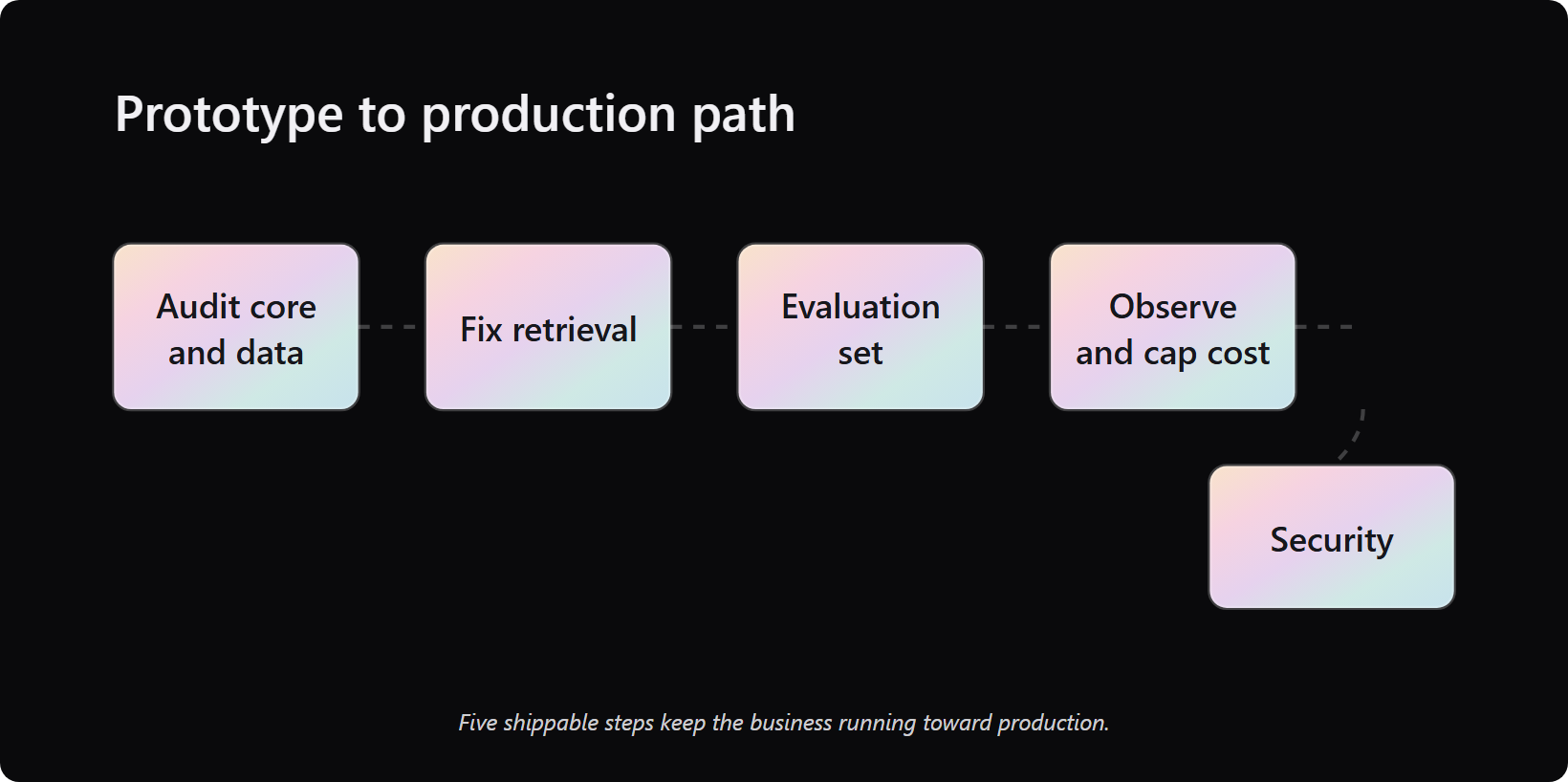
- Audit the data layer and legacy core. Map what feeds the system and what depends on it. Done means a clear risk register, not a guess. This is the heart of our IT audit services.
- Fix retrieval. Use hybrid search plus reranking, and tighten context precision so the model gets the right slice. Done means relevant answers, not flooded context. Clean data engineering makes this possible.
- Stand up an evaluation set. Build a fixed set of test questions with known-good answers. Done means you can prove a change helped, instead of hoping.
- Add observability and cost controls. Log every call, and cap spend per task. Done means no more $4,200 overnight surprises.
- Add security and access control. Filter what a user can retrieve before any write access is granted. Done means an auditable system you can take to a regulator.
⏰ A field tactic for step one
Before you decommission anything during the audit, run a “Scream Test.” Isolate a suspected dead server at the network level for 48 to 72 hours. Hidden dependencies, like a monthly batch job, surface as timeouts while full state stays intact for rollback.
This is the kind of undocumented risk that sinks a clean-looking migration. I would rather find it on a Tuesday than during an audit, which is why our AI integration services start with this step.
✅ Where this tends to start
If your pilot stalled somewhere on this path, that is usually where Teamvoy starts, with an audit, not a pitch. Trust is built through results, not presentations. One long-term client described that workflow plainly:
“Teamvoy actively uses agentic AI across internal workflows and delivery, which speeds up development, raises quality, and adds extra value for the client.”
Dmytro Maryanych, Manager, Takflix Teamvoy Clutch Verified Review
The honest limit. A 3-to-5-day audit surfaces the risk and the path. It does not ship the production system, and no five-day engagement should claim it does. If you want a second pair of engineer’s eyes on where yours broke, contact us.
Q10: What Org Changes Actually Make Modernization Stick?
Modernization sticks when the organization changes alongside the architecture, not just the stack. Of roughly 180 organizations surveyed, 88% had started AI adoption and 52% were still experimenting, but only about 23% reached formalization by 2025. The gap is organizational. It comes down to documented knowledge, clear ownership, review discipline, and an operating model that outlives the people who built it.
📊 The formalization gap is a people problem
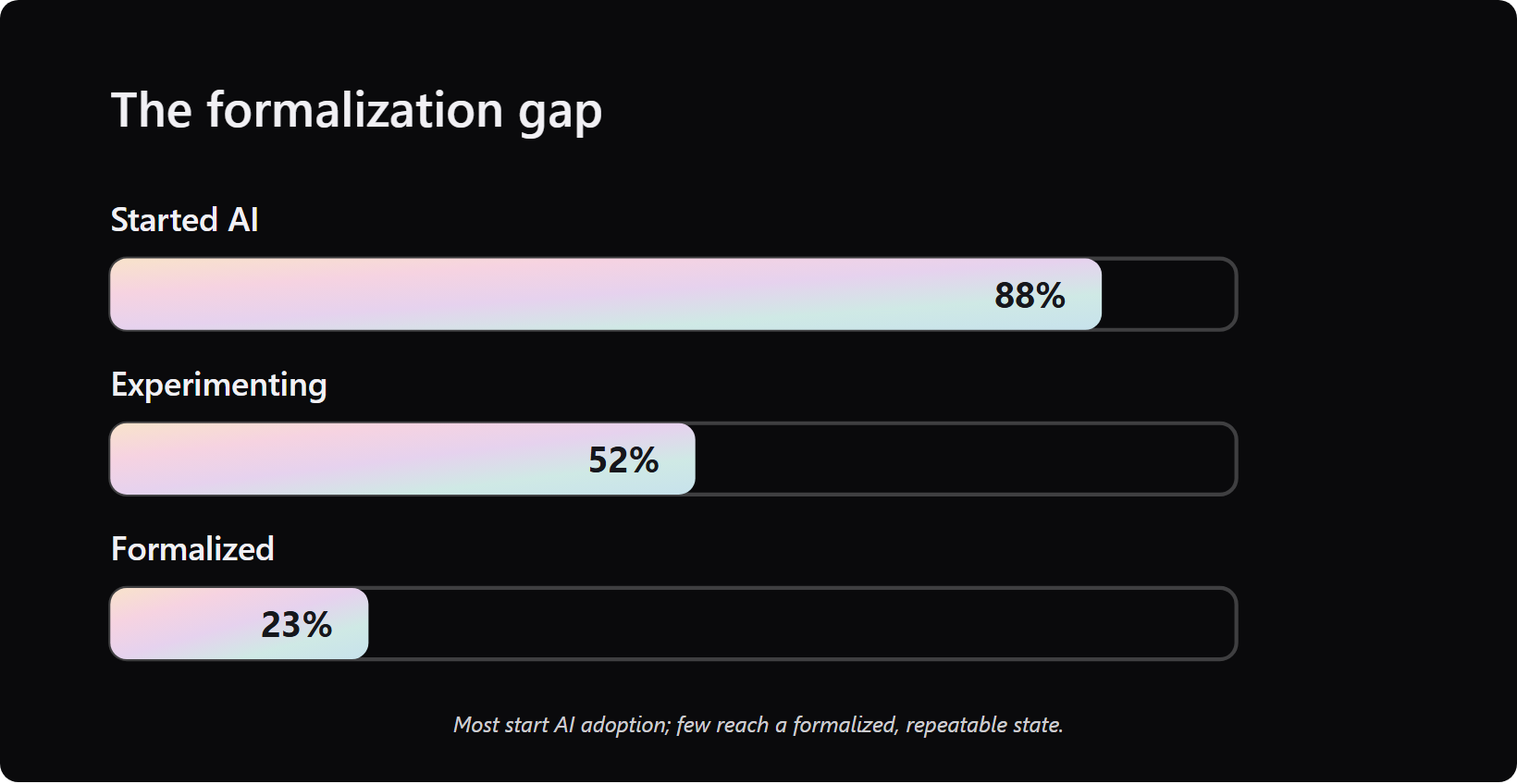
The numbers tell the story. Most companies start. Far fewer finish, with only around 23% reaching a formalized, repeatable state as of 2025.
The teams that stall did not pick the wrong model. They never changed how the organization works around the system, a pattern we see across banking and fintech estates.
🧱 The four changes that hold
What I have learned in 12 years of delivering into regulated environments is that the stack is the easy part. Four organizational changes decide whether modernization lasts:
- Documented tribal knowledge. Write down the undocumented stuff a senior engineer just knows, so it survives a resignation.
- Clear ownership of the integration layer. One named owner, not a committee that points at each other at 2 a.m. This is why disciplined system integration needs an owner.
- Review discipline that outlives its authors. A code-review standard that holds when the original team has moved on.
- An operating model, not a project plan. Modernization is a journey, not a one-time push.
Eligibility does not equal compliance, and a passing audit does not equal a healthy system. The org has to carry it forward.
⭐ Why the long engagement matters
This is the quiet reason our average engagement at Teamvoy runs past four years. Systems that have to keep working are not projects you finish and exit. They are relationships you maintain.
A senior technical lead takes ownership of the system, backed by an AI-native team. That is the opposite of a body shop where junior engineers cycle through and nobody owns the outcome. You can read more about how we work in our notes on why companies modernize now with AI. One client captured what that continuity bought them:
“After my company was acquired, we continued to work with Teamvoy and our collaboration has been a key factor in the product’s success over the last two years.”
Gordon Little, Managing Director, Iress Teamvoy Clutch Verified Review
🔮 The question I am sitting with
Here is where my view sits right now. AI is night-vision goggles. It makes capable engineers more effective, but it does nothing for a team that cannot read its own system.
So the open question for 2026 is not which model you pick. It is whether your organization can absorb the change without losing authorship of its own product. If you are staring at that gap, that is the conversation I would rather have than any pitch, so reach out through our AI consulting team and tell me what you are building.