TL;DR
- Enterprise RAG architecture is the full production system around an LLM: ingestion, retrieval, generation, plus evaluation, observability, cost, and security layers.
- Most pilots stall on the data layer and integration layer, not the model. We audit those first, before anyone proposes swapping models.
- Retrieval quality comes from chunking, hybrid search, and reranking. More context is not better; models degrade past roughly 40% of the window.
- Run cost leaks through agentic loops that bill quadratically. Circuit breakers, per-run budgets, and context compaction stop the bleed.
- Security must enforce access before retrieval, and the prototype-to-production path is a shippable sequence, not a rewrite.
Q1. What is enterprise RAG architecture, and why do most pilots stall before production?
Enterprise RAG architecture is the full production system that grounds a large language model (LLM, the AI that generates text) in your own trusted data. It covers ingestion, chunking, embeddings, hybrid retrieval, reranking, and generation, plus the evaluation, observability, cost, and security layers around them. The prototype is a demo over a vector store. Production is everything that keeps it accurate, auditable, and affordable once real users and real data arrive.
🧩 The “fancy search box” that never grows up
I have watched this scene play out more than once. A team ships a slick demo in two weeks. It summarizes the company wiki. Leadership is thrilled. Then the system meets real users, real edge cases, and a real audit, and it freezes.
The pilot was a fancy search box. It summarized documents. It never took an action, touched a transaction, or proved why it answered the way it did. Retrieval-augmented generation (RAG) means the model fetches your data before it answers, instead of guessing from training memory.
The gap between that demo and production is where most projects die. Research backs this up: roughly 95% of enterprise generative AI pilots have failed to deliver a single dollar of measurable return. This is exactly the territory where our AI integration services begin, with the system underneath the demo.
🏗️ What the production system actually contains
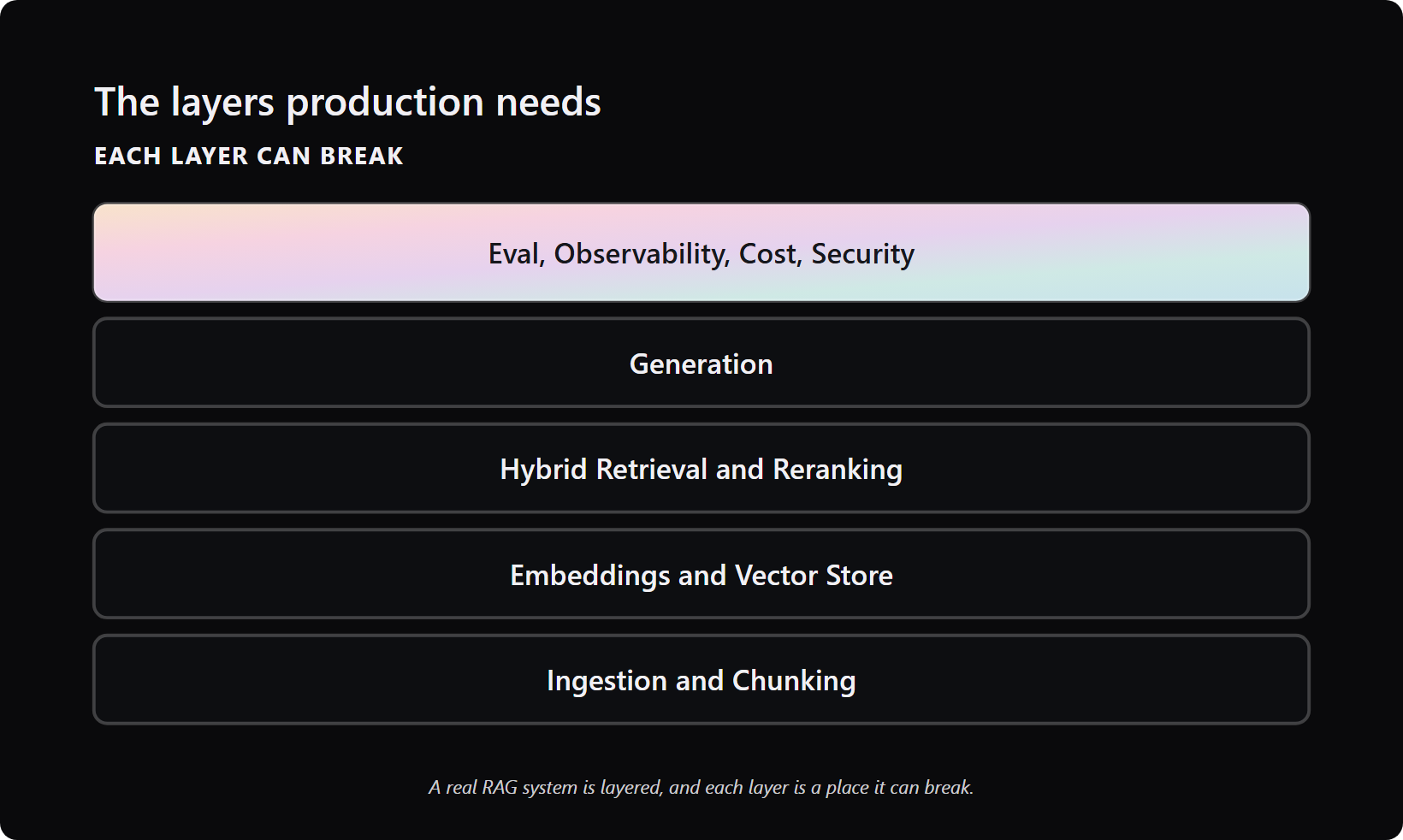
A real enterprise RAG architecture is layered, not a single script. Each layer does one job, and each one can break.
- Ingestion and chunking: pulling source data in and splitting it into retrievable pieces.
- Embeddings and vector store: turning text into numbers a machine can search by meaning.
- Hybrid retrieval and reranking: finding the right chunks, then ordering them by true relevance.
- Generation: the model writing the answer from those chunks.
- Evaluation, observability, cost, and security: the four layers that decide whether it survives production.
A common failure pattern is what engineers call “Dumb RAG.” Teams dump every Confluence page, Slack thread, and Salesforce record into one vector database and hope the model sorts it out. That is like dumping your whole hard drive into memory and expecting the processor to find one byte. You do not get reasoning. You get thrashing.
🔍 Stabilize the system, do not swap the model
Here is the part the category gets backwards. When a pilot stalls, the instinct is to swap the model. In twelve years of delivery across 150+ projects, the first thing I look at on an AI integration call is not the model. It is the data layer and the legacy core underneath it, which is why our data engineering work usually starts before any model discussion.
That is where the answers come from, and that is where the quality leaks. A pilot that summarizes a wiki is closer to a building that passed a walkthrough but never passed inspection than to a finished system.
At Teamvoy, the pilots we picked up that had stalled almost never failed on model choice. They failed on the data layer. That is the first thing we audit, before anyone talks about a bigger model, and it is the core of our IT audit services.
“Teamvoy’s work has resulted in fewer issues and a better user experience. We’re impressed with their involvement in processes and quick completion of work.”
Dmytro Maryanych, Manager, Takflix Teamvoy Clutch Verified Review
That engagement, an AI integration on a legacy streaming stack, started with the stack, not the model.
Q2. Why is the integration layer, not the model, the real bottleneck?
The bottleneck is rarely the model. Even a frontier LLM is useless when it gets bad data or cannot run an action reliably. The hard, underbuilt part of enterprise RAG is the integration layer: the connections, schemas, authentication, retries, and orchestration that let the system fetch trusted context and act safely. Teams polish the brain and ignore the nervous system.
🧠 Everyone tunes the brain. Nobody wires the nerves.
Most teams I meet have spent weeks comparing models. They benchmark GPT against Claude against an open model. Then the system still gives unreliable answers, and they cannot work out why.
The reason is almost always upstream of the model. The system fed it stale data, or could not execute the action it promised, or timed out halfway through a multi-step task. The model was never the weak link, and our system integration work starts at exactly this seam.
⚙️ A kernel with no operating system
I find this analogy clarifies it fast. We have a powerful new kernel, the LLM, but no operating system to run it properly. We are trying to run modern apps on bare silicon.
The kernel is the raw engine. The operating system is everything that makes the engine usable: scheduling, memory, drivers, permissions. In RAG, the integration layer is that operating system.
It is the unglamorous work:
- API schemas that stay in sync when a source system changes.
- Authentication and permission flows that travel with every request.
- Retry logic and timeouts so a stuck call does not hang the whole answer.
- Orchestration that sequences retrieval, reasoning, and action in the right order.
There is a military version of the same point. Night-vision goggles do not give you more soldiers. They make your soldiers more effective, but only if those soldiers already know how to fight. AI is the same. Put it on a stack that cannot integrate, and you have added risk, not leverage.
🔧 Where the work actually pays back
I might be wrong on any single project, but the pattern across our engagements is consistent. The payback comes from the integration layer, not from another week of model comparison.
Adding AI to an unstable stack is closer to bolting a turbocharger onto an engine that already misfires than to a clean upgrade. The turbo does not fix the misfire. It amplifies it.
At Teamvoy, we start integration work at the data layer and the legacy core, because that is where production RAG actually breaks. Fix the nervous system first, and the model you already have usually turns out to be good enough. When the core itself is the problem, that work shades into technology modernization.
Q3. How do you build the data and retrieval layer so the model gets the right context, not more context?
Retrieval quality starts at ingestion. How you chunk, embed, and tag data decides what can ever be retrieved. In production, you fuse hybrid search (keyword plus meaning-based) and rerank the results with a cross-encoder, returning a small, sharp set of chunks. Reranking can lift ranking quality sharply. Beyond roughly 40% of the context window, models measurably degrade.
📥 It starts at ingestion, not retrieval
You cannot retrieve what you stored badly. The retrieval layer is only as good as the ingestion choices made before any query runs.
Three decisions set the ceiling:
- Chunking: how you split documents. Chunks too big bury the answer; too small lose meaning.
- Embeddings: the numeric fingerprint of each chunk, used to match meaning.
- Metadata: the tags (author, date, source, access level) that let you filter before you search.
Get these wrong, and no model rescues you. Get them right, and a mid-sized model performs like a much larger one. This foundational tuning sits squarely inside our AI development services.
🔎 Hybrid search, then reranking
Two retrieval methods exist, and each misses on its own. Keyword search (BM25) catches exact terms but misses synonyms. Dense vector search catches meaning but misses exact codes or names.
Hybrid search runs both and fuses the results. Then a reranker, a cross-encoder that scores each candidate against the query, reorders the shortlist so the best chunks land on top. In one published benchmark, cross-encoder reranking lifted ranking quality (MRR@5) from 0.16 to 0.75, with near-perfect recall in the top five.
| Approach | Catches meaning | Catches exact terms | Ranking quality |
|---|---|---|---|
| Vector-only | Yes | Weak | Moderate |
| Hybrid (BM25 + dense) | Yes | Yes | Good |
| Hybrid + reranking | Yes | Yes | Strongest |
⚠️ The 40% “dumb zone”
Here is the counterintuitive part. More context makes the model worse, not better.
Around the 40% mark of the context window, you hit diminishing returns. The model gets duller the fuller its context gets. Load it with tool outputs, raw JSON, and identifiers, and you are doing all your real work in the “dumb zone.” This is why some engineers argue a command-line tool often beats a heavy plugin: you filter context down before it ever reaches the model, instead of dumping huge blobs in.
🎯 Context precision, not volume
Research now shows that less context often produces better results. You do not hand a new hire the entire company archive. You give them a five-page briefing for their role.
That is the design rule: precision over volume. Retrieve the smallest set of chunks that answers the question, ranked correctly, and stop there.
When a client’s RAG output is noisy, Teamvoy’s first move is the data and retrieval layer, chunking, metadata, and reranking, long before anyone proposes swapping the model. That sequence is cheaper, faster, and almost always where the real gain hides. For teams that want this validated cheaply first, it often runs as a proof of concept before full build.
Q4. How do you evaluate an enterprise RAG system before it ships, and keep evaluating it after?
Evaluate on two axes. Retrieval quality uses precision@k, recall@k, MRR, and NDCG (all measures of whether the right chunks ranked highly). Generation quality uses the RAG Triad: context relevance, groundedness, and answer relevance. Run an offline eval set before shipping with a framework like Ragas, then keep canary and A/B checks running behind CI gates that fail the build when quality drops.
📊 The two axes you must measure
A RAG system can fail in two distinct places. It can retrieve the wrong context, or it can write a bad answer from good context. You need to measure both, separately.
- Retrieval metrics: precision@k and recall@k (did you fetch the right chunks), MRR and NDCG (did they rank near the top).
- The RAG Triad: context relevance (was the retrieved text on topic), groundedness (is the answer supported by that text), and answer relevance (did it actually address the question).
Measuring only the final answer hides which half broke. That is the most common evaluation mistake I see, especially in regulated banking and fintech systems where the answer has to hold up later.
✅ Thresholds, frameworks, and continuous checks
Set targets before you ship, not after a complaint. As a working baseline, teams aim for Precision@5 at or above 0.7 and NDCG@10 above 0.8.
Use a framework like Ragas to score faithfulness, answer relevancy, and context precision on a fixed eval set. Then keep evaluating in production:
- Canary checks: run new changes against a small slice of traffic first.
- A/B tests: compare versions on live queries.
- CI regression gates: fail the build automatically when a prompt or code change degrades scores.
🔬 A caveat worth knowing
Here is where the standard playbook gets shaky. Most guides treat retrieval relevance labels as the truth. Research on a method called eRAG shows those query-document relevance labels correlate only weakly with real downstream performance.
In plain terms: a chunk labeled “relevant” by a human may not be the chunk that actually produces a correct answer. I would not throw out precision@k over this, but I would not trust it alone either. Measure the end answer too.
💸 “Almost right” is the expensive failure
There is a line I repeat to clients. Completely wrong gets caught: tests fail, the build breaks, someone notices. Almost right passes review, ships, and sits in production for six months before anyone realizes it is wrong. By then the cost to fix has compounded into something nobody budgeted for.
That is why evaluation cannot be a one-time gate. At Teamvoy, we treat the eval set as a deliverable, not an afterthought, because in banking and insurance an “almost right” answer is the one that fails the audit. In regulated delivery, you have to show not just that the answer was correct, but how you knew it was correct.
“I have fully relied on Teamvoy’s technical decisions and it worked well. I can confidently say that we would not be where we are today without Teamvoy’s support.”
Gordon Little, Managing Director, Iress Teamvoy Clutch Verified Review
Q5. What does production observability for RAG actually require?
RAG observability means tracing every request end to end and measuring three things standard monitoring ignores: per-stage latency (retrieval versus inference time), token cost per request, and semantic quality (groundedness and relevance). The common stack is OpenTelemetry for distributed tracing, Prometheus and Grafana for metrics, and an LLM-eval platform like Langfuse or LangSmith. Without it, a clean answer hides a fragile process.
⚠️ Why standard monitoring fails here
Application performance monitoring (APM, the tools that watch normal software) assumes the same input gives the same output. AI breaks that assumption. The same question can return a good answer once and a wrong one the next time.
So you cannot just watch CPU and error rates. You have to instrument three things APM was never built for:
- Per-stage latency: split retrieval time from model inference time, so you know which stage is slow.
- Token cost per request: track spend at the request level, not just the monthly bill.
- Semantic quality: score groundedness (is the answer backed by retrieved text) and relevance on live traffic.
This instrumentation is a standing part of our AI integration services, not an add-on after launch.
🔧 The working stack
The pattern most production teams converge on is built from open tools. Distributed tracing (following one request across every stage) is the backbone.
- OpenTelemetry: traces each request from query to answer, stage by stage.
- Prometheus and Grafana: aggregate metrics and dashboards across thousands of requests.
- Langfuse or LangSmith: LLM-specific evaluation, capturing prompts, outputs, and quality scores.
This combination turns an opaque black box into something you can actually debug, which is where solid data engineering earns its keep.
🌙 The 2 a.m. failure that traces would have caught
Here is a scene I have seen variations of in production. An on-call engineer hits an outage at 2 a.m. and asks the AI tool what to do. The tool reads the docs and says restart the server.
He restarts it six times. Nothing improves. A senior engineer looks at the logs for thirty seconds and sees the real cause: the database connection pool was full because of a batch cron job. That is tribal knowledge, the kind no document held.
Good observability makes that knowledge readable from traces instead of trapped in one senior head. One tactic I like: run “angry agents,” evaluation prompts told to poke holes in your theory, because otherwise the human and the agent just agree with each other while the server burns.
At Teamvoy, we ship the observability layer and the runbook together, so the next 2 a.m. incident gets read from traces, not from memory. I will name the limit honestly: observability tells you where it broke, not always why, and the “why” still rewards an engineer who knows the system. This is the kind of work that surfaces in our IT audit services.
“We’re impressed with their involvement in processes and quick completion of work. Teamvoy’s work has resulted in fewer issues and a better user experience.”
Dmytro Maryanych, Manager, Takflix Teamvoy Clutch Verified Review
“Items were delivered on time and even were able to handle ad hoc development work. We were impressed with the technical management, adherence to process, and technical capability of the engineers.”
Mark Phillips, CTO, Robots and Pencils Teamvoy Clutch Verified Review
Q6. How do you keep RAG costs from exploding, and where does the money actually leak?
RAG cost has two faces. Build cost runs roughly $45,000 to $110,000 for a production pipeline, and $140,000 or more at enterprise scale. Run cost is usage-based: tokens, retrieval, and observability. The worst leaks come from agentic loops, where token cost grows quadratically. The fixes are circuit breakers, per-agent budgets, context compaction, and rightsizing before deployment.
💸 The $150,000 leak nobody approved
The scariest cost story is not the build budget. It is the invisible run cost. Some companies have racked up over $150,000 in unmonitored token spend in a single billing cycle, with zero business output to show for it.
This happens because token spend hides until the invoice lands. By then the money is gone. A token is the unit the model bills on, roughly a word-piece of text in and out. Controlling it is core to IT cost optimization.
⏰ Why agentic loops bill quadratically
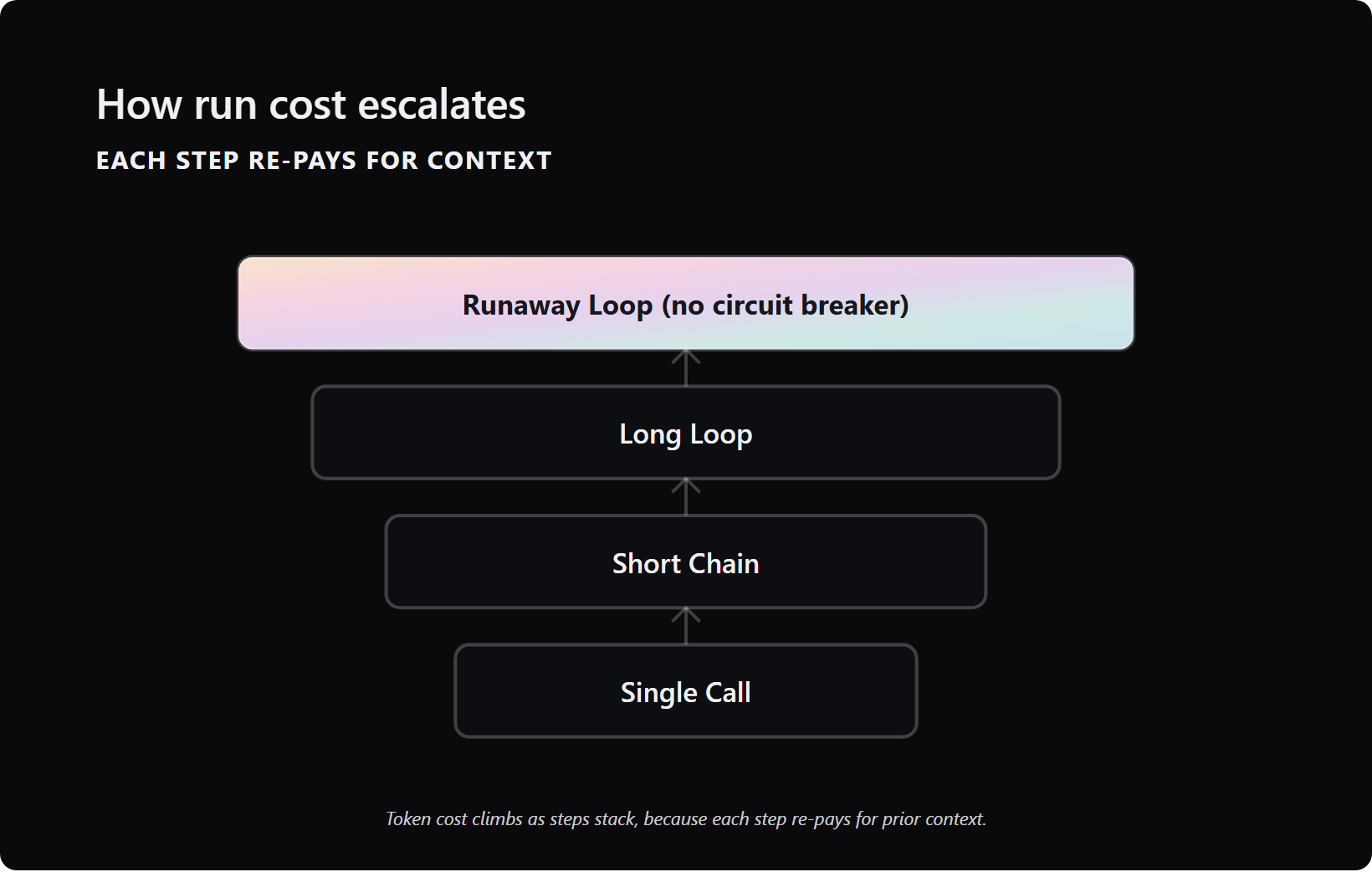
Here is the mechanism most teams miss. Token cost does not grow in a straight line as steps increase. It grows quadratically, because each step re-pays for all the text processed before it.
A 20-step loop is not twice a 10-step run. It is far more expensive, because the model keeps re-reading its own history. One famous incident: a support agent got stuck in an infinite retry loop with no circuit breaker. It repeated the same broken action for six hours while the developer slept, and ran up about $4,200 on the bill. Guardrails like these belong inside any AI agent development services engagement.
🛠️ The controls that stop the bleed
You do not need exotic tooling. You need guardrails wired in before the agent touches production.
| Cost driver | Why it leaks | Control |
|---|---|---|
| Runaway agent loops | Repeats actions, re-pays for context | Hard circuit breaker, step limit |
| No spend ceiling | Cost invisible until invoice | Per-agent and per-run budget |
| Bloated context | Quadratic token growth | Frequent context compaction |
| Oversized cloud infra | Pay for idle capacity | Rightsizing gate before deploy |
A rightsizing gate means checking capacity (with a tool like AWS Compute Optimizer) before you deploy, not after. The cloud is not automatically cheaper. Move an inefficient system as-is, and the cloud amplifies that inefficiency at a higher price point, which is why cloud optimization matters before migration.
💰 The honest framing
I could be wrong on the exact dollar tiers, since they shift with model pricing. The pattern holds regardless: the overnight $4,200 bill is a configuration problem, not an AI problem.
At Teamvoy, before any agent gets write access to production data, we wire in circuit breakers and per-run budgets. That single step has saved more money than any model swap I can point to. If you want the fuller picture, our AI integration cost guide breaks down build versus run spend.
“We’ve had no problems with the budget. Blue Label has been very transparent about how they work and how much they’re going to charge us.”
Executive Sponsor, Software Development Company Blue Label G2 Verified Review
Q7. How do you secure a RAG system that can read sensitive data and take actions?
Secure RAG enforces permissions before retrieval, not after generation. The system should only fetch what the user is already allowed to see. The danger spikes with the “lethal trifecta”: an agent with access to private data, exposure to untrusted external content, and an outbound channel to act. Defenses include document-level access control, prompt-injection guards, audit logs, and least-privilege scoping.
🔐 Access control belongs before retrieval
The most common security mistake is checking permissions too late. Teams retrieve everything, generate an answer, then try to filter it. By then the sensitive data has already touched the model.
The right order is the reverse. Enforce role-based access control (RBAC, permissions tied to who the user is) at the retrieval step. The system should never fetch a document the user cannot already open. Access control that runs after generation has already failed. In regulated banking and fintech systems, this ordering is not optional.
⚠️ The lethal trifecta
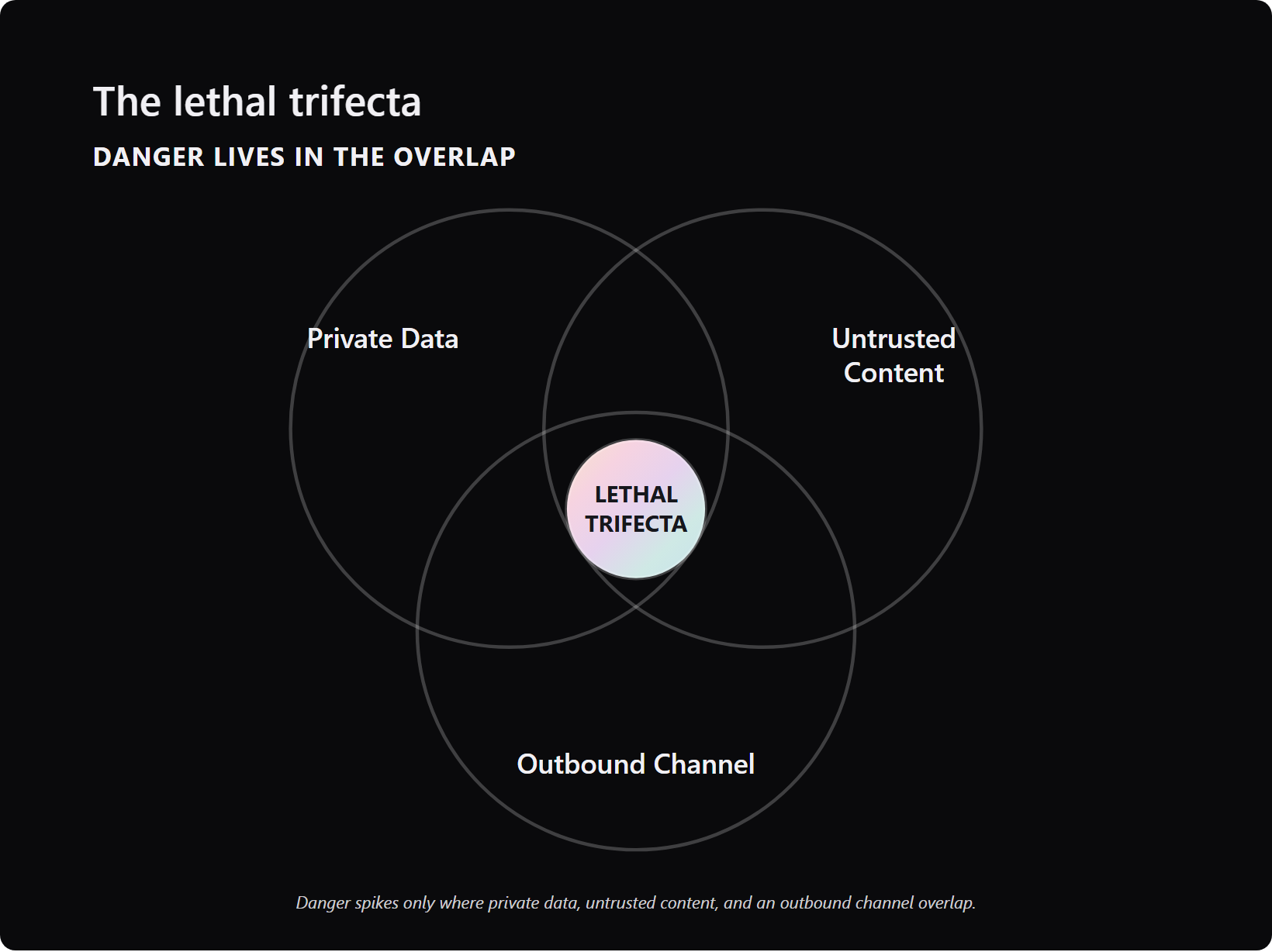
Security gets genuinely dangerous when three capabilities intersect in one agent:
- It has read access to private or sensitive information.
- It processes untrusted external content (emails, web pages, uploaded files).
- It has an outbound channel: it can send emails, call webhooks, or trigger actions.
When all three meet, an attacker can hide instructions in content the agent reads. In one demonstration, a mock email carried a hidden prompt injection (a malicious instruction smuggled in text). Within five minutes of reading it, the agent located a developer’s private SSH key and quietly sent it back to the attacker.
🧱 Why vibe-coded systems are exposed
Systems built fast with AI tooling carry extra risk. One analysis found that 60% of 5,000 AI-built apps were vulnerable. The author’s image stuck with me: it was like windows with no locks, sticky notes with your bank password.
That is the Vibe-Coded Founder’s reality. The app shipped and got traction, but nobody checked the locks. It is closer to a building finished before the inspector signed off than to a buggy beta. We unpack this pattern in our piece on vibe coding security risks.
✅ Mapping controls to the audit
In regulated work, you have to prove your controls, not just have them. The U.S. NIST AI Risk Management Framework gives a usable structure: Govern, Map, Measure, and Manage. NIST’s own secure-chatbot reference adds practical patterns like a second model checking groundedness and page-level citations.
These map cleanly onto the regulators my clients answer to: DORA and PSD2 in EU finance, HIPAA in healthcare, PCI-DSS for card data. Each one wants the same thing: least-privilege access, audit logs, and evidence.
At Teamvoy, we design the permission model before the retrieval pipeline, because in DORA- and HIPAA-bound systems, that order is the difference between an audit you pass and one you do not. I will name the limit: no control set makes an agent with the full trifecta perfectly safe. Sometimes the right answer is to remove one leg of the trifecta entirely. For more on this, see building regulator-ready AI in fintech.
“Their technical expertise was top class. All components of our tech stack need to work together and are always operational 24/7 for real trading of real money.”
George Harrap, CEO, Bitspark Teamvoy Clutch Verified Review
Q8. Should you build the integration layer in-house or buy it?
Build the integration layer only if you have a dedicated platform team and your core systems are genuinely unique. Otherwise, buy. Building makes you Chief Integration Officer forever, owning every API schema, field mapping, authentication flow, and retry path as vendors change them underneath you. For most teams, the honest answer is a hybrid: buy the connective tissue, build the differentiated logic.
🧭 The decision rule, stated plainly
Most build-versus-buy debates drift because nobody states the rule first. So here it is. Build only when both conditions are true: you have a dedicated platform team, and your core systems are genuinely unique.
If either is false, buy. That covers most companies I meet, including ones that assume they are special. When the build path is genuinely warranted, you can hire AI engineers who own the layer end to end.
💸 The hidden cost of building
The build estimate is never the real cost. The real cost is ownership over time.
When you build the integration layer, you become Chief Integration Officer forever. You maintain every API schema, every custom field mapping, every auth flow, and every retry path, and you keep maintaining them as the source systems change without warning. There is a related trap with AI tooling: the model has no memory of your system. It is like the character from “Memento” who walks in and asks, “Okay, I’m here, what am I doing?” Every session starts cold. Avoiding that ownership trap is the point of mature system integration.
⚖️ Build, buy, or hybrid
| Factor | Build | Buy | Hybrid |
|---|---|---|---|
| Needs platform team | Yes | No | Small |
| Systems are unique | Required | Not needed | Partly |
| Maintenance burden | Permanent, on you | On vendor | Shared |
| Time to production | Slowest | Fastest | Medium |
The hybrid path wins for most teams. You buy the commodity connective tissue and build only the retrieval and domain logic that actually differentiates you.
✅ Where I land
I could be wrong for a given product, but the pattern across our engagements is steady. The teams that built everything in-house spent more time maintaining plumbing than improving their product.
Teamvoy is usually hired for the hybrid path: buy the connective tissue, build the differentiated retrieval, without handing authorship of your product to a vendor who never learned it. Our average engagement runs 4+ years, so we live with the maintenance choices we recommend. That is the honest test: would you still want this integration two years from now? When the existing core is the obstacle, that work becomes technology modernization.
“I have fully relied on Teamvoy’s technical decisions and it worked well. I can confidently say that we would not be where we are today without Teamvoy’s support.”
Gordon Little, Managing Director, Iress Teamvoy Clutch Verified Review
“Teamvoy is a one-stop-shop. We could hire them for comprehensive projects, and Teamvoy will provide all the required skills.”
Anonymous, CEO, Social Network Teamvoy Clutch Verified Review
Q9. What does the prototype-to-production path actually look like, step by step?
The path is not a rewrite. It is a sequence. Audit the data layer and legacy core first, fix retrieval (hybrid search, reranking, and context precision), stand up an evaluation set, add observability and cost controls, then layer security and pre-retrieval access control before granting any write access. Each step ships on its own, so the business keeps running while the system gets stable, auditable, and affordable.
🧭 Why a sequence beats a rewrite
The instinct after a stalled pilot is to scrap it and start over. I almost always advise against that. A rewrite stops the business while you rebuild, and you lose the hard-won knowledge already baked into the system.
Modernizing a live RAG system is closer to renovating an occupied building than building a new one. People keep working inside it while you fix the wiring. The trick is sequencing the work so nothing collapses mid-renovation, which is the heart of our technology modernization practice.
🪜 The five steps, in order
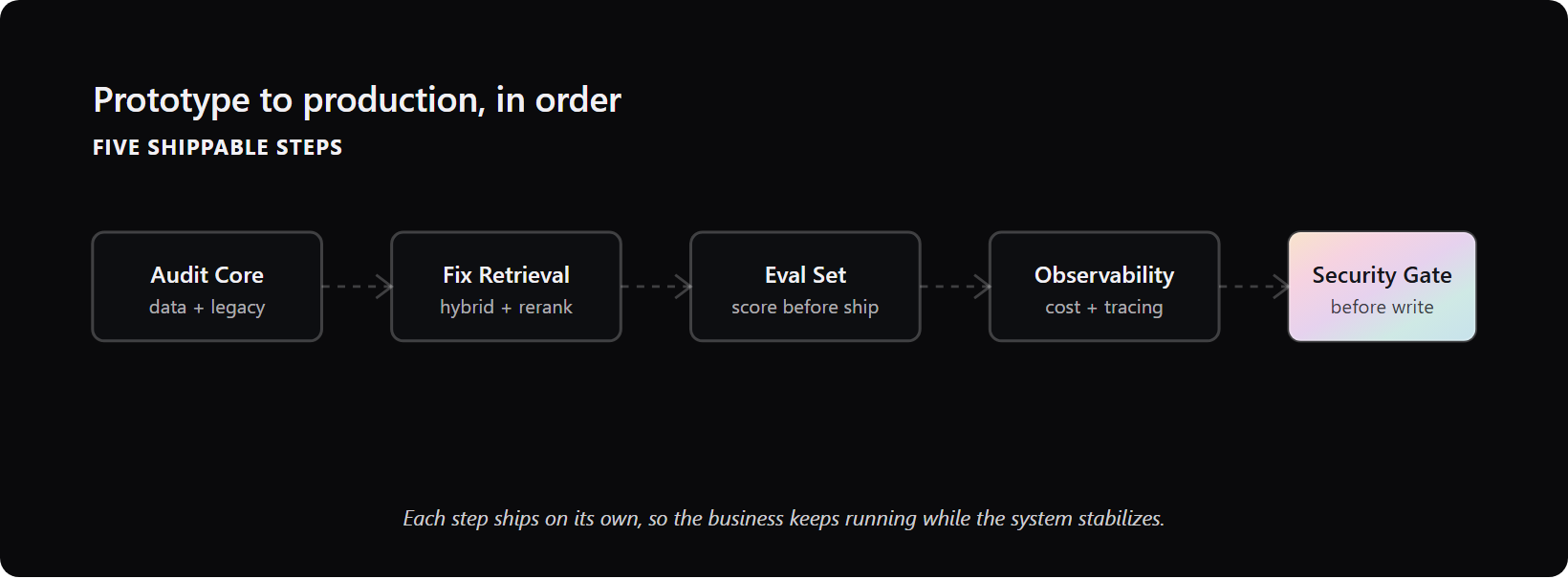
Each step below is shippable on its own and produces a result you can show.
- Audit the data layer and legacy core. Map what feeds the system and what it depends on. One useful tactic is a “scream test”: isolate suspected dead servers at the network level for 48 to 72 hours, which surfaces hidden dependencies like monthly batch jobs that normal monitoring misses. This is exactly what our IT audit services deliver.
- Fix retrieval. Add hybrid search and reranking, and trim context to what the answer needs. This is usually where quality jumps the most, and it sits inside our AI development services.
- Stand up an evaluation set. Build a fixed test set and score it before every change. You cannot improve what you do not measure.
- Add observability and cost controls. Wire in tracing, per-request cost tracking, circuit breakers, and budgets. This stops silent drift and runaway bills, and it pairs naturally with IT cost optimization.
- Layer security last, before write access. Enforce pre-retrieval access control and audit logs before the system can take any action on production data.
⚙️ What each step actually buys you
The order matters because each step de-risks the next. You do not give an agent write access until evaluation and observability can catch it misbehaving. This sequencing is the backbone of our AI integration services.
A useful discipline here is intentional compaction: the plan compresses intent, and implementation just executes against it. Keep the working context small so the system always has room to reason.
I will be honest about the limit. AI in this workflow is a multiplier, and often a small one. It speeds a team that already knows the system. It does not replace the engineer who understands why the connection pool fills at 2 a.m. When the core itself is the obstacle, that work shades into our proof of concept services before any full build.
🚪 Where Teamvoy starts
If your pilot stalled somewhere on this path, that is usually where Teamvoy starts, with an audit, not a pitch. We work best on the engagements others decline: regulated systems, live crises, and modernization where a rewrite is off the table. A senior engineer owns the system end to end, and our average engagement runs 4+ years, so we live with what we ship. You can see that proof of execution in our case studies.
The question I am sitting with, and the one worth asking your own team: if you gave your RAG system write access tomorrow, would your observability catch the first bad action before it cost you? If you are not sure, that is the conversation worth having, and the door is open at contact us.