
- LLM observability and LLM evals are the two systems that tell you whether a production language model is still doing what you approved.
- LLM evals run offline and gate every release against a golden dataset before it ships.
- LLM observability runs online and tracks live quality, drift, and cost after deployment.
- Together, they form the core of LLMOps.
- In regulated fintech, they help prevent silent model regressions from being discovered first by customers, auditors, or regulators.
Key takeaways:
LLM observability and evals for production fintech require two separate systems, not one dashboard: offline evals that gate a model release before it ships, and online observability that watches live traffic after it ships. An uptime check or error-rate alert will not catch a model that answers fluently but wrong, drifts on edge cases, or silently changes behavior after a vendor updates a model version. Fintech teams need golden datasets, LLM-as-judge scoring with human-reviewed calibration, retrieval-quality metrics for RAG, and drift detection tied to specific failure modes a risk committee will ask about by name. Build both before you scale past a pilot, not after an examiner asks how you know the model is still doing what you approved.
- LLM observability and evals are two halves of one discipline: evals gate releases offline, observability watches quality online.
- LLMOps is the operational layer around a production model, and observability plus evals are its two load-bearing parts.
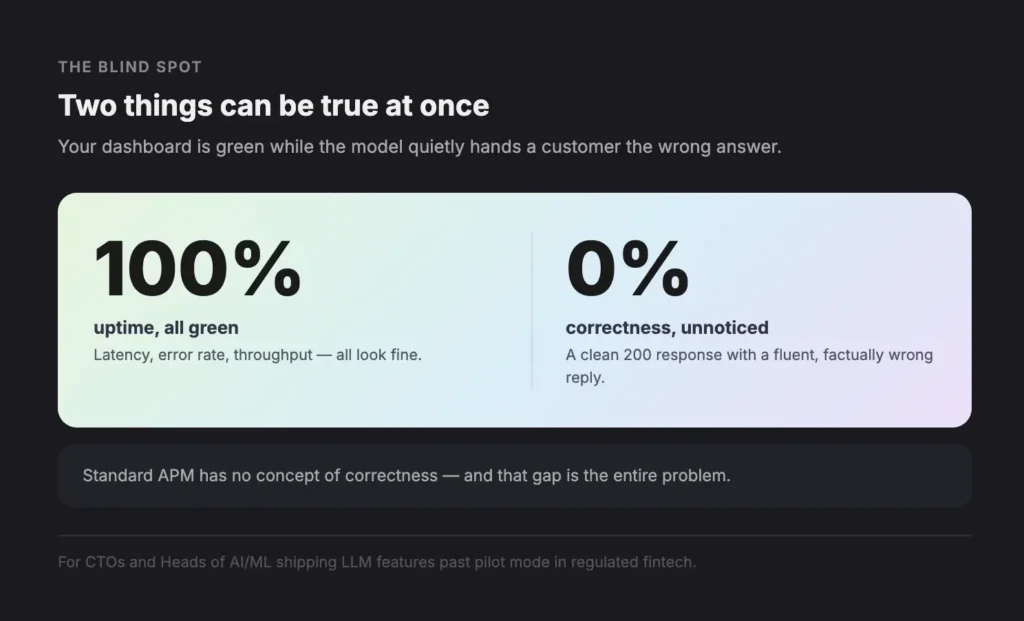
- A model can have 100% uptime and 0% correctness, and standard APM will not tell you.
- LLM-as-judge is unreliable alone. Pair it with golden datasets and human-reviewed calibration.
- RAG systems need retrieval metrics (faithfulness, context precision) on top of output quality.
- Model-risk review wants versioned evals, not a demo. SR 11-7 assumes documented, repeatable testing.
- Drift detection needs task-specific metrics, not just cosine similarity on embeddings.
- LLMOps services exist because most fintech teams need this layer before they have hired the ML engineers to build it.
Introduction
Your dashboard says 100% uptime. Your model just told a customer their account balance was $0. Both are true at the same time, and that gap is the entire problem this post is about.
If you are a CTO or Head of AI/ML shipping LLM features into a regulated fintech environment, you have already learned that Datadog dashboards and PagerDuty alerts do not tell you when a model starts hallucinating account balances or misclassifying a fraud case. This guide is for the engineering leader moving past pilot mode. It covers what LLMOps actually is, the four signal types a normal monitoring stack misses, a working comparison of evals versus observability versus traditional QA, what LLMOps services include when you buy rather than build, the concrete steps to stand up an eval and observability pipeline that survives a model-risk committee, and where a team like Teamvoy fits (and where it does not).
What is LLMOps?
LLMOps is the practice of operating large language models in production: the tooling, processes, and monitoring that keep a deployed model reliable, measurable, and auditable over time. Think of it as MLOps adapted for the specific failure modes of generative models. Where MLOps centers on training pipelines and model registries, LLMOps centers on prompts, retrieval, evals, and live output quality, because most fintech teams consume a foundation model through an API rather than training their own.
LLM observability and evals are the two load-bearing parts of LLMOps. Everything else supports them.
The full scope of LLMOps usually breaks into six areas:
- Prompt and version management. Every prompt, model version, and retrieval index treated as a versioned artifact, so you can trace which combination produced a given output.
- Evaluation (evals). Offline scoring of model quality against a golden dataset before any change ships.
- Observability. Online tracing of every generation, retrieval call, and tool invocation in production, with quality and drift signals on top of latency and cost.
- Guardrails and safety. Input and output filters for prompt injection, PII leakage, and off-policy responses.
- Cost and latency control. Token budgets, caching, and routing, because production LLM spend moves fast and quietly. We cover where that spend hides in the hidden costs of AI agents.
- Governance and audit. The documented evidence a model-risk review expects: dataset versions, calibration results, drift alerts, and rollback criteria.
For a fintech shipping KYC extraction, transaction summarization, or a customer-facing agent, LLMOps is not optional infrastructure you add later. It is the difference between a feature you can defend to a regulator and one you cannot.
Why can’t you monitor an LLM like a normal service?
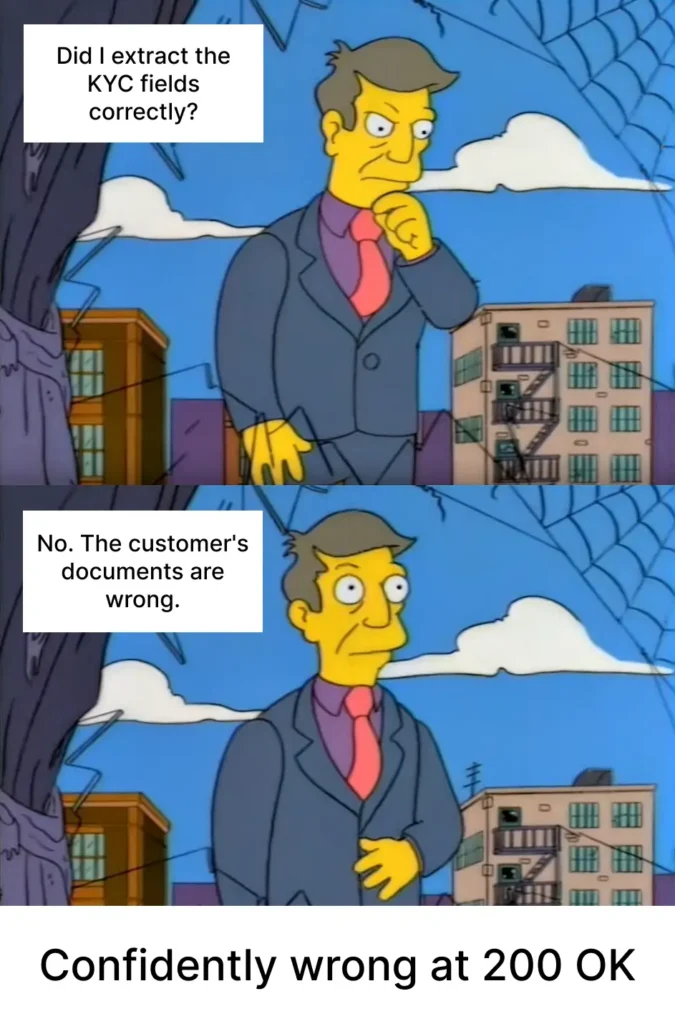
You cannot monitor an LLM like a normal service because its failure mode is not “down.” It is “confidently wrong,” and standard APM tools have no concept of correctness. A REST API either returns a 500 or it does not. An LLM returns a 200 with a plausible-sounding answer that is factually incorrect, off-policy, or subtly different from what it said yesterday on the same input. Latency, error rate, and throughput all look fine while the model quietly gets worse.
This is a real objection raised often in engineering communities such as r/devops and r/LocalLLaMA: you cannot health-check semantic correctness with a synthetic transaction the way you would ping an endpoint. That is true, and it is exactly why LLM observability is a distinct discipline from classic APM, not an extension of it. Three things make LLM behavior structurally different from a normal service:
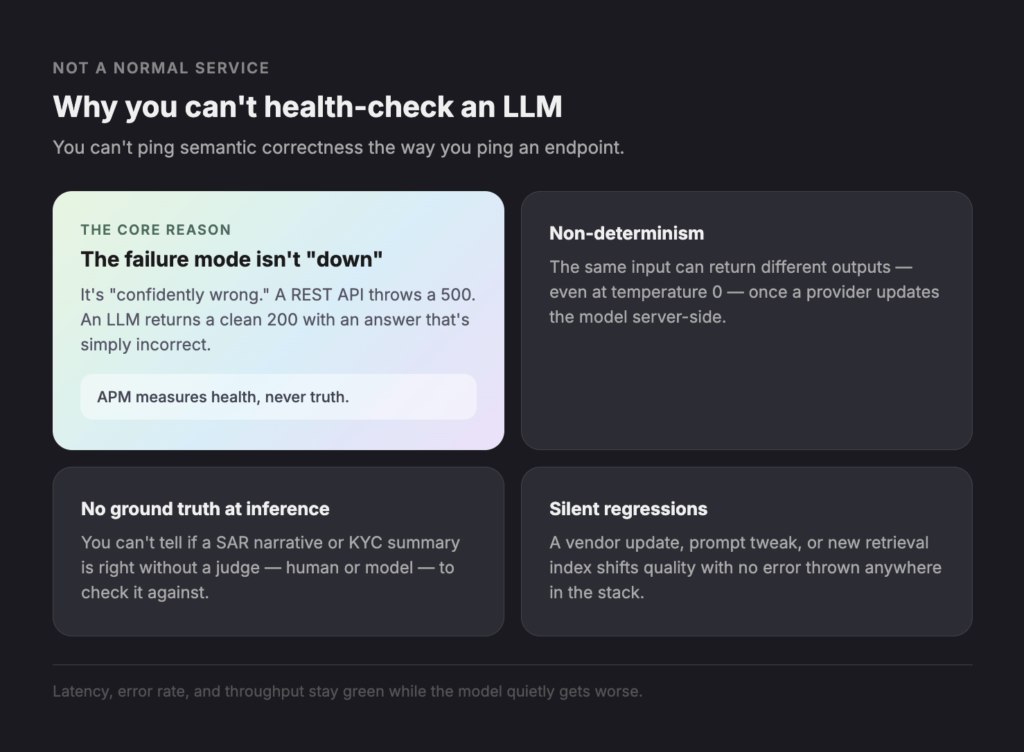
Non-determinism. The same input can produce different outputs across calls, even at temperature 0, once you factor in provider-side model updates.
No ground truth at inference time. You do not know if a generated SAR narrative or KYC summary is correct without a judge, human or model, to check it against.
Silent regressions. A vendor model update, a prompt template change, or a new retrieval index can shift output quality without any error being thrown anywhere in the stack.
For a fintech shipping features like transaction summarization, KYC document extraction, or a customer-facing support agent, the cost of missing this is not a five-minute outage. It is a wrong answer that reaches a customer, an auditor, or a regulator, and nobody notices until a complaint or exam finding surfaces it. Our take on why so many pilots stall before they reach this level of engineering discipline is in why most AI pilots in fintech never reach production.
Symptoms your monitoring stack is blind to LLM failure
- Your only quality signal is a thumbs-up/thumbs-down widget almost no user clicks.
- Output quality complaints arrive from customers or compliance, never from your alerting.
- A prompt or model change “felt fine in testing” but degraded a specific edge case in production.
- Nobody can say, with evidence, whether last month’s model version was better or worse than this month’s.
How do you solve LLM observability and evals for production fintech?
You solve LLM observability and evals by running two separate systems in parallel: offline evals that gate every release before deploy, and online observability that watches live traffic after deploy, with traditional QA still handling the parts of the system that are deterministic. Treating these as one system is the most common design mistake we see in fintech AI teams.
Evals vs. observability vs. traditional QA
| Dimension | Traditional QA | Offline evals | Online observability |
|---|---|---|---|
| Purpose | Verify deterministic logic (routing, auth, calculations) | Score model/prompt quality against a fixed benchmark before release | Track live quality, cost, and drift signals in production |
| When it runs | Pre-deploy, CI/CD | Pre-deploy, on every prompt/model/RAG-index change | Continuously, post-deploy |
| What it catches | Broken logic, regressions in code paths | Accuracy drop, hallucination rate, regression vs. prior model version | Drift, outlier inputs, latency/cost spikes, live user-facing failures |
| Ground truth | Fixed expected output (assert equals) | Golden dataset plus rubric, often scored with LLM-as-judge | No fixed ground truth, relies on proxy signals and sampled human review |
| Typical tooling | pytest, Selenium, Postman | Braintrust, Ragas (RAG-specific), promptfoo, custom golden-set suite | LangSmith, Arize Phoenix, Langfuse, OpenTelemetry-based tracing |
| Owner | QA / engineering | ML engineering plus risk/compliance sign-off | ML engineering plus on-call |
The four signals a standard dashboard misses
These are the four signal types a normal monitoring stack cannot see, and the ones a model-risk review will specifically ask you to demonstrate:
- Task-level accuracy against a golden dataset. Not “did it respond,” but “did it get the KYC field extraction right,” scored against 200-plus labeled examples that get re-run on every change.
- Faithfulness and retrieval quality for RAG. Whether the answer is actually grounded in retrieved documents, measured with metrics like context precision and faithfulness, which Ragas implements directly for RAG pipelines, not just whether the answer is fluent.
- Judge-model agreement with human raters. LLM-as-judge scores are only trustworthy once you have measured how often the judge agrees with a human reviewer on a sample. Without that calibration step, you are trusting an unverified proxy.
- Distributional drift on inputs and outputs. Tracking whether the shape of incoming queries or the length, tone, and refusal rate of outputs is shifting week over week, which is often the earliest signal of an upstream model version change.
On the “LLM-as-judge is unreliable” objection: it is a fair critique of a lazy implementation, not of the technique. A single judge call with no calibration will drift, agree with itself more than with humans, and reward verbosity. The fix is not to abandon LLM-as-judge. The fix is to calibrate the judge against a human-labeled sample and report the agreement rate, use structured rubrics instead of “rate 1 to 10,” and re-run that calibration whenever you change the judge model. Treat the judge itself as a component under evaluation, not as ground truth.
Steps to stand up an eval and observability pipeline that survives a model-risk review
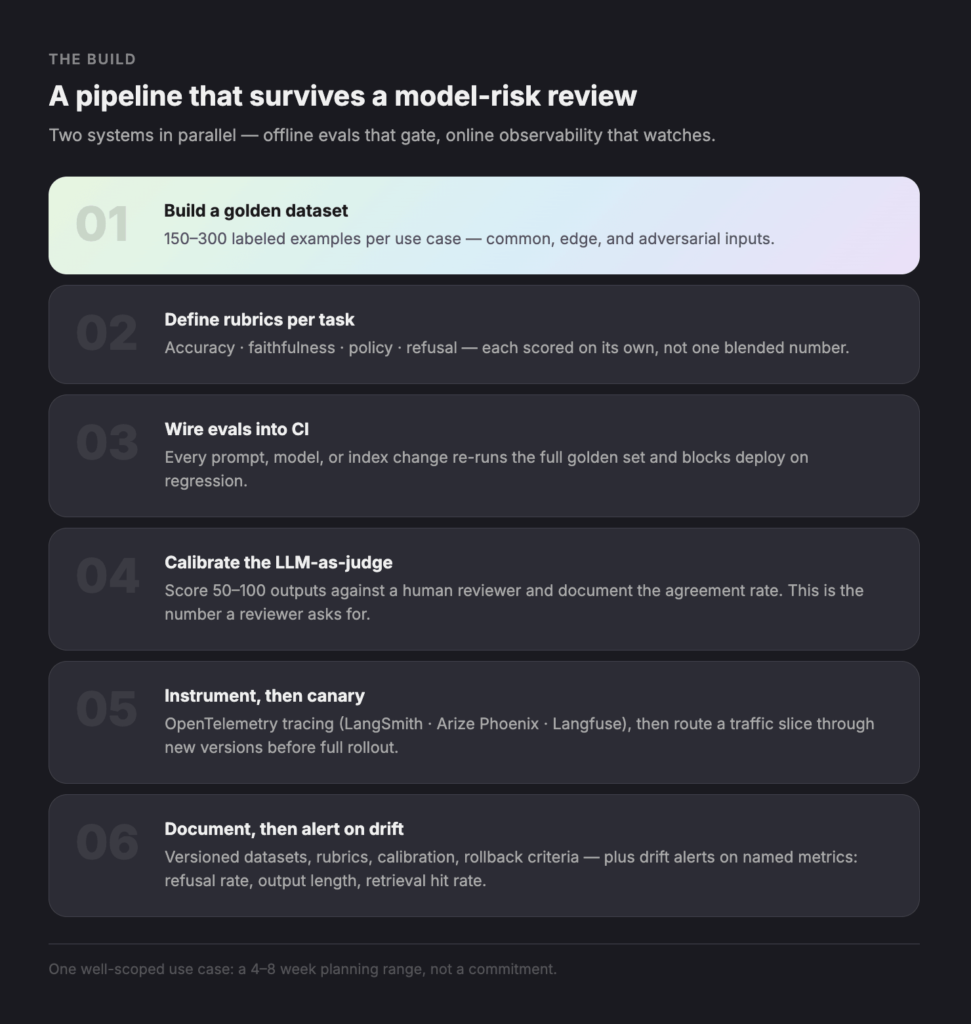
Build a golden dataset per use case. 150 to 300 labeled examples covering common cases, known edge cases, and adversarial inputs (prompt injection attempts, ambiguous KYC documents, out-of-scope questions).
Define pass/fail rubrics per task, not a single quality score. Accuracy, faithfulness (for RAG), policy compliance, and refusal-appropriateness, each scored independently.
Wire evals into CI so every prompt, model, or retrieval-index change re-runs the full golden set and blocks deploy on regression, using a tool like Braintrust, promptfoo, or a custom golden-set suite built on your eval framework of choice.
Calibrate your LLM-as-judge against a 50 to 100 example human-labeled sample and document the agreement rate. This number is what a risk reviewer will ask for.
Instrument production traces with OpenTelemetry-compatible tooling (LangSmith, Arize Phoenix, or Langfuse) so every generation, retrieval call, and tool invocation is logged with inputs, outputs, latency, and cost.
Set up canary or shadow deployments. Route a small percentage of live traffic, or a shadow copy, through the new model or prompt version and compare its outputs against the current production version before a full rollout.
Define drift alerts on specific metrics such as refusal rate, output length distribution, and retrieval hit rate, not generic anomaly detection, so alerts map to a named failure mode someone can act on.
Document the whole pipeline: dataset versions, rubric definitions, judge calibration results, and rollback criteria. A model-risk review under a framework like the Fed’s SR 11-7 guidance or the NIST AI Risk Management Framework will ask for evidence of ongoing monitoring, not a one-time validation.
For teams building the RAG layer specifically, our tooling roundup goes deeper on category tradeoffs in the best LLMOps tools this year.
Key takeaways for this section
- Run evals and observability as two systems, connected by canary or shadow deployments.
- The four signals to instrument are golden-set accuracy, RAG faithfulness, judge-human agreement, and distributional drift.
- Document as you build, because the paper trail is the deliverable a reviewer signs off on.
What do LLMOps services include?
LLMOps services are outsourced or embedded engineering that builds and runs the operational layer around a production language model so an internal team does not have to assemble it from scratch. Buyers reach for LLMOps services when they have a working LLM feature but no repeatable way to prove it keeps working, and no ML platform team to build one before the next audit.
A credible LLMOps services engagement covers the same six areas as LLMOps itself, delivered as working systems rather than advice:
| LLMOps service | What it delivers | Why fintech buys it |
|---|---|---|
| Eval harness build | Golden datasets, rubrics, CI-wired scoring, calibrated LLM-as-judge | Proves a change is safe before it ships |
| Observability setup | OpenTelemetry tracing through LangSmith, Arize Phoenix, or Langfuse | Sees live quality and drift, not just uptime |
| Guardrails engineering | Prompt-injection filters, PII redaction, output policy checks | Meets security and privacy review |
| RAG evaluation | Faithfulness and retrieval-quality metrics via Ragas | Stops confident answers from ungrounded context |
| Cost and latency control | Token budgets, caching, model routing | Keeps production spend predictable |
| Model-risk documentation | Versioned evidence package for SR 11-7 / NIST AI RMF | Passes examiner and internal audit |
Two things separate real LLMOps services from a slide deck. First, the output is a running pipeline wired into your CI and your existing observability stack, not a strategy document. Second, whoever builds it has taken a similar pipeline through an actual model-risk or examiner review, so the documentation is written to survive scrutiny. If a vendor treats observability as a line item rather than an engineering deliverable, that is a pattern worth reading about in the hidden costs of AI agents before you sign.
When should you bring in Teamvoy for LLMOps services?
Bring in Teamvoy when you need LLM observability and evals built by engineers who have taken a similar pipeline through an actual model-risk or examiner review, not just through a demo. We build the eval and observability layer as part of shipping the underlying LLM feature: golden dataset design, judge calibration, OpenTelemetry-based tracing wired into your existing observability stack, and the documentation package a risk committee expects to see, covered in more depth in building regulator-ready AI in fintech.
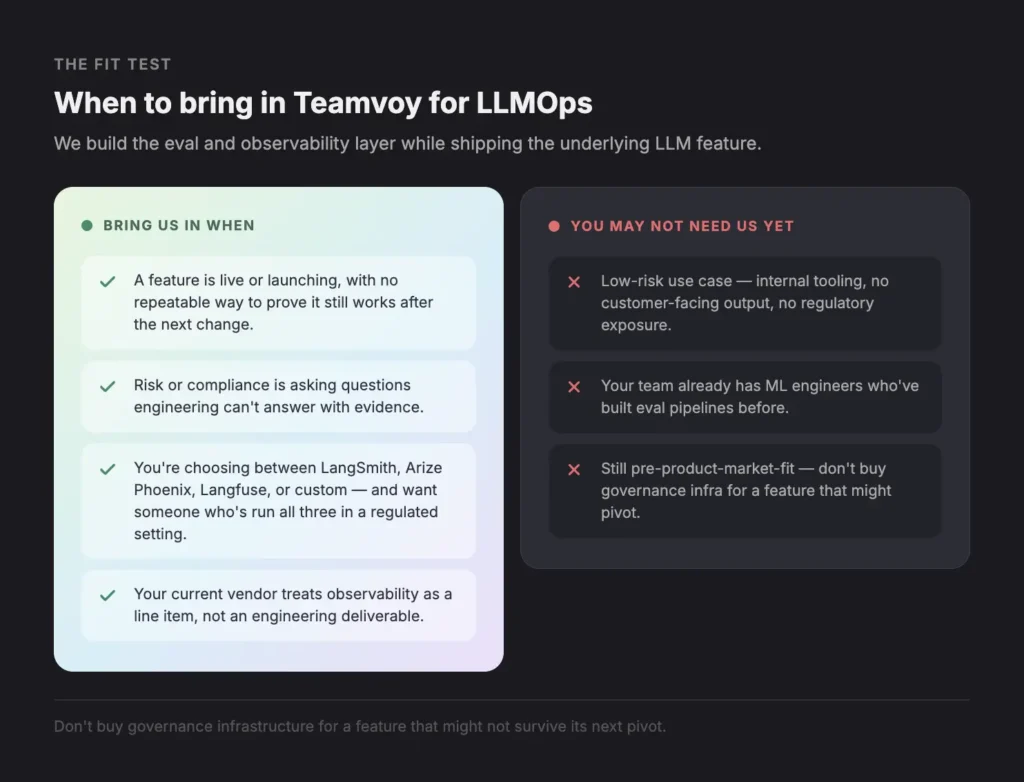
Signals you are ready for LLMOps services from outside help:
- You have an LLM feature live or about to launch, and no repeatable way to prove it still works after the next model or prompt change.
- Your risk or compliance team has started asking questions your engineering team cannot answer with evidence.
- You are choosing between LangSmith, Arize Phoenix, Langfuse, or a custom stack and need someone who has actually run all three in a regulated environment, not just read the docs. That choice also intersects with your underlying model, covered in Anthropic vs. OpenAI.
- Your current AI vendor treats observability as a line item, not an engineering deliverable.
You may not need us if your use case is low-risk (internal tooling, no customer-facing output, no regulatory exposure), your team already has ML engineers who have built eval pipelines before, or you are still pre-product-market-fit and the cost of building a full model-risk-grade pipeline outweighs the cost of a slower, more manual review process for now. Do not buy governance infrastructure for a feature that might not survive its next pivot.
What does LLM observability and evals look like for production fintech?
LLM observability and evals in production fintech look like two connected but distinct systems: an offline eval suite (golden datasets, calibrated LLM-as-judge scoring, RAG-specific metrics via Ragas) that gates every release in CI, and an online observability layer (OpenTelemetry-based tracing through LangSmith, Arize Phoenix, or Langfuse) that tracks live quality, drift, and cost. Canary or shadow deployments bridge the two, letting you compare a new version against production before full rollout. The output is a documented, versioned pipeline a model-risk reviewer can audit, not a dashboard someone checks when a customer complains.
Conclusion
Fintech teams that ship LLM features without a separate eval and observability layer are flying on infrastructure metrics that were never designed to catch semantic failure. LLM observability and evals are the two load-bearing parts of LLMOps, and the fix is not exotic: golden datasets, a calibrated LLM-as-judge, RAG-specific metrics where relevant, OpenTelemetry-based production tracing, and canary deployments before full rollout. Three things to take from this post:
- Evals gate releases before deploy; observability watches quality after deploy. You need both, wired into CI and production separately.
- LLM-as-judge is only as trustworthy as its calibration against human review. Measure and report the agreement rate.
- A model-risk review wants documented, repeatable evidence, not a demo. Build the paper trail as you build the pipeline.
If your team is shipping an LLM feature into production and cannot yet answer “how do you know it is still working” with evidence, book a free 30-minute consultation with a Teamvoy CPO and we will walk through what a model-risk-ready LLMOps pipeline looks like for your specific use case.