
Key takeaways:
Ruby on Rails app modernization for AI is a strategic, incremental program that balances risk and business continuity while embedding AI where it lifts performance and user experience. Understand the technical debt first. Upgrade Rails one major version at a time. Raise test coverage and CI quality before you refactor. Modularize business logic into service objects, then integrate AI through asynchronous processing and a provider abstraction. Store prompts, responses, and confidence scores so the AI layer is auditable and controllable in production. The result is a maintainable Rails app running AI safely, not a two-year rebuild that stalls.
- Incremental upgrades reduce downtime and risk versus a full rewrite, and deliver steady gains in stability.
- A strong test suite and CI pipeline are the precondition for safe modernization and reliable AI integration.
- AI logic belongs in service objects and background jobs so the app stays responsive under load.
- A provider abstraction layer over model APIs gives you flexibility and testable AI components.
- Persisting AI inputs, outputs, and confidence scores supports audit, debugging, fallbacks, and cost control.
| Step | Action | Key point | Tip |
|---|---|---|---|
| Assess current state | Run a technical audit | Identify tech debt and business priorities | Focus on code quality, dependencies, security posture |
| Plan incremental upgrades | Move Rails majors in sequence | Fewer compatibility breaks, faster access to new features | Never skip a major version |
| Enhance testing | Raise coverage, wire modern CI | Prevent regressions, raise developer confidence | Cover unit, integration, and system tests |
| Refactor code | Extract service objects and concerns | Improve maintainability, prepare for AI | Follow Rails MVC conventions |
| Integrate AI | Use background jobs and an abstraction layer | Keep the app responsive, keep providers swappable | Store AI data with confidence scores; add fallbacks |
| Test AI components | Mock model responses in automated tests | Reliability and predictable behavior | Version prompts as testable code |
Introduction
How to transition legacy Ruby on Rails apps to AI-enabled architectures is a live question inside most organizations running Rails in production today. Legacy Rails apps are widely deployed and still ship revenue, but many carry the technical debt and dated components that block agility. This guide covers Ruby on Rails app modernization as the practical, sequenced program it is: not a rewrite, and not a pure upgrade either, but a plan to add AI capability where it changes the numbers. It is written for the CTO, engineering director, or staff engineer who owns the codebase and has to move without stopping delivery. You leave with the assessment steps, upgrade sequence, integration patterns, and a read on when to bring in help.
What are legacy Ruby on Rails apps and why does modernization matter now?
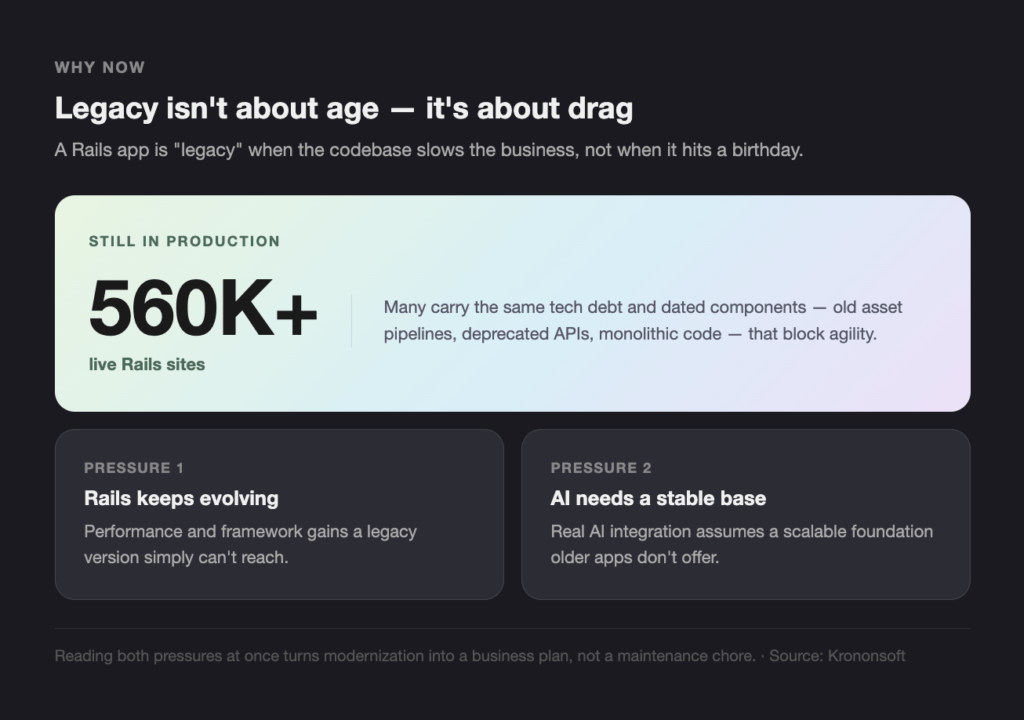
Legacy Ruby on Rails apps are not defined by age. They are defined by how the codebase affects business agility. These apps typically carry technical debt, run on outdated Rails versions, and slow every development cycle, which blunts your ability to react to market changes. Modernization restores stability, cuts maintenance cost, and creates the foundation modern technologies like AI actually need.
The visible symptoms are familiar: slow upgrades, degraded performance, and engineer frustration around fragile code and dated dependencies. The business impact is measurable. Delivery timelines drift, operational cost rises, and opportunities pass. Over 560,000 live sites still run Ruby on Rails, and many of the organizations behind them face the same modernization pressure (Krononsoft).
The window matters. Rails continues to evolve and ship performance and framework improvements that a legacy version cannot use. AI integration also needs a stable, scalable foundation that older apps do not offer. Understanding both pressures at once is what turns Ruby on Rails app modernization into a business plan instead of a maintenance chore.
What technical debt shows up in a legacy Rails app?
Technical debt in legacy Rails apps accumulates through years of patches, quick fixes, and skipped upgrades. It shows up as dated gems, deprecated APIs, and monolithic code that is hard to maintain or extend. Many apps still run older asset pipelines like Sprockets or jQuery, while current Rails has moved to Hotwire and Turbo. This debt slows feature work and raises the risk profile: security holes, unstable behavior, and cascading upgrade cost.
What are the business consequences of running unmodernized Rails?
Legacy Rails apps become the bottleneck that slows decisions and responsiveness. Slow deploys and fragile suites delay updates that customers and revenue depend on. Recruiting and retaining engineers gets harder when the stack looks dated or the code is undocumented, which pushes cost up and knowledge into a few heads. Every one of these effects compounds until modernization becomes the only way forward.rization, or a customer-facing agent, LLMOps is not optional infrastructure you add later. It is the difference between a feature you can defend to a regulator and one you cannot.
How do you run incremental modernization that minimizes risk?
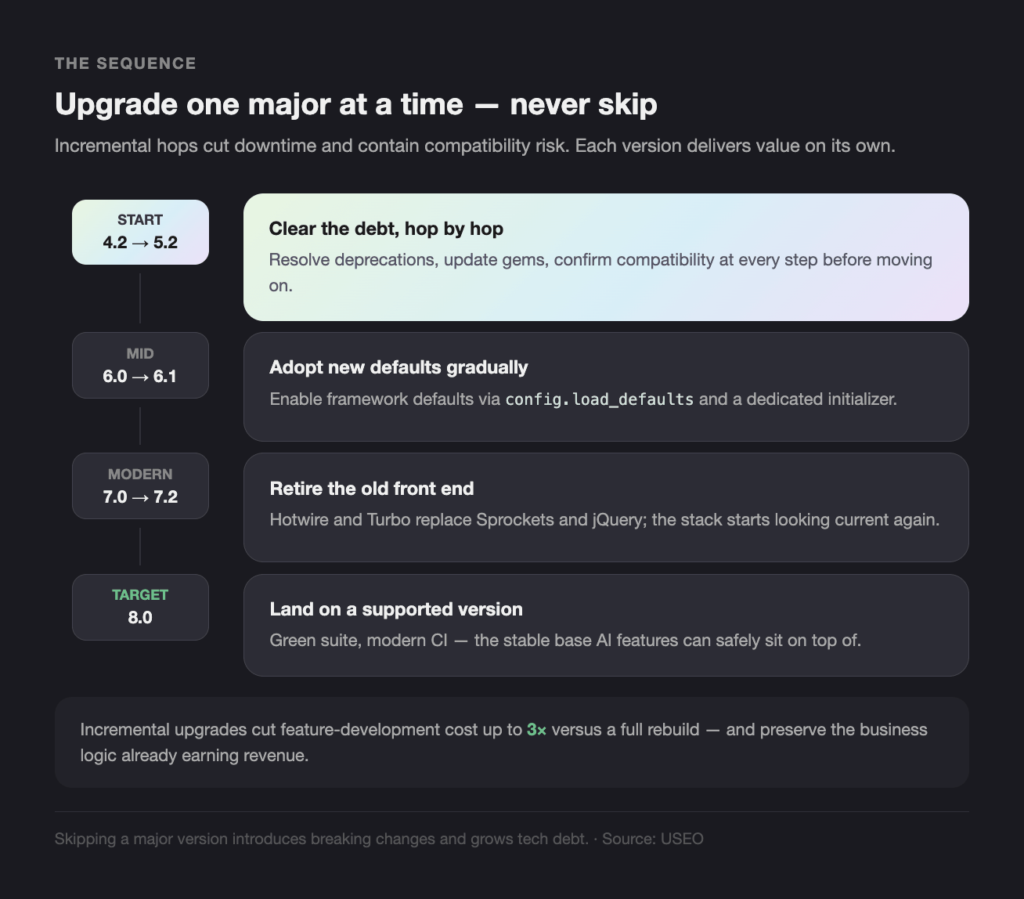
If in-house capacity is the constraint rather than the plan itself, Teamvoy’s Ruby on Rails developers can execute this incrementally alongside your existing team without disrupting the sequence. This approach cuts downtime, keeps the business running, and steadily improves stability and maintainability. The core discipline is to upgrade Rails versions systematically, for example 4.2 to 5.0, then 5.2, then 6.0, and to raise test and CI quality alongside each move. That sequence contains compatibility risk and lets each major deliver value on its own.
Avoiding a rewrite saves time and preserves the business logic already earning revenue. Incremental upgrades have been shown to cut feature development cost by up to three times compared to a rebuild (USEO). The strategy builds engineer confidence and stabilizes the code so future work, including AI integration, lands more smoothly. For teams pursuing Ruby on Rails app modernization, incremental upgrades are the proven path that balances risk and reward.
How do you sequence Rails version upgrades?
Move through each major Rails version in sequence. A representative path is 4.2, 5.0, 5.2, 6.0, 6.1, 7.0, 7.2, then 8.0. At each step, resolve deprecations, update gems, and confirm compatibility. Skipping versions to save time introduces breaking changes and grows tech debt. Follow the official Rails upgrade guide for the target version and enable new framework defaults gradually via config.load_defaults and a dedicated initializer.
How do you strengthen the test suite and CI pipeline?
Test coverage is the precondition for safe modernization. Legacy apps often lack automated tests, which multiplies regression risk during any change. Invest in unit, integration, and system tests, and wire a modern CI pipeline (GitHub Actions, GitLab CI, CircleCI) that runs the suite on every push. Once that pipeline is solid, it’s also the foundation for running AI agents safely inside CI/CD — see Teamvoy’s playbook for building AI agents into your CI/CD pipeline for the next step. Automated tests give engineers the confidence to refactor at speed. For our full pattern, see testing strategy for legacy app migration.
How do you refactor and modularize the codebase?
Incremental modernization opens the door to structural cleanup. Using Rails MVC conventions, extract business logic into service objects, concerns, and modules. This modularization improves maintainability today and creates the seams AI features slot into next.
How do you enable AI on top of a legacy Rails app?
AI integration in a legacy Rails app needs deliberate architecture to stay scalable, maintainable, and cost-controlled. At Teamvoy, the pattern is asynchronous AI processing through background jobs (Sidekiq or similar), which decouples model calls from user-facing requests and keeps the app responsive.
Isolate AI logic in service objects for clean, testable code that is easy to update or swap. Wrap provider APIs in an abstraction layer so the app can move between vendors or models without a rewrite. Store every AI input and output with confidence scores in a structured format like JSONB, so you can audit and replay. Add fallback strategies for the cases where AI output is uncertain or delayed. Mock model responses in automated tests to validate behavior across scenarios. This combination lets AI features augment a legacy Rails app without compromising stability.
Which architectural patterns fit AI integration?
AI features in a legacy Rails app benefit from a clean separation of concerns. Service objects hold the AI logic. A background job framework such as Sidekiq handles the asynchronous call. This design prevents blocking user requests and lets AI workloads scale independently. For how these patterns extend to coordinating multiple AI agents rather than a single model call, see Teamvoy’s guide to AI agent orchestration patterns and use cases. A recommendation engine, for example, can process user data in the background and update profiles without touching UI latency.
How does a provider abstraction layer help?
An abstraction layer over model APIs gives you the flexibility to switch between providers such as OpenAI, Anthropic, Hugging Face, or a self-hosted model without changing business logic. The same abstraction makes tests easier: swap the real client for a mock during development and CI so tests are fast and deterministic.
How do you manage AI data and audit trails?
Store AI inputs, outputs, and confidence scores in JSONB columns on PostgreSQL. That gives you auditability and reproducibility. It supports debugging, compliance review, and model retraining. If a classification is wrong, engineers can pull the exact input and output pair, refine the prompt or model, and version the change.
How do you control cost and add fallbacks?
Model API calls are a real budget line. Set confidence thresholds and fallback logic so an uncertain output does not degrade user experience. When confidence is low, revert to deterministic logic, a cached prior answer, or a human review queue. Enforce a per-tenant daily cost cap at the job layer.
How do you test AI components?
Mock model responses in automated tests to keep the system reliable and prevent unpredictable behavior. Treat prompts as versioned, testable code. That enables continuous improvement and stops regressions in AI features from shipping unnoticed.henever you change the judge model. Treat the judge itself as a component under evaluation, not as ground truth.
What are the benefits of an AI-enabled Rails architecture?
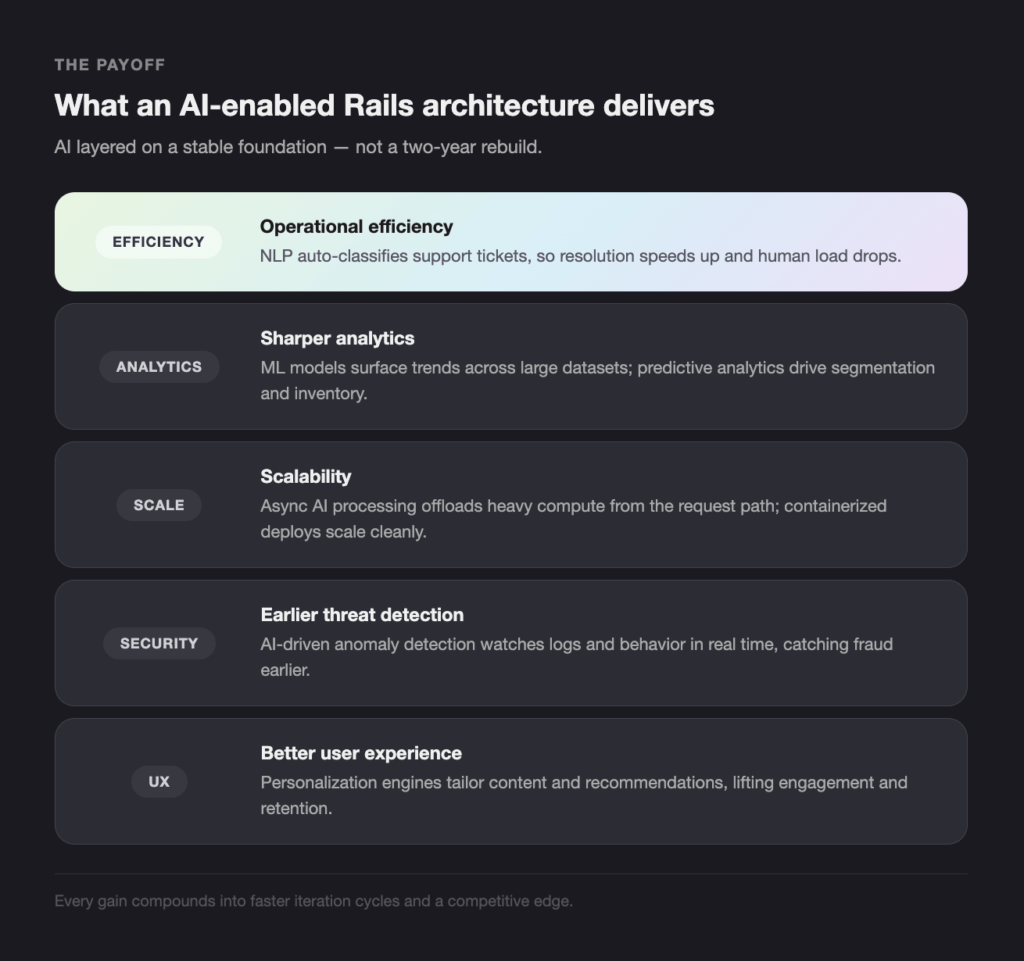
Modernizing a Ruby on Rails app with AI capability delivers concrete business and technical gains. Intelligent automation cuts manual work and improves operational efficiency. AI-supported decisions give the team sharper insight and better strategic choices. On the technical side, an AI-enabled architecture scales better because heavy processing runs asynchronously, and security improves through AI-driven anomaly detection. User experience lifts through personalization and predictive features. Every one of these translates into faster iteration cycles and a competitive edge in a shifting market.
Operational efficiency. Natural language processing can auto-classify support tickets, so resolution is faster and human load drops.
Sharper analytics. Machine learning models integrated into the Rails app can process large datasets to surface trends. Predictive analytics support inventory, segmentation, and personalized marketing.
Scalability. Asynchronous AI processing offloads heavy computation from the main request path. Containerized deployment and cloud services support a growing user base without degradation.
Security. AI-driven anomaly detection watches application logs and user behavior in real time, catching potential breaches or fraud earlier.
Better user experience. Personalization engines deliver content, recommendations, and interfaces tailored to the user, which raises engagement and retention.
When should you bring in a partner for Ruby on Rails app modernization?
Bring in a partner when internal delivery has stalled for more than one quarter, the team lacks recent AI-in-production experience, or a compliance deadline is closer than current velocity supports. Do it in-house when the team ships weekly, has bandwidth for a 20% side program, and the AI use case is well-scoped.
Signals it is time to bring in help:
- Rails is two or more majors behind and no engineer has run an upgrade this decade.
- A live AI prototype never made it past staging because no one owns operations for it.
- Board or regulator has set a date. Missing it has a number attached.
- The senior Rails engineer just gave notice, and they were the only owner of the modernization plan.
Our Ruby on Rails development team works across Dedicated Team, Staff Augmentation, and Project Outsourcing models — scoped to a single senior engineer or a full team, depending on what stalled delivery actually needs. Every engagement starts with a technical audit that maps the code, dependencies, security posture, and tech debt against your business priorities. Upgrades run incrementally with zero-downtime targets and test coverage improved along the way. AI features are scoped to the domain and workflow: retrieval and search, drafting and summarization, classification and routing, or agent workflows. Post-launch, we transfer knowledge and stay available for on-call. For a scoped first step, see the Teamvoy AI Readiness Assessment: two weeks, fixed scope, working code merged to your repo. What to push back on in a vendor quote: any multi-month “discovery phase” that ends in a slide deck, any proposal that names juniors on delivery, any pricing model without a locked scope.
Two things separate real LLMOps services from a slide deck. First, the output is a running pipeline wired into your CI and your existing observability stack, not a strategy document. Second, whoever builds it has taken a similar pipeline through an actual model-risk or examiner review, so the documentation is written to survive scrutiny. If a vendor treats observability as a line item rather than an engineering deliverable, that is a pattern worth reading about in the hidden costs of AI agents before you sign.
When should you bring in Teamvoy for LLMOps services?
See Teamvoy’s roundup of the best LLMOps platforms and tools this kind of pipeline typically draws from. We build the eval and observability layer as part of shipping the underlying LLM feature: golden dataset design, judge calibration, OpenTelemetry-based tracing wired into your existing observability stack, and the documentation package a risk committee expects to see, covered in more depth in building regulator-ready AI in fintech.
Conclusion
Ruby on Rails app modernization succeeds when the legacy system is respected and AI is added on top of a foundation that can carry it. Understand the modernization needs first. Upgrade Rails incrementally. Layer AI into service objects and background jobs with a provider abstraction, persisted interactions, and cost controls. The output is an agile, intelligent platform that keeps shipping.
- Sequence beats speed: audit, upgrade, test, refactor, then integrate AI.
- Never skip a Rails major and never refactor untested code.
- Own the AI layer through a provider client, service object, background job, and audit table.
Teamvoy brings the expertise and frameworks to guide this transition and minimize risk. For a scoped first step, book a call with a Teamvoy engineer or start with an AI Readiness Assessment. See our Ruby on Rails modernization best practices guide for the deeper playbook.ough what a model-risk-ready LLMOps pipeline looks like for your specific use case.