CardB: A Crypto Payment App Built from MVP to Full Fintech Platform
A blockchain-based mobile app that lets users pay with crypto anywhere traditional cards are accepted – on Apple Pay, Google Pay, Samsung Pay, and Garmin Pay. Wondering what it takes to ship a crypto payment app in time for Money20/20? Let's talk!
Executive Summary
How Did Teamvoy Build the CardB Crypto Payment App from MVP to Fintech Platform?
CardB is a fintech company based in the UAE and Kazakhstan with a clear ambition: let people spend cryptocurrencies as easily as they spend cash – at shopping malls, in online stores, anywhere traditional cards are accepted. To get there, CardB needed a crypto payment app that could issue crypto cards, plug into Apple Pay, Google Pay, Samsung Pay, and Garmin Pay, and be topped up instantly. And they needed the MVP fast: in time for Money20/20 USA and Web Summit in Lisbon, where investors would be watching.
This case study walks through how Teamvoy delivered that app across three stages – an eight-month MVP built for the two industry events, an expansion into a full B2B and B2C product with Binance integration and PCI DSS compliance, and a strategic pivot from crypto wallet to full payment gateway supporting both crypto and fiat. Along the way we also led CardB’s branding, from the “Plan B” naming to the visual system. The app welcomed over 40,000 users in the first two months and one marketing campaign pulled in 10,000 new users in five hours.
01. Our Client
Who Is CardB and What Does Cryptocurrency Mobile App Development Need to Solve?
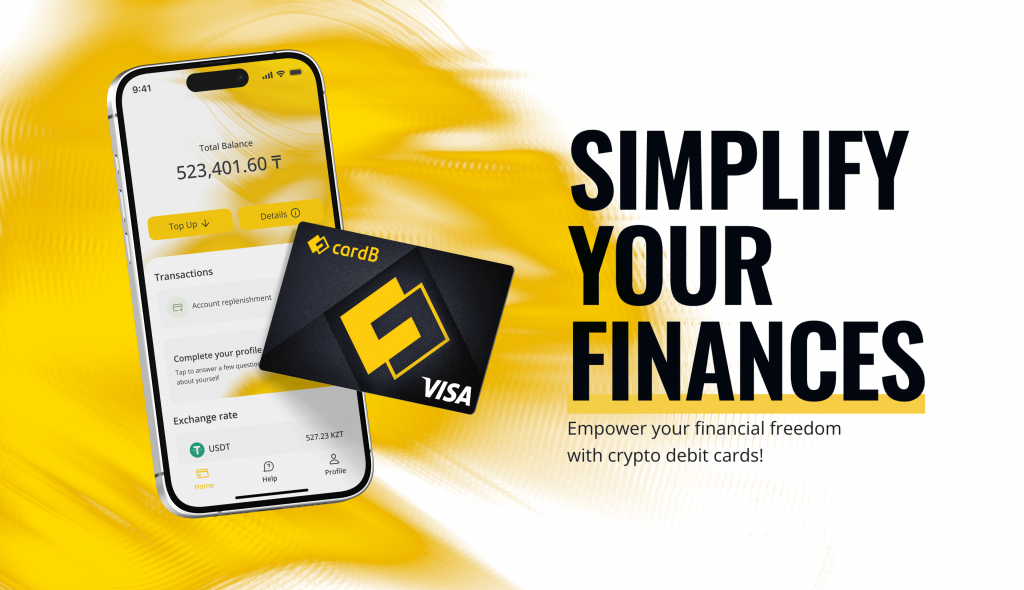
CardB is a forward-thinking fintech company based in the UAE and Kazakhstan, working to redefine how digital assets are used in everyday life. The team wanted a crypto payment app that closed the gap between owning crypto and spending it – not a wallet you had to think about, but a card you could tap at the register.
Cryptocurrency mobile app development at this level of ambition is not just a mobile project. It has to integrate with an exchange for deposits, meet PCI DSS on the card side, comply with KYC and AML rules across two jurisdictions, plug cleanly into every major mobile wallet, and stay easy enough to use that non-crypto users can actually spend with it. CardB reached out to Teamvoy on a recommendation from a previous client, on the strength of a track record in blockchain and fintech.
02. The Challenge
What Has to Ship Before a Crypto Payment App Development Project Wins Investors?
CardB approached Teamvoy with an urgent challenge: a high-quality MVP under a hard deadline, in time for Money20/20 USA and Web Summit in Lisbon. The MVP could not just be functional. It had to perform under live demo conditions at two of the year’s biggest industry events, in front of investors whose interest and funding would determine whether the product moved past MVP at all.
Beyond the immediate deadline, the ambition was longer term: a fully functional, secure mobile app compliant with industry regulations, and a brand that could hold two contradictory ideas at once – the reliability of banking and the innovation of crypto. Striking that balance in naming, visual identity, and product positioning was as much a challenge as the code was.
There was one more challenge worth naming: CardB was evaluating two vendors in parallel, each building a separate MVP. The engagement started as a bake-off, and the winning team would earn the rest of the roadmap.
Why This Approach
Why a Cross-Platform Crypto App on React Native and Ruby on Rails?
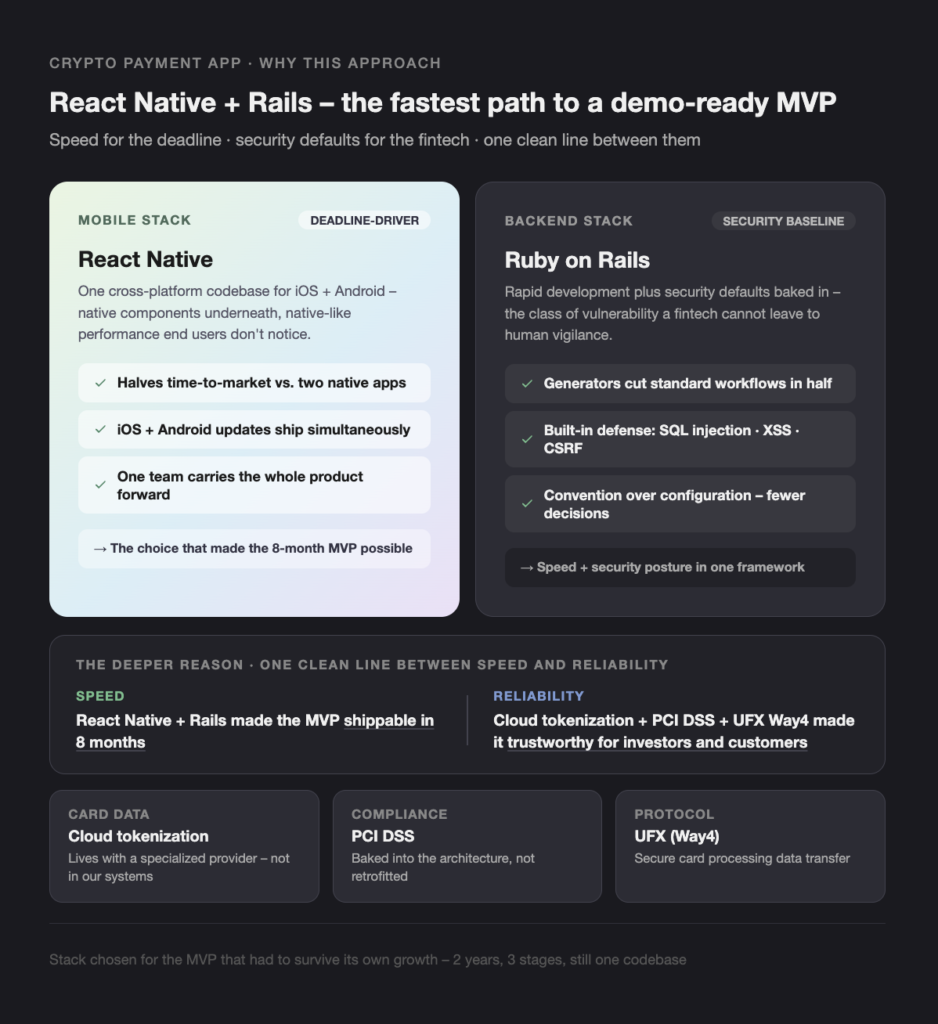
A crypto payment app has to move as fast as its market. That framed every technical choice. React Native for the mobile side, because a single cross-platform codebase halves the time-to-market versus two native apps, ships updates simultaneously to iOS and Android, and gets close enough to native performance that end users don’t notice the difference – exactly the profile CardB needed to hit two industry events on schedule.
Ruby on Rails for the backend, because for a fintech under a hard deadline the calculus is: how fast can we ship, and how many security foundations come baked in? Rails answers both well. Its built-in generators and conventions accelerate development, and its default protections against SQL injection, XSS, and CSRF are exactly the class of vulnerability a crypto payment app cannot afford to leave to human vigilance.
The deeper reason this stack worked is that it drew a clean line between speed and reliability. React Native + Rails made the MVP shippable in eight months. Cloud-based tokenization, PCI DSS compliance, and the UFX (Way4) payment protocol made it trustworthy enough to actually put in front of investors – and, later, in front of paying customers.
03. Solution
How Did Teamvoy Build the CardB Crypto Payment App Across Three Stages?
The engagement began in 2022 and continues today. The product has gone through three distinct stages, each with its own scope, its own deadline, and its own way of proving the product further.
Stage 1: A high-quality MVP for Money20/20 USA and Web Summit. The eight-month MVP delivered a crypto card users could integrate into Apple Wallet and Samsung Wallet, and a pay wallet built for the everyday use case – buying a cup of coffee with crypto, quickly. React Native drove the mobile app; Coinbase handled deposits via wallet addresses. When the two vendors’ MVPs were compared, Teamvoy’s was fully functional; the other was rushed. Teamvoy’s CTO and CPO represented the product alongside CardB’s team at both events, which was decisive in earning the rest of the roadmap.
Stage 2: Full B2B and B2C product, Binance integration, launch at Blockchain Week. With MVP funding secured, CardB moved to a full product with a Binance integration replacing Coinbase, Binance-linked registration and full KYC, expanded deposit paths via ETH and TRX wallet addresses, and a web version alongside the mobile app. Security partners implemented card tokenization, ensured PCI DSS compliance, and ran penetration tests. Teamvoy also led the brand work at this stage – the “Plan B” naming, the visual identity, and the market positioning that ties them together.
Stage 3: From crypto wallet to full payment gateway. CardB made a strategic call to grow beyond a blockchain product into a mature financial company. The product shifted focus from a crypto wallet to a complete payment gateway supporting both crypto and fiat. A Kazakhstan banking license and bank partnerships opened up account creation and card issuance for non-residents; Visa and Mastercard partnerships broadened payment processing; and Teamvoy shipped the supporting product work – AML document upload, in-app KYC, a B2B API for businesses integrating CardB’s payments, immediate top-up via direct wallet address, and in-app transaction history.

Tech Stack
Which Technologies Power the Blockchain Payment App?
- React Native – cross-platform mobile framework, using native components for close-to-native performance across iOS and Android.
- Ruby on Rails – backend framework, chosen for rapid development plus built-in protections against SQL injection, XSS, and CSRF.
- GraphQL – the API layer between mobile, web, and backend services.
- PostgreSQL – relational store for the application data.
- Azure – cloud infrastructure, chosen for ISO 27001:2005 compliance and its posture on data security.
- Blockchain integrations – Coinbase in Stage 1, then Binance from Stage 2 onward; deposits via BTC, ETH, and TRX wallet addresses.
- Cloud-based card tokenization – a specialized third-party payment infrastructure; the app never stores card data locally, only tokens.
- UFX protocol (Way4) – the payment data transfer protocol behind secure card processing.
- Apple Pay, Google Pay, Samsung Pay, Garmin Pay – mobile wallet integrations users tap at the point of sale.
Key Features
Which Features Define This Crypto Card App at Production Scale?
- Crypto card issuance that integrates directly with Apple Wallet, Samsung Wallet, Google Pay, and Garmin Pay.
- Pay wallet for everyday crypto transactions – small, frequent purchases handled with the same tap as a bank card.
- Binance-linked registration with full KYC, plus deposits via ETH and TRX wallet addresses.
- Cross-platform mobile app (React Native) plus a web version for broader reach and simpler simultaneous updates.
- In-app AML document upload and full KYC for regulatory compliance across jurisdictions.
- B2B API for businesses integrating CardB’s crypto payments into their own products.
- Immediate top-up via direct wallet address, plus in-app transaction history.
- Cloud-based card tokenization: card data lives with a specialized payment infrastructure provider, not on the device or in CardB’s own systems.
- PCI DSS compliance, penetration testing, and Azure ISO 27001-compliant infrastructure behind it all.
Key Engineering Decisions
Which Engineering Decisions Made the App Ship on Two Industry-Event Deadlines?
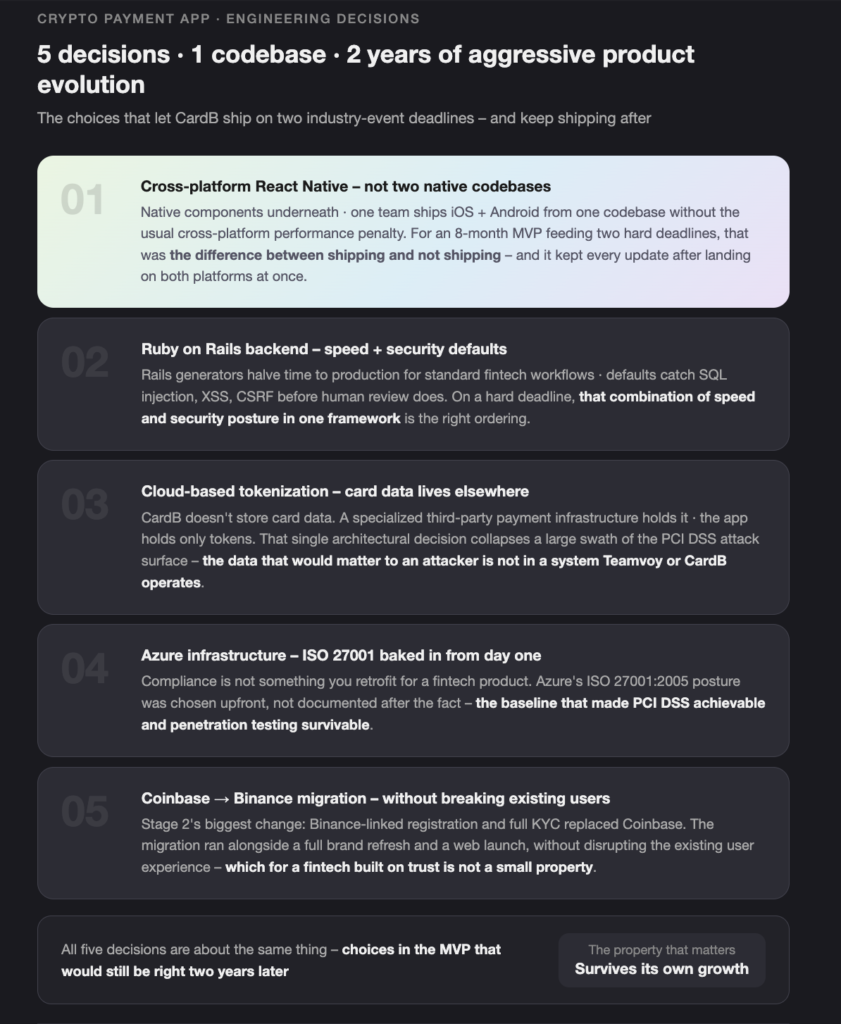
Five decisions shaped how CardB was built, and they are the same ones that let one codebase serve two years of aggressive product evolution.
Cross-platform React Native, not two native codebases. React Native uses native components underneath, which lets one team ship iOS and Android from one codebase without the usual cross-platform performance penalty. For an eight-month MVP feeding two hard deadlines, that was the difference between shipping and not shipping – and it kept every update after that landing on both platforms at once, which for a growth-focused product matters more than the initial time savings.
Ruby on Rails for the backend, for the speed and the security defaults. Rails ships with generators that halve the time to production for a lot of standard fintech workflows, and with defaults that catch SQL injection, XSS, and CSRF before human review does. For a crypto payment app on a hard deadline, that combination of speed and security posture is exactly the right ordering.
Cloud-based card tokenization: card data lives elsewhere, not with us. CardB does not store card data. A specialized third-party payment infrastructure holds it; the app holds only tokens. That single architectural decision collapses a large swath of the PCI DSS attack surface – the data that would matter to an attacker is not in a system that Teamvoy or CardB operates.
Azure infrastructure with ISO 27001 compliance baked in. Compliance is not something you retrofit for a fintech product. Azure’s ISO 27001:2005 posture and its data security management story were reasons it was chosen upfront, not reasons someone documented after the fact. That baseline is what made PCI DSS achievable and penetration testing survivable.
Product evolved from Coinbase to Binance without breaking existing users. Stage 2’s biggest change was the deposit path: Coinbase in Stage 1, then Binance-linked registration and KYC in Stage 2. The migration ran alongside a full brand refresh and a web launch, without disrupting the existing user experience – which for a fintech built on trust is not a small property.
04. Impact
What Impact Did the CardB Crypto Payment App Have on the Business?
Two months after launch, CardB had welcomed over 40,000 users. The strongest marketing campaign the team ran during that window brought in 10,000 new users in just five hours – the kind of curve that only shows up when the product and the moment are lined up. The app has held a 4+ star rating on the App Store since.
Behind the numbers is a product that matured across three stages without a rewrite. The Stage 1 MVP was strong enough to win a bake-off and unlock investor funding. Stage 2 grew it into a full B2B and B2C product with Binance integration, PCI DSS compliance, and a brand identity that could stand in the room with the incumbents. Stage 3 pivoted it from crypto wallet to full payment gateway, with a banking license, Visa and Mastercard partnerships, and B2B API access on top of the same codebase.
Qualitative Results at a Glance
- 40,000+ users welcomed in the first two months of live production.
- One marketing campaign brought in 10,000 new users in five hours – the peak signup rate the product has seen.
- 4+ App Store rating held throughout the growth ramp.
- MVP delivered in time for Money20/20 USA and Web Summit – and functional enough to win the bake-off against a competing vendor.
- Binance integration replaced Coinbase in Stage 2 without disrupting existing users; ETH and TRX deposit paths added alongside.
- PCI DSS compliance, penetration testing, and Azure ISO 27001-compliant infrastructure achieved as part of Stage 2, not retrofitted after the fact.
- Brand identity – from the Plan B naming to the visual system – designed to sit next to banking incumbents while signaling crypto innovation.
The broader payoff is durability. Two years and three stages later, the product is still on the same codebase, still on the same brand system, still meeting the same compliance bar. That is the deliverable a fintech is ultimately measured on.
Lessons Learned
What Should Teams Building a Crypto Payment App Know Before They Start?
A few takeaways generalize beyond this engagement and apply to anyone weighing a crypto payment app as more than a science project.
Cross-platform is the right default for a fintech under deadline. Two native codebases is a defensible choice; it is rarely the right choice for a team trying to hit an industry event with an investor demo. React Native lets one codebase carry the whole product forward, and it keeps every update after the first landing on both platforms at once.
Do not store card data. Cloud-based tokenization removes the largest single risk in a card-linked fintech product. The card data belongs with a specialized payment infrastructure provider, not in your database. That decision does not have to be revisited; the ones you don’t make don’t come back to hurt you.
Compliance is architectural, not procedural. PCI DSS, ISO 27001, KYC, AML – these are properties of the stack you chose and the vendors you integrated with, not documents you produce at the end. For a crypto payment app, they are non-negotiable, and they are cheaper baked in than bolted on.
Brand at the same level as the product. CardB’s Plan B positioning is what let a crypto product stand next to banking incumbents. Teams that treat branding as a Stage 3 activity end up with a product the target audience does not trust visually – which for a fintech is the same as not trusting it at all.
Pick a vendor who shows up. Teamvoy’s CTO and CPO represented the product at Money20/20 and Web Summit alongside the client. That kind of engagement is not universal in outsourced product development, and it is the reason a bake-off turned into a multi-year engagement.

05. Conclusion
Where Should Teams Start with Blockchain Payment App Development?
For CardB, the crypto payment app engagement was less about the individual features and more about building a product that could survive its own growth. The React Native mobile app, the Ruby on Rails backend, the Azure + PCI DSS + tokenization security stack, and the brand system Teamvoy built alongside the code turned an eight-month MVP into a mature financial product on the same foundation – 40,000+ users in two months, Binance integration, banking license, Visa and Mastercard partnerships, and a B2B API layer.
If you are evaluating blockchain payment app development, the most important question is not “which framework or exchange should we integrate first?” – it is “which choices we make in the MVP will still be right two years from now?” The answer is usually the cross-platform stack, the tokenized card architecture, the compliance-first infrastructure, and the brand system that can grow with the product instead of being replaced by it.
Thinking about building a crypto payment app?
Tell us what your first deadline is and what the compliance picture looks like – Teamvoy will help you map the mobile stack, the backend, the tokenization architecture, and the realistic path from MVP to a product your investors and your users will both trust.