DORA Compliance Software Development (EU)
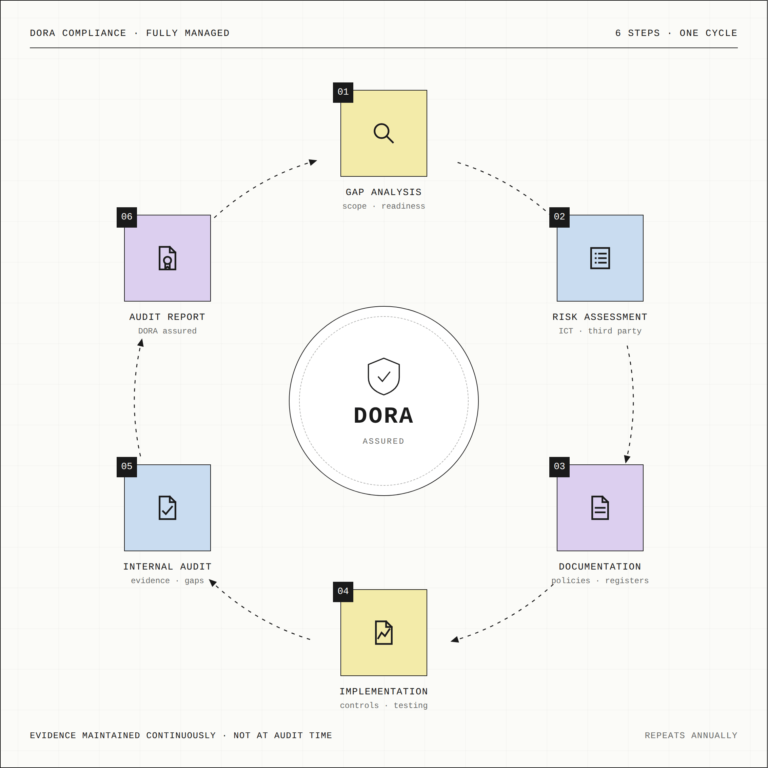
We build the systems that carry a DORA obligation from the first alert to the supervisor submission: incident classification, the register of information, and the function-to-asset map underneath both. They read from the CMDB, GRC platform and procurement records you already run, and write to your national reporting channel. The hard part is not the rule text, it is holding the same facts across all three at the moment a supervisor asks.
Trusted by engineering teams.





Teamvoy has delivered engineering work for Nasdaq, Panasonic, Afriland First Bank, and 50+ other companies since 2013.

Verified B2B client reviews from fintech, insurance, healthcare, and hi-tech engagements.

A B2B review platform that connects businesses with verified software solutions providers.

Transparent platform where current and former employees share company reviews and interview experiences.
DORA Compliance Services We Offer
Six offerings. Each one is scoped, estimated and delivered separately, and most engagements start with a single one of them.
Tell us what you are trying to evidence.
-
Register of Information Platforms
The relational model behind the ESAs reporting templates: entities, contractual arrangements, ICT services, providers, and the functions each one supports, with LEI and EUID resolution on the provider side. We generate the submission from the same records the incident and contract paths already write to, so the annual file is a read of live data rather than a spreadsheet rebuilt before every reference date.
– ITS template mapping
– LEI and EUID resolution
– Contractual arrangement model
– Subcontracting chain capture
– Annual submission validation -
Incident Classification and Reporting
Classification rules written against the RTS criteria, clients affected, data losses, service downtime, geographical spread, economic impact and criticality of services, that re-run as the facts firm up instead of once in the first hours. Every run is kept, so the classification as it stood at any point in the incident can be reproduced rather than recalled.
– Materiality threshold rules
– Awareness timestamp capture
– Initial, intermediate and final reports
– Reclassification and replay
– Recurring incident aggregation -
Critical Function Dependency Mapping
The graph that resolves an affected asset to the critical or important functions it supports, built from the CMDB you already maintain rather than from a fresh inventory exercise. Where the CMDB stops at the application layer, we do the data engineering that closes the gap to the function register, because no configuration of a GRC tool can invent a link that was never recorded.
– Function register modelling
– CMDB and asset reconciliation
– Impact tolerance and RTO mapping
– Provider-to-function linkage
– Concentration risk views -
ICT Third-Party Risk Workflows
Pre-contract due diligence, Article 30 clause coverage, exit plan status and subcontracting chains, held as structured data rather than as a shared folder of signed PDFs. One provider record feeds the register submission and the incident path, so due diligence findings and outage history sit against a single entity instead of in two systems that disagree.
– Article 30 clause coverage
– Due diligence workflow
– Exit plan tracking
– Nth-party chain mapping
– Provider register synchronisation -
Resilience Testing Evidence Systems
The scoping, scheduling and evidence store behind the testing programme, including threat-led penetration testing under TIBER-EU where your supervisor requires it. Findings are tracked against the function they threaten rather than against the team that raised them, which is the view an examiner asks for and the one most trackers cannot produce.
– Test programme scheduling
– TLPT scope documentation
– Finding-to-function tracking
– Remediation deadline monitoring
– Evidence retention and export -
Supervisory Reporting Interfaces
The submission layer for your competent authority: schema validation before the file leaves your network, an incident reference that stays stable across the initial, intermediate and final reports, and a receipt stored beside the payload that produced it. We build against the published ITS schema and version the mapping when the ESAs revise it, rather than against a vendor summary of it.
– ITS schema validation
– National portal integration
– Reference continuity across reports
– Submission receipt archiving
– Schema version migration
DORA Compliance Success Stories
Check out our product and experience design case studies. Learn how we’ve helped businesses like yours launch stunning solutions and succeed in target markets.

AI-Native Engineering for Faster Time-to-Market

Banking App Refactoring & Performance Optimization: 10× Throughput at a Central African Consortium

Next-Gen White-Label Internet Banking: 400,000 Users, MVP in 6 Months
One ICT incident, seven layers
It reads as a single outage. Between the first alert and the supervisor receipt it is seven handovers, and the reporting clock runs across all of them.

01. Signal intake
Events arrive from monitoring, the service desk, payment rails and third-party status feeds, and are normalised into one incident record carrying one identifier. Breaks when the same outage lands as three records from three tools, and the clock starts from whichever one an analyst happens to open first.
02. Function resolution
The affected asset is resolved through the CMDB to the critical or important functions it supports, which is what decides whether the DORA path applies at all. Breaks when the CMDB holds the application but not its function link, so the incident is triaged as an ordinary IT ticket and never enters classification.
03. Classification against the RTS criteria
Clients affected, data losses, downtime, geographical spread, economic impact and criticality of services are measured against the materiality thresholds as the numbers firm up. Breaks when classification runs once on partial figures and is never re-run, so an incident that crosses the threshold six hours in is still on file as non-major.
04. Clock start and notification assembly
The moment of awareness is recorded as its own attested field with the evidence that set it, and the initial notification is assembled against the ITS fields. Breaks when awareness is inferred from the ticket creation time, which nobody can defend to a supervisor a year later.
06. Evidence write-back
Every state change and the data behind it is appended to an immutable record, and the incident is written back to the GRC platform and the originating ticket.
Breaks when evidence is a folder of screenshots, so the classification inputs as they stood in hour four cannot be reconstructed after the fields were overwritten overnight.
07. Feedback into the register and the test plan
Root cause is tied to the provider and the contractual arrangement in the register of information, and the scenario is added to the resilience testing plan.
Breaks when the register is a separate annual exercise, so the provider that caused the outage still submits as low criticality at the next reference date.

Could you reproduce today
what you knew at hour four?
Why choose Teamvoy for DORA compliance software?
Four things that are true of how we work on supervised builds, two of which cost us something.

The engineers who scope the work build the work.
No handover from a pre-sales team to a delivery team. The person who tells you what the work will cost is the person who then has to make that estimate true. Costs us: we cannot start faster than we can staff, so we turn down work that needs a squad this month.
You own the source code from the first commit.
The repository is yours, in your organisation, from day one. Not transferred at the end, not held until the final invoice clears. Costs us: we give up the lock-in that comes from holding a repository, so we have to be re-chosen every quarter.
Every classification decision can be reproduced from the data as it stood at the time.
Rules, inputs and outputs are appended on each run, so a decision taken in hour four survives the same fields being overwritten overnight. When a supervisor or an internal auditor asks why an incident was not escalated to major, the answer is a replay rather than a recollection.
We build the system that executes your compliance decision. We do not make the decision.
Scope, materiality thresholds and legal position stay with your compliance function and your counsel. We turn what they decide into rules that run, log and can be re-run, and we write that boundary into the statement of work rather than absorbing an interpretation nobody has signed for.
Three ways to start
Three ways to start working with Teamvoy on outcome-based AI. No long discovery. No sales process. No forms to fill. Every engagement starts with a real technical conversation, and every engagement is priced to a result. We move as fast as the situation needs.
DORA Readiness Review
Two engineers trace one critical or important function from asset to submitted report and mark every point where the data does not yet exist. You keep the function map, the field-level register gap list and the incident clock trace whether or not we build anything afterwards.
One Function, Wired
A single critical or important function goes through the whole path in your environment: dependency map, classification rules, evidence store and a submission file validated against the test channel. It runs on your infrastructure and in your repository, and the second function costs less than the first.
Call a CTO
Fifteen minutes with the engineer who would scope the work. Bring the function you would least like to be asked to evidence tomorrow, and you get an answer on what closing it takes, including the answer that you do not need us.
What changes when the register is generated instead of assembled.
These rows are the questions worth putting to any vendor quoting DORA work, including us.
What our DORA compliance engineers work in.
Services and APIs


Data and regulatory reporting


Durability and evidence


Cloud and deployment


Systems we integrate with
Control frameworks we map to


We engineer for:
Start with the function you cannot evidence.
Talk to a Chief Technology Officer on the first call.