Fintech Product Design & Development
We design and build the parts of a fintech product where money changes hands: onboarding, identity checks, funding, payments and every state in between. Products rarely lose people on the happy path. They lose them in the states nobody drew, which is why we draw those first.
Trusted by engineering teams.











Teamvoy has delivered engineering work for Nasdaq, Panasonic, Afriland First Bank, and 50+ other companies since 2013.

Verified B2B client reviews from fintech, insurance, healthcare, and hi-tech engagements.

A B2B review platform that connects businesses with verified software solutions providers.

Transparent platform where current and former employees share company reviews and interview experiences.
Fintech Product Design & Development Services We Offer
Six offerings, each scoped separately and each shipped against your own rails, partners and customers rather than a prototype.
Product Discovery and Flow Design
We map the path from first open to first funded transaction, then write down every state it can be in, including refer, pending, partially funded and reversed. That state list is the deliverable that survives into the build, because it is what engineers implement and what support reads at three in the morning.
Onboarding and KYC Experience
We design and build account opening against your provider: document capture, liveness, screening outcomes and manual review. Refer and pending get their own screens and their own data model, so a customer waiting on a check can be moved forward by an agent instead of starting again.
Mobile and Web Application Build
Native and React Native mobile alongside the web application, with offline states, background refresh and step-up authentication built into the first release rather than retrofitted. Session and device handling is written against your SCA obligations instead of around them.
Payments and Money Movement
We build the money path against your rails and partner: initiation, limits, fraud step-up, submission and the status the customer actually sees. Webhook handling is ordered and idempotent, so a duplicated or late callback cannot move a settled payment back to pending.
Design System and Accessibility
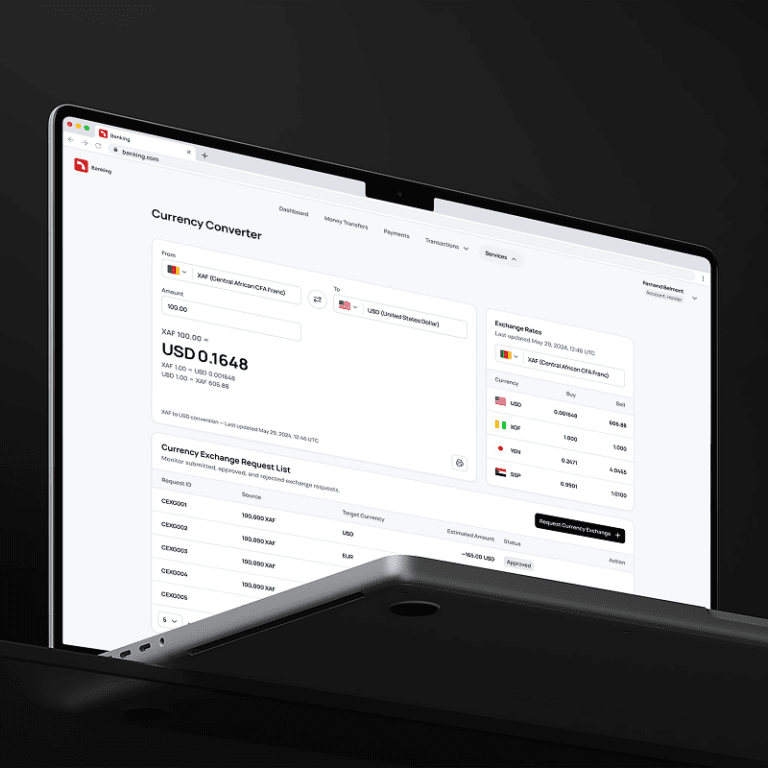
One component library shared by design and code, carrying the money components generic kits do not have: amount entry, currency switching, transaction states, mandate and consent screens. Accessibility is tested on device with a screen reader against WCAG 2.2 AA, not by a plugin score.
Analytics, Experimentation and Support Tooling
Event schemas, funnels and experiment infrastructure go in with the feature rather than after it, and the agent console is treated as a product with its own design. Support sees the event sequence behind the customer screen, which is what turns a complaint into a short answer.
Fintech Product Success Stories
Check out our product and experience design case studies. Learn how we’ve helped businesses like yours launch stunning solutions and succeed in target markets.



One new customer, seven layers
On the roadmap it is one sign-up. Underneath it is seven handovers between your app, your partners and your ledger, and each one has states the happy path never shows.
Seven layers:
Breaks when onboarding is resumable in the design but not in the data, so someone who closes the app at step four comes back to step one and does not come back again.
Breaks when a check returns refer rather than pass or fail and the flow has no state for it, so a real customer sits in limbo and no agent has a screen to move them from.
Breaks when the partner call succeeds, the local write fails, and the retry carries no idempotency key, so the customer ends up with two accounts and one of them holds money.
Breaks when the balance is served from a local cache after card authorisation but before settlement, so a customer spends against funds that later fail to settle.
Breaks when the step-up fires after the interface has already shown success, so the customer reads confirmation and then a hold, and support hears about it first.
Breaks when callbacks arrive out of order and a stale earlier state overwrites the terminal one, so a settled payment reverts to pending on the customer screen.
Breaks when the console shows current state but not the sequence of events, so nobody can tell the customer why the payment failed rather than that it failed.
Why choose Teamvoy for fintech product design and development?
Four commitments, each with the thing it costs us to hold to it. In a regulated product the trade-offs a team accepts matter more than the screens in its portfolio.
The engineers who scope the work build the work.
No handover from a pre-sales team to a delivery team. The person who tells you what the work will cost is the person who then has to make that estimate true.
Costs us: we cannot start faster than we can staff, so we turn down work that needs a squad this month.
You own the source code from the first commit.
The repository is yours, in your organisation, from day one. Not transferred at the end, not held until the final invoice clears.
Costs us: we give up the lock-in that comes from holding a repository, so we have to be re-chosen every quarter.
We design the failure states before the happy path.
Refer, pending, partially funded, reversed, stepped up, timed out. Each one gets a screen, a copy deck and a place in the data model, because those are the states your support queue is actually made of.
Costs us: the first design review is a list of edge cases rather than a hero screen, and we lose pitches to prettier decks.
Compliance sits in the design review, not at the end of it.
Your compliance lead sees flows while they are still cheap to change, and the constraint is recorded next to the screen it shaped rather than in a separate document nobody opens.
Costs us: design cycles run slower, and we sometimes redraw a flow we have already shown you and were pleased with.
Three ways to start
Pick the one that matches how much you already know about where your product loses people.
Onboarding and flow audit
We walk your live flow as a customer would, annotate every drop-off point and list the states the product does not currently handle, with the analytics to show which ones cost you most. You keep the map whether or not we build anything.
One flow designed, built and instrumented
One flow, usually onboarding or first payment, taken from state map to a release in your environment with the events, the failure screens and the agent view that go with it. Built so your team can carry the next flow themselves.
A call with the designer and engineer who would scope it
Bring the flow you worry about, the partners behind it and the step where people stop. You get an honest read on what is a design problem and what is a data problem, and no follow-up sequence.
The rows that decide a fintech build are the ones nobody puts in the demo.
Take this table into your next agency call and ask for their answer in the middle column.

Do you know where your onboarding
actually loses people?
We engineer for:
What our fintech product designers and engineers work in.
Design and research
Mobile and web


Services and data


Fintech systems we integrate with
Analytics and experimentation
Run, evidence and controls


Find out where your product actually loses people.
Talk to a Chief Technology Officer on the first call.