AI Fraud Detection Software Development
We build the scoring path that runs inside your authorization window: features computed at decision time, the model, the rules around it and the case queue behind it. It scores live traffic in shadow, beside your current decisions, until your analysts agree with what it would have done. The hard part is not the model. It is the label, which arrives weeks after the transaction and only for the payments you approved.
Trusted by engineering teams.











Teamvoy has delivered engineering work for Nasdaq, Panasonic, Afriland First Bank, and 50+ other companies since 2013.

Verified B2B client reviews from fintech, insurance, healthcare, and hi-tech engagements.

A B2B review platform that connects businesses with verified software solutions providers.

Transparent platform where current and former employees share company reviews and interview experiences.
AI Fraud Detection Services We Offer
Six engagements, scoped and estimated separately. You can buy the first one and stop there.

Fraud Model Development
Scoring models for card, payment and account fraud, trained on your own decision history rather than a vendor sample. Features are built from the state of the record as it was at decision time, not as it looks now, which is the difference between a model that reads well offline and one that holds in production.
– Card and payment fraud scoring
– Account takeover and session models
– Graph features for linked accounts
– Point-in-time feature construction
– Champion and challenger evaluation
Real-Time Feature and Scoring Infrastructure
The path from event to score inside the authorization timeout. Velocity and aggregate features are maintained on the stream so they are correct at the moment of the decision rather than as of last night, and the timeout fallback emits an explicit score instead of a silent approval nobody can see on a dashboard.
– Streaming aggregates and velocity features
– Feature store and point-in-time joins
– Low-latency inference services
– Timeout and fallback policy
– Score logging and event replay
Rules, Policy and Thresholds
The layer where mandated rules, blocklists and risk appetite meet the model output. Every decision records which component produced it, so a decline can be explained a year later without reconstructing what the system looked like that day.
– Rule and model arbitration
– Operating point and threshold tuning
– Blocklist and allowlist management
– Decision logging and audit trail
– Reason codes on declines
Case Management and Analyst Tooling
The queue your analysts work and the tooling around it. Dispositions are captured as structured labels rather than free text, because the review queue is the only place in the system where new training data is created.
– Alert triage and queue design
– Structured disposition capture
– Case summaries and evidence assembly
– Analyst throughput instrumentation
– Integration with your case system
Monitoring, Labels and Retraining
Drift on feature distributions, performance at the operating point, and a retraining path that accounts for labels arriving weeks after the decision. A small randomly approved holdout is built in from the start, because otherwise the model is only ever measured on traffic it selected itself.
– Feature drift and data quality checks
– Delayed label handling
– Random-approve holdout design
– Challenger rollout and promotion
– Alerting on score distribution shifts
Model Risk and Regulatory Evidence
The documentation a validation function or a supervisor asks for: what the model does, on what data, with what monitoring, and who is allowed to override it. Written in the repository as the model is built rather than assembled in the weeks before an inspection.
– Model documentation and lineage
– Validation and challenge packs
– Human review and override paths
– Outcome testing across customer groups
– Retention of decision records
AI Fraud Detection Success Stories
Check out our product and experience design case studies. Learn how we’ve helped businesses like yours launch stunning solutions and succeed in target markets.

Eliminating the 90% Noise: How Teamvoy Re-Engineered Trade Surveillance Software for a Global Exchange

High-Performance Web Platform for Scalable Trade Surveillance
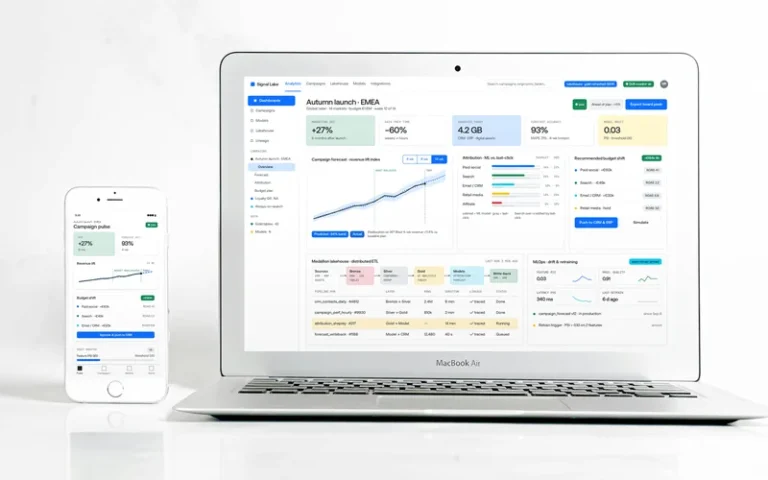
Real Time AI Marketing Analytics: +27% ROI for a Global Retail Analytics Company
One authorization decision, seven layers
It looks like one score returned in a few hundred milliseconds. It is seven handovers, and the last one happens weeks later.
01. Event capture and enrichment
The authorization message arrives with device, session and merchant signals attached, some of them fetched from third parties. Breaks when an enrichment call sits on the synchronous path and the vendor slows down. The system fails open and approves everything for the duration, and because the fallback path emits no score, nothing on the dashboard moves while it happens.
02. Feature computation at decision time
Velocity counters, historical aggregates and graph features are assembled for this customer and this merchant. Breaks when training reads a row as it looks today and serving reads it as it looked at the moment of the decision. The offline numbers are strong, the production numbers are not, and the gap is invisible until the model is live.
03. Model inference
The feature vector is scored and a probability comes back inside the budget the processor allows. Breaks when the model is retrained on data whose fraud labels have not arrived yet. Chargebacks and confirmed fraud land weeks after the transaction, so the most recent months look clean and the model learns that recent behaviour is safe.
04. Rules, policy and arbitration
Mandated rules, blocklists and risk appetite are applied around the score, and one of them wins. Breaks when a rule and the model disagree and nothing records which produced the outcome. Months later a complaint or a regulator asks why this customer was declined, and the answer has to be reconstructed from what the system looked like that day.
05. Decision and action
Approve, step up, hold or decline, returned before the authorization window closes. Breaks when the step-up path has a different outcome profile from the decline path. An abandoned challenge is counted as neither fraud nor good, so it leaves the denominator and every rate the team reports improves without anything changing.
06. Case creation and analyst review
Held and flagged events become cases, an analyst works the queue and each case is closed with a reason. Breaks when dispositions are captured as free text. The queue produces work and no training data, and six months of analyst judgement cannot be joined back to the events that created it.
07. Label capture, feedback and retraining
Chargebacks, disputes and confirmed fraud arrive, labels are joined to decisions, and the next model is trained and evaluated. Breaks when outcomes exist only for what was approved. Declined transactions have no label, so each retrained model is measured on a population its predecessor selected, and confidence grows in a loop with nothing outside it. A small randomly approved holdout is the only thing that breaks the loop.

Do you know what share of your declines
were actually fraud?
Three ways to start.
Each one ends in something you keep. None of them obliges you to buy the next.
Decision Data Review
We replay a sample of your past decisions against your own label history and write up what we find: where features carry information that did not exist at decision time, how late your labels arrive, how much of your declined population has no outcome at all, and where your operating point actually sits. Yours whether or not we build anything.
One Scoring Path in Shadow
One fraud type scored on live traffic in your environment, running beside your current decisions and changing nothing for customers. You get the disagreement log, the operating point curve, and your analysts verdict on the cases the model would have caught and the ones it would have missed.
Technical Call
Fifteen minutes with an engineer who has run a scoring path inside an authorization window. Bring your label lag and the ratio of good declines to caught fraud, if you have it. No deck, no discovery workshop, no follow-up sequence.
Two fraud detection proposals can promise the same lift and measure it on completely different data.
What our fraud detection engineers work in.
Models and training

Real-time features and scoring


Data and pipelines


Monitoring and evaluation


What we integrate with
Platform and controls


We engineer for:
Tell us what your declines actually cost you.
Talk to a Chief Technology Officer on the first call.