AI Portrait Generator: 70% Annotation Cost Cut, Deployment from Days to Hours
A scalable synthetic data and generative AI infrastructure for an AI-generated headshots platform. Stable Diffusion at the core, containerized CI/CD around it, enterprise OCR and compliance integrated end-to-end. Wondering what it takes to build a production-grade AI portrait generator that doesn't bleed cash on annotation?
Executive Summary
How Did a Generative AI Company Build an AI Portrait Generator That Scales Without Manual Annotation?
A company in the AI-generated professional headshots space (the same category as instaheadshots) set out to build an AI portrait generator that could ship new models on fast iteration cycles without ballooning data costs. The hard parts were the obvious ones: high data annotation costs, a shortage of labeled datasets, long deployment cycles that slowed every experiment, enterprise-level performance demands on image generation, and the need to integrate cleanly with existing OCR and compliance systems.
This case study walks through how Teamvoy built the platform end-to-end, a synthetic data engine on Stable Diffusion that turns out realistic AI generated faces at scale, an end-to-end MLOps pipeline for training, validation, and monitoring across environments, containerized CI/CD that closes the gap between code and production, and improved enterprise OCR for document digitization and compliance. The result: 70% less spent on data annotation, and a model deployment cycle that moved from days to a few hours.
01. About The Client
Who Is the Client, and What Does It Take to Run a Modern AI Avatar Generator at Production Scale?
The client is a company building a platform for AI-generated professional headshots, in the same product category as instaheadshots.com. The proposition for end users is simple: upload a few reference photos, get a set of polished, realistic AI generated faces back, a way to create an AI avatar for LinkedIn, marketing, or anywhere else a clean headshot is needed without a studio session. The challenge for the team behind it is anything but simple. To run a competitive AI avatar generator at production scale, three things had to move in lockstep: data, deployment, and infrastructure. Data annotation is the dominant cost of training image models, deployment cycle length is the dominant constraint on innovation pace, and a real generative AI infrastructure is what lets a small team operate like a large one. Teamvoy was hired to put all three under the platform.
02. The Challenge
What Has to Be Solved Before an AI Portrait Generator Is Production-Ready?
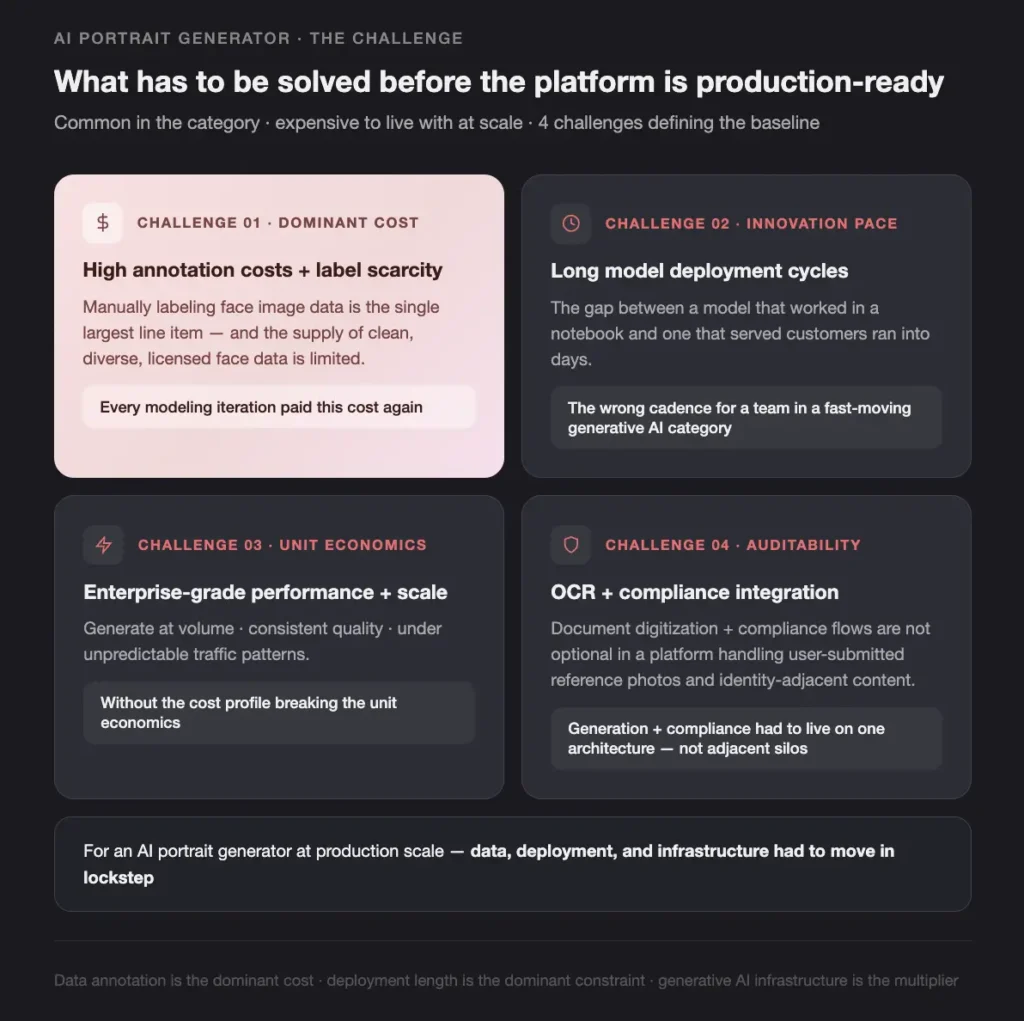
Four challenges defined the baseline – each one common in the category, each one expensive to live with at scale.
High costs for data annotation and a lack of labeled datasets. Manually labeling face image data is the single largest line item in training a portrait generator, and the supply of clean, diverse, licensed face data is limited. Every modeling iteration paid this cost again.
Long model deployment cycles that hindered innovation. The gap between a model that worked in a notebook and one that served customers ran into days, which is the wrong cadence for a product team trying to keep up with a fast-moving generative AI category.
Enterprise-level performance and scalability for large image generation. The platform needed to generate at volume, with consistent quality, under unpredictable traffic patterns, without the cost profile breaking the unit economics.
Integration with existing OCR and compliance systems. Document digitization and compliance flows are not optional in a platform that handles user-submitted reference photos and identity-adjacent content. The generative side and the compliance side had to live on the same architecture, not in adjacent silos.
Why This Approach
Why Synthetic Data, Stable Diffusion, and a Real Generative AI Infrastructure?
A generative AI infrastructure is the combination of model training, inference, data pipelines, deployment automation, and monitoring that lets a team ship and operate generative models at production scale. For an AI portrait generator, the category-specific bottleneck is data: annotation costs grow faster than dataset diversity, and the model quality plateau follows the dataset, not the architecture.
Synthetic data generation with Stable Diffusion was the right fit for two concrete reasons. It expanded dataset diversity without adding a single human labeling hour, and it turned data scarcity from a hiring problem into a compute problem, which is the form of the problem product teams can actually solve. Stable Diffusion’s open-weight, customizable nature also let the team fine-tune the generator against the specific distribution of realistic AI generated faces the product needed, rather than depending on whatever a closed API happened to return.
The deeper reason this worked is that it drew a clean line between data, models, and infrastructure. Synthetic data made the dataset tractable. MLOps made the model lifecycle predictable. Containerized CI/CD made deployment routine. Each layer could be improved without breaking the ones around it, which is what makes a generative AI infrastructure operationally sound instead of demo-grade.
03. Solution
How Did Teamvoy Build the AI Portrait Generator and Its MLOps Backbone?
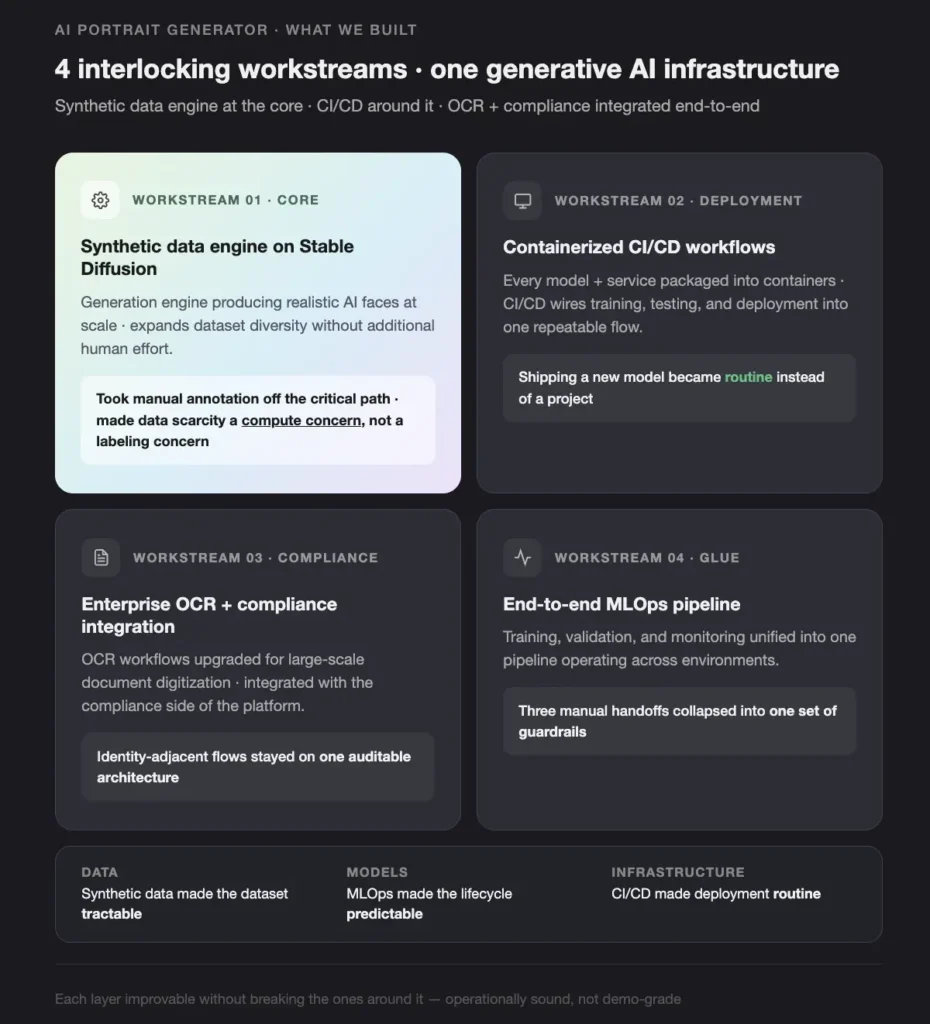
The engagement delivered four interlocking workstreams: a synthetic data generation platform, containerized CI/CD, enterprise OCR for document digitization and compliance, and an end-to-end MLOps pipeline that ties them together.
- Synthetic data generation platform on Stable Diffusion. Teamvoy built a generation engine that produces realistic AI generated faces at scale, designed to expand dataset diversity without additional human effort. The platform took manual annotation off the critical path for new model versions and made data scarcity a compute concern instead of a labeling concern.
- Containerized CI/CD workflows. Every model and service was packaged into containers, with CI/CD pipelines wiring training, testing, and deployment into a single repeatable flow. Shipping a new model became routine instead of a project.
- Improved enterprise OCR for document digitization and compliance. OCR workflows were upgraded to handle large-scale document digitization, and integrated with the compliance side of the platform so that identity-adjacent flows stayed on a single, auditable architecture.
- End-to-end MLOps pipeline. Training, validation, and monitoring were unified into one pipeline operating across environments. New experiments now run, validate, and monitor themselves under one set of guardrails, instead of being three separate manual handoffs between data scientists and engineers.
Tech Stack
Which Technologies Power the Generative AI Infrastructure?
- Stable Diffusion: the open-weight diffusion model at the core of the synthetic data generation engine and the realistic AI generated faces the platform produces.
- End-to-end MLOps pipeline: for model training, validation, and monitoring across environments under one set of guardrails.
- Containerized CI/CD workflows: packaging every model and service into containers, with training-to-deploy automated through CI/CD.
- Enterprise OCR layer: upgraded for large-scale document digitization and integrated into the platform’s compliance flows.
Key Features
Which Features Define a Best-in-Class AI Avatar Generator at Production Scale?
- Stable Diffusion-powered synthetic data engine, expands dataset diversity without manual labeling, turning data scarcity from a hiring problem into a compute problem.
- Realistic AI generated faces produced at enterprise-grade scale, with consistent quality under unpredictable traffic.
- End-to-end MLOps pipeline covering training, validation, and monitoring across environments under one set of guardrails.
- Containerized CI/CD workflows that turn shipping a new model into a routine release instead of a manual project.
- Enterprise OCR integrated into the platform’s compliance flows, document digitization and identity-adjacent processes on one architecture.
- Operational posture sized to let users create an AI avatar without service-quality dips even under traffic spikes.
Key Engineering Decisions
Which Engineering Decisions Made the Platform Reliable Under Production Load?
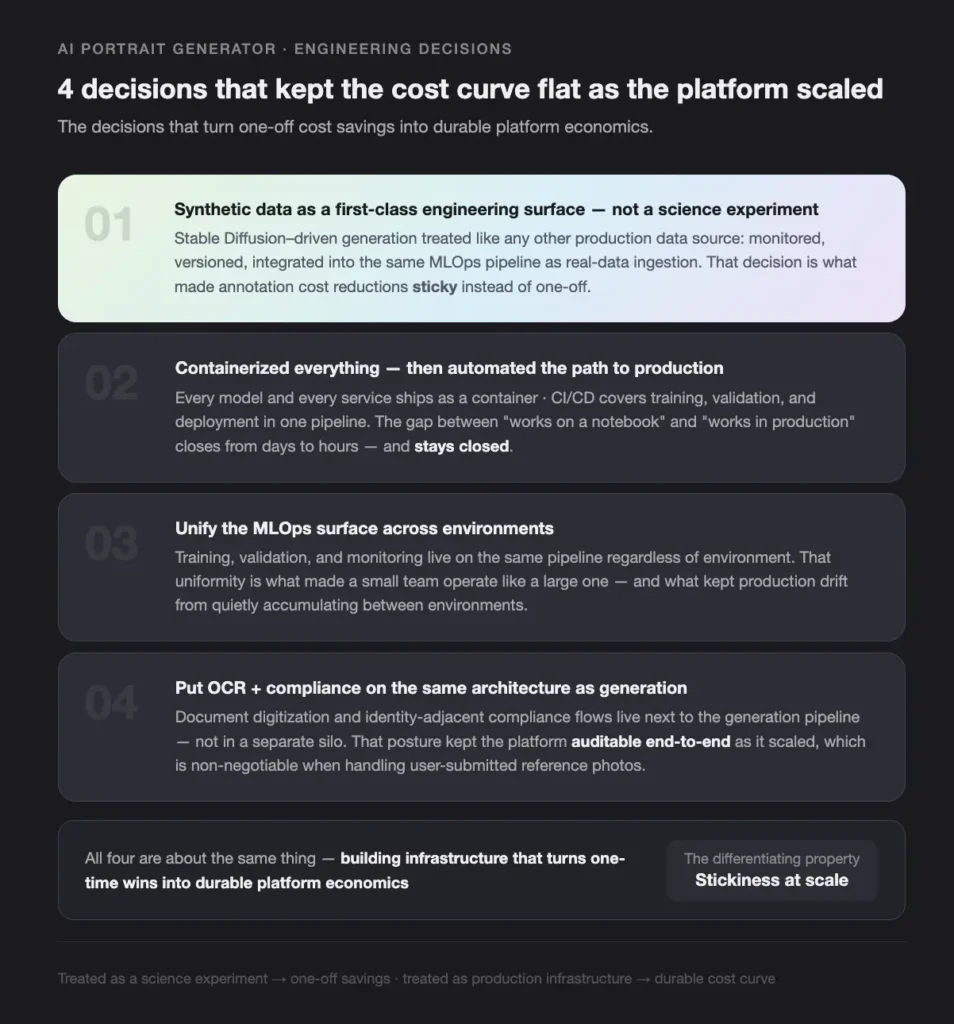
Four decisions shaped how the AI portrait generator behaves under real production load, and they are the same ones that keep the cost curve flat as the platform scales.
- Synthetic data as a first-class engineering surface, not a science experiment. Stable Diffusion-driven generation was treated like any other production data source: monitored, versioned, and integrated into the same MLOps pipeline that handles real-data ingestion. That decision is what made annotation cost reductions sticky instead of one-off.
- Containerized everything, then automated the path to production. Every model and every service ships as a container, with CI/CD covering training, validation, and deployment in one pipeline. The gap between “works on a notebook” and “works in production” closes from days to hours, and stays closed.
- Unify the MLOps surface across environments. Training, validation, and monitoring live on the same pipeline regardless of environment. That uniformity is what made a small team operate like a large one, and is what kept production drift from quietly accumulating between environments.
- Put OCR and compliance on the same architecture as generation. Document digitization and identity-adjacent compliance flows live next to the generation pipeline, not in a separate silo. That posture kept the platform auditable end-to-end as it scaled, which is non-negotiable for any AI portrait generator handling user-submitted reference photos.
04. Impact
What Impact Did the AI Portrait Generator Platform Have on the Business?
The platform’s measured impact moved the two numbers the company cared about most. By integrating a synthetic data generation engine powered by Stable Diffusion, the client eliminated most manual labeling tasks, reducing annotation costs by up to 70% and expanding dataset diversity without additional human effort. Containerized CI/CD workflows and automated MLOps pipelines shortened the model deployment cycle from days to just a few hours – roughly a 30% gain in overall deployment speed, accelerating experimentation and innovation across the product team.
Qualitative Results at a Glance
- Annotation costs cut by up to 70% – synthetic data generation eliminated most manual labeling tasks.
- Dataset diversity expanded without adding a single human labeling hour, by leaning on Stable Diffusion-generated samples.
- Model deployment cycle shortened from days to a few hours, roughly +30% faster deployment overall.
- End-to-end MLOps pipeline unified training, validation, and monitoring across environments under one set of guardrails.
- Enterprise OCR upgraded and integrated into compliance flows, document digitization and identity-adjacent processes now live on one architecture.
- Experimentation and innovation cadence across the product team accelerated meaningfully, shipping new models became routine, not a project.
The broader payoff is operational: the constraint on the platform’s modeling cadence used to be annotation budget and deployment friction. With both removed, the team’s bottleneck moved upstream. to product judgment and creative direction, which is the right place for the constraint to live in an AI portrait generator competing in a fast-moving category.
Lessons Learned
What Should Teams Building an AI Portrait Generator Know Before Going to Production?
A few takeaways generalize beyond this engagement and apply to anyone building an AI portrait generator, an AI avatar generator, or any production-grade generative imaging platform. Synthetic data is the answer to annotation cost – if you treat it like production data. Stable Diffusion-generated samples can replace most of the manual labeling work in a face image platform, but only if the synthetic pipeline is engineered, versioned, and monitored like any other data source. Treated as a science experiment, it produces a one-off cost saving. Treated as production infrastructure, it produces a durable cost curve.
Deployment speed is a feature of the platform, not of the model. Containerized CI/CD and a unified MLOps pipeline is what shortens the days-to-hours gap. The model architecture is rarely what determines how fast you can iterate; the infrastructure around it is. Compliance is part of the architecture, not a bolt-on. For an AI portrait generator handling user-submitted reference photos and identity-adjacent flows, OCR and compliance need to sit on the same architecture as the generation pipeline. Separate silos accumulate audit risk faster than separate teams can pay it down.
A real generative AI infrastructure is what lets a small team operate like a large one. The platform’s MLOps, CI/CD, and data pipelines are not nice-to-haves in this category, they are the actual product moat behind the user-facing experience.
05. Conclusion
Where Should Teams Building an AI Avatar Generator Start?
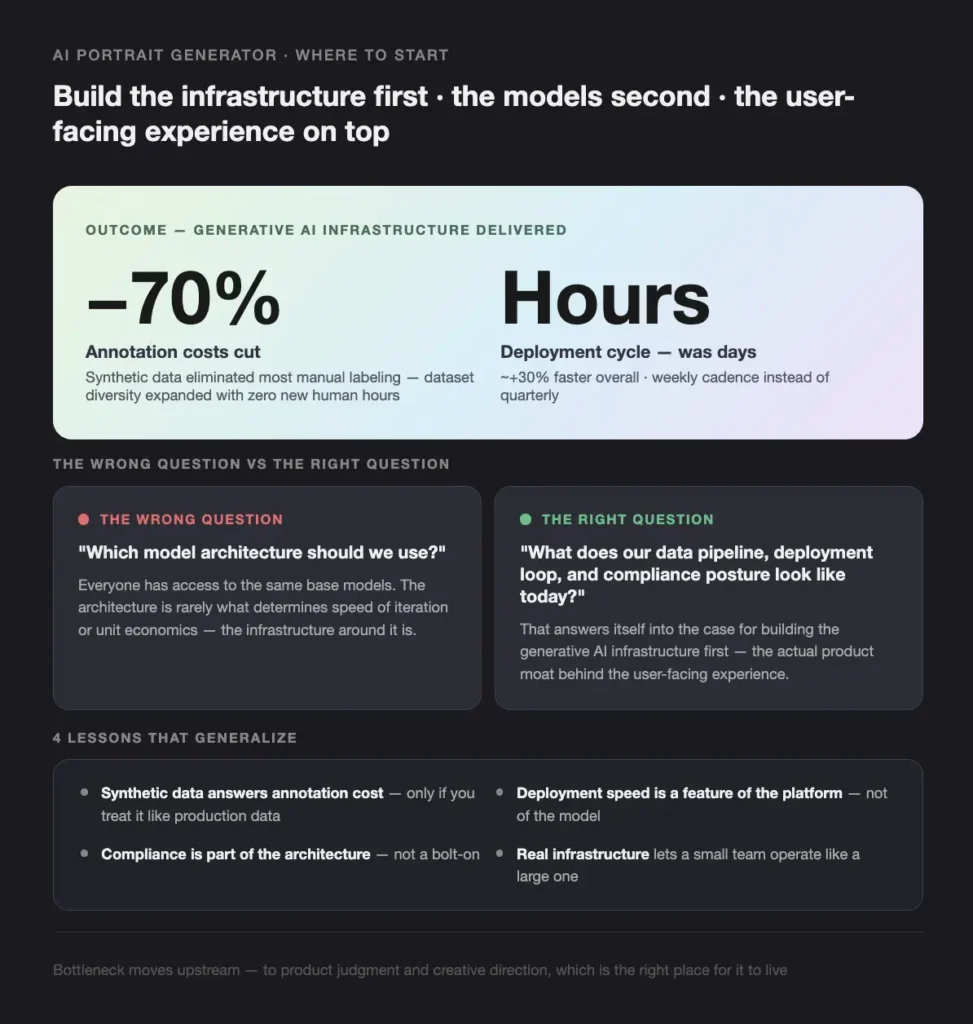
For this company, the AI portrait generator engagement was less about adopting a model and more about putting a real platform underneath the product. The Stable Diffusion-powered synthetic data engine, the end-to-end MLOps pipeline, the containerized CI/CD workflows, and the integrated OCR and compliance layer turned a category bottleneck into an operational advantage – 70% less spent on annotation, deployment cycles down from days to hours, and a team that ships new models on weekly cadence instead of quarterly.
If you are evaluating what it takes to build the best AI avatar generator in a category where everyone has access to the same base models, the most important question is not “which model architecture should we use?” – it is “what does our data pipeline, our deployment loop, and our compliance posture look like today?” The answer is usually the case for building the generative AI infrastructure first, the models second, and the user-facing experience on top of both.
Thinking about building or scaling an AI portrait generator?
Tell us what your synthetic data pipeline and MLOps look like today. Teamvoy will help you map the Stable Diffusion engine, the deployment loop, the OCR and compliance integration, and the realistic path from prototype to a platform that lets your users create an AI avatar at production scale.