Conversational AI for Retail: Automating B2B Customer Research with n8n and Qwen
A large US retailer needed to understand what drives its business customers' purchasing decisions, and a way to read hundreds of open-ended replies before the findings went stale. Teamvoy built an n8n orchestrator with Qwen running locally through Ollama, live in one month. Wondering how B2B research could move from brief to report without an engineer in the loop?
01. Summary
Teamvoy built a conversational AI for retail solution that helps a large US retailer collect and analyze feedback from business customers. The system creates questionnaires from campaign briefs, conducts follow-up conversations through messaging platforms, and generates reports with recurring themes, sentiment analysis, and supporting customer quotes. An n8n AI agent orchestrator manages the workflow. Qwen, deployed locally through Ollama, conducts conversations and analyzes responses. All model inference runs within the retailer’s environment, without sending customer conversations to an external model API.
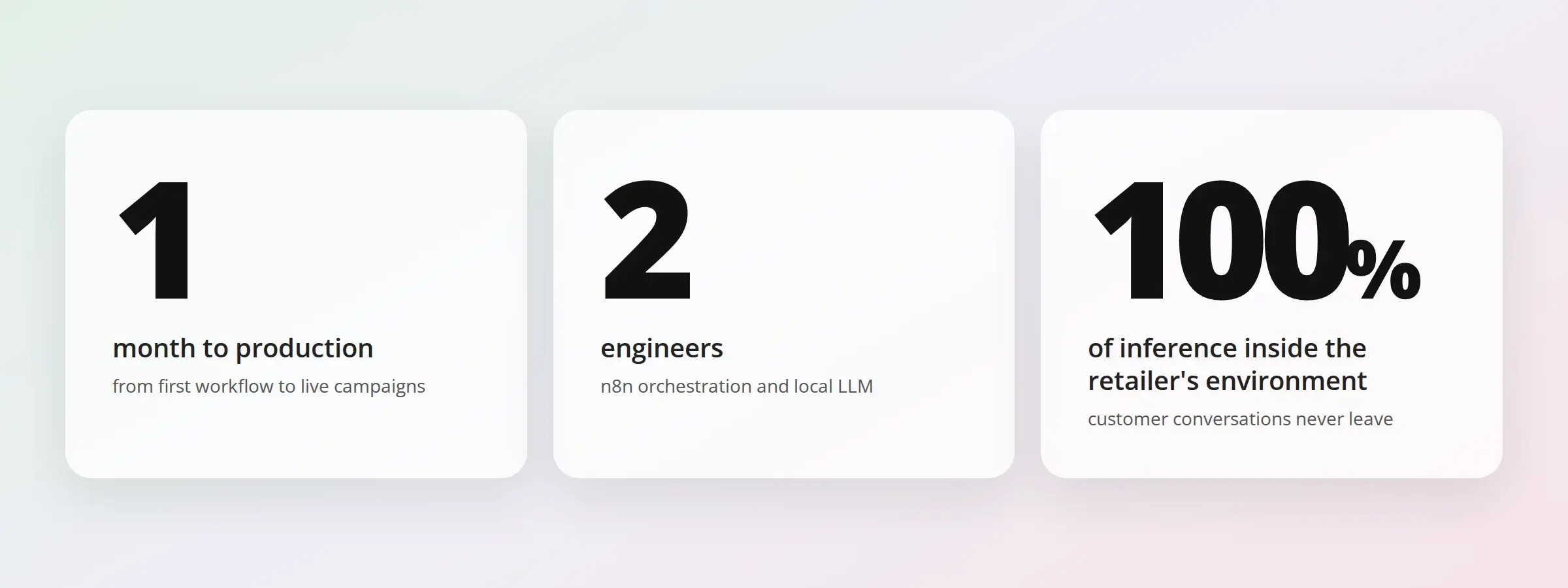
— 1 month to production, 2 engineers, 100% of inference inside the retailer’s environment.
Two engineers delivered the system to production in one month, completing five iterations of the conversation design.
| PROJECT DETAIL | DESCRIPTION |
| Client | A large US retailer |
| Industry | Retail |
| Status | Live in production |
| Channel | Messenger integrations |
| Technology | n8n, Qwen, Ollama |
| Team and timeline | 2 engineers, 1 month |
Example: understanding B2B purchasing decisions through follow-up questions
| EXAMPLE BUSINESS CUSTOMER RESPONSE | RELEVANT FOLLOW-UP QUESTION | INFORMATION CAPTURED FOR ANALYSIS |
| “We moved part of our purchasing to another supplier.” | “What influenced that decision?” | Supplier selection criteria and reasons for switching |
| “Availability has been inconsistent.” | “Which products are most affected, and how does that influence your ordering plans?” | Availability gaps and purchasing impact |
| “Your minimum order quantities are too high.” | “What order quantities would better match your demand and inventory capacity?” | Ordering constraints and inventory requirements |
| “Delivery times make it difficult to plan.” | “What delivery window does your business need?” | Delivery expectations and operational requirements |
| “We need more information before placing larger orders.” | “What information would help your team evaluate a larger purchase?” | Approval requirements and information gaps |
02. Problem
The retailer needed a more efficient way to understand what influenced its business customers’ purchasing decisions.
Collecting feedback was only the first step. Reviewing open-ended responses, identifying recurring concerns, and preparing summaries created a bottleneck. B2B research also required more context than a fixed questionnaire could capture. A comment about availability might reflect lost sales, inventory constraints, or a change in suppliers. The research team needed relevant follow-up questions to understand the business impact behind each answer. Existing survey tools remained in place for structured questions. The new system focused on open-ended research that required deeper conversation and interpretation.
- Streamline analysis. Organize customer responses into clear findings supported by quotes.
- Explore purchasing decisions. Adapt follow-up questions to each answer while covering the topics in the campaign brief.
- Keep model processing local. Analyze conversations without sending them to an external model API.
- Store analytics data. Retain summaries, themes, sentiment analysis, and supporting quotes for future review and comparison.
03. Solution
How can a team launch B2B customer research without engineering support?
Teamvoy built an n8n workflow that manages the research process from campaign brief to report. Qwen handles the language tasks, while Ollama serves the model locally within the retailer’s. The research team starts with a brief describing the target customer group, the product or business topic, and the questions it wants to explore. The n8n workflow converts that brief into a questionnaire, sends the opening message through a messenger integration, and manages the exchanges that follow. Once response collection is complete, Qwen analyzes the conversations and generates a report.
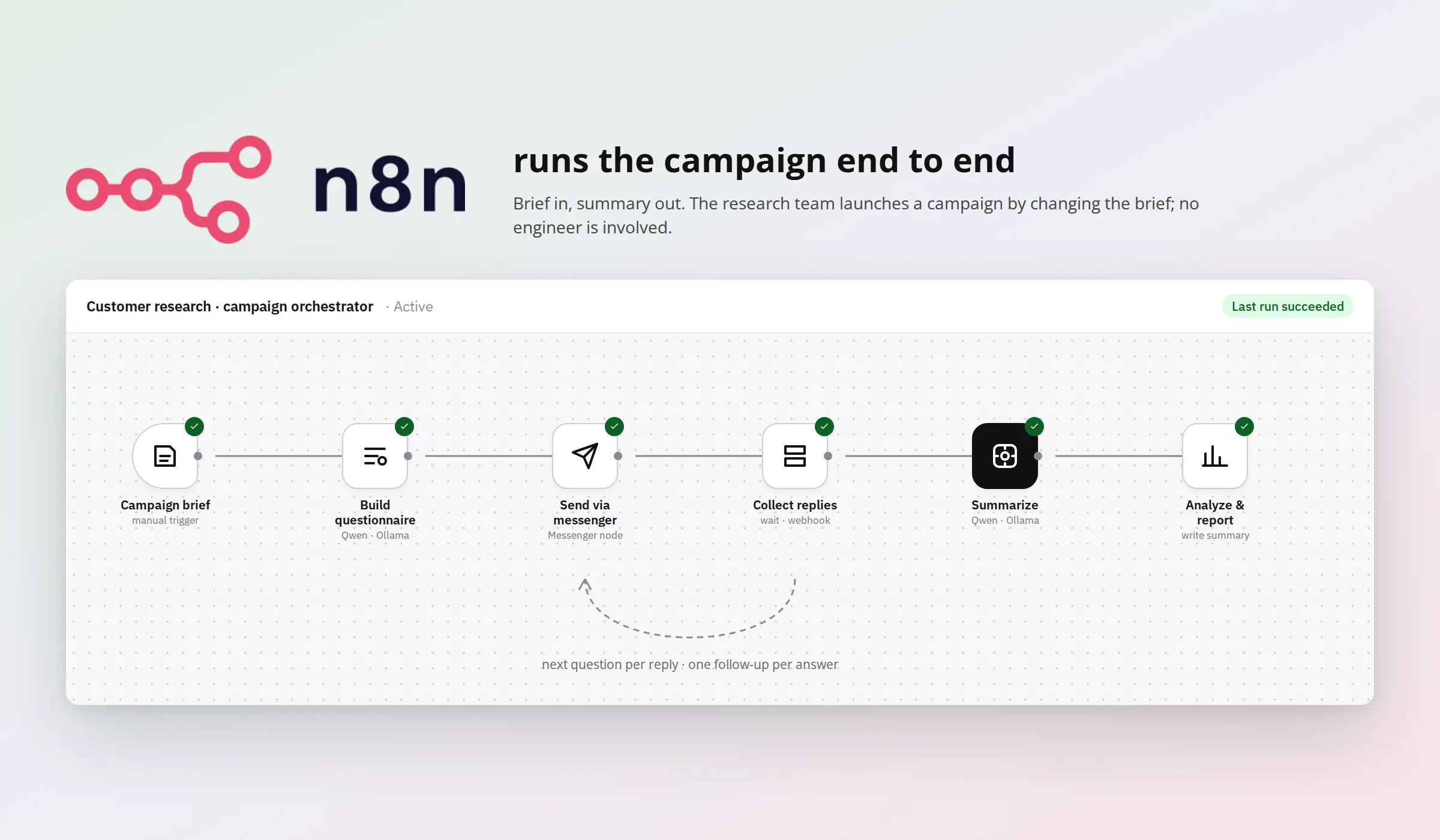
— The n8n workflow that runs the campaign: brief, build questionnaire, send via messenger, collect replies, summarize on the local model, analyze and report. The loop is the follow-up question per reply.
Can an AI questionnaire explore the reasons behind a business purchasing decision?
The agent uses each response to ask a relevant follow-up question. This helps the research team understand the commercial and operational factors behind a customer’s answer. For example, if a buyer mentions inconsistent availability, the agent can ask which products are affected and how shortages influence ordering plans. If the concern is minimum order quantities, it can explore the buyer’s demand and inventory constraints.
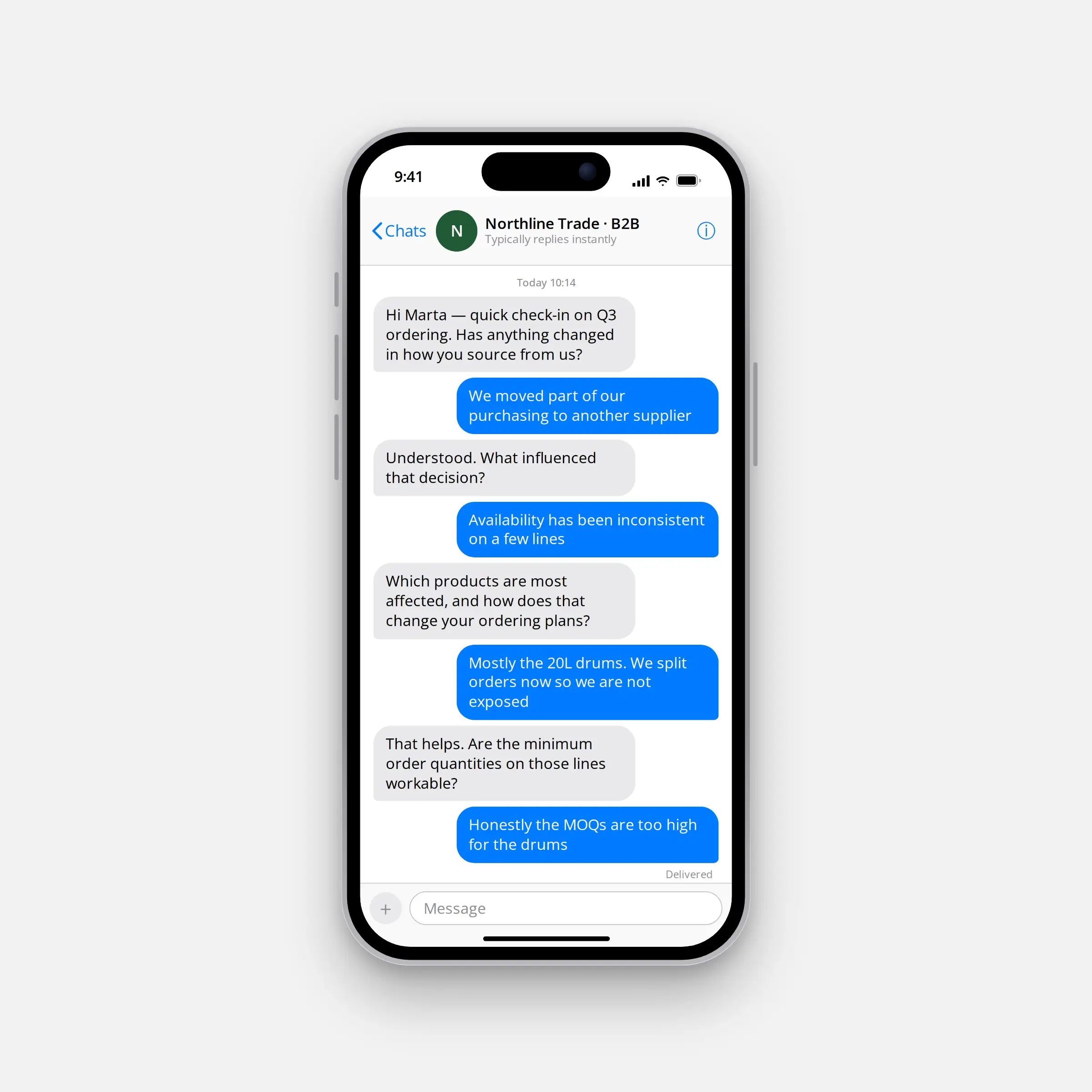
— A research conversation in the messenger the customer already uses: one question, one answer, and the follow-up that answer invites.
The conversation stays focused on the research brief while giving customers room to explain their requirements.
The team completed five iterations of the conversation design during the one-month development period. Early versions were fluent and on-topic but felt scripted. The refinements focused on helping the agent build on each customer’s answer, ask relevant follow-up questions, and maintain a natural flow while covering the research objectives.
How does AI turn open-ended customer feedback into a report?
Qwen analyzes the collected conversations and generates a report with recurring themes, a sentiment breakdown, and supporting customer quotes. For B2B research, those themes can help organize feedback around topics such as supplier selection, product availability, ordering requirements, and delivery expectations. The actual findings depend on the campaign brief and the responses received.
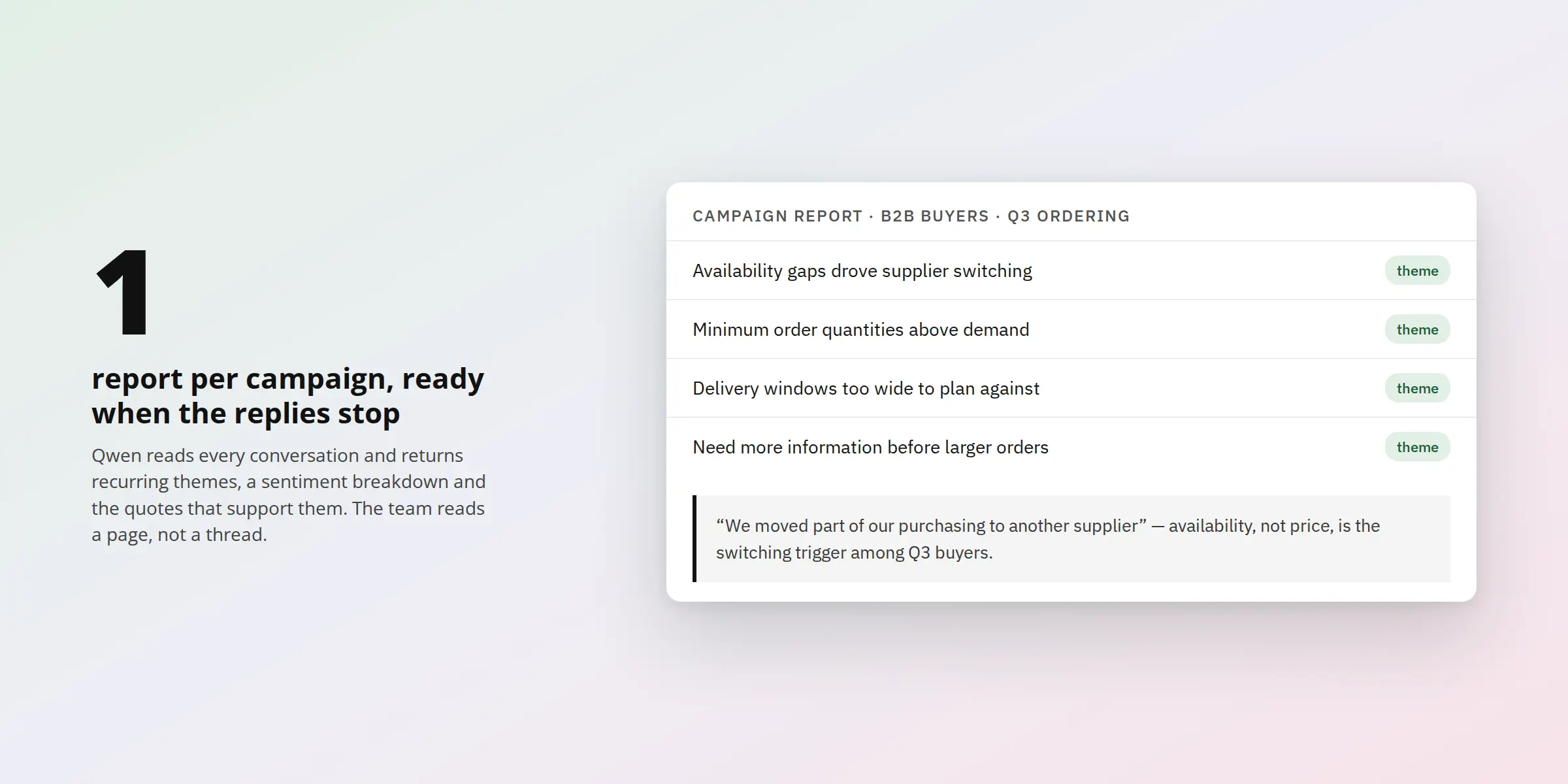
— One report per campaign: recurring themes, a sentiment breakdown, and the quotes that support them.
How can researchers check an AI-generated finding?
Researchers can review the conversations behind a finding and assess whether the summary reflects what customers said. Supporting quotes connect the report’s themes to the source material.
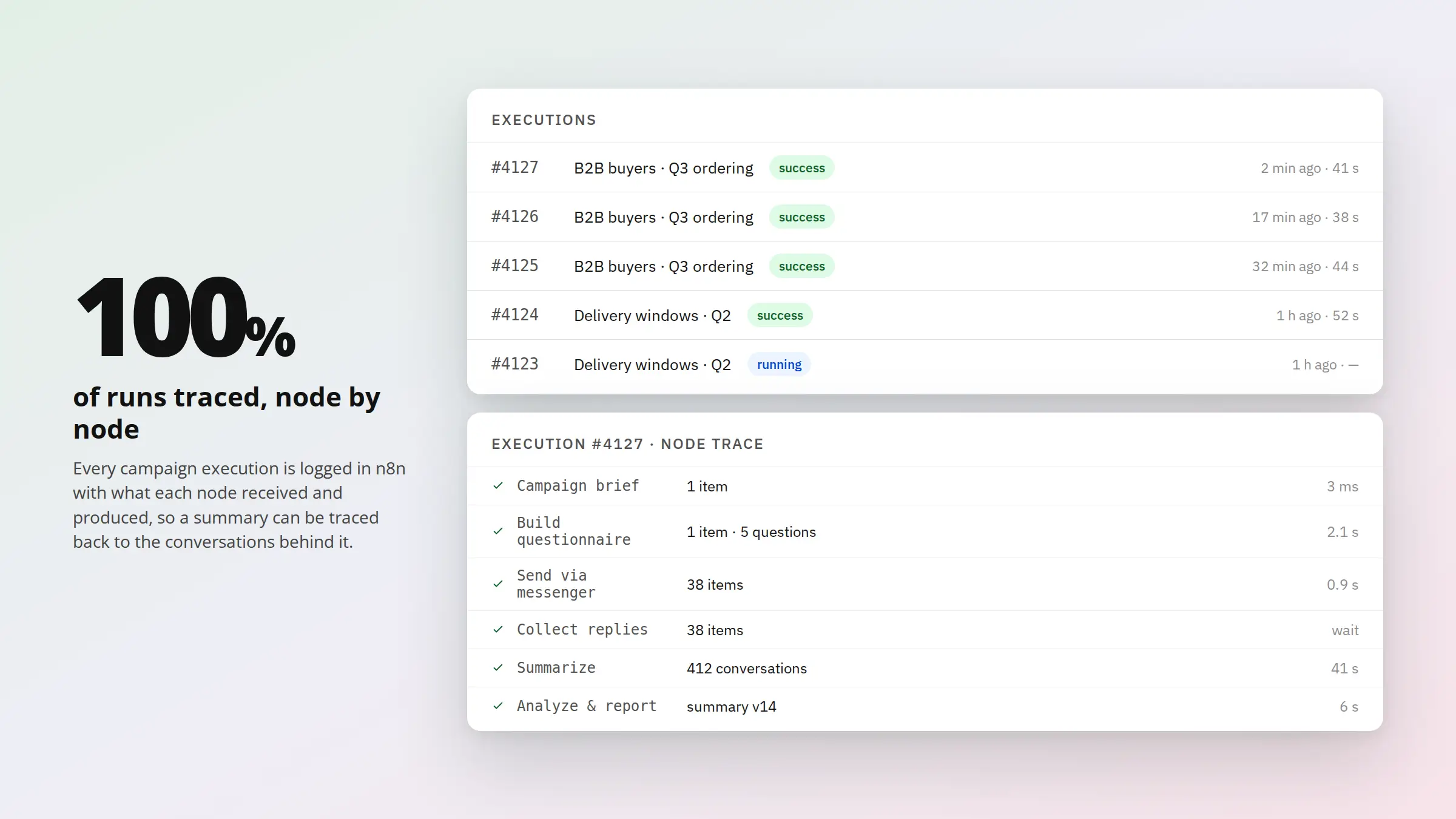
— Every campaign run is logged in n8n node by node, recording the inputs and outputs of each workflow step.
Can business customer feedback be analyzed without an external AI API?
In this deployment, Qwen runs locally through Ollama, and all LLM inference takes place within the retailer’s environment. Customer conversations are not sent to an external model API.
What analytics data needs to be stored after each campaign?
The storage requirement covers campaign summaries, identified themes, sentiment analysis, and supporting customer quotes. Retaining this information allows researchers to revisit findings and compare results across campaigns. Original conversations remain available for reviewing the context behind individual findings. The specific storage destination is not identified in this case study.
| TECHNOLOGY | ROLE IN THE SOLUTION |
| n8n | Orchestrates the campaign: questionnaire build, messenger send, reply collection, summary and report |
| Qwen | Conducts follow-up conversations and analyzes customer responses |
| Ollama | Serves the Qwen model locally within the retailer’s environment |
| Messenger integrations | Deliver questions and collect customer responses; specific platforms are not identified |
| Reporting destination | Analytics storage is required; the specific destination is not identified |
"The most challenging part was designing useful follow-up questions. Across five iterations, we focused on making each question build on the customer's answer while keeping the conversation aligned with the research brief."
04. Results
Teamvoy delivered the system to production in one month with two engineers
Five conversation-design iterations refined how the agent responded to customers and explored the topics in each brief. The system connects campaign setup, customer conversations, and reporting in one workflow. Research teams can launch campaigns from a brief and review a written summary alongside the supporting source material.
| METRIC | BEFORE | AFTER | CHANGE | WINDOW |
| Time to launch a campaign | Requires an engineering build | Brief only, no engineer involved | Structural | Since launch |
| Reply format | Form fields | Follow-up conversation per answer | Structural | Since launch |
| Time from campaign close to summary | 8 business hours — illustrative | 1 business hour — illustrative | 87.5% reduction — illustrative | Proposed comparison: 5 similar campaigns before and after launch |
| Response rate | 20% — illustrative | 25% — illustrative | +5 percentage points — illustrative | Proposed comparison: equivalent audiences, channels, and response windows |
| Analyst hours per campaign | 6 hours — illustrative | 2 hours — illustrative | Approximately 67% reduction — illustrative | Proposed comparison: 5 similar campaigns before and after launch |
| Inference location | — | 100% inside the retailer’s environment | Architectural | Since launch |
05. Conclusion
Teamvoy’s conversational AI for retail solution gives the retailer a repeatable process for exploring business customers’ needs and purchasing decisions
Research teams can move from a campaign brief to a report with recurring themes, sentiment analysis, and supporting customer quotes. The system combines n8n orchestration with Qwen running locally through Ollama. Five iterations refined the conversation design, while source conversations and workflow logs support review. Local inference meets the retailer’s model-processing requirement, and retaining analytics data allows findings to support future research and comparison.
Talk to Teamvoy About Your B2B Customer Research
Tell us how a research campaign runs in your operation today