

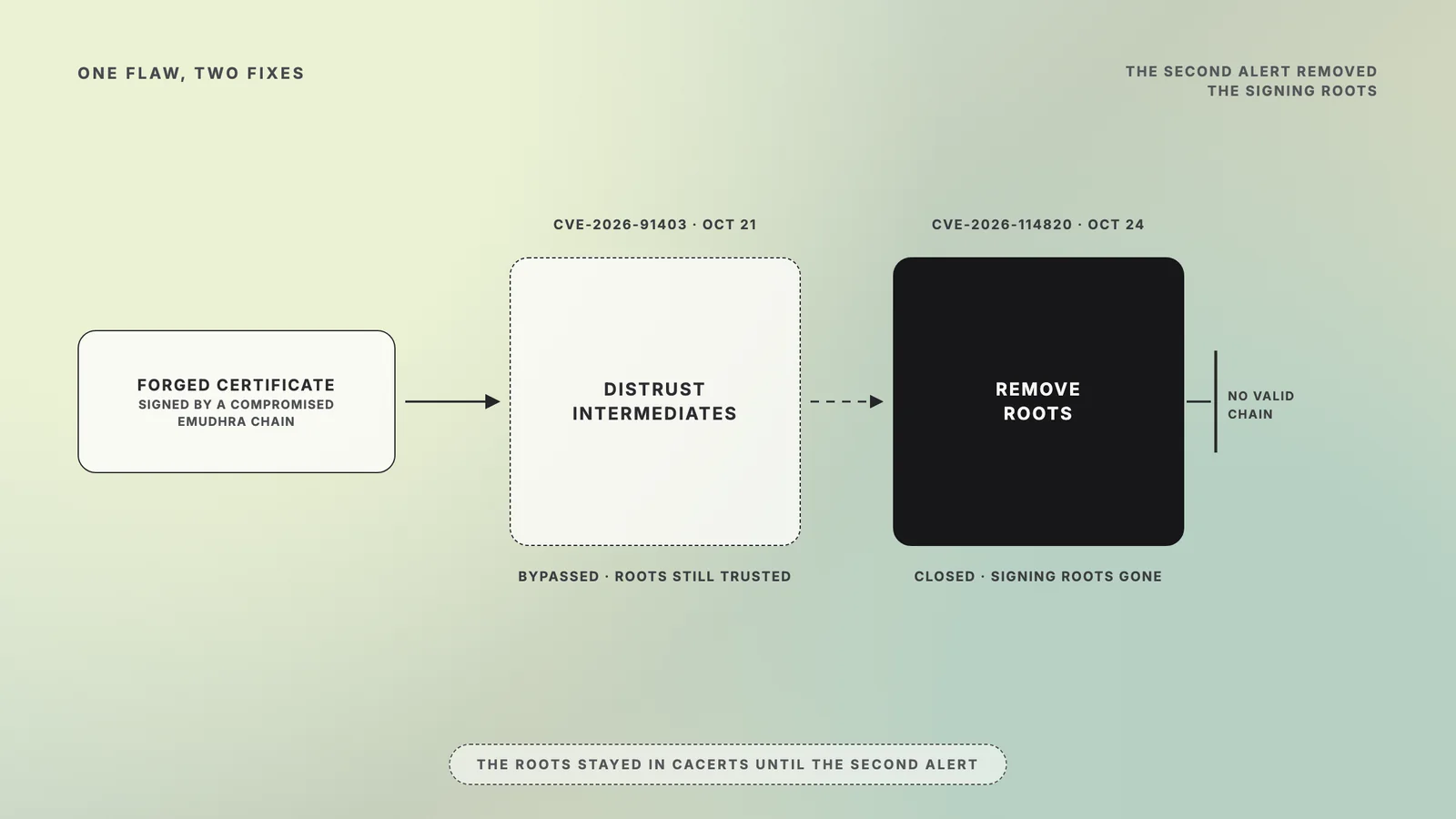
The Java vulnerability CVE-2026-91403 is a certificate-trust flaw, not a code-execution bug. Oracle rated it CVSS 3.1 9.1 Critical on 2026-10-21 after the private keys of eight eMudhra intermediate CA certificates were compromised (Oracle, OpenJDK). The first fix only distrusted those intermediates. Red Hat describes it as “insufficient and easy to bypass” (Red Hat, retrieved 2026-11-17), so Oracle and OpenJDK shipped a second alert, CVE-2026-114820, on 2026-10-24 that removes the root certificates outright (Oracle). If you updated to an Oracle .0.2 or 8u511-b32 build in the first three days, you’re on a version Oracle now lists as affected.
- Fix the second CVE, not the first: your vendor's release notes must name JDK-8395690 / CVE-2026-114820.
- Current Oracle Java SE baselines as of 2026-11-17: 8u513-b04, 11.0.33.1+4, 17.0.21.1+4, 21.0.13.1+4, 25.0.5.1+4, 27.0.1.1+4.
- OpenJDK lists every supported line, 8 through 27, as affected; vendor build numbers differ from Oracle's.
- OS-packaged OpenJDK on RHEL and Fedora is fixed through the OS certificate bundle; Debian and Ubuntu need a manual keystore rebuild.
- No evidence of active exploitation and no CISA KEV entry as of 2026-11-17. Treat that as a window, not a pass.
Is there a gloWhat is CVE-2026-91403, and why did it need a second CVE?
CVE-2026-91403 is a Java vulnerability in how the runtime decides which certificates to trust. Eight eMudhra intermediate CA certificates had their private keys compromised, which means an attacker holding those keys can mint certificates that a stock Java trust store accepts (OpenJDK, updated 2026-10-24). Oracle’s advisory places the issue in the JSSE component and scores it CVSS 3.1 9.1: network attack vector, low complexity, no privileges, no user interaction, high confidentiality and integrity impact, no availability impact (Oracle, 2026-10-21). OpenJDK files the same flaw under security-libs/java.security with the same 9.1 vector (OpenJDK advisory, 2026-10-21).
The business consequence is plain. Any TLS connection your Java services make to a payment gateway, an identity provider, or a partner API can be intercepted if the attacker can also route traffic and present a forged certificate. Signed JARs verified by a vulnerable runtime can be forged the same way. Oracle’s note on the vector says the flaw is reachable “by using APIs in the specified Component, e.g., through a web service which supplies data to the APIs” (Oracle). Confidentiality and integrity are the stated impacts. Oracle and NVD stop short of classifying this as arbitrary code execution, and this article does too.
The second CVE exists because the first patch took the narrow path. OpenJDK’s October 21 change blocked the compromised intermediates but left the roots that signed them in cacerts. Red Hat’s write-up is the clearest public account: upstream “first attempted to address this issue by only blocking problematic intermediate certificates without changing the list of trusted root CAs,” and “the fix proved insufficient and easy to bypass,” so upstream later removed the roots and assigned CVE-2026-114820 (Red Hat, retrieved 2026-11-17). Oracle’s October 24 alert says the same thing in its own words: the new updates “remove the set of impacted root CA certificates related to eMudhra” (Oracle, 2026-10-24).
Which Java versions are affected?
Every supported Java line from 8 through 27 is affected, but the exact build boundary depends on who built your runtime. Unlike most Java vulnerabilities, which land in one library you can bump, this one lives in the runtime’s trust store, and the trust store is vendor- and package-specific. Keep Oracle’s numbers and OpenJDK’s numbers in separate columns. Vendor builds (Temurin, Corretto, Zulu, Microsoft, SAP, IBM Semeru) use their own numbering and their own certificate-store behavior, so the Oracle table does not transfer to them.
Oracle Java SE and GraalVM
| Product | Affected by CVE-2026-91403 (Oracle, 2026-10-21) | Still affected by CVE-2026-114820 (Oracle, 2026-10-24) | First Oracle build fixing both (2026-10-24) | Current Oracle security baseline (2026-11-17) |
|---|---|---|---|---|
| Java SE 8 | 8u511, 8u511-perf | 8u511-b32, 8u511-perf-b32 | 8u511-b33 | 8u513-b04 |
| Java SE 11 | 11.0.33 | 11.0.33.0.2 | 11.0.33.0.3 | 11.0.33.1+4 |
| Java SE 17 | 17.0.21 | 17.0.21.0.2 | 17.0.21.0.3 | 17.0.21.1+4 |
| Java SE 21 | 21.0.13 | 21.0.13.0.2 | 21.0.13.0.3 | 21.0.13.1+4 |
| Java SE 25 | 25.0.5 | 25.0.5.0.2 | 25.0.5.0.3 | 25.0.5.1+4 |
| Java SE 27 | 27.0.1 | 27.0.1.0.2 | 27.0.1.0.3 | 27.0.1.1+4 |
Sources: Oracle Security Alert CVE-2026-91403, Oracle Security Alert CVE-2026-114820, and the Oracle JDK 27 release notes for the October 24 and November 17 releases (Oracle, retrieved 2026-11-17). The JDK 27.0.1.0.3 notes state that the release “contains the fix for the security Java vulnerability described in” the CVE-2026-114820 advisory and list JDK-8395690, “Removal of eMudhra and Comodo (owned by Sectigo) AAA Root Certificates.” The .0.3 column is the first Oracle build that closes both CVEs; the baseline column is the version Oracle expects you to run now, because the November 17 Critical Patch Update superseded it.
OpenJDK and vendor builds
| Line | Affected per OpenJDK (2026-10-21) | What “fixed” means for a vendor build |
|---|---|---|
| OpenJDK 8 | 8u504 and earlier | Vendor release notes name JDK-8395690 / CVE-2026-114820 |
| OpenJDK 11 | 11.0.32.1 and earlier | Same |
| OpenJDK 17 | 17.0.21 and earlier | Same |
| OpenJDK 21 | 21.0.13 and earlier | Same |
| OpenJDK 25 | 25.0.5 and earlier | Same |
| OpenJDK 27 | 27.0.1 and earlier | Same |
Source: OpenJDK vulnerability advisory, 2026-10-21 and openjdk.org/emudhra. OpenJDK publishes no vendor-neutral “fixed” version number. Its instruction is a release-note test: install a runtime whose notes “document that it fixes issue JDK-8395690, CVE 2026-114820,” and do this “even if you have updated your runtime in the past few days” (OpenJDK). For Temurin, Corretto, Zulu, Microsoft Build of OpenJDK, SAP Machine and IBM Semeru, confirm the JDK-8395690 fix in that vendor’s advisory before you publish an internal baseline.
OS-packaged OpenJDK is a third category, and the one where “openjdk vulnerability” advice from a vendor forum most often goes wrong. On Arch, Fedora, Gentoo, Oracle Linux and RHEL, the JDK reads the operating system’s certificate bundle, so an updated ca-certificates package is “likely sufficient” (OpenJDK). Red Hat confirms it fixed RHEL through ca-certificates and will not ship an OpenJDK update claiming to address CVE-2026-91403 (Red Hat). Debian, Ubuntu and Devuan are the exception: a long-standing bug in ca-certificates-java means updating the packages alone doesn’t refresh the Java keystore, and you have to delete and recreate it by hand (OpenJDK).
What happened between October 21 and October 24?
The timeline matters because it determines whether a team that moved fast is done or has to move again. In three days this Java vulnerability went from one advisory to two, and the build that counted as “fixed” on October 21 was on Oracle’s affected list by October 24. Every date below comes from Oracle, OpenJDK, NVD or CISA pages retrieved 2026-11-17.
| Date | Event | Source |
|---|---|---|
| 2026-10-21 | Oracle Security Alert CVE-2026-91403; OpenJDK advisory for lines 8–27. Fix distrusts eMudhra intermediates. Oracle ships 8u511-b32 and .0.2 builds. | Oracle, OpenJDK |
| 2026-10-23 | CISA’s ADP record on NVD logs SSVC Exploitation: none. | NVD API, retrieved 2026-11-17 |
| 2026-10-24 | Oracle Security Alert CVE-2026-114820 lists the b32 / .0.2 builds as affected and ships 8u511-b33 and .0.3. OpenJDK updates its guidance to require the JDK-8395690 fix. | Oracle, Oracle release notes, OpenJDK |
| 2026-11-17 | Oracle’s scheduled Critical Patch Update sets new baselines (8u513-b04, .1+4 builds). NVD still shows CVE-2026-91403 as Awaiting Analysis. Both CVEs are absent from CISA KEV (catalog 2026.11.17, 1,782 entries). | Oracle release notes, NVD, CISA KEV |
A team that patched on October 22 and recorded “done” in its ticket tracker is running a build Oracle named as affected two days later. That is the scenario this article exists to catch. It’s also why a Java CVE tracker that stores one ID per incident will mislead you here: the record to watch is CVE-2026-114820, not the one that made the news.
Is your Java runtime exposed? A decision path
Answer five questions per runtime, in order, and the exit tells you what to do. Run it against every runtime copy, not every application, because the trust store belongs to the runtime.
- Where does Java run? Host packages, container base images, bundled JREs inside vendor appliances, CI agents, developer laptops, GraalVM native-image toolchains, and desktop tooling all count. A runtime you can’t list is a runtime you can’t prove patched.
- Who built it? java -version and java -XshowSettings:properties -version 2>&1 | grep java.vendor give you vendor and full version string. Sort each runtime into Oracle, standalone vendor build, or OS package.
- Which build is it? Oracle: compare against the baseline column above; anything at or below .0.2 / b32 is exposed to CVE-2026-114820. Vendor build: find the release note that names JDK-8395690. OS package: check whether the distribution routes Java through the system certificate bundle.
- Where does it read trust from? $JDK_HOME/lib/security/cacerts on JDK 11+, $JDK_HOME/jre/lib/security/cacerts on JDK 8, or the OS bundle (OpenJDK). FreeBSD and Homebrew packages keep their own store and need a direct package update.
- Does CheckCerts still flag it? Run OpenJDK’s `CheckCerts.java`, which works on JDK 8 and later, against the installed runtime. A clean result is your evidence; a flagged result sends you to the runbook.
Exits: Oracle at .1+4 / 8u513-b04 with a clean CheckCerts is done. Vendor build with a JDK-8395690 release note and a clean CheckCerts is done. Everything else is either “update now” or “apply the temporary mitigation and schedule the update.”
How do you remediate and prove it?
Update to a build that fixes CVE-2026-114820, rebuild everything that embeds the runtime, restart every live instance, and keep the evidence. The runbook below follows OpenJDK’s published order of preference: vendor update first, root removal second, revocation checking as a backstop (OpenJDK).
Step 1: Update the runtime
- Oracle: move to the current baseline for your line (8u513-b04, 11.0.33.1+4, 17.0.21.1+4, 21.0.13.1+4, 25.0.5.1+4, 27.0.1.1+4 as of 2026-11-17). Oracle’s notes say the .0.3 release shouldn’t be used after the November 17 CPU, and the .1 release shouldn’t be used after the next CPU on 2027-01-19 (Oracle).
- Vendor build: install the release whose notes name JDK-8395690 / CVE-2026-114820. Confirm the note text yourself; a version number alone won’t tell you which of the two fixes it carries.
- OS package on RHEL, Fedora, Oracle Linux, Arch, Gentoo: update ca-certificates. Red Hat tracks its bundle fix as CVE-2026-114406 (Red Hat).
- Debian/Ubuntu: as root, rm -f /etc/ssl/certs/java/cacerts then update-ca-certificates –fresh (OpenJDK).
Step 2: Rebuild and redeploy every copy
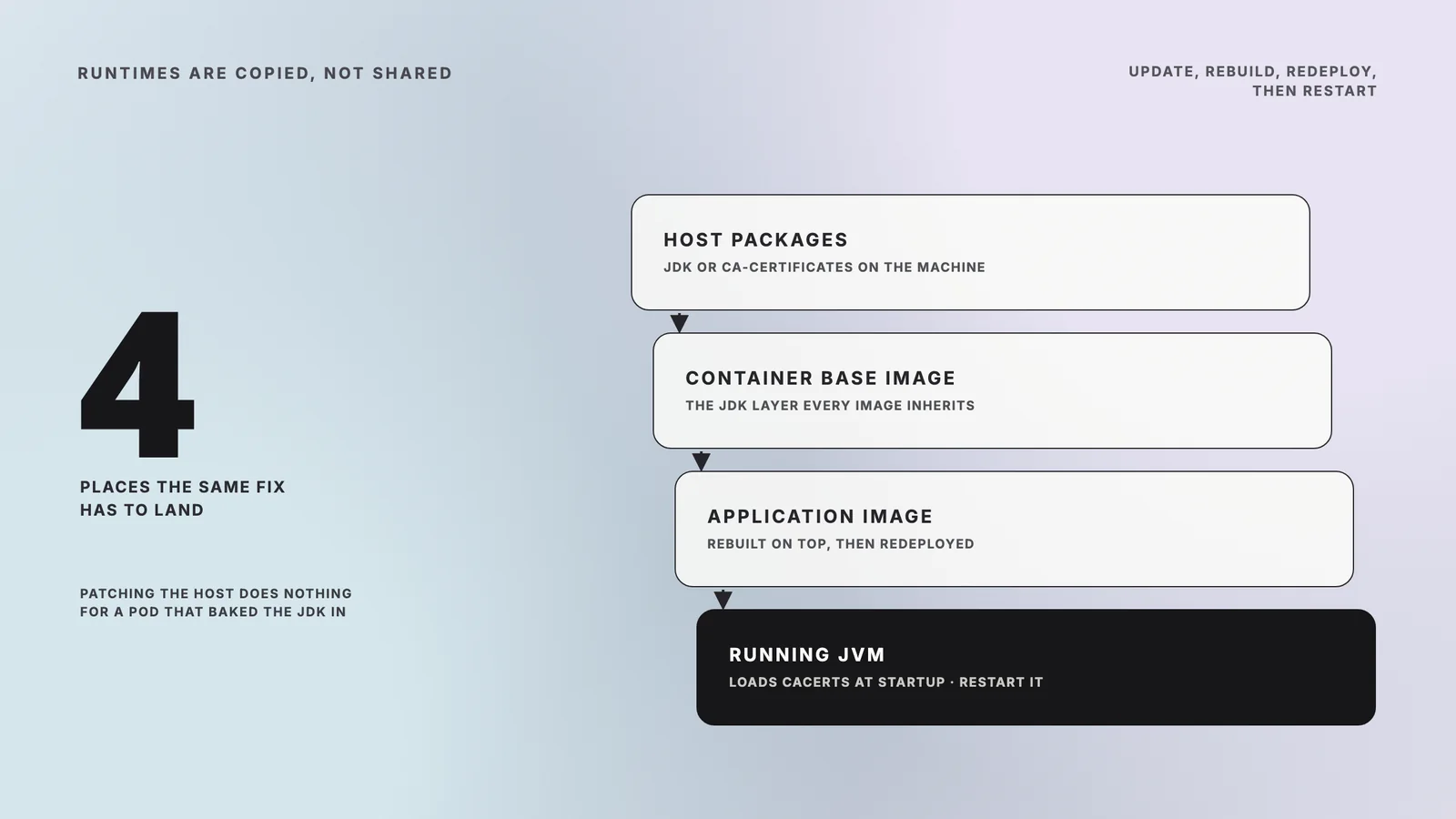
Java runtimes are copied, not shared. A container image bakes the JDK into a layer, so patching the host does nothing for the pods. Rebuild base images, rebuild application images on top of them, redeploy, and then check that no workload is still scheduled from the old digest. Bundled JREs inside commercial software need the vendor’s patched release. CI runners and build agents that sign or verify JARs are runtimes too.
Step 3: Restart live instances
OpenJDK’s guidance is explicit: “Restart any live instances of the runtime” after changing the keystore (OpenJDK). A JVM loads cacerts at startup. A long-running service on a patched host with an unrestarted process is still trusting the old store.
Step 4: Verify
- java -version on every runtime matches the target build.
- CheckCerts.java returns clean.
- Container image digests in production match the rebuilt images.
- For TLS-heavy services, -Dcom.sun.net.ssl.checkRevocation=true -Dcom.sun.security.enableCRLDP=true on the command line, if you don’t already enforce revocation (OpenJDK).
- For signed JARs on JDK 17+, jarsigner -verify -revcheck -strict $SIGNED_JAR (OpenJDK).
Step 5: Keep proof
For each runtime: vendor and full version string before and after, package version or image digest, deployment timestamp, restart confirmation, and the CheckCerts output. Your auditor, your cyber insurer, and your own incident review will ask for this in that order.
Temporary mitigation when no update exists yet
OpenJDK documents a manual fallback for standalone runtimes: back up cacerts, then delete the four roots with keytool -delete -cacerts -alias “<alias>” on JDK 11+ (or -keystore $JDK_HOME/jre/lib/security/cacerts on JDK 8) for emsignrootcag1 [jdk], emsignrootcag2 [jdk], emsigneccrootcag3 [jdk] and comodoaaaca [jdk], ignoring “does not exist” errors, and restart (OpenJDK). Treat this as a change-controlled stopgap with a rollback, not as the fix. The next runtime update will replace the keystore anyway, and a hand-edited store that nobody documented is how the next audit finding starts.
What’s the trade-off?
Emergency runtime updates close the exposure quickly, and they can break things. Removing roots from the trust store is the correct fix for this Java vulnerability. It also means any partner, internal PKI, or legacy integration that chained to an eMudhra or Comodo AAA root stops working the moment you restart. Applications pinned to a specific JDK image for reproducibility now need a new image, a new test pass, and a new release. Oracle’s November 17 baselines also fold in the rest of the quarterly Critical Patch Update, so you’re taking a broader change than the certificate fix alone.
The opposite choice, waiting for a full regression cycle, keeps today’s stability and extends the window in which a forged certificate is accepted. The sources give you no exploitation evidence to lean on either way: CISA’s SSVC entry says none as of 2026-10-23, and the CVE is absent from KEV as of 2026-11-17, which tells you nothing about private use of compromised keys.
The workable middle is a staged emergency path. Inventory first. Update one canary runtime per family. Exercise the TLS and signed-JAR flows that matter commercially, including partner callbacks. Then roll the rest with the evidence trail from Step 5. Where a dependency breaks on the new trust store, the fix belongs with that dependency, not in a decision to keep trusting a compromised root. If your Java estate is old enough that updating the runtime means a toolchain migration, that cost was already there; the CVE made it visible. Teamvoy’s piece on the hidden costs of legacy systems covers how to size that work.
What Java Vulnerability means by industry
The mechanism is the same everywhere; the exposure sits where Java talks to systems you don’t control. The five patterns below are where a forged certificate does commercial damage first, and they’re the integrations to test on the canary before you roll the update across the estate. Each is a risk pattern for the sector, not a Teamvoy outcome claim.
- Fintech. Payment, KYC and open-banking integrations run on mutual TLS and signed payloads. A forged partner certificate here is a confidentiality and integrity failure under PCI DSS and DORA, so the inventory has to include every gateway client and SDK, not only the services you wrote. See Teamvoy’s work on AI software development for fintech.
- Insurance. Claims platforms exchange PII with repair networks, reinsurers and document services over TLS from JVM-based middleware. Policy-admin suites often bundle their own JRE, which means the vendor, not your platform team, owns the fix date. See insurance software development.
- Healthcare. HL7/FHIR integration engines and PHI-handling services are commonly Java, and HIPAA’s breach rules don’t distinguish between a forged certificate and a lost laptop. See healthcare software development.
- Manufacturing. MES and ERP middleware runs on long-lived JVMs on plant-floor servers that nobody restarts, which is where the “patched host, unrestarted process” gap lives. See manufacturing software development.
- Retail. Commerce and order-management services fan out to payment, tax, shipping and loyalty APIs from containerized Java, so the rebuild-and-redeploy step is the whole job. See retail software development.
Java Vulnerability: Conclusion
The Java vulnerability CVE-2026-91403 is a CA compromise that turned into two CVEs because the first fix stopped at the intermediates. The remediation test is whether your build carries the CVE-2026-114820 root removal: Oracle’s current baselines as of 2026-11-17, a vendor release note that names JDK-8395690, or a refreshed OS certificate bundle on distributions that use one. Then rebuild every image, restart every JVM, run CheckCerts, and keep the evidence. For the PHP side of the same runtime-response discipline, Teamvoy’s PHP vulnerability 2026 article covers the parallel case.
Talk to Teamvoy About Java Runtime Security
If your Java estate spans Oracle, vendor builds and OS packages across containers and bundled JREs, the inventory is the hard part and the patch is the easy part. Teamvoy’s Java development and modernization team can run the runtime inventory, stage the update with a canary and proof trail, and scope what the older lines will cost to move. Talk to us about your Java runtime inventory.