

- There was no global internet outage today, November 17, 2026, that any reviewed primary source could establish by our 20:47 UTC check, and no shared root cause or global cyberattack either. Separate provider incidents did exist: Cloudflare reported partial degradation in R2 and some AI models, Apple had ongoing iCloud sign-in and Apple Business Manager issues, Twilio listed country-specific voice and SMS problems, and OpenAI's Costs API was delayed. Microsoft, GitHub and Google Cloud showed no active incidents; AWS showed only two long-running regional disruptions in UAE and Bahrain.
- Those are coincident failures, not a global internet outage, and none of them was attributed to an attack. This is a dated fact check, not a live monitor. The rest of the article shows how to classify what you're seeing and what to do in the first 15 minutes, the first hour, the first four hours and the following two days.
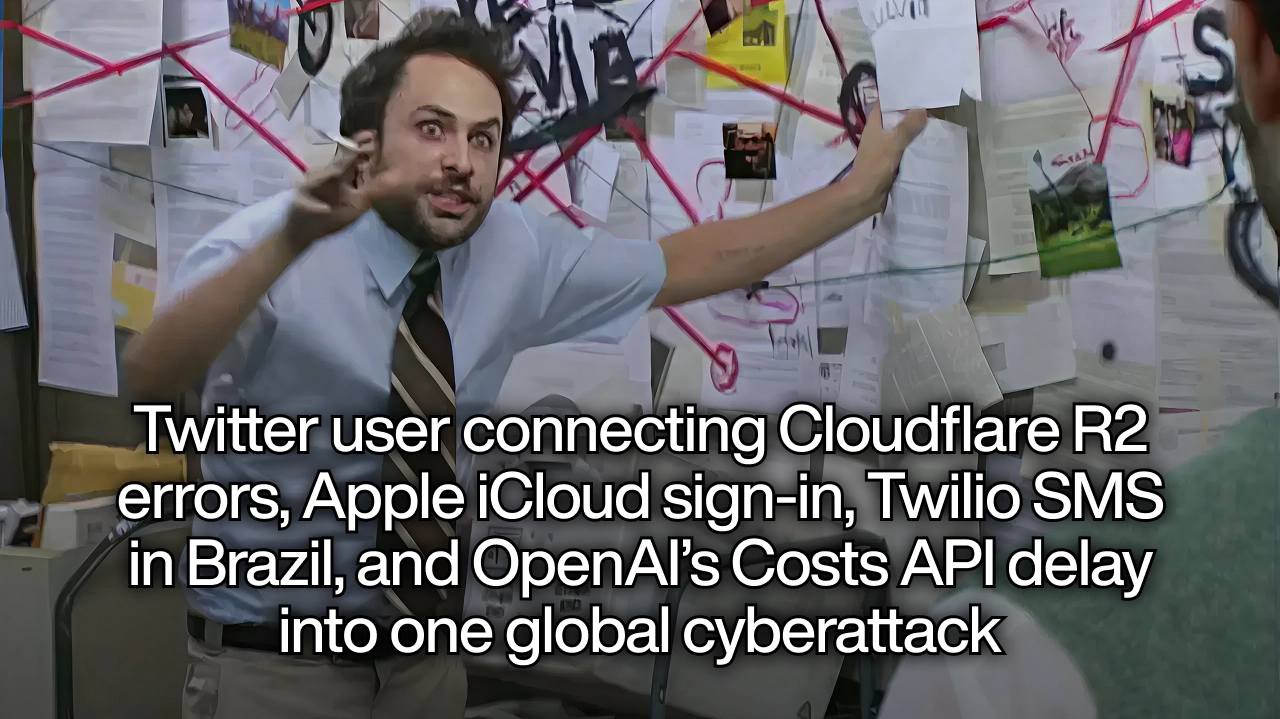
Is there a global internet outage today, November 17, 2026?
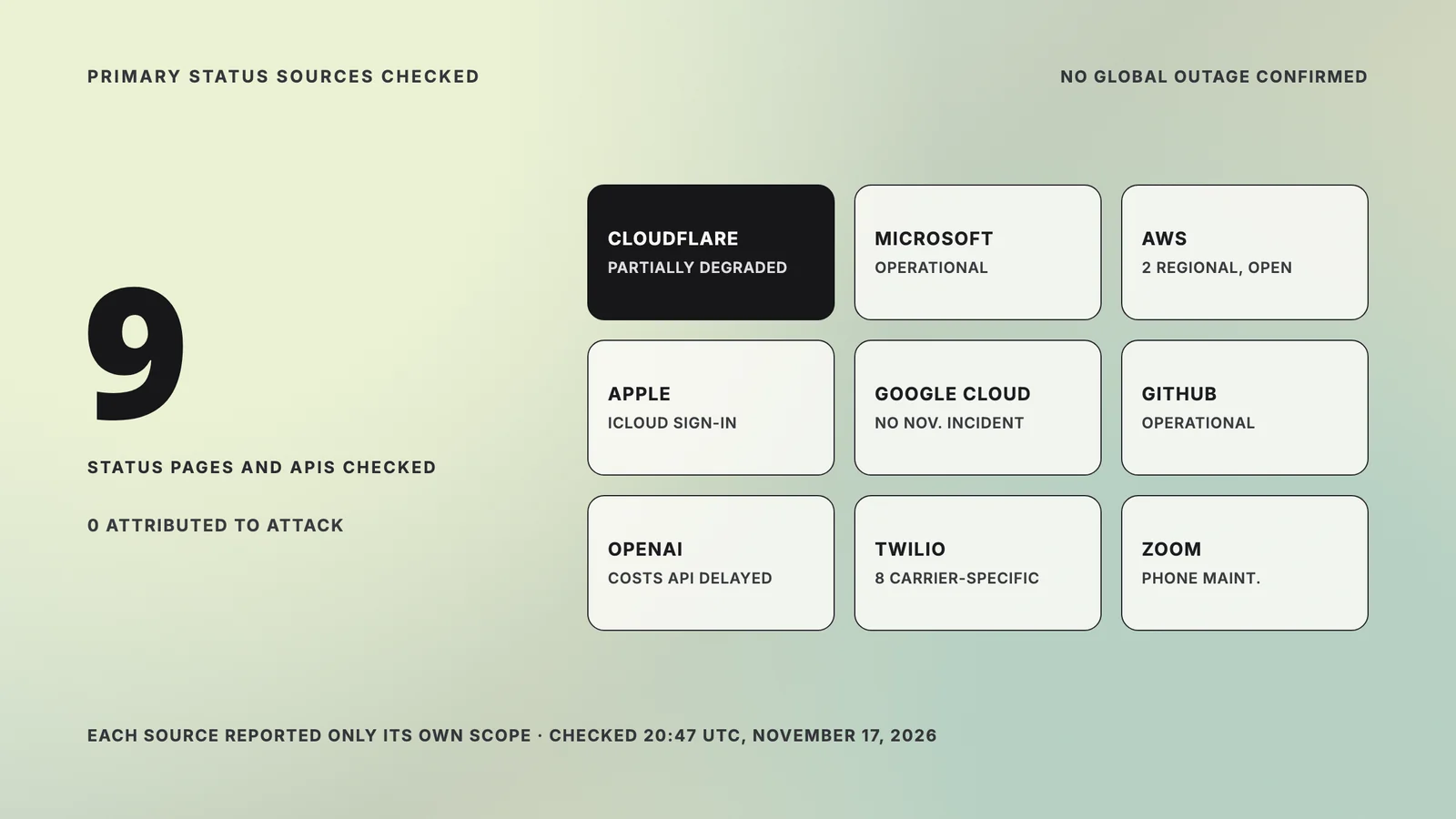
There was no global internet outage on November 17, 2026 that any primary source we reviewed could establish by 20:47 UTC. We checked nine provider status pages and APIs directly, and each one reported only its own scope. The pattern was several unrelated incidents that overlapped in time, which is exactly what a user-report map renders as “everything is down.” If evidence changes after this cutoff, the provider pages below will show it before any article does.
Here’s what each primary source said at the cutoff, and what that observation does not prove.
| Provider (source) | Observed state at 20:47 UTC, Nov 17, 2026 | Scope | What it doesn’t prove |
|---|---|---|---|
| Cloudflare Status | “Partially Degraded Service”: R2 errors and timeouts for requests from South America, errors on some AI models, Workers event-subscription issue open since Nov 11; several PoPs under scheduled maintenance | Specific products and regions | A worldwide CDN or DNS failure |
| Microsoft Service Health | “All products are operational” | Public view only; tenant admin center may differ | Health of every Microsoft 365 tenant |
| AWS Health Dashboard | Two open operational issues, both regional and long-running: UAE and Bahrain | Two Middle East regions | A new global AWS event on Nov 17 |
| Apple System Status | Ongoing: iCloud Account & Sign In and iCloud web apps (since 16:45 UTC), AppleCare on device (since 16:15 UTC), Apple Business Manager, Apple School Manager and Schoolwork (since 18:40 UTC). Resolved: App Store and Volume Purchase Program at 20:00 UTC | Apple services | Any failure outside Apple’s own platform |
| Google Cloud incidents feed | No incident with a November 2026 start date | Public feed | Health of every workload or project |
| GitHub Status | “All Systems Operational” (updated 19:09 UTC) | GitHub | Anything beyond GitHub |
| OpenAI Status | “Partial System Degradation”: Costs API data delayed, monitoring | One API | Model or platform outage |
| Twilio Status | Eight open incidents, each tied to a named carrier or country: Brazil, Colombia, Mexico, Chile, Puerto Rico, the Philippines and the UK | Carrier-by-carrier telecom delivery | One shared telecom cause |
| Zoom Status | “Service Under Maintenance”: Zoom Phone and Zoom Phone EMEA | Scheduled maintenance | An outage |
Two things stand out. First, every entry is bounded by product, region or carrier. Second, no provider in the set attributed its incident to malicious activity. A global internet outage requires a shared layer to fail: a backbone, a major DNS or BGP path, or a cloud control plane that many of the others depend on. The November 17 evidence shows none of that.
Why “the internet is down” is usually six different problems
The phrase “global internet outage” covers six failure classes, and only one of them deserves the word “global.” Your first job during an incident is to decide which class you’re in, because the fix, the people you call and the message you send customers differ for each.
- Local ISP or customer-premises failure. Your office fiber, a modem, an ONT, or a regional ISP footprint. The symptom is that everything is unreachable from one location while the same services work from a phone on cellular. A branded search like armstrong internet outage is this class: one carrier, one footprint.
- Regional carrier or backbone disruption. A transit provider, a subsea cable or a metro ring loses capacity. Multiple independent networks in one geography lose the same paths. Scope is wide but bounded by geography.
- DNS or BGP incident. DNS turns names into addresses; ICANN’s DNS overview (September 13, 2022) describes it as the naming layer the rest of the internet depends on. BGP, defined in RFC 4271 (January 2006), is how networks announce which addresses they can reach. A bad route announcement or a resolver failure can make healthy services unreachable for millions of users with no intrusion anywhere.
- Cloud or SaaS dependency outage. One provider’s region, availability zone or control plane fails, and every product built on it degrades at once. The November 2026 Microsoft Outlook outage is a recent example of how one SaaS dependency pulls several downstream services with it.
- DDoS or confirmed cyberattack. A distributed denial-of-service attack exhausts a target’s resources with traffic. CISA’s DDoS guidance describes it as an availability attack, which is a different thing from an intrusion that compromises systems or data.
- Coincident reports that only look global. Several unrelated incidents happen in the same hour, user-report maps light up everywhere, and social media supplies the word “global.” This class is the leading explanation for the November 17, 2026 evidence set.
The word “outage” belongs to classes one through four and six. The word “attack” belongs to class five, and only after a provider or your own security team confirms it.
How do you tell an ISP outage from a DNS, BGP or cloud failure?
Match the symptom to the layer, run one cheap check, then collect the evidence that would move you to the next class. The matrix below is the order an on-call engineer should work through, because each row rules out the cheaper explanation before you escalate.
| Symptom you see | Likely layer | First check (under 5 minutes) | Evidence that confirms it | Evidence that is not enough |
|---|---|---|---|---|
| Everything is unreachable from one office; a phone on cellular works | Local ISP / CPE | Modem or ONT signal lights; ISP status page or account notice; a second site on the same ISP | ISP notice naming your footprint; neighbors on the same carrier affected | A spike on a national outage map |
| Several sites in one region lose the same destinations; other regions are fine | Regional carrier / backbone | Traceroute from two providers in the region; carrier NOC notice | Multiple independent networks losing the same paths; route telemetry showing withdrawn or re-routed prefixes | A list of unrelated SaaS apps that happen to be slow |
| Sites “won’t load” but IPs ping; browsers show SERVFAIL or NXDOMAIN | DNS | Query a second resolver (your ISP’s and a public one); test authoritative servers for your own domains | Resolver or authoritative failures with a provider acknowledgement | A user saying “the website is down” |
| A specific set of destinations unreachable from many networks at once; paths change abruptly | BGP / routing | Looking-glass or route-collector check for your prefixes and the destination’s | Abnormal announcements or withdrawals plus an operator statement | Social posts speculating about a hack |
| One vendor’s products degrade together; your own infrastructure is healthy | Cloud / SaaS dependency | The provider’s status page and your tenant’s service-health view | Provider incident naming the region, service and impact | Downdetector alone |
| Your edge or app floods with traffic; latency climbs; provider mitigation engages | DDoS | Edge and WAF dashboards; provider DDoS notice | Traffic evidence plus provider or security-team confirmation and a mitigation record | Outage size or suddenness |
| Unexpected admin activity, data access or config changes with the outage | Intrusion | Identity logs, change audit, EDR alerts; open an incident with security | Forensic evidence of compromised accounts or systems, or a provider disclosure | Any loss of availability by itself |
Run the rows top to bottom. A team that starts at “is the internet hacked” and works backward wastes the first hour, because it’s chasing the rarest explanation first. A team that starts at “is it our ISP” clears the most common explanation in five minutes.
Was the internet hacked? global internet outage vs security incident
An outage is a loss of availability; a security incident is evidence that confidentiality, integrity or control was compromised. On November 17, 2026, the primary sources documented the first and none of the second. The search phrase internet hacked appears whenever an outage is large, but Ahrefs maps that query to home-router compromise, not to worldwide events, which tells you how people actually use the words.
| Question | Outage | Security incident |
|---|---|---|
| What failed? | Reachability or capacity | Trust: an account, a system, a dataset or a control plane |
| Who declares it? | Provider status page, NOC, your SRE lead | Your security team, the provider’s security disclosure, or a regulator |
| What does the evidence look like? | Status incident, route telemetry, resolver errors, provider maintenance records | Forensic artifacts, compromised credentials, attacker activity in logs, a disclosure |
| What ends it? | Service restored and confirmed by synthetic checks | Containment, eradication, recovery and a written root cause |
| Customer message | “Provider X is degraded; here’s the workaround and the next update time” | Legal and compliance review before any statement |
| Can one become the other? | Yes: a DDoS is an attack whose effect is an outage | Yes: an intrusion often starts with availability symptoms nobody investigated |
Two boundaries matter for your runbook. A DDoS sits in both columns: it’s an attack by intent and an outage by effect, and CISA’s guidance treats it as an availability problem to mitigate, not proof that anything was breached. An internet security vulnerability is a weakness that could be exploited; it becomes a security incident only when someone exploits it. Treat an unpatched internet vulnerability in your edge devices as a reason to investigate during an outage, not as a reason to announce an attack.
The practical rule: use the word “attack” only after a responsible primary source confirms it. Everything before that is an outage of unknown cause.
What should your team do in the first 15 minutes, hour and day?
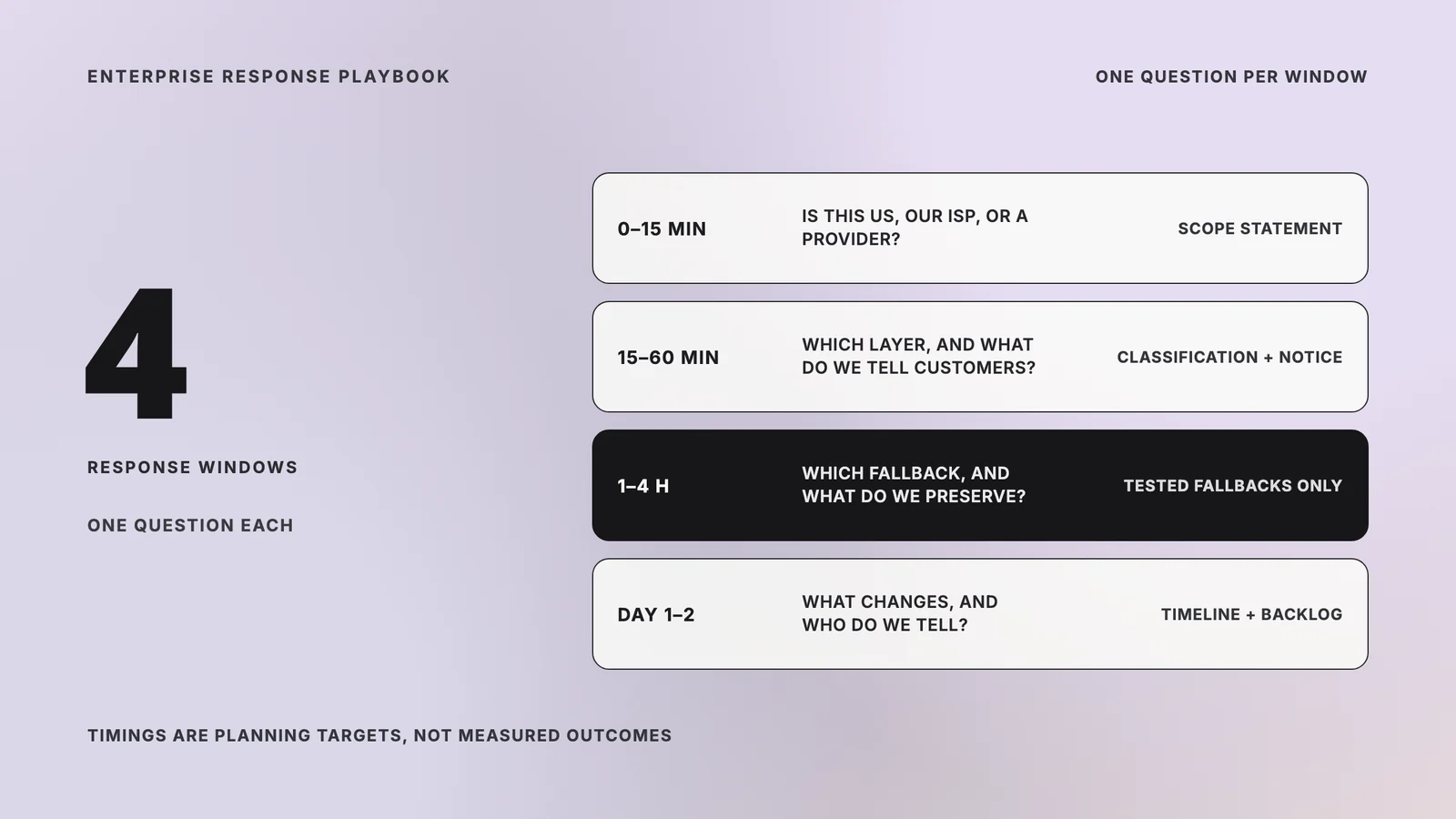
Establish scope before you touch anything. The table below is written for the on-call lead; each window has one question to answer and a short list of actions that answer it. Timings are planning targets, not measured outcomes.
| Window | Question to answer | Actions | Output |
|---|---|---|---|
| 0–15 minutes | Is this us, our ISP, or a provider? | Confirm the symptom from a second network (cellular hotspot, a second office, a cloud VM). Check your ISP’s status page and your own synthetic monitors. Identify one known-good path for the most critical flow (for example, payments or patient access). Open an incident channel and name an incident lead. | Scope statement: internal, ISP, or provider, with the evidence that says so |
| 15–60 minutes | Which layer, and what do we tell customers? | Run the diagnosis matrix: second resolver, traceroute from two providers, provider status pages and your tenant’s service-health view, edge traffic dashboards. Pull your dependency map and list every customer-facing flow that touches the affected layer. Publish one customer message with the known scope, the workaround and the next update time. Route all other communication through the incident lead. | Classification (ISP, backbone, DNS/BGP, cloud/SaaS, DDoS, intrusion suspected) and a timestamped customer notice |
| 1–4 hours | Which fallback do we activate, and what do we preserve? | Activate only fallbacks you’ve tested in the last quarter: secondary DNS, a second ISP path, a provider-independent path for the critical flow. Leave untested failovers alone; a failed failover doubles the incident. Preserve logs, route snapshots, DNS query logs and edge traffic captures with timestamps, in case the classification moves toward attack. Re-check provider pages every 30 minutes and record each check. | Fallback log with timestamps; evidence bundle; updated customer notice |
| Day 1–2 | What changes, and who do we tell? | Reconstruct the incident timeline from your evidence, not from memory. Review the dependency map: which flows failed, which fallbacks worked, which didn’t exist. Decide the resilience changes that the business impact justifies. Send reciprocal updates to customers, partners and the providers whose status you relied on. If any evidence pointed to intrusion, hand the bundle to security for a separate incident. | Timeline, dependency review, prioritized resilience backlog, closing communications |
The two most expensive mistakes sit in windows three and four. Activating an untested fallback at hour two turns one outage into two. Skipping evidence preservation means that if the classification later moves to attack, the logs that would prove or disprove it have rotated away.
Which industries feel a global internet outage first?
Industries where the customer-facing flow depends on a provider you don’t control feel it first, and five of them show the pattern clearly. The consequences below are the dependency chains to map before an incident, without any claim about how often they fail.
- Fintech. Payments, KYC checks and end-of-day reconciliation each sit behind a third-party API, a cloud region and a DNS path. A failure in any one looks like “payments are down” to a customer. Mapping which of those flows needs a provider-independent control path is the resilience decision that matters most, and it’s the kind of dependency work Teamvoy does in AI software development for fintech.
- Insurance. Claims intake, broker portals and document workflows stall when identity, storage or messaging providers degrade, and customers file a first notice of loss on the day of the storm, not after it. See how Teamvoy approaches insurance software.
- Healthcare. Patient access, identity and clinical integrations fail in ways that affect care, not only revenue. An offline-safe procedure for scheduling and records access is a patient-safety control. Teamvoy’s healthcare software work starts from those integration boundaries.
- Manufacturing. Plants, MES and supplier systems keep running on local networks only if someone designed them to. A cloud dependency in the middle of a production line turns a SaaS outage into a stopped shift. Teamvoy’s manufacturing software practice treats offline-safe operation as a design requirement.
- Retail. Checkout, inventory and fulfillment depend on payment providers, CDNs and cloud regions at the same time. On a peak day, an hour of degraded checkout is the whole margin. Teamvoy’s retail software work maps those dependencies before the peak, not during it.
The common thread: the industry doesn’t change the diagnosis; it changes which flow gets the known-good path in minute zero.
How much network resilience is worth paying for?
Enough to keep the flows whose failure would cost more than the redundancy, and no more. Multi-provider redundancy is the standard answer to every outage post-mortem, and it’s the right answer for a short list of flows. For everything else it adds cost, operational complexity, inconsistent controls and new failure modes of its own. That’s the trade-off, and it runs against the interest of any vendor who sells resilience work, including Teamvoy.
Here’s how the decision looks in practice.
Where independence pays. A second ISP on a different physical path at a site that can’t work on cellular. Secondary DNS at a different provider, with the zone actually replicated and tested. A provider-independent path for the one or two customer flows whose outage triggers a regulatory clock or a measurable revenue loss within the hour: payment authorization in fintech, patient access in healthcare, line control in manufacturing.
Where independence costs more than it saves. Running two clouds for a workload that can tolerate four hours of downtime. Dual-vendor SaaS for email or chat. Any failover you can’t test quarterly, because an untested failover is a second incident waiting for the first one. Every added provider is also an added internet security vulnerability surface: a second identity integration, a second set of credentials, a second patch cycle.
The resilience architecture decisions that matter:
- Dependency map first. List each customer-facing flow and every provider, region, DNS zone and route it touches. You can’t decide what deserves independence until you can see what depends on what.
- Known-good path per critical flow. For each flow on the short list, define the path that works when the primary provider doesn’t, and who is authorized to switch to it.
- Tested failover or no failover. A failover that hasn’t been exercised in the last quarter is removed from the runbook until it has been.
- Evidence by default. Logs, route snapshots and DNS query records retained long enough to classify an incident after the fact, because the outage-or-attack question is often answered days later.
- One status source of truth. Decide in advance which provider pages and which internal monitors your incident lead trusts, so nobody classifies an incident from a social feed.
A team that gets those five right has most of the network resilience it will ever use. A team that buys a second cloud before doing the dependency map has bought a second set of problems.
Conclusion
As of 20:47 UTC on November 17, 2026, the primary evidence showed separate provider incidents and no global internet outage today, no shared root cause and no confirmed cyberattack. The same classification work that produced that answer is the work your team needs during any incident: rule out your ISP, then DNS and routing, then the cloud or SaaS dependency, and reserve the word “attack” for evidence that justifies it. Build the dependency map and the known-good paths before the next one, and buy redundancy only where the business impact earns it.
Talk to Teamvoy About Network Resilience
If your team can’t yet say which customer-facing flows depend on which providers, that map is the first deliverable, and it decides everything downstream: known-good paths, tested failovers and what you don’t need to buy. Teamvoy builds that dependency review and the resilience changes it justifies, for fintech, insurance, healthcare, manufacturing and retail. Talk to Teamvoy about a dependency and resilience review.