
- The NGINX vulnerability batch published on 2026-11-18 covers ten CVEs across the resolver, HTTP/2, HTTP/3, TLS 1.3, mail, stream, and specific directive combinations. NGINX Open Source 1.31.9 and 1.30.7 fix the batch, except CVE-2026-120993, which existed only in mainline 1.31.4–1.31.8 and is fixed in 1.31.9 (NGINX security advisories, retrieved 2026-11-19).
- Five records support conditional code-execution wording; five don't. Your configuration and running binary decide which risks can reach you.

What changed in the November 18, 2026 NGINX security release?
NGINX published ten advisories and fixed releases on 2026-11-18. The affected components include common internet-facing features, but the batch isn’t ten versions of the same flaw (NGINX security advisories, retrieved 2026-11-19).
NGINX labels the set as three major, four medium, and three minor. F5, the CNA, assigns separate CVSS ratings from 9.2 Critical to 6.3 Medium (CVE-2026-123007, published 2026-11-18). These are different vocabularies, not conflicting scores. Keep them separate when setting priorities.
The oldest affected range starts at 0.5.33. That doesn’t mean every deployment is exposed to every NGINX vulnerability. Reachability depends on compiled modules, active directives, accepted protocols, and the binary serving traffic. The NGINX index also renders one ID as CVE-CVE-2026-121810; its linked record confirms CVE-2026-121810 (CVE Program, retrieved 2026-11-19).
Which of the 10 NGINX CVEs can reach your deployment?
Each NGINX CVE requires a specific configuration. Use the table to map those conditions to nginx -V and nginx -T; don’t prioritize from the headline alone. Open Source ranges follow the NGINX index. Conditions, impacts, and CVSS scores come from F5 CNA records published 2026-11-18 and retrieved 2026-11-19 (NGINX index; records linked per row).
| CVE (F5 article) | Component and required condition | Impact, as F5 states it | NGINX label | Open Source affected → fixed | F5 CNA CVSS 3.1 / 4.0 | CISA status on 2026-11-19 |
| CVE-2026-123634 (K000163925) | Resolver: proxied server name contains variables, and an SSI or mirror subrequest resolves the same name | Worker use-after-free; crash, memory corruption or remote code execution if ASLR is disabled or bypassed | Medium | 0.6.18–1.31.8 → 1.30.7 / 1.31.9 | 8.1 High / 9.2 Critical | Not in KEV; SSVC Exploitation: none (2026-11-18) |
| CVE-2026-123007 (K000163926) | HTTP/2 enabled; flow-control window exceeds its threshold | Heap buffer overflow, worker segfault; “potentially execute code remotely” under the ASLR condition | Major | 1.9.5–1.31.8 → 1.30.7 / 1.31.9 | 8.1 High / 9.2 Critical | Not in KEV; SSVC none (2026-11-18) |
| CVE-2026-121810 (K000163927) | HTTP/3 enabled | Worker use-after-free and restart; “possibly trigger a code execution” under the ASLR condition; depends on conditions outside the attacker’s control | Medium | 1.25.0–1.31.8 → 1.30.7 / 1.31.9 | 8.1 High / 9.2 Critical | Not in KEV; SSVC none (2026-11-18) |
| CVE-2026-123633 (K000163928) | HTTP/2 client connections proxied to a backend, while the worker is low on worker_connections | Worker use-after-free; DoS or “may allow a code execution” under the ASLR condition | Medium | 1.19.7–1.31.8 → 1.30.7 / 1.31.9 | 8.1 High / 9.2 Critical | Not in KEV; SSVC none (2026-11-18) |
| CVE-2026-118899 (K000163930) | listen … ssl in the http block with TLS 1.3 enabled; crafted connection while the worker reads a request body | Infinite loop in the worker; remote unauthenticated DoS; F5 makes no code-execution claim | Major | 1.13.0–1.31.8 → 1.30.7 / 1.31.9 | 7.5 High / 8.7 High | Not in KEV; SSVC none (2026-11-18) |
| CVE-2026-113425 (K000163931) | Configured as a mail proxy (ngx_mail_proxy_module) | Worker use-after-free; crash or memory corruption; “Remote code execution is a potential impact” under the ASLR condition | Major | 0.5.33–1.31.8 → 1.30.7 / 1.31.9 | 8.1 High / 9.2 Critical | Not in KEV; SSVC none (2026-11-18) |
| CVE-2026-120993 (K000163932) | Stream SSL with dynamic certificate loading plus stream proxy with proxy_protocol v2; abbreviated handshake | Worker termination; DoS | Minor | 1.31.4–1.31.8 → 1.31.9 only | 5.3 Medium / 6.9 Medium | Not in KEV; SSVC none (2026-11-18) |
| CVE-2026-125283 (K000163933) | try_files and alias used with a map variable; specific regex-capture combinations | Worker segmentation fault; DoS | Minor | 0.9.6–1.31.8 → 1.30.7 / 1.31.9 | 5.3 Medium / 6.9 Medium | Not in KEV; SSVC none (2026-11-18) |
| CVE-2026-120967 (K000163934) | Non-default stream virtual server with ssl_verify_client on | Client-certificate verification bypass; confidentiality and integrity impact | Medium | 1.25.5–1.31.8 → 1.30.7 / 1.31.9 | 4.8 Medium / 6.3 Medium | Not in KEV; SSVC none (2026-11-18) |
| CVE-2026-123640 (K000163935) | ngx_stream_ssl_preread_module enabled; crafted ClientHello | Forged preread variables; stream routing-segmentation bypass; possible access to an internal backend | Minor | 1.15.2–1.31.8 → 1.30.7 / 1.31.9 | 5.3 Medium / 6.9 Medium | Not in KEV; SSVC none (2026-11-18) |
The source records contain two range mismatches. CVE-2026-121810’s JSON says 1.25.09 where the NGINX index says 1.25.0; CVE-2026-118899’s JSON starts a catch-all range at 1.31.0 where the index says 1.13.0. The table uses the NGINX index values; both mismatches were present on 2026-11-19.
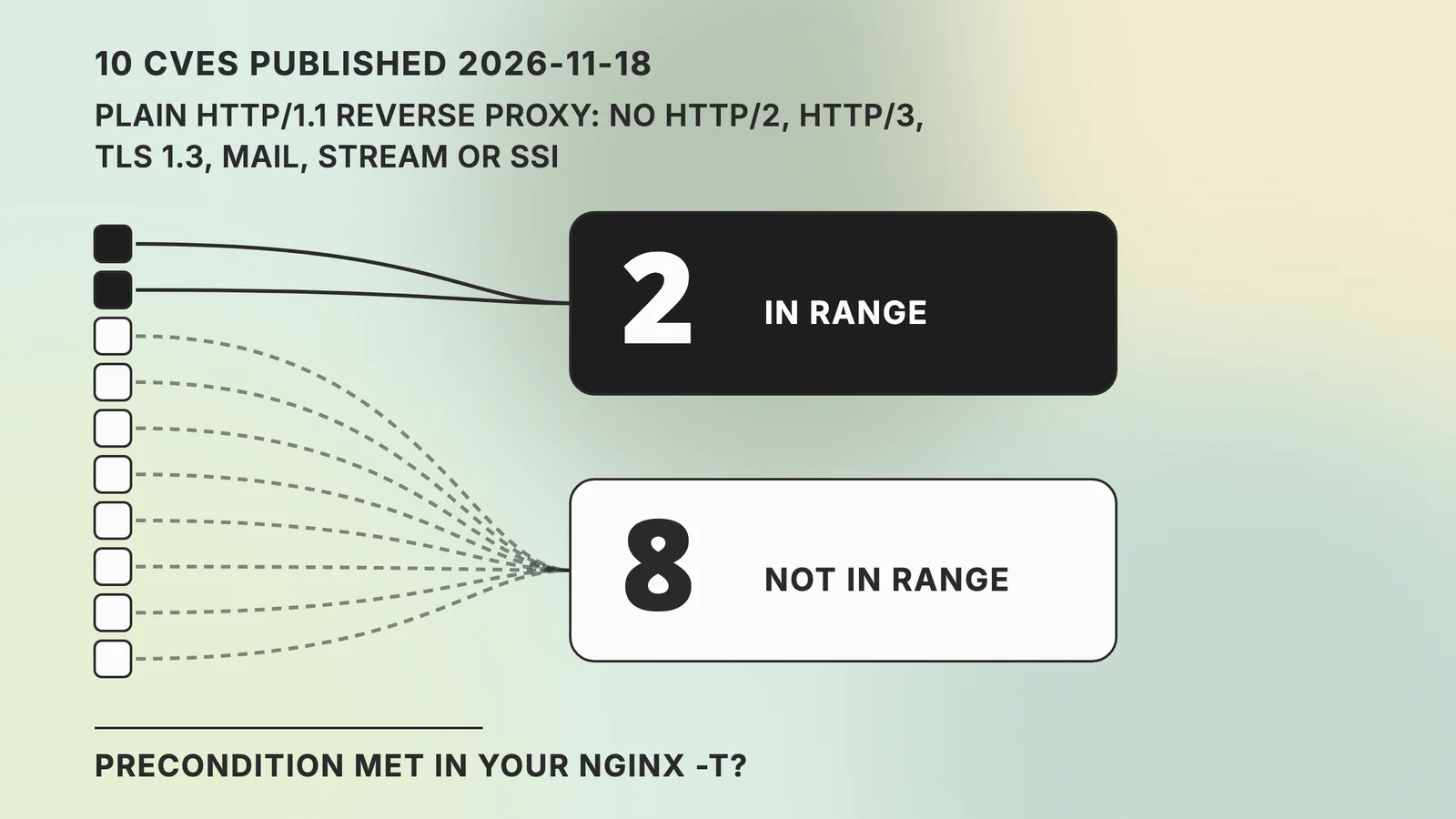
A plain HTTP/1.1 reverse proxy without TLS 1.3, HTTP/2, HTTP/3, mail, stream, or SSI can rule out eight CVEs by condition. CVE-2026-125283 still needs the try_files/alias/map combination. CVE-2026-123634 still needs variable upstream naming plus an SSI or mirror subrequest. An internet-facing edge with HTTP/2 and TLS 1.3 should treat CVE-2026-123007, CVE-2026-123633, and CVE-2026-118899 as reachable until configuration proves otherwise (NGINX security advisories, retrieved 2026-11-19).
How do you check the running binary, package, container, and ingress layer?
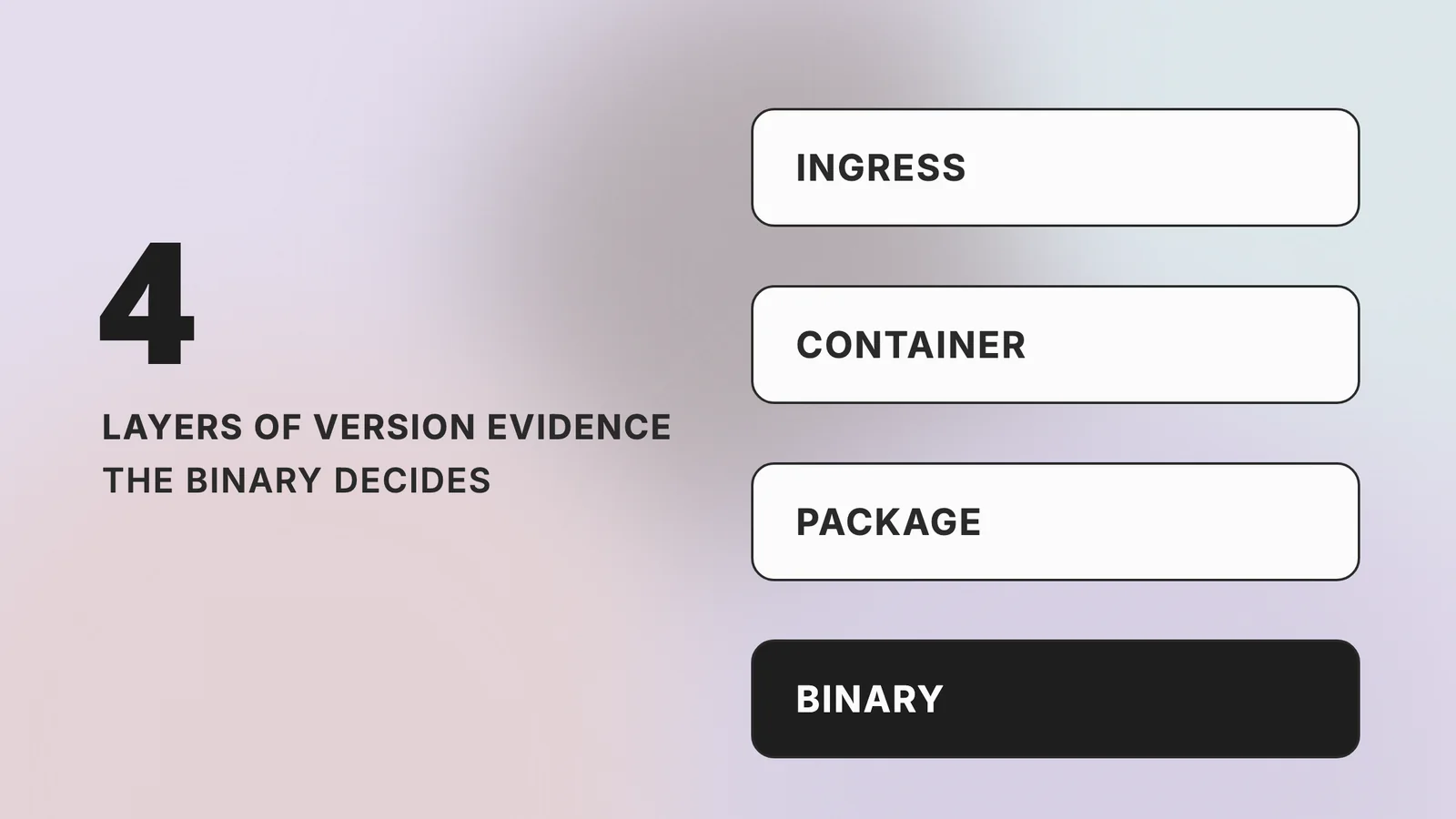
Check the binary serving traffic, its compiled modules, active directives, and its package or image source. A version string alone can’t prove exposure or remediation.
“bash nginx -v nginx -V 2>&1 nginx -T 2>/dev/null | grep -nE ‘http2|http3|quic|ssl_preread|ssl_verify_client|proxy_protocol|ssi on|mirror|try_files|alias|^mail|^stream’ sudo ls -l /proc/$(pgrep -o nginx)/exe dpkg -s nginx 2>/dev/null | grep ‘^Version’ || rpm -q nginx || apk info nginx “
A package upgrade can replace the file on disk while the master still runs the old executable. The /proc path catches that gap. For containers, capture both the immutable digest and the binary inside each live pod:
“bash docker inspect –format ‘{{.Image}} {{index .RepoDigests 0}}’ <container> docker exec <container> nginx -v kubectl get pods -n <ns> -l app=<label> -o custom-columns=’POD:.metadata.name,IMAGEID:.status.containerStatuses[*].imageID’ kubectl exec -n <ns> <pod> — nginx -v “
Distribution packages require a vendor check, not a comparison with the upstream fix number. On 2026-11-19, Ubuntu listed 1.24.0-2ubuntu7.20 for Ubuntu 24.04 and 1.18.0-6ubuntu14.23 for Ubuntu 22.04 as fixed for CVE-2026-123007 (Ubuntu Security, retrieved 2026-11-19). Debian marked sid’s 1.30.6-4 fixed for nine CVEs and CVE-2026-120993 not applicable to its packages (Debian Security Tracker, retrieved 2026-11-19). This is the distro-backport caveat: an older upstream string can be patched. Recheck Red Hat, Amazon Linux, and Alpine before publication.
F5 NGINX Ingress Controller and community ingress-nginx are separate products with separate release trains (F5 docs; kubernetes/ingress-nginx, retrieved 2026-11-19). Record the controller release, bundled nginx -V, image digest, and enabled features; then use that product’s advisory. NGINX Plus has separate release numbering, and End of Technical Support releases weren’t evaluated (CVE-2026-123633, published 2026-11-18). Older Plus branches need an F5 determination.
If your team can’t produce this inventory within a working day, an IT audit can close the ownership and evidence gap before the next advisory.
Which NGINX vulnerability can lead to code execution?
Five records name code execution as a potential impact, always conditionally: ASLR must be disabled or bypassed. They are CVE-2026-123634, CVE-2026-123007, CVE-2026-121810, CVE-2026-123633, and CVE-2026-113425 (CVE-2026-123634, published 2026-11-18).
The wording matters. F5 says the resolver flaw could permit RCE; the HTTP/2, HTTP/3, proxying, and mail records say “potentially,” “possibly,” or “may allow” code execution. Their F5 CVSS 3.1 vectors carry high attack complexity and score 8.1 High, while CVSS 4.0 scores them 9.2 Critical (CVE-2026-123634, published 2026-11-18). NGINX labels are still a separate system. An NGINX RCE headline that drops the ASLR condition or applies to all ten is unsupported.
The other five records describe denial of service, client-certificate verification bypass, or stream routing bypass. CVE-2026-118899 is major, but F5 describes an infinite-loop DoS and makes no code-execution claim (CVE-2026-118899, published 2026-11-18).
As of 2026-11-19, none of the ten appeared in CISA’s KEV catalog, and each CVE record carried CISA SSVC Exploitation: none dated 2026-11-18 (CISA KEV, retrieved 2026-11-19). This dated KEV/SSVC observation isn’t an all-clear and doesn’t support an NGINX zero day claim. Recheck both before rollout.
How do you patch each NGINX distribution channel?
Upgrade to the release your channel identifies as fixed. NGINX’s packages use 1.31.9 mainline or 1.30.7 stable; distro backports, Plus releases, and controller images use their own identifiers (NGINX security advisories, retrieved 2026-11-19).
For official packages, refresh metadata, inspect the candidate, upgrade, and test the configuration. For distro packages, match the full package revision to each vendor CVE page. Custom builds require a rebuild, including compatible third-party modules. A failed module load can turn a security fix into an outage, so preserve the current binary and rollback package.
For containers, rebuilding is only the first step. Push the image, pin its digest, change the workload template, and replace every old replica. A floating tag doesn’t prove what the cluster pulled (Docker Hub: nginx, retrieved 2026-11-19). Record the resulting digest.
Disabling HTTP/2 temporarily removes the preconditions for CVE-2026-123007 and CVE-2026-123633. It can reduce connection efficiency and doesn’t mitigate the TLS 1.3, HTTP/3, mail, stream, resolver, or directive-specific flaws. Use it only for a listener you can’t patch yet, with a removal ticket.
How do you roll out the fix without causing an outage?
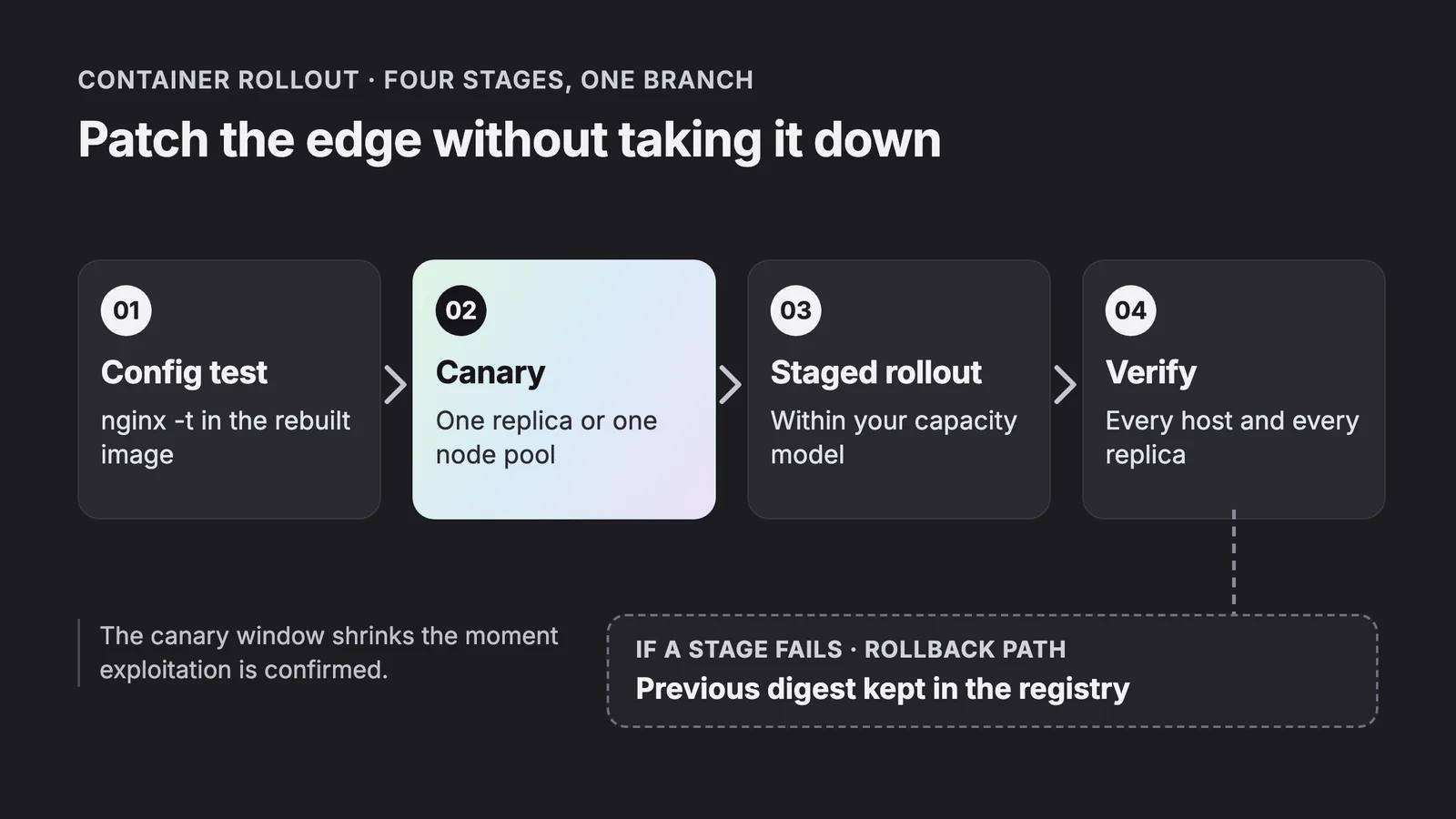
Use a config test, one-replica canary, staged rollout, per-replica verification, and a retained rollback digest. Updating every listener at once closes exposure fastest but concentrates operational risk.
- Rebuild or install the fixed channel release, then run nginx -t against the production configuration.
- Canary one replica or node pool. Watch error rate, upstream connection time, TLS handshake failures, and worker restarts through a representative traffic period.
- Roll out by immutable digest or package revision. Let your capacity model set maxUnavailable.
- Keep the prior image or package until every replica passes verification.
The trade-off is deliberate. A fleet-wide emergency restart reduces the exposure window, but a module incompatibility or changed listener behavior can take down the whole edge. With no confirmed exploitation in the primary sources on 2026-11-19, a controlled canary followed by a staged same-day rollout is safer (CISA KEV, retrieved 2026-11-19). If KEV or a credible exploit appears, shrink the canary window to the time needed to confirm the config test and health checks.
How do you prove every node and replica is fixed?
Remediation is complete when every running master process and pod reports a fixed channel release, with evidence stored for review. A merged Dockerfile, package log, or green deployment status shows intent, not the binary serving traffic.
On hosts, inspect /proc/<master-pid>/exe; (deleted) means the file changed while the old process remained. NGINX’s process-control documentation says a reload re-reads configuration under the existing master rather than replacing that executable (NGINX process control, retrieved 2026-11-19). Package post-install behavior varies.
For each host or pod, retain its name, running version, package revision or image digest, restart time, and nginx -V output. Query all Deployments, DaemonSets, StatefulSets, sidecars, and ingress controllers. kubectl rollout status covers one workload, not the cluster (Kubernetes Deployments, retrieved 2026-11-19).
If exploitation is plausible, copy access logs, error logs, journals, crash evidence, the old binary, and its nginx -V output to storage the host can’t modify before patching. A worker crash or CPU spike isn’t proof of exploitation, but losing the evidence prevents a defensible conclusion.
Conclusion
This NGINX vulnerability batch is ten configuration-specific decisions, not one “critical RCE.” Map each condition, trust the fix identifier for your distribution channel, and prove the running binary changed. A controlled canary preserves availability while exploitation remains unconfirmed; a credible exploit should shorten that window. The durable fix is an inventory that connects every listener to its owner, build source, configuration, and rollout evidence.
Talk to Teamvoy About an IT Audit
If your team can’t list every NGINX binary, package, container and ingress controller it operates, or can’t tell a vendor backport from an unpatched upstream build, the patch isn’t the hard part. Teamvoy’s IT audit maps the edge you actually run and separates Open Source, Plus, distro and container channels. You leave with the inventory and the rollout procedure the next NGINX vulnerability will need. Talk to us about auditing your NGINX estate.