Vibe-Coded Security App: Technical Assessment Before Production
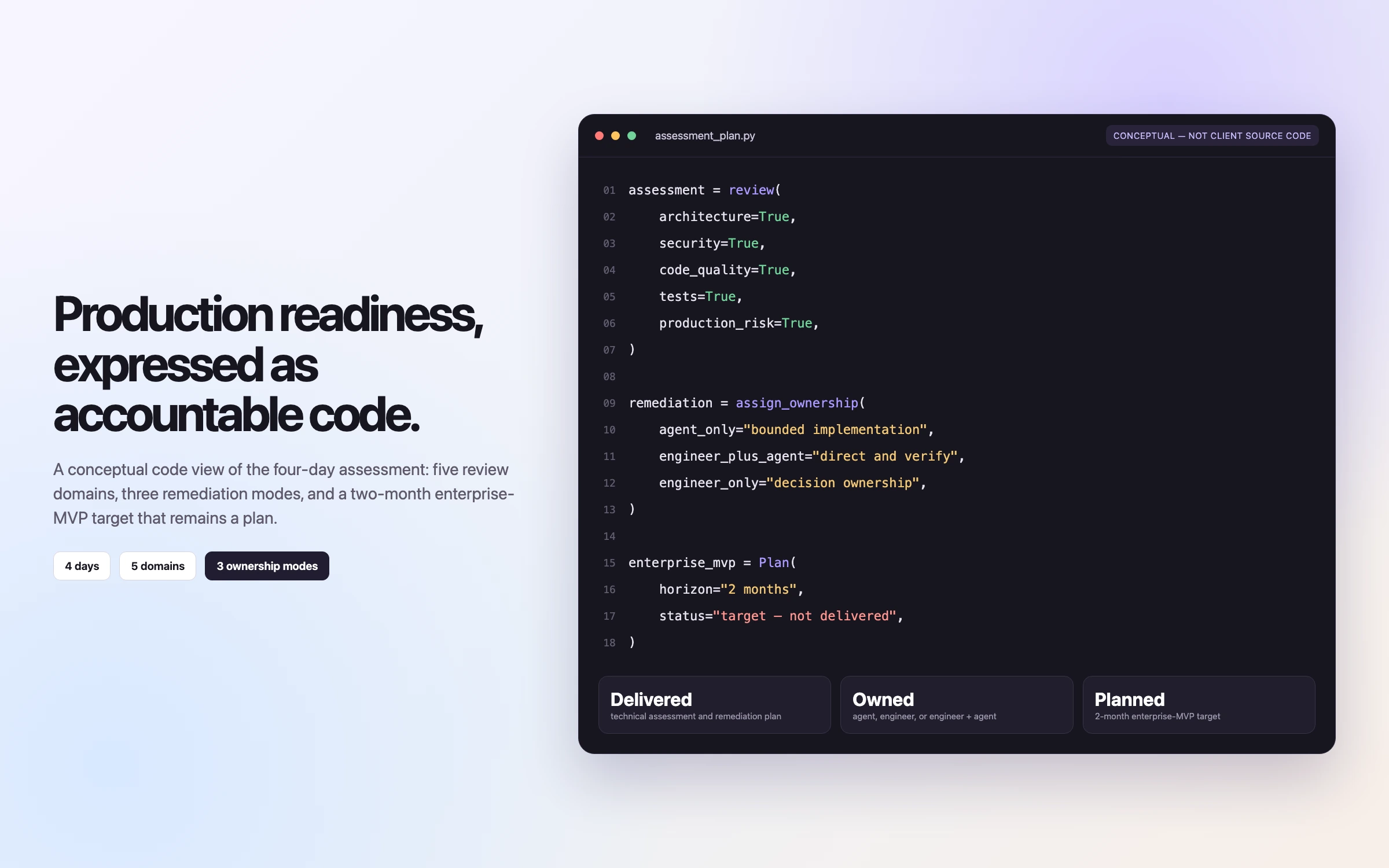
Teamvoy assessed an existing Python security application built with Claude coding agents. The four-day review covered five domains and produced a remediation plan aimed at an enterprise MVP in two months.
| Project detail | Value |
|---|---|
| Application | Existing Python security application built with Claude coding agents; purpose, users, and data remain |
| Engagement | Technical assessment and production-readiness review |
| Assessment duration | Four days |
| Review scope | Architecture, security, code quality, tests, and production risk |
| Delivered output | Prioritized remediation plan with three execution modes |
| Target state | Enterprise MVP in two months; plan only, not a confirmed delivery outcome |
| Team | Software architect led the assessment; full team shape and engagement model remain |
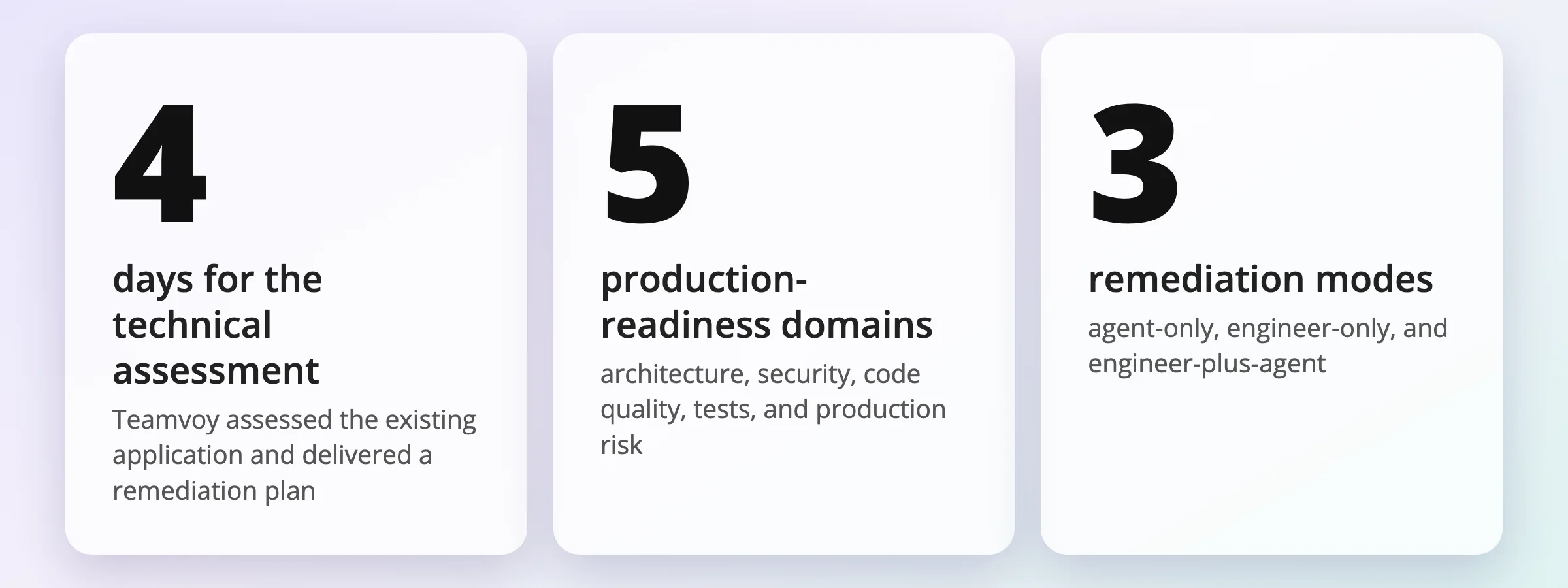
— The assessment took four days, covered five production-readiness domains, and defined three
remediation modes.
01. Summary
A vibe coded app assessment examines whether prompt-generated software can move beyond a working demonstration without transferring hidden risk into production
In four days, Teamvoy reviewed an existing Python application across architecture, security, code quality, tests, and production risk. The output was a prioritized remediation plan with clear ownership boundaries. A vibe coded app can advance quickly when coding agents turn instructions into working features. New behavior can arrive before architecture decisions, operational controls, and acceptance evidence receive the same attention. The demonstrated path may work while distribution, observability, authentication, traceability, and failure handling remain open. The problem is not that an agent wrote code. Generation speed can make delegation look like accountability. The assessment separated those concerns. Some remediation tasks could return to coding agents with defined acceptance checks. Others required an engineer to decide. A third group called for engineer-plus-agent remediation with an engineer directing and verifying the work. This assessment story shows the production gaps and ownership decisions behind the two-month enterprise-MVP plan. The target remains a plan rather than a delivered outcome.
02. Problem
The client needed to know what stood between a vibe coded app and enterprise use
The client needed to know what stood between a vibe coded app and enterprise use. The application was written in Python with Claude coding agents. The missing decision was whether the codebase, product controls, and operating model could support a production commitment.
- Assess the whole application, not only generated code. The review had to connect architecture and code quality to tests, operational behavior, and production risk.
- Preserve attribution. Teamvoy was assessing an existing application. A useful report couldn't imply that Teamvoy had designed the original system or already remediated it.
- Assign ownership, not just priority. Each gap needed an execution path: agent-only, engineer-only, or engineer-plus-agent.
The supplied gap register showed why a narrow AI code security audit lens was insufficient. AI generated code security mattered, but so did dashboards, diagnostics, connector validation, persistent state, recommendation validation, evidence traceability, multi-tenant limits, and performance evidence. These concerns cross product, architecture, testing, and operations. That wider boundary follows the logic behind secure software development: security work belongs across the lifecycle rather than in a final code scan. NIST’s Secure Software Development Framework provides general context for that principle. It is not evidence that this project followed or achieved NIST conformance. Teamvoy’s existing guide explains the broader security risks and limits of vibe coding. This engagement started at the next question: what does this specific application need before someone can take responsibility for it in production?
03. Solution
Teamvoy turned a broad production-readiness concern into two decisions: what needed remediation, and who should own it
An AI code security audit lens covered only part of the problem; security was one domain in a five-domain review. The plan then grouped work into three execution modes, preserving agent speed without assigning engineering judgment to an agent by default.
Five Review Domains Kept the Assessment Wider Than a Code Scan
The production-readiness assessment considered architecture, security, code quality, tests, and production risk. Each domain creates different evidence. Code can look consistent while a vibe coded app lacks operational diagnostics. A feature can pass a demo while relying on data, connectors, or state behavior that hasn’t been validated at enterprise scale. The table groups supplied gaps for publication; the exact internal domain mapping remains.
| Review domain | Assessment question | Relevant supplied gaps |
|---|---|---|
| Architecture | Can the application’s boundaries, state, integrations, and tenancy support the target environment? | Persistent state, connector coverage, platform limits, and multi-tenant constraints were identified as gaps |
| Security | Are identity, distribution, data handling, and control boundaries suitable for enterprise review? | Authentication hardening, installer signing, and external LLM considerations were identified; no compliance status was claimed |
| Code quality | Can engineers understand, change, and verify the AI-generated code safely? | Python and Claude coding agents are confirmed; frameworks, dependencies, and quality metrics are not approved for publication |
| Tests | Do checks cover expected behavior and failure paths well enough to accept remediation? | Tests were in scope; coverage figures and test tooling were not supplied |
| Production risk | Can teams observe, diagnose, support, and scale the application after release? | Monitoring, tracing, dashboards, alerting, diagnostics, evidence traceability, and performance validation remained incomplete |
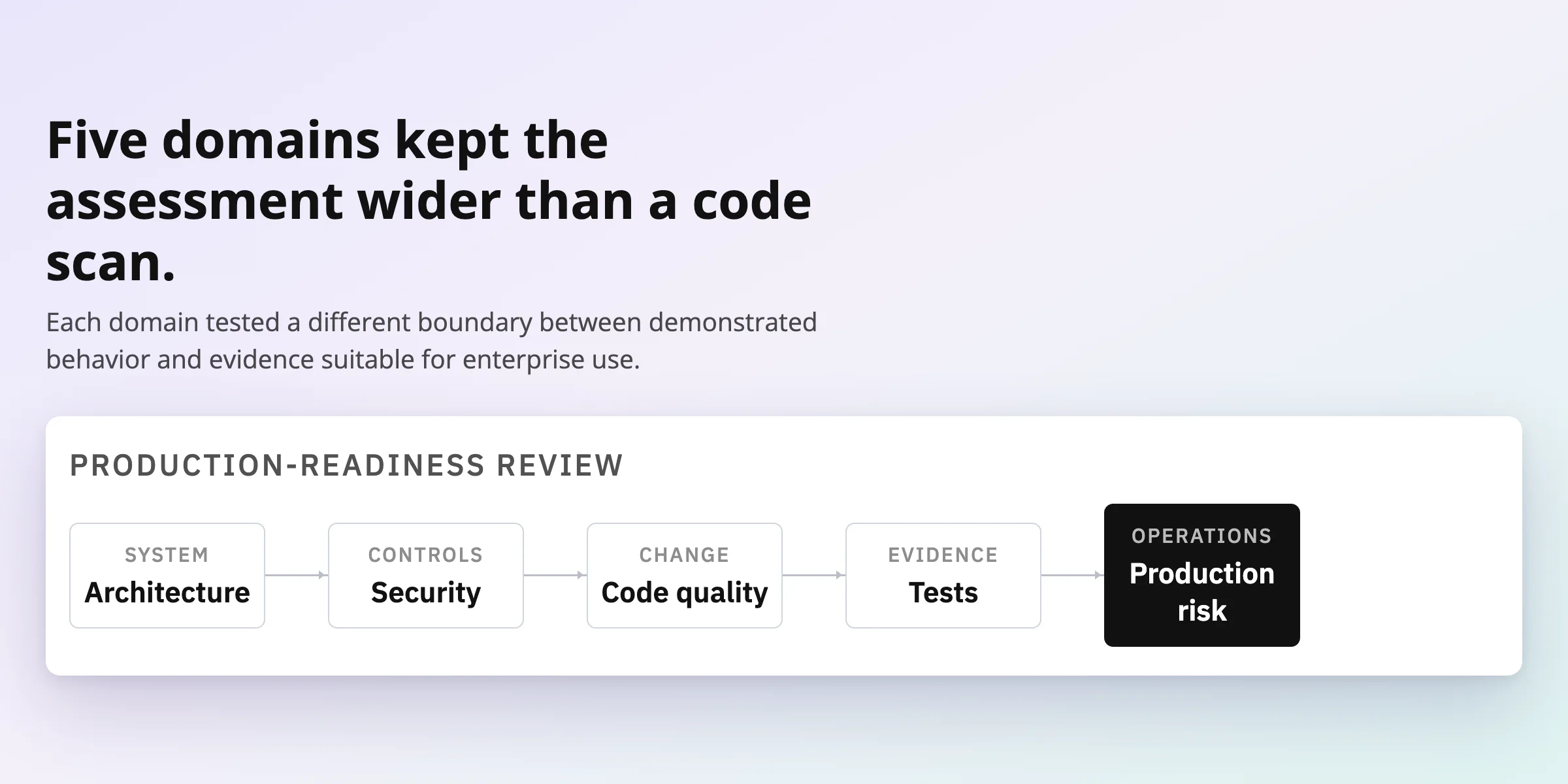
– The production-readiness review covered architecture, security, code quality, tests, and production risk.
The review did not label every item a vulnerability. A missing dashboard is an operational gap. Limited live connector validation is a product-maturity constraint. External LLM use raises questions about data flow, retention, contracts, and customer requirements; it does not prove compliance or noncompliance.
The Gap Register Connected Product Maturity to Production Risk
The supplied findings described demonstrated workflows without all the controls and evidence expected for enterprise use. The assessment kept those gaps visible instead of reducing them to a single security score.
| Gap area | Supplied evidence | Why it affects production readiness |
|---|---|---|
| Packaging and distribution | Unsigned installer, no EV certificate, Windows-only distribution | Enterprise distribution needs a trusted, supportable release path |
| Operational readiness | No unified operational dashboard; incomplete metrics, tracing, alerting, and diagnostics | Operators need to see connector state, approvals, configuration, failures, and system health |
| Product maturity | Limited reconciliation scenarios, live connector coverage, recommendation validation, persistent state, and feedback loops | Demonstrated behavior must become repeatable behavior across supported conditions |
| Evidence and scale | Incomplete evidence traceability and unvalidated enterprise-scale performance | Reviewers need to reconstruct decisions and understand capacity limits |
| Enterprise controls | Authentication needs hardening; licensing is not fully enforceable | Identity and commercial controls must behave predictably in the target environment |
| Platform boundary | Windows-only pipeline and remaining multi-tenant limitations | The deployment model may constrain customer fit, isolation, and support |
Most workflows had been shown on demo data, and only a small subset of connectors had been validated live. That defines the distance between demonstrated capability and evidence that supports an enterprise commitment.
Three Remediation Modes Put Accountability Before Automation
The remediation plan did not send every AI generated code security issue back to a coding agent. It separated work assigned to agents from work assigned to engineers or to engineers working with agents. The exact classification and acceptance criteria remain.
| Remediation mode | Delivered classification | Accountability boundary |
|---|---|---|
| Agent-only | Work the plan assigned to coding agents | Exact review and acceptance process [VERIFY] |
| Engineer-only | Work the plan assigned directly to an engineer | The engineer owns the decision and implementation |
| Engineer plus agent | Work the plan assigned to an engineer using an agent as an implementation tool | The engineer directs the work and owns the result |
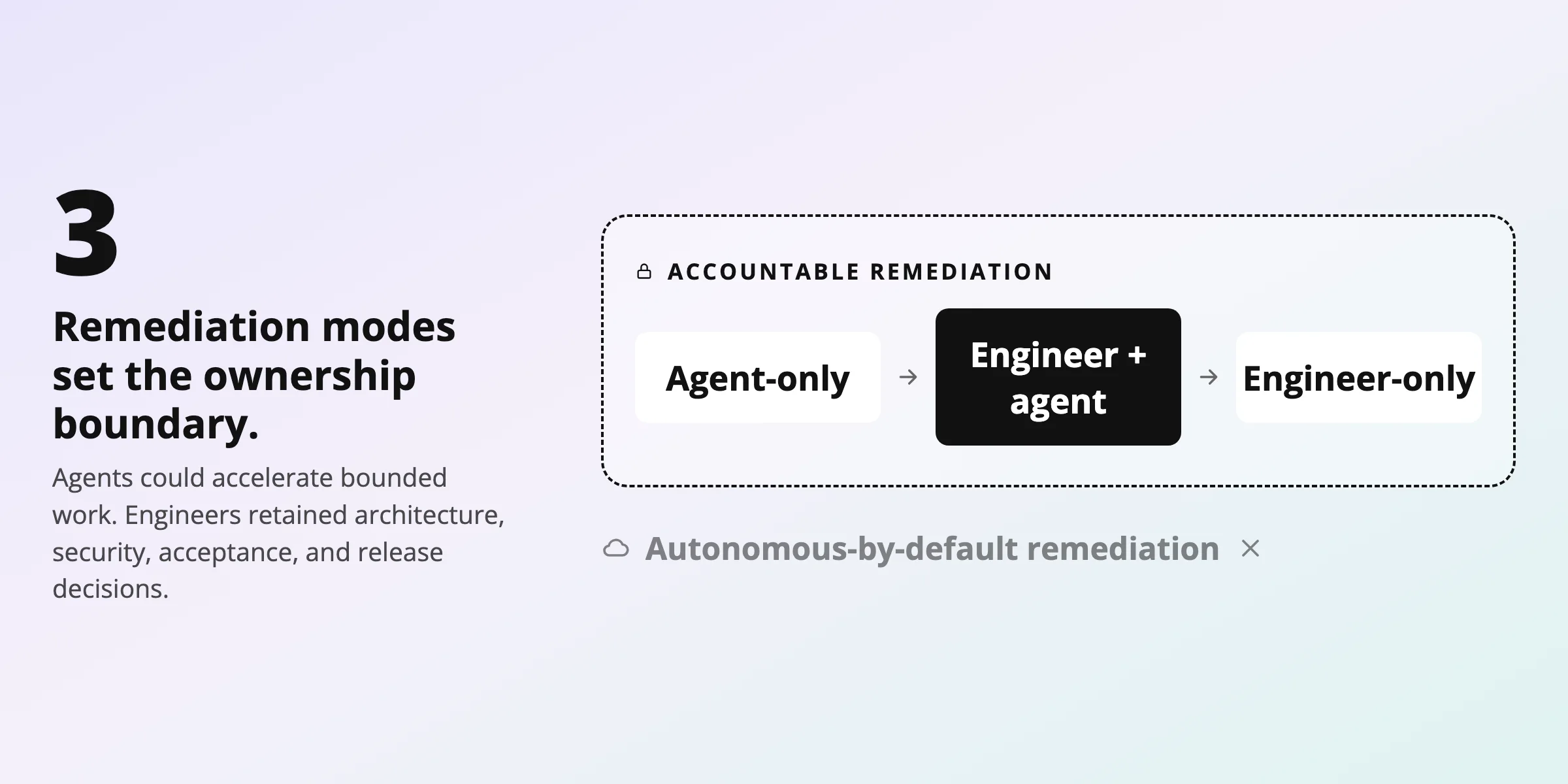
– The remediation plan separated agent-only, engineer-only, and engineer-plus-agent work instead of defaulting every task to autonomous execution.
This was the central trade-off. Maximum agent throughput could shorten parts of remediation, but speed alone could not establish who accepted the security, architecture, and production consequences. The plan traded autonomous throughput for explicit engineering ownership. CISA’s Secure by Design guidance supports the general principle that technology producers should own customer security outcomes. In this case, the practical expression was narrower: every remediation category had a named execution owner.mTeamvoy’s AI-assisted development workflow and guidance on AI code verification and deployment guardrails provide broader implementation context. The project evidence here supports the classification model, not a claim that a specific CI/CD control set was already deployed.
The Assessment Took Four Days. The Plan Targeted Two Months.
The technical assessment was completed in four days. It produced a remediation path intended to reach an enterprise MVP in two months. That second figure is a planning target, not a measured delivery result, and the supplied evidence does not confirm that implementation started or reached production.
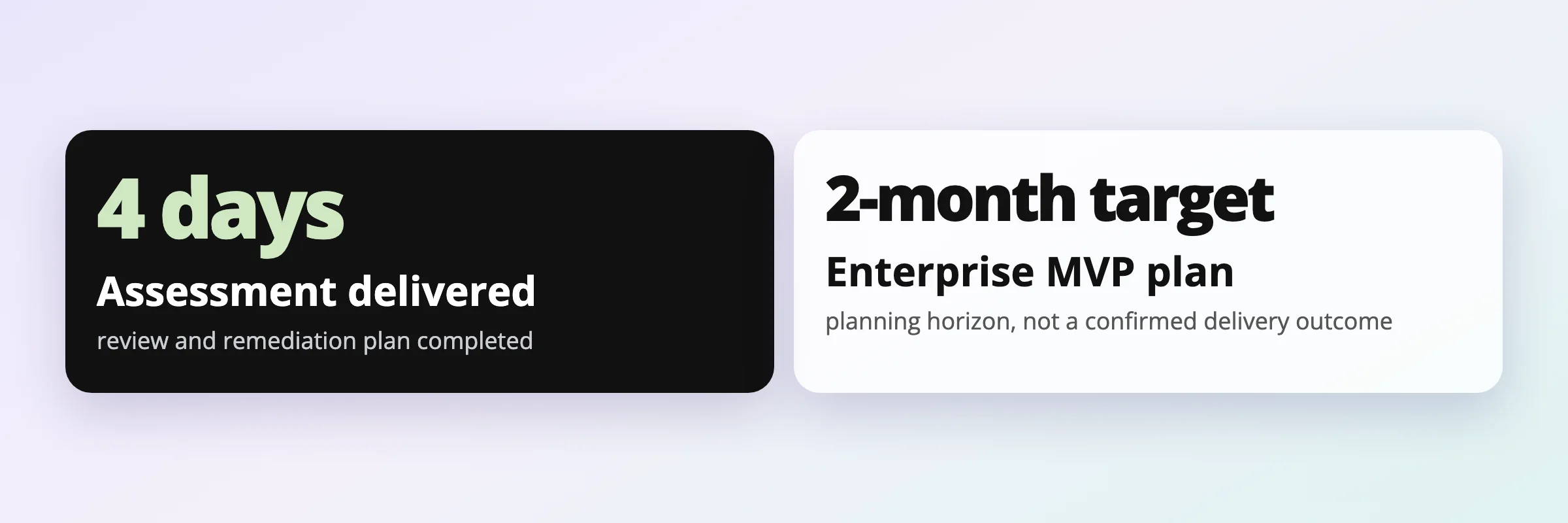
– The four-day assessment was delivered; the two-month enterprise-MVP horizon remained a plan target, not a confirmed outcome.
An assessment can reduce uncertainty quickly because it narrows the problem, groups the risks, and assigns ownership. Remediation still depends on scope, acceptance criteria, engineering capacity, product decisions, and evidence from the target environment. The exact definition of enterprise MVP and the estimate method remain open for approval. The plan did not promise that every gap would disappear within eight weeks. It showed what coding agents could accelerate and where engineering judgment remained on the critical path.
04. Results
The verified results are assessment outputs rather than implementation outcomes: a four-day review, five production-readiness domains, and three remediation modes
Teamvoy delivered the assessment and an accountable route into remediation. The supplied evidence does not yet establish backlog counts, production performance, remediation completion, or an enterprise launch.
| Assessment output | Before | Delivered state | Status |
|---|---|---|---|
| Production-readiness view | A working AI-generated application with unresolved enterprise-use questions | One assessment across architecture, security, code quality, tests, and production risk | Verified |
| Remediation ownership | Not documented in the supplied pre-assessment evidence | Agent-only, engineer-only, and engineer-plus-agent paths defined | Verified; exact item counts |
| Planning horizon | No approved remediation route in the supplied evidence | Two-month enterprise-MVP target | Verified as a plan; definition and estimate method |
| Implementation | Existing application assessed | Remediation start, completion, and production launch | Verified |
| Measured readiness | Baselines not supplied | Test coverage, security posture, deployment readiness, and performance results | Verified |
The deliverable made the next decision explicit: which work could be delegated and which work needed accountable engineering judgment. The remaining constraint is proving each completed item against approved acceptance criteria. The page should remain an assessment story until implementation evidence is available.
The Assessment in Four Numbers
| Number | What it establishes |
|---|---|
| 4 days | Duration of the technical assessment |
| 5 domains | Architecture, security, code quality, tests, and production risk |
| 3 modes | Agent-only, engineer-only, and engineer-plus-agent remediation |
| 2 months | Target for an enterprise MVP plan, not a confirmed outcome |
05. Conclusion
A vibe coded app can reach working software faster than its engineering evidence matures
This assessment did not treat that gap as proof that AI-generated code was unusable. It turned the gap into accountable work: five review domains, a production-readiness register, and three remediation modes tied to engineering ownership.
Talk to Teamvoy About a Production-Readiness Assessment
Tell us what your vibe coded app does today, how it is tested and what enterprise environment it must enter.