
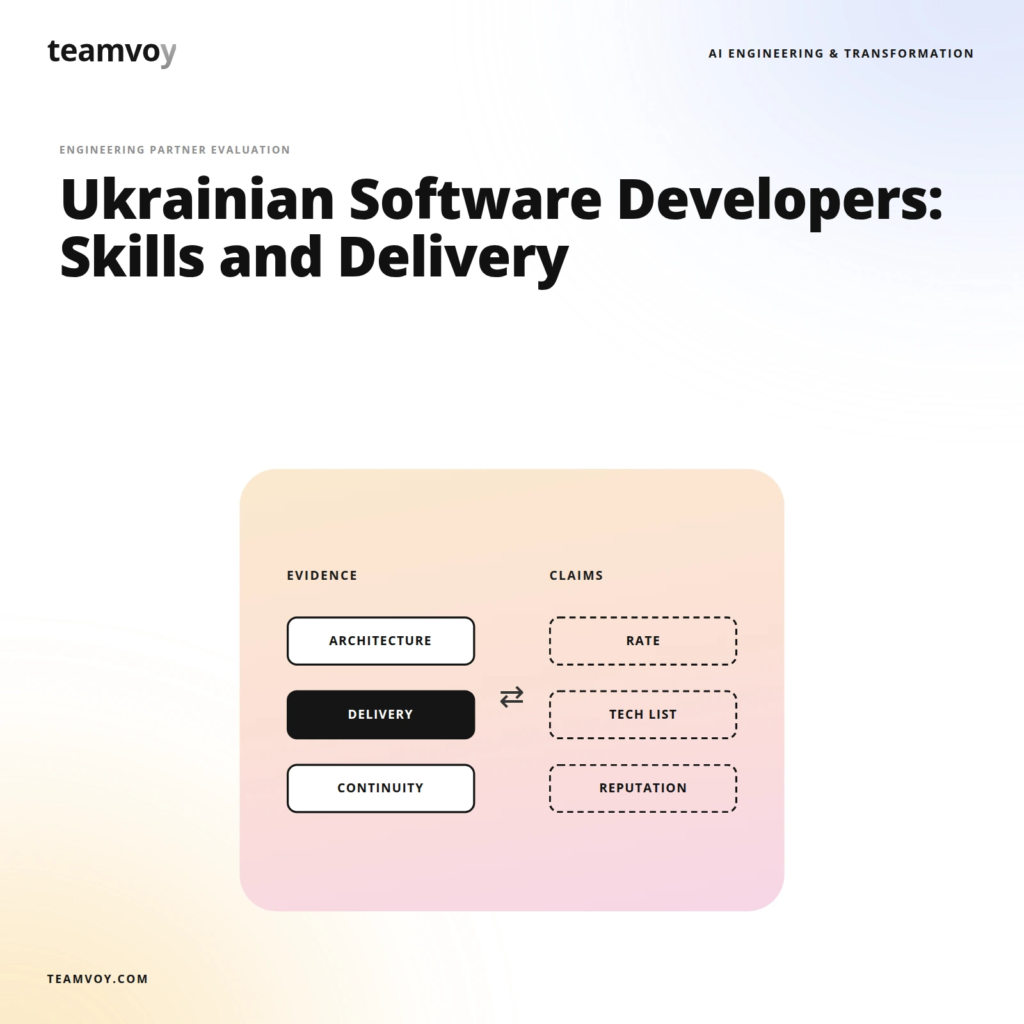
A country-level reputation won’t tell you whether a team can own architecture, production support, and continuity. This guide shows how to evaluate Ukrainian software developers through technical evidence, delivery mechanics, security controls, contract terms, and a paid pilot tied to your actual system.
Key Takeaways
Ukrainian software developers remain part of a large export-oriented technology sector, but geography alone doesn’t predict delivery quality. Buyers should evaluate architecture judgment, communication, security, continuity, and commercial ownership. Ukraine offers a broad engineering market and established international delivery experience. The right decision still depends on evidence from the specific team, not claims about the country. Start with proof from the people who will do the work.
- Use a paid technical exercise tied to your actual system, not a generic coding test.
- Check who owns architecture, production support, security, and delivery risk.
- Review continuity plans for power, connectivity, staffing, and critical incidents.
- Put IP assignment, data access, subcontracting, and exit terms in the contract.
- Choose the engagement model that fits the work, even when that means hiring internally.
| Decision area | Evidence to request | Warning sign | Buyer action |
|---|---|---|---|
| Technical depth | Architecture review, code sample, production examples | Framework lists without design reasoning | Run a system-specific technical interview |
| Delivery ownership | Named delivery lead, release process, escalation path | Responsibility split across unnamed people | Define one accountable owner |
| Continuity | Documented staffing and infrastructure plan | “We have never had an issue” | Test the plan with a scenario |
| Security | Access controls, SDLC practices, audit evidence | Security discussed only after contract signature | Complete security review before access |
| Commercial fit | Scope assumptions, change process, exit terms | Low rate presented as total cost | Compare delivery cost and risk, not hourly price |
The History of Software Engineering in Ukraine
Ukraine’s software engineering base grew from technical education and research institutions, while a private export sector added new paths after independence. This history helps explain the size of the talent market, but you still need to test each engineer’s skills. You also need proof that the company can own production delivery.
Kyiv Polytechnic Institute and Lviv Polytechnic have educated engineers in math, electronics, computer science, and applied engineering. The private software sector then connected that talent to product and services work abroad.
This background matters when you need engineers who can reason across systems, yet a university name or national reputation is weak hiring evidence. Ask a candidate to explain why a service boundary exists and how data failures are handled. They should also explain what monitoring misses and what changes under ten times the load.
Ukrainian programmers work across product companies, service firms, startups, freelance networks, and international engineering organizations. Those environments produce different habits. Your evaluation should distinguish them instead of treating “Ukrainian developer” as one profile. The same applies when comparing developers in Ukraine with engineers working from other locations.
So the work splits in two. The mechanical half is where current tools are strong: find the duplication, apply the transformation, write the characterization test. The judgement half stays with the engineers who carry the consequences. Which duplication was intentional. Where the module boundary belongs. Whether this code should exist at all.
Current State of the Ukrainian IT Industry
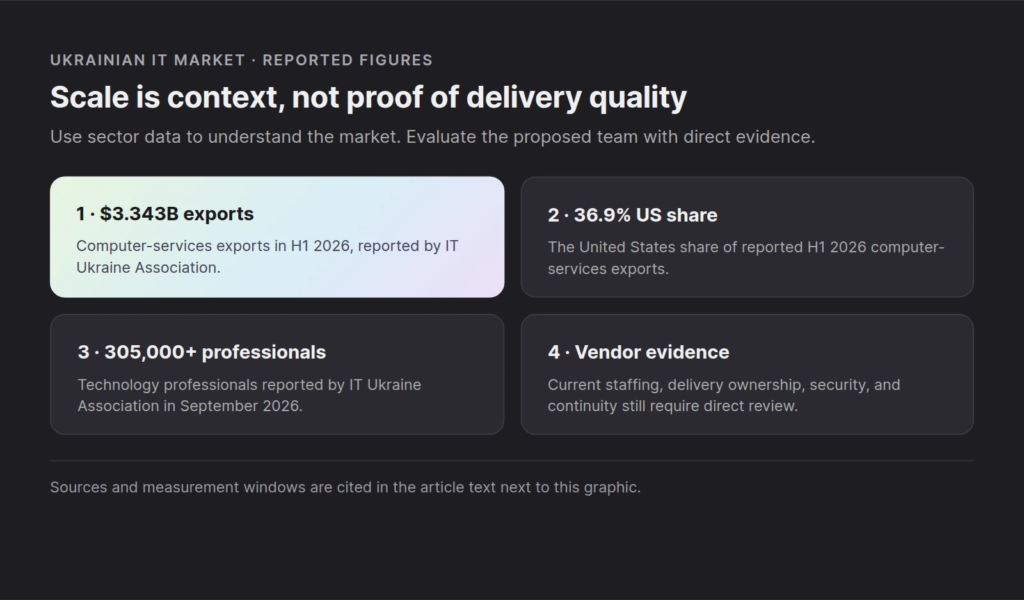
The Ukrainian IT industry remains a major exporter despite wartime and global market pressure. In its August 6, 2026 update, IT Ukraine Association reported $3.343 billion in computer-services exports in the first half of 2026, up 4.1% year over year. The US share was $1.234 billion, or 36.9% (IT Ukraine Association, 2026-08-06).
The National Bank of Ukraine reported $6.8 billion in IT-services exports in 2025, or 12.6% of total goods and services exports. The report also names a global tech downturn as a risk to demand (National Bank of Ukraine, Inflation Report, January 2026). IT Ukraine Association later reported more than 305,000 tech professionals and $6.6 billion in IT-services exports in 2025 (IT Ukraine Association, 2026-09-16). The figures differ across sector summaries, so check their terms and time windows before comparing them.
For a buyer, the conclusion is narrow: software developers in Ukraine still work with clients abroad, and the United States remains a major customer market. Procurement teams should review current staffing, locations, infrastructure, and continuity controls. Sector data doesn’t prove that every vendor has mature operations.
vendor specific evidence
What Makes Ukrainian Developers Unique?
Ukrainian developers are often linked with technical education and work for global clients, but useful differences must still be seen in practice. Look for clear design logic, good writing, and ownership during incidents. Engineers should connect technical choices to product risk, so test these signals instead of relying on assumptions about nationality.
A strong interview for Ukrainian software developers should go beyond syntax. Give the candidate a real system constraint, then ask what information is missing and where the approach can fail. Senior engineers should discuss cost, migration risk, security boundaries, and user impact. Test communication directly because English skill varies by person, as it does in every market. Ask for a short design note, run a live technical discussion, and simulate an incident update. You will see whether the engineer states doubt, raises risk early, and records key choices.
Adaptability also needs proof because a resume with many tools may show frequent context switching rather than depth. Ask what the engineer learned between systems and which rules stayed stable. They should also name a production mistake that changed their work.
Open Source Contributions by Ukrainian Developers
Open-source work offers public evidence of how some Ukrainian programmers design, review, document, and maintain software. The community-run Made in Ukraine repository lists projects made or heavily supported by Ukrainian maintainers. Examples include Ansible, Drizzle ORM, pnpm, AVA, Leaflet, and GraphQL.js.
The repository uses stated criteria, but it is still a community list. Use it to find projects, then check the maintainer and commit history in the project’s own repository. Open-source work can help you assess quality because you can inspect it. Review pull requests, issue threads, release notes, tests, and breaking changes. A star count shows reach. It doesn’t prove that a contributor can work within your system, security model, or contract.
The same rule applies to candidates without public repositories. Proprietary product work can be deeper than public work. Give them another way to demonstrate judgment through a design review, debugging session, or anonymized postmortem.
Key Advantages of Hiring Ukrainian Developers
The main advantages are market depth, work with global clients, and several ways to engage a team. The trade-off is more due diligence because buyers must test continuity, communication, and delivery ownership. A rate comparison won’t answer those questions or expose operating risk.
A broad talent market can support backend, web, mobile, cloud, data, QA, and AI work. Developers from Ukraine have years of cross-border experience. Exported tech services form a large part of the sector. Many software developers in Ukraine build for customers abroad. Each supplier still needs a direct review.
Time-zone overlap can support a useful handoff between Europe and North America. It can also delay decisions when teams depend on synchronous meetings. Define core overlap hours, asynchronous approval rules, and the incidents that justify after-hours escalation.
Cost can be lower than in many US hiring markets. Hourly rates still give an incomplete view. Savings disappear when designs change often, questions wait for answers, or production has no owner. Compare the cost of a stable release and its operation. Don’t compare one engineering hour.
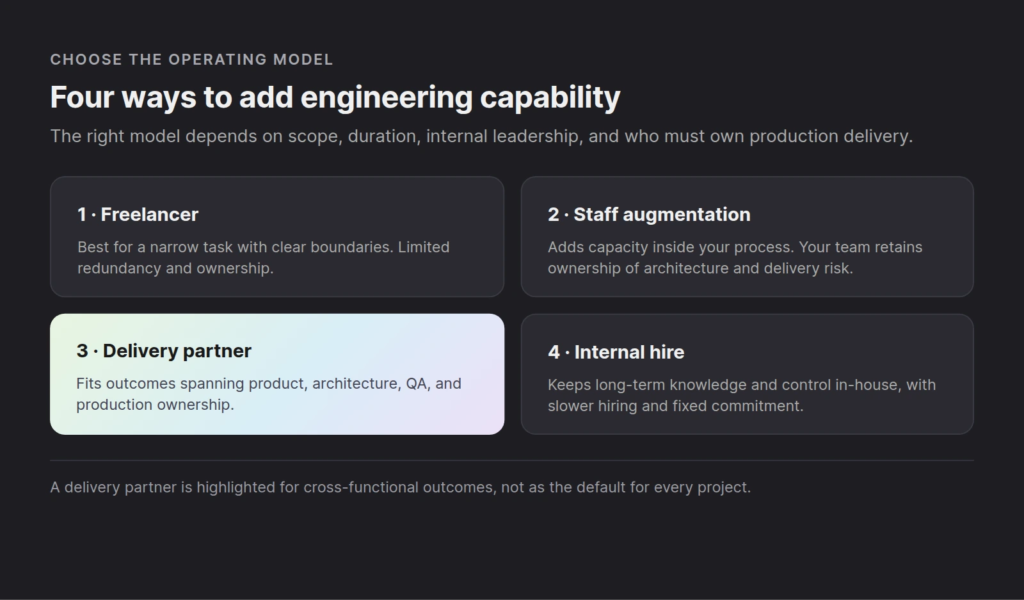
| Model | Best fit | Main advantage | Main trade-off |
|---|---|---|---|
| Freelancer | Narrow task with clear boundaries | Direct access and low setup cost | Limited redundancy and ownership |
| Staff augmentation | Your leaders can own architecture and delivery | Adds capacity inside your process | Your team keeps management and integration risk |
| Delivery partner | Outcome spans product, architecture, QA, and production | One party can own the release path | Higher setup cost and more supplier dependency |
| Internal hire | Long-lived core capability | Knowledge and control stay in-house | Slower hiring and higher fixed commitment |
An internal hire or specialist freelancer can be the better decision for stable, narrow work. An engineering partner earns its cost when the problem crosses architecture, delivery, operations, and product decisions.
Legal and Tax Considerations for Outsourcing to Ukraine
Ukraine’s Diia City regime sets rules for qualifying tech companies and includes employment and gig-contract models. It doesn’t replace buyer due diligence. Your contract still needs terms for IP, data, subcontractors, security, continuity, payment, governing law, and exit support for your project. The governing law is Ukraine’s Law No. 1667-IX on stimulating the development of the digital economy (Verkhovna Rada, current text). Confirm whether the supplier is a Diia City resident and which entity will sign the agreement. A vendor’s tax status doesn’t automatically change your rights or obligations.
Ask counsel to review at least these areas:
- IP assignment for source code, models, prompts, documentation, designs, and inventions.
- Data-processing roles, cross-border transfers, retention, deletion, and incident notice.
- Use of subcontractors and the right to approve access to sensitive systems.
- Security requirements, audit evidence, vulnerability handling, and access removal.
- Sanctions, export controls, sector-specific regulation, and customer restrictions.
- Continuity, termination assistance, repository access, and knowledge transfer.
Treat this section as procurement context rather than legal advice. The correct contract depends on your jurisdiction, data, industry, and the entities involved.
How to Select the Right Ukrainian Software Development Partner
Select a Ukrainian software development partner by testing the exact capabilities your project needs. The strongest process combines technical evidence, delivery evidence, commercial clarity, security review, and a small paid scope. References and certifications can support the decision, but they shouldn’t replace direct evaluation.
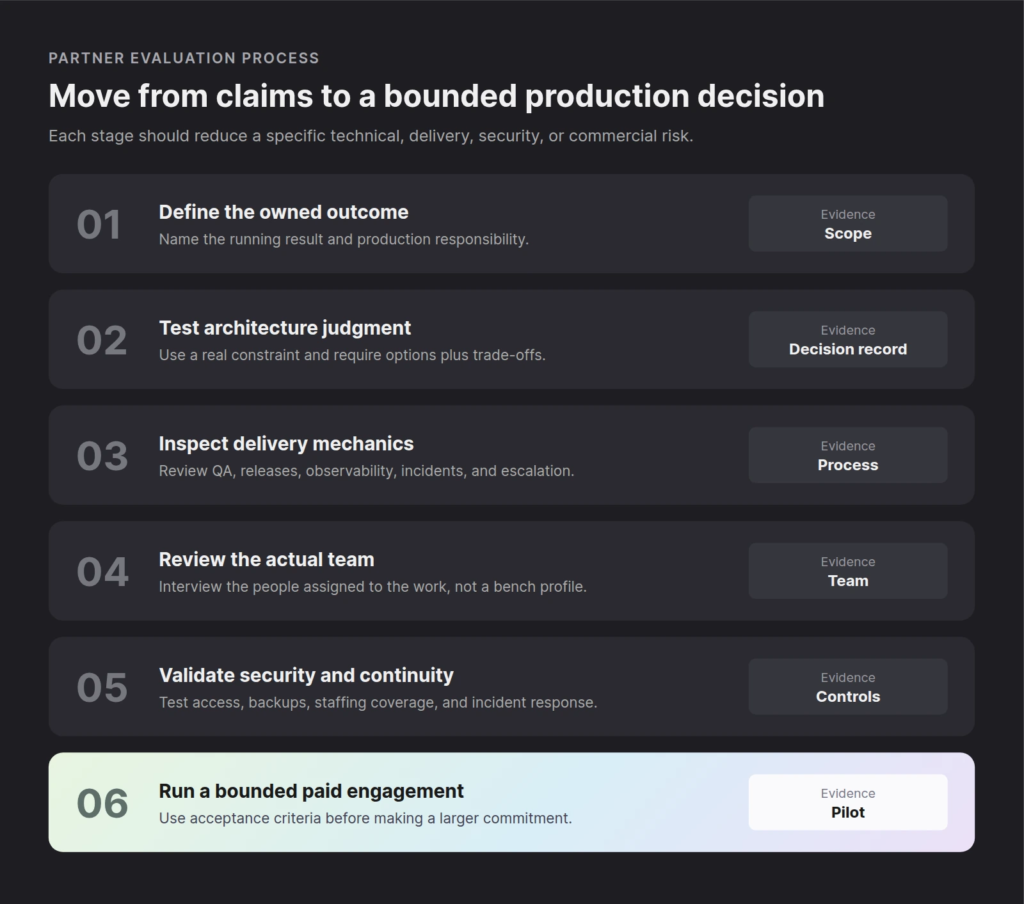
Use this six-step process:
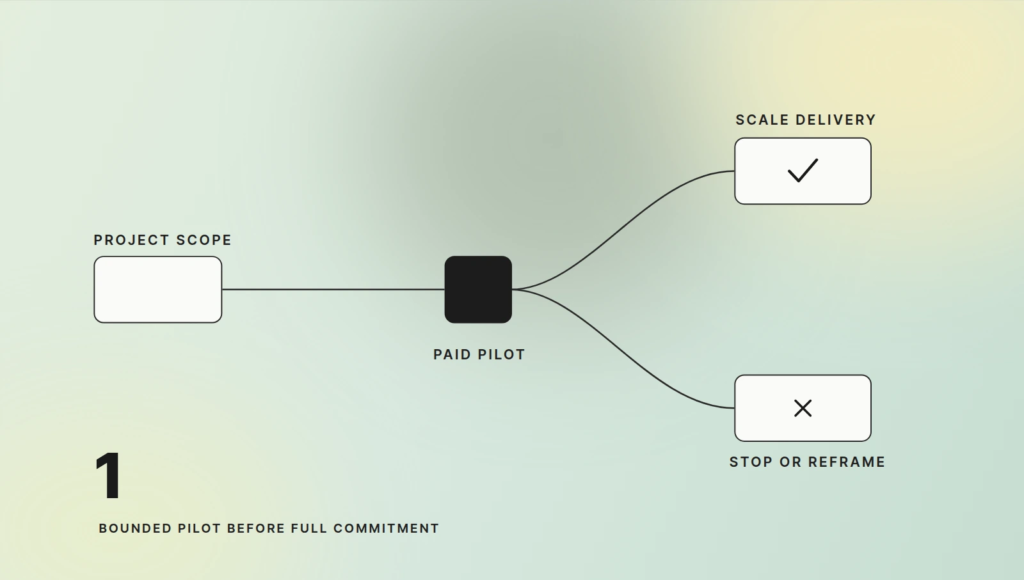
- Start with a bounded paid engagement. Choose an audit, prototype, migration slice, or production hardening task with acceptance criteria.
- Define the owned outcome. State what must be running, who uses it, and what production responsibility the supplier carries.
- Test architecture judgment. Review a real constraint from your system and ask for options, risks, and a recommended path.
- Inspect delivery mechanics. Check planning, code review, QA, release controls, observability, incident response, and decision records.
- Review the actual team. Interview the people who will do the work, not only sales or leadership.
- Validate security and continuity. Test access controls, business continuity, backups, staffing coverage, and escalation.
- Start with a bounded paid engagement. Choose an audit, prototype, migration slice, or production hardening task with acceptance criteria.
delivery team controls and a paid pilot
| Area | Evidence to request | Interview question | Warning sign |
|---|---|---|---|
| Architecture | Diagram and decision record from a comparable system | “Which option would you reject, and why?” | One recommendation with no alternatives |
| Product thinking | Scope assumptions and success criteria | “What should we avoid building?” | Every request becomes a feature |
| Quality | Test strategy, review rules, release checklist | “What can reach production without manual approval?” | Quality described only as QA’s job |
| Operations | Monitoring, on-call, incident example | “What happens when this fails at 2 a.m.?” | No named production owner |
| Communication | Status sample and escalation policy | “When do you tell us a date is at risk?” | Risk appears only near the deadline |
| Commercial model | Roles, dependencies, change rules, exit terms | “What remains our responsibility?” | Scope is broad but accountability is vague |
Industry experience matters when software must follow domain rules. Banking, insurance, health, and industrial teams need engineers who understand audit needs and customer harm. They must also understand operating risk. Ask how the system works, not which logos appear on a slide. For AI work, ask about evals, grounding, logs, cost control, human review, and production support. Teamvoy’s page on how to hire AI engineers explains embedded, squad, and fixed-scope models.
engagement
Teamvoy’s Approach to AI Modernization and Digital Transformation
Teamvoy focuses on AI development services and app modernization. It doesn’t act as a general developer marketplace. Work can start with an IT audit, a short sprint, one engineer, or a delivery team. The right model depends on what your team can own. For legacy systems, Teamvoy’s application modernization services cover assessment, design, integration, staged migration, data work, and production support. The team changes the system in small stages. This avoids a long feature freeze or one high-risk cutover.
For uncertain scope, an IT audit can be a lower-risk starting point than committing to a full build. It should leave you with a usable technical plan even if you choose another supplier for implementation. Teamvoy isn’t the right fit for every hiring need. A narrow maintenance task may suit a freelancer. A lasting core skill may justify a direct hire. A partner makes more sense when one problem spans AI, old systems, data, links, security, and production.
Conclusion
This talent market gives buyers access to engineers with current international delivery activity. The hiring case becomes credible only when the specific team proves technical judgment, communication, continuity, security, and ownership. Choose the work model that fits the problem. Keep narrow work narrow. When the work spans AI, old systems, data links, and production, judge partners by the result they can own. If you need help defining that scope, discuss the engineering problem with Teamvoy.