
Key takeaways
AI code refactoring uses language models and static analysis to restructure existing code without changing what it does, and it reduces technical debt only where tests, review and CI already work. The 2025 evidence points both ways. GitClear finds copy-pasted code rising while refactoring collapses, DORA finds AI raising delivery throughput and lowering stability, and METR finds experienced developers 19% slower with AI while believing they were faster. The practices below are the ones that survive that evidence.
- AI code refactoring works on duplication, mechanical transformation and test generation, not on architecture.
- Copy-pasted code rose from 8.3% to 12.3% of changed lines between 2020 and 2024 (GitClear).
- Refactored lines fell from 25% in 2021 to under 10% in 2024, the first time copy-paste exceeded reuse.
- Experienced developers were 19% slower with AI tools and believed they were 20% faster (METR, 2025).
- Characterization tests come before the first AI-suggested change, or the change cannot be verified.
What AI code refactoring is
AI code refactoring is the use of language models and static analysis to apply behaviour-preserving transformations to an existing codebase: extracting duplicated logic, renaming, splitting long functions, migrating framework versions, and generating the tests that prove nothing changed. Martin Fowler’s definition still governs it, “small behavior-preserving transformations”. The model proposes the transformation. The test suite decides whether it ships.
That distinction carries most of the practical difference between a useful refactoring pass and an expensive one. A model can rewrite a 400-line function into six named functions in seconds. It has no way of knowing that the odd branch in the middle exists because a payment processor returns a bad timestamp on the last day of the month. Somebody wrote that branch deliberately, without a comment, four years ago.
So the work splits in two. The mechanical half is where current tools are strong: find the duplication, apply the transformation, write the characterization test. The judgement half stays with the engineers who carry the consequences. Which duplication was intentional. Where the module boundary belongs. Whether this code should exist at all.
Understanding Technical Debt in the Age of AI
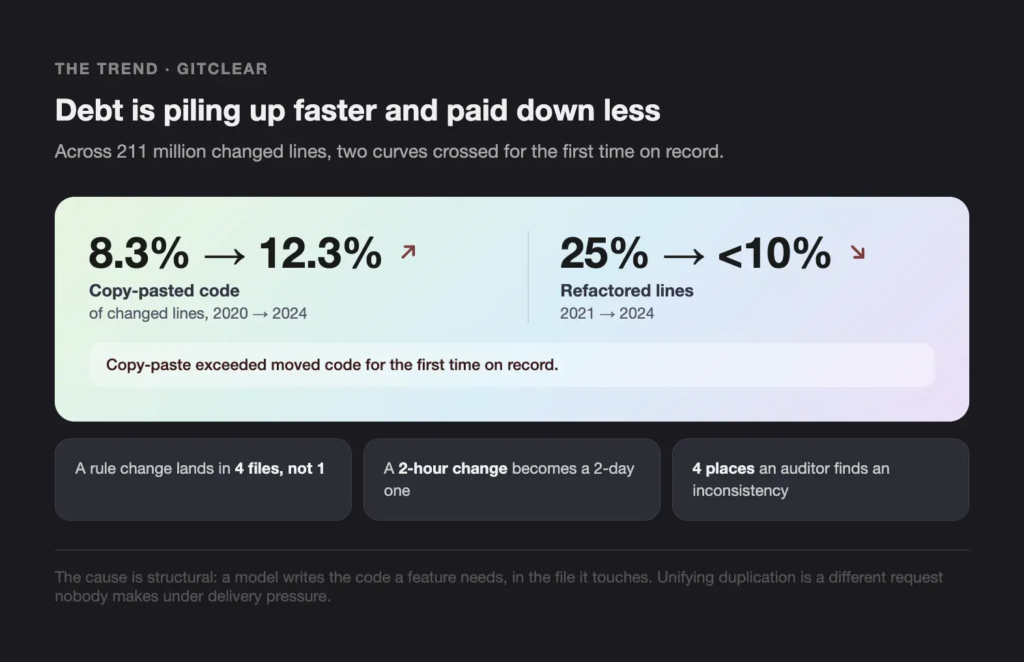
Technical debt management changed shape in 2024. GitClear’s analysis of 211 million changed lines found copy-pasted code rising from 8.3% to 12.3% between 2020 and 2024, while lines associated with refactoring fell from 25% in 2021 to under 10% in 2024. Copy-paste exceeded moved code for the first time on record. Debt is accumulating faster and being paid down less often, which is what technical debt management now has to account for.
The reason is structural rather than cultural. A model asked to add a feature writes the code that feature needs, in the file it touches. That is the request. Finding the three places that already do something similar and unifying them is a different request. Nobody makes it under delivery pressure.
For a CTO the consequence is a budget line, not a code-quality complaint. Duplicated logic means a rule change lands in four files instead of one. A two-hour change becomes a two-day change, with three chances to miss a copy. In a regulated system it also means four places an auditor can find an inconsistency. This is the cost curve behind why teams are modernizing now rather than later, and AI has made the curve steeper rather than flatter.
How AI Code Refactoring Reduces Technical Debt
AI code refactoring reduces technical debt on three tasks: finding duplicated logic across a large codebase, applying mechanical transformations at scale, and generating characterization tests for code that has none. Tools including Claude Code, GitHub Copilot, Cursor and Gemini CLI now run these across whole repositories rather than single files. The task they do not perform is deciding which duplication was deliberate.
To reduce technical debt at that scale, the tools have to run inside the repository rather than in a chat window. The scale change is real, and it is the reason the technique is worth using at all. Finding every place a currency conversion is hand-written across 900 files used to take a week of grep and judgement. It now takes an afternoon. The output is a list a senior engineer can argue with, rather than a task nobody starts.
What the tools do with that list is where the honest reading begins.
| Task | How well AI does it | What it still needs from a human |
|---|---|---|
| Finding duplicated logic | Strong across whole repositories; catches near-duplicates that grep misses | Deciding which duplicates were deliberate divergence |
| Mechanical transformation (rename, extract, split) | Strong and fast; consistent across hundreds of call sites | A test suite that proves behaviour held |
| Framework and language version migration | Good on well-documented paths; weak on internal or forked libraries | The list of libraries the model has never seen |
| Generating characterization tests | Good at covering the happy path | Every edge case the business actually depends on, which is where the debt lives |
| Choosing module boundaries | Weak; proposes boundaries that match file layout rather than transactions | The whole decision |
| Deciding what to refactor first | Weak; has no access to commit history, incidents or roadmap | The whole decision |
Four of those six rows end with a human. That ratio is the planning number, rather than the speed-up figure. A team that budgets review capacity against it usually ships. A team that budgets against the demo does not.
Risks and Pitfalls of AI-Generated Code
AI code review catches formatting drift and obvious duplication reliably, and misses architectural drift almost entirely. METR’s 2025 randomized trial put 16 experienced developers on 246 real issues in repositories they already knew well. With AI tools they were 19% slower. They had forecast a 24% speed-up beforehand, and afterwards still believed they had been 20% faster. The perception gap is the risk, more than the code.
That result is worth reading in full rather than quoting in part. It cuts against what almost every vendor on this topic sells, including us. These were experts working on familiar code. That is the setting where AI helps least, and it is where most enterprise refactoring happens. On unfamiliar code the same tools help a great deal.
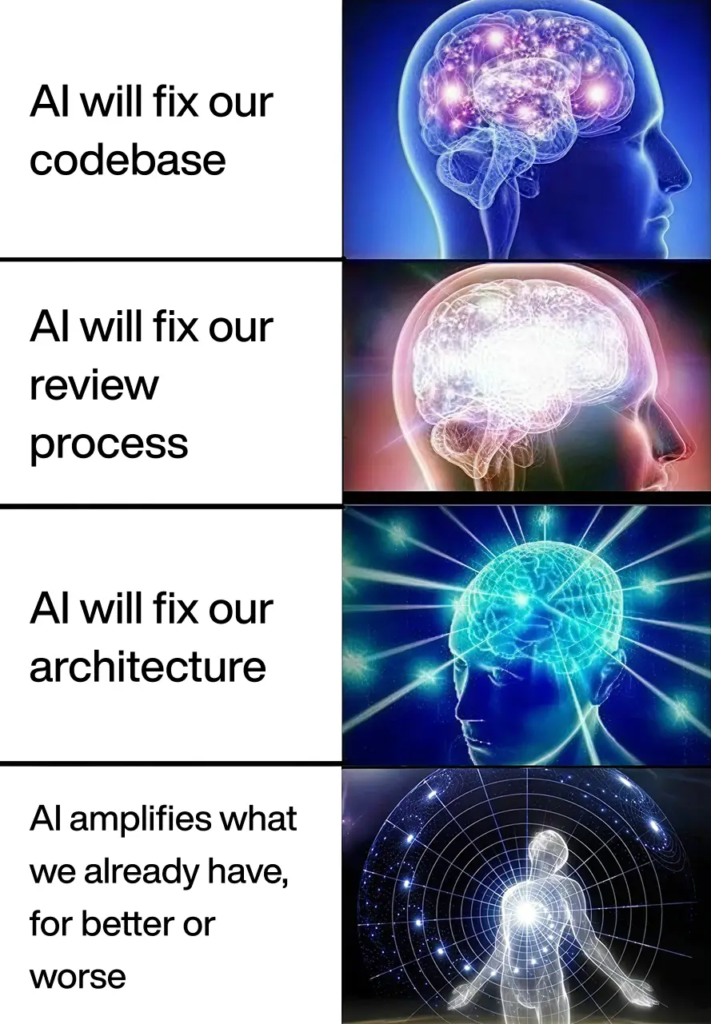
DORA’s 2025 report frames the same effect at organisation scale: 90% of respondents use AI at work, adoption relates positively to delivery throughput and negatively to delivery stability, and 30% report little or no trust in the code it produces. Its conclusion is that AI amplifies whatever is already there rather than fixing it. Teams with loose coupling and fast feedback get gains. Teams with tight coupling and slow review get volume. An AI code review step in the pipeline helps with the first group and adds noise to the second.
Practitioners have priced this in. In the 2025 Stack Overflow survey, 46% of developers said they distrust the accuracy of AI output, 33% said they trust it, and 3.1% said they highly trust it. A refactoring programme that assumes eager adoption is planning against a group that is, on balance, sceptical.
Governance and Controls in AI Refactoring
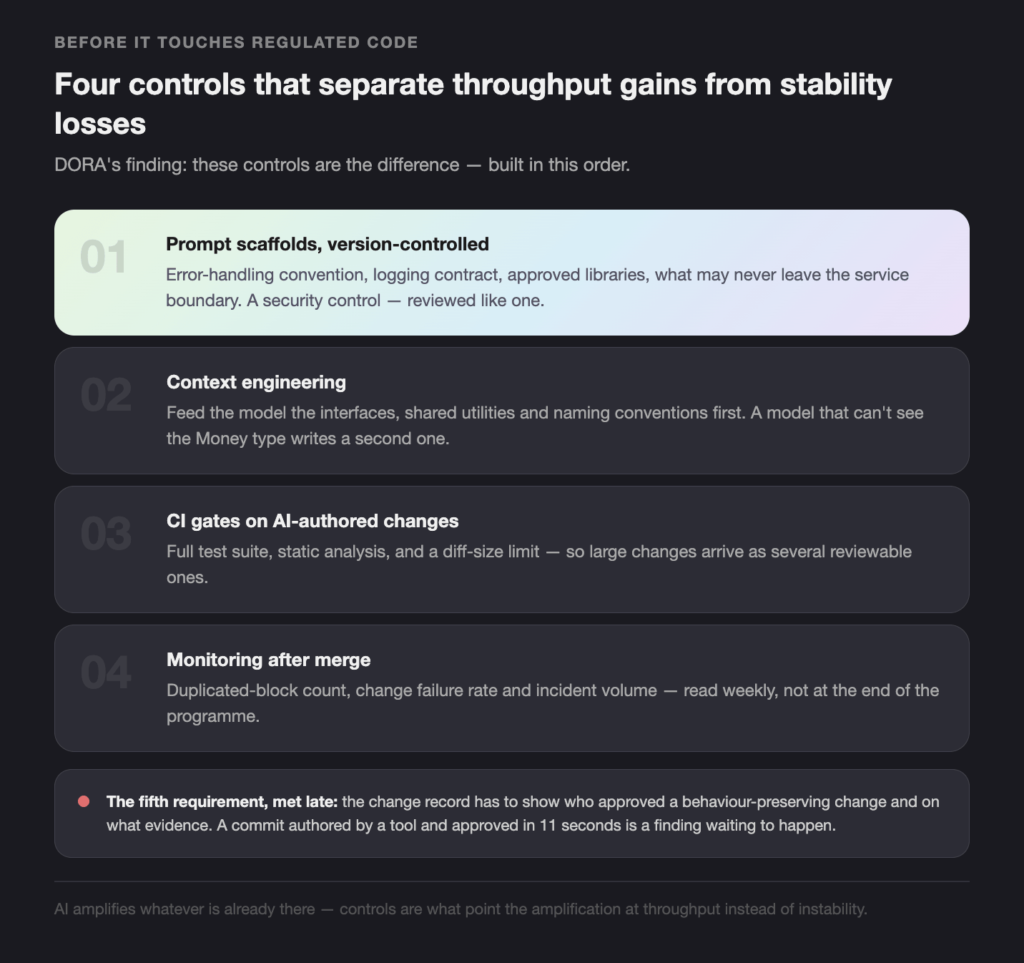
Automated code refactoring needs four controls before it touches a regulated codebase. State the architectural and security constraints in the prompt scaffold. Supply the existing interfaces as context so the model reuses rather than reinvents. Gate every AI-authored change on the full suite plus static analysis. Budget the diff. DORA’s finding is that these controls are what separates throughput gains from stability losses.
The four, in the order they get built:
- Prompt scaffolds, version-controlled. The constraints that matter belong in a checked-in scaffold: the error-handling convention, the logging contract, the approved libraries, and what may never leave the service boundary. A scaffold beats whatever an engineer typed that morning. Prompt wording changes secure-generation rates, so the scaffold is a security control and gets reviewed like one.
- Context engineering. Feed the model the interface definitions, the shared utility modules and the naming conventions before asking for a change. A model that cannot see the existing Money type will write a second one.
- CI gates on AI-authored changes. Full test suite, static analysis, and a diff-size limit. Large changes then arrive as several reviewable ones. This is the same discipline described in the playbook for AI agents inside a CI/CD pipeline, applied to refactoring rather than deployment.
- Monitoring after merge. Duplicated-block count, change failure rate and incident volume, read weekly rather than at the end of the programme.
Automated code refactoring inside a regulated system carries a fifth requirement that engineering teams often meet late. The change record has to show who approved a behaviour-preserving change and on what evidence. A commit authored by a tool and approved in eleven seconds is a finding waiting to happen, whatever the code looks like.anizations make informed, strategic decisions about which applications to modernize and how.
AI Modernization Sprint: Accelerating Transformation
An AI modernization sprint rapidly assesses and upgrades legacy applications by integrating AI-driven automation and analytics. This approach enables quick wins, reduces risk, and creates a foundation for ongoing innovation, making modernization both efficient and strategically aligned with business objectives.
An AI modernization sprint is a focused, accelerated effort to modernize legacy systems by embedding AI and automation from the start. At Teamvoy, our AI modernization sprint begins with a rapid assessment of your existing applications, identifying opportunities for AI integration and intelligent automation.
This sprint-based approach delivers early value and reduces risk. By tackling modernization in short, iterative cycles, organizations can test new ideas, address challenges quickly, and show measurable progress. For example, automating data processing in a legacy system can free teams for higher-value work and lay groundwork for future innovation.
Sprints also make it easier to align IT changes with business objectives, ensuring that every modernization step contributes to company goals. For a deeper dive into this approach, see our detailed post on AI Modernization Sprints: A New Delivery Model for Companies That Can’t Afford a Rewrite. AI gateway in front of the providers is what makes switching between them a config change rather than a project.The next three are slow delivery at 20%, distrust of the payment form at 19%, and forced account creation at 18%.
Best Practices for AI Code Refactoring
Code refactoring pays back where change is frequent, so prioritize by commit frequency and incident history rather than by how bad the code looks. A module nobody has touched in three years is stable by definition, and refactoring it spends scarce review capacity for no return. Start where the next two quarters of roadmap actually land. Anywhere else, the work costs review time and does not reduce technical debt that anyone is paying interest on.
Four practices hold across the engagements where this works.
Rank by change frequency crossed with incident history. Both numbers are already in the repository and the incident tracker. The overlap is usually five to fifteen files. It is rarely the file the team complains about most.
Refactor in one behaviour-preserving pass, then change behaviour in a second. A pull request that both restructures and fixes is hard to review. It is also the shape AI tools produce by default unless told otherwise.
Cap the diff. Several hundred lines is a review; several thousand is a rubber stamp. The cap is the control. Reviewers honour it when CI enforces it, rather than when a meeting requests it.
Pair the model with the person who owns the module. The same approach applies when moving a legacy Rails app to an AI-enabled architecture: the model handles volume. The owner supplies the four facts about the system that nobody wrote down.
The trade-off is explicit. Two passes and a diff cap make the first feature slower than a single large rewrite would have been. Payback arrives on the third and fourth change to the same module. A code refactoring programme that cannot wait that long should not start.
Implementing AI Refactoring in Legacy Systems
Refactoring legacy code with AI starts with characterization tests, which capture what the system currently does including the behaviour nobody intended. Without them, a behaviour-preserving transformation and a silent change look identical in a diff. The sequence below runs in five phases, each with an exit condition, and each phase reaches production before the next one starts.
| Phase | What happens | Exit condition |
|---|---|---|
| 1. Map | Commit frequency, incident history and dependency graph pulled; target modules ranked | A ranked list of 5 to 15 files agreed with the module owners |
| 2. Characterize | AI generates characterization tests against current behaviour; owners add the edge cases | Suite passes against unmodified code and covers the known edge cases |
| 3. Transform | Behaviour-preserving changes only, capped diff, one module at a time | Every change green on the full suite and static analysis |
| 4. Ship | Merged and deployed behind the existing release process | One full release cycle with no regression attributed to the pass |
| 5. Measure | Duplicated-block count, change failure rate and review time compared with the pre-work baseline | Baseline comparison written up and the next target list agreed |
This is the same delivery shape as AI modernization sprints, and it sits inside the wider question of application modernization rather than replacing it. Refactoring legacy code this way is slower per change than a rewrite. It also avoids a delivery freeze, which is the trade most teams under a roadmap commitment want.
Business Impact and ROI of AI Code Refactoring
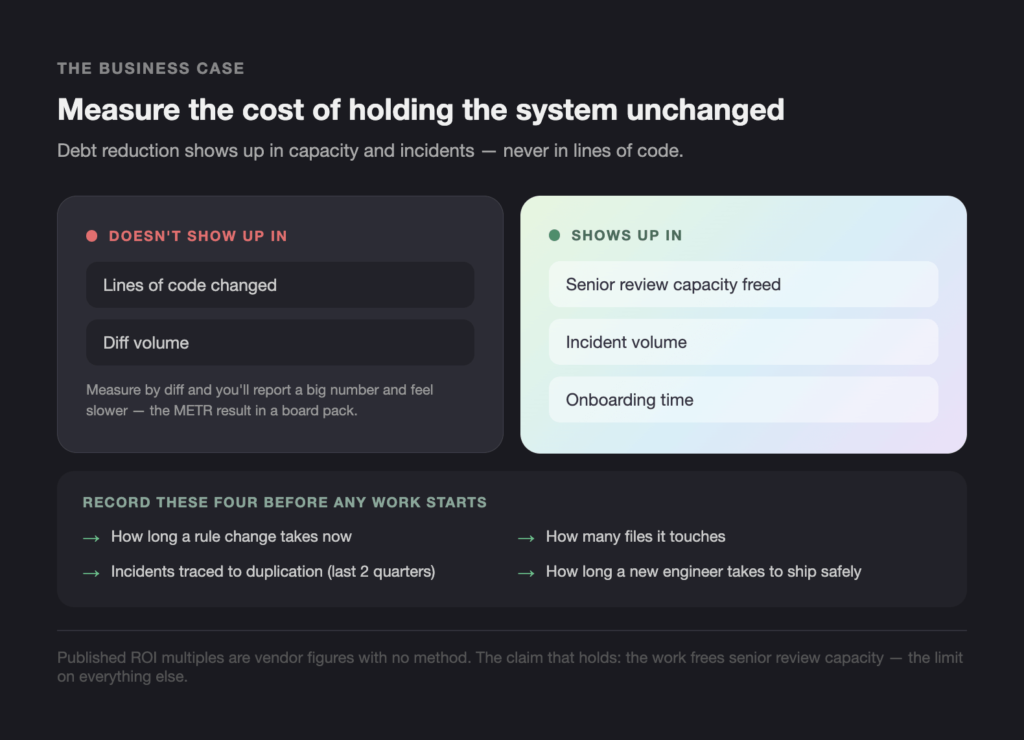
Technical debt reduction shows up in review capacity, incident volume and onboarding time. It does not show up in lines of code changed. A team measuring an AI refactoring programme by diff volume will report a large number and feel slower, which is the METR result restated in a board pack. The business case for technical debt reduction is the cost of holding the system unchanged.
That cost is measurable before any work starts. How long a rule change takes now. How many files it touches. How many incidents in the last two quarters traced back to a duplicated implementation. How long a new engineer takes to ship safely. Those four numbers are the baseline, and they are the ones legacy systems quietly charge every quarter.
Published ROI multiples for AI refactoring are vendor figures with no traceable method behind them. The claim that holds up is narrower and more useful. The work frees senior review capacity, and that capacity is the limit on everything else.
Measuring Success in AI-Powered Modernization
Four numbers carry an AI code modernization programme: change failure rate, time to first safe commit for a new engineer, the share of changes touching more than one module, and duplicated-block count. Each is gameable on its own, which is why they are read together. Change failure rate moves first. It rises when AI-authored volume outruns the review capacity behind it, which is the earliest signal an AI code modernization pass is going wrong.
| Metric | What it tells you | How it gets gamed |
|---|---|---|
| Change failure rate | Whether the pass held behaviour | Smaller, more frequent releases lower it without improving anything |
| Time to first safe commit | Whether the code got easier to understand | Better onboarding docs move it without touching the code |
| Changes touching >1 module | Whether duplication is actually falling | Bundling unrelated work into one commit hides it |
| Duplicated-block count | The direct GitClear-style signal | Renaming variables defeats naive detectors |
Conclusion
AI code refactoring is a capacity multiplier on a control system that already works, and a debt accelerator on one that does not. The tools are strong on duplication, mechanical transformation and test generation. They are weak on every decision that turns on why the code is the way it is. Build the tests first, cap the diff, and measure the four numbers.
If a legacy system is holding a roadmap, Teamvoy’s application modernization services run this as a phased engagement against your existing release process.