
- What does RAG stand for? RAG stands for Retrieval-Augmented Generation, an AI pattern that retrieves relevant information from approved external sources before a large language model generates its answer. This lets the application use current, private, or specialized knowledge without encoding every fact in the model’s trained parameters.
- Retrieval finds useful passages or records, augmentation adds that evidence to the model’s context, and generation produces an answer based on both the question and the retrieved information.
- RAG can make AI answers more current, specific, traceable, and easier to verify, especially when the required knowledge is private, specialized, or frequently updated.
- RAG does not automatically eliminate hallucinations. Weak sources, poor retrieval, broken permissions, or unsupported model claims can still produce an incorrect answer.
- Production RAG requires clean source data, permission-aware retrieval, evaluation, observability, and security rather than treating an LLM and vector database as the complete system.
A language model can write a fluent answer without knowing whether its information is current, approved, or even correct. RAG changes the workflow: before the model answers, the system searches a trusted knowledge source and places the most relevant evidence into the model’s context. That sounds simple. In production, the difficult part is usually not generation. It is retrieving the right information, enforcing permissions, and proving that the answer is grounded in evidence.
What does RAG stand for in AI?
In AI, RAG stands for Retrieval-Augmented Generation: a system retrieves relevant evidence from an external source, adds it to the model’s working context, and then generates an answer. The model still writes the response, but it no longer has to rely only on facts encoded during training.
The name describes the three stages of the pattern:
- Retrieval: search external data for information related to the user’s question.
- Augmentation: add the retrieved information to the prompt or context sent to the model.
- Generation: ask the model to produce an answer using that context.
RAG connects a generative model to knowledge that sits outside the model’s trained parameters. That external knowledge might include product documentation, policies, support tickets, research papers, database records, or an internal wiki.
The term comes from the 2020 paper Retrieval-Augmented Generation for Knowledge-Intensive NLP Tasks. The researchers described models that combine a generative model’s parametric memory with an external, searchable non-parametric memory. In practical systems today, the term is used more broadly for applications that retrieve evidence before generating an answer (Lewis et al., 2020).
RAG AI meaning in one sentence
RAG is a way to help an AI answer with selected external evidence instead of relying only on information encoded during model training. That distinction matters when the answer depends on private, specialized, or frequently changing information.
How does retrieval-augmented generation work?
A typical RAG workflow has two phases: preparing knowledge and answering a query. Teams first clean, divide, tag, and index approved source content. At query time, the application retrieves relevant evidence, applies access rules, places the evidence in the prompt, and asks the model to answer from it.
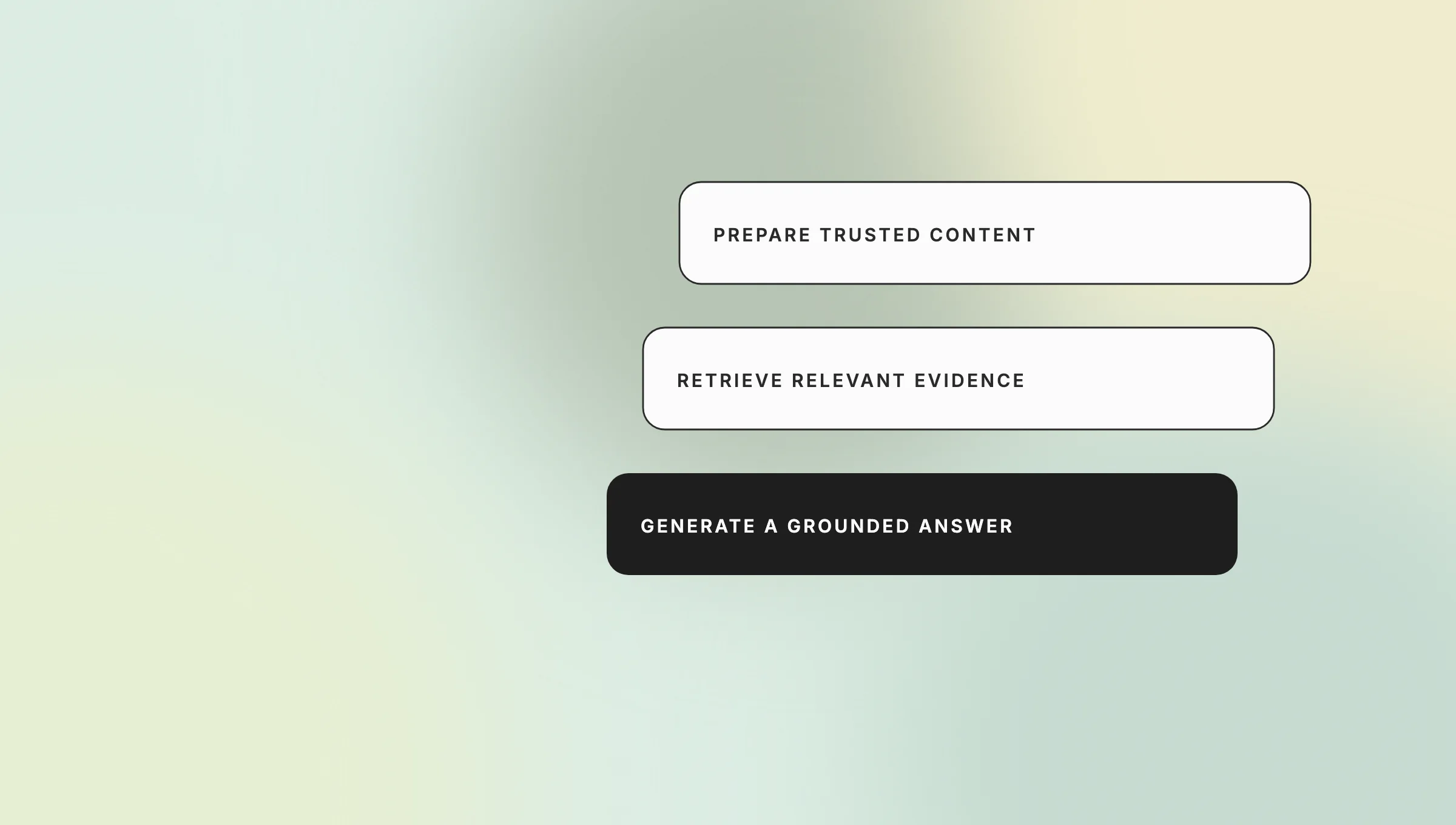
The basic RAG loop: prepare trusted content, retrieve relevant evidence, and generate a grounded answer.
Phase 1: Prepare the knowledge source
Before users ask questions, the system prepares the information it may retrieve.
- Connect data sources. These may include files, web pages, content management systems, databases, ticketing platforms, or internal applications.
- Parse and clean content. Remove irrelevant navigation, duplicated text, broken formatting, and stale versions.
- Split content into chunks. Large documents are divided into smaller passages that can be retrieved independently.
- Add metadata. Useful fields include document type, owner, date, department, jurisdiction, product, and access level.
- Index the content. Many systems create embeddings and store them in a vector index. Others combine vector retrieval with keyword search or query structured databases directly.
Phase 2: Retrieve and generate
When a user asks a question, the live pipeline begins.
- The system interprets or rewrites the query.
- A retrieval service searches the approved sources.
- Filters apply permissions, recency rules, and other constraints.
- The highest-ranked passages are placed in the model’s context.
- The LLM generates an answer, ideally with citations or links to the source material.
- The application logs the request and evaluates the result.
Modern RAG systems may use hybrid search, reranking, query decomposition, or multiple retrieval steps. Microsoft’s current guidance, for example, distinguishes classic RAG from agentic retrieval, where an LLM helps break a complex question into focused searches (Microsoft Learn).
What are the main components of a RAG system?
A production RAG architecture includes the source systems, ingestion pipeline, searchable knowledge layer, retrieval and ranking logic, prompt orchestration, language model, application interface, and evaluation stack. Each component can improve or damage the final answer, so treating RAG as only “a vector database plus an LLM” hides most operational risk.
| Component | What it does | Common failure mode |
|---|---|---|
| Source systems | Hold the facts the application may use | Stale, duplicated, or contradictory content |
| Ingestion pipeline | Parses, cleans, chunks, tags, and updates content | Broken parsing or delayed refreshes |
| Search index or knowledge layer | Makes content searchable | Missing metadata or weak index design |
| Retriever | Finds candidate evidence for a question | Relevant evidence is missed |
| Reranker and filters | Reorders results and enforces constraints | Unauthorized or low-quality content passes through |
| Prompt orchestration | Combines the question, instructions, and evidence | Too much context or conflicting instructions |
| Generator | Produces the response | Unsupported statements or poor synthesis |
| Evaluation and observability | Measures quality, latency, cost, and failures | Regressions remain invisible |
| Application layer | Presents answers, citations, and actions to users | Users cannot verify or correct the output |
A vector database can be part of this architecture, but it isn’t synonymous with RAG. Some use cases work better with keyword search, hybrid search, a graph, SQL queries, API calls, or a combination of retrieval methods.
What types of RAG architecture are used in practice?
RAG architectures range from a single retrieval step to multi-stage systems that rewrite questions, search several sources, rerank evidence, and repeat retrieval. These labels describe engineering patterns rather than a universal taxonomy. The right design is the least complex pattern that meets the use case’s accuracy, latency, permission, and operating requirements.
Basic RAG
Basic RAG performs one retrieval pass and one generation pass. The application converts the user’s question into a search query, retrieves a small set of passages, inserts them into the prompt, and asks the model to answer.
Hybrid and reranked RAG
Hybrid RAG combines retrieval methods instead of relying on vector similarity alone. A pipeline may blend keyword search, vector search, metadata filters, and structured queries. A reranker then scores the candidate passages again before the application sends the strongest evidence to the model.
Conversational RAG
Conversational RAG uses dialogue history to interpret follow-up questions. If a user asks, “What is the retention period?” and then says, “Does that apply in California?”, the system must resolve what “that” refers to before it retrieves evidence.
Agentic or multi-step RAG
Agentic RAG lets a model plan the retrieval process. It may decompose a complex question, choose among sources, run several searches, inspect the results, and retrieve again before composing an answer. Microsoft describes agentic retrieval as an approach that uses an LLM to break complex input into focused subqueries.
Why use RAG with generative AI?
RAG is useful when a general-purpose model needs knowledge it cannot reliably carry in its trained parameters. Retrieval can supply current policies, private documentation, product data, or specialized evidence at query time. This can improve relevance and traceability without retraining the model whenever the underlying information changes.
Use current information
A model’s training data is not a live connection to your policies, catalog, or operating systems. RAG can retrieve updated content at query time, provided the connected source and index are refreshed correctly.
Use private or domain-specific knowledge
A support assistant can retrieve approved product guidance. An employee copilot can search internal procedures. A financial application can reference permissioned policies and records. The model does not need to be retrained every time a document changes.
Improve traceability
A well-designed RAG interface can show which sources supported an answer. This does not prove that the answer is correct, but it makes review, correction, and auditing more practical.
Reduce unsupported answers
Giving the model relevant evidence can reduce the chance that it fills a knowledge gap with an invented answer. AWS describes RAG as a way to reference an authoritative knowledge base before generation rather than depending only on training data (AWS).
The important caveat is that grounding is not a guarantee. The retriever can return the wrong passage, the model can misread a correct passage, or the system can cite evidence that does not support the final claim.product covers the process with reasonable configuration, buying usually produces value sooner and transfers part of the product-maintenance burden to a vendor.
RAG vs. a standard LLM, semantic search, and fine-tuning
RAG, semantic search, fine-tuning, long-context prompting, and a standard LLM solve different problems. Search finds content; RAG finds content and uses it to draft an answer. Fine-tuning changes model behavior, while RAG supplies knowledge at runtime. Teams often combine these approaches rather than choosing only one.
| Approach | Primary job | Best fit | Main limitation |
|---|---|---|---|
| Standard LLM | Generate from instructions and trained parameters | General writing, summarization, reasoning | No dependable access to your current private knowledge |
| Semantic search | Retrieve relevant existing passages | Finding documents or records by meaning | Does not necessarily synthesize a direct answer |
| RAG | Retrieve evidence and generate an answer from it | Knowledge assistants, support, research, internal search | Quality depends on retrieval, data, and controls |
| Fine-tuning | Adjust model behavior using examples | Style, format, classification, repeated task behavior | Not an efficient way to keep factual knowledge current |
| Long-context prompting | Put a large set of content directly into the prompt | Small, bounded document sets | Cost, latency, and distraction grow with context size |
RAG vs. semantic search
Semantic search returns content that is similar in meaning to the query. RAG uses retrieved content as input to a generative model, which can compare sources, summarize them, and formulate a direct response.
Search is therefore often a component of RAG rather than a competing technology.
RAG vs. fine-tuning
Fine-tuning changes model behavior. RAG supplies knowledge at runtime.
Use fine-tuning when the main problem is how the model behaves—for example, output format or task style. Use RAG when the main problem is what information the model needs right now. A production application may use both.
Does RAG prevent AI hallucinations?
No. RAG can reduce hallucination risk, but it does not prevent hallucinations by itself. A system can retrieve the wrong passage, use stale source material, lose a qualifier during chunking, or generate a claim the evidence does not support. Production controls must test retrieval and generation separately.
- The source contains inaccurate or outdated information.
- Chunking separates a statement from an important qualifier.
- Retrieval misses the correct document.
- Ranking promotes a plausible but irrelevant passage.
- Permissions are applied after retrieval instead of before it.
- The prompt contains too much competing context.
- The model adds a claim that is not supported by the evidence.
- A malicious document includes prompt-injection instructions. OWASP notes that RAG does not fully mitigate prompt injection because external content can carry indirect instructions.
Google Cloud emphasizes that retrieval quality is critical: a response may be grounded in retrieved content and still be off-topic or incorrect if the content itself is not relevant (Google Cloud). The practical target is not “zero hallucinations.” It is a system that can measure retrieval quality, abstain when evidence is weak, show citations, protect access, and make failures visible.
What is generative AI RAG used for?
Generative AI RAG works best when users need a direct answer synthesized from a defined body of knowledge. Common applications include internal knowledge assistants, customer support, document research, software operations, and regulated workflows. The strongest use cases have identifiable source owners, clear permissions, and a reason to generate rather than return documents.
Internal knowledge assistants
Employees can ask questions across policies, technical documentation, project records, and approved internal guidance without manually searching each repository.
Customer support
A support assistant can retrieve current product instructions, troubleshooting steps, account rules, and escalation policies before drafting a response. Sensitive account data still needs strict authorization and redaction controls.
Document and research workflows
RAG can help users compare contracts, summarize reports, review research, or trace a question across a collection of documents. The interface should preserve links to the original material for verification.
Software and IT operations
Engineering copilots can retrieve runbooks, architecture decisions, incident histories, and code documentation. IT service tools can use approved procedures to suggest—not silently execute—remediation steps.
Regulated workflows
In healthcare, finance, insurance, and legal operations, RAG can provide relevant internal or public guidance. However, retrieval doesn’t make a model compliant or qualified to make a regulated decision. Human review, data minimization, audit trails, and clear responsibility remain essential.
What are the limitations of RAG?
RAG avoids some limits of a standalone model, but it introduces a distributed information system that your team must operate. Retrieval quality, document ownership, permissions, index freshness, latency, cost, and evaluation all become product concerns. A polished prototype can still fail if any one of those layers is weak.
Retrieval quality becomes the bottleneck
If the correct evidence never reaches the model, generation quality has a hard ceiling. Teams need representative test questions and labeled evidence to evaluate whether retrieval works.
Source quality matters more than model fluency
A polished answer built from stale or contradictory documents is still wrong. Content ownership, lifecycle rules, and deletion policies are architectural requirements.
Permissions are difficult
An enterprise assistant must not reveal a document merely because it is semantically relevant. Authorization should be enforced during retrieval, using the user’s identity and source-system permissions.
Cost and latency can spread across the pipeline
Embedding, search, reranking, model calls, and multi-step orchestration all add time and cost. Caching and smaller models may help, but only after the team measures where the cost occurs.
Evaluation is not one score
Teams need separate checks for retrieval relevance, answer groundedness, completeness, citation correctness, safety, latency, and cost. A single “accuracy” percentage hides the failure mode. For a deeper production view, see Teamvoy’s guide to enterprise RAG architecture.
How do you evaluate a RAG system?
Evaluate RAG as a pipeline, not as a single model score. Measure whether retrieval found the right evidence, whether the answer used that evidence correctly, whether citations support the claims, and whether the system met its latency, cost, safety, and access-control requirements. A good answer score alone cannot identify where a failure began.
| Evaluation layer | Question to test | Example measure |
|---|---|---|
| Source quality | Is the authoritative information present and current? | Version, owner, freshness, duplicate rate |
| Retrieval | Did the system find the passages needed to answer? | Recall at K, precision at K, ranked relevance |
| Generation | Is each claim supported by retrieved evidence? | Groundedness and citation correctness |
| Task result | Did the answer resolve the user’s actual request? | Answer relevance, completeness, task success |
| Safety and permissions | Did the system avoid restricted or malicious content? | Leakage tests, injection tests, policy violations |
| Operations | Can the application meet its product constraints? | Full-pipeline latency, cost per request, failure rate |
Build the evaluation set from real work
Start with questions users actually ask, then add cases designed to break the system. Include incomplete questions, conflicting documents, revoked permissions, outdated policies, uncommon terminology, and questions with no supported answer. Each test should identify the expected evidence, not only an ideal response.
A test set built only from clean demonstration questions will reward a demo architecture. Production evaluation needs edge cases and negative examples, including situations where the correct behavior is to abstain or ask for clarification.
Separate retrieval failure from generation failure
When an answer is wrong, inspect the retrieved evidence first. If the correct passage is missing, the problem may be query rewriting, chunking, metadata, indexing, filters, or ranking. Changing the language model will not repair a missing source.
If the correct evidence is present but the answer misstates it, investigate prompt construction, context ordering, conflicting passages, model selection, or response validation. This separation prevents teams from spending model budget on an information-retrieval defect.
Evaluate citations as claims, not decorations
A citation is useful only if the linked passage supports the sentence attached to it. Evaluation should check whether every material claim has evidence, whether the citation points to the relevant source version, and whether the generated answer adds unsupported details beyond that evidence.
This check matters for summaries that sound plausible. A model may cite the correct policy document while misreading an exception or combining two unrelated clauses. Showing a source link improves traceability, but citation correctness still has to be measured.
Monitor performance after launch
Offline evaluation cannot capture every production query or source change. Track retrieval patterns, empty-result rates, abstentions, user corrections, feedback, latency, and policy violations after launch. Sample real interactions for review under an approved privacy and retention policy.
Use versioned evaluation sets when ingestion logic, embedding models, ranking, prompts, source systems, or generation models change. A RAG pipeline can regress even when the application code did not change because its documents and external services continue to evolve.
How should enterprises secure a RAG pipeline?
RAG security has to span ingestion, storage, retrieval, generation, and the user interface. The system should preserve source permissions, filter unauthorized content before model access, treat retrieved text as untrusted input, protect logs, and maintain provenance. A secure model endpoint cannot compensate for an insecure retrieval pipeline.
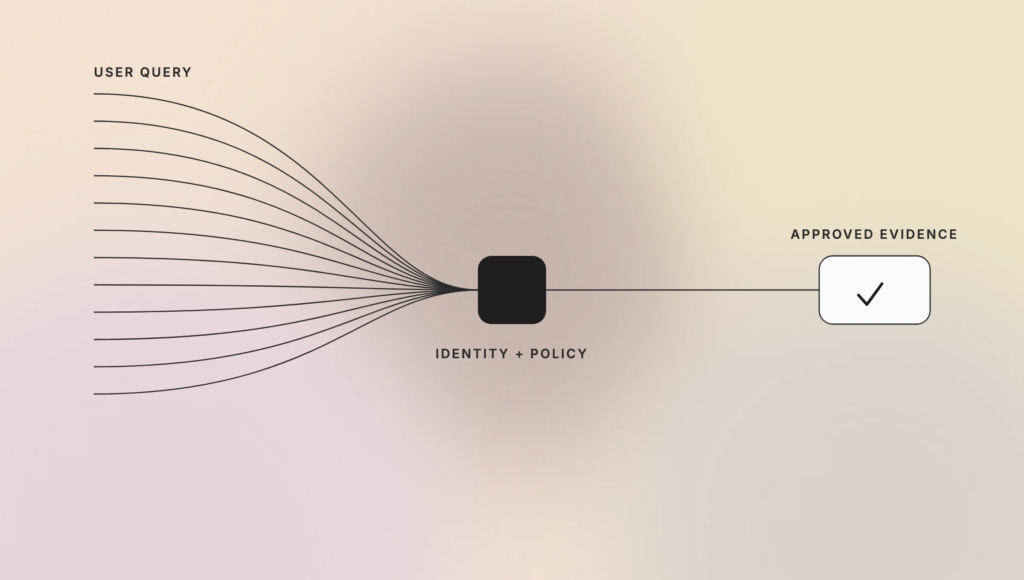
Start with these controls:
- Source-level authorization: preserve the permissions of the original system where possible.
- Pre-retrieval filtering: remove unauthorized content before it can enter the model context.
- Data minimization: index only content required for the approved use case.
- Encryption and secret management: protect data in transit and at rest; keep credentials out of prompts and logs.
- Prompt-injection defenses: treat retrieved content as untrusted data, not as system instructions.
- Citation and provenance: record which source and version supported each answer.
- Retention controls: define how long prompts, retrieved passages, model outputs, and logs are stored.
- Audit logs: capture access and system decisions without exposing more sensitive content than necessary.
- Human escalation: route low-confidence, high-risk, or regulated questions to a qualified person.
Microsoft identifies granular access control as a core challenge because users and agents must retrieve only content they are authorized to see (Microsoft Learn).
How do you build a RAG system that can reach production?
The fastest route to production is usually a narrow, measurable RAG use case rather than an organization-wide knowledge bot. Define the task, authoritative sources, permission model, expected evidence, and failure behavior first. Then establish a simple retrieval baseline and add complexity only when evaluation shows which layer needs it.
1. Define the decision or task
Choose a question users ask repeatedly and a source set that has a clear owner. Define what the system may answer, when it must abstain, and which actions remain human-owned.
2. Build an evaluation set before optimizing
Collect representative questions, expected evidence, acceptable answers, and failure cases. Include ambiguous questions, outdated documents, permission boundaries, and adversarial content.
3. Clean and govern the source layer
Remove duplicates, define authoritative versions, attach metadata, and set refresh rules. Do not treat the vector index as the system of record.
4. Establish a simple retrieval baseline
Start with the least complex approach that can answer the evaluation set. Compare keyword, vector, and hybrid retrieval before adding multi-agent orchestration.
5. Add citations and abstention
Require the application to expose evidence and to say when evidence is insufficient. A confident answer without adequate support should count as a failed result.
6. Enforce security before retrieval
Carry user identity and permissions through the query. Test cross-tenant leakage, revoked access, deleted files, malicious content, and logging behavior.
7. Instrument the full pipeline
Trace ingestion version, query transformation, retrieved chunks, ranking, prompt construction, model response, latency, token usage, and user feedback. Teamvoy’s LLMOps guide explains the broader monitoring and operational layer around production language-model systems.
8. Improve one failure mode at a time
If retrieval misses the right evidence, changing the LLM may not help. If evidence is correct but the response misuses it, improve prompt logic, generation, or model selection. Diagnosis should determine the fix.
Teamvoy’s production view starts with the data and integration layers rather than assuming a larger model will repair weak retrieval. Read more about connecting models, permissions, and enterprise systems through AI integration services.
When should you use RAG, and when should you not?
Use RAG when answers depend on a defined, changing knowledge source and users benefit from generated synthesis. Choose search, deterministic rules, database queries, or direct long-context prompting when those options solve the task with less risk. The right decision depends on evidence, permissions, and failure cost – not on whether RAG is available.
Use RAG when:
- answers depend on a defined and changing knowledge source;
- users need synthesized responses rather than a document list;
- citations or traceability add value;
- permissions can be enforced end to end;
- the organization can maintain the source and evaluation set.
Do not default to RAG when:
- a deterministic database query or business rule can return the answer;
- the source collection is tiny enough to handle directly and safely;
- users need the original document, not a generated synthesis;
- the organization cannot identify an authoritative source;
- the risk of an incorrect generated answer is unacceptable without mandatory human review.
Sometimes the right product is better search. Sometimes it is a workflow with rules. RAG earns its place when generation adds useful synthesis on top of reliable retrieval.
| Situation | Likely fit | Why |
|---|---|---|
| Users need answers across changing, permissioned documents | RAG | Retrieval can supply current evidence before generation |
| Users only need to locate the original file | Search | Generated synthesis adds risk without enough value |
| The answer is a deterministic record or calculation | Database query or business rule | Structured logic is easier to test and audit |
| A small, fixed document set fits safely in context | Long-context prompting | A separate retrieval layer may add unnecessary complexity |
| The task requires a consistent format or behavior | Fine-tuning or prompt design | The problem is behavior rather than missing knowledge |
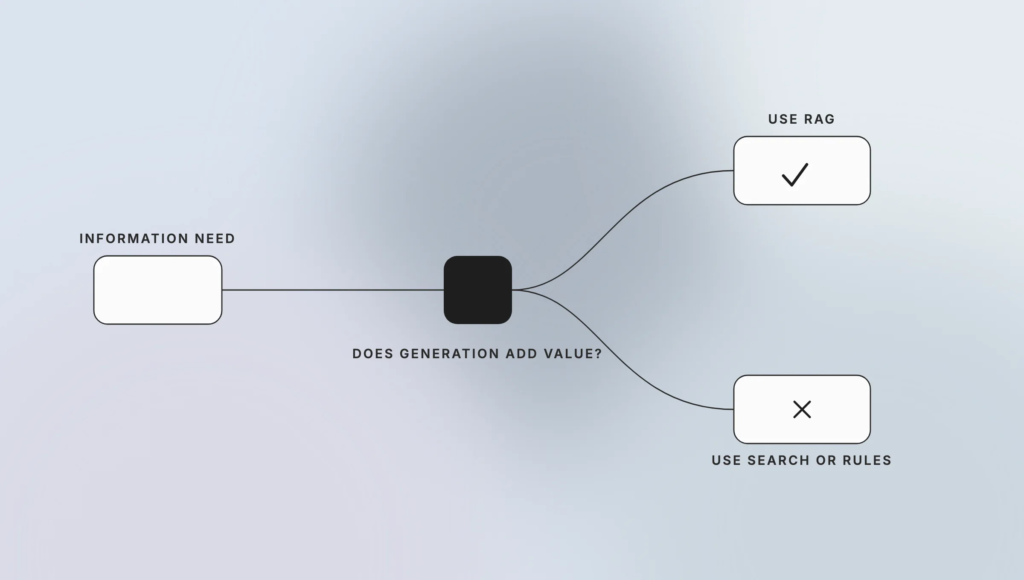
From the acronym to a production decision
Understanding what RAG stands for is the easy part. Building a useful system requires decisions about source ownership, retrieval quality, permissions, evaluation, and failure handling. The practical question is whether retrieval adds enough trustworthy evidence to justify the extra architecture, operational work, latency, and security surface.
A prototype can connect an LLM to documents quickly. A production system must also prove that it retrieved the right evidence, respected access rules, generated a supported answer, and exposed enough information for a user or operator to review what happened.
If you are deciding whether RAG fits your product—or trying to move a retrieval prototype into production – Teamvoy can assess the data layer, integration design, security boundaries, and evaluation plan. Explore our AI development services or discuss the use case with an AI engineer.
FAQ
These answers cover the most common questions behind searches for what RAG stands for in AI, the RAG AI meaning, vector databases, hallucinations, fine-tuning, real-time data, and AI agents. Each answer addresses one concept directly; production choices still depend on your data, permissions, and risk profile.