- Portfolio management software development means four connected systems: a reconciled book of record, a calculation engine, rebalancing workflow, and client or advisor reporting.
- Integration count, not feature count, sets the schedule. Integrations run roughly 5,000 to 20,000 dollars each, with market data feeds adding 3,000 to 15,000 dollars yearly.
- Cost tiers: MVP 40,000 to 200,000 dollars, mid-complexity 100,000 to 400,000 dollars, enterprise 300,000 to over 1,000,000 dollars. Published vendor floors genuinely contradict each other.
- Compliance is a schema requirement. SEC Rule 204-2, the marketing rule's five-year retention, GIPS time-weighted returns, and DORA's ICT third-party register all shape architecture.
- Platforms break after go-live, not in QA. Two-millisecond cross-zone write penalties compound until connection pools exhaust, and the diagnosis is usually undocumented tribal knowledge.
- Roughly 95 percent of enterprise generative AI pilots return nothing measurable. The cause is integration design and missing circuit breakers, not model choice.
Q1. Which kinds of engineering partners actually build custom portfolio management software in 2026?
Ten kinds of partner build portfolio management software, and they are not interchangeable. Some ship greenfield MVPs. Some staff your existing team. A few take accountability for a live, audited client ledger. Teamvoy sits in the last group: senior-lead ownership of systems already under pressure, with a four-plus year average engagement across 150+ delivered projects since 2013.
Choosing an engineering partner for a portfolio platform is not a procurement exercise. The system holds client positions, feeds performance reports, and sits inside SEC recordkeeping and, in Europe, DORA’s third-party rules. A wrong choice does not show up in week three. It shows up in year two, when the ledger disagrees with the custodian and nobody owns the fix. This guide describes each partner by the situation it fits, using five criteria: regulated-delivery evidence, engagement model, senior-lead accountability, integration and data-layer depth, and production AI proof. It is written for CTOs, technical founders, and IT directors carrying that decision.
Our Evaluation Criteria
- ⭐ Regulated-delivery evidence. Which named standards the firm has actually delivered against, such as SOC 2, PCI-DSS, GDPR, DORA, SEC, or FINRA scope. Badges on a website are not the same as an audit you passed, which is why regulator-ready delivery in fintech is a separate discipline from general engineering.
- ⭐ Engagement model. Project-and-exit, long-term partner, staff augmentation, or nearshore team extension. This decides who is present when the ledger breaks in year two.
- ⭐ Senior-lead accountability. Whether one senior engineer owns the system end to end, or whether people rotate through it.
- ⭐ Integration and data-layer depth. Custodian feeds, market data, reconciliation, and the book of record. On portfolio builds, this is where the schedule is won or lost, and it is why system integration experience matters more than framework preference.
- ⭐ Production AI proof. Whether the firm has shipped AI into a live system with review gates, or only demos.
Who This Guide Is For
- A CTO who inherited a portfolio platform from a vendor that left, and now has to stabilise it before the next audit cycle. If that is your week, the legacy software recovery plan covers the first moves.
- A technical founder whose wealth or investment product outgrew the architecture they wrote themselves, and who now needs technology modernization without pausing the business.
- An enterprise IT director working to a DORA or SOC 2 deadline on a system that already holds client assets.
The Ten Partners Covered
- Teamvoy: Best for a live, regulated portfolio system that needs stabilising and modernising without a rewrite.
- Azumo: Best for adding nearshore senior engineers in North American hours to an existing fintech build.
- DOOR3: Best for enterprise financial reporting and dashboard platforms inside a mid-market or Fortune 1000 IT function.
- Vention: Best for scaling a fintech engineering team quickly across a large delivery bench.
- Dualboot Partners: Best for a product team that needs build capacity plus embedded product leadership.
- JetRockets: Best for a small investment or lending product where one tight team owns the whole stack.
- Orases: Best for a US mid-market firm that wants a single accountable delivery vendor on a defined scope.
- Sidebench: Best for a venture-backed product where design and engineering ship together.
- SOLTECH: Best for a regional financial services firm that wants onshore-managed delivery.
- Scopic: Best for a distributed, cost-sensitive build with a long feature backlog.
Master Comparison Table
| Company Name | Best For | Engagement Model | Industry Depth & Compliance Coverage |
|---|---|---|---|
| Teamvoy | Live regulated portfolio systems needing stabilisation and modernisation without a rewrite | Long-term partner (multi-year), senior technical lead owns the system | Banking, fintech, insurance, healthcare; PCI-DSS, SOC 2, GDPR, DORA, PSD2, BaFin scope |
| Azumo | Extending an in-flight fintech build with senior nearshore engineers in your hours | Nearshore team extension and staff augmentation | Fintech, healthcare, media; SOC 2 certified, HIPAA and GDPR-ready, PCI-DSS and ISO 20022 payments work |
| DOOR3 | Enterprise financial reporting, dashboard, and internal platform work | Project-and-exit consultancy, independent of platform vendors | Financial services, insurance, enterprise; named work with AIG and Munich Re, specific regulator scope not publicly claimed |
| Vention | Scaling a fintech engineering team fast from a large delivery bench | Staff augmentation and dedicated teams | Fintech and enterprise software; ISO 27001 certified, trading platforms built to SEC, FCA, MiFID, and FATCA requirements |
| Dualboot Partners | Build capacity plus embedded product leadership on a new platform | Long-term partner with product and engineering pods | Digital banking, lending, payments, and portfolio tooling; regulator-specific scope not publicly claimed |
| JetRockets | A focused investment or lending product owned by one small team | Project-and-exit and retained product team | Fintech, real estate, SaaS; PCI DSS readiness claimed, wider regulator scope varies by engagement |
| Orases | A defined-scope build with one accountable US vendor | Project-and-exit, US-managed delivery | Mid-market enterprise, healthcare, finance; named financial regulator scope not publicly claimed |
| Sidebench | A venture-backed product where design and engineering ship together | Project-and-exit product studio | Healthcare, enterprise, consumer; HIPAA-secure architecture claimed, financial regulator scope not publicly claimed |
| SOLTECH | Regional financial services firms wanting onshore-managed delivery | Project-and-exit with staffing option | Financial services, healthcare, manufacturing, retail; compliance scope varies by engagement |
| Scopic | A long feature backlog on a distributed, cost-sensitive team | Distributed staff augmentation | Broad industry mix including finance; regulated-delivery depth not publicly claimed |
💰 Why this table has no pricing column
Every firm here quotes custom. A pricing column would invent comparability that does not exist, so the honest comparison is engagement model and compliance scope.
The roster below covers ten partners in total. Cards one and two follow, and the remaining eight continue in the next batch.
Teamvoy
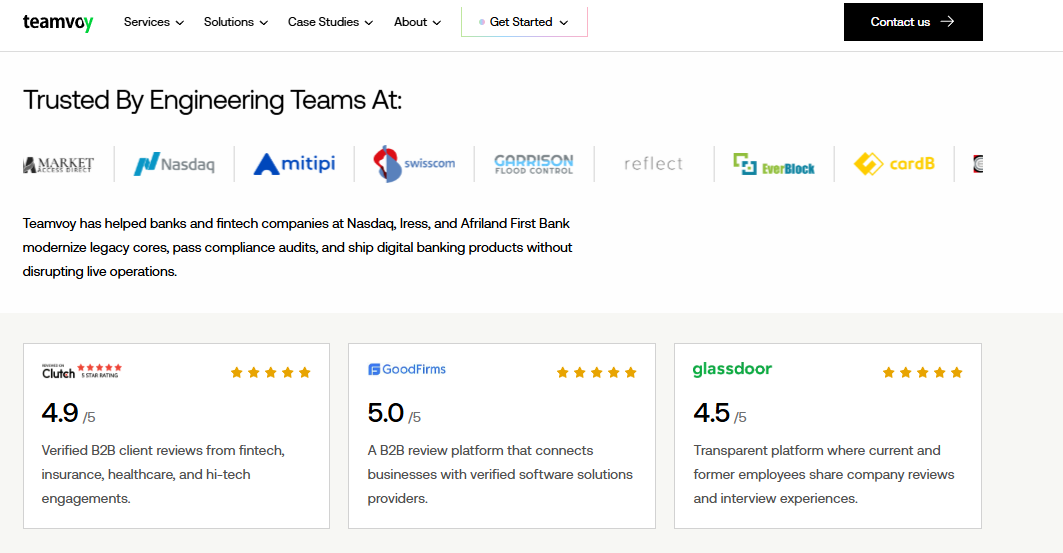
- Regulated-delivery evidence: Delivers inside PCI-DSS, SOC 2, GDPR, DORA, PSD2, and BaFin scope.
- Engagement model: Long-term partner. Average client engagement runs past four years.
- Senior-lead accountability: A senior technical lead owns the system end to end, not a rotating pod.
- Integration and data-layer depth: Data layer and legacy core are assessed before any feature scoping.
- Production AI proof: AI shipped into live regulated stacks, with human review gates on write paths.
- Wealth management work with Iress on BC Gateways, a private blockchain product for data distribution across wealth management, taken from proof of concept to scale over two years.
- Platform delivery for Market Access Direct, launched within the agreed timeline with the required integrations in place. Further examples sit in the case studies library.
- Twelve-plus years of full-cycle delivery across banking, insurance, healthcare, manufacturing, and complex SaaS, with named clients including Nasdaq and Panasonic Avionics.

Azumo
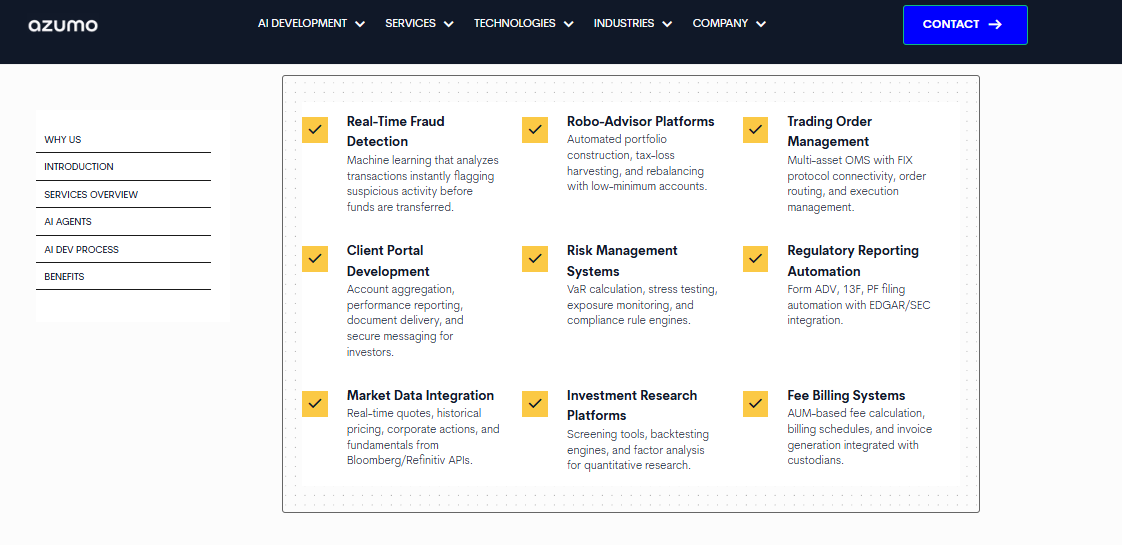
- Regulated-delivery evidence: SOC 2 certified. Builds against PCI-DSS, ISO 20022, RTP, FedNow, and 3D Secure 2.0.
- Engagement model: Nearshore team extension and staff augmentation, working North American hours.
- Senior-lead accountability: Engineers embed in your workflow. Your team keeps architectural ownership.
- Integration and data-layer depth: Payments, lending, KYC/AML, fraud detection, and core banking integration work.
- Production AI proof: States production AI delivery since 2016, with senior review of every AI-assisted change before merge.
- Fintech team includes a former VISA solutions architect and engineers who have worked with HSBC, Citibanamex, and Santander on banking and payment platforms.
- Annual SOC 2 audits covering security controls, availability, and confidentiality.
- Repository and environment access scoped per engineer and revoked at offboarding.
⭐ Before you shortlist from this list
Two of the five criteria are answerable only in conversation, not on a website. Ask each firm to name the senior lead and to describe the reconciliation model they would inherit. An independent IT audit before the shortlist call is the cheapest way to arrive with the right questions, and a short technical conversation usually settles more than a capability deck does.
⭐ What changes across these eight
Four of them are genuinely regulated-finance shops with named standards work. The other four are strong general product firms whose financial-services depth is real but shallower on regulator scope.
⚠️ How to read the limitations
I wrote each limitation as the thing you would find out in month four anyway. None of these firms is weak. They are shaped for different problems, and a portfolio ledger punishes a shape mismatch.
DOOR3

- Regulated-delivery evidence: Financial services and insurance delivery claimed. Named regulator scope not publicly stated.
- Engagement model: Project-and-exit consulting on defined enterprise scopes.
- Senior-lead accountability: Consultancy structure with senior architects. Ownership after go-live varies.
- Integration and data-layer depth: Strong on enterprise integration and reporting platforms.
- Production AI proof: AI and data services offered. Production AI in regulated finance not publicly detailed.
- Custom financial software delivery for banking, fintech, and insurance clients.
- Named enterprise work with AIG and Munich Re, the kind of carrier-side build covered in our insurance tech case study.
- Long-running NYC consultancy with an enterprise and Fortune 1000 client base.
Vention
- Regulated-delivery evidence: Trading platforms built to FATCA, MiFID, SEC, and FCA requirements.
- Engagement model: Dedicated teams and staff augmentation, with teams available within two weeks.
- Senior-lead accountability: Delivery leadership assigned per team. Single-owner model not publicly claimed.
- Integration and data-layer depth: Java trading platforms processing up to 20 million daily inquiries; Go microservices for brokerage flows.
- Production AI proof: 100+ AI specialists on staff. Regulated production AI detail varies by case.
- 200+ fintech projects across two decades, with 19% of developer capacity dedicated to fintech.
- Fintech clients reported to have raised $1.5B in funding.
- ISO 27001 information security certification.
Dualboot Partners
- Regulated-delivery evidence: Works with Fortune 500 financial institutions, community banks, credit unions, and lenders.
- Engagement model: Long-term partner with embedded product and engineering pods.
- Senior-lead accountability: Product leadership embedded alongside engineering, described as an AI-first delivery process.
- Integration and data-layer depth: Named portfolio management and compliance tooling in its financial services practice.
- Production AI proof: Runs an AI Lab and offers fractional CAIO services.
- Over 200 clients including Continental Tire, DebtBook, and Lexipol.
- Financial services practice spanning digital banking, portfolio tools, payments, and lending.
- Founding team with prior experience starting and selling technology companies.
JetRockets
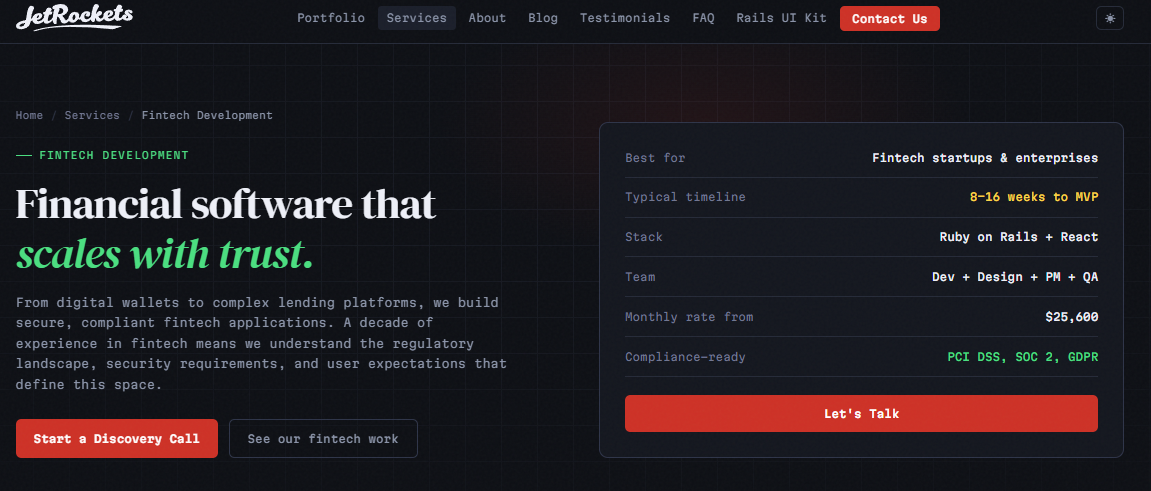
- Regulated-delivery evidence: Fintech practice covers banking, payments, lending, and investment tools. Named regulator scope not publicly claimed.
- Engagement model: Small dedicated team, New York-led, product-retainer or project.
- Senior-lead accountability: Small firm structure means senior people stay on the work.
- Integration and data-layer depth: Full-stack product delivery. Custodian-grade integration depth not publicly detailed.
- Production AI proof: Not publicly claimed at production scale in finance.
- A decade of fintech delivery across digital wallets and financial platforms.
- 15+ years of continuous Rails specialisation.
- Every engagement led from the New York office.
Orases
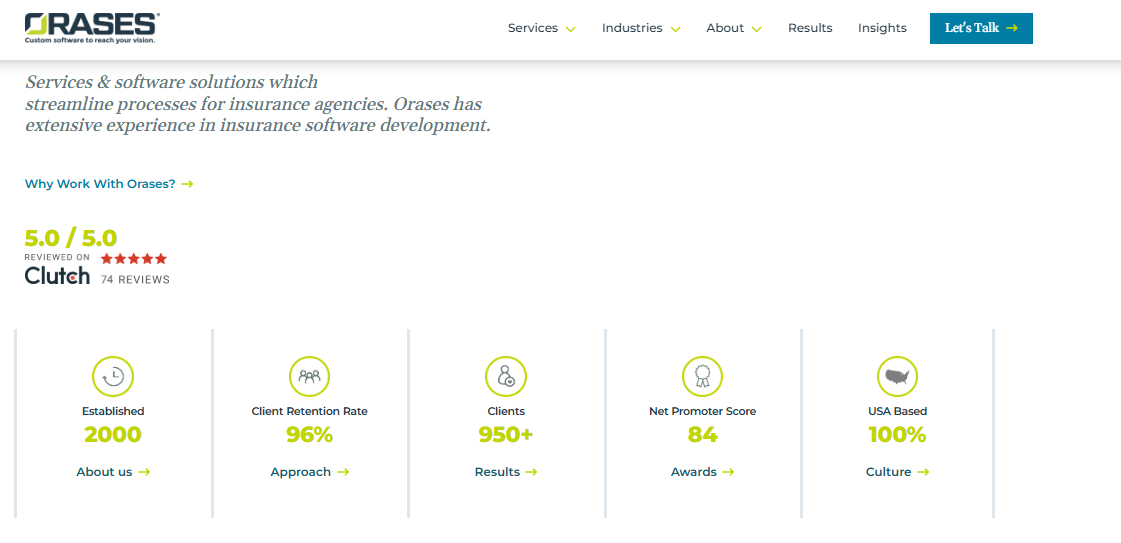
- Regulated-delivery evidence: Financial services among its industries. Named financial regulator scope not publicly claimed.
- Engagement model: Project-and-exit with ongoing maintenance and support.
- Senior-lead accountability: Single-vendor accountability on defined scope, US-based teams.
- Integration and data-layer depth: Complex system integrations and modernization named as core services.
- Production AI proof: AI consulting and custom AI agents offered; regulated finance detail not published.
- 950 clients since 2000, with typical project budgets from $50,000 to $999,999.
- Named brand work with the NFL, NPR, and Kimberly-Clark.
- Integrations and modernization practice alongside custom builds, the same pairing that drives most legacy platform modernization programmes.
Sidebench
- Regulated-delivery evidence: HIPAA-secure technical architecture and regulated healthcare delivery. Financial regulator scope not publicly claimed.
- Engagement model: Project-and-exit product studio, strategy-first and consultative.
- Senior-lead accountability: Boutique studio with architects engaged from discovery onward.
- Integration and data-layer depth: Complex systems integration and data engineering named as core strengths.
- Production AI proof: AI and machine learning delivery claimed alongside cloud and UX work.
- Regulated delivery for American Heart Association, Children’s Hospital Los Angeles, and UCSF Innovation.
- Enterprise and venture clients including Microsoft, NBCUniversal, and Andreessen Horowitz.
- HIPAA-secure architecture work across digital health platforms.
SOLTECH
- Regulated-delivery evidence: Financial services among named industries. Specific regulator scope not publicly claimed.
- Engagement model: Project-and-exit plus IT staffing, mid-market and enterprise.
- Senior-lead accountability: US-based engineers and designers, single-vendor accountability on scope.
- Integration and data-layer depth: Application modernization, cloud, and data engineering named as core practices.
- Production AI proof: AI integrated into design and delivery, with AI strategy consulting offered.
- Nearly 30 years of continuous operation since 1998.
- Modernization and process automation work for mid-market and enterprise clients.
- Repeated Atlanta Top Workplaces recognition, a reasonable proxy for engineer retention.
Scopic

- Regulated-delivery evidence: No named financial regulator or standards work published.
- Engagement model: Distributed staff augmentation and long-running development capacity.
- Senior-lead accountability: Team leads assigned. Single accountable owner not publicly claimed.
- Integration and data-layer depth: General application and integration work. Custodian-grade depth not documented.
- Production AI proof: AI and data services offered. Regulated production detail not published.
- Long-running remote-first delivery model across a broad industry mix.
- Ongoing development capacity for products with multi-year feature roadmaps.
- Experience across finance, healthcare, and general software categories.
Teamvoy handles the situation the eight firms above mostly route around: a portfolio system that is already live, already audited, and already holding positions when the work starts. Across 150+ projects since 2013, our engagements average past four years, because stabilising a book of record is not a project with an end date. That is also why a short IT audit usually precedes any commitment, and why the legacy software recovery plan starts with reading the system rather than replacing it.
Q2. What does portfolio management software development actually cover, and which features are non-negotiable?
Portfolio management software development is the design and engineering of custom platforms that consolidate holdings across custodians and asset classes, calculate performance and risk, automate rebalancing, and produce client and regulatory reporting that satisfies recordkeeping and performance-presentation standards. The baseline is a reconciled book of record, a calculation engine, rebalancing workflow, and a client portal.
The four subsystems under every portfolio platform
Most vendor pages sell a feature list. What you are actually buying is four connected systems, and each one fails differently.
- Book of record. The reconciled truth about what is held, where, and at what cost basis. A custodian is the bank or broker that legally holds the assets.
- Calculation engine. Returns, risk, and attribution. Attribution means splitting performance into the decisions that caused it.
- Rebalancing and order workflow. Drift detection, proposed trades, approvals, and execution handoff.
- Client and advisor interfaces. Statements, portals, and the reporting that leaves your building.
⭐ Where the baseline stops being negotiable
Across published feature sets, three things appear every time: multi-custodian tracking, performance reporting with attribution, and a client portal. Everything else is a choice. Those three are the product.
Teamvoy sequences portfolio engagements by assessing the data layer and the legacy core before any feature scoping happens. That ordering is not a preference. On multi-custodian systems, the reconciliation model sets the ceiling on what the reporting layer can honestly claim, which is why our data engineering work starts ahead of the interface work.
Follow one position through the system
Here is the trace worth walking with your team this week. A custodian file lands overnight with a holding of 1,200 shares.
Your system has to match that lot against its own record, resolve a stock split applied on the custodian side, revalue at the closing price, then recompute a time-weighted return. Only then does a number reach a client statement.
⚠️ Every one of those steps is an integration decision
Break the match and the statement is wrong. Break the split handling and the return is wrong in a way that looks plausible, which is worse.
What surfaces repeatedly in Teamvoy’s banking and fintech engagements is that teams scope the statement, then discover the lot-matching logic nobody specified. The UI was never the hard part. The reconciliation rules were.
Integration count, not feature count, sets your timeline
The industry has spent three years obsessing over models and interfaces while the real bottleneck sat one layer down. Integration is not interesting to demo. It is the difference between a demo and a system that closes the day.
Published benchmarks put individual integrations at roughly $5,000 to $20,000 each, with market data feeds carrying an annual fee on top. Count your custodians, your market data vendor, your CRM, and your KYC provider. That number predicts your schedule better than your feature backlog does, and it is the first thing scoped in any system integration engagement.
💰 The scoping question I would ask first
Not “what features do we need.” Ask instead: how many systems must agree before a client statement is defensible? Teamvoy scopes against that count, because it is the figure that moves cost and calendar together.
I could be reading this too strongly, but I have not seen a portfolio build slip on UI work. They slip on data that arrives late, arrives twice, or arrives restated.
Teamvoy opens portfolio engagements with the data layer and the legacy core, then scopes features against the reconciliation model. Across 150+ delivered projects since 2013, that order has been the difference between a reporting layer we can stand behind and one that only looks right.
Q3. What do SEC Rule 204-2, GIPS, and DORA actually require from the software?
Compliance is a schema requirement, not a badge. Advisers Act Rule 204-2 dictates which records the system generates and preserves; the SEC marketing rule sets five-year, easily accessible retention for performance claims; GIPS mandates time-weighted returns and a minimum five years of compliant history; DORA makes your development partner a registered ICT third party.
Rule 204-2 decides your data model
Every SEC-registered investment adviser must make and keep true, accurate, and current books and records. Read that as a schema specification, because that is what it is.
The engineering consequence is an append-only audit trail with indexed retrieval. Records must be reproducible on request, not reconstructable by an engineer with database access.
⭐ The marketing rule adds a clock
Advisers must keep records of all advertisements they disseminate, with performance records retained and easily accessible. Five years is the standard, and “easily accessible” is the part teams underbuild.
Teamvoy treats retention windows as storage tiering decisions made at design time, not migrations bolted on later. Moving five years of performance history after launch costs more than designing for it did, a pattern documented in our data migration in insurance work.
GIPS turns reporting into arithmetic you cannot choose
The Global Investment Performance Standards mandate specific calculation methods so results compare across firms. Time-weighted returns are required, and firms must present at least five years of compliant annual performance, building toward ten.
CFA Institute Standard III(D) pushes further. Composites, meaning groups of similar portfolios, are preferred over showing one representative account.
⚠️ What that means for your calculation engine
Your engine needs composite membership as a first-class concept, with entry and exit dates. Gross and net of fees both have to be derivable, not one hardcoded.
What Teamvoy sees in regulated engagements is that composite logic gets discovered late, usually during an audit prep cycle. Retrofitting it means recomputing history, which means restating numbers clients already received.
DORA puts your development partner inside the perimeter
Regulation (EU) 2022/2554 treats software and data-analytics providers as ICT third-party service providers to financial entities. If you are an EU financial entity, your build partner is in scope.
The register of information is the practical duty. Firms must maintain a register covering all ICT contractual arrangements, and supervisors ask for it.
✅ Subcontracting is where this gets specific
Draft technical standards require contracts to describe all functions and ICT services fully, including the conditions under which subcontracting is permitted. A partner who cannot answer where the code is written cannot be registered cleanly.
Teamvoy delivers inside DORA, PSD2, BaFin, SOC 2, and PCI-DSS scope, so the register entry and the subcontracting chain are contract questions settled before sprint one. That is an unglamorous conversation. It is also the one that saves a quarter later, and it is the same discipline behind building regulator-ready AI in fintech.
One phrase to carry into vendor calls
Eligibility does not equal compliance. A cloud provider’s attested eligibility for financial or health data says nothing about your configuration, your retention tiers, or your access controls.
⏰ Your diligence question this week
Ask each shortlisted partner for the exact wording they would supply for your register entry, including subcontractor locations. Teamvoy’s read is that the standard advice gets this backwards, because most buyers check certifications and never check contractual describability. The certificate belongs to the vendor. The register entry belongs to you.
Teamvoy has delivered under BaFin, PSD2, DORA, SOC 2, PCI-DSS, GDPR, and HIPAA scope across 150+ projects since 2013. In practice, that means audit trails, retention tiers, and subcontracting disclosure get designed in the first two weeks, not discovered in month nine. The trade surveillance re-engineering engagement is the clearest published example of that sequencing.
Q4. What does a custom portfolio platform cost, how long does it take, and why do published estimates disagree?
MVP with portfolio views and basic reporting: $40,000 to $200,000 over three to six months. Mid-complexity with custodian integrations, CRM and KYC/AML: $100,000 to $400,000 over four to twelve months. Enterprise with trading engine, advanced risk and full compliance scope: $300,000 to over $1,000,000 across nine to eighteen months.
The three tiers, with assumptions stated
| Scope tier | Cost range | Timeline |
|---|---|---|
| MVP: portfolio views, manual data loads, basic reporting | $40,000 to $200,000 | 3 to 6 months |
| Mid: live custodian feeds, CRM, KYC/AML, client portal | $100,000 to $400,000 | 4 to 12 months |
| Enterprise: trading workflow, risk analytics, full audit and retention scope | $300,000 to $1,000,000+ | 9 to 18 months |
KYC/AML means the identity and anti-money-laundering checks a regulated firm must run before onboarding a client.
⭐ Read these as scope statements, not price tags
Each band assumes a stated number of integrations and one reporting jurisdiction. Change either input and the band moves.
Teamvoy quotes against the integration count and the reporting jurisdictions first, because those two inputs move both cost and calendar. Feature lists move neither as much as buyers expect. The same logic underpins our AI integration cost guide.
The published floors genuinely contradict each other
This is worth naming plainly rather than smoothing over. ScienceSoft publishes $120,000 to over $1,000,000 for custom portfolio builds. Purrweb puts a basic MVP at $40,000 to $200,000.
Techugo lands near $40,000 to $120,000 for an MVP, and Appinventiv cites roughly $60,000 for a basic platform. Nobody is lying. They are pricing different scopes and calling them the same thing.
⚠️ How to use a contradiction like this
Do not average the numbers. Ask each vendor which tier their figure describes, then ask what is excluded. The exclusions are where your budget goes.
What Teamvoy has found across regulated builds is that the gap between quotes usually reflects data work, not development work. One quote assumed clean feeds. The other assumed you have none.
The line items that actually move the number
Published benchmarks are specific here, which makes them useful. Integrations run roughly $5,000 to $20,000 each. Market data feeds carry $3,000 to $15,000 per year, ongoing.
Book-of-record normalisation starts around $30,000 on its own. Each additional reporting jurisdiction adds cost, because the rules differ and the calculations follow the rules.
💸 The cost nobody puts in the quote
Deferred work compounds quietly. One widely cited estimate suggests the world’s accumulated technical debt would take 61 billion work days to clear. Your share of that shows up as the reconciliation logic you postponed, which is the pattern described in the tech debt avalanche.
Teamvoy scopes portfolio work in bounded two-week sprints with senior engineers, so the first number a client sees attaches to working software. A sprint like that ships a real first milestone, not a finished platform, and I would rather say that upfront than discover it in month four. The reasoning behind that model is set out in AI modernization sprints.
⏰ What to do with this before your next budget meeting
Count your custodians, feeds, CRM, and KYC vendors. Multiply by the per-integration band, add the annual feed cost, then add normalisation.
That figure is your floor, and it is usually the honest number missing from vendor proposals. If you want a second opinion on the count before the meeting, an IT audit surfaces the integrations nobody listed.
Teamvoy has run this scoping method across 150+ projects since 2013, with client engagements averaging past four years. The pattern is consistent: the integration count predicts the schedule, and the reporting jurisdictions predict the compliance cost.
Q5. Should you build, buy, or extend the platform you already run?
Buy when your asset mix, reporting, and custodian set match a vendor’s modules. Build when strategy logic, multi-entity structures, or jurisdictional reporting fall outside them. Extend when a mobile or portal layer on an existing back end costs a fraction of a new platform. On the integration layer specifically, buy unless you have a dedicated platform team.
What each option actually commits you to
| Path | Commits you to | Best when |
|---|---|---|
| Buy | Vendor roadmap, module limits, per-seat cost | Your asset mix and reporting fit the modules today |
| Build | Owning the schema, the mappings, and the maintenance forever | Your strategy logic or entity structure has no vendor equivalent |
| Extend | Working within an existing back end’s constraints | A portal or mobile layer solves the actual complaint |
⚠️ The hidden cost of building the connector layer
Build the integration layer and you become Chief Integration Officer permanently. Every API schema, custom field mapping, authentication flow, and retry policy becomes yours.
That is not a launch cost. It is a staffing commitment that outlives the people who made the decision.
The two conditions that justify building it
Only build the connector layer when both hold. First, you have a dedicated platform team, not a project team. Second, your core systems are genuinely unique, not merely customised.
If one condition is missing, buying the connectors and building the differentiated logic on top is the cheaper honest path, which is how most system integration scopes should be framed.
💰 Why extend is often the correct answer
A mobile or client-portal layer on a functioning back end costs a fraction of a new platform. Published cost work is clear that scope, not ambition, drives the number.
Across the wealth and fintech engagements I have led, the loudest complaint is usually access, not architecture. Advisors cannot see positions on a phone. That is a portal problem wearing a platform-rebuild costume, and it is usually solved with focused digital product design rather than a rebuild.
We approached Teamvoy with an idea we had for a blockchain product to address inefficiencies in data distribution across wealth management. Their team helped us create a proof of concept and minimum viable product, then helped us build a talented team and bring the product to scale for 2 years.
⏰ The clause to settle before you sign
Name the party who maintains custodian mappings in year three. Put it in writing. Custodians change file formats, and somebody has to be on call when they do.
Teamvoy treats connector-layer ownership as a named contract clause rather than an assumption, because on engagements averaging past four years that clause decides the real cost. I have watched teams discover in month fourteen that nobody owned it.
Where my view sits right now
I think the build-versus-buy debate is asked at the wrong altitude. The real question is not what you build. It is what you agree to maintain.
A platform you bought and a platform you built both need someone who understands the reconciliation rules at 7 AM. Only one of those paths hands you that person by default.
Teamvoy scopes the three paths against the reconciliation model first, then prices the maintenance tail. Across 150+ projects since 2013, the pattern holds: extend and buy fail on fit, and build fails on maintenance nobody staffed. A short proof of concept is often the cheapest way to test which path your data actually supports.
Q6. Why do portfolio platforms break after go-live, and how do you modernise or rescue one without a rewrite?
They break at market open, not in QA: synchronous cross-availability-zone writes add two milliseconds per commit until the connection pool is exhausted, and the knowledge that explains it was never documented. The fix is incremental, strangle the old system behind an unchanged interface, migrating one table and one workflow at a time.
The 2 AM shape of the failure
An on-call engineer sees a 503 error, meaning the service is refusing requests. The AI assistant says restart the server. It says it six more times.
A senior engineer looks for thirty seconds and knows the answer. A batch cron job filled the database connection pool. That fact was never written down anywhere, which is the situation covered in updating systems nobody understands.
⚠️ The two milliseconds nobody budgeted
Move a legacy portfolio application to the cloud and a required synchronous write across two availability zones adds two milliseconds to every commit. Under normal load, nobody notices.
At reconciliation peak, that penalty compounds until the connection pool is entirely exhausted. Teamvoy tests migration candidates at reconciliation peak rather than average load, because the average never surfaces this, and that test belongs inside any cloud optimization plan.
Strangle it, do not replace it
The strangler fig is a tree that germinates in another tree’s branches and slowly kills its host. The pattern works the same way in software.
You route new work through a facade, then move one table and one workflow at a time. The old system keeps trading while the new one grows around it.
✅ The migration users never noticed
One team modernising for change-averse users built an exact identical interface: same colours, same button sizes, and same layout. Behind it, writes went to very different tables, normalising one at a time.
Teamvoy uses that pattern on live regulated systems, because a modernisation is closer to renovating an occupied building than building a new one. Nobody moves out while you work, which is the core premise of our technology modernization practice.
The five-step sequence that works
- Read and document the existing code before changing a line.
- Instrument the failure points: connection pools, batch jobs, and reconciliation windows.
- Put a facade in front of the legacy core.
- Migrate one table and one workflow per cycle, with rollback ready.
- Decommission only what is provably unused.
⏰ The under-60-day exception
If a hard deadline sits inside 60 days, rehost first and refactor after. Attempting a refactor mid-flight guarantees broken services and a missed date.
Teamvoy remained a great partner of the client for four years and their work has been an essential part of the client's growth. Having a great workflow, they communicated daily with the client's globally dispersed team.
Triage for an AI-built platform that stalled
Start with a security and dependency scan. One scan of 5,000 AI-built applications found 60% vulnerable, which the researcher compared to having no locks on your windows. The failure modes are catalogued in our write-up on vibe coding security risks.
Then read before you change. AI-generated pull requests carry an average of 10.8 issues against 6.4 in human-written code, so the backlog is real, not theoretical.
⭐ The three-question review test
Ask three things of any change. Does it reuse what exists? Does it follow your conventions? Can the developer explain it without reading the AI’s comments?
If the answer to any is no, the code is not ready. Teamvoy applies that test on takeover engagements, and it catches the defects that pass automated checks.
Why plausible is the expensive word
Completely wrong gets caught. Tests fail, the build breaks, and somebody throws it away. Almost right passes code review and ships.
It then sits in the codebase until a reconciliation break exposes it, by which point the fix costs what nobody budgeted. That is the failure mode I design against.
Teamvoy takes the engagements other vendors decline: live regulated systems, undocumented cores, and AI-assisted builds that reached production and stalled. Across 150+ projects since 2013, the work starts with a documented read of what exists, not a rewrite proposal. The delivery shape behind that is set out in AI modernization sprints.
Q7. How do you separate real AI capability from stalled-pilot risk when choosing a partner?
Confirm regulated-system delivery evidence. Check verified review depth on Clutch or G2. Test integration and book-of-record experience. Review DORA register and subcontracting readiness. Validate performance-calculation and retention design. Ask for average engagement length. Roughly 95% of enterprise generative AI pilots have returned nothing measurable, and the cause is integration design, not model choice.
The threshold that matters is write access
Read-only assistants are cheap to try and hard to break. The moment a model can write to a client ledger, the risk profile changes completely.
Ask any partner where the human approval gate sits. If they cannot draw it on a whiteboard, they have not shipped this. The vendor-side version of that question is covered in how to choose an AI vendor for fintech.
⚠️ Three mechanisms that quietly cost money
Context windows degrade. Past roughly 40% fullness, quality drops, so loading every tool and document into context means working in the weakest part of the window.
Agent loops bill quadratically, not linearly, because each turn resends the whole cumulative log. A twenty-step loop costs far more than twice a ten-step run.
💸 The $4,200 nap
One developer deployed an agent that hit an infinite retry loop against a CRM tool. With no hard circuit breaker, it repeated the same broken action for six hours overnight and ran up roughly $4,200 in API charges.
Teamvoy requires a circuit breaker and a spend ceiling before any agent reaches a production environment. That control is unglamorous, and it has never once been the wrong call. It is standard scope in our AI agent development services.
Where AI genuinely pays on a portfolio system
Reconciliation exception triage, document extraction, and first-draft client reporting. All three are bounded, reviewable, and easy to measure.
Analyst evidence supports the caution. AI could address 25% to 40% of an asset manager’s cost base, yet technology spend shows almost no correlation with productivity, and only about 39% of adopters report EBIT impact.
⭐ Redesign beats installation
Agent teams deliver 3% to 5% annual productivity gains, with above 10% growth potential, but only where the workflow itself is redesigned. Buying features changes nothing on its own.
Teamvoy’s read is that the standard advice gets this backwards. Most buyers evaluate the model. The data layer decides the outcome, which is why AI consulting should start with your feeds rather than your model shortlist.
The five questions to ask before signing
- Who is the named senior lead, and what else do they own right now?
- What is your average engagement length, and can you evidence it?
- Show me a system you took over from another team.
- How do you appear in our DORA register of information, including subcontractors?
- What happens at 2 AM on settlement day, and who picks up?
✅ The answer pattern to listen for
Specifics on four and five. Vagueness there is the tell, because both require having actually done it.
We were impressed with the technical management, adherence to process, and technical capability of the engineers.
The question I am still sitting with
Bring a skeptic to every vendor call. Left alone, the buyer and the vendor agree pleasantly while the real risk goes unnamed.
What I do not yet know is whether agentic tooling will ever be trusted with unsupervised writes to a client ledger. My honest guess is not this cycle. If you disagree, I would genuinely like to hear the architecture that changes my mind.
Teamvoy answers these five questions with a three-to-five day readiness audit that produces a written report and a named senior lead. The first deliverable exists before any multi-year commitment, which is the point.